
The link below is to an article that looks at the end of Google Reader.
For more visit:
http://www.teleread.com/net-related-tooks-from-search-engines-to-blogware/google-to-close-down-google-reader-as-of-july-1/

The link below is to an article that looks at the end of Google Reader.
For more visit:
http://www.teleread.com/net-related-tooks-from-search-engines-to-blogware/google-to-close-down-google-reader-as-of-july-1/
The link below is to an article taking a look at the future of Barnes & Noble.
For more visit:
http://mhpbooks.com/the-slow-death-of-barnes-and-noble/
The link below is to an article that lists a number of book cover trends that the writer would like to see end before 2013 – do you agree? Tell us what you think.
For more visit:
http://bookriot.com/2012/12/14/book-cover-trends-that-should-die-before-2013/
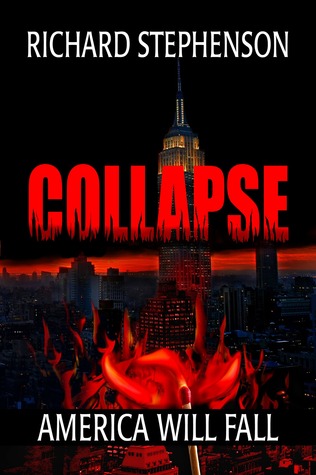 ‘Collapse’ by Richard Stephenson is book one in the ‘New America’ series and I believe Stephenson’s first novel. The novel is set in the year 2027, with the USA falling apart. It is in the grip of the 2nd Great Depression and is at war with the Great Empire of Iran. The state of Florida has been devastated by a hurricane that has left over 1 million people dead and Texas is about to face the same fate. The government is about to fall. The people are descending into anarchy. What will become of the USA?
Though a first novel, the suspense and action of the novel is first rate. It is very easy to read and carries you along quite easily. However, there are serious issues with the grammar and spelling, as well as some fairly obvious errors in the actual text of the story. A good proof reader should have picked up on these mistakes and that would have resulted in a far more polished and professional product.
There is also a short sex scene tacked onto the end of the story which I thought was somewhat tacky and unnecessary. It did nothing for the story as a whole and was completely out of place in the overall development of the novel.
If you can see past these obvious flaws without too much prejudice, the novel is a very good read and I do look forward to picking up the story when the next book in the series is released in 2013.
Buy this book at Amazon:
http://www.amazon.com/Collapse-Richard-Stephenson/dp/1477654631/
The link below is to an article that looks at the future for book covers in the digital age.
For more visit:
http://www.npr.org/2012/08/05/157886049/in-the-e-book-world-are-book-covers-a-dying-art
The link below is to an article reporting on the future of the book cover in the digital age.
For more visit:
http://www.theatlantic.com/entertainment/archive/2012/04/has-kindle-killed-the-book-cover/255935/
I have now started to read ‘Post War,’ by Tony Judt. The edition I have was published in 2005 by The Penguin Press. It is a massive work of over 900 pages, that includes both photographs and maps.
The period of history being dealt with is post war Europe from the end of World War II to 2005. It includes the immediate aftermath of World War II, right through the Cold War period and the collapse of the Soviet Union.
Though I have only just started (yesterday) I have completed about 100 pages thus far, which has taken me through the preface, introduction and the first chapter, ‘The Legacy of War.’ The first chapter deals with the immediate aftermath of the war and its consequences for the people of Europe. It is an horrific picture of post war Europe and the devastation it had on the entirety of Europe – nations, cities and towns, peoples and families. It is the legacy of total war.
I have now read this book and have found my earlier thoughts sadly confirmed. My first comments on this book on this Blog at:
So I not only agree with my earlier thoughts on the book, but have even more to say about it. The illustrations (cartoons) I found to be completely inappropriate and the attempts by the author to justify them as irrelevant. There is just no place for the comical depictions of God given in the book.
The treatment of Calvin’s life is disappointing, with not enough detail given to it and some of the important events/incidents in his life are not treated or merely glossed over. It would have been better to have settled on the summary of the Institutes or do a full biography of John Calvin.
I also found the conclusions toward the end of the book disappointing and would suspect Calvin to be turning in the grave as a result of them.
The summary of the Institutes was probably not too bad, but I would have been better served to have read the Institutes rather than this book.
In summary – a very disappointing book that I would not recommend to anyone else to read.
I never expected to agree with everything that ‘365 Ways to Change the World,’ by Michael Norton, suggested. So it comes as no surprise to me to find a suggestion with which I have an issue – so to speak.
The suggestion for today is about buying Palestinian olive oil as a show of solidarity with the Palestinian people and their plight. However, I am loathe to do this.
Why? Is it because I support the Israeli oppression of the Palestinians? No, I do not support the oppression of the Palestinian people. But neither do I support the anti-Israel rhetoric that seems to be continually doing the rounds.
I would love to see an end to the occupation of lands captured during the 1967 war and do not support Israeli settlements in these areas. However, one does need to remember the fact that Israel did not start that 1967 war and the surrounding nations have largely set an agenda since the birth of the modern Israeli state to crush it. There has also been an unending campaign of terror against the Israeli state and Israel has a right to defend itself.
It would be great to see lasting peace in Palestine and for that to happen both sides need to address the important issues I have mentioned here and others. But it is both sides that need to do it – not just Israel and not just the Palestinian people. It is both sides. That is what I support here.
A response to reading ‘365 Ways to Change the World,’ by Michael Norton
Rating: 4 out of 5 stars.
‘Shameful Flight’ relates the history of the final years of the British Raj in India, including the partition of India into both Pakistan (West and East) and India, and the early hostility of the two new nations destined for perpetual warfare in such regions as the Kashmir.The history of this era of political instability on the subcontinent includes all the main players from Great Britain, India and Pakistan.These main players include Winston Churchill, Viceroy Louis Mountbatten, Mahatma Gandhi, Pandit Nehru and Quaid-i-Azam Jinnah. There is not a single figure in this history of India’s partition who comes out of it in a good light, though several seem to have had very well-intentioned aims and motivations. It is the true story of lost opportunity and the devastating consequences of human pride and selfishness that have reverberated down through the decades to the present day and remain visible in the continuing clashes between India and Pakistan, as well as in the extremism expressed in both the Islamic and Hindu communities throughout the sub-continent. It is a story of perpetual tragedy and human suffering with no end in sight.
This book is extremely easy to read, passes on a wealth of historical information and whets the appetite for further research on the India/Pakistan situation. It provides enlightenment, by bringing understanding to the current political instability in both India and Pakistan, by clearly revealing the root of the problem – the manner of the birth of both nations out of British imperialism and that nation’s final haphazard departure aptly described as a ‘Shameful Flight.’ This is a great book for understanding the sub-continent and the wounds it still carries to this day.
This book was provided to me for review by Oxford University Press – www.oup.com
 At the BookShelf
You must be logged in to post a comment.