Unknown's avatar

Article: The Real William Shakespeare?


The link below is to an article that reports on new research that sheds new light on the life of William Shakespeare. 

For more visit:
http://www.telegraph.co.uk/culture/theatre/william-shakespeare/9963602/Shakespeare-was-a-tax-evading-food-hoarder-study-claims.html

Unknown's avatar

Article: Bookish Uncovered


The link below is to an article that looks at the ‘real’ Bookish.

For more visit:
http://www.the-digital-reader.com/2013/02/21/bookish-has-a-dirty-little-secret/

Unknown's avatar

Article: Ebook Readers Loosing Ground


The link below is to an article that suggests ebook readers are on the way out, being replaced by various tablet computers. I guess this is a real possibility, which I haven’t really thought a great deal about. I have noticed some ebook readers (i.e. Kindle) beginning to look more and more like a tablet computer, so this should not be a great surprise.

For more visit:
http://www.teleread.com/ereaders/survey-says-e-readers-are-racing-toward-extinction/

Unknown's avatar

Book Review: Phantoms on the Bookshelves, by Jacques Bonnet


‘Phantoms on the Bookshelves,’ by Jacques Bonnet was translated from the French original by Sian Reynolds and has an introduction by James Salter. The copy I have is a Kindle edition. It was first published in Great Britain in 2010 by MacLehose Press. It is a relatively short book at 123 pages in length, so it won’t take too much to get through it.

Phantoms on the Bookshelves, by Jacques BonnetThe introduction to the book by James Salter is a good, brief read concerning the author of the book and his book collecting ways. It could easily describe me, though I have nowhere near as many books as Bonnet, even though I have thousands myself in traditional form and/or digital format. I see similarities between the description given of Bonnet by Salter and myself, with my far fewer volumes. I too struggle now to find room for them all, with my virtual bookshelves requiring expansion in the near future to accomodate my book collecting ways into the current century and digital age. Traditional books have long run out of room in this house, as I suspect they have in Bonnet’s apartment.

Bonnet is a man who loves books and his thoughts on what is normal in a home, the presence of many books, is something I can relate to. I also find myself in wonder when I see homes with no books, particularly in some of the circles in which I move or have moved. How can they get by without books? Mind you it is probably not as easy a situation to read (no pun intended – truly not) these days, with books now being able to be stored by the thousands on a home computer and/or on an external hard drive or two. Still, I have wondered this for many years and I think Bonnet would probably agree with me. Relating to others is made easier when discussing books for Bonnet and I find this an agreeable thing also. It is the way of Bibliophiles, whether we use that term or not (perhaps for some Bibliomaniac is a better term).

I did not find Bonnet’s chapter on cataloguing and organisation helpful at all, though I expect it would help some. This is probably because I have developed my own system which closely resembles that of the Dewey to almost certainly be called a Dewey system. The Bonnet decsription horrified me and I thought it would become far too confusing and disorienting for me. He is certainly right about the Internet making a major impact on libraries and the need to have as many books as he has in his collection. It is not only the storing of works on the World Wide Web, in the cloud and on other digital storage systems like computers, external drives, etc, where libraries are changing and/or have changed, but also in the cataloguing and organisation of books. I have a large number of books stored on digital devices and by digital means, but I also have access to far more over the Internet from vast libraries that I can access online. But I also have both offline and online digital methods for assisting me in cataloguing and organising my books, which I use as best I can and with great relief for being able to do so. Yet it boils down to individual choice and comfortableness, being able to manage these resources in a way that allows the individual to harness them to the greatest effect, which is indeed something of an indiviual matter and process.

The Bonnet method of reading will not be everyones cup of tea, but that’s OK too, because that is also a very individualistic thing. Bonnet likes lying down to read, I prefer sitting at a desk. Bonnet likes to underline and write in his books as he reads, I prefer to highlight and collate quotes via other media. There is no one rule for all, but many different rules for many different people. The thing is to retain what one reads in some way, that I think is the key to reading. It is certainly not a requirement to read each and every book from cover to cover, but to take a dip in each one to some extent and to achieve some purpose when doing so is required if you wish to say that you read your books and they aren’t just display items.

The manner in which Bonnet has collected his books is almost baffling to someone who has not done so in the same manner. He seems almost obsessed with completing lists and collections of books, of following every author/book line that comes up in what he reads or experiences. It seems any book mentioned must be obtained for his library. This is the way of a Bibliomaniac, that is for sure. His obsession with collecting ‘picture’ books is another seemingly crazed hobby which almost seems to be a driving force for him. I too collect books, but this insight into how another book lover and lover of reading goes about collecting his books is one that is beyond my experience. It is a fascinating world of book hunting and gathering if ever there was one. Something about one book leads to another which leads to another, or some conversation leads to a book which leads to another, etc.

Bonnet’s reflections upon his books shows someone who truly absorbs what he reads and imbibes the being of those written about. He seems to feel them, to know them, far better than any creator of them. Authors of books, whether fictional pieces or biographical/autobiographical works fade with the passing of time, if indeed a true reflection of them is left in the pages of the books they write or in the annals of history. However, those created and placed within the realms of literature remain the same and can be known almost completely. There are places to visit, whether real or ethereal, people to meet and to greet. Books bring a whole world to one’s home and experience, and even beyond that one travels into the realm of fictional lands and peoples. A plethora of experience that is only exaggerated when the library is swollen by multimedia resources. What an amazing world the library can become – is.

Buy this book at Amazon:
http://www.amazon.com/Phantoms-Bookshelves-Jacques-Bonnet/dp/1590207599/

Unknown's avatar

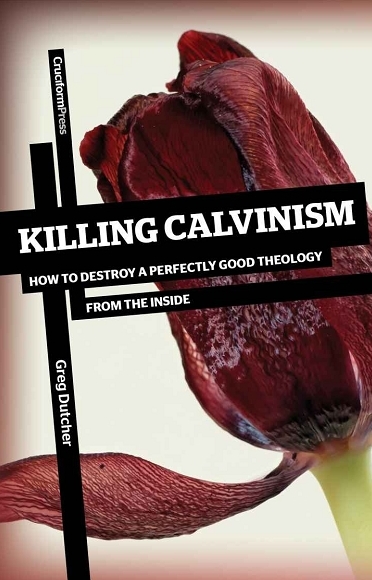
Book Review: Killing Calvinism – How to Destroy a Perfectly Good Theology from the Inside, by Greg Dutcher


Killing CalvinismI have started reading ‘Killing Calvinism – How to Destroy a Perfectly Good Theology from the Inside,’ by Greg Dutcher. This book was released by Cruciform Press in June 2012, so I have been reading a new book for a change. Generally I read books that were written many years ago, often several centuries ago, so this was a bit unusual for me. It was however the title of the book, along with a review that I had read somewhere, that drew my attention to it and so I decided to buy it at Amazon in Kindle format.

So reading the book I quickly discovered that it was a very easy book to read, even though it dealt with a subject that was indeed crucial, timely and weighty. Calvinism is the behemoth of Christian theology, being a system of truth that epitomises the teaching of Scripture. It has produced great works of theology, some very technical and verbose in nature. Yet here was a book looking at this system of truth that was easy to read and speaking straight to the heart with great warmth and even humour (yes humour).

However, it would be a mistake to think that this book dealt with Calvinism in a detached manner, somehow separated from the adherent to it. Indeed, this book seeks to penetrate the hearts of the adherents of Calvinism and to strike at the heart of the matter. This is not a book that somehow produces a barren formalism, rather it smashes through formalism and seeks the real Calvinism, one that comes from the inner person regenerated by the spirit of God and transforms the lives of those that profess it. It is a living Calvinism that this book seeks and challenges everything else that claims to be Calvinism, but yet has nothing of its soul. This book is a clarion call for a Calvinism that ignited the hearts of a Calvin, of a Spurgeon and of a Bunyan and desires a turning away from all that is not. I love Calvinism – it leads me to God and the way of life he wishes me to lead and live. This book reminds me of this and for that I am thankful to Him for allowing me to read it. It is as Dutcher describes it, the windscreen of truth that allows me to see God and how he wants me to live for Him.

Buy this book at Amazon:
http://www.amazon.com/Killing-Calvinism-Perfectly-Theology-ebook/dp/B0088PBC5G

Unknown's avatar

Terrorism and the Illuminati – A Three Thousand Year History, by David Livingstone


I have started to read ‘Terrorism and the Illuminati – A Three Thousand Year History,’ by David Livingstone. I haven’t read a lot as of yet, but it appears to be a book full of conspiracy theories about a secret society (the Illuminati) that are behind world events. Not being a believer in such a theory I am not sure just how much of this book I’ll be able to stomach, but having only read the introduction at this point I’ll try and keep myself restrained from speculating too much on the book. I do have to say that what I have read in the introduction had me thinking ‘is this for real?’ I don’t mean that in the sense of being convinced, but rather in the sense of ‘can anyone really believe this?’

With the death of Osama Bin Laden recently and the various conspiracy theories that have surfaced as a result, this sort of book will probably be enjoying a wider audience at the moment. If conspiracy theories interest you, then this book may very well be of interest to you. There are various associated links below.

There is an online version at the book’s website:
http://www.terrorism-illuminati.com/

You can also find the book at Scribd:
http://www.scribd.com/doc/42090550/Terrorism-and-the-Illuminati-A-Three-Thousand-Year-History

If you prefer to buy a copy at Amazon, it is available at:
http://www.amazon.com/Terrorism-Illuminati-Three-Thousand-History/dp/1419661256


Unknown's avatar

Changing the World: December 1 – AIDS Prevention and Treatment


Today’s suggestion is probably one that most people wouldn’t think a great deal about these days. In the Western World, the issue of AIDS is probably somewhat on the backburner so to speak, though that would depend on the community you live within or deal with on a daily basis.

Though AIDS remains a major health threat in Western countries, the real frontline is in the Third World, where entire countries are under serious threat from AIDS/HIV and/or the consequences of the disease on the economy, the community, the family, etc.

So helping to prevent AIDS and to assist in the provision of treatment for AIDS/HIV, as well as caring for those left in it’s wake are all very important.

Some web sites with valuable information:

www.unaids.org

www.aids.net.au

www.afao.org.au

A response to reading ‘365 Ways to Change the World,’ by Michael Norton

Unknown's avatar

‘The Reformers and Their Stepchildren,’ by Leonard Verduin


As readers of this Blog would know, I have been reading ‘The Reformers and Their Stepchildren,’ by Leonard Verduin. I have now completed this book and maintain that this is a book that should be read by all Reformed believers. It is a brilliant treatment of both the Reformers and those who sought a more ‘radical’ reform, in order to bring the church back to that which was modelled on the New Testament example.

Verduin deals with many of the disputed areas between the Reformers and the Stepchildren, and in so doing shows how the Reformers chose to go only so far in their work of reformation and indeed how some chose to back peddle in some areas. As much as I respect many of the Reformers (if not all), I have always been saddened by their refusal to fully reform the church/separate from it, and to set up a church based on the New Testament model, which was something the stepchildren also sought. The Reformers treatment of the stepchildren will always be a blight on their legacy also.

Read this book without being biased either way and allow the truth of the Scriptures to determine the path on which you walk. There is much food for thought in this book and a real challenge for Reformed believers throughout.

Unknown's avatar

Changing the World: November 22 – Thanks


The suggestion for today is to acknowledge and express thanks for those who have improved the human condition – for humanity in general and for myself in particular.

Today is known in the United States as ‘Thanksgiving Day.’ Here in Australia we know no such day – something which could be seen as both a good thing and a bad thing. Good, in that it is not another day commercialised and bad, in that there is no particular day for acknowledging our gratitude to those that have improved our lives, etc.

But why do we need a particular day for this – can we not be thankful and express our gratitude on a daily basis? I think we can. I am not calling for a false expression of gratitude and thankfulness, but that which is real and true – surely we can all find something to be thankful for? I know it isn’t hard for me to find plenty to be thankful for throughout each day.


A response to reading ‘365 Ways to Change the World,’ by Michael Norton

Unknown's avatar

Changing the World: November 10 – Prevent Genocide


Today’s suggestion for changing the world is to prevent genocide – what a truly noble suggestion and aim. Is it possible? Sadly, history would say no, none-the-less we should be doing what we can to stop it. Wouldn’t it be great if world leaders did more to prevent it?

Is there really any serious action going on to stop the Darfur genocide in Sudan? It seems to me that most of the action by western world governments has been reluctant at best. Perhaps there isn’t enough oil? Who knows what the real reason is – but a reason there is for not doing enough.

A web site with more information in Australia:

http://www.darfuraustralia.org/

So what can I do? I certainly can’t storm Sudan – but is there something I can do? Perhaps something that is symbolic will play a part, even a small part to get something done. Perhaps it will help to get the ball rolling (or keep it rolling)?

I can sign the pledge against genocide at Genocide Watch – that is something that I can do. It is also something that you can do. Just have a look at the links below:

http://www.genocidewatch.org/

http://www.genocidewatch.org/getinvolved/pledgeagainstgenocide.html


A response to reading ‘365 Ways to Change the World,’ by Michael Norton