Unknown's avatar

A beginner’s guide to reading and enjoying poetry


Poetry doesn’t need to be meticulously studied. Like a novel, you can curl up on the sofa and read it for pleasure.
Oqvector/Shuttertsock

Andrew McMillan, Manchester Metropolitan University

One of the things you get asked most when people find out that you’re a poet is whether you can recommend something that could be read at an upcoming wedding, or if you know something that might be suitable for a funeral. For most people, these occasions – as well as their schooldays – are the only times they encounter poetry.

That feeds into this sense that poetry is something formal, something which might stand to attention in the corner of the room, that it’s something to be studied or something to “solve” rather than something to be lounged with on the sofa. Of course, this needn’t be true.

We’ve seen over the past couple of months how important poetry can be to people. It’s forming a response in advertisements and marketing campaigns, it’s becoming a regular part of the public’s honouring of frontline heroes and, for people who write poetry more often, it’s becoming a way to create a living historical document of these unprecedented times – this latter point was the aim of the new Write where we are Now project, spearheaded by poet Carol Ann Duffy and Manchester Metropolitan University.

In years to come, alongside medical records and political reporting, historians and classes of schoolchildren will look to art and poetry to find out what life was like on a day-to-day basis – what things seemed important, what things worried people, how the world looked and felt and was experienced. Write where we are Now will, hopefully, be one such resource, with poets from all over the world contributing new work directly about the Coronavirus pandemic or about the personal situations they find themselves in right now.

So the crisis has perhaps brought poetry – with its ability to make the abstract more concrete, its ability to distil and clarify, its ability to reflect the surreal and strange world we now find ourselves in – back to the fore.

Many of you might be thinking now is the time to try and get to grips with poetry, maybe for the first time. A novel might feel too taxing, watching another film just involves staring at another screen for longer, but a poem can offer a brief window into a different world, or simply help to sustain you in this one.

How to enjoy poetry

If you’re nervous around poetry or are scared it might not be for you, I wanted to offer up some tips.

1. You don’t have to like it

Poetry is often taught in very strange ways: you’re given a poem and told that it’s good – and that if you don’t think it’s good then you haven’t understood it, and you should read it again until you have, and then you’ll like it. This is nonsense. There are poets and poems for every taste. If you don’t like something, fine. Move on. Find another poet. Anthologies are great for this, and a good place to start with your poetry journey.

2. Read it aloud

Poetry lives on the air and not on the page, read it aloud to yourself as you walk around the house, you’ll get a better understanding of it, you’ll feel the rhythms of the language move you in different ways – even if you’re not quite sure what’s going on.

3. Don’t try and solve it

This is something else that goes back to our educational encounters with poetry – poems are not riddles that need solving. Some poems will speak to you very plainly. Some poems will simply move you through their language. Some poems will baffle you but, like an intriguing stranger, you’ll want to step closer to them. Poems aren’t a problem to be wrestled with – mostly poems are showing you one small thing as a way of talking about something bigger. Poems aren’t a broken pane of glass that you need to painstakingly reassemble. They’re a window, asking you to look out, trying to show you something.

4. Write your own

The best way to understand poetry is to write your own. The way you speak, the street you live on, the life you’ve lived, is as worthy of poetry as anything else. Once you begin to explore your own writing, you’ll be able to read and understand other people’s poems much better.


Read more:
Eavan Boland: the great Dublin poet and powerful feminist voice


I would say this as a poet, but poetry is going to be even more central to how we rebuild after this current crisis. Poetry, especially the teaching of how we might write it, has this wonderful ability to create a new language, to imagine new ways of seeing things, to help people to articulate what it is that they’ve just been through. The way we move forward, as a community, as a society and, in fact, as a civilisation, is to push language to new frontiers, to use language to memorialise, reimagine and rebuild, but also to remember that poetry can be an escape, something to be enjoyed, something to cherish.

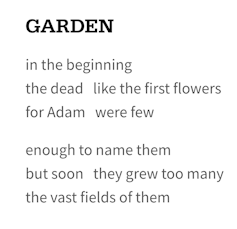
With that in mind here is a poem I wrote for Write where we are Now.The Conversation

Andrew McMillan, Senior Lecturer, Department of English, Manchester Metropolitan University

This article is republished from The Conversation under a Creative Commons license. Read the original article.

Unknown's avatar

Quitting


The link below is to an article that looks at it being OK to quit reading a book.

For more visit:
https://www.readitforward.com/essay/article/why-its-okay-to-quit-a-book/

Unknown's avatar

How to read Shakespeare for pleasure


Martin’s Droeshout portrait of William Shakespeare (1623)
Bodleian Library, Oxford.

Emma Smith, University of Oxford

In recent years the orthodoxy that Shakespeare can only be truly appreciated on stage has become widespread. But, as with many of our habits and assumptions, lockdown gives us a chance to think differently. Now could be the time to dust off the old collected works, and read some Shakespeare, just as people have been doing for more than 400 years.

Many people have said they find reading Shakespeare a bit daunting, so here are five tips for how to make it simpler and more pleasurable.

1. Ignore the footnotes

If your edition has footnotes, pay no attention to them. They distract you from your reading and de-skill you, so that you begin to check everything even when you actually know what it means.

It’s useful to remember that nobody ever understood all this stuff – have a look at Macbeth’s knotty “If it were done when ‘tis done” speech in Act 1 Scene 7 for an example (and nobody ever spoke in these long, fancy speeches either – Macbeth’s speech is again a case in point). Footnotes are just the editor’s attempt to deny this.

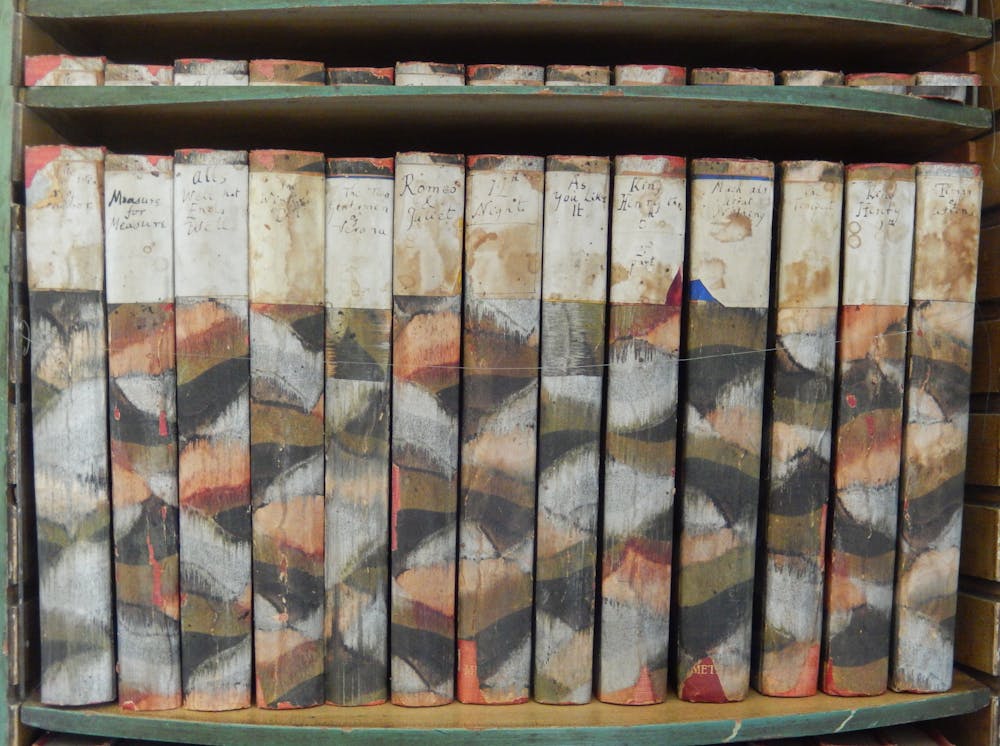
Shakespeare plays hand bound by Virginia Woolf in her bedroom at Monk’s House, Rodmell, Sussex, UK.
Ian Alexanber/Wikimedia Commons, CC BY-NC-SA

Try to keep going and get the gist – and remember, when Shakespeare uses very long or esoteric words, or highly involved sentences, it’s often a deliberate sign that the character is trying to deceive himself or others (the psychotic jealousy of Leontes in The Winter’s Tale, for instance, expresses itself in unusual vocabulary and contorted syntax).

2. Pay attention to the shape of the lines

The layout of speeches on the page is like a kind of musical notation or choreography. Long speeches slow things down – and, if all the speeches end at the end of a complete line, that gives proceedings a stately, hierarchical feel – as if the characters are all giving speeches rather than interacting.

Short speeches quicken the pace and enmesh characters in relationships, particularly when they start to share lines (you can see this when one line is indented so it completes the half line above), a sign of real intimacy in Shakespeare’s soundscape.

Blank verse, the unrhymed ten-beat iambic pentamenter structure of the Shakespearean line, varies across his career. Early plays – the histories and comedies – tend to end each line with a piece of punctuation, so that the shape of the verse is audible. John of Gaunt’s famous speech from Richard II is a good example.

This royal throne of kings, this sceptered isle,
This earth of majesty, this seat of Mars.

Later plays – the tragedies and the romances – tend towards a more flexible form of blank verse, with the sense of the phrase often running over the line break. What tends to be significant is contrast, between and within the speech rhythms of scenes or characters (have a look at Henry IV Part 1 and you’ll see what I mean).

3. Read small sections

Shakespeare’s plays aren’t novels and – let’s face it – we’re not usually in much doubt about how things will work out. Reading for the plot, or reading from start to finish, isn’t necessarily the way to get the most out of the experience. Theatre performances are linear and in real time, but reading allows you the freedom to pace yourself, to flick back and forwards, to give some passages more attention and some less.

Shakespeare’s first readers probably did exactly this, zeroing in on the bits they liked best, or reading selectively for the passages that caught their eye or that they remembered from performance, and we should do the same. Look up where a famous quotation comes: “All the world’s a stage”, “To be or not to be”, “I was adored once too” – and read either side of that. Read the ending, look at one long speech or at a piece of dialogue – cherry pick.

One great liberation of reading Shakespeare for fun is just that: skip the bits that don’t work, or move on to another play. Nobody is going to set you an exam.

4. Think like a director

On the other hand, thinking about how these plays might work on stage can be engaging and creative for some readers. Shakespeare’s plays tended to have minimal stage directions, so most indications of action in modern editions of the plays have been added in by editors.

Most directors begin work on the play by throwing all these instructions away and working them out afresh by asking questions about what’s happening and why. Stage directions – whether original or editorial – are rarely descriptive, so adding in your chosen adverbs or adjectives to flesh out what’s happening on your paper stage can help clarify your interpretations of character and action.

One good tip is to try to remember characters who are not speaking. What’s happening on the faces of the other characters while Katherine delivers her long, controversial speech of apparent wifely subjugation at the end of The Taming of the Shrew?

5. Don’t worry

The biggest obstacle to enjoying Shakespeare is that niggling sense that understanding the works is a kind of literary IQ test. But understanding Shakespeare means accepting his open-endedness and ambiguity. It’s not that there’s a right meaning hidden away as a reward for intelligence or tenacity – these plays prompt questions rather than supplying answers.

Would Macbeth have killed the king without the witches’ prophecy? Exactly – that’s the question the play wants us to debate, and it gives us evidence to argue on both sides. Was it right for the conspirators to assassinate Julius Caesar? Good question, the play says: I’ve been wondering that myself.

Returning to Shakespeare outside the dutiful contexts of the classroom and the theatre can liberate something you might not immediately associate with his works: pleasure.The Conversation

Emma Smith, Professor of Shakespeare Studies, University of Oxford

This article is republished from The Conversation under a Creative Commons license. Read the original article.

Unknown's avatar

Missing your friends? Rereading Harry Potter might be the next best thing


Unsplash, CC BY

Elaine Reese, University of Otago

Humans are innately social creatures. But as we stay home to limit the spread of COVID-19, video calls only go so far to satisfy our need for connection.

The good news is the relationships we have with fictional characters from books, TV shows, movies, and video games – called parasocial relationships – serve many of the same functions as our friendships with real people, without the infection risks.


Read more:
Say what? How to improve virtual catch-ups, book groups and wine nights


Time spent in fictional worlds

Some of us already spend vast swathes of time with our heads in fictional worlds.

Psychologist and novelist Jennifer Lynn Barnes estimated that across the globe, people have collectively spent 235,000 years engaging with Harry Potter books and movies alone. And that was a conservative estimate, based on a reading speed of three hours per book and no rereading of books or rewatching of movies.

This human predilection for becoming attached to fictional characters is lifelong, or at least from the time toddlers begin to engage in pretend play. About half of all children create an imaginary friend (think comic strip Calvin’s tiger pal Hobbes).

Preschool children often form attachments to media characters and believe these parasocial friendships are reciprocal — asserting that the character (even an animated one) can hear what they say and know what they feel.

Younger children form easy relationships with fictional heroes.
Photo by Josh Applegate/Unsplash, CC BY

Older children and adults, of course, know that book and TV characters do not actually exist. But our knowledge of that reality doesn’t stop us from feeling these relationships are real, or that they could be reciprocal.

When we finish a beloved book or television series and continue to think about what the characters will do next, or what they could have done differently, we are having a parasocial interaction. Often, we entertain these thoughts and feelings to cope with the sadness — even grief — that we feel at the end of a book or series.

The still lively Game of Thrones discussion threads or social media reaction to the death of Patrick on Offspring a few years back show many people experience this.

Some people sustain these relationships by writing new adventures in the form of fan fiction for their favourite characters after a popular series has ended. Not surprisingly, Harry Potter is one of the most popular fanfic topics. And steamy blockbuster Fifty Shades of Grey began as fan fiction for the Twilight series.

As good as the real thing?

So, imaginary friendships are common even among adults. But are they good for us? Or are they a sign we’re losing our grip on reality?

The evidence so far shows these imaginary friendships are a sign of well-being, not dysfunction, and that they can be good for us in many of the same ways that real friendships are good for us. Young children with imaginary friends show more creativity in their storytelling, and higher levels of empathy compared to children without imaginary friends. Older children who create whole imaginary worlds (called paracosms) are more creative in dealing with social situations, and may be better problem-solvers when faced with a stressful event.

As adults, we can turn to parasocial relationships with fictional characters to feel less lonely and boost our mood when we’re feeling low.

As a bonus, reading fiction, watching high-quality television shows, and playing pro-social video games have all been shown to boost empathy and may decrease prejudice.

Collectively, humans have spent more than an estimated 200,000 years in the world of Harry Potter. And that’s not counting rereading or rewatching.
Chekyravaa/Shutterstock

Get by with a little help

We need our fictional friends more than ever right now as we endure weeks in isolation. When we do venture outside for a walk or to go the supermarket and someone avoids us, it feels like social rejection, even though we know physical distancing is recommended. Engaging with familiar TV or book characters is one way to rejuvenate our sense of connection.

Plus, parasocial relationships are enjoyable and, as American literature professor Patricia Meyer Spacks noted in On Rereading, revisiting fictional friends might tell us more about ourselves than the book.

So cuddle up on the couch in your comfiest clothes and devote some time to your fictional friendships. Reread an old favourite – even one from your childhood. Revisiting a familiar fictional world creates a sense of nostalgia, which is another way to feel less lonely and bored.


Read more:
Couch culture – six months’ worth of expert picks for what to watch, read and listen to in isolation


Take turns reading the Harry Potter series aloud with your family or housemates, or watch a TV series together and bond over which characters you love the most. (I recommend Gilmore Girls for all mothers marooned with teenage daughters.)

Fostering fictional friendships together can strengthen real-life relationships. So as we stay home and save lives, we can be cementing the familial and parasocial relationships that will shape us – and our children – for life.The Conversation

Elaine Reese, Professor of Psychology, University of Otago

This article is republished from The Conversation under a Creative Commons license. Read the original article.

Unknown's avatar

Study Finds Ebook Readers Read More


The link below is to an article that reports on a report that found ebook readers read more than other readers.

For more visit:
https://goodereader.com/blog/e-book-news/people-who-read-ebooks-read-more

Unknown's avatar

Digital Readers More Likely to Be Writers


The link below is to an article that reports on a report that found digital readers are more likely to be writers than print only readers. The article contains a link to the report concerned.

For more visit:
https://lithub.com/digital-readers-are-more-likely-to-be-writers-than-print-only-readers-says-a-new-report/

Unknown's avatar

Book clubs and the Blitz: how WWII Britons kept calm and got reading


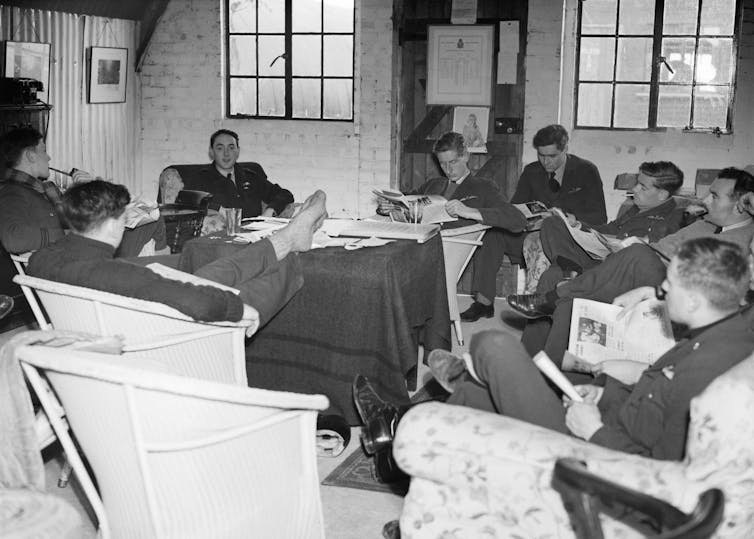
Pilots and air crew passing the time with books and newspapers.
S.A. Devon, RAF official photographer/Imperial War Museum

Nicola Wilson, University of Reading

These are unprecedented times – but, even so, comparisons are being made to the second world war in terms of the magnitude of the crisis that coronavirus represents. Some of this rhetoric is unhelpful but, as we bunker down into our homes and the government gets on a war footing, there is little doubt that the challenge to our liberty, leisure time and sense of wellbeing is real.

With early reports that book sales are soaring while bookshops and warehouses close down and publishers reassess their lists, what can the reading patterns of an earlier generation tell us about getting through a crisis and staying at home?

The restrictions at the beginning of the second world war affected all aspects of day-to-day life. But it was the blackout that topped most people’s list of grievances – above shortages of food and fuel, the evacuation, and lack of news and public services. Households were reprimanded and fined for showing chinks of light through windows, car lights were dimmed, and walking around, even along familiar streets, late at night became treacherous.

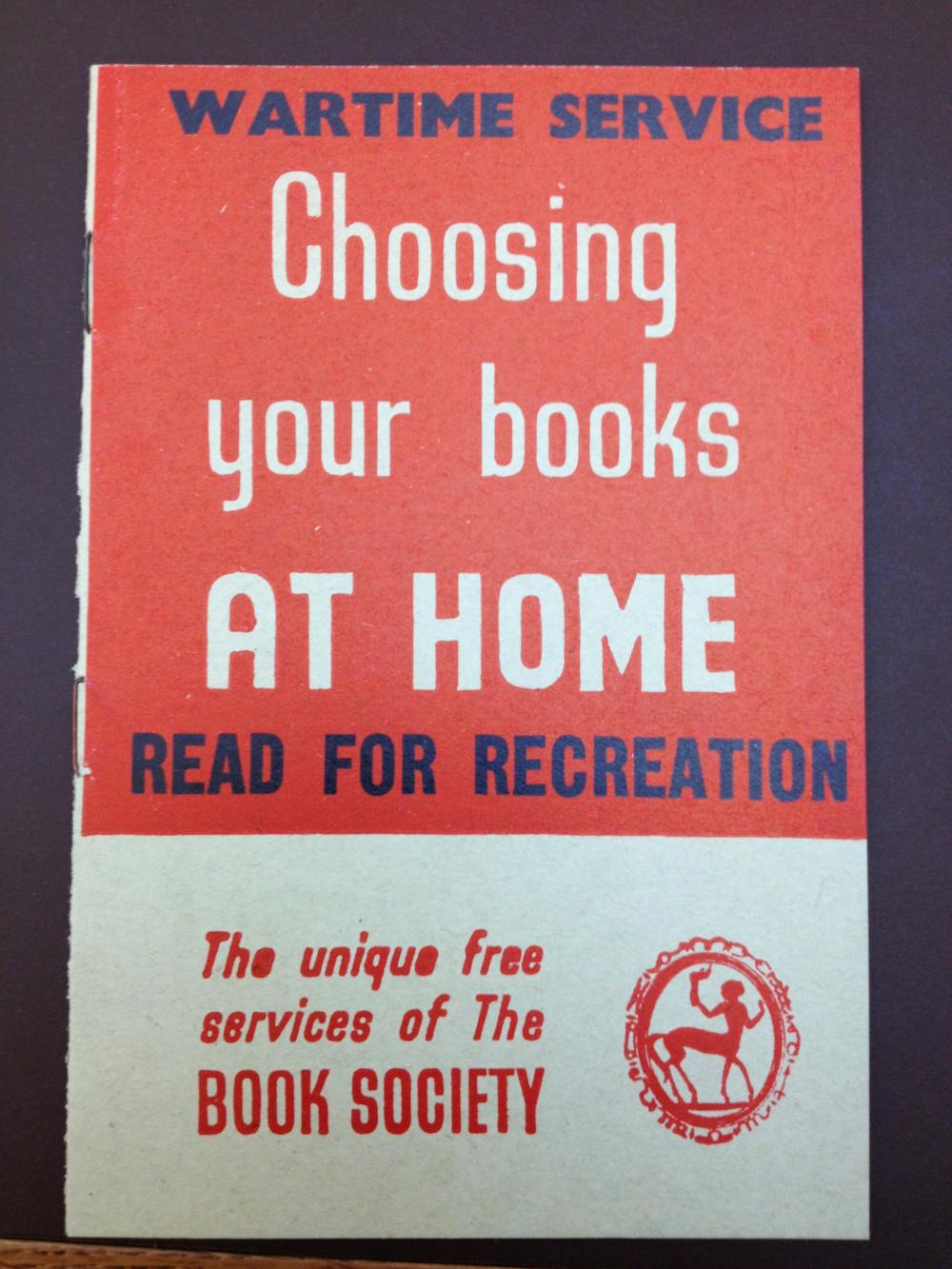
With the widespread limitations to free movement, the book trade was quick off the mark. Books were promoted by libraries and book clubs as the very thing to fight boredom and fill blacked-out evenings at home or in shelters with pleasure and forgetfulness. “Books may become more necessary than gas-masks,” the Book Society, Britain’s first celebrity book club, advised.

Selling tales

I’ve been researching the choices and recommendations of the Book Society for the past few years. The club was set up in 1929 and ran until the 1960s, shipping “carefully” selected books out to thousands of readers each month. It was modelled on the success of the American Book-of-the-Month club (which launched in 1926) and aimed to boost book sales at a time when buying books wasn’t common. It irritated some critics and booksellers who accused it of “dumbing down” and giving an unfair advantage to some books over others – but was hugely popular with readers.

Boots Book-lovers’ Library flyer, c. 1939.
Boots Company archives, Nottingham

The Book Society was run by a selection committee of literary celebrities – the likes of JB Priestley, Sylvia Lynd, George Gordon, Edmund Blunden and Cecil Day-Lewis – chaired by bestselling novelist Hugh Walpole. Selections were not meant to be the “best” of anything, but had to be worthwhile and deserving of people’s time and hard-earned cash.

Guaranteeing tens of thousands of extra sales, the club had a huge impact on the mid-20th-century book trade, with publishers desperate to get the increased sales and global reach of what publisher Harold Raymond called “the Book Society bun”.

Books will go on

The Book Society guided readers through the confusion of appeasement and the run-up to the second world war with a marked increase in recommendations of political non-fiction examining contemporary geo-politics. The classic novel of appeasement was Elizabeth Bowen’s The Death of the Heart (Book Society Choice in October 1938) in which a sense of malaise and inevitability of future war haunts the characters’ desperate actions.

When Britain finally declared war against Germany in September 1939, the Book Society judges were divided. Some were relieved that, as George Gordon put it, “an intolerable situation has at last acquired the awful explicitness of war”. But others were devastated, especially Edmund Blunden who was still traumatised from fighting in the first world war.

Book Society flyer, c. 1939.
John Johnson Collection of Printed Ephemera, Bodleian Library, University of Oxford

The judges advised members that when they became weary of news, people “will turn to books as the best comfort”, as had happened in the first world war with the increase in reading and library membership. Publishers and booksellers faced huge challenges during the second world war, including paper shortages, problems in distribution, a vanishing workforce, and bomb damage to offices and warehouses. But there were more readers – and from a wider social class – at the end of it. Demand consistently outstripped supply as consumer expenditure on books more than doubled between 1938 and 1945.

What people were reading

Throughout the second world war, the Book Society varied its lists between books that offered some insight on the strangeness of contemporary life and works of fiction – especially historical fiction – that took readers’ minds off it.

Titles in the first group include comic novels by the likes of E M Delafield and Evelyn Waugh, as well as forgotten bestsellers like Ethel Vance’s Escape (1939) (an unlikely thriller set in a concentration camp) and Reaching for the Stars (1939), American journalist Nora Waln’s inside account of life in Nazi Germany.

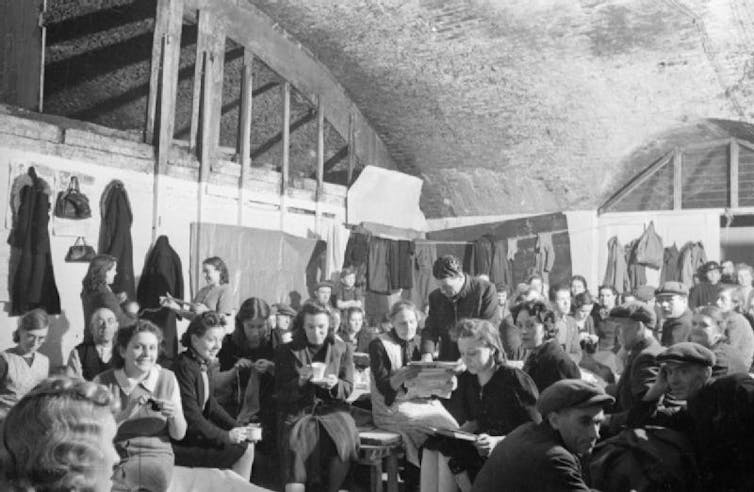
Settling down with something to read underneath the arches during an air raid.
Imperial War Museum, CC BY

More topical non-fiction became a priority as the devastation of the Blitz kicked in. Winged Words: Our Airmen Speak for Themselves (1941) and Into Battle: Winston Churchill’s War Speeches (1941) were especially popular.

Historical fiction was consistently in demand. Half the club’s choices in 1941 were long novels with historical settings. As today’s readers prepare to batten down the hatches with Hilary Mantel’s 900-page latest book, it is sobering to reflect on how an imaginative connection with the past has long helped readers find relief from the madness of the present.


Read more:
The Mirror and the Light: Hilary Mantel gets as close to the real Thomas Cromwell as any historian


The other fail-safes in the second world war were the classics. As books already in print became scarce, the Book Society reissued new editions of Jane Austen’s Pride and Prejudice, and Tolstoy’s War and Peace and Anna Karenina. These were books that Walpole said he believed he could sit down with even through an air raid.

Indeed, Neilsen BookScan has reported a rise in sales of classic fiction as the coronavirus crisis deepens – including War and Peace – as readers use this unfamiliar time to knuckle down to the heavyweights.

You can also join a War and Peace reading group online if you want a bit of company. After the homeschooling, working from home, and everything else. Here goes.The Conversation

Nicola Wilson, Associate Professor in Book and Publishing Studies, University of Reading

This article is republished from The Conversation under a Creative Commons license. Read the original article.

Unknown's avatar

What my students taught me about reading: old books hold new insights for the digital generation


Sophie Elvis/Unsplash

Kate Flaherty, Australian National University

Every year about 150 students enrol in the introductory English literature course at the Australian National University, which I teach. The course includes works by Shakespeare, Austen, Woolf and Dickens.

I know what these books did for me as a student 20 years ago, but times have changed. I am curious to discover what reading these old books does for young people today.

Last year, 2019, saw the first cohort of students who were born in or beyond 2000 – the so-called digital generation. These students have grown up in a world where you can read a book without holding the physical object.


Read more:
Love, laughter, adventure and fantasy: a summer reading list for teens


I decided to introduce the option of a bibliomemoir – an increasingly popular form of creative non-fiction – into their final year assignment. This would allow me to tease out the particular connections students were making between literature and their own lives.

My first year students have grown up in a world where you can read a book without holding the physical object.
Dexter Fernandes

The idea for a bibliomemoir was sparked in a workshop run by our then writer-in-residence, celebrated Australian teen novelist and author of Puberty Blues, Dr Gabrielle Carey.

Carey described bibliomemoir as a piece of writing that shows literary criticism is “best written as a personal tale of the encounter between a reader and a writer”.

Written with flair and precision the students’ bibliomemoirs revealed the formative effects of reading on their lives. Many of their insights related directly to challenges of growing up in the digital age.

They wrote about responding to distraction and cultivating compassion, connection, concentration and resilience.

Why a bibliomemoir?

A bibliomemoir might be an account of how one book or author has shaped a person’s life. Or it might be the memoir of a life structured by reading books. In Outside of a Dog, for instance, Rick Gekoski tells his life story through 25 books that have influenced him, including authors from Dr Seuss to Sigmund Freud.

Gekoski pointed out in an interview that bibliomemoir reveals the formative effects of reading. I saw immediately that I could adapt bibliomemoir to help me understand how my students saw books as shaping their lives.


Read more:
5 Australian books that can help young people understand their place in the world


So, for the final essay of the introductory English course, Carey and I designed a new essay question. It invited students to write a brief bibliomemoir based on one of the novels in the course. Like a traditional essay this would allow me to evaluate their skills of written expression, argument and technical analysis of literary language.

Students who write the bibliomemoir can still be assessed on technical aspects of their writing style.
Unsplash/Christin Hume

Unlike a traditional essay, it would allow me to see inside their individual reading experience. I would be able to understand how these books were influencing my students’ view of the world and their understanding of themselves.

Here’s what the students wrote

One student shared how reading Virginia Woolf’s Mrs Dalloway prompted a conversation with his flatmate about experiences of digital distraction and strategies for concentration:

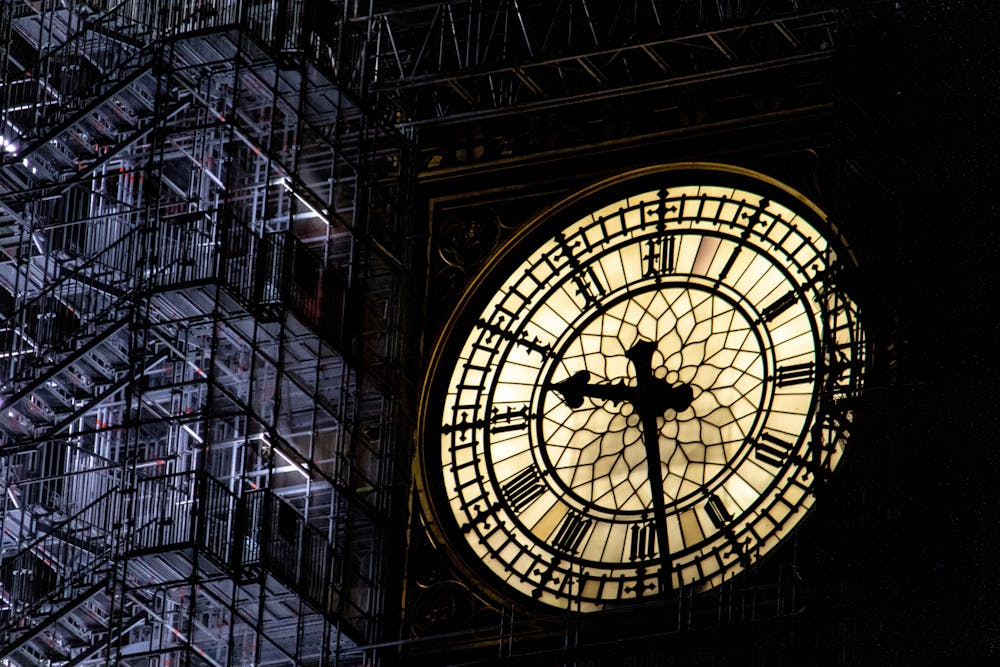
Soon we came to the subject of Big Ben, which Woolf uses as a motif through the book. [My friend] said that the way Big Ben interrupted the characters’ thoughts reminded her of how a notification from your phone can interrupt your stream of thought.

I had also noticed the motif of Big Ben, however I appreciated it as an element of structure and pacing in a book that had no chapters, in fact I had sometimes structured my reading sessions around the ringing of Big Ben in the book.

Another student, reading of the mental torment experienced by the returned soldier Septimus in Mrs Dalloway, gained a new perspective on people who don’t seem to fit in. Reflecting on her initially judgemental perception of a dishevelled man boarding her bus the student asked: “was he so different from Septimus? Wise and lost?”.

She then explained she gained a new and unexpected perspective on life:

[Woolf] gave me glasses I never knew I needed – lenses smeared with multiple fingerprints that enhanced rather than hindered the view.

She concluded that

to be a reader is to suspend rigid views, to consider and honour the perspectives of the characters one meets.

A third student reflected on the challenges of reading itself, and on the rewards of persisting when structure and characterisation are unfamiliar. The student said she set out wanting to be an “inspired reader” but confessed to feeling “frustrated” by Woolf’s “merciless indifference” to her characters in Mrs Dalloway.

In noting this frustration, the student had registered the novel’s lack of clear protagonist or plotline. The novel is difficult to read because, while we do see individual characters trying to interpret their lives as coherent stories, Woolf refuses to impose an artificial grand narrative.

After sticking with it, however, the student recognised the novel’s achievement:

There lies the beauty of it: the ordinary day captured in time and words as a novel.

This student’s bibliomemoir was a story of the dividends paid by sustained concentration and a flexible mindset.

One student wrote about how the ringing of Big Ben in Mrs Dalloway was similar to a phone alert.
Nick Fewings/Unsplash

A fourth student used the bibliomemoir to analyse how Jane Austen’s Northanger Abbey showed her the value of observing people closely, and has equipped her with resilience as a student facing the challenge of dyslexia:

I could not work out how to do the exact things my teachers wanted me to do. What I could do was learn to understand my teachers. By learning to watch them, like Austen watched people, and learning to understand them as people, I began to understand how to jump through their hoops.

While she couldn’t quantify the competencies reading books had given her, the student said she just knew books had formed who she was:

I cannot list the strategies that I employ when reading and writing […] I give all the credit to reading literature, to books like Northanger Abbey and writers like Jane Austen and so volunteer myself as an example of how reading literature is valuable in our era.

These examples revealed some of the many reasons new readers, even of the digital age, return to old books and old ways of reading them. The readers expressed an urgency for connection with narratives more complex than a news feed.


Read more:
If you can read this headline, you can read a novel. Here’s how to ignore your phone and just do it


They recognised that truthful self-reflection can be prompted by sustained engagement with fiction. They proved that connection with others, compassion and resilience are nurtured through a deepened understanding of story in the study of literature.

I can only conclude that for this group of readers, taking a book into their hands is a very deliberate act of identification with the bigger, shared story of reading.The Conversation

Kate Flaherty, Senior Lecturer (English and Drama) ANU, Australian National University

This article is republished from The Conversation under a Creative Commons license. Read the original article.

Unknown's avatar

Falling Asleep While Reading


The link below is to an article that looks at falling asleep while reading – certainly an issue for me.

For more visit:
https://bookriot.com/2020/02/14/why-do-i-fall-asleep-when-i-read/

Unknown's avatar

Are People Reading Less Books/Ebooks?


The link below is to an article that asks ‘why people aren’t reading books anymore?’ It also briefly comments on other survey findings, which seem largely irrelevant to the main question of the article.

For more visit:
https://goodereader.com/blog/e-book-news/why-arent-people-reading-books-anymore