Demonstrators protest the awarding of the 2019 Nobel literature prize to Peter Handke in Stockholm, in December 2019. Stina Stjernkvist/TT News Agency via AP
Austrian writer Peter Handke received the 2019 Nobel Prize in literature. The award is for “a writer’s life work,” and Handke has written novels, travelogues, theatre plays, screenplays and poetry.
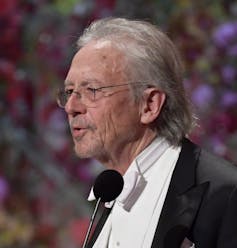
Literature laureate 2019 Peter Handke gives his speech during the Nobel banquet at Stockholm City Hall, on Dec. 10, 2019. Anders Wiklund/TT News Agency via AP
The announcement of the award generated public uproar.
The controversy has spurred long-standing debates about where stories come from, who is responsible for them and what it means as a writer to bear witness to truth — and also, which persons or institutions have the authority to do so.
The publisher of the English-language 1997 translation describes the book on its jacket as both a “sensitive and nuanced meditative travelogue through Serbia,” and a “scathing criticism of western war reporting.”
Handke’s Nobel nomination particularly inflamed journalists and survivors of the Srebrenica genocide, where more than 8,000 Bosnian Muslim men and boys were killed in July 1995, during the 1992-95 war in Bosnia. Various intellectuals, as well as the broader public voiced their dissent about Handke receiving the award on Twitter following the award announcement.
The bigger context is that some perpetrators denied findings of the International Criminal Tribunal for the former Yugoslavia (sometimes referred to as the Hague Tribunal, based in The Hague, Netherlands) — and the tribunal documented atrocious strategies to conceal crimes, such as moving mass graves. Denials of the Srebrenica genocide continue today.
Many statements in defence of the award echo earlier French and British 20th century literary criticism.
Evaluating the text’s language alone?
The French philosopher Roland Barthes’s influential 1967 essay “The Death of the Author” served to elevate literary work and its language. Barthes wrote: “It is language which speaks, not the author.”
For French philosopher Michel Foucault, the author is a kind of scribe who commits language to paper. The implication is that the author is writing down the realities of the world outside. In his view, “the function of the author is to characterize the existence, circulation and operation of certain discourses within a society” — meaning, ideas and messaging, as he elaborated in his 1969 essay “What is an Author?”
Before them, T.S. Eliot proclaimed in 1919 that writing “is not the expression of personality, but an escape from personality.”
As feminist literary scholar Cheryl Walker has noted, independence-of-the-text critiques have to a certain extent helped “liberate the text for multiple uses,” like re-reading canonical texts from critical feminist perspectives.
But such critiques have also been at odds with literary traditions on the margins.
Historically, the significance of lived personal and collective experiences have been central features of texts by women, Black, Indigenous and people of colour, queer or transgender writers.
These literatures, their readers and their institutions of criticism have long resisted calls to separate author, text and political or social impact.
They have have asserted either that the personal is political or that perspective is situational — and rejected the notion that literary work can considered unpolitical.
Award fuelled ethnonationalist politics
Critics of Handke’s receipt of the Nobel award challenge the notion that Handke’s literary work can be evaluated apart from its political implications.
How or if the Swedish Academy will respond to these developments as the public demands it approach the award more cautiously remains to be seen. It seems unlikely that it will rescind Handke’s award.
But the academy is implicated in this affair no matter what.
New novels about climate change – climate fiction, or cli-fi – are being published all the time. The nature of the climate crisis is a difficult thing to get across, and so imagining the future – a drowned New York City, say; or a world in which water is a precious commodity – can help us understand what’s at stake.
This is unsurprising in these times of crisis: fiction allows us to imagine possible futures, good and bad. When faced with such an urgent problem, it might seem like a waste of time to read earlier texts. But don’t be so sure. The climate emergency may be unprecedented, but there are a few key ways in which past literature offers a valuable perspective on the present crisis.
1. Climate histories
Historical texts reflect the changing climatic conditions that produced them. When Byron and the Shelleys stayed on the shores of Lake Geneva in 1816, the literature that they wrote responded to the wild weather of the “year without a summer”.
This was caused largely by the massive eruption of the Indonesian volcano Mount Tambora the previous year, which lowered global temperatures and led to harvest failures and famine. Literary works such as as Byron’s “Darkness”, Percy Shelley’s “Mont Blanc”, and Mary Shelley’s Frankenstein reveal anxieties about human vulnerability to environmental change even as they address our power to manipulate our environments.
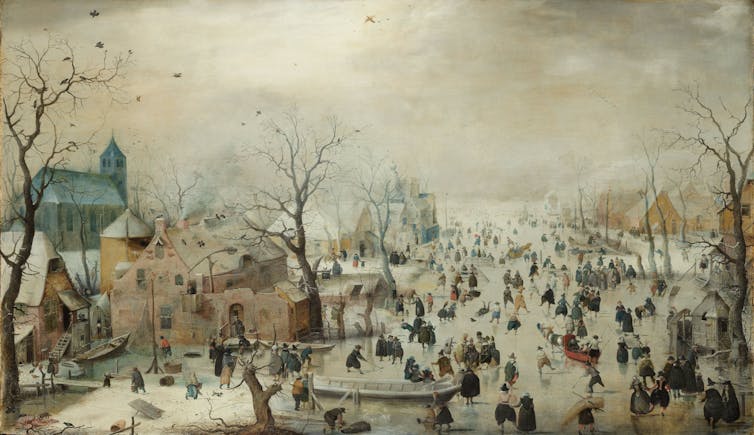
Many older texts also bear indirect traces of historical climate change. In Paradise Lost (1667), Milton complains that a “cold climate” may “damp my intended wing” and prevent him from completing his masterpiece. This may well reflect the fact that he lived through the coldest period of the “Little Ice Age”.
Hendrick Avercamp, Winter Landscape with Skaters, c. 1608. Rijks Museum
Even literature’s oldest epic poem, The Epic of Gilgamesh (c. 1800 BC), contains traces of climate change. It tells of a huge flood which, like the later story of Noah in the Old Testament, is probably a cultural memory of sea level rise following the melting of glaciers at the end of the last Ice Age.
These historical climatic shifts were not man made, but they still provide important analogues for our own age. Indeed, many cultures have seen human activity and climate as intertwined, often through a religious framework. One of the ironies of modernity is that the development of the global climate as an object of study, apparently separate from human life, coincides with the development of the carbon capitalism that has linked them more closely than ever.
2. How we view nature
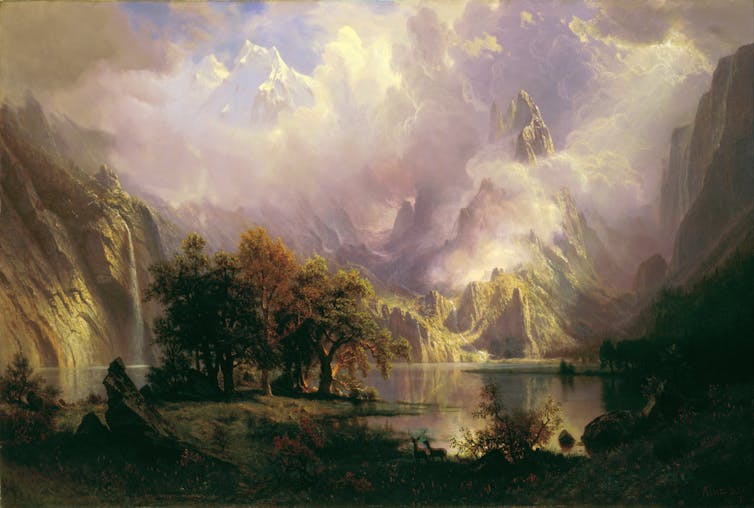
Reading historical literature also allows us to trace the development of modern constructions of the natural world. For example, the Romantic ideal of “sublime” nature, which celebrated vast, dramatic landscapes like mountains and chasms, has influenced the kinds of places that we value and protect today in the form of national parks.
When we understand that such landscapes are not purely natural, but are produced by cultural discourses and practices over time – we protect these landscapes above others for a reason – we can start to debate whether they can be better managed for the benefit of humans and non-humans alike.
Or consider how in the 18th and early 19th centuries, the work of nature writers such as Thomas Bewick, Charlotte Smith and Gilbert White played a powerful role in promoting natural theology: the theory that evidence for God’s existence can be found in the complex structures of the natural world. Past literature has also been crucial in disseminating new scientific ideas such as evolutionary theory, which understood natural phenomena as entirely secular. Literature does not just reflect changing views of the natural world; it shapes them.
Studying historical texts helps us to understand how modern cultural attitudes towards the environment developed, which in turn allows us to perceive that these attitudes are not as “natural” or inevitable as they may seem. This insight allows for the possibility that today, in a time in which our attitude towards the environment could certainly improve, they can change for the better.
3. Ways of thinking
Some of the attitudes towards the natural world that we discover in historical literature are contentious, even horrifying: for example, the normalisation of animal cruelty portrayed in books such as Black Beauty.
But we can find more promising models too. Voltaire’s poem on the 1755 Lisbon earthquake, for example, has been used to think about the ethics of blame and optimism in responses to modern disasters, like the 1995 Kobe earthquake and the 2009 L’Aquila earthquake.
Reading past literature can also help us to appreciate the natural world for its own sake. Samuel Johnson commented of the natural descriptions in James Thomson’s poems The Seasons (1730) that the reader “wonders that he never saw before what Thomson shows him and that he never yet has felt what Thomson impresses”. Amid the frenzied distractions of modern life, the work of authors like Thomson, Dorothy Wordsworth and John Clare can help us to slow down, notice and love nature.
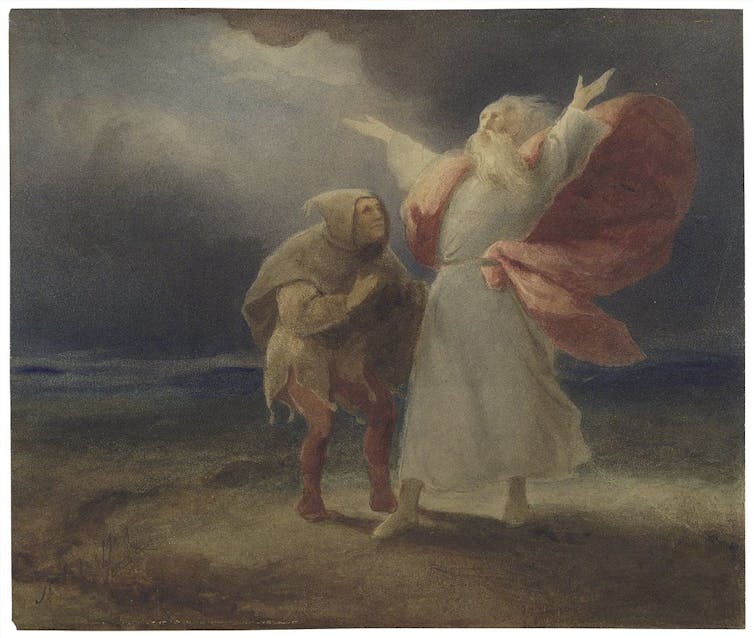
Historical literature can remind us of our own vulnerability to elemental forces. The famous depiction of a storm in King Lear, for example, mocks Lear’s attempt:
In his little world of man to out-scorn
The two-and-fro-conflicting wind and rain.
Shakespeare might appear to aestheticise dangerous weather, but the play reminds us that the storm is far bigger and messier than any human attempt to represent and interpret it.
At the same time, literature can remind us of the need to take responsibility for our own impacts upon the environment. We may not want to follow pre-modern and early modern literature in viewing climate change as divine punishment for bad behaviour. But when Milton suggests that it was the fall of man that brought in “pinching cold and scorching heat” to replace the eternal spring of Eden, his narrative has clear figurative resonance with our present crisis.
Historical literature can show us how writers responded to climate change, trace how they influenced modern ideas about nature, and reveal valuable ways of relating to and thinking about nature. The climate crisis cannot be addressed only through technological solutions. It also requires profound cultural shifts. To make those shifts requires an understanding of past ideas and representations: both those that led to our current predicament and those that might help us address it.
Mystery is the bestselling genre in literature. Crime/mystery fiction, to give the genre its full title, beats inspirational, science fiction, horror and apparently even romance to take the top spot.
What there doesn’t seem to be much of in mystery fiction, however, is female detectives who begin detecting in middle age (two cases in point: Sara Paretsky’s V.I. Warshawski was 32 when we began to follow her adventures, while Patricia Cornwell’s Kay Scarpetta was 36). Women in the 40-to-60 range don’t get much of a showing as main characters in literature generally, so maybe it’s no surprise that they don’t show up as headliners in the mystery genre.
But it’s a surprise if you’re a woman in your 40s who is beginning to write mystery novels – which not so long ago I was. And while it’s a cliche that people write what they know, when I decided to write a mystery I entered into that cliche wholeheartedly. I started writing mysteries in my 40s – and I made my detectives two women in their 40s.
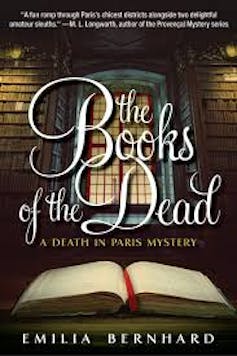
Two middle-aged American women and a dead man in a bowl of Vichyssoise. Amazon
But while I designed my detectives in part to mirror myself, I also chose their age for entirely different reasons. For all its advances and improvements, contemporary culture remains uncomfortable, not just with middle-aged women, but to an even greater degree with contentedly single middle-aged women – and to an even greater degree than that with childless women who are childless by choice. I wanted to confront this odd aversion head on, so I made sure that between them my detectives fill all these categories.
This decision is a small one, but for me it engaged with a question I’ve long struggled with, the question of what, intellectually, literature is supposed to do. Should it report on the world as it is, or should it model the world as it might – could, should, would – be?
Angry women
Recent fiction may not have been filled with middle-aged women, but it has been filled with angry ones. It’s jam packed with dystopian models of female repression and with women and men implacably set against one other: look at Naomi Alderman’s The Power, Leni Zumas’s Red Clocks, Margaret Atwood’s The Testaments. As I began to create my fictional world, I was troubled by the question of whether these outpourings of rage, all justified, all earned, are enough.
In one way this literature is unquestionably good: female rage is something else culture has assiduously avoided considering for centuries, and during those centuries women have been subjugated, silenced, used and abused in ways that deserve outpourings of anger.
The sleuths return. Amazon
Nor is this landscape of female repression changing quickly, and there is value in forcing it before readers’ eyes. In a recent article for The Guardian about the Staunch Prize, the new award for the best crime/mystery novel that does not feature violence against women, the novelist Kaite Welsh wrote that she wouldn’t “sanitise my writing in service of some fictional, feminist utopia … my work lies in marrying my imagination with the ugly truth”. This is an important argument.
Modeling the future
But while I don’t care about the absence of feminist utopias, I do care about the absence of writing that models the future we want. What will it be like, the world we’re striving for where the playing field is level and men and women are just people being people together? I believe that we can only imagine based on what we’ve seen, and that it’s part of literature’s job to help us see what doesn’t yet exist but could.
For this reason, although I grounded my novels firmly in the present (well, Death in Paris is set in 2014 and The Books of the Dead in 2016), I made some specific choices about that present. In my books, every person in a powerful position is a woman. Department heads and doctors, sources of knowledge and implacable foes: all are female.
More importantly, as far as I was concerned, no one draws attention to that. It’s so normal as to be unworthy of note. Nor does anyone comment on the fact that both my detectives are childless, and one remains happily unmarried in her mid-40s. Both of these detectives are heterosexual, but I made that decision so I could give each a husband or boyfriend who sees them as an intellectual and emotional equal, and for whom that equality is also the norm. The women in my books have and enjoy good sex, and they have and enjoy good conversations – almost none of them about men.
My books are full of oversights and omissions, and I’m far from satisfied with them. But what I aimed to do, and am still trying to do, is to augment the justifiable depictions of anger, the honest depictions of ongoing brutality and violence against women, with a small model that allows for a morsel of hope.
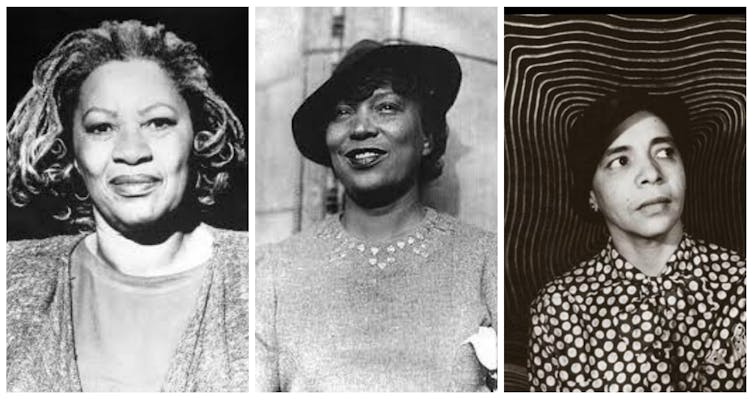
Toni Morrison, Zora Neale Hurston and Nella Larsen are on this short list of enduring must-read writers. Left to right: Nobel Prize, U.S. Library of Congress, Yale archive
In Mules and Men (1935), anthropologist, creative writer and Harlem Renaissance upstart Zora Neale Hurston relays the evocative folktale “Why the Sister in Black Works Hardest.” Fatigued after the work of Creation, God casts a massive bundle onto the earth. Intrigued by the mysterious object, a white Southern woman during the antebellum era asks her husband to retrieve it. Reluctant to tote the load himself, the master instructs a slave to fetch it.
Soon wearied of the task, the slave then commands his wife to shoulder the burden. She does so, excited at the prospect of exploring the contents. When she opens the package, however, what leaps out at her and Black women for all posterity is none other than hard work.
African American women writers have tackled the hard work of representing a diverse spectrum of lived and imagined experiences, including and especially their own. This labour occurs against the backdrop of centuries-long struggles with racist oppression and gender-based violence, including — but not limited to — slavery’s culture of endemic rape, forced or interrupted motherhood, infanticide, concubinage, fractured families and egregious physical and mental abuse.
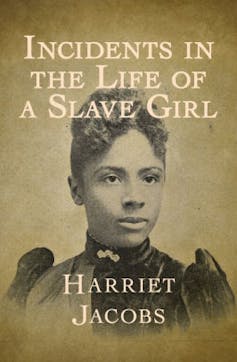
These ordeals also emerge in slave narratives by women. Harriet Jacobs’ Incidents in the Life of a Slave Girl (1861) emphasizes such travails. A target of relentless sexual harassment by her much-older master, Jacobs laments, “When they told me my new-born babe was a girl, my heart was heavier than it had ever been before. Slavery is terrible for men; but it is far more terrible for women.”
Once emancipated, African American women still faced staggering impediments when pursuing educational, entrepreneurial and employment opportunities. Political participation meant restrictions on voting rights both as women and as people of colour. Racist caricatures impugned everything from a woman’s intelligence and moral capacity to her skin color, texture of hair and body shape. Stereotypes like the docile Mammy, the Tragic Mulatta, the clownish Topsy, the oversexed Jezebel, the greedy Welfare Queen, the amoral Hoodrat and the Mad Black Woman (still prevalent today) remain testaments to a history of disrespect and erasure.
Hurston’s tale symbolizes the enduring social struggles Black women have faced living in what feminist critic bell hooks has termed white supremacist capitalist patriarchy.
In addition to influential autobiographers like Maya Angelou, dramatists like Lorraine Hansberry and poets like Gwendolyn Brooks, fiction writers have consistently demonstrated how imaginative art can simultaneously inform, persuade, entertain, catalyze social change and address individual as well as collective concerns.
Here is a short list of pivotal texts by African American women from the past century. These writers are but a small sample of the artists and intellectuals whose output resisted the force of what contemporary feminist critic Moya Bailey has termed misogynoir, or the corrosive fusion of anti-Blackness and misogyny prevalent in popular culture today. These women have completed the groundwork — and hard work — of envisioning a more just, inclusive society going forward.
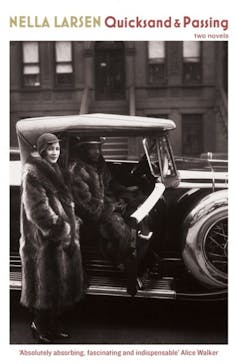
Quicksand (1928) and Passing (1929) by Nella Larsen
These novellas follow mixed-race women whose uneasy status on the colour line (including the lure of passing as white) complicates their lives in dangerous, even fatal ways. Passing is revolutionary for its depiction of homoerotic tension between two upper-middle-class Black women. Quicksand offers insight into the exoticization of African American women abroad and the contest between art and domesticity as viable avenues for a fulfilling life.
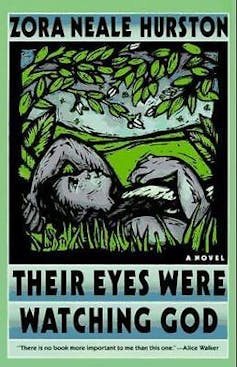
Their Eyes Were Watching God (1937) by Zora Neale Hurston
This story is the lyrical account of thrice-married Janie Crawford who finds a mature vision of love and fulfillment amid incessant gossip and a difficult family history. The all-Black township of Eatonville, Fla., and the rich “muck” of the Everglades contribute to a portrait of community health, daily striving and resolute self-awareness.
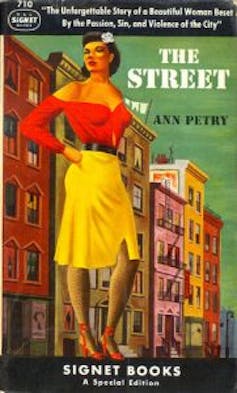
The Street (1946) by Ann Petry
This social realist novel follows single mother Lutie Johnson as she attempts to make a life for her young son in a predatory urban space. Weathering sexism, racism, classism, poverty and intense personal frustration, Lutie attempts to resist the brutality of the environment that gives the novel its loaded name.
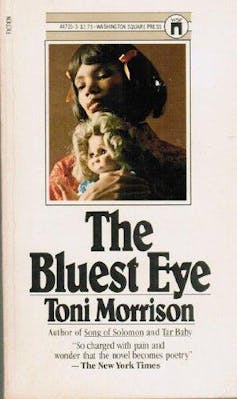
The Bluest Eye (1970) by Toni Morrison
This book is a searing portrait of a young girl’s coming-of-age and eventual undoing in the years following the Great Depression. Tumultuous family dynamics, psychological trauma and incest, the quest for compassion and self-love, and the toxic myth of Black ugliness coalesce in this first novel by the Nobel Laureate and author of neo-slave narrative Beloved (1987).
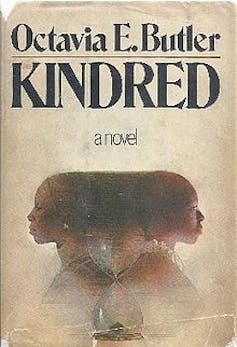
Kindred (1979) by Octavia Butler
Oscillating between the 1970s and the early 19th century, this science fiction odyssey (re)connects a contemporary Black woman writer and her white husband with her ancestors on a Maryland plantation. The novel is buoyed up by the dramatic tension of time travel and the juxtaposition of the pre-civil War Antebellum-era with Civil Rights-era racial attitudes, including those about interracial love and allyship.
The Women of Brewster Place (1982) by Gloria Naylor
Structured like a narrative quilt, these interconnected experiences of seven women span different generations, professions, class backgrounds and understandings of their place in the world. The eroded apartment complex that links them is the backdrop for unbearable pain as well as the promise of transformation and reconciliation.
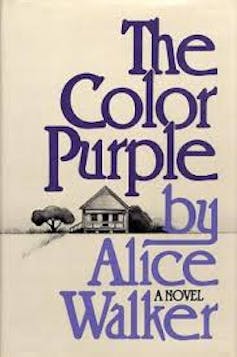
The Color Purple (1982) by Alice Walker
A tale of two sisters, Celie and Nettie, this novel constellates their love and longing via letters and imagined conversations across the Atlantic. Unsparing in its critique of domestic violence and toxic masculinity, yet tender in its treatment of various human weaknesses, the novel underscores Black women’s need for self-regard and mutual care. Not only are these acts revolutionary, but they also offer a glimpse of the divine.
Nancy Kang, Assistant Professor of Women’s and Gender Studies and Canada Research Chair in Transnational Feminisms and Gender-Based Violence, University of Manitoba
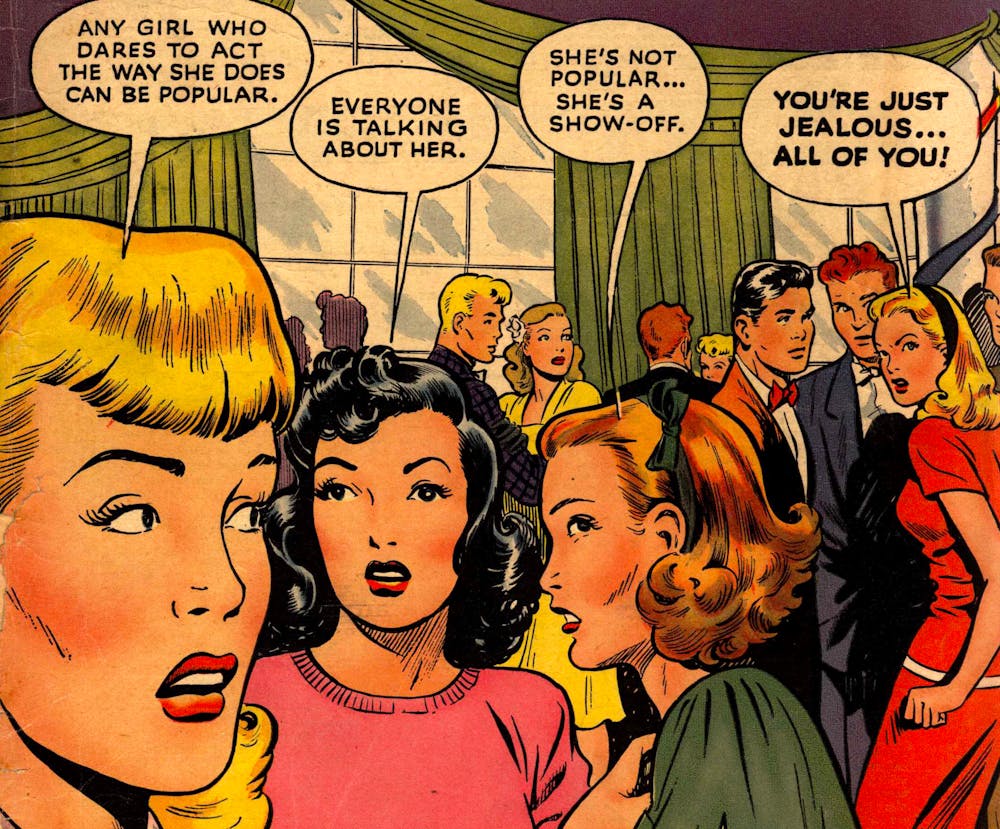
With over 100 issues, ‘Young Love’ was one of the longest running romance comics series. Gary Lee Watson Comic Book Collection, Irvin Department of Rare Books and Special Collections, University of South Carolina Libraries, Author provided
As the reference and instruction librarian, I’m tasked with getting to know the collection so I can exhibit parts of it and use the materials for teaching. One of the great pleasures of assessing and cataloging Watson’s collection has been learning about how comic books have changed over time. Sifting through Watson’s vast collection of 140,000-plus comics, I’m able to see the genre’s entire trajectory.
Before World War II, superheroes were all the rage. Reflecting anxieties over the Great Depression, the rise of fascism and the march to war, readers yearned for mythical figures who would defend the disenfranchised and uphold liberal democratic ideals.
Once the war ended, the content of comic books started to change. Superheroes gradually fell out of fashion and a proliferation of genres emerged. Some, such as Westerns, offered readers a nostalgic fantasy of a pre-industrial America. Others, like true crime and horror, hooked readers with their lurid tales, while science fiction comics appealed to the wonders of technological advancement and trepidation about where it might lead us.
But there was also a brief period when the medium was dominated by the romance genre.
Grounded in artistic and narrative realism, romance comics were remarkably different from their superhero and sci-fi peers. While the post-war popularity of romance comics only lasted a few years, these love stories ended up actually having a strong influence on other genres.
Romance comics’ origin story
Though today they are most famous for creating “Captain America,” the creative duo of Joe Simon and Jack Kirby launched the romance comic book genre in 1947 with the publication of a series called “Young Romance.”
Teen comedy series like “Archie” had been around for a few years and occasionally had romantic story lines and subplots. Romance pulps and true confession magazines had been around for decades.
But a comic dedicated to telling romantic stories hadn’t been done before. With the phrase “Designed for the More Adult Readers of Comics” printed on the cover, Simon and Kirby signaled a deliberate shift in expectations of what a comic could be.
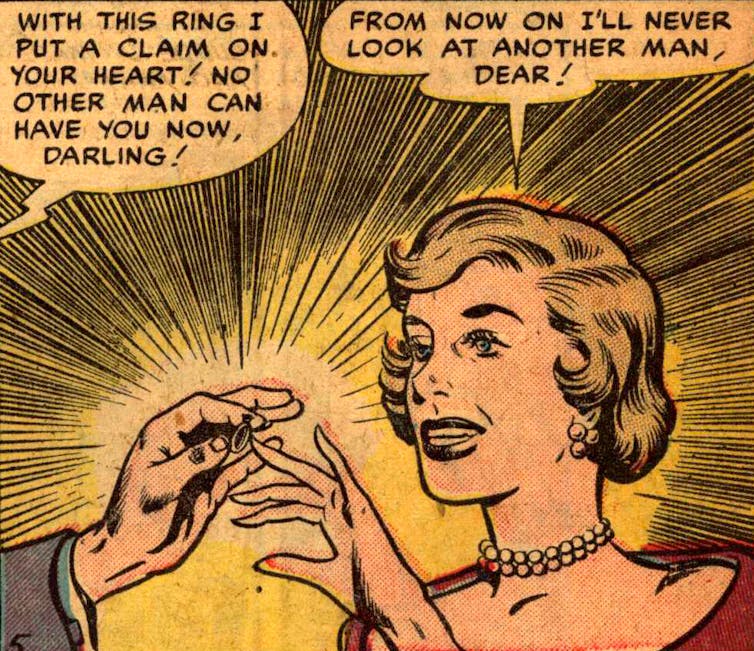
While most scholars have argued that romance comics tend to reinforce conservative values – making marriage the ultimate goal for women and placing family and middle-class stability on a pedestal – the real pleasure of reading these books came from the mildly scandalous behavior of their characters and the untoward plots that the narratives were ostensibly warning against. With titles like “I Was a Pick-Up!,” “The Farmer’s Wife” and “The Plight of the Suspicious Bridegroom,” “Young Romance” and its sister titles quickly sold out of their original print runs and began outselling other comics genres.
Issue #1 of ‘Teen-Age Romances’ (St. John, 1949). Gary Lee Watson Comic Book Collection, Irvin Department of Rare Books and Special Collections, University of South Carolina Libraries, Author provided
Other publishers noticed the popularity of the genre and followed suit with their own romance titles, most of which closely followed Simon and Kirby’s style and structure. By 1950, about 1 in 5 of all comic books were romance comics, with almost 150 romance titles being sold by over 20 publishers.
The rage for all things romance was so sudden that publishers eager to take advantage of the new market altered titles and even content in order to save on second-class postage permits. Second-class or periodical postage is a reduced rate that publishers can use to save on the cost of mailing to recipients. Rather than apply for new permits every time they tested a new title, comics publishers would simply alter a failing title while retaining the issue numbering in order to keep using the preexisting permit. To comics historians, this is a telltale sign that the industry is undergoing a sudden change.
One striking example of this is when comics publisher Fawcett ended its failing superhero comic “Captain Midnight” in 1948 with issue #67 and launched its new title, “Sweethearts,” in issue #68. In this case, the death of a superhero comic became the birth of a romance comic.
Issue #3 of ‘Bride’s Romances’ (Quality Comics, 1953). Gary Lee Watson Comic Book Collection, Irvin Department of Rare Books and Special Collections, University of South Carolina Libraries, Author provided
With so many new titles flooding newsstands and department stores, the bubble was bound to burst. In what comic book historian Michelle Nolan has dubbed “the love glut,” 1950 and 1951 witnessed a rapid boom and bust of the romance genre. Many romance titles were canceled by the mid-1950s, even as stalwarts of the genre, such as “Young Romance,” remained in print into the mid-1970s.
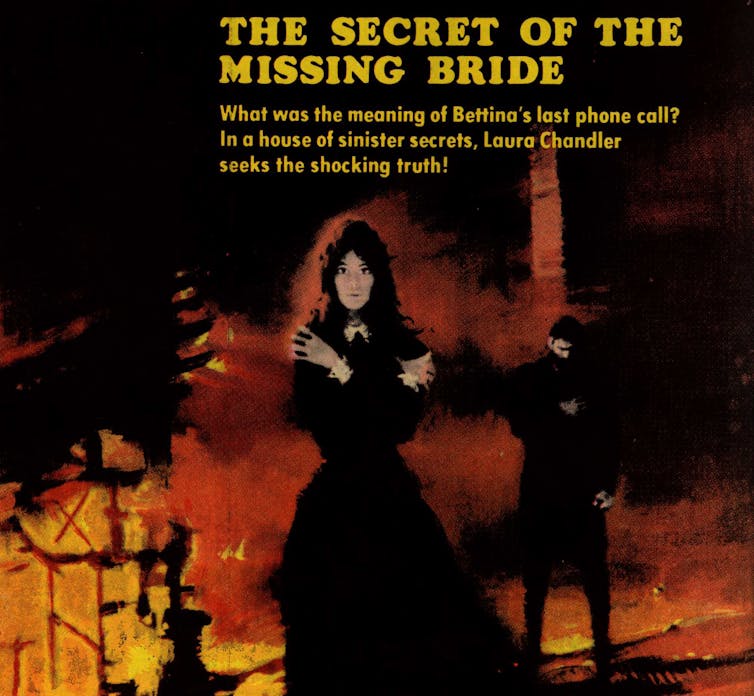
There was the brief popularity of the sub-genre of gothic romance comics in the 1970s – series with names like “The Sinister House of Secret Love” and “The Dark Mansion of Forbidden Love.” But romance comics would never approach their brief, postwar peak.
Gothic romances – like this issue of ‘The Dark Mansion of Forbidden Love’ – had a brief run in the 1970s. Gary Lee Watson Comic Book Collection, Irvin Department of Rare Books and Special Collections, University of South Carolina Libraries, Author provided
A brief boom, an enduring influence
Among collectors, issues of romance comics are less sought after than those of other genres. For this reason, they tend to go under the radar.
Romance comics, however, featured work by pioneering artists like Lily Renée and Matt Baker, both of whom worked on first issue of “Teen-Age Romances” in 1949.
Baker is the first-known black artist to work in the comic book industry and Renée was one of comics’ first female artists. Prior to working on “Teen-Age Romances,” they both drew “good girl art” – a set of artistic tropes borrowed from pinups and pulp magazines – for several titles. Their work in both genres exemplifies how earlier pulp magazine themes of desire and seduction could readily be applied to newer genres.
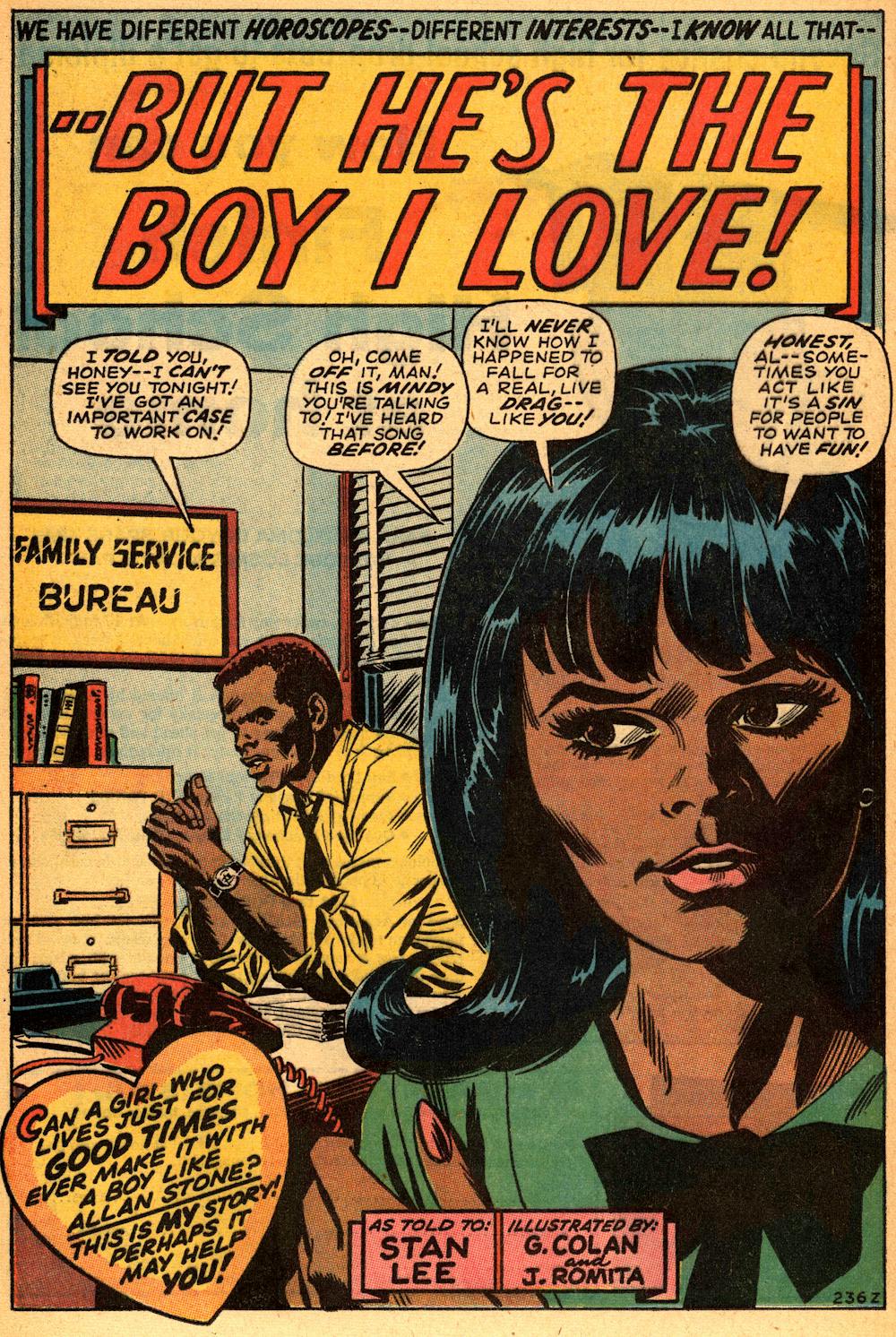
‘But He’s the Boy I Love’ was one of the few romance comic to feature black characters. Gary Lee Watson Comic Book Collection, Irvin Department of Rare Books and Special Collections, University of South Carolina Libraries, Author provided
After the “love glut,” sub-genre mashups nonetheless emerged. For example, cowboy romances were briefly popular. Later, in response to the civil rights movement, Marvel published the 1970 story “But He’s the Boy I Love,” which was the first story in a romance comic to feature African-American characters since Fawcett’s three-issue run of “Negro Romance” in 1950.
Even after romance comics largely fell out of fashion, the genre’s visual tropes and narrative themes became more prevalent during what’s known as the “Silver Age,” a superhero revival that lasted from 1956 to 1970. Titles such as “Superman’s Girl Friend Lois Lane” often borrowed heavily from romance for their plots to generate intrigue and tension in the hopes of driving up sales.
Issue 89, in which Lois marries Bruce Wayne, is a prime example of such marketing techniques. Issues such as these were often situated as “what if” narratives that offered readers speculative story lines, such as “What if Lois Lane married Bruce Wayne?” Though they’re generally thought of as separate from the superhero canon, these love stories show that comic book writers had internalized the main narrative techniques of romance comics even if the genre itself was in decline.
But other comics didn’t merely use romantic themes for the occasional gimmick issue. Instead, they made the love lives of their characters a central plot point and a fundamental aspect of their characters’ identities. Comics such as the “Fantastic Four” and the “X-Men” rely heavily on the heated emotions and jealousies found in group dynamics and love triangles.
Take Wolverine. Presumably tough and stoic, he’s so enamored of Jean Grey – and so envious of her love interest, Scott Summers – that you could argue that unrequited love is one of his primary motivations throughout the series.
Thanks to romance comics, even stoic superheroes got bitten by the love bug.
Over the past month, Romance Writers of America, one of the country’s largest writing associations, with over 9,000 members, has erupted in a race-related scandal.
The controversy began when diversity activist and romance writer Courtney Milan, in a pointed tweet, criticized racial stereotypes that appeared in a book by a fellow member. Writers took sides. A punishment was handed down. Backlash ensued.
Now the very existence of the 40-year-old organization is in doubt. But you’d never know it from the cheeky media coverage, which hasn’t been able to resist casting the controversy as a battle between forlorn lovers.
CNN, for instance, describes the Romance Writers of America as “more scandalized than a dowager countess finding her headstrong niece alone on the lap of a rakish duke,” while NBC News tells us there’s “lots of passion but not too much love” among the writers.
As a former journalist, I get the appeal of a saucy lead. But as a scholar who’s spent nearly a decade studying romance writers and their networks, I see how portraying the incident as a catfight or a relationship gone wrong oversimplifies the controversy, which has serious implications for the rest of the publishing industry – and beyond.
It all falls apart
To briefly recap what happened: In August, Romance Writers of America member Courtney Milan, who is Chinese American, Twitter-shamed a novel written by a white member, calling it a “racist mess” for its depiction of Asian women.
The book’s author filed an ethics complaint, accusing Milan of bullying and damaging her business prospects. In December, Milan was suspended from the organization for a year and banned from future leadership positions.
The result shocked almost everyone involved. Milan has been a vocal and effective advocate for inclusion. In protest, nine members of the board resigned, including eight women of color. The president and executive director quit. The RITA Awards – the Oscars of romance publishing – were canceled, while major publishers pulled their sponsorship from the annual conference.
A tradition of support
Here’s why it matters: For 40 years, romance writers have been successfully pushing back against second-class treatment in the publishing industry.
My research suggests this is due to their surprisingly effective – and somewhat counterintuitive – approach to social networking and support.
Unlike other professional organizations, they welcome novices, share trade secrets and readily exchange advice about how to leverage new technology to advance their careers. These tactics have helped authors improve the terms of their publishing contracts, pioneer new promotional techniques and form a grassroots network of writers that can quickly adapt to changes in the market.
Disrespect and exclusion united romance authors in the first place. The Romance Writers of America was formed in 1980, when a diverse group of white, black and Latina women writers got fed up with being dismissed by mostly male agents and editors. In an era before email, the group managed to build a far-reaching network of women authors and editors who encouraged one another and taught each other to succeed.
The group’s efforts eventually led to some serious wins.
For instance, many romance authors write under several pseudonyms, which create distinctive brands for their various series. For decades, the romance publisher Harlequin didn’t let authors own the rights to their own pseudonyms. That meant if authors changed publishers, they couldn’t bring along their pen names and the fans who followed them, which hurt their ability to negotiate good terms. But in 2002, the Romance Writers of America – under President Shirley Hailstock, who is black – persuaded Harlequin to let authors keep their own pseudonyms, even when they switched publishers.
Then, when e-books and digital self-publishing came along, the group’s tradition of advice sharing and innovation catapulted the careers of romance writers. My research shows that romance writers’ median income nearly doubled after the explosion of self-publishing. This took place at a time when authors in other genres saw massive declines in income.
Diverse writers still left behind
But the group’s gains have not been equally shared by all authors.
In my study of more than 4,000 romance authors, I found romance authors of color earned about 38% of white romance authors in 2014. Another study found that only about 8% of traditionally published romance novels are written by authors of color. Until last summer, no black writer had won a RITA. In interviews, writers of color told me about some stunningly racist comments from editors at romance conferences that the organization failed to publicly address.
These statistics mirror those of the publishing industry as a whole. According to a forthcoming report for the Authors Guild that I wrote, authors of color across all publishing categories earn about half the median income of white authors. Roughly 80% of book editors are white. Authors of color write just 7% of children’s books, while black authors pen only 2% to 3% of stories in science fiction magazines.
When publishing organizations attempt to change, the backlash can be swift. In perhaps the the most glaring example, in 2015, a set of right-wing, anti-diversity science fiction authors known as the Sad Puppies formed a voting bloc to try to prevent diverse authors from winning at the annual Hugo awards, science-fiction’s most prestigious award ceremony.
What could have been
The Romance Writers of America has tried prioritize inclusiveness over the past few years.
Members – including Milan – sought reform by openly talking about issues on social media while also utilizing the organization’s traditional, behind-the-scenes networking. Vociferous Twitter debates over diversity ensued; the hashtag #RitasSoWhite circulated; bestselling authors used their award acceptance speeches
or their prominent platforms to call for fair treatment for authors regardless of race, sexual orientation or ability.
Moved by these efforts, the membership elected a very diverse board in 2019, with nearly half made up by authors of color. Judging procedures for the RITAs were changed, and other diversity measures adopted. Three women of color won RITAs last August, and 20 out of the 30 speakers or winners at the ceremony made it a point to celebrate diverse authors.
In the end, however, it wasn’t enough. For many, the ruling against Milan was the last straw. The fallout, which includes the disbanding of the Las Vegas chapter on Jan. 20, continues.
Taken together, these events suggest that even organizations that seem to be addressing issues of inclusion in good faith are susceptible to fracturing. Either that, or exclusion is so deeply ingrained in certain institutions that it can’t ever be adequately addressed – and the entire organization needs to be torn down.
This could be bad news for other predominantly white groups and industries trying to evolve. Witness the ongoing struggles of the film industry to diversify, the continued predominantly white male makeup of Silicon Valley or the bitter divide over the organizers and participants in the Women’s March. All have faced calls for change. To many, the results have been unsatisfactory.
For a time, the Romance Writers of America seemed to be showing that change could occur from within. Now that seems increasingly far-fetched.
Whatever happens, this controversy can serve as a lesson about the profound challenges of building relationships and instituting organizational change in the digital age.
Two manuscripts of the visionary, writer and composer St. Hildegard of Bingen (1098-1179) survived the Dresden bombings after a librarian stashed them in a bank vault. (Avraham Pisarek/Deutsche Fotothek/Wikimedia), CC BY-SA
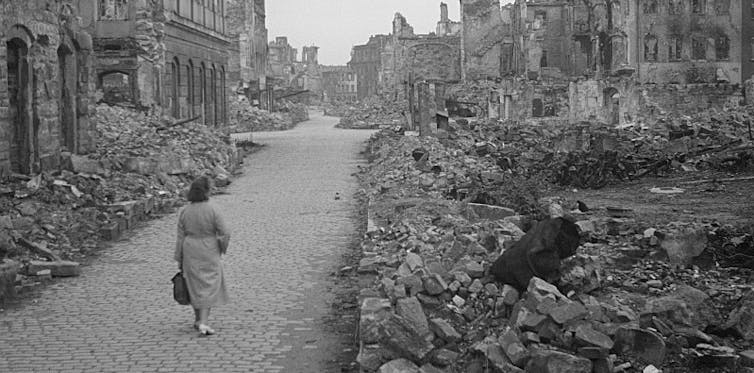
Seventy-five years ago, in February 1945, during the Second World War, Allied forces bombed the magnificent baroque city of Dresden, Germany, destroying most of it and killing thousands of civilians.
Hildegard Abbey, near Wiesbaden, Germany. (Kate Helsen), Author provided
Hildegard, whose writings documented her religious visions, including a theology of the feminine and an ecological consciousness, and who practised medicinal herbology, was venerated locally as a saint for centuries. The Catholic Church only recently recognized her as one, and also designated her a Doctor of the Church.
After the Dresden bombings, the Soviet Army seized and inspected the surviving vault. The first bank official to enter the vault afterwards found it pillaged, with only one manuscript remaining. The bank could never confirm if the vault was emptied in an official capacity or if it was plundered.
The missing manuscript has not been seen in the West since. The other made its way back to its original home of Wiesbaden, on the other side of Germany, through the extraordinary efforts of two women.
This is the story of how those women conspired to return the manuscript home.
The librarian
In 1942, Gustav Struck, the director of the state library in Wiesbaden, became worried about local air raids. Following many European institutions, he decided that his library’s manuscripts needed to be sent elsewhere for safe keeping.
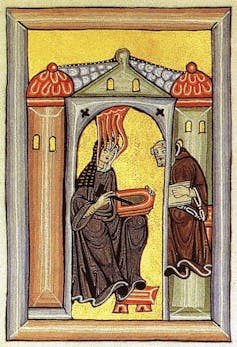
Hildegard receiving visions, a reproduction of an image from the ‘Scivias’ manuscript. (Wikimedia/Miniatur aus dem Rupertsberger Codex des Liber Scivias)
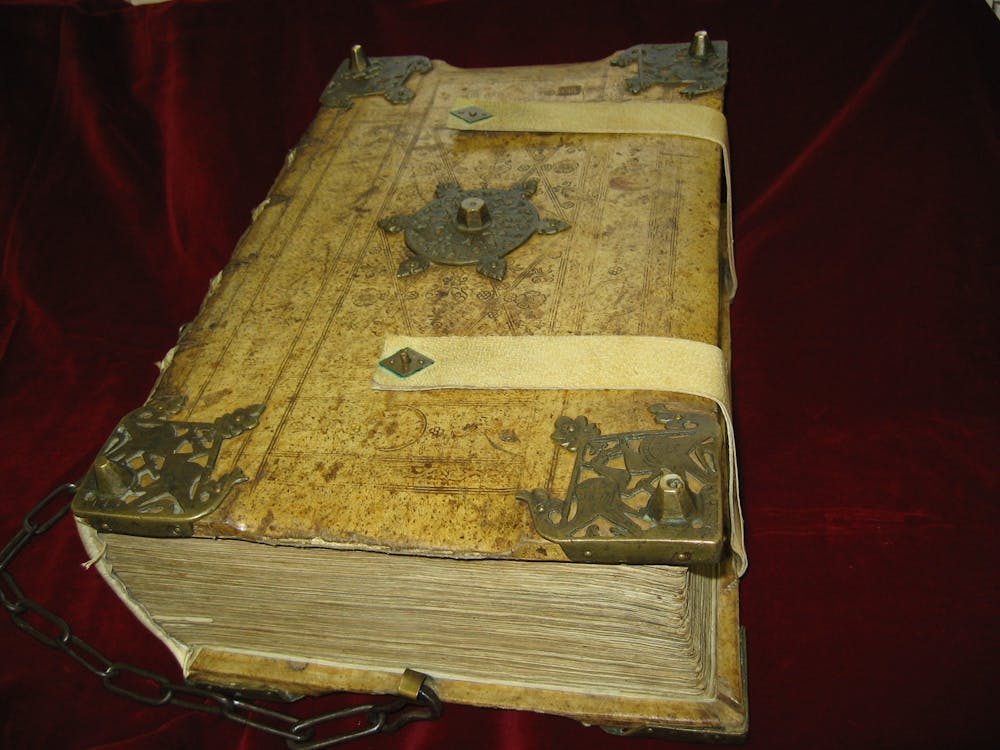
Two of the library’s most valuable possessions were manuscripts of Hildegard’s works. One was a beautifully illuminated copy of Scivias, a collection of 26 religious visions. The other manuscript, known as the Riesencodex, is the most complete compilation of her works, including the visionary writings, letters and the largest known collection of her music.
Why Struck chose to store the manuscripts in a bank vault in Dresden is still a mystery, but their journey there by train and streetcar mid-war is thoroughly documented.
The manuscripts sat in the bank vault for three years until the attack on Dresden.
After the war
Immediately after the war, the Americans sacked Struck in their denazification efforts. Librarian Franz Götting took over his job.
Götting inquired about the manuscripts as soon as mail service to Dresden resumed, and learned that the Scivias manuscript was missing, either seized or plundered, but that the bank still had the Riesencodex.
Götting asked repeatedly for the Riesencodex to be returned from Dresden to Wiesbaden. The difficulty was that Dresden was in the newly formed Soviet zone, while Wiesbaden was in the American zone. (The Allies had divided Germany into four occupation zones, and similarly divided Germany’s capital city, Berlin, into four sectors.) The Soviets had issued a decree stating that all property found in German territory occupied by the Red Army now belonged to them.
Hildegard’s composition ‘O Most Noble Greenness.’
The plan
A scholar and medievalist in Berlin, however, came up with a scheme to retrieve the manuscript. Margarethe Kühn, a devout Catholic who expressed a great love for Hildegard, held a position as a researcher and editor with the Monumenta Germaniae Historica project. After the war she found herself living in the American sector of Berlin and working in the Soviet sector.
Photograph of the 12th-century ‘Risencodex’ manuscript. (Wikimedia/Landesbibliothek Wiesbaden), CC BY
Kühn had stayed at the Hildegard Abbey for several days in March 1947 and had even explored joining the Abbey as a nun herself. She must have heard while she was there that the Riesencodex was being held in Dresden without any promise of return. She devised a plan to help.
Kühn asked Götting for permission to borrow the manuscript for study purposes. Götting asked the Soviet-run Ministry for Education, University and Science in Dresden on Kühn’s behalf. Much to the librarian’s surprise, ministry officials agreed to send the manuscript for Kühn to examine at the German Academy, a national research institute established in 1946 in Berlin by the Soviet administration.
Kühn was convinced that the bureaucrats in Dresden would not recognize the Riesencodex. She decided that when returning the manuscript, with help from the Wiesbaden librarian, Götting, she would send a substitute manuscript to Dresden, and the original to Wiesbaden.
The crossing
Kühn enacted the plan with the help of an American woman, Caroline Walsh.
How exactly Kühn and Walsh met is not known, but Caroline’s husband Robert Walsh was in the American air force and was stationed in Berlin as the director of intelligence for the European command from 1947-48.
In an interview in 1984, Robert explained that when he and Caroline were in Berlin she had “worked a great deal with the Germans and with the religious outfits over there, too.” Since the Walshes were also Catholic, it is likely that they and Kühn met through Catholic circles in the city.
Caroline’s position as the wife of a high-ranking military officer may have made it easier for her to travel across military occupation zones and sectors.
In any case, we know that Caroline travelled by train and car and delivered the manuscript in person to the Hildegard Abbey in Eibingen on March 11, 1948. The nuns notified Götting at the Wiesbaden library and returned the manuscript.
The swap
A Scivias illumination on an edition of Hildegard’s medical works. Beuroner Kunstverlag
Götting, meanwhile, had not found a suitably sized manuscript to stand in for the large Riesencodex to trick the Soviets. He instead selected a 15th-century printed book of a similar size and had sent this to Kühn in Berlin.
It took some time for Kühn to deliver it to the Ministry for Education, University and Science in Dresden, and two further months before anyone there opened the package in January 1950. By that time, Hildegard’s manuscript was safely in Wiesbaden. But officials spotted the deception and Kühn was in trouble.
An official in Dresden wrote to the German Academy in Berlin demanding to know why they had been sent a printed book rather than the Riesencodex manuscript.
Kühn’s boss, Fritz Rörig, who received the letter was furious with her. Rörig and Götting smoothed things over with Dresden by offering another manuscript in exchange. But Rörig told Kühn that the East German police were inquiring about her, the implication being that he had reported her.
One still missing
Although she remained deeply worried for some time afterwards, Kühn never lost her job at the Monumenta nor was she arrested, despite Rörig’s threats. For the rest of her life she maintained a rare cross-border existence, living on Soviet wages in the American sector while continuing at the same job until her death in 1986, at the age of 92.
As one of many scholars who regularly consults the Riesencodex, now available online, I am enormously grateful to Caroline Walsh, and particularly to Kühn who risked her livelihood for the sake of a book.
I am not alone, however, in hoping that during my lifetime someone, somewhere will find the pilfered Scivias manuscript and return it as well.
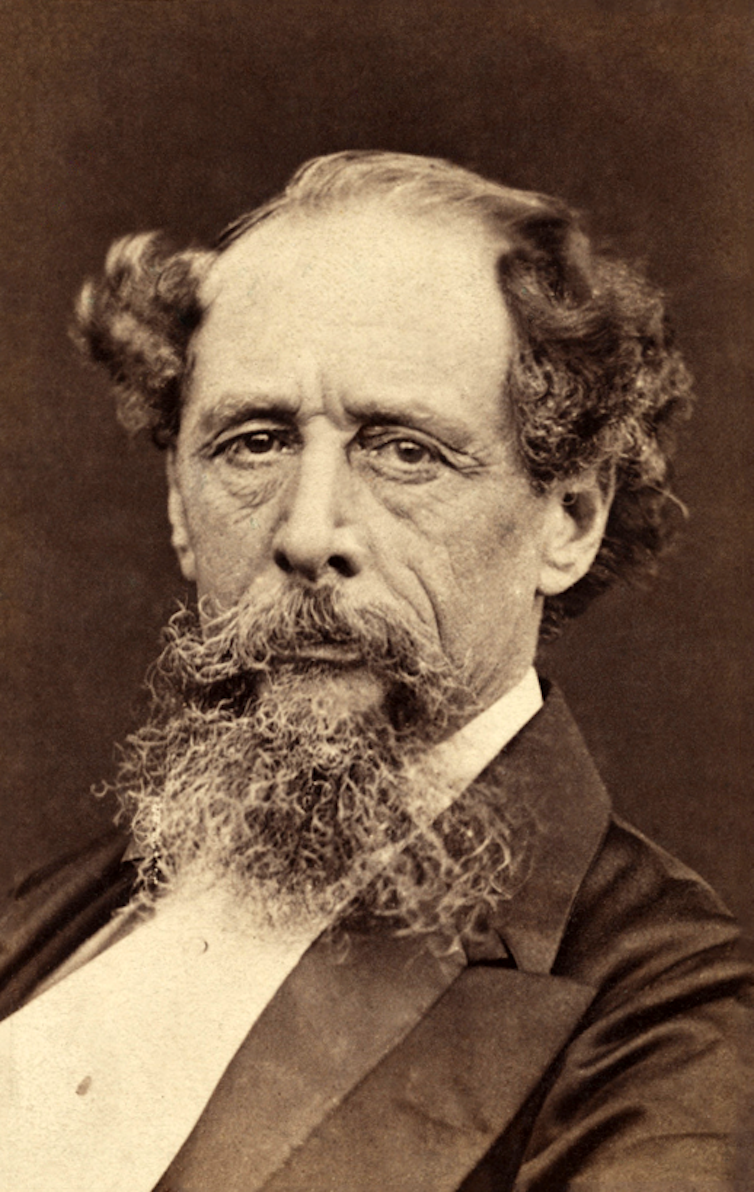
When Charles Dickens died, he had spectacular fame, great wealth and an adoring public. But his personal life was complicated. Separated from his wife and living in a huge country mansion in Kent, the novelist was in the thrall of his young mistress, Ellen Ternan. This is the untold story of Charles Dickens’s final hours and the furore that followed, as the great writer’s family and friends fought over his final wishes.
My new research has uncovered the never-before-explored areas of the great author’s sudden death, and his subsequent burial. While details such as the presence of Ternan at the author’s funeral have already been discovered by Dickensian sleuths, what is new and fresh here is the degree of manoeuvring and negotiations involved in establishing Dickens’s ultimate resting place.
Dickens’s death created an early predicament for his family. Where was he to be buried? Near his home (as he would have wished) or in that great public pantheon, Poet’s Corner in Westminster Abbey (which was clearly against his wishes)?
“The Inimitable” (as he sometimes referred to himself) was one of the most famous celebrities of his time. No other writer is as closely associated with the Victorian period. As the author of such immortal classics as Oliver Twist, David Copperfield and A Christmas Carol, he was constantly in the public eye. Because of the vivid stories he told, and the causes he championed (including poverty, education, workers’ rights, and the plight of prostitutes), there was great demand for him to represent charities, and appear at public events and visit institutions up and down the country (as well as abroad – particularly in the United States). He moved in the best circles and counted among his friends the top writers, actors, artists and politicians of his day.
Dickens was proud of what he achieved as an author and valued his close association with his public. In 1858 he embarked on a career as a professional reader of his own work and thrilled audiences of thousands with his animated performances. This boost to his career occurred at a time when his marital problems came to a head: he fell in love with Ternan, an 18-year-old actress, and separated from his wife Catherine, with whom he had ten children.
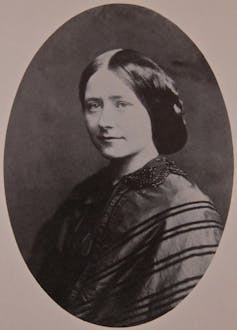
Ellen Ternan, the young actress who became Charles Dickens’s mistress. Wikimedia
Dickens was careful to keep his love affair private. Documentary evidence of his relationship with Ternan is very scarce indeed. He had wanted to take her with him on a reading tour to America in 1868, and even developed a telegraphic code to communicate to her whether or not she should come. She didn’t, because Dickens felt that he could not protect their privacy.
On Wednesday June 8 1870, the author was working on his novel Edwin Drood in the garden of his country home, Gad’s Hill Place, near Rochester, in Kent. He came inside to have dinner with his sister-in-law, Georgina Hogarth, and suffered a stroke. The local doctor was summoned and remedies were applied without effect. A telegram was sent to London, to summon John Russell Reynolds, one of the top neurologists in the land. By the following day the author’s condition hadn’t changed and he died at 6.10pm, on June 9.
Accepted wisdom concerning Dickens’s death and burial is drawn from an authorised biography published by John Forster: The Life of Charles Dickens. Forster was the author’s closest friend and confidant. He was privy to the most intimate areas of his life, including the time he spent in a blacking (boot polish) warehouse as a young boy (which was a secret, until disclosed by Forster in his book), as well as details of his relationship with Ternan (which were not revealed by Forster, and which remained largely hidden well into the 20th century). Forster sought to protect Dickens’s reputation with the public at all costs.
Last Will and Testament
In his will (reproduced in Forster’s biography), Dickens had left instructions that he should be:
Buried in an inexpensive, unostentatious, and strictly private manner; that no public announcement be made of the time or place of my burial; that at the utmost not more than three plain mourning coaches be employed; and that those who attend my funeral wear no scarf, cloak, black bow, long hat-band, or other such revolting absurdity.
Forster added that Dickens’s preferred place of burial – his Plan A – was “in the small graveyard under Rochester Castle wall, or in the little churches of Cobham or Shorne”, which were all near his country home. However, Forster added: “All these were found to be closed”, by which he meant unavailable.
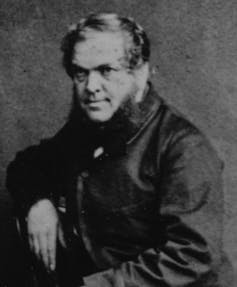
John Forster (1812-76). Leon Litvack
Plan B was then put into action. Dickens was set to be buried in Rochester Cathedral, at the direction of the Dean and Chapter (the ecclesiastical governing body). They had even dug a grave for the great man. But this plan too was scuppered, in favour of interment in Poets’ Corner, in Westminster Abbey – the resting place of Geoffrey Chaucer, Samuel Johnson, and other literary greats.
Forster claims in the biography that the media led the way in agitating for burial in the abbey. He singles out The Times, which, in an article of January 13 1870, “took the lead in suggesting that the only fit resting place for the remains of a man so dear to England was the abbey in which the most illustrious Englishmen are laid”. He added that when the Dean of Westminster, Arthur Penrhyn Stanley, asked Forster and members of the Dickens family to initiate what was now Plan C, and bury him in the abbey, it became their “grateful duty to accept that offer”.
The private funeral occurred early in the morning of Tuesday June 14 1870, and was attended by 14 mourners. The grave was then left open for three days so that the public could pay their respects to one of the most famous figures of the age. Details of the authorised version of Dickens’s death and burial were carried by all the major and minor newspapers in the English-speaking world and beyond. Dickens’s estranged wife Catherine received a message of condolence from Queen Victoria, expressing “her deepest regret at the sad news of Charles Dickens’s death”.
This article is part of Conversation Insights
The Insights team generates long-form journalism derived from interdisciplinary research. The team is working with academics from different backgrounds who have been engaged in projects aimed at tackling societal and scientific challenges.
The effect that Dickens’s death had on ordinary people may be appreciated from the reaction of a barrow girl who sold fruits and vegetables in Covent Garden Market. When she heard the news, she is reported to have said: “Dickens dead? Then will Father Christmas die too?”
The funeral directors
My investigation has revealed, however, how Dickens’s burial in Poets’ Corner was engineered by Forster and Stanley to satisfy their personal aims, rather than the author’s own. While the official story was that it was the “will of the people” to have Dickens buried in the Abbey (and there were articles in The Times to this effect), the reality was that this alteration suited both the biographer and the churchman.
Forster could conclude the volume he was contemplating in a fitting manner, by having Dickens interred in the national pantheon where so many famous literary figures were buried. He thus ensured that a stream of visitors would make a pilgrimage to Dickens’s grave and spread his reputation far and wide, for posterity.
Stanley could add Dickens to his roll of famous people whose burials he conducted. They included Lord Palmerston, the former UK prime minister, mathematician and astronomer Sir John Herschel, missionary and explorer David Livingstone, and Sir Rowland Hill, the postal reformer and originator of the penny post.
The efforts of Forster and Stanley to get Dickens buried exactly where they wanted enhanced the reputations of both men. For each of them, the interment of Dickens in the abbey might be considered the highlight of their careers.
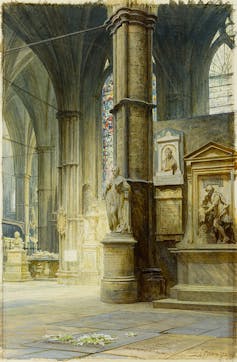
Luke Fildes, Dickens’s grave in Westminster Abbey (1873). Charles Dickens Museum, CC BY
‘Mr Dickens very ill, most urgent’
The new evidence I have found was gathered from libraries, archives and cathedral vaults and prove beyond a doubt that any claims about the Westminster burial being the will of the people are false.
What emerges is an atmosphere of urgency in the Dickens household after the author collapsed. Dickens’s son Charley sent the telegram to the author’s staff in London, requesting urgent medical assistance from the eminent neurologist, John Russell Reynolds:
Go without losing a moment to Russell Reynolds thirty eight Grosvenor St Grosvenor Sqr tell him to come by next train to Higham or Rochester to meet… Beard (Dickens’s physician), at Gadshill … Mr Dickens very ill most urgent.
Dickens’s sister-in-law, Georgina Hogarth, who ran his household and cared for his children after the separation from Catherine, was clearly disappointed that the specialist could do nothing for her much-adored brother-in-law. She sent a note to her solicitor with the doctor’s fee: “I enclose Dr Reynolds’ demand (of £20) for his fruitless visit.”
Dean Stanley had met Dickens in 1870, after being introduced by the churchman’s brother-in-law, Frederick Locker, who was a friend of the novelist. Stanley confided to his private journal (now housed in the archives of Westminster Abbey) that he was “much struck” by his conversation with Dickens and appreciated the few opportunities he had to meet the author before he died.
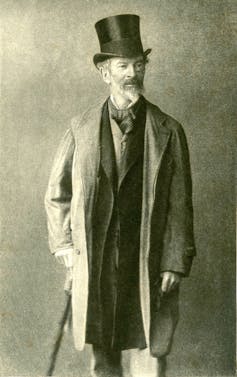
Frederick Locker, from My Confidences, 1896.
Locker’s memoir also records an interesting conversation he had with Stanley before this 1870 meeting, which sheds light on the Dean’s attitude towards the novelist, his death and funeral. Locker writes about talking to Stanley “of the burials in the abbey” and they discussed the names of some “distinguished people”. Stanley told him there were “certain people” he would be “obliged to refuse” burial, on account of personal antipathies. But his attitude changed when the name of the author “came up” and he said he “should like to meet Dickens”. Then, to “gratify” Stanley’s “pious wish”, Locker asked Dickens and his daughter to dine. Thus even while Dickens was still alive, Stanley privately expressed a desire to bury him.
When the end came, Locker conveyed the news to his brother-in-law on that very day – June 9. The Dean wrote to Locker to say:
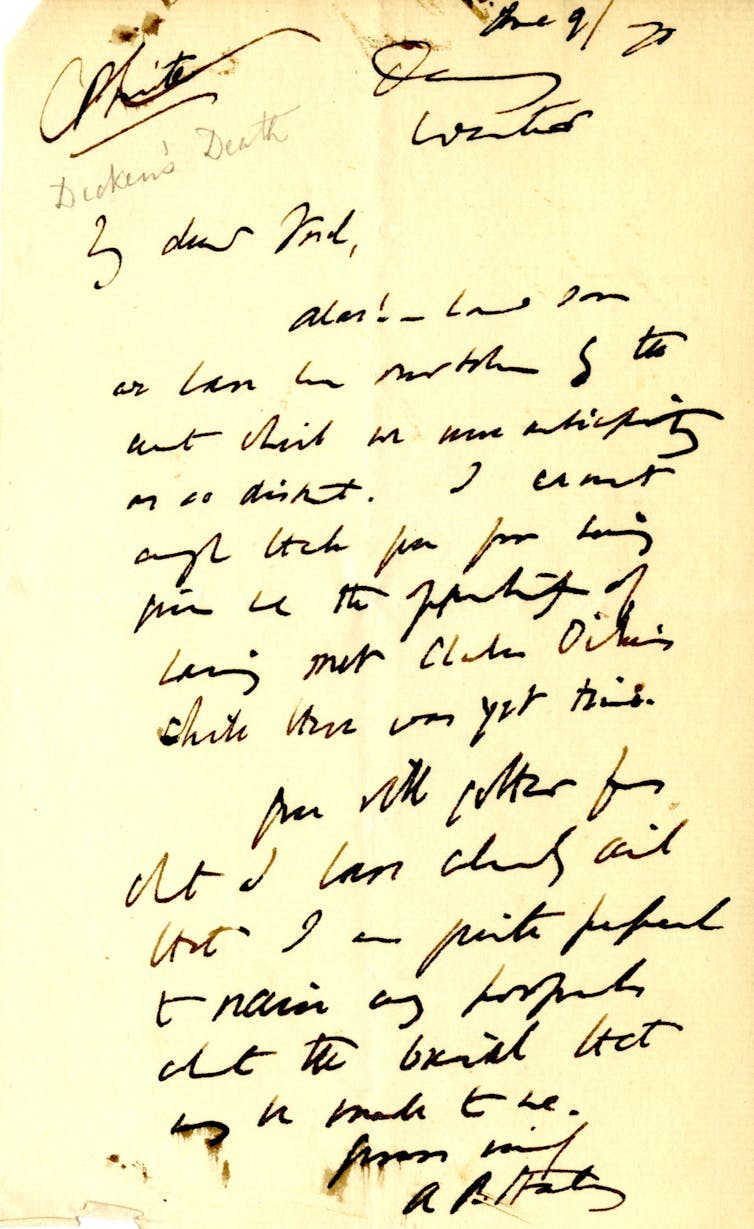
Alas! – how soon we have been overtaken by the event which we were anticipating as so distant. I cannot amply thank you for having given me the opportunity of having met Charles Dickens while there was yet time. You will gather from what I have already said that I am quite prepared to raise any proposals about the burial that may be made to me.
Letter from A.P. Stanley to Frederick Locker, June 9 1870. Locker wrote in pencil towards the top: ‘Dickens’ Death’. By kind permission of the Armstrong Browning Library., Author provided
The letter is fascinating. On the very day of the famous author’s death, the Dean was already thinking about burial in the Abbey. But there was a catch: Stanley could only entertain such a proposal if it came from the family and executors. He could not act unilaterally.
Locker quickly seized the opportunity hinted at in Stanley’s letter and sent a copy of it to Charley Dickens (the author’s son) on June 10. He wrote in his covering note: “I wish to send you a copy of a letter that I have just received from Dean Stanley and I think it will explain itself. If I can be of any use pray tell me.”
False claims and ambition
Meanwhile, the idea of getting Dickens to Poets’ Corner was growing in Stanley’s imagination. He wrote to his cousin Louisa on Saturday June 11 to say “I never met (Dickens) till this year… And now he is gone … and it is not improbable that I may bury him”. It’s interesting how quickly the plan crystallised in the Dean’s mind. Within the space of 48 hours, he went from hypothetical proposals from the family for burial, to foreseeing a key role for himself in the proceedings.
However, an answer from Charley Dickens wasn’t forthcoming. Stanley waited until the morning of Monday June 13, before seeking another way of making his wishes known to the family. He got in touch with his friend Lord Houghton (formerly Rickard Monckton Milnes – a poet, politician and friend of Dickens), reiterating his preparedness “to receive any proposal for (Dickens’s) burial in the Abbey” and asking Houghton to “act as you think best”.
It was at this point in the proceedings that Forster took charge of the planning. He had been away in Cornwall when Dickens died and it took him two days to reach Gad’s Hill. When he reached Dickens’s country home on Saturday June 11 he was overcome with grief at the death of his friend and clearly unprepared for the suddenness with which the blow was struck. His first thoughts, and those of the immediate family, were to accede to Dickens’s wishes and have him buried close to home. While the official account, in his Life of Dickens, claims that the graveyards in the vicinity of his home were “closed”, an examination of the records of the churches in Cobham and Shorne demonstrate this to be false.
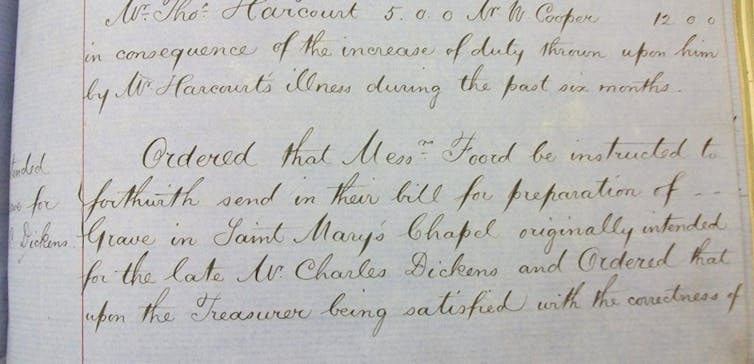
The proposed burial in Rochester Cathedral was not only advanced, but in fact finalised, costed, and invoiced. The Chapter archives demonstrate that a grave was in fact dug in St Mary’s Chapel by the building firm Foord & Sons. The records also show that the Cathedral authorities “believed, as they still believe (after Dickens was buried in the Abbey), that no more fitting or honourable spot for his sepulture could be found than amidst scenes to which he was fondly attached, and amongst those by whom he was personally known as a neighbour and held in such honour”.
Extract from the minute book of the Chapter of Rochester Cathedral, June 23 1870, confirming the payment made to John Foord & Sons for preparing Dickens’s grave in St Mary’s chapel. Medway Archives & Local Studies., Author provided
These views are reinforced by the claims of Hogarth, Dickens’s sister-in-law, in a letter to a friend:
We should have preferred Rochester Cathedral, and it was a great disappointment to the people there that we had to give way to the larger demand.
Let (Dickens) lie in the Abbey. Where Englishmen gather to review the memorials of the great masters and teachers of their nation, the ashes and the name of the greatest instructor of the nineteenth century should not be absent.
Despite this appeal appearing in the press, Stanley’s private journal records that he still “had received no application from any person in authority”, and so “took no steps” to advance his burial plan.
Stanley’s prayers must have seemed answered, then, when Forster and Charley Dickens appeared at the door of the Deanery on that same day. According to the Dean, after they sat down, Forster said to Stanley: “I imagine the article in the ‘Times’ must have been written with your concurrence?” Stanley replied: “No, I had no concern with it, but at the same time I had given it privately to be understood that I would consent to the interment if it was demanded.” By this Stanley meant the letter he had sent to Locker, which the latter had forwarded to Charley. Stanley of course agreed to the request from Dickens’s representatives for burial in Poets’ Corner. What he refrains from saying is how much he personally was looking forward to officiating at an event of such national significance.
While it’s clear, from the private correspondence I have examined, that Stanley agitated for Dickens’s burial in the abbey, the actions of Forster are harder to trace. He left fewer clues about his intentions and he destroyed all of his working notes for his monumental three volume biography of Dickens. These documents included many letters from the author. Forster used Dickens’s correspondence liberally in his account. In fact, the only source we have for most of the letters from Dickens to Forster are the passages that appear in the biography.
But as well as showing how Forster falsely claimed in his biography that the graveyards near his home were “closed”, my research also reveals how he altered the words of Stanley’s (published) funeral sermon to suit his own version of events. Forster quoted Stanley as saying that Dickens’s grave “would thenceforward be a sacred one with both the New World and the Old, as that of the representative of the literature, not of this island only, but of all who speak our English tongue”. This, however, is a mis-quotation of the sermon, in which Stanley actually said:
Many, many are the feet which have trodden and will tread the consecrated ground around that narrow grave; many, many are the hearts which both in the Old and in the New World are drawn towards it, as towards the resting-place of a dear personal friend; many are the flowers that have been strewed, many the tears shed, by the grateful affection of ‘the poor that cried, and the fatherless, and those that had none to help them’.
Stanley worked with Forster to achieve their common aim. In 1872, when Forster sent Stanley a copy of the first volume of his Life of Dickens, the Dean wrote:
You are very good to speak so warmly of any assistance I may have rendered in carrying out your wishes and the desire of the country on the occasion of the funeral. The recollection of it will always be treasured amongst the most interesting of the various experiences which I have traversed in my official life.
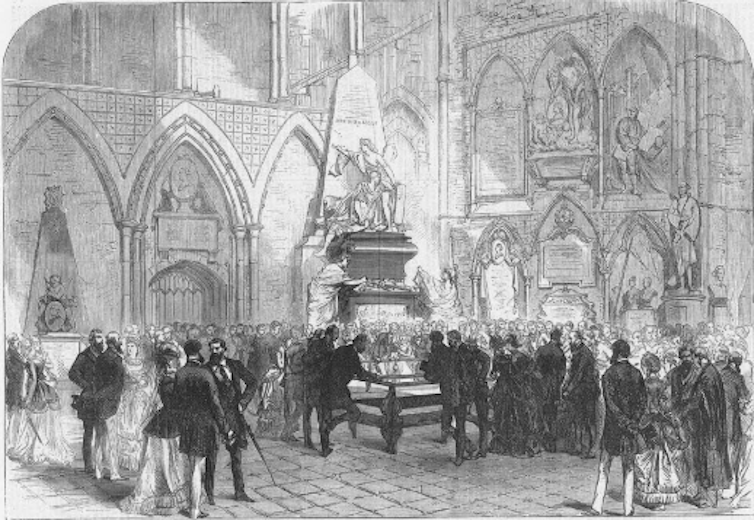
‘The Grave of Charles Dickens in Poets’ Corner, Westminster Abbey Illustrated London News, June 1870. Leon Litvack
For the ages
My research demonstrates that the official, authorised accounts of the lives and deaths of the rich and famous are open to question and forensic investigation – even long after their histories have been written and accepted as canonical. Celebrity is a manufactured commodity, that depends for its effect on the degree to which the fan (which comes from the word “fanatic”) can be manipulated into believing a particular story about the person whom he or she adores.
In the case of Dickens, two people who had intimate involvement in preserving his reputation for posterity were not doing so for altruistic reasons: there was something in it for each of them. Stanley interred the mortal remains of Dickens in the principal shrine of British artistic greatness. This ensured that his tomb became a site of pilgrimage, where the great and the good would come to pay their respects – including the Prince of Wales, who laid a wreath on Dickens’s grave in 2012, to mark the bicentenary of his birth.
Such public commemorations of this Victorian superstar carry special meaning and mystique for his many fans. This year, on February 7 (the anniversary of his birth), Armando Iannucci (director of the new film adaptation The Personal History of David Copperfield) is scheduled give the toast to “the immortal memory” at a special dinner hosted by the Dickens Fellowship – a worldwide association of admirers. The 150th anniversary of his death will be observed at Westminster Abbey on June 8 2020.
Whether it’s the remembrance of the author’s death or his birth, these public acts symbolise how essential Dickens is to Britain’s national culture. None of this would have been possible, however, had it not been for the involvement of Dickens’s best friend and executor, John Forster. Forster organised the private funeral in Westminster Abbey in accordance with Dickens’s wishes, and ensured that his lover Ellen Ternan could discreetly attend, and that his estranged wife would not. But he is also the man who overruled the expectations of the author for a local burial. Instead, through an act of institutionally sanctioned bodysnatching, the grave in Poets’ Corner bound Dickens forever in the public mind with the ideals of national life and art and provided a fitting conclusion to Forster’s carefully considered, strategically constructed biography. It ends with these words:
Facing the grave, and on its left and right, are the monuments of Chaucer, Shakespeare, and Dryden, the three immortals who did most to create and settle the language to which Charles Dickens has given another undying name.
To hear about new Insights articles, join the hundreds of thousands of people who value The Conversation’s evidence-based news. Subscribe to our newsletter.
Do authors really put deeper meaning into poems and stories – or do readers make it up? Jordan, 14, Indianapolis, Indiana
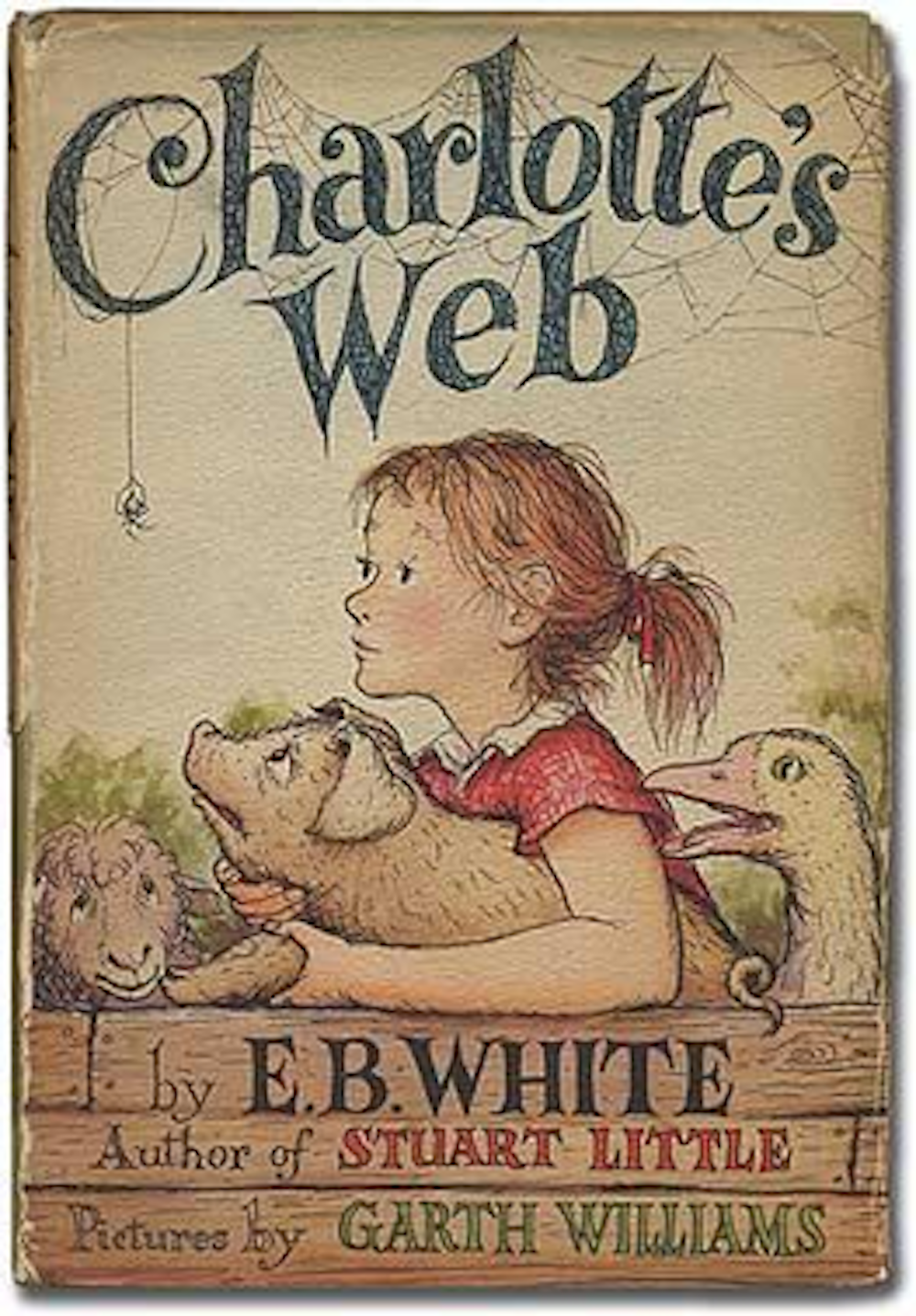
One of my favorite novels is “Charlotte’s Web,” the famous story of a friendship between a pig and a spider.
I often talk about this novel with my students studying children’s literature. At some point, someone always asks about “deeper meaning.” Is it really a story of, say, the cycle of death and rebirth? Or the importance of friendship? Or the significance of writing?
Or is it just a story of life in the barn, with talking animals?
In a way, it doesn’t matter. Because every writer is also a reader, and that means that whatever a writer puts into a story probably came from somewhere else, whether it’s another story, or a poem, or their own life experience.
And readers, too, will bring their own experience – of other stories, other poems and life – and that will direct their interpretation of what they absorb. We can see one example of this if we look at the spider in “Charlotte’s Web.”
The meaning of character
That spider, Charlotte, is based on a real spider. We know this because E.B. White drew pictures of spiders, studied them and made sure to be as accurate as he could when he wrote about them.
But, to a reader she may also represent Arachne, the talented weaver who challenged the goddess Athena and was changed into a spider for her pride. Or she may be the “noiseless patient spider” of Walt Whitman’s poem, who flings out thread-like filaments as the poet flings out words.
She may also be the spider who weaves “the silken tent” of Robert Frost’s poem. Maybe we’ll think about how the spider, like a human storyteller, generates something seemingly out of nothing, which makes her web miraculous.
Each of these spiders symbolizes different things. When we read about her, then, we may think of all those other spiders. Or we may just think about the spider we saw on our own front porch that morning, weaving her own web.
As the writer Philip Pullman said, “The meaning of a story emerges in the meeting between the words on the page and the thoughts in the reader’s mind.”
The reader is in charge
What Pullman is suggesting, then, is that it’s up to readers to make the meaning they want out of the stories they hear and the books they read.
It’s a powerful statement: We are in charge.
This doesn’t mean that anything goes. Meanings come from context, from convention, from older stories and from previous usage. But it’s up to us to interpret what we read and to make the case for how we’re doing it.
Or, as the novelist John Green writes of his books, “They belong to their readers now, which is a great thing – because the books are more powerful in the hands of my readers than they could ever be in my hands.”
What we do with the books we read matters, Green tells us. It’s up to us to make the meaning and up to us to decide what to do with that meaning once we’ve made it.
Hello, curious kids! Do you have a question you’d like an expert to answer? Ask an adult to send your question to CuriousKidsUS@theconversation.com. Please tell us your name, age and the city where you live.
And since curiosity has no age limit – adults, let us know what you’re wondering, too. We won’t be able to answer every question, but we will do our best.























 At the BookShelf


You must be logged in to post a comment.