
Unknown's avatar

Book Review: Killing Calvinism – How to Destroy a Perfectly Good Theology from the Inside, by Greg Dutcher


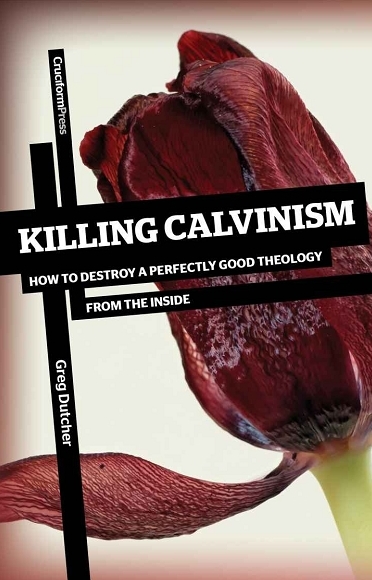
Killing CalvinismI have started reading ‘Killing Calvinism – How to Destroy a Perfectly Good Theology from the Inside,’ by Greg Dutcher. This book was released by Cruciform Press in June 2012, so I have been reading a new book for a change. Generally I read books that were written many years ago, often several centuries ago, so this was a bit unusual for me. It was however the title of the book, along with a review that I had read somewhere, that drew my attention to it and so I decided to buy it at Amazon in Kindle format.

So reading the book I quickly discovered that it was a very easy book to read, even though it dealt with a subject that was indeed crucial, timely and weighty. Calvinism is the behemoth of Christian theology, being a system of truth that epitomises the teaching of Scripture. It has produced great works of theology, some very technical and verbose in nature. Yet here was a book looking at this system of truth that was easy to read and speaking straight to the heart with great warmth and even humour (yes humour).

However, it would be a mistake to think that this book dealt with Calvinism in a detached manner, somehow separated from the adherent to it. Indeed, this book seeks to penetrate the hearts of the adherents of Calvinism and to strike at the heart of the matter. This is not a book that somehow produces a barren formalism, rather it smashes through formalism and seeks the real Calvinism, one that comes from the inner person regenerated by the spirit of God and transforms the lives of those that profess it. It is a living Calvinism that this book seeks and challenges everything else that claims to be Calvinism, but yet has nothing of its soul. This book is a clarion call for a Calvinism that ignited the hearts of a Calvin, of a Spurgeon and of a Bunyan and desires a turning away from all that is not. I love Calvinism – it leads me to God and the way of life he wishes me to lead and live. This book reminds me of this and for that I am thankful to Him for allowing me to read it. It is as Dutcher describes it, the windscreen of truth that allows me to see God and how he wants me to live for Him.

Buy this book at Amazon:
http://www.amazon.com/Killing-Calvinism-Perfectly-Theology-ebook/dp/B0088PBC5G

Unknown's avatar

Free Book: A God Entranced Vision of All Things – The Legacy of Jonathan Edwards


The link below is to a Blog where you can get a free ebook copy of this book, which is edited by John Piper and Justin Taylor. This book examines the character and teaching of Jonathan Edwards, a pastor from the era of the Great Awakening in the USA.

How do you get a copy? Simply leave a request in the comments section of the post linked to below.

If you would like other books visit the Blog, subscribe to it to keep up to date on what books are available and tell your friends about the site.

To Obtain a Copy of the Book, Visit:
http://searchandtrace.wordpress.com/2012/03/29/a-god-entranced-vision-of-all-things-the-legacy-of-jonathan-edwards/

Visit the Blog at:
http://searchandtrace.wordpress.com/


Unknown's avatar

Knowing God: J. I. Packer – Free Audio Book Download


For the month of January 2012, ‘Knowing God (audio book),’ by J. I. Packer is available for free download from christianaudio.com. To take advantage of this great offer visit the link below.

http://christianaudio.com/knowing-god-j-i-packer

Unknown's avatar

This Little Church Went to Market – The Church in the Age of Entertainment, by Gary Gilley


I have decided to start reading this book again. I have mentioned ‘This Little Church Went to Market’ in an earlier post in At the BookShelf and this is linked to below:

https://atthebookshelf.wordpress.com/2010/10/30/this-little-church-went-to-market-by-gary-gilley/

Back in October 2010 when I started to read this book I put it aside for some reason – I may have gone on holiday and forgot about it on my return. Anyhow, I decided to take it up again and then to read the two other books that come after it as per my original post. So that is my plan over the next few weeks and months.

This Little Church Went to Market, by Gary Gilley, was first published in 2002 by Xulon Press (ISBN: 1 5916 0049 9). The edition I have is that published as a paperback by Evangelical Press in 2010 (ISBN: 0-85234-596-8 & ISBN-13 978-085234-596-2). The book was revised and updated in 2006. My edition has 142 pages, so it isn’t a large book by any means.

So about to start reading the book – feel free to read it also and join in the discussion on it.


Book Group

I have added this book to read at the book group at BookClubIt. Please join in the discussion at the book group or add your thoughts here on the Blog.

At the BookShelf (book reading group at BookClubIt):
http://www.bookclubit.com/bookclub.php?id=404


The Book – Get a Copy

At Goodreads:
http://www.goodreads.com/book/show/2275230.This_Little_Church_Went_to_Market

At Shelfari:
http://www.shelfari.com/books/6229162/This-Little-Church-Went-to-Market-The-Church-in-the-Age-of-Enter

Purchase a copy of the book at Amazon:
http://www.amazon.com/This-Little-Church-Went-Market/dp/1591600499
http://www.amazon.com/This-Little-Church-Went-Market/dp/0852345968/

Or Visit:
http://www.monergismbooks.com/This-Little-Church-Went-to-Market-p-16471.html


Note: This is a completely independent review – I have received nothing for it.


Unknown's avatar

A Cartoon History of the George Dubya Bush Years, By Elena Steier


 I have just had a quick look at ‘A Cartoon History of the George Dubya Bush Years,’ by Elena Steier. This book is a collection of cartoons from the George W. Bush years as president of the United States. They are a comical look at those years and I’m sure will produce a laugh or two for some people. I however found little in it that amused me – perhaps because I live in Australia and don’t get all the political jokes based on the US political scene of the George W. Bush years.

I have to say that I found some of the cartoons quite offensive and a good number without anything that made them funny to my way of thinking at all. I quite openly state that I am a Christian and therefore some of the material in these cartoons is particularly shocking and offensive to me.

I have had a good laugh at a good number of the cartoons I have seen of George W. Bush in Australian papers, so I do not base my opinion of this book on my appreciation of George W. Bush as a president or for not being able to have a laugh at politics. I simply did not find this book particularly funny or appealing in any way. In fact, I have rid myself of it completely.

Available at Amazon:
http://www.amazon.com/Fringe-Cartoon-History-George-Dubya/dp/1439211744

There is a copy here:
http://www.scribd.com/doc/23408494/A-Cartoon-History-of-The-George-Dubya-Bush-Administration


Unknown's avatar

This Little Church Went to Market, by Gary Gilley


I have just bought three books by Gary Gilley, two of which I already owned (and had forgotten that I did – probably because of the move, storage and other issues over the last few years). The three books, which I intend to read back to back as it were, are:

  1. This Little Church Went to Market – Is the Modern Church Reaching Out or Selling Out?
  2. This Little Church Stayed Home – A Faithful Church in Deceptive Times, and
  3. This Little Church Had None – A Church in Search of the Truth

As can be seen by the titles of the three books, they all have to do with the modern church and its current state.

So today I start on the first of the three books, ‘This Little Church Went to Market.’

Unknown's avatar

‘Reformers and Their Stepchildren,’ by Leonard Verduin – An Update


As visitors to ‘At the BookShelf’ would know, I have been reading ‘Reformers and Their Stepchildren,’ by Leonard Verduin. I have now started chapter four and progress through the book may appear slow and you may think this is a reflection on the quality of the book. That would be a mistaken assumption however.

In reality I am finding the book a brilliant treatment of the differences between the ‘partial reformers’ (such as Luther, Calvin, Zwingli, etc) and the more ‘radical reformer’ who sought a complete transformation of the church to that which more accurately reflected the New Testament model.

The ‘slowness’ of my reading is more a reflection of my reading half a dozen or so books at the same time. Reading so many books at any given time is fairly normal for me – in fact, I would call normal (for me) reading far more books at any given time, but I am trying to reign myself in a little here. I just love reading – I am a bibliophile and bookworm remember 🙂

The third chapter of Verduin’s work has to do with the lack of true church discipline in the churches of the Reformers and their indifference (generally speaking) to ungodliness in the church (remembering that their churches basically included all in a given location or region).

The third chapter presents a very clear case of the real time contradiction of the Reformers and the reform they were bringing to bear on such places as Geneva, Zurich, etc. To a large extent their work of reform didn’t go anywhere near far enough to satisfy their ‘stepchildren,’ who when they tried to go further were branded as heretics, with their efforts at a more thorough reform being identified by the reformers as evidence of their heresy.

It is a very engaging chapter I believe and one that is helpful for shedding light on Christianity even to this day.

Unknown's avatar

‘The Reformers and Their Stepchildren,’ by Leonard Verduin


I have been reading ‘The Reformers and Their Stepchildren,’ by Leonard Verduin, in the last week or so. It is not the first time that I have read this book, having read it some time ago – probably 10 years ago now I would say.

This is a book that I would recommend to any believer, but particularly to a Reformed believer, whether he be Paedobaptist or Baptist. Verduin seeks to analyse the Reformation and the relationship between the Reformers and their ‘stepchildren’ from a Biblical standpoint, rather than any particular denominational standpoint. Though he does defend the stepchildren, he does so only when they are in line with Scriptural teaching on the point being discussed within that particular chapter.

Who are the stepchildren? The stepchildren or the ‘second front,’ as Verduin also describes them, are those believers who sought a complete reforming of the church. In fact, it may be fair to say that these believers sought a complete break from the Romish church, and a new church built on the teachings of Scripture and modelled on the New Testament church alone.

The frustration for these nonconformist believers was that the reform movement only went so far and did not result in the complete renewal that they desired and that the situation required.

Thus far I have read only the first two chapters of the book and once again I am finding it a very worthwhile read. I find myself in substantial agreement with the position of many of the stepchildren and with Verduin. With as much respect as I have for the Reformers, such as John Calvin, Martin Luther and John Knox, I too would have found myself frustrated at the level of reform achieved by them (though they were better men than I). A complete break and renewal would have been the way forward I believe.

The first two chapters deal with the joint secular-religious church-state that was set up at both the time of Constantine and then at the Reformation in the various Protestant nations that embraced the Reformation. They deal with the all-embracing religion that was constructed in such centres as Geneva and the ‘unified’ approach to it, as well as the reaction of the stepchildren and their withdrawal from it.

This book is as close to a must read for believers as there is I think – especially of the Reformed persuasion.

My copy of the book (paperback) is by William B. Eerdmans Publishing Co. and was printed in 1964.

Unknown's avatar

The History of the English Baptists


from the Reformation to the Beginning of the Reign of King George I, by Thomas Crosby.

I have just started to read the above titled book – well, at least the first volume anyway. This title is made up of four volumes, all of which are over 500 pages in length. I have also started to add the work to my web site at:

 http://particularbaptist.com 

The original work (Volume 1) was first published in 1738 and includes some old English, which in the version I am placing on my web site, I have tried to update without changing the overall sense and flow of the text.

It is generally understood that Crosby deals with a mix of both the Particular Baptists and General Baptists, or if you prefer, the Calvinistic Baptists and the Arminian Baptists.

To follow my progress and to read the book, visit:

http://particularbaptist.com/library/Crossby-Thomas_Vol1_HistoryEnglishBaptists_contents.html