Unknown's avatar

Here’s one to gymnologize over: the case for bringing back snollygostery, trumpery and humbuggery


File 20170605 20608 6fa0bk
The Oxford English Dictionary overflows with words that have been created (most during the 1800s) to tilt at governments of various sorts.
Africa Studio/Shutterstock

Kate Burridge, Monash University

Words and expressions come and go. Sometimes you can understand why they don’t linger. It’s hard to imagine there was ever much call for peristeronic, “suggestive of pigeons” – and there’s no evidence that gymnologize, “to argue whilst naked”, or decacuminated, “having the tops cut off”, have even been used.

Words of such spectacular pomp and pointlessness only ever had lives inside dictionaries (early lexicographers were notorious for making them up).

But sometimes we seem to let extremely useful expressions drop by the wayside. Humans suffer from a kind of congenital leximania, an irresistible passion for creating new words (such as leximania). In our lust for neologisms we lose sight of those expressions already doing a very fine job.

Here is a handful of such words – they have political applications and are today as apt and as ept as they ever were.

Political smutting and besmearing

Now is not the time to let roorback go – a neatly packaged expression that covers any false report, or slander, propagated for political purposes.

It derives from the name of a fictitious author Baron von Roorback. Published in 1844, his account of a gang of slaves destined for the Louisiana sugar mills was intended to disgrace James K. Polk, the Democratic candidate for president of the United States. The humbug was exposed, but usually the timing of roorbacks is such that they can’t be detected before voters go to the polls.

Clearly, spreading disparaging furphies for political gain is not new. The word was popular throughout the 19th century, even used a little into the 20th century, before it quietly shuffled off the lexical coil.

But today’s digital world is providing the perfect ecosystem for the roorback to flourish. A word for “political dirty tricks” – how could we let that one go?

Monumental talknophical assumnacy

Snollygoster is another wonderful creation to come out of the USA (around the same time as roorback). It could refer generally to smart people without principles, but its reference narrowed rather quickly to the crafty and unprincipled politician. The definition provided by the Columbus Dispatch (October 28, 1895) is worth repeating in full:

A snollygoster is a fellow who wants office, regardless of party, platform or principles, and who, whenever he wins, gets there by the sheer force of monumental talknophical assumnacy.

Whenever I ponder the phrase “monumental talknophical assumnancy”, I’m reminded of Alice’s words on hearing the poem Jabberwocky: “Somehow it seems to fill my head with ideas – only I don’t exactly know what they are.” Talknophical assumnancy – there’s a lot of it about.

The delightful name snollygoster conceals its nasty origins. The word is probably connected to snallygaster, a reshaping of Pennsylvania German schnelle Geister (“quick spirits”) – dragon-like creatures which, as folklore describes, made a practice of stealing children and chickens from unsuspecting farm folk.

The shift from “grotesque gargantua” to “political shyster” is telling. But it’ll take more than a hex sign on a building or rabbit’s-foot talisman to keep these modern-day snollygosters at bay.

A flourishing of ocracies

The Oxford English Dictionary overflows with words that have been created (most during the 1800s) to tilt at governments of various sorts. One stands out and that is kakistocracy, the creation of English writer Thomas Love Peacock for “government by its most unprincipled citizens” (from Greek kakistos “the worst”). In fact little needs to be done to rehabilitate his word.

Its comeback of late has been spectacular, with headlines heralding a new era of kakistocratical rule.

So will we be seeing a reappearance of other “ocracies”? Foolocracy and kleptocracy spring to mind.

Trumpery and puffery

Though strictly not a political term, the old word trumpery has always had close links with political shenanigans, even before it acquired its extra significance today.

The word appeared in English in the 1400s, meaning “deception; fraud”. It derives from the verb trump “to deceive; cheat” – not to be confused with the other trump verb around at that time meaning “to blow a trumpet” or “break wind audibly” (though it seems to me these trumps have always been tightly linked).

Trumpery then shifted to mean “something of less value than it seems” before extending to “something of no value at all” (applied to abstract things, objects and people).

Of course, trumpery has deception at its root, but the -ery ending adds that extra layer of unscrupulousness (bringing to mind trickery, humbuggery, jiggery-pokery and a pile of other seedy “ery” words).

And while there is the other positive trump (that appears in expressions like turn up trumps), it’s worth highlighting that this trump is nothing more than a corrupted form of triumph (an alternative pronunciation that appeared in the 1500s).

The two trumps are currently on a collision course, and we know from experience that rarely do positive meanings prevail when senses coincide in this way. Besides, there’s always been a dishonest whiff around even the trump card in its extended uses — and, as the behaviour of words over time shows, dishonest whiffs will just get whiffier.

The ConversationTrumpery, kakistocracy, snollygoster and roorback are words worthy of a phoenix-like re-application — let’s pick them up, dust them off and put them to work.

Kate Burridge, Professor of Linguistics, Monash University

This article was originally published on The Conversation. Read the original article.

Unknown's avatar

Kindle Notes and Highlights Update


The link below is to an article that takes a look at the latest update for kindle Notes and Highlights.

For more visit:
https://the-digital-reader.com/2017/06/06/amazon-gave-notes-highlights-new-home-web/

Unknown's avatar

Used Books?


The link below is to an article that takes a look at what to do with used books.

For more visit:
http://bookriot.com/2017/06/06/what-to-do-with-used-books/

Unknown's avatar

Time for a ‘digital’ reality check on Fairfax and The New York Times


Merja Myllylahti

I think it’s time to take a reality check on the state of news publishers digital transformation. While digital revenue streams may be delivering, there’s still a strong reliance on print for revenue and research shows readers engage more with print.

Media economist Robert G. Picard. summarises well the key problem with digital transformation. He notes that as news publishers focus on growing digital revenue, they forget their customers and their needs.

He notes that while journalism institutions have embraced the challenge of monetising digital media and increase revenue, this “institutionally focused strategy is designed to serve institutional interests not improve its offerings”.

In fact, newspapers keep offering the wrong things to their audiences. In Picard’s words, they sell readers horses when they actually prefer sports cars.

I think his words also apply accurately to Fairfax Media. Its digital strategy is focused on increasing shareholder revenue, and has very little to do with its journalism or journalistic offerings.

My recent research focused on the digital strategies of Fairfax Media and The New York Times Co. While the two “journalism institutions” pursue different digital strategies, the outcomes for two newsrooms are somewhat different. The New York Times strategy is based on digital-only subscriptions, whereas Fairfax is betting on its digital property listing service (Domain).

The main difference between the two is that while The New York Times continues to invest in its newsrooms and expand internationally (it has journalists filing stories from over 150 countries), Fairfax continues to chop newsroom jobs. It’s currently planning to cut 25% its newsroom staff from its Australian flagship papers to save $A30 million.

Digital is growing, but so what?

In 2016 major newspapers in the United States saw strong growth in digital subscriptions: The New York Times recorded a 47% rise and The Wall Street Journal 23% growth, according to the recently published State of the News Media report by Pew Research Center.

However, the report also notes that “these gains did not translate into circulation growth for the industry overall” and the combined digital and print circulation of newspapers fell 8% – “marking the 28th consecutive year of declines”. Digital advertising revenue also declined, but the proportion of digital advertising revenue of total revenue grew to 29%, because print advertising income continued to decline.

Fairfax, currently in the midst of a bidding war among private equity firms, is still driven by digital revenue from Domain. But the management of the company changed its tune in February, in terms of its print strategy.

Fairfax CEO Greg Hywood explained “while we have considered many options, the model we have developed involves continuing to print our publications daily for some years yet”, adding that “this is the best commercial outcome for shareholders based on current advertising and subscription trends”.

In May, media industry commentator Mark Westfield said that Hellman & Friedman, which is bidding for Fairfax’s media assets, “wouldn’t be interested in buying [Fairfax] unless they saw the assets of The Age, Sydney Morning Herald and Australian Financial Review and Domain as good assets to maintain”.

The sale or closure of newspapers wouldn’t make sense as Fairfax is still print reliant in terms of its revenue, and the same applies to The New York Times. My research shows in 2016 Fairfax print still delivered 78.6% of revenue, while digital was only 21.4% of its total revenue. Digital advertising made 18.5% of the total revenue, and digital subscriptions 2.86% of total.

I also found in a six-year period from 2011 to 2016, digital revenue of Fairfax grew 69% and at the same time print & other revenue declined 31.5%.

In comparison, in a five-year period from 2012 to 2016 (when figures were available) The New York Times digital revenue grew 32% – more slowly than Fairfax’s, but its print revenue dropped less than Fairfax’s – 11.5%. In 2016, digital made 27.8% of its total revenue and print 72.2%. The New York Times also continues to be print reliant in terms of its revenue.

Recent studies by media scholars Neil Thurman and Iris Chyi & Ori Tenenboim suggest that print continues to be strong in terms of readership. A study of 11 British newspapers by Thurman shows that the readers spent more time with print newspapers than with the online edition.

In their study, Chyi and Teneboim found that the “(supposedly dying) print product still reaches far more readers than the (supposedly promising) digital product in these newspapers’ home markets”.

The ConversationIn the light of this, it can be argued that digital transformation is continuing, but being fully reliant on digital readers may be a myth – as academic Vincent Mosco puts it: “a captivating fiction, a promise unfulfilled and perhaps unfulfillable.”

Merja Myllylahti, Project manager and author for Journalism, Media and Democracy (JMAD) Research Center

This article was originally published on The Conversation. Read the original article.

Unknown's avatar

The best way to support writers is to feed them new ideas


File 20170531 25664 i4krd4
Writing has never been easy, but sending writers out to find new ideas and people might be one way to help.
Shutterstock.com

Julian Novitz, Swinburne University of Technology

Books and writing seem to be as popular as ever, but writers are having a hard time making a living from their work. While writers may have always struggled, a number of recent ideas have been put forward suggesting ways to help them out.

Writing in Meanjin, Frank Moorhouse proposed, among other measures, renewable ten-year “national contracts” for mid-to-late career writers. And in the Sydney Review of Books, Ben Eltham describes an initiative that he is working on that would aim to provide literary fellowships for fixed periods of three to four years.

Both writers make the valid point that, as fewer successful writers are able to sustain themselves via book sales and royalties, the role of public support becomes more important. They both argue for the need to radically expand the range of fellowships available to writers.

While more secure fellowships are certainly welcome ideas, there are other ways to support writing that address the current economics. So in the spirit of keeping the conversation going, here are a few thoughts.

The value of books

Moorhouse and Eltham both seem to be arguing for fellowships that might provide the long-term security that many working writers currently lack. This suggests a fundamental shift in the purpose of this kind of writing support.

Individual grants and fellowships have typically been provided as a short-term investment in a writer or author, with a duration ranging from a few months to a year. They are there, ideally, to encourage new projects and innovation – offering opportunities for a concentrated period of work, for research, for travel. The University of Melbourne Asialink arts residencies program is a strong example of this. It offers support to a range of Australian writers and artists to live and pursue creative projects in Asia for six weeks to three months.

Longer-term fellowships would certainly have many benefits for established writers. They help compensate them for cultural labour that is not always adequately rewarded in the literary marketplace. As Moorhouse observes, the value of a book often goes beyond its cover price. Books are read and reread, loaned to family members and friends, speculated upon and debated. They inspire insights, arguments and critical and creative forms of engagement. Singular sales and royalty payments cannot reflect this hidden or social value of a book.

However, the criteria that Moorhouse proposes for his ten-year contracts – multiple publications, international distribution, being the subject of academic research – could cluster a lot of funding around a small number of conventionally successful authors.

A particular kind of writing?

In his article, Eltham suggests that a lack of individual fellowships has contributed to the rising importance of literary prizes in Australia. According to Eltham, prizes have become “the closest thing to a fellowship most Australian writers can aspire to”. In the same vein as Ivor Indyk’s 2015 Sydney Review of Books article, he argues that “‘prize literature’ is now a discernible genre of its own, taken to represent a certain form of middlebrow that is accessible, appealing and safe.” The implication is that the exclusive pursuit of prizes results in stylistically homogenous literary fiction, and that more individual grants and fellowships would provide writers with more freedom to experiment and take risks.

However, shifting a writer’s focus from winning a literary prize to appeasing a grant committee or funding body will not necessarily result in more adventurous fiction. Writing in 1971 about the Commonwealth Literary Fund (which subsidised Australian writers from 1908 to 1973), Maurice Dunlevy reflected on the value of literary fellowships, observing that “the fund has yet to aid the birth of a genius” or even a “classic Australian novel”.

He went on to claim that “the overwhelming number of fellowships have been awarded to well-known mediocrities who have produced mediocre work.” I won’t pretend to know exactly how fair Dunlevy is being to the fellowship writers of this period. But his critique can easily be compared to some of the contemporary objections to Australian prize culture.

There are a number of questions any new fellowships would need to answer. What kinds of literary work and lives would they encourage writers to work towards? What kinds of writing would be eligible for this kind of support? Would it favour the writer who produces a steady output of moderately successful publications over a powerful single work? Or the traditional print-based author over a writer creating innovative material for digital platforms?

Meeting the world

I don’t want to argue against more fellowships for writers (especially since, given the state of arts funding, this would likely be an argument over imaginary money). But we should question whether fellowships of the length that Moorhouse and Eltham are proposing are sustainable or even desirable.

In his 1991 lecture, On Writing, the Canadian author Robertson Davies expressed some of his reservations about the culture of writing grants, noting that even as they seem to offer freedom for writers they also potentially isolate them. Davies argues that, for a writer, a job isn’t just a distraction from the serious business of their craft. It is also a valuable opportunity to “meet the world” in their own particular way, and to find a daily task that keeps them from “writing too much” to the point where “their talent has become diseased, hypertrophied because of the continual gross and indecent solicitation of the imagination”.

I can’t pretend to share Davies’s distain for writing grants, having been the grateful beneficiary of a couple myself. But I think that there is a spleeny contrarian wisdom to his critique that is worth considering.

Relatively few successful authors throughout history have lived professional lives that were focused solely on writing. For many, the kind of subsidy that Eltham and Moorhouse have proposed might not be particularly useful. Being able to focus solely on writing for three, four or ten years might offer some incredible benefits, but it also presents the possibility of isolation, insularity, and a continued dependence on this kind of funding that might be detrimental for a writer’s work in the long run. As Davies writes: “Nothing – including grants – is for nothing”. The kind of freedom they offer always comes at a cost.

The ConversationOn balance, individual funding might be more suited to providing opportunities for travel (like the brilliantly conceived Antarctic Arts Fellowship), cultural exchange, or residencies. These require engagement with the life and rhythms of unfamiliar institutions, offering both emerging and established writers new ways of meeting the world.

Julian Novitz, Lecturer, Writing, School of Media and Communication, Swinburne University of Technology

This article was originally published on The Conversation. Read the original article.

Unknown's avatar

In defence of grammar pedantry


File 20170601 25658 d7aakj
It’s really ok to be a grammar pedant.
Shutterstock

Roslyn Petelin, The University of Queensland

This week, the financial press reported the downfall of a high-profile grammar pedant, Professor Paul Romer, the World Bank’s chief economist, who was hoist(ed) on his own pedantic petard.

He is being replaced as head of the bank’s research arm after he demanded that his colleagues write succinct, clear, direct emails, presentations and reports in the active voice with a low proportion of “and’s”. Romer will remain the bank’s chief economist.

In fact, he had threatened not to publish the bank’s central publication, World Development Report, “if the frequency of ‘and’ exceeded 2.6 per cent”. He had also cancelled a regular publication that he believed had no clear purpose.

Why, you may ask, did the economists who work in the World Bank’s research department take exception to these strictures? Who wouldn’t want the corporate report that was a flagship publication of the bank to be narrow and “penetrate deeply like a knife”? Romer’s 600 colleagues, that’s who. But why?

It seems that, while he was encouraging his staff to avoid their customary convoluted “bankspeak” and consider their readers, he failed to follow his own advice. He was apparently curt, abrasive and combative. The troops refused to fall into line and he was ousted.

Such a shame, Professor Romer, because we need more pruning of the muddy prose that is endemic in so many institutions, particularly banks. We can only imagine how Australia’s four big banks are readying themselves to obfuscate their documents in response to the recent budget measures.

The various shades of pedantry

There are two kinds of people in this world: pedants and everybody else. Pedantry isn’t confined to grammar, of course. Pedantry can be found in architecture, cooking (for example, Julian Barnes’s lovely little book The Pedant in the Kitchen), geometry, music, philosophy, politics and science. Think Sheldon Cooper in The Big Bang Theory, the most popular show on American television.

Romer’s case, however, highlights the key dilemma of grammar pedants: how do you handle your pedantry so that you don’t lose your job? It depends on what kind of pedant you are.

Do you practise your pedantry privately by just “thinking” corrections at other people when they write “bunker” instead of “hunker” down? Or do you practise your pedantry publicly and thereby subject yourself to taunts of “peevish prescriptivist”, “nit-picking, hair-splitting pedant”, or the more arcane and colourful “pettifogging pedant”?

This sort of abuse rained on Bryan Henderson, the American software engineer who had removed 47,000 instances of “comprised of” from Wikipedia by the end of 2015.

BBC journalist Jeremy Paxman was quoted in The Guardian in 2014 as saying:

People who care about grammar are regularly characterised as pedants. I say that those who don’t care about it shouldn’t be surprised if we pay no attention to anything they say — if indeed they are aware of what they’re trying to say.

Pedants anonymous

I am a fervent believer that grammar provides writers with analytical tools to choose and combine words felicitously into English sentences to a set of professional standards that serve utilitarian needs and provide intellectual pleasure.

However, aware from long experience that it’s rare to be thanked for pointing out a solecism that has made me wince, I attempt to shield the newly minted graduates of my grammar course at The University of Queensland from the potential consequences of sharing their knowledge with those less grammatically alert. To this end, I lead a discussion about their stance on grammar in the final class of the semester.

To counter the negative connotations evoked by the term “grammar pedant” and to celebrate their pleasure in language, they invent playful monikers such as “grammartiste”, “grammagician”, “grammardian angel”, “grammar groover”, “grammartuoso” and “grammasseur”.

Anne Curzan, a grammar maven who contributes to the Lingua Franca blog on The Chronicle of Higher Education, favours “grammando”; I prefer the much less warlike “grammond” (modelled on gourmand, “one who has a refined palate for grammar and savours it at its best”).

That “linguifier” Stephen Fry begs us to abandon our pedantry, but he confines his admonition to non-professional contexts and admits: “It’s hard not to wince when someone aspirates the word ‘aitch’ and uses the genteelism of yourself and myself instead of you and me.”

Fry says that “context, convention and circumstance are all”. And this is what Professor Romer forgot. What we need to abandon is not pedantry. After all, its etymological origins are in teaching.

It is peevish, condescending and competitive pedantry that is the culprit. We could take a lesson from the Bristol engineer who has for 13 years used his specially designed long-handled apostrophiser and step-ladder to remove aberrant apostrophes and plant missing ones on buildings in Bristol and managed to remain anonymous.

The wonderful parodist Craig Brown’s solution may be an even better choice:

It’s always pleasant to go carol-singing, or carols-singing, with the Pedants’ Association, formerly the Pedants Association, originally the Pedant’s Association. I first joined ten years ago with the long-term aim of attracting the requisite number of votes in order to change its title to The Association of Pedants, thus rendering the apostrophe redundant.

The ConversationI’ll leave the uses and abuses of “and” aside for another day.

Roslyn Petelin, Associate Professor in Writing, The University of Queensland

This article was originally published on The Conversation. Read the original article.

Unknown's avatar

7 Reasons to Love Reading


The link below is to an article that looks at 7 reasons to love reading.

For more visit:
http://www.omnivoracious.com/2017/05/7-reasons-to-love-reading-from-abebooks.html

Unknown's avatar

Reading classic novels in an era of climate change


File 20170420 2392 1k8dc3k
Smoke rises over the city of Manchester in William Wyld’s painting Manchester from Kersal Moor.
(1852).
Wikimedia commons

Philip Steer, Massey University

There is a strange and troubled kind of intimacy between our own moment of climate change and 19th century Britain. It was there that a global, fossil fuel economy first took shape, through its coal-powered factories, railways, and steamships, which drove the emergence of modern consumer capitalism. The Conversation

What might we now find if we look again at the literature of the 19th century? Although Victorian writers lacked our understanding of a warming planet, we can learn from their deep awareness of the rapid and far-reaching ways that their society was changing. In their hands, the novel became a powerful tool for thinking about the interconnections between individuals, society, economics, and the natural world.

North and South

One place to start thinking about such things might be Elizabeth Gaskell’s North and South (1855), a classic example of the “industrial novel” genre that flourished in the middle decades of that century.

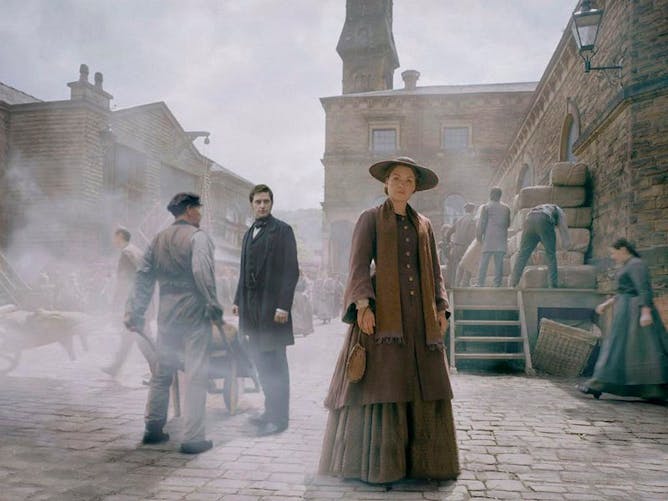
Most of the novel’s events take place in the industrial town of Milton-Northern (Manchester), the epicentre of Victorian coal-fired industrial production. Our protagonist, Margaret Hale, is forced to relocate there due to family circumstances, and her first numb impressions are that the environment, the economy, and the city’s urban geography have all been transformed by fossil fuel consumption:

For several miles before they reached Milton, they saw a deep lead-coloured cloud hanging over the horizon in the direction in which it lay … Nearer to the town, the air had a faint taste and smell of smoke; perhaps, after all more a loss of the fragrance of grass and herbage than any positive taste or smell. Quick they were whirled over long, straight, hopeless streets of regularly-built houses, all small and of brick.

Milton is covered in a thick layer of pollution as a result of the town’s industrialisation, as depicted in the BBC mini-series North and South (2004), which starred Daniela Denby-Ashe as Margaret.
British Broadcasting Corporation

Gaskell brings her refined but impoverished heroine into contact with a forceful cotton-mill owner, John Thornton — imagine if Pride and Prejudice were set in a factory. Their love plot offers a symbolic means of restoring harmony to a nation disrupted by the new economy, as Margaret softens the edges of Thornton’s laissez faire practices and brings about improved relations with his workers. As he admits to one of his acquaintances, near the end of the novel,

My only wish is to have the opportunity of cultivating some intercourse with the hands beyond the mere ‘cash nexus’.

Thinking about this resolution in light of the fossil fuel economy, however, what comes into focus is how vulnerable this harmonious social vision is to wider social and environmental forces. By the novel’s conclusion, the global market — the source of raw materials, investors, and customers — proves to be so powerful and destabilising that the harmony of Thornton’s factory can provide only temporary solace at best, and he is bankrupted:

Meanwhile, at Milton the chimneys smoked, the ceaseless roar and mighty beat, and dizzying whirl of machinery, struggled and strove perpetually… . Few came to buy, and those who did were looked at suspiciously by the sellers; for credit was insecure… . [F]rom the immense speculations that had come to light in making a bad end in America, and yet nearer home, it was known that some Milton houses of business must suffer[.]

Looking back at North and South now, we can see how interconnected its vision of a fossil-fuelled society and the economy is, and how artificial the borders of the nation prove to be when faced with the instabilities that it causes.

The Time Machine

Australian author James Bradley suggests that writers today, grappling with how to represent climate change, have found genres such as science fiction more suited to the task than classic realism.

“In a way this is unsurprising,” he comments, because of those genres’ interest in “estrangement” from everyday circumstances, and their fascination with “experiences that exceed human scales of being.”

The last decades of the Victorian era were, like now, a stunning time of generic innovation, and prominent amongst those late-century innovations were the “scientific romances” of H. G. Wells.

The Time Machine’s bleak view of humanity’s future (seen here in the 1960 film adaptation) is a chilling one.
George Pal Productions

In The Time Machine (1895) Wells found a narrative device that would allow him to think about social and environmental change over enormous spans of history. Near the end of the novel, the inventor of the machine undertakes a voyage to the very end of the planet’s history:

I looked about me to see if any traces of animal life remained… . I saw nothing moving, in earth or sky or sea. The green slime on the rocks alone testified that life was not extinct… .
From the edge of the sea came a ripple and a whisper. Beyond these lifeless sounds the world was silent. Silent? It would be hard to convey the stillness of it. All the sounds of man, the stir that makes the background of our lives — all that was over.

In imagining this bleak beach, Wells is taking up contemporary predictions that the law of entropy meant the inevitable “heat death” of the universe. Global cooling rather than global warming, then, but one thing that resonates now is how the novel views humanity as a species — and a finite one, at that — rather than from a more limited individual or even national perspective.

The Victorians were the first to stare into the abyss of geological deep time, and to confront the idea of natural history as a succession of mass extinctions.

As a result, Wells raises the idea of a future where even technology cannot overcome calamitous natural processes, and dares to imagine a planet without a human presence.

Tess of the D’Urbervilles

The novelist Amitav Ghosh has recently described a “broader imaginative and cultural failure that lies at the heart of the climate crisis,” arguing that the characteristics of the realist novel have made it resistant to representing those environmental and social complexities. Does the realist novel really have nothing to offer and nothing to say in an era of climate change?

The melting icebergs of Breidamerkurjokull’s Vatnajokull glacier in Iceland: is there a role for the realist novel in an era of climate change?
Ints Kalnins/Reuters

One place to look for an answer is another famously bleak Victorian text, Thomas Hardy’s Tess of the D’Urbervilles (1891). The plot is set in motion with Tess’s father’s discovery that his family name, Durbeyfield, is a corruption of D’Urberville, and they are in fact descended from an ancient family that once dominated the area. When they are ultimately thrown out of their home, the Durbeyfields end up seeking refuge at a church, amongst the graves of their ancestors:

They were canopied, altar-shaped, and plain; their carvings being defaced and broken; their brasses torn from the matrices, the rivet-holes remaining like marten-holes in a sand-cliff. Of all the reminders that she had ever received that her people were socially extinct there was none so forcible as this spoliation.

A bit like our own era of increasingly constrained resources, Tess inhabits an exhausted present, and she moves amidst the ruins left by previous generations who have consumed the material wealth that once made life abundant.

Hardy is also deeply attuned to the ecological damage produced by increasingly industrialised forms of agriculture. Late in the novel, when Tess is abandoned by her lover, Angel Clare, she is forced to accept work on the vast and stony fields of Flintcomb-Ash farm.

She labours through a brutal winter, and endures the relentless demands imposed by a steam-powered threshing machine — “a portable repository of force” — that reduces the workers to automatons. Around the same time, Angel abandons England for Brazil, only to find that English bodies do not translate to tropical ecosystems:

He would see mothers from English farms trudging along with their infants in their arms, when the child would be stricken with fever and would die; the mother would pause to dig a hole in the loose earth with her bare hands, would bury the babe therein with the same natural grave-tools, shed one tear, and again trudge on.

Gemma Arterton as Tess in the 2008 mini series adaptation. Stuck on a farm, Tess seesk to make ethical choices despite overwhelming constraints in Hardy’s novel.
British Broadcasting Corporation

Both Tess and Angel — and the anonymous, sundered colonial families — seem to be climate refugees of a kind, caught between hostile climates and the environmental wreckage wrought by agribusiness.

What little Tess of the D’Urbervilles offers in the face of all this bleakness also centres on Tess. For one thing, she doesn’t just think of herself as an isolated individual, but sees herself as part of larger social and ecological collectives — her family, her fellow milkmaids, even the rural landscape.

She persists in her determination to care for those around her — including, most challengingly, the son she gives birth to after her rape — despite the weight of the moral and economic systems that bear down upon her. After her father refuses to let the parson visit, Tess chooses to baptise her dying son herself — naming him Sorrow — and then secures him a Christian burial:

In spite of the untoward surroundings … Tess bravely made a little cross of two laths and a piece of string, and having bound it with flowers, she stuck it up at the head of the grave one evening … putting at the foot also a bunch of the same flowers in a little jar of water to keep them alive.

Tess refuses to abandon her project of care despite its futility, persisting with her fidelity in the midst of catastrophe.

Literature in itself isn’t going to save us from global warming — if salvation is even possible, at this point — but then neither, on their own, will economics or science. But if Amitav Ghosh is right, and climate change has revealed an imaginative paralysis in western culture, one thing that the Victorian novel offers us is a means of thinking and feeling about our own moment anew.

The Sydney Writers Festival will host a session on the rise and rise of Cli-Fi featuring James Bradley, Sally Abbott, Hannah Donnelly and Ashley Hay on Friday May 26.

Philip Steer, Senior Lecturer in English, Massey University

This article was originally published on The Conversation. Read the original article.

Unknown's avatar

Australian copyright laws have questionable benefits


Beth Webster, Swinburne University of Technology and Mitchell Adams, Swinburne University of Technology

As the Australian Copyright Agency comes under pressure for appearing to use member royalties to enshrine self-serving copyright laws, it’s time to question the purpose of copyright. Some argue current laws ensure artists are fairly paid and make more local content. The evidence doesn’t support this idea. The Conversation

Copyright is primarily concerned with creative works.

Exploitation of copyright occurs when the author of a creative work excludes all others from reproducing or otherwise using their work for up to 70 years after their death, unless they, the authors, agree to authorise any such use (i.e. pay a fee or a royalty under voluntary or compulsory licences).

On the pro-copyright side, we have the global movie and music industry, many IP lawyers and prominent authors.

Opposing copyright, we have academics, economists and other public policy analysts.

Does copyright encourage more creative work?

The intention of copyright laws is to encourage people to create cultural products such as books, songs, movies and fine art etc. The argument goes that if the authors of these works (or their owners) can charge royalties to those who enjoy these works, then more people will decide to work as authors.

The author gets an income and can therefore spend more time creating works.

However, there are strong arguments that copyright may have gone too far. Royalties only go to a small amount of people, and they mostly prop up the incomes of “rent seekers”. Rent seeking is when income from copyright just makes existing creators wealthier and does not encourage more people to become creators.

The contra-copyright group see some advantage from copyright lasting a few decades, but not the current system, which grants copyright for life plus 70 years after death (there are some exceptions).

Royalties should not be paid beyond the point at which the income stream has an effect on decisions to create more now. Existing copyright laws (which can give control for over 100 years) are merely lining the pockets of movie houses and the heirs of dead authors, without having any effect on the current group of artists.

Australian culture will falter without copyright

The next argument in favour of copyright is that the true value of copyright is the ability for the owner to control the use of their work through licensing.

Given the ubiquity of the internet, it is now very easy to copy works and local authors will not be able to make a living from their work.

Hence, any time or effort they put into creations will be in their spare time after working elsewhere. Enabling authors to receive some royalties goes some way towards providing them with independent income.

But the contra-copyright group say the fact that most royalties go to very few authors, or go overseas to the big music and movies houses and publishers, means copyright does little for emerging and local artists.

In fact, the best way to encourage the local cultural sector might be to offer stipends or grants directly to local artists.

It is not to use copyright to overcharge the ordinary householder; prosecute those who illegally download movies; or to waste the time of students and school teachers filling in royalty forms.

A right to control your creation?

Another pro-copyright argument is that copyright is needed to ensure authors are credited for, and control, their work. This is also known as “moral rights”, and creates the obligation to attribute creators and treat their work with respect.

But we could question whether this is the role of copyright. Gifting moral rights does not necessarily mean the artist should be able to decide who can read or watch his or her work for the purpose of genuine enjoyment.

Authors should be paid for their contribution to society

The pro-copyright group claim that royalties are justified on fairness grounds. People should be rewarded according to their contribution to society and as royalties are linked to use (reading or watching), it is a clever way to link contributions.

However, in terms of value to society, a case can be made that primary school teachers, civil engineers or surgeons should be paid more. And as copyright only delivers a living wage to very few artists, we can question whether the current laws are a fair system.

Fair use

The Productivity Commission recently agreed with the Australian government to reform the education statutory licensing scheme, but commented that this decision was missing a recommendation to move to a “fair use” system of copyright exceptions.

Fair use allows for certain circumstances where people can use copyrighted material without the copyright holder’s permission.

Australia does not have a fair use exception. It only has a more limited “fair dealing” exception which means we can only avoid permission for uses that are on a list.

A fair use system would allow users such as schools and universities to use works in some situations without paying any royalties. Maybe, we should limit copyright to 20 years and increase our stipends to local artists instead.

Beth Webster, Director, Centre for Transformative Innovation, Swinburne University of Technology and Mitchell Adams, Research Fellow in Intellectual Property Law, Swinburne University of Technology

This article was originally published on The Conversation. Read the original article.

Unknown's avatar

Dangerous: Reading in Bed!!!


The link below is to an article that will alert you to the dangers of reading in bed.

For more visit:
https://www.theatlantic.com/technology/archive/2017/05/reading-in-bed/527388/