Unknown's avatar

Friday essay: the feminist picture book revolution


File 20170516 7001 1q1tim0
Sarah and Olive Kanake read one of the new breed of girl-power picture books.
Miriam Ackroyd from Life is Beautiful Photography

Sarah Kanake, University of the Sunshine Coast

A year and a half ago I gave birth to my first child. A girl named Olive. I’m a writer and a writing teacher so, naturally, our friends and family gave us books. The Conversation

One after another, we unwrapped picture books and added them to the slightly tattered collection salvaged from our own childhoods. In the early weeks of Olive’s life, I spent a lot of time looking through those pages and thinking about how I wanted to raise her and what ethics I felt strongly about passing on to her. Maybe because I was already asking myself these questions, I noticed something in those books.

Very few featured strong, empowering girl leads.

The same thing was noticed by the authors of a new book called Good Night Stories for Rebel Girls (2017) and captured in an accompanying video that has since gone viral.

The video opens with a mother and daughter in a bookshop. Together they remove books from the shelf based on their representation of female characters. First, they remove the books with “zero male characters”. (Three). Then, they remove the books with “zero female characters”. (Seventy six).

Then, they remove the books where “females don’t speak” (One hundred and forty one).

Next they ask, do these characters have dreams or aspirations? They remove all the books where female characters are waiting for a prince. No number is provided for these. No number is needed. The shelf that was still pretty full is now virtually empty.

The video ends with the young girl turning to a bookseller off camera and asking,

I’m interested in Mars … do you have any books about that?

Princesses and rebels

I’m a feminist. I’m not what I’d call an anti-princess feminist. I see no reason to pit myself against the princess as a person. Princess is, after all, a job like King or Prime Minister. I know there are feminist representations of princess characters in books for children (I discuss a few below) but overall, I, like many feminists, object to the princess as a fictional construct.

Why?

Because the princess common to children’s literature is virtually always seen through the lens of her desirability, her romantic contribution and subsequent morality. She works best when she makes the prince his best possible self. When she fixes him. Over time, this princess may grow, new stuff gets added in and old sexist stuff gets carted out, but she’s still locked to her male counterpart. She’s defined by her “love” story. This construction is used as a way to package girlhood (and womanhood too), and in that packaging, the princess creates limits for real girls.

But girls are interested in Mars. Where are the books on Mars?

Halfway through the Rebel Girls video we are introduced to the authors of Good-Night Stories for Rebel Girls, co-founders of Timbuktu Labs, Elena Favilli and Francesca Cavallo. They say they wrote the book as a response to bedtime stories where the female characters had no agency. Its 100 stories are about real women who did extraordinary things.

There aren’t any pretty pink princesses in this book, but queens are represented. We read about Nefertiti, Hatshepsut, Yaa Asaantewaa, and Elizabeth I. Inventors, olympians, activists, artists, spies, surgeons, scientists. There are women you would expect to see: Frida Khalo, Jane Goodall, Maya Angelou, and Rosa Parks.

There are women I’d never heard of like the Irish “pirate queen” Grace O’Malley, the Nobel Peace Prize winner Wangari Maathai and the 19th Century physician and feminist Mary Edwards Walker. There are also contemporary girls and women like gymnast Simone Biles, sailor Jessica Watson and dancer Misty Copeland.
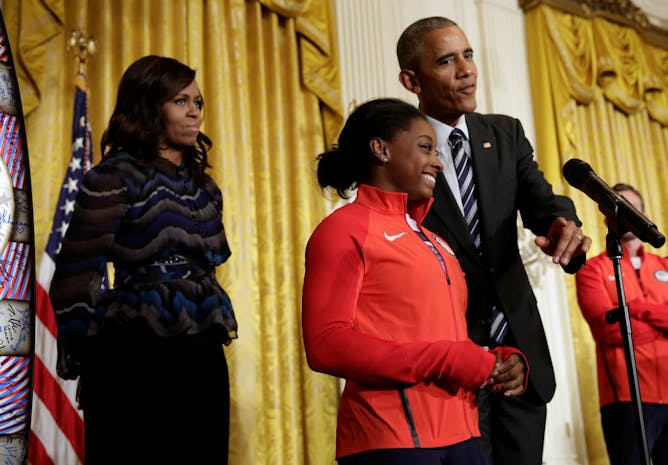
Simone Biles with the Obamas at the White House last year: she features in Good-Night Stories for Rebel Girls.
Yuri Gripas/Reuters

There are a few women missing. I wanted to see feminist Gloria Steinem or former President of Indonesia, Megawati Sukarnoputri. I’d have liked an Australian woman included, like former Prime Minster, Julia Gillard, feminist writer Germaine Greer or author Miles Franklin.

But there’s still time and, no doubt, another edition on the horizon.

As a first step, Good Night Stories for Rebel Girls accomplishes what it sets out to do. It takes the frame of the bedtime princess story and populates it with champions, thinkers, artists and activists, but as a social artefact, the book represents so much more. It was funded through Kickstarter to the tune of one million dollars, breaking Kickstarter’s record. Favilli and Cavallo originally set out to raise $400,000 to print 100 books but interest soon swelled.

Since Olive was born, I’ve spent countless hours scouring feminist picture book lists online, stalking A Mighty Girl and Amy Poehler’s Smart Girls on Facebook for book recommendations, asking friends, booksellers, googling, and, overall, I’ve been pleasantly surprised by the number and quality of newish picture books out there for the budding feminist.

Here are some of my favourites…

Feminist princess picture books

I worked as a bookseller for almost 20 years and if there was one thing I heard daily from mothers, it was that they wanted something other than passive Disney princesses to give their daughters. In Don’t Kiss the Frog (2013) by Fiona Waters, Rapunzel would really like to cut off her locks and dye what’s left blue. In The Princess and the Peas (2013) by Caryl Hart and Sarah Warburton, “princess” is a phase, a disease. Ordinary girl, Lily-Rose will not eat her peas and so is diagnosed with “Princess-itus”. She gets sent to a castle where she trains and works – day in and day out – at being a princess.

Meanwhile, in Ian Falconer’s Olivia and the Fairy Princesses (2012), the fashionable, eccentric, Chanelesque Olivia questions what a princess actually is and why she’s always dressed in pink, tiaras and fairy wings. Olivia also confronts the “whiteness” of this aesthetic by dressing in princess costumes from around the world and asking why the default for princess isn’t one from India, or China. In the end, Olivia decides she doesn’t want to be a princess. She’ll be a queen instead.

Lots of other girls in contemporary picture books come to a similar conclusion as Olivia. Some don’t even see the argument as relevant, or part of the story. These girls are often inventors or scientists.

Feminist science and inventor picture books

The original Rosie the Riveter.

Leading the charge here are Rosie Revere Engineer (2013) and Ada Twist, Scientist (2016) by Andrea Beaty (illustrated by David Roberts). In Beaty and Roberts’s series, Rosie Revere is an aspiring inventor and niece of the real Rosie the Riveter. Her classmate, Ada Twist, is a gifted if somewhat mess-making scientist. Another notable book in this category is The Magnificent Thing (2014) by Ashley Spires.

These books position science and inventing as central to the story. The lesson of Rosie Revere Engineer is not that girls should invent, but that you should never let mistakes or failures keep you from inventing. The lesson of Ada Twist, Scientist is not that girls should be scientists, but that parents should accept their children for who they are, no matter how messy it is.

These books don’t argue that girls should be inventors and scientists: they suppose they already are.

Feminist activist picture books

The next category arming young girls with heroes are stories (mostly non-fiction) about activist girls, such as the unstoppable Malala Yousafzai. There’s Malala: Activist for Girls’ Education (2017) by Raphaele Frier and illustrated by Aurelia Fronty, Malala Yousafzai: Warrior of Words (2014) by Karen Leggett Abouraya, illustrated by L.C Wheatley, and a bunch of others detailing her extraordinary story.

Malala Yousafzai, Nobel Peace Prize laureate, meeting Canadian president Justin Trudeau last month. Her story has inspired many books.
Chris Wattie/Reuters

Books about broader activism (such as conservation, segregation, the right to vote) featuring girls or women include One Plastic Bag; Isatou Ceesay and the Recycling Women of Gambia (2015) by Miranda Paul and illustrated by Elizabeth Zunin and The Youngest Marcher; The Story of Audrey Faye Hendricks, a Young Civil Rights Activist (2017).

Feminist political picture books

There is power in the political picture book to reveal the marginalised stories of women in politics, but only space in this article to mention a few. So I’ll start (of course) with Hillary (2016) by Jonah Winter, a biography of Hillary Rodham Clinton. Winter has had a number of political picture books published, including one about the work of Gertrude Stein and Alice B. Toklas, and Hillary’s daughter Chelsea Clinton has also written a picture book called She Persisted. According to a recent tweet from Clinton, it is about “women who didn’t take no for an answer”.
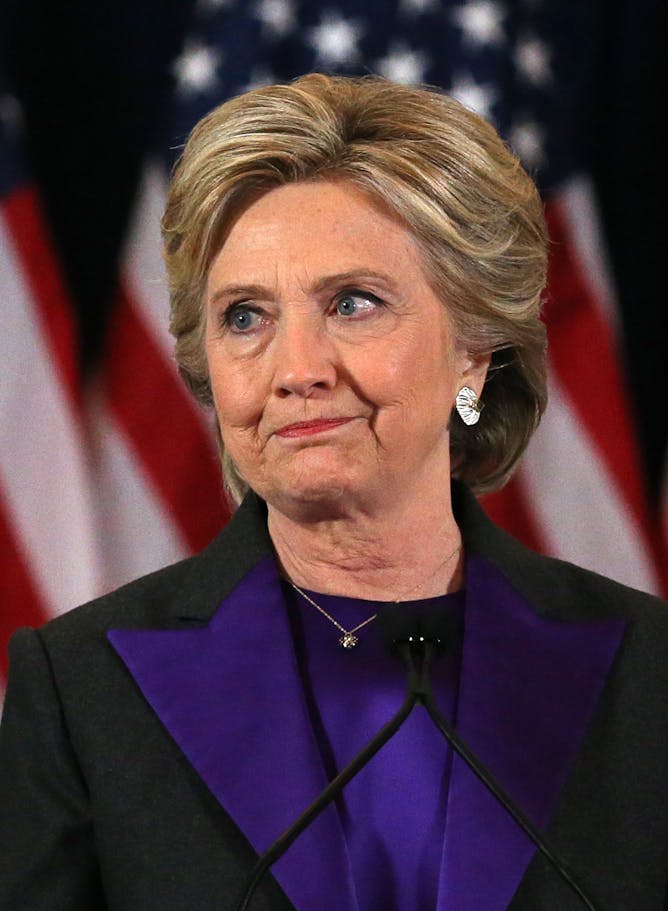
Hillary Clinton.
Carlos Barria/Reuters

My favourite in this category is, I Dissent: Ruth Bader Ginsburg Makes her Mark (2016) by Debbie Levy and illustrated by Elizabeth Baddeley. I Dissent uses the Notorious RBG to introduce ideas around working mothers, persistence, shared domestic responsibilities and stay-at-home dads. The book explores the language of dissent while showing the (completely lovable) liberal US Supreme Court justice in her real life, thereby positing the girl with a voice as something special, but nonetheless natural.

We can’t talk about political picture books without also mentioning Madam President (2008) by Lane Smith. This book follows a little girl (in a flared pantsuit!) as she imagines how she would preside over her country and develops the qualities she will need for the job. Qualities like calmness and wisdom, diplomacy and humility.

Feminist non-fiction/history/biography books

One of my favourite picture books in this category is Amazing Babes (2013) by Eliza Sarlos, illustrated by Grace Lee. Each page introduces us to a famous woman from history with a line such as, “I want the vision of Miles Franklin” or the “compassion and commitment of Mama Shirl”. It also includes unusual women such as fashion blogger, Tavi Gevinson.
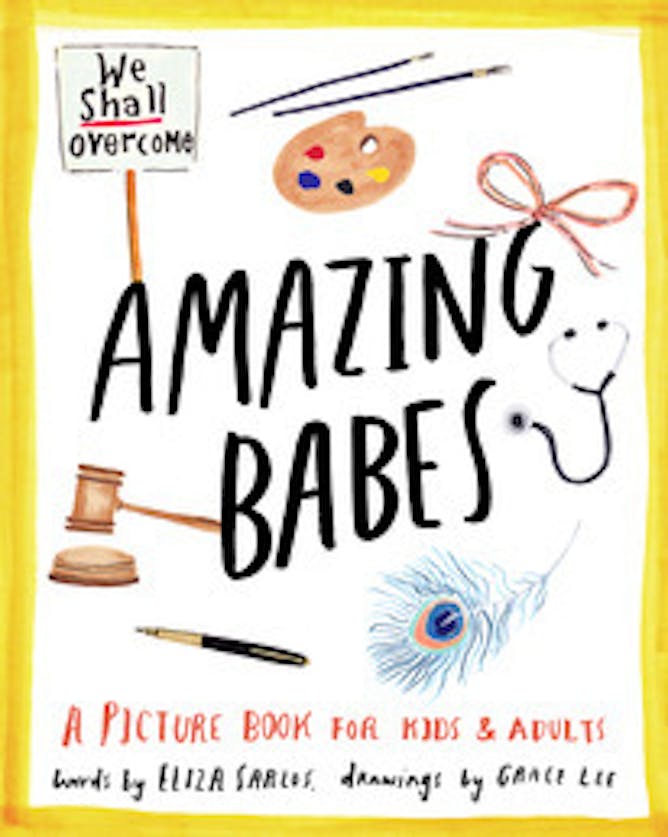
If you want to know more about any of the women in the book you can look them up in the index pages (Hedy Lamarr, I discovered, was an inventor!) This book speaks to a long history of women, and its framing device allows for a clear and deep reading of why each woman is important, and what modern girls can take from their lives. It only has one line per page/per illustration and uses repetition throughout, so it’s great for younger readers.

Another recent series Little People, Big Dreams, brings together a writer and illustrator to tell the story of a famous woman. There are six books in the collection – about Frida Kahlo, Marie Curie, Coco Chanel, Agatha Christie, Maya Angelou, and Amelia Earhart – with three more to be published later this year.

A few months ago, meanwhile, I stumbled across a list that introduced me to a treasure trove of recent biography picture books that amplified, uncovered or exposed the stories of women whose work had changed the world.

These include books about scientists like, Ada’s Ideas: The Story of Ada Lovelace, the World’s First Computer Programmer (2016) by Fiona Robinson, Swimming with Sharks: The Daring Discoveries of Eugenie Clarke (2016) by Heather Lang, illustrated by Jordi Solano and Rachel Carson and Her Book That Changed the World (2014) by Laurie Lawlor, illustrated by Laura Beingessnerr. There are also several great collection books for older readers, such as Women in Science: 50 Fearless Pioneers Who Changed the World (2016) by Rachel Ignotofsky, and Fantastically Great Women who Changed the World (2016) by Kate Pankhurst, a descendant of suffragette Emmeline Pankhurst.

How does Australia fare?

Australia doesn’t have the same number of overt feminist picture books as, say, the US but that doesn’t mean we don’t have empowering books for girls, about girl characters.

My favourite 2017 CBCA shortlisted book The Patchwork Bike (2016) by Maxine Beneba Clarke and illustrated by Van T. Rudd is a glorious picture book about a girl (and some other kids) living on the edge of the no-go desert. Together the kids build a bike from scraps, while Clarke and Rudd build a story about freedom and creativity and inventiveness.

Another favourite of mine is Molly and Mae (2016) by Freya Blackwood and Danny Parker. This is a story about two very different little girls who meet, become friends, and fall out during a long train ride. It’s a sincere and very realistic look at the often complex relationships and power dynamics between girls, set against a magnificent (moving) Australian backdrop.

My absolutely favourite girl picture book hero is Aaron Blabey’s Sunday Chutney. Stylish, outgoing, funny, resilient and creative, Sunday sometimes feels out of place, and struggles when she has to move and go to a new school. But Sunday has a powerful weapon in her confidence and wry sense of humour.

Finding your own rebel girl

Good Night Stories for Rebel Girls is not just a book. It’s a protest. We wanted it, we funded it, we saw the gap and refused to leave it alone. But the best part of the book, and what really sets it apart from the others I have mentioned, is the last two pages before the acknowledgements. One says “Write Your Story”, the other, “Draw Your Portrait”.

The book invites girls to write themselves into history. To be visible. To be seen. To have their wisdom heard.

I look forward to reading the story my daughter will write in this book one day, and seeing how she will represent herself. I won’t know what kind of rebel Olive will want to be for a few years yet, but until that day I’ll read her these stories, and urge every mother to do the same.

Sleep well, girls.

Sarah Kanake, Lecturer in Creative Writing, University of the Sunshine Coast

This article was originally published on The Conversation. Read the original article.

Unknown's avatar

Scrounging for money: how the world’s great writers made a living


File 20170516 11929 95xr0i
William Faulkner’s typewriter in Mississippi. The writing life may sound idyllic, but it was often a furious battle to make ends meet.
Visit Mississippi/Flickr, CC BY-SA

Camilla Nelson, University of Notre Dame Australia

It’s a lean time for writers, as arts funding shrinks on all sides, journalists are laid off in droves, broadcasting budgets are slashed, and book publishing remains in a state of seemingly unceasing upheaval. The Conversation

It often seems as if the age of living by the pen may be brought to a close by an increasingly rapacious approach to human affairs, interested only in hard numbers and bottom lines. Australian writers Frank Moorhouse and Ben Eltham have recently proposed several schemes to give writers a living wage to support their work.

And so it’s timely to reflect on some of the strange, desperate and occasionally dangerous ways in which writers have historically lived, if not always by their pens, then at least on their wits. Here’s twelve ways in which classics of western literature were written.

1) Advertising

Unlike other activities, advertising continues to pay very well (though many writers fear they may be required to sell their soul).

English crime writer Dorothy Sayers had a top floor office at Benson’s advertising, where she invented the Mustard Club, a fictional mustard-loving entity with half a million real life subscribers in the UK, and also devised “Just think what Toucan do” for Guinness.

Dorothy Sayers, apart from her contribution to crime fiction, gave the world Guinness’ toucan campaign.
Ben Sutherland/Flickr, CC BY

Peter Carey devised roof-tiling company Monier’s well-known jingle, “Top Cat in Roof Tiles”. Salman Rushdie spent many happy years at Ogilvy & Mather where he came up with “Look into the Mirror tomorrow – you’ll like what you see” for the Daily Mirror. Don Delillo was also employed at Ogilvy & Mather’s New York office, but doesn’t talk about it much.

Even F. Scott Fitzgerald did time at Barron Collier’s. Not only did he give us The Great Gatsby, he also produced – for the Muscatine Steam laundry in Muscatine, Iowa – “We keep you clean in Muscatine”.

2) Postal clerks

The postal service has provided a safe haven for many a writer. Anthony Trollope wrote his novels for three hours every morning before going off to his day job at the post office, which he kept for 33 years. Charles Bukowski also worked for the postal service, and kept his job for ten years. (His first novel was called Post Office and its protagonist was a postal clerk.)

William Faulkner was also a postmaster in Mississippi, but rather less good at holding his job. His resignation letter famously read,

As long as I live under the capitalistic system, I expect to have my life influenced by the demands of moneyed people. But I will be damned if I propose to be at the beck and call of every itinerant scoundrel who has two cents to invest in a postage stamp.

Faulkner went on to work as a night manager in a power plant where he penned As I Lay Dying in six or eight weeks, writing between the hours of midnight and 4 am.

3) Janitors and pest exterminators

Kesey’s One Flew Over the Cuckoo’s Nest was inspired by CIA-backed mind control experiments.

Ken Kesey was a night cleaner in a mental hospital. He also volunteered to be an experimental guinea pig in a CIA-backed mind control study conducted under the auspices of a front organisation at the Menlo Park facility. This experience gave us One Flew Over the Cuckoo’s Nest.

Stephen King also did time as a janitor in a high school. William S. Burroughs worked as a pest exterminator in Chicago. Jack Kerouac’s resume includes stints as a cotton picker, a dishwasher, a night guard, and gas station attendant.

4) Music transcription

Desperate writers, it seems, will do just about anything. Rousseau, with his books banned, and patrons running scared, transcribed an estimated 9,000 pages of music at six sols per page between 1770 and his death in 1778.

5) Poaching

Jack London, oyster pirate, 1914.

Jack London was famously an oyster poacher, though he preferred to call himself an “oyster pirate”. There’s also an apocryphal tale that Shakespeare was forced to flee Stratford when he was nabbed for poaching deer on the nearby Lucy estate, leading to a life-long feud with the local lord.

There’s no doubt that Shakespeare was adept at turning a guinea where he could. The Earl of Rutland paid no less than four pounds and eight shillings to Shakespeare and his lead actor Richard Burbage (who also moonlighted as a painter) to create a shield and write a motto so that Rutland could appear well dressed at a tournament.

Shakespeare sent his money home to his very clever wife in Stratford, who slowly bought up lots of farmland and cornered much of the local grain trade.

6) Academic

Many writers teach, but few do it for a career. David Lodge was Professor of English, back in the day when academics didn’t worry too much about things like Excellence in Research evaluation, or applying for research council grants. JRR Tolkien was Professor of Anglo Saxon at Oxford, producing definitive editions of Sir Gawain and the Green Knight and the Beowulf as well as his novels.

Robert Frost taught at Amherst and Vladimir Nabokov was Professor of Russian Literature at Cornell. But not everybody agreed this was a good idea. When Nabokov was up for a chair in literature at Harvard, the distinguished linguist Roman Jakobson protested, “What’s next? Shall we appoint elephants to teach zoology?”

7) Butterfly curator

Nabokov’s first job on arrival in the United States was as the curator of Lepidoptera at the Museum of Comparative Zoology, Harvard. He stayed there for six years.

Butterflies collected by Vladimir Nabakov.

8) Propagandist

It’s surprising how many writers have ended up on the murky side of politics. John Buchan, perhaps most famously, earned 1,000 pounds a year as the Director of the Ministry of Information, closely aligned to the War Propaganda Bureau where H.G. Wells, Arthur Conan Doyle, J.B. Priestly, and Ford Maddox Ford penned paid and unpaid articles, pamphlets and leaflets including Doyle’s To Arms! (1914) and Ford’s When Blood is Their Argument (1915). Arnold Bennett was head of British propaganda in France. Wells became Head of Enemy Propaganda until a strange series of events led to his spectacular resignation.

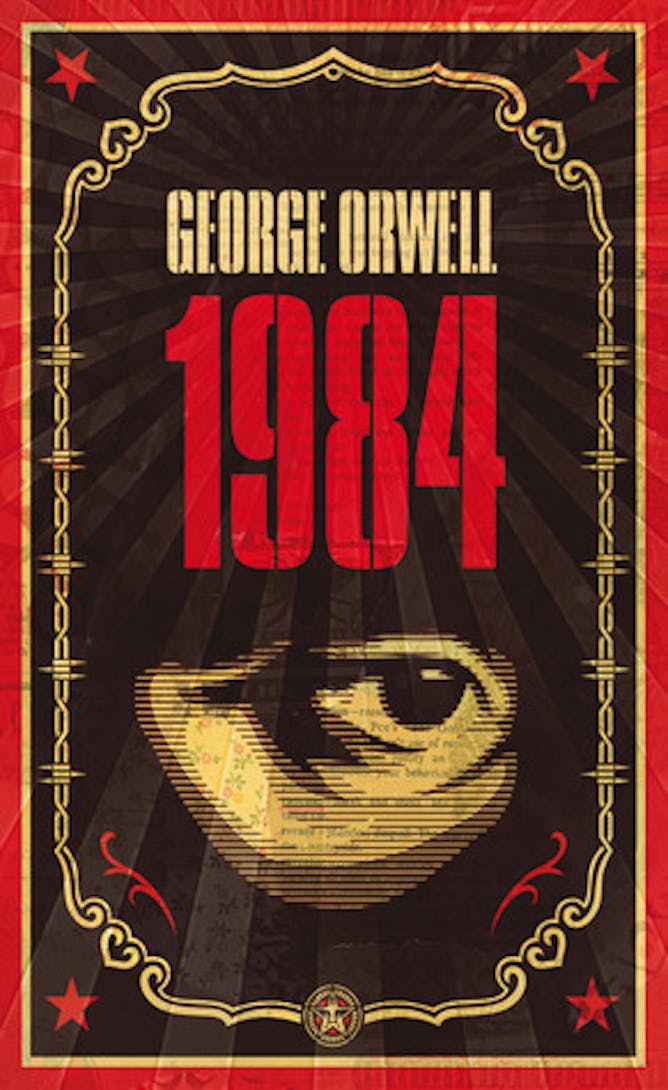
Orwell’s 1984 was inspired by his work as a propagandist.
Goodreads

George Orwell, who spent much of his life scraping money from wherever he could, was employed in the service of the Imperial Police in Burma, an institution he despised. On returning to London, he worked as a paid propagandist at the BBC, broadcasting to India. It was the psychic pain of the arch enemy of mindless patriotism serving as a wartime propagandist that gave us 1984.

9) Doctors, lawyers and clergymen

Some writers have known from the start that there are better ways to make a living. Henry Fielding was a Magistrate, but by “refusing to take a shilling from a man who would undoubtedly not have had another one left” halved his portion of what he called “the dirtiest money on earth”.

Jonathan Swift was the vicar of Laracor – his congregation of just 15 leaving him plenty of time to write, which he did, for the most part, in the glittering clubs of London.

Anton Chekov, Somerset Maugham and Williams Carlos Williams were doctors. So too was Arthur Conan Doyle. Doyle set up a not very successful medical practice in Portsmouth and famously penned A Study in Scarlet during the interminable wait times between patients. He later set up an ophthalmologist in Upper Wimpole St, London, but claims that he never secured so much as a single patient.

10) Cinema impressario

James Joyce scraped a living by teaching English in Trieste, while dreaming up wild moneymaking schemes. With the help of Italian friends he opened the Cinematograph Volta in Dublin, on Mary St, but couldn’t stick to it for more than seven months. He then planned to import Irish tweed to Trieste.

Ulysses would never have been written without the support of feminist publisher Harriet Shaw Weaver, who, in February 1917, shortly after she published Portrait of the Artist as a Young Man in book form, gave Joyce an income of £200 a year to support his work. Later Weaver created a trust fund, the interest from which gave Joyce an income for life.

11) Airline ticketing clerk

Harper Lee worked as a reservation clerk for Eastern Air Lines and BOAC for more than eight years. This only changed in in 1956, when the Broadway composer Michael Brown and his wife Joy gave Lee a Christmas gift with a card that said, “You have one year off from your job to write whatever you please.” Lee produced the first draft of To Kill a Mockingbird within 12 months.

Harper Lee being presented with a medal of freedom by President George W Bush in 2007.

12) Patronage

It’s hard to believe, but writers made nothing from their books until the invention of copyright in the 18th century. Instead, they relied on wealthy patrons to make a living.

This uneasy relationship led a frustrated Samuel Johnson to insert in 1755 a double-edged definition in his Dictionary. After the words, “Patron: One who countenances, supports and protects,” he added, “Commonly a wretch who supports with insolence and is paid with flattery.”

Shakespeare is said to have received an astonishing £1,000 for his flowery dedications to the Earl of Southampton (though it was more probably a still wildly generous £100). Hence he wrote, “The love I dedicate to your lordship is without end; whereof this pamphlet, without beginning, is but a superfluous moiety.”

But choosing a patron could be dangerous. The Earl of Southampton was later imprisoned by Queen Elizabeth I for his role in the Earl of Essex’s 1601 rebellion against the queen. Southampton had organised a special performance of Richard II. While there is no evidence Shakespeare was directly punished, he had good reason to be worried, with other writers tortured and even murdered in Elizabethan England.

Living by the pen

Of course, the preferred method of earning an income for writers has inevitably been journalism. Once patronage was replaced by the rise of the commercial press, writers were able to turn to the business of writing about real people. Samuel Richardson was a printer. Samuel Taylor Coleridge edited The Watchman and The Friend. Charles Dickens was a parliamentary reporter and then editor and publisher of Household Words.

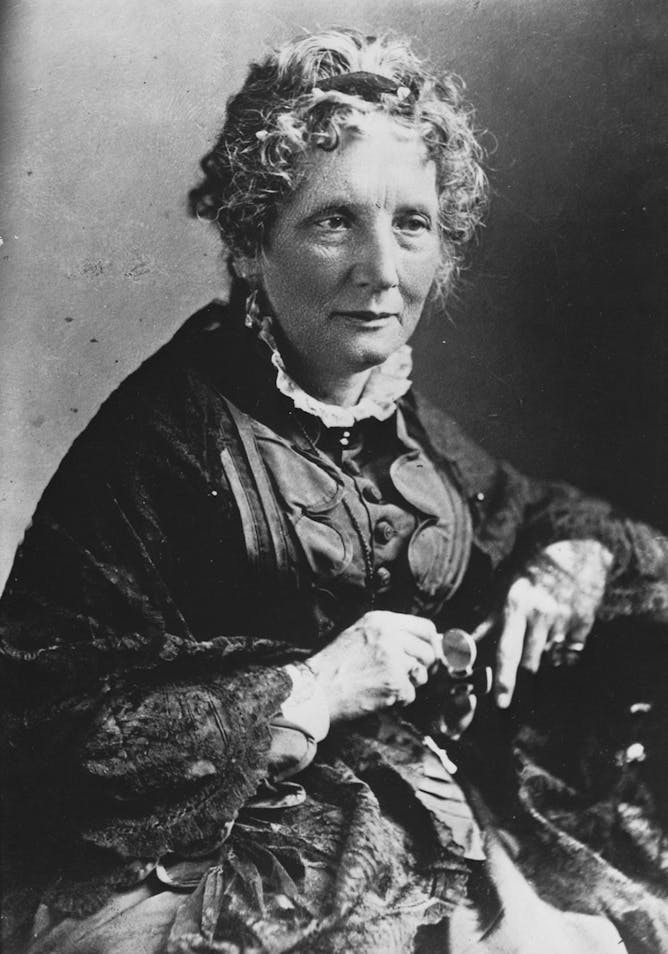
Harriet Beecher Stowe’s work as a journalist allowed her to write, and support her entire family.

Indeed, writing for periodicals was what allowed many women in the 19th century to secure an independent income. Jane Austen calculated that the life-long return on her novels was a mere 84 pounds and 13 shillings (works that made millions in the centuries that followed).

But Harriet Beecher Stowe was able to become the sole income earner for her family, penning not just Uncle Tom’s Cabin, but periodicals, gift books, textbooks and popular annuals. Margaret Fuller became the first female editor of the New York Tribune, and their first female foreign correspondent covering the Italian revolutions.

Today, the problem is that not only writers but also perhaps journalists could use an arts council grant.

Camilla Nelson, Associate Professor of Writing, University of Notre Dame Australia

This article was originally published on The Conversation. Read the original article.

Unknown's avatar

Reading Good for Mental Health


The link below is to an article that looks at reading and mental health.

For more visit:
http://bookriot.com/2017/05/16/reading-is-good-for-your-mental-health-heres-why/

Unknown's avatar

Audio Book Growth


The link below is to an article that takes a look at why audio book sales are soaring.

For more visit:
http://www.digitalbookworld.com/2017/9-reasons-audiobook-growth-is-soaring/

Unknown's avatar

Ebook Sales Down


The link below is to an article that takes a look at the latest sales figures for ebooks.

For more visit:
https://www-latimes-com.cdn.ampproject.org/c/www.latimes.com/business/hiltzik/la-fi-hiltzik-ebooks-20170501-story,amp.html

Unknown's avatar

Livrada Closes


The link below is to an article that looks at the closure of ebook gift card business ‘Livrada.’

For more visit:
https://the-digital-reader.com/2017/05/11/ebook-startup-livrada-shut/

Unknown's avatar

Explainer: how the brain changes when we learn to read


File 20170509 11008 n9tvg0
Learning to read is not actually that easy.
from shutterstock.com

Nicola Bell, The University of Queensland

Right now, you are reading these words without much thought or conscious effort. In lightning-fast bursts, your eyes are darting from left to right across your screen, somehow making meaning from what would otherwise be a series of black squiggles. The Conversation

Reading for you is not just easy – it’s automatic. Looking at a word and not reading it is almost impossible, because the cogs of written language processing are set in motion as soon as skilled readers see print.

And yet, as tempting as it is to think of reading as hard-wired into us, don’t be fooled. Learning to read is not easy. It’s not even natural.

The first examples of written language date back to about 5,000 years ago, which is a small fraction of the 60,000 years or more that humans have spent using spoken language.

This means our species hasn’t had enough time to evolve brain networks that predispose us to learn literacy. It is only through years of practice and instruction that we have forged those connections for ourselves.

How the brain learns to read

Brains are constantly reorganising themselves. Any time we learn a new skill, connections between neurons that allow us to perform that skill become stronger. This flexibility is heightened during childhood, which is why so much learning gets crammed in before adolescence.

As a child becomes literate, there is no “reading centre” that magically materialises in the brain. Instead, a network of connections develops to link existing areas that weren’t previously linked. Reading becomes a way of accessing language by sight, which means it builds on architecture that is already used for recognising visual patterns and understanding spoken language.

Words and letters are initailly stored in the brain as symbols.
from http://www.shutterstock.com

The journey of a word

When a skilled reader encounters a printed word, that information travels from their eyes to their occipital lobe (at the back of the brain), where it is processed like any other visual stimulus.

From there, it travels to the left fusiform gyrus, otherwise known as the brain’s “letterbox”. This is where the black squiggles are recognised as letters in a word. The letterbox is a special stopover on the word’s journey because it only develops as the result of learning to read. It doesn’t exist in very young children or illiterate adults, and it’s activated less in people with dyslexia, who have a biological difference in the way their brains process written text.

Words and letters are stored in the letterbox – not as individually memorised shapes or patterns, but as symbols. This is why a skilled reader can recognise a word quickly, regardless of font, cAsE, or typeface.

Information then travels from the letterbox to the frontal and temporal lobes of the brain, to work out word meaning and pronunciation. These same areas are activated when we hear a word, so they are specialised for language, rather than just reading and writing.

Because information can travel so quickly across the skilled reader’s synaptic highways, the entire journey takes less than half a second.

But what happens in the brain of a five-year-old child, whose highways are still under construction?

Learning to read takes a lot of effort.
from http://www.shutterstock.com

The growing brain

For young children, the process of getting from print to meaning is slow and effortful. This is partly because beginning readers have not yet built up a store of familiar words that they can recognise by sight, so they must instead “sound out” each letter or letter sequence.

Every time children practise decoding words, they forge new connections between the visual and spoken language areas of the brain, gradually adding new letters and words to the brain’s all-important letterbox.

Remember, when a practised reader recognises a word by sight, they process the letters in that word, rather than its shape.

Literacy instruction can therefore support children’s learning by highlighting the symbolic nature of letters – in other words, by drawing attention to the relationships between letters and speech sounds.

Here, evidence from brain imaging research and educational research converge to show that early phonics instruction can help construct an efficient reading network in the brain.

What might the future hold for literacy development?

As technology evolves, so too must our definition of what it means to be “literate”. Young brains now need to adapt not only to written language, but also to the fast-paced media through which written language is presented.

Only time will tell how this affects the development of that mysterious beige sponge between our ears.

Nicola Bell, PhD student, The University of Queensland

This article was originally published on The Conversation. Read the original article.
Unknown's avatar

New Europe Ebook Rules


The link below is to an article that takes a look at new rules in Europe for ebooks.

For more visit:
http://www.publishersweekly.com/pw/by-topic/industry-news/bookselling/article/73535-european-commission-s-new-e-book-rules-worry-booksellers.html

Unknown's avatar

Has the print book trumped digital? Beware of glib conclusions


File 20170508 20745 141cpks
What will an eBook be 20 years from now? What will a book be?
Voyagerix/shutterstock

Nick Earls, The University of Queensland

While just a few years ago, headlines predicted eBook supremacy and the demise of the paper book, that’s now reversed. They’re now saying the Kindle is clunky and unhip and paper books are cool and selling well as eBook sales crash. But are today’s claims any more accurate than those of 2012? The Conversation

The latest round of headlines was triggered by UK Publishers’ Association figures noting a fall in consumer eBook sales of 17% in 2016, while physical book sales rose 8%. This statistic seems straightforward enough on the surface, but it pays to go deeper.

Mainstream media have long been in the habit of relying on figures from publishers’ associations, retailers’ groups and Nielsen data, but the industry has changed. While these measures are accurate, they are only accurate in terms of what they measure, and they represent far less of the industry than they once did. They are no longer a proxy for the industry.

A recent history of eBooks

Amazon’s Kindle was launched in November 2007. Barnes & Noble followed with their Nook in October 2009 and Kobo with their eReader in May 2010. Apple’s launch of the iPad in January 2010, meanwhile, introduced a non-specialist device that gave a pleasing eReading experience. US eBook sales rose 1260% between 2008 and 2010. By early 2011, US advisory group Gartner reported that industry researchers were predicting a 70% annual growth rate for eReader sales globally.

In February that year, the REDgroup, the parent company of Angus&Robertson and Borders in Australia – chains responsible for 20% of the country’s book sales – went into receivership. Retailers across the industry in Australia were noticing a downturn. After 5% growth in 2009, Australian book sales contracted slightly in 2010, then dramatically in 2011, with falls of 13% in volume and 18% in value, and significant falls continuing into 2012.

In January 2011, Amazon announced that, for the first time, it was selling more eBooks than paperbacks. According to Nielsen figures, US eBook sales went from US$69m in 2010 to US$165m in 2011, a 139% increase. They increased a further 30% in 2012 and 13% in 2013.

Nielsen figures, though, only record sales of books with ISBNs, something many independently published eBooks do not have. Despite not counting many eBooks, Nielsen still recorded sales as increasing, albeit probably at diminishing growth rates each year.

In January 2011, Amazon announced that, for the first time, it was selling more eBooks than paperbacks.
Artem Evdokimov/shutterstock

With increases in both average smartphone screen size and smartphone use, the 2014 to 2015 period marked another shift – the phone was becoming a significant reading tool. According to US Nielsen surveys, while the percentage of the eReading population reading primarily on tablets had increased from 30% in 2012 to 41% in 2015, the number of eBook buyers who used their phones to read at least some of the time increased from 24% to 54% in the same period.

Judith Curr, publisher of Atria Books, stated in 2015 that,
“The future of digital reading is on the phone. It’s going to be on the phone and it’s going to be on paper”.

Peak eBook?

EBook sales in the US, though, appeared to plateau at 2013 levels, according to Association of American Publishers figures, and then dipped early in 2015. In the UK, the Publishers’ Association reported digital sales for the year 2015 falling slightly and print sales growing minimally. “Readers take a pleasure in a physical book that does not translate well on to digital,” the Publishers’ Association stated, and declarations of “peak eBook” became commonplace. Those figures, though, do not tell the whole story.

As Simon Jenkins admitted in The Guardian last year when declaring that peak digital was at hand, the adult colouring book fad made a contribution to print sales in 2015. Unlike fiction blockbusters, sales of colouring books are almost entirely in print format.

In the case of the UK market, the £20.3 million generated by adult colouring books in 2015 matched the growth in the overall print market. Without it, the pattern of zero or negative growth seen in the preceding seven years would have continued. In the US, Nielsen reported that sales of adult colouring books surged from one million units in 2014 to 12 million in 2015. Australia was also part of the adult-colouring craze. Nielsen BookScan’s November 2015 Australian top 20 featured eight colouring books, each one of them outselling the most successful Australian novel.

The adult colouring book fad was a huge boon to print sales in 2015.
shutterstock

Other factors were at work as well. Following the renegotiation of pricing between major American publishers and Amazon, eBook prices rose in the US Kindle Store in late 2014 and 2015. Until then, Amazon had pushed publishers to keep prices no greater than $9.99, and buyers had become conditioned to paying less than $10 for eBooks.

Publishers that increased prices above that mark subsequently recorded a fall in eBook receipts, and some identified higher prices as a factor. According to journalist Jeffery Trachtenberg, publishers viewed this pricing change as involving “some sacrifice, but they felt it was worth it to keep Amazon in check”.

The specific books published from one year to the next had an impact too. Some publishers noted that 2015 saw fewer “hot” titles. With nothing to match Frozen and the Divergent series, children’s and young-adult eBook sales fell 45.5% in 2015 in the US.

eReading growth not counted

While the Association of American Publishers’s figures are based on a survey of 1200 publishers and often seen as authoritative, the Amazon Kindle Store stocks many independently published titles and titles published by small and micro publishers not captured by the survey.

At the same time as the association was reporting a drop in overall eBook sales, Amazon, the retailer with the majority of the US eBook market, reported increases in sales in terms of both units and revenue.

And other avenues were opening up that facilitated continued growth in eReading that was not feeding into the statistics. Public libraries were lending eBooks and subscription eBook libraries were opening for business – Oyster in September 2013, Scribd the following month and Amazon’s Kindle Unlimited in July 2014.

While subscriber downloads earned an author readers and, in the case of subscription libraries, revenue, they did not count towards sales.

David Montgomery, CEO of publishing services company Publishing Technology, drew on these factors to declare last year that publishing had split into two markets, with a widening gap between them.

Self-published and micro-published authors, particularly those writing genre fiction, were pricing their eBooks much lower and claiming an increasing share of the market, particularly through Amazon, while large publishers were increasing eBook prices in a way that reduced eBook sales.

The subscription eBook library Scribd opened in 2013.
shutterstock

This pattern has continued, and the rhetoric that pits one format against another appears to be continuing too. At the Digital Book World conference in January 2017, Nielsen presented 2016 data from more than 30 traditional US publishers showing a fall in eBook sales from 2015 to 2016 and hardback unit sales overtaking eBooks for the first time since 2012.

Despite their data being an estimate and covering relatively few publishers, Publishers Weekly ran its story on the presentation with the headline “The Bad News About Ebooks”. The week after the conference, the Sydney Morning Herald published a Bloomberg-sourced piece headed “How Print Beat Digital in the Book World”.

Association of American Publishers (AAP) data released in February 2017 appeared to confirm the decline of eBooks, with eBook sales for the first nine months of 2016 down 18.7% on the year before.

However, at the Digital Book World conference in January, other evidence was presented that attracted less media attention.
An analysis by the Author Earnings website (an aggregator and analyser of eBook sales data) identified that, outside the world of traditional publishing, authors who were self-published, independently published or published directly by Amazon imprints, had sold more than 260 million eBooks worth more than US$850 million in the US in 2016.

Total eBook sales by Amazon – which makes up 83% of the US eBook market by volume and 80% by value – rose by 4% from early 2015 to early 2016, at the same time as eBook sales recorded by the AAP were falling.

Self published authors are claiming an increasing share of the market.
shutterstock

While no direct comparison exists for the UK market – where the Publishers’ Association reported a 17% fall in consumer eBook sales from 2015 to 2016 – 42% of eBook sales in that market are by self, indie or Amazon-published authors. This added up to 40 million of the 95 million units sold in the UK in 2016 – a percentage that is growing as the eBook market share held by the larger members of the Publishers’ Association falls.

The publishing industry has changed. It is no longer solely the domain of members of publishers’ associations and books with ISBNs that allow easy tracking and accumulation of data that appears robust but tells much less of the story than it once did.

Moving beyond the ‘format wars’

It is too easy to have our attention grabbed, and sometimes our biases or hopes confirmed, by an appealing set of statistics from an authoritative source, and to misunderstand what those statistics are measuring.

It is also too easy to fall into viewing the evolution in eBook and print sales solely through the prism of Amazon and its often public power struggle with publishers, and to be drawn too deeply into seeing the future of publishing as one format versus another.

While it is possible to speculate about the future trajectories of the eBook and paper book markets, many confident pundits have been wrong before, as new factors have emerged that have significantly impacted reader behaviour and sales patterns.

From the practical perspective of writers wishing to connect their work with readers, it is prudent to see both paper and eBooks as significant for any book-publishing project in the present and near future, and to develop strategies to meet both of them. It is also prudent to look beyond both platforms to another, one that had long been regarded as a peripheral player: audiobooks.

All we can be sure of is that the digital platform is still evolving. What will an eBook be 20 years from now? What will a book be?

Nick Earls, PhD Candidate in Creative Writing, The University of Queensland

This article was originally published on The Conversation. Read the original article.

Unknown's avatar

Unstacked: revealing the hidden gems of the State Library of NSW


Elisa Lee, University of Technology Sydney

What are people looking for when they browse the State Library of NSW’s collection of six million items? The Conversation

There are books in there, of course, but also photographs, soldiers diaries from World War One, locks of childrens’ hair, a vast array of paintings and sketches, maps, diaries from First Fleet officers and soldiers, Aboriginal artefacts and even floppy disks from the 1980s.

As winners of the inaugural DX Lab Fellowship at the State Library of NSW, we wanted to reveal the breadth and diversity of this collection (most of which is held in the library’s underground stacks), and show what odd and interesting items pop up when people search the collection online.

The result is Unstacked, launched this week by the library’s DX Lab, Australia’s first cultural-heritage innovation lab. DX Lab aims to build and support new ways of design thinking, experimentation and research with digital technologies.

So what is Unstacked? It is a webpage that updates to show what items people are accessing from the State Library of NSW’s collection. When people look at a collection item, it pops up on Unstacked. It is essentially a window into the collection, and an insight into what people are interested in at any given time.

Unstacked because it presents in a visual form items which are physically or digitally coming delivered from “the stacks”; the underground space where the library stores holds much of their collection.

You can view Unstacked on your computer, mobile phone or device. The plan is to display this project over a large space in the library for everyone to see. We’ve found that when it is shown in a public space, it provokes conversation and this was one of our aims.

What are people searching for?

The work reveals that the library’s users have very different interests and this highlights the diversity of the collection.

People use the library for all types of research. On any given day you might see searches ranging from Shakespeare, the psychology of teenagers or HSC papers to subdivision plans, kisses, houses in Lilyfield in the 1970s, or mosquito management.

For example, if you were looking at Unstacked when someone accessed a photograph of colonial houses from the collection, then you would see that photograph appear.

If you were interested in finding out more about this photograph then you could enlarge it and see more details. You could then click on the link to its record in the library’s online catalogue.

You may well see this photograph displayed alongside a book on The History of the Bean Bag, war diaries or Snugglepot and Cuddlepie. It depends on what other people are looking at, at that moment.

And because people access the collection chiefly through the library’s web-based catalogue, the search queries displaying on Unstacked could be coming from anywhere – in the library, in regional NSW or on the other side of the world.

Visualising the searches

In respect to design, we wanted to showcase items with minimal fuss and let the contents of the collection speak for themselves. We thought a lot about how much information to show and when to show it.

In consultation with the library, we settled on a visualisation that balances communication and aesthetics. In other words, it looks good but is still easy for anyone to understand what they’re looking at. One of the challenges we encountered was how to deal with items from the collection that don’t have images attached to their records.

For published items including books, we used a palette of colours created by Chris Gaul for the UTS Library, which represent the different Dewey Decimal topics. For example, blue represents social sciences and orange represents geography and history.

We’ve had responses like “I had no idea the State Library of NSW had things like that” and “I’m going to look that up too”. People have been surprised by just how interesting and diverse the State Library’s collection is. They’re also amazed that anyone undertaking research can go into the library and look at the originals whether they be rare books, photographs or drawings.

We hope that Unstacked will increase the number of visits to the library both virtual and physical and inspire people to explore the State Library of NSW’s incredible collection.

This article was co-authored by Adam Hinshaw, a creative technologist specialising in interactive installation and a co-creator of Unstacked.

Elisa Lee, Lecturer and tutor in Visual Communications, University of Technology Sydney

This article was originally published on The Conversation. Read the original article.