It’s 20 years on June 26 since the publication of Harry Potter and the Philosopher’s Stone, the first in the seven-book series. The Philosopher’s Stone has sold more than 450 million copies and been translated into 79 languages; the series has inspired a movie franchise, a dedicated fan website, and spinoff stories.
Goodreads
I recall the long periods of frustration and excited anticipation as my son and I waited for each new instalment of the series. This experience of waiting is one we share with other fans who read it progressively across the ten years between the publication of the first and last Potter novel. It is not an experience contemporary readers can recreate.
The Harry Potter series has been celebrated for encouraging children to read, condemned as a commercial rather than a literary success and had its status as literature challenged. Rowling’s writing was described as “basic”, “awkward”, “clumsy” and “flat”. A Guardian article in 2007, just prior to the release of the final book in the series, was particularly scathing, calling her style “toxic”.
My own focus is on the pleasure of reading. I’m more interested in the enjoyment children experience reading Harry Potter, including the appeal of the stories. What was it about the story that engaged so many?
Before the books were a commercial success and highly marketed, children learnt about them from their peers. A community of Harry Potter readers and fans developed and grew as it became a commercial success. Like other fans, children gained cultural capital from the depth of their knowledge of the series.
My own son, on the autism spectrum, adored Harry Potter. He had me read each book in the series in order again (and again) while we waited for the next book to be released. And once we finished the new book, we would start the series again from the beginning. I knew those early books really well.
‘Toxic’ writing?
Assessing the series’ literary merit is not straightforward. In the context of concern about falling literacy rates, the Harry Potter series was initially widely celebrated for encouraging children – especially boys – to read. The books, particularly the early ones, won numerous awards and honours, including the Nestlé Smarties Book Prize three years in a row, and were shortlisted for the prestigious Carnegie Medal in 1998.
The seven books of the Harry Potter series, released from 1997 to 2007. Alan Edwardes/Flickr, CC BY-NC-ND
Criticism of the literary merit of the books, both scholarly and popular, appeared to coincide with the growing commercial and popular success of the series. Rowling was criticised for overuse of capital letters and exclamation marks, her use of speech or dialogue tags (which identify who is speaking) and her use of adverbs to provide specific information (for example, “said the boy miserably”).
The criticism was particularly prolific around the UK’s first conference on Harry Potter held at the prestigious University of St Andrews, Scotland in 2012. The focus of commentary seemed to be on the conference’s positioning of Harry Potter as a work of “literature” worthy of scholarly attention. As one article said of J.K. Rowling, she “may be a great storyteller, but she’s no Shakespeare”.
Even the most scathing of reviews of Rowling’s writing generally compliment her storytelling ability. This is often used to account for the popularity of the series, particularly with children. However, this has then been presented as further proof of Rowling’s failings as an author. It is as though the capacity to tell a compelling story can be completely divorced from the way a story is told.
Daniel Radcliffe in his first outing as Harry Potter in the Philosopher’s Stone, 2001. Warner Brothers
Writing for kids
The assessment of the literary merits of a text is highly subjective. Children’s literature in particular may fare badly when assessed using adult measures of quality and according to adult tastes. Many children’s books, including picture books, pop-up books, flap books and multimedia texts are not amenable to conventional forms of literary analysis.
Books for younger children may seem simple and conventional when judged against adult standards. The use of speech tags in younger children’s books, for example, is frequently used to clarify who is talking for less experienced readers. The literary value of a children’s book is often closely tied to adults’ perception of a book’s educational value rather than the pleasure children may gain from reading or engaging with the book. For example, Rowling’s writing was criticised for not “stretching children” or teaching children “anything new about words”.
Many of the criticisms of Rowling’s writing are similar to those levelled at another popular children’s author, Enid Blyton. Like Rowling, Blyton’s writing has described by one commentator as “poison” for its “limited vocabulary”, “colourless” and “undemanding language”. Although children are overwhelmingly encouraged to read, it would appear that many adults view with suspicion books that are too popular with children.
There have been many defences of the literary merits of Harry Potter which extend beyond mere analysis of Rowling’s prose. The sheer volume of scholarly work that has been produced on the series and continues to be produced, even ten years after publication of the final book, attests to the richness and depth of the series.
A focus on children’s reading pleasure rather than on literary merit shifts the focus of research to a different set of questions. I will not pretend to know why Harry Potter appealed so strongly to my son but I suspect its familiarity, predictability and repetition were factors. These qualities are unlikely to score high by adult standards of literary merit but are a feature of children’s series fiction.
If there is any difficulty in reading what I write it is because of the material I use. In my case the thought is always simple.
“Difficulty” is an understatement for the reader’s experience of the bewildering Ulysses, with its notoriously experimental styles and form, extravagantly wrought language, and approach, in which nothing is “stupidly explained” – a stance that the young Joyce had praised in his idol, Norwegian playwright Henrik Ibsen.
A 1922 portrait of James Joyce. shutterstock
Declan Kiberd’s book Ulysses and us: The art of everyday living explores the somewhat generous proposition that Ulysses is a “book of wisdom” about the everyday world. The key to understanding the genius and richness of Ulysses, I suggest, is Joyce’s inspired “simple” thought of interjecting into this “one day in the life” of a city — its smells and sounds, its sandwichboard men, jingling brass bed quoits, gorgonzola cheese and burgundy, its trams and pubs — an epic apparatus of correspondence that draws us to explore the vast canvas of the work.
By “correspondence”, I mean where one element – say an object, sensation, or cognition – resonates with another, forging a meaningful connection. The most overt form of this is the referencing of Homer’s Odyssey throughout the novel’s 18 episodes. Homer tells the story of Odysseus (the Roman form of this name being “Ulysses”), a guileful Greek warrior, and his epic adventures throughout the Mediterranean region on his way home to Ithaca, to be reunited with his kingdom, his constant wife Penelope (whose virtue is besieged by suitors), and his son Telemachus.
goodreads
The correspondences between this story and a rather uneventful day in Dublin are by no means self-evident. Odysseus’ counterpart in Ulysses, Leopold (Poldy) Bloom is an advertising salesman who leaves home to go to a funeral, and to work, in the knowledge that his wife Molly (Penelope) intends to have an affair that day with Blazes Boylan. Meanwhile, the young poet and intellectual Stephen Dedalus is living a somewhat bohemian life in the Martello Tower with the blasphemous, garrulous, amusing Buck Mulligan. The paths of Dedalus and Bloom cross during the day and night until they meet and have a wide-ranging conversation. Bloom takes care of a now drunken Stephen, and invites him home to stay the night.
The correspondences then, do not necessarily entail finding similarities between everyday life and the epic, but they can evoke connections and comparisons that lead us to reflect. The effect is often comic (Odysseus, participant in the great siege of Troy is reduced to Bloom besieging potential advertisers), in a book of which Joyce said “there is not one single serious line in it”, but some correspondences resonate deeply.
For instance, Poldy misses his natural son Rudy, whose death has badly affected his marriage. Stephen (corresponding to the son Telemachus) resembles his literal father rather too much: the verbally inventive, intemperately drinking Simon Dedalus. He could perhaps use the tempering touch of caring, practical-minded Bloom. And even a marriage marred by infidelity is, in Ulysses, something to celebrate. Learning how to read Ulysses also leads us to read human experience in ways that defy conventional expectations.
Dirt for art’s sake: Ulysses’ reception
Ulysses’ electrifying novelty polarised opinion from the outset. After it was published by Sylvia Beach in Paris in 1922, T.S. Eliot called it the
most important expression which the present age has found; it is a book to which we are all indebted, and from which none of us can escape.
Many readers were unprepared for the strong language, detailed attention to bodily functions, including female orgasm, and Molly Bloom’s uninhibited discourse. Not only does this modern-day Penelope defy the Homeric virtue of constancy, but she revels in her transgression: (“yes and damn well fucked too up to my neck nearly”). For many, including those who had read the book only partly or not at all, it was chaotic, formless, or as Joseph Brooker notes, a latrine, a “phone book”, a desert “as dry as it is stinking”.
First published by The Little Review, in serial form, it was the subject of an obscenity trial and was banned in the USA, then the UK. In 1933, however, Justice Woolsey’s decision in the US District Court observed that Ulysses was not “dirt for dirt’s sake”.
In Australia, the news that it was obscene, and the news that it was not, took longer to break. The Brisbane Courier Mail of 19 September 1941 claimed that “after being freely available to the public of Australia for the last 20 years”, Ulysses had been “banned by the Minister for Customs”. The ban was not overturned until Gough Whitlam’s 1972 accession to power. (Gough once gave a copy of the banned book to his wife.)
A damaged love story
Bloomsday in Dublin, 2011. William Murphy/flickr
One of Joyce’s enduring creations is that of a community of people worldwide who meet to read, discuss or dramatise Ulysses each June 16. Ulysses is not only Joyce’s time capsule of Dublin on that day in 1904, but a monument to his beloved partner Nora Barnacle. It was on June 16 1904 that Nora first “walked out” with Joyce, and administered what he described to her in a letter as a sexual “sacrament”. Later that year they eloped in self-proclaimed exile to the Continent.
However, on a rare return trip to Dublin five years later, Joyce’s friend Vincent Cosgrave hinted that he had enjoyed Nora’s favours before Joyce did. Joyce, agonised with doubt, was shattered. Ultimately a good friend, J.F. Byrne, reassured him that the story was untrue. Years later, Joyce assigned Byrne’s address to Bloom: 7 Eccles Street. Joyce’s crisis of faith over Nora’s fidelity had, somewhat masochistically, inspired the central event of Ulysses. And indeed, Peter Costello’s thoughtful biography of Joyce suggests that Cosgrave’s boast was not necessarily empty.
A Dublin Martello tower. David Jones/shutterstock
The “plot” of Joyce’s epic is otherwise just two cartographer’s lines, the intersecting paths of Bloom and Joyce’s alter ego Stephen Dedalus. Dedalus believes himself cast out of the Martello tower by flatmate Buck Mulligan, and surrenders the key to him. Bloom forgets his key. Both are symbolically usurped; Dedalus does not know where he will spend the night.
The first six episodes of Ulysses follow firstly Dedalus’ and then Bloom’s mornings, using internal monologue to reveal the protagonists’ thoughts. In later episodes, the structure, language and logic of the writing itself undergo a dizzying series of experiments. These developments constitute Joyce’s own “Odyssey of Style”, which takes the reader on a wild ride.
The seventh, breakout chapter for instance, “Aeolus”, is centred on the offices of the Freeman’s Journal and Evening Telegraph. Aeolus is associated with the Greek god of the winds, whom Joyce mischievously associates with the art of rhetoric. This was set out in a table of correspondences for each episode that he used to explain his design to a mystified public. Aside from the preponderant gossip and banter, in this episode both great oratory and nauseatingly flowery writing receive extended attention — the latter to hilarious effect, as Simon Dedalus and other layabouts damn the purple prose splenitively before, parched by their exertions, inevitably adjourning to the pub.
A panoply of rhetorical devices is employed in the episode, which is punctuated by a series of newspaper-style captions or sub-heads, and incorporates multiple references to air flow, as various blowhards in the offices shoot the breeze or, in the case of declining lawyer J.J. O’Molloy, seek to “raise the wind”: ie, borrow some cash.
But what is most impressive in this episode is how Joyce extracts meaning through adroitly signalled chains of correspondence that, in the political climate of 1904, make pointed connections between Ireland’s history of subjection (symbolised in Nelson’s Pillar and the GPO, from which “His Majesty’s vermilion mailcars” circulate), and her nationalistic aspirations. Chillingly, the episode is set at the time (12 noon) and place of the 1916 Easter Uprising. A gloomy proclamation by editor Myles Crawford, “We’re the fat in the fire” proves prophetic. Indeed, these offices did burn in 1916. Joyce had begun planning this episode in 1917.
Following episodes include a parodic history of English literature (“Oxen of the Sun”) and a phantasmagorical absurdist drama set in seedy Night-Town (“Circe”) where even objects such as gongs, soap and gas jets get speaking parts. Impressively, Joyce even wrings poetry and beauty out of an apparently technical and scientific mock catechism (“Ithaca”), which includes an inventory of seemingly every Bloom possession.
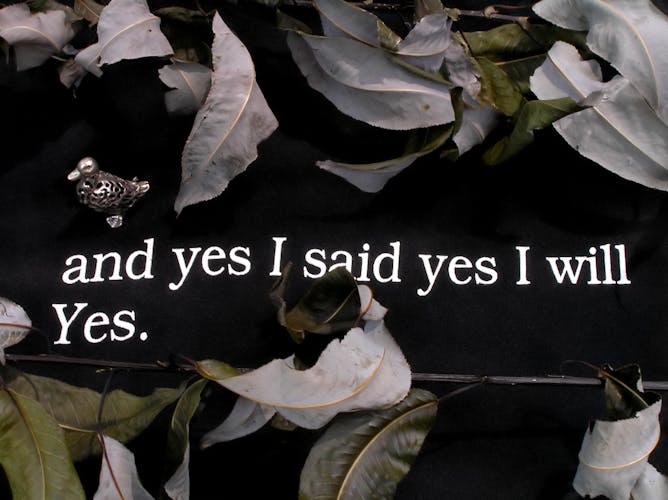
The last line of Molly’s famous monologue. greg/flickr, CC BY
Lastly, there is the justly famous tour de force of Molly’s unpunctuated stream of conscious monologue (“Penelope”), the subject of countless memorable rehearsed readings in Bloomsday activities. “Penelope” is an epic in its own right, in which Molly reviews her day, past lovers, Poldy himself. Molly is accorded the last word.
Ulysses by correspondence
Joyce likely derived his principle of correspondence from multiple sources, although he adapted it to his own purposes. His early interest in mystical and hermetic philosophy followed the loss of his fervent Catholic faith. Two early influences on Joyce were the poet William Blake and the Swedish philosopher and theologian Swedenborg. Both were interested in the idea of correspondence between the material and divine realms, and the spiritual principle that earthly conditions reflect higher realms.
Bloom expresses a parallel idea in a passage from the “Calypso” episode, where he visits the pork butcher to buy a kidney for breakfast.
Leaving the shop, Bloom responds to an everyday object:
Watering cart. To provoke the rain. On earth as it is in heaven.
Mysteriously, the very next line records that
A cloud began to cover the sun slowly, wholly. Grey. Far.
Even mundane experience need not be meaningless. Take for example, the references to meat in “Calypso”. In Homer, Calypso is the goddess who detained Odysseus on her island for years for her carnal pleasure. For Bloom, the sight of sausages in the butcher’s window is answered by his desire to perv on the “hams” of the next door girl, whom he in turn associates with a tattered religious garment, a scapular, “defending her both ways”. For Joyce, church and policing are closely linked; both are in the confession business. Bloom now indulges in a memory, or fantasy, of the girl enjoying a cuddle with a policeman in Eccles Lane: “They like them sizeable. Prime sausage.” Later, his disparate musings on meat link us to universal themes of sex, death and advertising.
Sausages invoke a reverie on sex, religion and death. Shutterstock
As a young man, Joyce had read Lamb’s The Adventures of Ulysses and was attracted to its supernatural elements. Ulysses is punctuated by curious parallels between Bloom and Dedalus, and various synchronicities: Poldy thinks about Blazes Boylan, who immediately appears; Stephen, who has complained about Ireland’s three masters, in a later scene turns his head back suddenly to see a three-master ship. These are not the contrived coincidences of Dickens but realistic experience, attended to in the spirit of wonder.
Bloom in wonderland
Ulysses is a feast of a book. The walls and the streets echo with laughter, song and banter. The life lived in the shops and pubs and workplaces, the décor, the clothes, the advertising signs and appliances, is brought back to life in these pages, filtered through the minds of artistic Stephen and scientific but “wonderstruck” Bloom. “Wonder” is one of Bloom’s favourite words; there is much to wonder at.
Ulysses captures the life of a city. Jaclin/flickr, CC BY-NC
In the first episode, Stephen stands at the stairhead on the tower, haunted by visions of his dead mother:
Buck Mulligan’s voice sang from within the tower. It came nearer up the staircase, calling again. Stephen, still trembling at his soul’s cry, heard warm running sunlight and in the air behind him friendly words.
Is this mere hallucination, the product of a stressful night, or the continuance of unresolved grief at his mother’s death? And what can we make of Bloom’s parallel experience that same morning?
Quick warm sunlight came running from Berkeley road, swiftly, in slim sandals, along the brightening footpath. Runs, she runs to meet me, a girl with gold hair on the wind.
Since a cloud has just begun to cover the sun, it seems likely that Stephen’s vision occurs at a similar time to Bloom’s. Kiberd’s beautiful suggestion that this is Bloom’s “Homeric vision”, is appealing. Equally, he could be hallucinating his absent daughter Milly, but then how do we explain Stephen’s similar vision? A definitive answer is not necessarily achievable.
Whatever we make of it, Joyce’s epic resembles the “open work” spoken of by Umberto Eco: one that invites us to explore it for ourselves. The supreme virtue of Ulysses is that it so richly rewards the considerable exertions required of us.
Some relevant resources:
Which edition of Ulysses?
Choosing the preferred edition of Ulysses is not a transparent choice, given the vexed publishing history of this book, and the so-called Joyce Wars. Many critics prefer Hans Walter Gabler’s corrected text (1986). Danis Rose’s attempt to find a more definitive text has met with mixed reviews. Jeri Johnson’s introductory essay to the book in the Oxford World’s Classics series is excellent, and this edition also has some very useful notes on each chapter at the back. Take note however that this is a reprint of the original typesetting of 1922 and so is prone to some possible textual errors.
Audio resource
An excellent audio recording from an ensemble cast that really brings the book alive. In my view, the best way to approach Ulysses: Free downloadable files at: https://archive.org/details/Ulysses-Audiobook
Guides and commentary
It has been said that one does not read Joyce, one studies Joyce. Certainly there is no shame in taking a guide book with one, when embarking on a reading odyssey. Bear in mind however that guides can be a mixed blessing: they can over-explain and over-interpret, or present us with an overwhelm of information.
A popular, updated guide to Ulysses:
Blamires, Harry. The New Bloomsday Book: A Guide through Ulysses 3rd ed. London: Routledge, 1996.
A reasonably demanding guide to and interpretation of Ulysses, from an influential Joyce critic:
Ellmann, Richard. Ulysses on the Liffey. London: Faber and Faber, 1972.
Non-profit investigative journalism centres have invigorated watchdog reporting in the United States over the past decade, a period commonly associated with despair over the state of serious journalism. My research attributes a sharp increase in the number of such centres in the United States directly to philanthropic funding, made more attractive by tax deductibility, and this same model could work in Australia.
This rescue mission of quality journalism has seen philanthropically funded news centres winning the most prestigious awards in journalism including several Pulitzer Prizes. Millions of Americans access stories written by non-profit investigative journalists, either on non-profit websites or published in mainstream media such as The New York Times, The Washington Post, NPR, PBS and other outlets.
Three key ways exist to fund the labour intensive and time consuming work of investigative journalism. The traditional media model, which today is characterised by market failure. Funding by government such as the ABC’s Four Corners program – a model that has worked well in Australia but that elsewhere raises questions of independence and funding security.
And there’s funding by foundations, wealthy benefactors and individuals. That’s different from crowd sourcing which may finance a specific story project but does not fund the necessary infrastructure (office, computers, rent, salaries etc.) or build the journalistic capacity required for a sustainable model.
In the United States, there are about 150 independent non-profit centres doing investigative and public interest journalism. The budgets of the biggest centres such as ProPublica, the Center for Public Integrity and Reveal at the Center for Investigative Reporting are about US$10 million a year; smaller centres less than US$100,000.
Non-profit status enables these organisations to avoid federal and some state taxes and donations to them can be tax deductible. The IRS does not have a distinct category for media organisations. Instead, investigative and public interest news organisations attract non-profit status under a broad education category.
There has been a profound cultural transformation in the way mainstream media organisations regard non-profit centre stories. Collaborations between legacy and non-profit media are commonplace in the United States because non-profit journalists have the same ethics, news values and editorial practices as journalists in the commercial and public media.
Foundation-funded journalism does not come close to replacing what has been lost due to staff and other cuts by mainstream media since the financial crisis. But it has been embraced by key media outlets as a means of boosting the quality of their stories. Non-profit centres do not compete with mainstream media; they complement it.
How this could work in Australia
A recent study found only a handful of Australian not-for-profit news organisations have been granted deductible gift recipient status by the Australian Tax Office and that news organisations face seemingly challenging obstacles in gaining such status. This may well discourage the creation of news organisations.
Given the diminished resources of Australian media to hold power to account, other measures to bolster democratic processes should be considered. Investigative journalism cannot readily be monetised.
It is expensive to do, takes a long time, sparks legal action and upsets powerful interests. It takes a big commitment by media organisations.
But the societal benefits can be huge: lives saved, corruption exposed, environments improved, governments and corporate interests held accountable. A recent book by a media economist found that for each US$1 spent on a specified investigative story, US$287 in policy benefits resulted.
Tax deductibility for independent journalism centres would provide incentives for individuals and philanthropic organisations to donate to producers of quality journalism.
The availability of tax deductions has the potential to increase the sum of quality journalism in Australia, enhance our democratic processes and better serve the community. I believe legacy and digital media in future would enter collaborative partnerships with non-profit investigative and public interest centres, ensuring a wider distribution and impact of their stories.
The Public Interest Journalism Foundation has some recommendations for the Australian Tax Office to consider when it comes to determining who should be granted deductible gift recipient status.
First is the history and background of the journalist who is applying, particularly their adherence to professional and ethical standards and whether the organisation they work for has conventional editorial practices. The organisation should create stories that are in the public interest and educate audiences rather than covering news of popular interest.
Another is introducing a commitment that the media nonprofit lists funding sources, including publication of the identities of donations of more than A$1,000, on its website. It also says anonymous grants, or funding from political and other entities where the source of the funding is not transparent, should be banned.
The foundation emphasises that individuals and organisations that advocate particular causes, should not be granted non-profit status under any media category.
No-one knows how sustainable the non-profit model will prove over time. However since 2007, I estimate that more than US$350 million has been donated to US non-profit investigative news centres; others have said closer to US$500 million.
We are in the midst of financial and technological disruption of traditional media models. No-one has yet worked out how to bolster accountability journalism that is essential to healthy democracies. The United States’ experience to date offers a potential solution that we should not ignore.
Many literary questions about smell are quite philosophical. Why do humans get pleasure from perfumes? Do rich bodies smell differently from poor ones? from http://www.shutterstock.com
Smell is the Cinderella of the senses in Anglophone literature. The Europeans do it differently from English writers. The Naturalists, with their anti-romantic, hyper realist commitment to scientific rigour, treated bodily smells with high seriousness.
One of their number, the French novelist, J-K Huysmans, wrote a famous essay (Le Gousset, 1874) comparing the natural armpit odours of blondes (“heady as sugared wines”), redheads (“sharp and fierce”) and raven-haired women (“audacious and fatiguing”), and had disparaging things to say about the odours of city women (“ammoniated valerian”, “prussic acid” and “chlorinated urine”), compared with their country kin (“wild duck” and “olives”). All this with a straight face.
James Joyce’s capturing of smell intensified in the course of his long writing career. Dubliners (1904-1914) barely registers smell – even the Misses Morkan’s Christmas feast in his celebrated short story “The Dead” is an aromatics-free zone, with the visuals dominating. Similarly in “Grace”, the collapsed inebriate’s bloody face after his fall is detailed. His stench is not. If the air is “musty” or “fragrant”, the notice is in passing, a decorative descriptive flourish while he concentrates on the conflicted mindscapes of his paralysed and self-contradicting Dubliners.
In A Portrait of the Artist as a Young Man (1916), smells become more insistent, but they tend to be highly conventional, and morally toned, or ignite memories. The religious zealot’s prayers rise up to God in wafts of “spikenard and myrrh and frankincense” while the hell Joyce creates to terrorise the sinner reeks of the sewer, offal and decaying corpses, itemised with comic hyperbole, as well as of more conventional smells – “sulfurous brimstone” and “pestilential odours”. Purity and defilement are the symbolic modus operandi.
There are hints in Portrait of the direction to be taken later in Ulysses (1922), when Stephen, in the spirit of mortifying his body, seeks out particularly disgusting smells. Lacking an “instinctive repugnance” to smells that repel others, he subjects his body to one that does revolt him: “a certain stale fishy stink like that of longstanding urine”. It is the experimental quality of this penitential programme that suggests a methodology that is systematically implemented in Ulysses, and subsequently abandoned in his dreamscape novel, Finnegans Wake (1939). Perhaps Joyce didn’t have olfactory dreams?
In Portrait of the Artist as a Young Man, the protagonist seeks out particularly disgusting smells. lets.book/flickr, CC BY-NC-ND
There is a palpable gear-change, however, in representing the olfactory in Ulysses (composed 1914-22). It is well known that the novel is encyclopaedic in design – a “book of the world”, as Marilyn French styles it. It is crammed with allusions to his literary rivals (the Bible, Homer, Dante, Shakespeare, Yeats, among many), to organs of the body, and their excretory functions (not one is omitted), to music from opera to street rhymes, and with real persons, streets, workplaces and Dublin marginalia.
Only two critics have noted its catalogue of smells, both detailed and implied. Still, a working database of smells in the book, compiled by Melbourne scriptwriters who were writing a play about Joyce and smell, runs to 41 pages. And the tenor of how Joyce deploys smells also undergoes a sea-change. His focus is steadily on the everyday smells of living – in a house, on the streets, or in a body, especially an eroticized one.
Body odour and black fabrics
There are many reasons Joyce’s take on the ordinary, everyday smells of bodies was revolutionary in his day and is still so in ours. The iconoclast in Joyce by the time he was writing Ulysses presents odoriferous bodies matter-of-factly, to raise many questions, some quite philosophical in tendency.
Do rich bodies smell differently from poor ones? What is to be learned from one’s “toe-jam” about the continuity of life? And from one’s excrement about one’s well-being? Is man-smell different from woman-smell? Are women attractive to men olfactorily when menstruating? Do smells cling to black fabrics more than other kinds and why? Where do body odours come from – from ingested food, from nether parts, armpits or neck? Does one fall in love at first smell? Why do humans get pleasure from perfumes? Might they get pleasure from undeodorised bodily smells? Are they perhaps not very different from animals in the role smelling plays in erotic encounters? Can the nose sabotage the brain?
In detailing the smells public and private of his world, Joyce takes on a newly emerging medical research machine – the sexologists of the decades abutting the turn of the 20th century. He certainly knew his Freud, and Jung treated Joyce’s daughter Lucia.
Joyce actively and transgressively has fun in Ulysses with the adjudicator of deviance, the German psychiatrist Richard von Krafft-Ebing and his catalogue of sexual deviance, Psychopathia Sexualis (1886), the raciest parts of which are written in Latin, to deter the non-medically trained.
He even more productively puts to good use the findings of the more liberal Havelock Ellis who devoted a lengthy chapter to smell in his multi-volume Studies in the Psychology of Sex (1897-1928).
But, being Joyce, his treatment of what these medical/psychological luminaries have to say about smell is joco-serious, and astonishingly prescient. He is curious about the perfume culture, and more radically about natural body odours, the impulse to disguise them, and their links to eroticism. He’s aware of the function of the aprocrine glands of the axillae in sexual arousal (and way ahead of the science in being so). He’s not bothered by the divide between human and animal, and does not fear to venture into the murky intersection of art and pornography, finding both moments of transcendence mingling with what is ridiculous in human behavior.
The smell journey in Ulysses is mainly its protagonist Leopold Bloom’s, and in the second half of “Nausicaa”, a chapter devoted to eye and nose, Joyce gives us Bloom trying to sort out what “mansmell” and “womansmell” might be, and where it comes from:
Tell you what it is. It’s like a fine veil or web they have all over the skin, fine like what do you call it gossamer and they’re always spinning it out of them, fine as anything, rainbow colours without knowing it. Clings to everything she takes off. Vamp of her stockings. Warm shoe, Stays. Drawers. …. Know her [Molly’s] smell in a thousand…. Bathwater too. …. wonder where it is really. There or the armpits or under the neck. Because you get it out of all holes and corners.
But Bloom’s wife Molly is also a connoisseur, if potty-tongued. She is deeply offended that her husband Leopold Bloom has not put barriers in the way of his rival, Blazes Boylan, and smell is a way to taunt her husband (like a hunting dog, she erroneously believes she can discern the perfume of another woman on his clothes).
In detailing the smells – public and private – of his world, Joyce takes on a newly emerging medical research machine. lilszeto/flickr, CC BY-ND
What Joyce does with smell at the height of Bloom’s epiphany at the end of Ch.17 (Ithaca) is nothing short of resignifying the most abject part of the anatomy and smell is the lure. Bloom, having gone through an inventory of his moral and legal options in relation to his wife’s adultery, enters the traduced marital bed fully conscious of his rival’s smells and traces of the picnic the adulterers had enjoyed in it, and is overwhelmed by the smell and cosmic shape of his wife’s posterior:
He kissed the plump mellow yellow smellow melons of her rump, on each plump melonous hemisphere, in their mellow yellow furrow, with obscure prolonged provocative melonsmellonous osculation.
Just as on the Hill of Howth, Bloom had fallen in love with Molly at first smell, Joyce makes it clear that in this moment, his limbic brain has sabotaged his thinking brain. Her “adipose anterior and posterior female hemispheres” undergo a metamorphosis, becoming heavenly:
islands of the blessed, the isles of Greece, the land of promise … redolent of milk and honey.
For some, this would be blasphemy. For Joyce, I would argue, it was to modernize and secularise the notion of the body, in all its moral frailty and compromises, as a temple.
This is an edited extract of the 2016 A. N. Smith Lecture in Journalism, delivered by Emily Bell, the founding director of Columbia University’s Tow Centre for Digital Journalism, at the University of Melbourne on March 15, 2017.
The 2016 US presidential election tells us a great deal about the current state of the news media and, more importantly, about the information environment we are operating within. Some of it is shocking, some is deeply worrying, and some of it is hopeful.
There are four key things Donald Trump’s election tells us about the state of journalism today.
The new fusion of media, power and technology
It is the early morning of Sunday, March 5. All over the east coast of America, journalists’ phones vibrate with alerts. So it begins: the president is awake, and he is angry.
It is as well, with the terrible decline in the popularity of The Apprentice, that we have another mesmerising show to keep us on our toes.
Imagine being an American political journalist. Every Saturday and Sunday at 6AM or 7AM, your phone buzzes with a message from the president.
Barack Obama “had my wires tapped in Trump Tower”. Quite a serious allegation. Presidents have been impeached for less. Press Secretary Sean Spicer was at pains to point out the next week that this is not literally what Trump had meant – it was a broader referral to the activities of agencies and surveillance during the campaign.
Welcome to 2017 in the United States of America, where we can experience government in real time, sometimes even before the people in power find out about it themselves.
As journalists who cover Trump have told me, the president, like his audience, reads newspapers and watches cable news. This is why he tweets early in the morning, often about stories that broke on social media the previous day. He opens the “failing” New York Times and, provoked by their “fake news”, he is off.
Trump might not spend much time on social media but he has an acute understanding of how virality in media works, and what the dynamics are that are needed to activate an online following to amplify your message.
How to cover the president is an abiding press topic, because he is unlike any president most have ever seen. Invitations to press conferences where journalists were ignored or insulted. Press huddles that suddenly elevated outlets like OANN or Breitbart above the “failing” New York Times and the “fake news” Washington Post.
In elevating Breitbart’s Steve Bannon to be his chief strategist, Trump has consolidated the idea of putting media presence at the heart of his administration.
There were many media commentaries suggesting that journalists should boycott the press room at the White House. Another extended hand-wringing session took place around whether or not to cover Trump’s tweets at all – again, were the media being played? Was access journalism getting in the way of real stories? And there were questions on how to deal with Trump’s apparent lack of interest in whether something was true or not.
What has happened is that Trump’s Twitter feed and the White House press room have become the live rails of this administration. If you start to think about Trump and Bannon as a media organisation run from the Oval Office, it makes sense that the PR channels of the press room and a Twitter feed with 25 million followers are actually now live policy theatre.
The tweeting, the press conferences and the rallies are confusing for us because they feel like smokescreens. Even more unsettling is the notion that they are not smokescreens at all, but they are the actual presidency.
Political messaging on social media has come of age in a powerful way. In the election of Rodrigo Duterte in the Philippines, we saw similar patterns of deployment as we did in the Trump campaign: tight circles of hyperactive fans and bots on social media that co-ordinate to tweet hashtags signalling the campaign’s most important messages in a repetitious cycle: #TrumpWon, #CrookedHillary, #HillarysHealth.
These are commonly used tactics, and they are bipartisan. Hillary Clinton’s campaign was just as active in similar ways.
But, for Trump, the use of real-time communication was not simply an election tactic: it is his modus operandi. Effectively, the substance of the US government is being shaped by a social media app.
Donald Trump appointed media executive Steve Bannon to his inner White House circle. Reuters/Kevin Lamarque
Online media reinforce homogeneity of view
According to the Pew Research Centre in the US, more than 70% of the population now has a smartphone. Of that universe, more than 60% get news through social media. Around 45% of US adults say they get news from Facebook. This is an enormous amount of power concentrated in one newsfeed algorithm.
For more than a decade, 1,000 flowers bloomed on the open web, and 1,000 tabs opened on each desktop.
This diversity is threatened with the commercialised, mobile social web. Smartphones and social media, which work in lock-step to focus our attention on the smaller screen, have been a great rebundling of news services – and a great rebundling of all services.
Facebook, I once observed, was swallowing journalism. But it is also swallowing everything else too.
As the user base has grown from millions to hundreds of millions to billions, the sorting algorithms target us not to show us everything – that would be unmanageable and absurd – but to show us each our own heavily personalised version of the world.
The ubiquity of social media and the way its business model works, targeting us with more of what we like, is an open invitation to stay in our lane – in our interests, our geographies, our views, our media and our lives.
The really efficient thing about social media is we don’t have to even try to do that ourselves anymore. The mysterious algorithmic underpinnings of Google and Facebook do it for us, and we don’t even notice. Until we miss something that happened in someone else’s lane. For liberal America, Trump happened in someone else’s lane.
Breitbart, more than any other news site, represents the noisy voice of the far right. Two weeks ago, the Berkman Klein Center for Internet and Society at Harvard released a paper that looked at how a large, fast-growing, right-wing news ecosystem had grown rapidly within Facebook in a relatively short time. Breitbart is the epicentre of that particular echo chamber.
The researchers mapped how that particular ecosystem works. They noted that most of the new hyper-partisan right-wing websites saw few links with the mainstream media, that the readership on the right was more isolated, and that the sites were very efficient in recycling the same themes – Trump’s anti-immigration stance, and Clinton’s emails.
As the campaign wore on the Harvard study notes the attacks were routinely targeted at both Clinton and the “mainstream media”. These messages were also repeated often by Trump. The campaign for him was arguably never about policy development: it was about a ratings-driven approach to winning.
The study’s authors say:
Use of disinformation by partisan media sources is neither new nor limited to the right wing, but the insulation of the partisan right-wing media from traditional journalistic media sources, and the vehemence of its attacks on journalism in common cause with a similarly outspoken president, is new and distinctive.
One of the remarkable things about the 2016 election was how the two worlds of polarised opinion could co-exist without any central arbitration by more moderate “connectors”.
The independent press should have a role here to moderate and foster argument from the point of view of trying to reach a broad consensus. But there is only a small incentive left to do that.
Watching a Trump press conference on Facebook Live video streamed from the Washington Post’s page showed only glowering angry emoji faces. The same stream, viewed from Fox News’ page, had only smiles.
I have wondered more than once during this election cycle whether the American media landscape is particularly badly affected by the encroachment and rise of newer, less-well-known and more-partisan forces because it lacks an equivalent of the ABC or BBC.
Facebook is swallowing journalism – and everything else. Reuters/Regis Duvignau
Obsession with ‘fake news’ obscures the real problems
There is something mesmerising about watching what happens when people are able to continually lie without facing the consequences.
After his initial Obama wiretapping accusations, Trump officials adjusted their body language about the reasons to believe, or not believe, that this “wiretap” had happened.
The story seems to have originated on right-wing talk radio and was picked up by other right-wing media, and then repeated by Trump on Twitter. If this is not true, though, what are the consequences?
Does a lack of truth matter? The tweet is not about the truth: it is about enriching a distracting narrative.
As a profession and a field we have to acknowledge the role we have played over many years in creating a commercial media environment that places higher priority on readership, ratings and reach than on the absolute integrity of information.
The open web was meant to make this better. It was initially a great big engine for correcting and contesting what is published. Instead, on balance, the form of the web we have at the moment enables bad journalism as much as, or maybe even more than, it helps good journalism.
The key to this is in the workings of the advertising market. It is increasingly automated, and decreasingly regulated.
In a digital microtargeted environment, ads are sold not against the integrity of the publication hosting them, but on the value of the person seeing them. Why pay the Wall Street Journal’s ad rates when you can buy one of their desirable readers a couple of sites or pages away?
And how to engage those readers? Well, good jokes and sensational content works better than nuance and complexity.
A combination of human nature, commercial marketplaces and sophisticated large-scale technology has combined to produce almost-perfect conditions for the proliferation of lowest-common-denominator material. The “fake news” epidemic is not new either, but the electrifying possibility it might have contributed to upending democracy has pushed it to the forefront of the debate.
I am not a fan of the phrase “fake news”. The term in Trump’s hands can mean “news you don’t need to pay attention to” or “news I don’t like”. We ought to be calling propaganda what it is, and calling misinformation and lies what they are too.
Buzzfeed media editor Craig Silverman has been into this issue for years. In 2015 he wrote a white paper for the Tow Centre entitled Lies, Damn Lies and Viral Content. It looked at the growth of precisely this epidemic in rumours that circulate through social media at lightning speed and are proliferated and amplified by mainstream news outlets at a much higher rate than they are ever corrected.
It was in the course of doing this work that Silverman started to notice the same patterns confirmed by the Harvard research – notably that the hyper-partisan websites, particularly of the right, were the powerhouses for a particular type of disinformation.
The incentives for feeding made-up stories or maybe even sentiments and stories into this cycle are twofold. First, they are political. Second, they are financial.
In the election these fabricated stories soared in popularity, outperforming the real news stories on Facebook in the closing stages of the campaign.
These were both propagandistic and opportunistic.
“Fake news” was undoubtedly put out by both sides during the election to benefit their preferred candidate. But another type of fakery was manufactured, quite legally, by people who can exploit the attention market for great profit. Someone who actually makes fake news (or, rather, used to) told me he could make US$10,000 from a single post.
In the future, we will see both the automation and more authentic fabrication of material. It is not clear that the platform companies are winning the war with faked propagandistic messages. But it is clear that they have been too relaxed about the type of material that circulates, whether for political or economic advantage.
If the advertising model rewards popularity and shareability – regardless of originality, value and quality – then it is little wonder that it provides a living for a Macedonian teenager but not enough to support core reporting functions in local newsrooms.
Facebook founder Mark Zuckerberg has said he does not want to be the “arbiter of truth” – which is lucky, because at the moment that is a distant aspiration. Perhaps a more achievable aspiration is not to be the enemy of truth either.
There is a cultural confusion within technology companies about how they execute both their ideological and market positions to encourage the maximum participation – but not to edit their platforms.
The major platforms, and Facebook in particular, were unsettled by the result of the 2016 election and the role they might or might not have played in Trump’s surprising rise. Why else would Zuckerberg write a 6,000-word manifesto about the issues facing global citizens and what Facebook could do to fix them?
The social web is visual; it rewards jokes and comments and easily digestible commentary. It rewards feelings and emotions. It rewards intensity of usage and engagement. It does not really care about veracity or verifiability.
Some of this is not new at all. Tabloid newspapers have always had more readership than broadsheets; cartoonists are more famous than op-ed writers. But the uneven distribution of attention on the web, and the algorithmic response to that – broadly promoting more of the same – shows again that the breaking of the distribution monopoly of old media has been replaced by another kind of monopoly, a monopoly of time, or attention.
Fake news has become a meaningless and rather dangerous phrase. But the problem of feeling unsure of what to believe and what not to believe, the obliteration of credible brands and the squeezing of all types of content into the same undelineated window, is very real.
Mark Zuckerberg says he does not want Facebook to be ‘the arbiter of truth’. Reuters/Stephen Lam
Journalism matters
In Western democracies we have become used to the luxury of being sceptical and dismissive of the importance of a free press. Now in the White House Press Room, on Twitter and Facebook, in the feed of the president of the United States of America, that dismissiveness has turned to an open hostility.
I know why phrases like “post-truth societies” or “alternative facts” or “fake news” have taken hold as a result of the election. It is important, though, to be able to separate media theory from reality. We are not in fact living in a world where facts and truth don’t exist anymore.
People who care about democracy recognise this, and the US has seen what is known as the “Trump bump” for news organisations with subscription or membership models. The “failing” New York Times has seen almost 300,000 new subscribers join in the last quarter of 2016 – more additional subscribers than the organisation managed in the previous year.
The head of digital at another national subscription-based news organisation noted that:
Every time Trump tweets about how terrible we are, another 10,000 people give us money. It’s incredible.
Non-profit investigative unit ProPublica has seen enough voluntary contributions coming in to enable it to open another office. The Committee to Protect Journalists, a great organisation that does the hardest work in defending and protecting journalists around the world, was invoked by Meryl Streep, that “over-rated actress”, on stage at the Golden Globes.
I was recently at a marketing conference full of marketing executives talking on stage to two Washington Post executives who were given a spontaneous ovation – by advertisers.
Despite the rocky professional outlook, there is no decline in the number of people applying to Columbia Journalism School – quite the opposite.
And, underneath this, we have seen some really remarkable reporting and analysis from the campaign trail and now from inside the administration. Leakers are posting material through Secure Drop to newsrooms at unprecendented rates.
The advent of a president who calls the press “the enemy of the people” has galvanised news organisations and handed them a mandate.
And the light the election campaign has shone on what an information environment can become, without regulation and without a hierarchy that reflects civic values, I think has rejuvenated the case for a strong and independent press.
Even Zuckerberg recognises the importance of journalism. On President’s Day weekend, he posed outside the offices of the Selma Times-Journal with his wife, Priscilla Chan, and thanked journalists for their work. Via a Facebook post, of course.
In his 6,000 word manifesto he wrote about what Facebook might do to support journalism more:
There is more we must do to support the news industry to make sure this vital social function is sustainable – from growing local news, to developing formats best suited to mobile devices, to improving the range of business models news organisations rely on.
He did not mention a significant transfer of wealth – but maybe that is coming.
What we have seen in the 2016 election cycle though is very clarifying for journalism. We have seen that the information ecosystem has grown in ways that work against the interests of civic society and good journalism.
The functions of journalism – from the packaging and distribution, to the audiences and branding, to the data collection, and crucially the monetisation – have all been subsumed by much larger systems of power and wealth.
Until very recently, technology platforms were ambivalent or even hostile to the idea that they might bear some responsibility for creating a better public sphere. The election cycle of 2016 has shone a light on that too. There is no such thing as algorithmic neutrality. Platforms and technologies have values, and if they carry consequences, intended and accidental.
Recently, a smart, local start-up in upstate New York, the Watershed Post, announced it could not do what it was doing anymore. A very technically literate two-person team had set up the Watershed Post as a new model for local journalism. Founder Lissa Harris wrote about why they could no longer carry on:
The titans of the web have huge and increasing reach, even in our rural communities. They have sophisticated tools for targeting likely customers by geography and demographics. They have products that a business owner can buy for $5 with a few clicks of a mouse, products that require no human time investment on the other end for design or sales or customer support.
What they don’t have is reporters.
Journalism matters, but the institutions that support and contain reporting are only healthy if they have subscribers, or vast scale, or another source of revenue. In the US, this increasingly means philanthropy, or a return to the wealthy individual sinking hundreds of millions into an uncertain future.
And the promise of the open web – that it would support all type of new journalistic institutions – is unfulfilled.
Reporting, unlike memes and jokes and native advertising, does not scale well on the privatised social mobile web. This is not the fault of one set of people; I don’t believe that the founders of platforms and search companies wanted to destabilise functions that are civically important but financially insecure. And I don’t believe the generation of creative, technically gifted journalists who are struggling with this necessarily did anything wrong either.
The problem is more that the speed of the emerging landscape for media has been so quick, and largely illegible, so free of regulation in nearly all aspects, that rather like financial deregulation before it, we haven’t been able to really grasp the problem until it is almost too late.
I say “almost” because, as an eternal optimist, I think we have an opportunity to make the right interventions to press for systems that favour sustainable journalism. But we have to be organised, and we have to do it now.
We need better collective action in understanding the complexity of the problems, and we need institutions that will not be buffeted by the markets to help work these problems out in the long term.
We also need the attention, wealth and influence of technology companies.
I have been dismayed as a bystander to see how institutions like the BBC in the UK and the ABC to some extent in Australia are not apparently part of the central conversation for this resettlement for journalism. Their own issues are too often framed in terms of the market and not often enough in terms of civic need and what we might require independent media institutions to do to protect democracy.
Too often we have given into the Silicon Valley narrative that old institutions are inevitably going to perish.
The “free market of information” on the web erases the necessity for old-fashioned public interventions, doesn’t it? The market will fix everything, won’t it? I could not disagree more.
Leadership in public-service journalism institutions is at a critical moment where it can redefine its role in relationship to this new landscape; where it can make a strong case for the support of reporting and innovation that can endure separately from the alternate systems of tech power.
Public media is not the only solution, but it is an important element in figuring out how we manage our way through a complicated and rapidly changing commercial converged marketplace.
I was recently at a rather curious gathering in the UK countryside – between NGOs, government, technology companies and journalists – to talk about the crisis in news and information. I can’t do better than repeat the words of one of the attendees:
We should be thanking Donald Trump, because without him we would not be having the long overdue conversation we need about what kind of news environment we want.
Public interest reporting is often equated with watchdog or investigative reporting. But it can include other factual stories that serve the public interest. Shutterstock
Public interest journalism could be considered the antithesis of media’s darker side, which includes fake news, propaganda, censorship and voyeurism.
The outcomes of public interest reporting can expose corruption, launch royal commissions, remove improper politicians from office, and jail wrongdoers.
Think of recent stories like ABC Four Corners’ exposure of the treatment of young people at Don Dale Detention Centre; The Sydney Morning Herald’s revelatory stories on now-convicted MP Eddie Obeid; or The Newcastle Herald’s exposure of child sex abuse by priests. All of these led to public hearings. Then there was last week’s collaboration between Fairfax Media and the ABC, revealing the extent of Chinese money and influence in Australian politics.
For these reasons, this form of reporting headlines the Senate select committee’s Future of Public Interest Journalism inquiry. The closing date for public submissions is June 15.
Yet, public interest journalism is not universally defined. One common understanding among media practitioners and academics is that it refers to a journalist pursuing information that the public has a right to know.
Often implied in this definition is that, if it were not for the reporter, undisclosed information affecting the public that governments, companies and other powerful interests hold would remain hidden.
In this way, public interest reporting is often equated with watchdog or investigative reporting. But it can include other factual stories that serve the public interest, whether by providing a platform for debate or informing the electorate.
This is not stories that are simply “interesting to the public” (read here: stories about the Kardashians) – that is, entertaining, but with no civic value. These profit-oriented stories have filled certain tabloids and glossy magazines for years. Today they serve as clickbait to attract eyeballs and advertisers in the digital space, and are often found under traditional media banners.
The former editor of Britain’s Guardian newspaper, Alan Rusbridger, uses the analogy of a public figure such as a cricketer to make the point that not all revelations or “truths” are worth pursuing, and particularly not in the name of the “public interest”. Rusbridger suggests the “quality” of the target and its relationship to the public interest differentiate a story from mere smear or exposure journalism. He says:
What’s the public interest in a cricketer having a love romp in a hotel room … But if elected representatives are arguing a case in Parliament but not revealing that they are being paid to do so, then that strikes at the heart of democracy. That’s public interest; this is an easy distinction.
From this example, it is clear that context matters. As author of Understanding Journalism, Lynette Sheridan Burns reminds us that other social concerns might need to be weighed up alongside public interest storytelling. These might include an individual’s right to privacy, legal considerations, and the potential for other harms such as national security risks.
Through the liberal democratic lens of understanding the role of news media, diverse and plural voices are generally seen as enriching public discourse. This provides a range of perspectives to contest ideas and inform citizens. Ultimately, it informs their electoral choices.
Herein lies a key motivation for calling the 2017 inquiry hearings. With thousands of editorial jobs cut in the past five years at Australia’s major news media outlets – Fairfax Media, ABC, News Corp, Channel Ten – and the closure of many regional bureaus and mastheads, there is real concern about the state of public interest journalism.
Put simply, are there enough trained journalists to provide independent journalism that matters? Are Australia’s regions as well served with diverse and independent reporting as the major cities? These questions speak to the first and fourth of the inquiry’s six terms of reference.
The other questions for the committee broadly relate to the viral spread of misinformation, and to safeguards against market power in the media landscape in the name of public interest journalism.
Interestingly, rather than directly tackle what the government’s proposed removal of media competition safeguards might mean for Australian audiences’ interests, the committee is directed to examine the market impacts of new players. That is, what impact social media and search engines have on the “Australian media landscape”.
The complete absence of “audience” and an emphasis on “markets” in the terms of reference could be seen as a win for the persistent lobbying of Australia’s most powerful commercial media companies.
In a rare display of unified power, 25 heads of Australia’s major commercial media outlets met the prime minister in Canberra last month to urge the parliament to pass media reforms. To improve their commercial viability, media companies are seeking to scrap the 75% reach provision (preventing 100% market share) and two-out-of-three ownership rule.
Notwithstanding new international entrants into Australian markets such as Buzzfeed, The Guardian and Daily Mail, such law changes, I have previously argued, would likely result in concentrating proprietorial power of the biggest media operators in Australia’s most dominant news media markets: radio, television and print.
The committee’s inquiries into “fake news, propaganda, and public disinformation” are important issues to consider, but we should remember that these concerns have existed alongside public interest journalism for more than a century.
From the sensationalist, fear-mongering “yellow journalism” of the penny press in the late 1800s, to the media propaganda arising out of the world wars of the 20th century, there is nothing new about fake news and disinformation. What is unprecedented, however, is its speed and global spread in the digital sphere.
Inaccurate reporting, whether deliberately fake or just sloppy, has consequences for news media’s capacity to serve a well-informed citizenry that underpins a healthy democracy. For example, a recent US Pew Research study found 88% of Americans believe fake news confuses the public about basic facts.
These are problems for all to tackle – search engines, internet service providers, commercial media outlets, public broadcasters and social media. As is occurring overseas, this might involve media outlets and others working together to provide news literacy tools to help the public recognise fact from fiction. Any successful approach must address sources, messengers and audiences of fake news, not just target Facebook and Google.
When the committee reports in December, let’s hope it offers ways to strengthen public interest journalism by placing Australian audiences’ interests ahead of all others.
Andrea Carson, Lecturer, Media and Politics, School of Social and Political Sciences; Honorary Research Fellow, Centre for Advancing Journalism, University of Melbourne
In this series, we’ll discuss whether progress is being made on Indigenous education, looking at various areas including policy, scholarships, school leadership, literacy and much more.
In a town by the sea that lies in the homeland of the Yawuru people, there sits a small publisher. But in the scope of its ambition, the depth and complexity of its range, and its commitment to bringing the voices of Aboriginal and Torres Strait Islander peoples to all Australians, Magabala Books looms large on the Australian literary landscape.
The Broome-based publisher was established in the 1980s, partly in response to concerns that Indigenous stories were being taken and published without permission by non-Indigenous academics and storytellers.
Today, Magabala has the most extensive list of Indigenous children’s literature of any Australian publisher. So for parents and teachers looking to introduce children to the many worlds of Aboriginal and Torres Strait Islander peoples, Magabala Books is a good place to begin.
And anyone who buys a Magabala publication also has the comfort of knowing that they are purchasing an ethically published book. Indigenous peoples hold copyright in their stories and there is a return of benefits to the Indigenous storytellers and/or their communities.
While it is not possible to cover the depth of Magabala’s range in a single article, I offer here, as a starting point, five picture books that have wisdom to share with all ages. While most of these books are listed as suitable for lower primary, I’d suggest this is the point at which children can begin reading the books but not where enjoyment of these texts ends.
Magabala Books
Tjarany Roughtail
By Gracie Greene, Joe Tramacchi and Lucille Gill
Ability: lower primary
First published in 1992, this book is rightly considered a classic. A collection of Tjukurrpa (Dreaming) stories of the Kukatja people of the Kimberley region of Western Australia, Tjarany Roughtail is a bilingual illustrated narrative in which the pictures speak as powerfully as the words. It is also a book that can grow with children through the layers of knowledge it offers.
Young children will enjoy the stories of the Dreaming ancestors. Older children can explore the diagrams that explain the meaning of the symbols used in the artwork, as well as the maps of the Kukatja kinship system which shows the web of relationships between Aboriginal peoples and their homelands. And all ages can treasure a book that is at once a culture, language, art and philosophy text.
Magabala Books
Stolen Girl
By Trina Saffioti and Norma MacDonald
Ability: lower primary
This is a Stolen Generations tale written by Trina Saffioti (Gugu Yulangi people) and illustrated by leading artist Norma MacDonald (Yamatji and Nyungar peoples). It is told in nuanced, sparse text accompanied by illustrations that convey the warmth of family, the terror of removal, and the loneliness of life in an institution. The book ends with the hope of returning home, captured through the image of a girl stepping through a half open door into a sunlit landscape.
Stolen Girl is a moving tale that gently introduces children to a traumatic aspect of Australian history that echoes through the lives of Indigenous peoples today.
Magabala Books
Fair Skin Black Fella
By Renee Fogorty
Ability: lower primary
This masterful work by Wiradjuri writer and illustrator Renee Fogorty addresses Aboriginal identity, and in particular that being Indigenous is about culture, community and family rather than skin colour. The story is brought to life by illustrations that sensitively and appropriately capture the message of a tale that speaks to the importance of inclusiveness and belonging.
Magabala Books
Our World
By the One Arm Point Remote Community School
Ability: Upper primary
What is life like in worlds different from your own? This book tells of the Bardi Jaawi people of the Ardiyooloon community, weaving together history and traditional stories with the seasons and rhythms of everyday existence.
Our World features the children’s artwork as well as photographs of them undertaking activities such as fishing, constructing windmills from pandanus leaves, and learning animal tracks. As a whole, the book conveys a wonderful sense of Bardi Jaawi children speaking of their lives to the child-readers of the text in a meeting of lives and worlds.
Magabala Book
Once
By Dub Leffler
Ability: lower primary
This reconciliation tale by artist and writer Dub Leffler (Bigambul and Mandandanji people) is an evocative tale of friendship across difference, with the poetic text given full expression in illustrations that capture the beauty of the story and speak straight to the heart.
These books, along with the many other narratives by Indigenous storytellers, offer opportunities for children and adults to journey through diverse Indigenous realities – and in so doing, to begin to build bridges across worlds.
The link below is to an article that takes a look at a survey conducted by the Australia Council and Macquarie University on Australian reading habits.



 A focus on children’s reading pleasure rather than on literary merit shifts the focus of research to a different set of questions. I will not pretend to know why Harry Potter appealed so strongly to my son but I suspect its familiarity, predictability and repetition were factors. These qualities are unlikely to score high by adult standards of literary merit but are a feature of children’s series fiction.




 Ellmann, Richard. Ulysses on the Liffey. London: Faber and Faber, 1972.
  We are in the midst of financial and technological disruption of traditional media models. No-one has yet worked out how to bolster accountability journalism that is essential to healthy democracies. The United States’ experience to date offers a potential solution that we should not ignore.




 For some, this would be blasphemy. For Joyce, I would argue, it was to modernize and secularise the notion of the body, in all its moral frailty and compromises, as a temple.


 We should be thanking Donald Trump, because without him we would not be having the long overdue conversation we need about what kind of news environment we want.
 When the committee reports in December, let’s hope it offers ways to strengthen public interest journalism by placing Australian audiences’ interests ahead of all others.


 •
•  At the BookShelf
You must be logged in to post a comment.