Unknown's avatar

New African literature is disrupting what Western presses prize


File 20171009 6947 1o4a3h.jpg?ixlib=rb 1.1
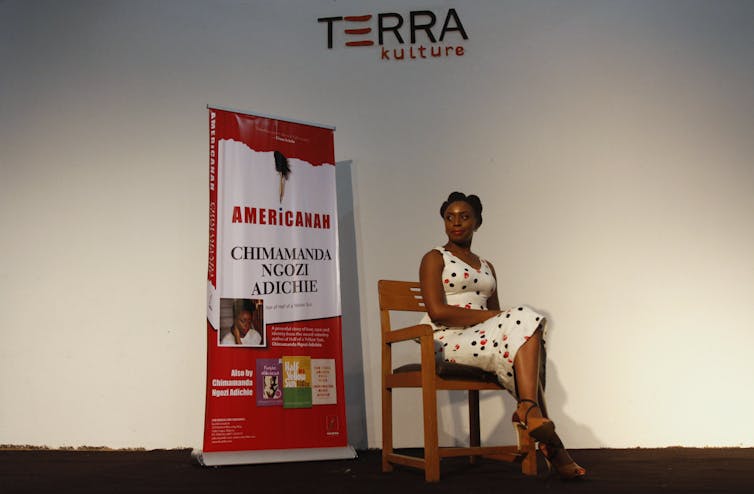
Novelist Chimamanda Ngozi Adichie after a reading of her book ‘Americanah’ in Lagos in 2013.
Akintunde Akinleye /Reuters

Jeanne-Marie Jackson, Johns Hopkins University

African literature is the object of immense international interest across both academic and popular registers. Far from the field’s earlier, post-colonial association with marginality, a handful of star “Afropolitan” names are at the forefront of global trade publishing.

Books like Chimamanda Adichie’s “Americanah” and “Half of a Yellow Sun”, Teju Cole’s “Open City”, Taiye Selasi’s “Ghana Must Go” and Yaa Gyasi’s “Homegoing” have confounded neat divisions between Western and African literary traditions. The Cameroonian novelist Imbolo Mbue captured a million-dollar contract for her first book, “Behold the Dreamers”. That’s even before it joined the Oprah’s Book Club pantheon this year.

Such commercial prominence, though, has attracted considerable and unsurprising push back from Western and Africa-based critics alike. Far from advancing narratives with deep roots in local African realities, such critics fear, many of Africa’s most “successful” writers hawk a superficial, overly diasporic, or even Western-focused vision of the continent.
Noviolet Bulawayo was shortlisted for the Man Booker prize in 2013 for her book
Olivia Harris/Reuters

The most visible of these critiques has been directed at the Zimbabwean writer NoViolet Bulawayo’s “We Need New Names” (2013). The Nigerian novelist Helon Habila worried in a review in the London Guardian that it was “poverty-porn”. The popular Nigerian critic Ikhide Ikheloa (“Pa Ikhide”) frequently makes a similar point. Fellow Nigerian writer Adaobi Nwaubani critiqued the West’s hold on Africa’s book industry in a much-circulated New York Times piece called “African Books for Western Eyes”.

Such debates about African writing could, and likely will, go on forever. Questions about Africa’s place in the current global literary marketplace broaden some of the most urgent queries of the postcolonial era. Who gets to document African realities? Who are the “gatekeepers” of African publishing traditions?

It goes on: To what sort of audience does African writing cater? What is the role – and what should it be, if any – of Western institutions in brokering cultural prestige?

All these issues merit concern.

Between the default poles

Too often, though, African writing ends up volleyed between two default poles of “corporate global” and “activist local”. Some onlookers, as in a recent essay by the Canadian scholar Sarah Brouillette, go as far as to name the biases of even Africa-based print outlets. Kenya’s Kwani Trust is exposed as “Western-facing” due to a web of donor relations. “West” here is code for neoliberal. “Western-facing” is for complicity with a market that skews toward British and American interests.

Faced with a “world system” argument like Brouillette’s, African literature would seem trapped between a rock and a hard place.

But, in fact, this tells only a small part of the story of how African writing now makes its way through the world. It is incomplete to the point of being outdated, given the boom over the past five years in new, globally conscious small US literary presses collaborating with African writers.

A “West subsuming Africa” brand of critique works fine for scholars with no real skin in the game of literary publishing. It also denies real agency to a lot of African writers and other literary professionals. On the ground the literary field is far more forward-thinking and diverse.

There is an entire new body of African writing that escapes this closed circuit of damning truisms. A wave of new or recently galvanised independent literary presses in the US and the UK are working in tandem with some of Africa’s most generative outlets. Together they are publishing and promoting work by young and adventurous African writers.

Labours of love

Books published originally by presses like Umuzi (South Africa), amaBooks (Zimbabwe) and Kwani (Kenya) find second lives with international publishers working to defy the constraints of profitability. They’re mostly labours of love with skeleton staffs that speak to a transcontinental commitment to innovative African writing.

Here are a few key examples of African texts published by independent American outlets – “independent” here refers to presses beyond the “Big Five” US trade publishers (Hachette Book Group, HarperCollins, Macmillan, Penguin Random House and Simon and Schuster.

These include Jennifer Nansubuga Makumbi’s Ugandan epic “Kintu” which was originally launched by Kwani. It was the first Anglophone novel put out by the brand-new Transit Books based in Oakland, California. The press seeks maximum visibility for translated fiction alongside texts originally written in English. They advocate for more ethical legal and financial dealings with translators, as well as international writers.
Congolese author Fiston Mwanza Mujila.
Marc de Gouvenain

A number of similarly tiny, ambitious ventures have published some of the most acclaimed recent African writing in translation. Deep Vellum Publishing was behind the English translation of Fiston Mwanza Mujila’s Etisalat Prize-winning “Tram 83”.

Also dedicated exclusively to works in translation, LA-based Phoneme Media in 2016 published the first ever Burundian novel in English, Roland Rugero’s deeply contemplative “Baho!”. Phoneme’s tagline, fittingly, is “curious books for curious people”.

In a similar vein, Brooklyn’s Restless Books was founded to combat “parochial, inward-looking, and homogenised trends in American publishing”. Among their forthcoming titles, translated from the French is Naivo’s “Beyond the Rice Fields”. It’s the first novel from Madagascar to see its way to English.

Veteran nonprofit press Archipelago Books is also in Brooklyn. In 2015, it published the translation from the Portuguese of Angolan writer Jose Eduardo Agualusa’s “A General Theory of Oblivion”.

Every one of these throws a wrench in a clear, cynical sense of what kind of novel Western presses prize. That is not to mention the many African writers, publishers, and editors working in concert to promote these same texts.

Small, focused channels

It applies to the Anglosphere too. Books that offer a decidedly more locally textured experience than those of the “Afropolitan” rock stars have made their way abroad through small, focused channels.

These works might include Tendai Huchu’s “The Maestro, the Magistrate, and the Mathematician” (published originally by amaBooks, and in the US by Ohio University Press); Imraan Coovadia’s “Tales of the Metric System” (from Umuzi, and again by Ohio University Press); and Masande Ntshanga’s “The Reactive” (also Umuzi; in the US by family-run Two Dollar Radio.

Clearly, this collection just scratches the surface. But what these works have in common is an investment in stylistic and structural experimentation that confounds rather than caters to an international taste for “digestible” fiction, or to mostly Western points of cultural and institutional reference.

This counter-current of transnational African literary life complicates the equation of culture, geopolitics and economics in more useful ways than stale materialist critiques.

As such titles and presses continue to gain acclaim and recognition by an international readership that is aware of and hostile to shallow representations of Africa – and who crave engagement with challenging fiction, regardless of its origin – critics will need to rethink some of their orthodoxies.

The ConversationThere is more to both African literature and Western publishing than meets an eye too practised in its suspicion. If literature is doomed only to echo the failings of globalisation, then why bother? On the contrary, a new generation of writers and publishers deserve our awareness of the “global literary marketplace” as a meaningfully multidimensional space.

Jeanne-Marie Jackson, Assistant Professor of World Anglophone Literature, Johns Hopkins University

This article was originally published on The Conversation. Read the original article.

Unknown's avatar

The ‘inevitable sadness’ of Kazuo Ishiguro’s fiction


File 20171006 25784 1ghvr4m
British novelist Kazuo Ishiguro listens to a question during a press conference at his home in London on Oct. 5, 2017.
Alastair Grant/AP Photo

Cynthia F. Wong, University of Colorado Denver

On a damp October day in 2006, I followed Kazuo Ishiguro and my 10-year-old daughter Grace to a back table at a bustling cafe in London for an interview. As Ishiguro answered my questions, he explained how he “auditions” his characters’ voices and personalities in his head before they appear in his fiction. He spoke candidly about a writer’s messy work.

Now he is the laureate for the Nobel Prize in literature, for what the Swedish Academy praised as his unapologetic portrayals of “the abyss beneath our illusory sense of connection with the world.”

It’s a nod to the self-delusion that many of Ishiguro’s characters possess. One, for example, rationalizes his service to a fascist loyalist. Others see their past through the cloudy lens of trauma. If we were to peel back the warped self-deception, we might find a bottomless pit of despair.

At that interview years ago, Ishiguro talked about his characters’ painful chasms, the way they protected themselves by concealing their mistakes. But when everything seems hopeless, his characters often courageously turn to their imagination to forge a connection to life and meaning.

In doing so, they beckon readers to imagine something better, too.

When I asked Ishiguro about his 2005 dystopic novel “Never Let Me Go,” his tone shifted. He lowered his voice when he told me about the students in that novel, and how they eventually perish. But he was surprised when I said that I found the novel sorrowful.

“There is an inevitable sadness,” he admitted. “On the other hand, it’s not a bleak view of human nature.”

I could sense Ishiguro’s concern for how my daughter might take his observations about death and despair.

He continued: “The question, ‘What are we useful for?’ is the question that your daughter Grace asks, and one Tommy and Kathy ask in ‘Never Let Me Go.’ Some cold system says to Tommy and Kathy that they will be useful [to the world], and it’s the same as another system saying to Grace that someday she will be useful to the world economy.”

Human systems figure in all of Ishiguro’s novels, whether these are governments, communities or families. Often, these systems are damaged, and humans still must move through them. They try to repair them or save themselves. Ishiguro has examined many facets of what it means to live among and within countless systems.

The first-person narrators of Ishiguro’s first three novels, “A Pale View of Hills,” “An Artist of the Floating World” and “The Remains of the Day,” reflect on personal losses in the context of world events: friends and families dead from atomic bombings in Japan, unrealized romances, wrong choices and lives founded on delusion. These characters long for clarity, retribution or forgiveness.

The narrators of his next three novels are, variously, a pianist (“The Unconsoled”), a London detective (“When We Were Orphans”) and a roving hospice-type worker (“Never Let Me Go”). Whether they’re situated in Japan, Great Britain, some unnamed European city or even a medieval village, Ishiguro’s characters beguile his readers with their disclosures. His eloquent prose expresses their anguish or their repressed longings. We sense time passing darkly for these characters. We see how they face disappointments and ache for dignity.

Ishiguro explained that to probe the emotional force of his novels, we must understand that the characters are set within “an internal world [and] it’s an emotional logic that is being played out.”

In narrating their sorrows and their fruitless optimism, Ishiguro gives his readers a way to empathize with his characters’ situations.

Ishiguro’s capacity for compassion was cultivated during his university gap year, when he worked with the homeless. He also studied piano and guitar and dreamed of a career in music before he detoured to the creative writing program at the University of East Anglia. He still writes musical lyrics and works with musicians as an avocation.

By his own admission, Ishiguro is a slow writer; he produces a novel every few years. In 2015, when he came to Denver’s Lighthouse Writers Workshop to promote his latest novel, I was able to catch up with him. He remarked that he may have only a couple more books forthcoming.

“We’re not immortal,” he said. “We’re here for a limited time. There is a countdown.”

The Swedish Academy honors a laureate for a lifetime of achievement. To date, Ishiguro has published eight books as well as many short stories, television and film scripts. His career may seem disjointed when focusing on only the best-known novels, “The Remains of the Day” and “Never Let Me Go.”

But few contemporary authors have dared to take as many risks as Ishiguro. The more complicated, Kafka-esque novel “The Unconsoled” is a book some critics called disappointing. A different sort of writer might have quit, but Ishiguro persisted.

Similarly, even though some readers responded coolly to “The Buried Giant,” Ishiguro had taken yet another literary leap: The highly metaphorical story is set in an early English era that predated historical records. Memory, repression of pain and the resolve to protect oneself and loved ones return as themes, but in unusual, allegorical ways.

Each novel is a singular achievement; each successive undertaking enriches a broader canvas of Ishiguro’s portraits of alienated lives.

During that 2006 London interview, I watched Ishiguro banter with my daughter during a break. They were laughing about what it means to “snarf” food, and they were picking up some biscuits and spooning melted ice cream to demonstrate. Ishiguro’s ease and humor when speaking with my child captivated me.

In spite of the sadness in his books, Ishiguro is a gracious guardian of humanity. He is a fine curator of emotions and a skilled storyteller.

The ConversationWe don’t know how many more books Ishiguro will publish. But we can be certain that in his literary explorations, he will remain undaunted.

Cynthia F. Wong, Professor of English, University of Colorado Denver

This article was originally published on The Conversation. Read the original article.

Unknown's avatar

The enduring power of print for learning in a digital world


File 20171002 12115 5nz9dp

PHOTO FUN

Patricia A. Alexander, University of Maryland and Lauren M. Singer, University of Maryland

Today’s students see themselves as digital natives, the first generation to grow up surrounded by technology like smartphones, tablets and e-readers.

Teachers, parents and policymakers certainly acknowledge the growing influence of technology and have responded in kind. We’ve seen more investment in classroom technologies, with students now equipped with school-issued iPads and access to e-textbooks. In 2009, California passed a law requiring that all college textbooks be available in electronic form by 2020; in 2011, Florida lawmakers passed legislation requiring public schools to convert their textbooks to digital versions.

Given this trend, teachers, students, parents and policymakers might assume that students’ familiarity and preference for technology translates into better learning outcomes. But we’ve found that’s not necessarily true.

As researchers in learning and text comprehension, our recent work has focused on the differences between reading print and digital media. While new forms of classroom technology like digital textbooks are more accessible and portable, it would be wrong to assume that students will automatically be better served by digital reading simply because they prefer it.

Speed – at a cost

Our work has revealed a significant discrepancy. Students said they preferred and performed better when reading on screens. But their actual performance tended to suffer.

For example, from our review of research done since 1992, we found that students were able to better comprehend information in print for texts that were more than a page in length. This appears to be related to the disruptive effect that scrolling has on comprehension. We were also surprised to learn that few researchers tested different levels of comprehension or documented reading time in their studies of printed and digital texts.

To explore these patterns further, we conducted three studies that explored college students’ ability to comprehend information on paper and from screens.

Students first rated their medium preferences. After reading two passages, one online and one in print, these students then completed three tasks: Describe the main idea of the texts, list key points covered in the readings and provide any other relevant content they could recall. When they were done, we asked them to judge their comprehension performance.

Across the studies, the texts differed in length, and we collected varying data (e.g., reading time). Nonetheless, some key findings emerged that shed new light on the differences between reading printed and digital content:

  • Students overwhelming preferred to read digitally.

  • Reading was significantly faster online than in print.

  • Students judged their comprehension as better online than in print.

  • Paradoxically, overall comprehension was better for print versus
    digital reading.

  • The medium didn’t matter for general questions (like understanding the main idea of the text).

  • But when it came to specific questions, comprehension was significantly better when participants read printed texts.

Placing print in perspective

From these findings, there are some lessons that can be conveyed to policymakers, teachers, parents and students about print’s place in an increasingly digital world.

1. Consider the purpose

We all read for many reasons. Sometimes we’re looking for an answer to a very specific question. Other times, we want to browse a newspaper for today’s headlines.

As we’re about to pick up an article or text in a printed or digital format, we should keep in mind why we’re reading. There’s likely to be a difference in which medium works best for which purpose.

In other words, there’s no “one medium fits all” approach.

2. Analyze the task

One of the most consistent findings from our research is that, for some tasks, medium doesn’t seem to matter. If all students are being asked to do is to understand and remember the big idea or gist of what they’re reading, there’s no benefit in selecting one medium over another.

But when the reading assignment demands more engagement or deeper comprehension, students may be better off reading print. Teachers could make students aware that their ability to comprehend the assignment may be influenced by the medium they choose. This awareness could lessen the discrepancy we witnessed in students’ judgments of their performance vis-à-vis how they actually performed.

3. Slow it down

In our third experiment, we were able to create meaningful profiles of college students based on the way they read and comprehended from printed and digital texts.

Among those profiles, we found a select group of undergraduates who actually comprehended better when they moved from print to digital. What distinguished this atypical group was that they actually read slower when the text was on the computer than when it was in a book. In other words, they didn’t take the ease of engaging with the digital text for granted. Using this select group as a model, students could possibly be taught or directed to fight the tendency to glide through online texts.

4. Something that can’t be measured

There may be economic and environmental reasons to go paperless. But there’s clearly something important that would be lost with print’s demise.

In our academic lives, we have books and articles that we regularly return to. The dog-eared pages of these treasured readings contain lines of text etched with questions or reflections. It’s difficult to imagine a similar level of engagement with a digital text. There should probably always be a place for print in students’ academic lives – no matter how technologically savvy they become.

Of course, we realize that the march toward online reading will continue unabated. And we don’t want to downplay the many conveniences of online texts, which include breadth and speed of access.

The ConversationRather, our goal is simply to remind today’s digital natives – and those who shape their educational experiences – that there are significant costs and consequences to discounting the printed word’s value for learning and academic development.

Patricia A. Alexander, Professor of Psychology, University of Maryland and Lauren M. Singer, Ph.D. Candidate in Educational Psychology, University of Maryland

This article was originally published on The Conversation. Read the original article.

Unknown's avatar

We, robot: the computer co-authoring a story with a human writer


File 20171002 12115 f0kpql
shutterstock.
Shutterstock

Leah Henrickson, Loughborough University

In Isaac Asimov’s I, Robot, a collection of nine short stories about robotics, Asimov explores the possibilities of human-computer interaction. How can humans and computers co-exist? How can they work together to make a better world?

A research group from the Meertens Instituut in Amsterdam and the Antwerp Centre for Digital Humanities and Literary Criticism recently introduced a new digital creative writing system. Using a graphical interface, an author drafts a text sentence by sentence. Then, the system proposes its own sentences to continue the story. The human and the computer work together to create what the system’s developers call “synthetic literature”.

The paper detailing this project describes the text generation system as an attempt to:

Create a stimulating environment that fosters co-creation: ideally, the machine should output valuable suggestions, to which the author retains a significant stake within the creative process.

How to train your robot

To learn language and sentence structure, the system has been trained using the texts of 10,000 Dutch-language e-books. Additionally, the system was trained to mimic the literary styles of such renowned authors as Asimov and Dutch science fiction author Ronald Giphart by generating sentences that use similar words, phrases, and sentence structures as these authors.

As part of this year’s annual Nederland Leest (The Netherlands Reads) festival, Giphart has been trialling the co-creative writing system to write a tenth I, Robot story. Once Giphart’s story is completed it will be published at the end of a new Dutch edition of Asimov’s classic text. Throughout November, participating libraries throughout the Netherlands will be offering free copies of this edition to visitors to get people thinking about this year’s festival theme: Nederland Leest de Toekomst (The Netherlands Reads the Future).

As Giphart types new sentences into the system’s graphical interface, the system responds by generating a selection of sentences that could be used to continue the story. Giphart can select any of these sentences, or ignore the system’s recommendations altogether.

The point of the system, its developers explain, is to “provoke the human writer in the process of writing”. Giphart says he still considers himself “the boss, but [the system] does the work”. One article even described the system as being ideal “for those who have literary aspirations, but who lack talent”.

Can a computer be creative?

The “synthetic literature” referred to by this system’s developers implies a combined production effort of both human and computer. Of course, the human still guides production. As co-developer Folgert Karsdorp explained: “You have numerous buttons to make your own mix. If you want to mix Giphart and Asimov, you can do that too.” The system follows its user’s direction, responding by using its own capacity for creativity.

But can a computer ever be truly creative? This is a question that the field of computational creativity has been studying since computers were invented. The field generally accepts that a computer can be called creative if its output would be considered creative had it been produced by a human.

Computational creativity debates are all rooted in one underlying question: is the computer merely a tool for human creativity, or could it be considered a creative agent itself? In a discussion about computer-generated art, creativity scholar Margaret Boden noted that:

It is the computer artist [the developer] who decides what input a system will respond to, how the system will respond, how unpredictable the system’s output will be, and how transparent the system’s functionality will be to users.

Even the most unpredictable output, according to Boden, results from choices the computer artist has made. While a developer may not be able to predict a system’s exact output, the output nevertheless reflects the choices the developer has made while programming.

Computer systems can be trained to mimic the language and sentence structure of particular writers.
Shutterstock

The co-creative writing system Giphart is using isn’t able to produce an entire book by itself, but it can produce paragraphs that continue Giphart’s story for him. Giphart, though, ultimately has the power to choose what computer output he uses.

But does this mean that Giphart alone will be credited as the author of his Ik, robot story, or will his computer be given credit as a co-author? It’s still unclear. Although it could be hotly debated whether the creative writing system is just a tool for Giphart’s vision or could be considered an agent itself, we won’t be seeing the demise of human authors any time soon.

One Nederland Leest blog post compares this new method of writing to the evolution of the electric guitar. It may have existed for nearly a century, but it wasn’t until Jimi Hendrix showed us how to really play the instrument that its potential was realised. Similarly, we still need to discover how to “play” this writing system to get the best results, whatever they might be.

So is synthetic literature the future? Maybe. Keep reading to find out.

The ConversationA video explaining the project is available here, in Dutch.

Leah Henrickson, PhD Candidate, Loughborough University

This article was originally published on The Conversation. Read the original article.

Unknown's avatar

Nobel-winner Kazuo Ishiguro shows us the illusion of connection with the world


Jen Webb, University of Canberra

English author Kazuo Ishiguro has won the 2017 Nobel Prize for Literature. For some weeks now, the bookies have been offering odds on the likely winner. Kenya’s Ngũgĩ wa Thiong’o was front runner earlier this week, followed closely by Japan’s Haruki Murakami. Ishiguro was some way down the list of favourites: a surprise win, no doubt, for the bookies, and one that is likely to generate plenty of discussions and debate.

The commentary about this year’s prize, though, is unlikely to run as hot as it did last year, following the bombshell announcement that Bob Dylan was the new Laureate. With Ishiguro, love him or not, we are unquestionably in the company of a noteworthy writer, one who has been widely honoured. He has been winning literary awards since 1982, when A Pale View of the Hills won the Winifred Holtby Memorial Prize.

Despite this record of success – or perhaps as an inevitable consequence of the current media climate — Ishiguro seems to have been caught unawares by the win. Not unlike Helen Garner’s first response to the email telling her she’d won the Windham-Campbell prize, he thought the announcement of the award was fake news.

This year’s award was based on Ishiguro’s contribution as a writer “who, in novels of great emotional force, has uncovered the abyss beneath our illusory sense of connection with the world”. Sara Danius, Permanent Secretary to the Nobel Academy, added that he is “a writer of great integrity”, one who tackles those complex and enduring themes of “memory, time, and self-delusion”.

Ishiguro’s 1989 novel The Remains of the Day.
Goodreads

Personally, I’m delighted with the win. Ishiguro’s novels have helped give shape and texture to my life. An Artist of the Floating World (1986; winner of the Costa Book Award) and Remains of the Day (1989; Booker Prize winner) accompanied me through long insomniac nights. The uncertainty, barely-declared unhappiness and sense of dislocation found in both narrators fitted perfectly with my experience of being a stranger in a strange land. When We Were Orphans (2000), with its awkward misfit narrator and its haunting/haunted location, might be considered his least successful book, but I found all that unresolved guilt and unconfirmed identity both compelling and disturbing.

Never Let Me Go was named as Time Magazine’s Book of the Year in 2005. Its exquisite voice, and exquisitely painful dystopia, seemed to fit perfectly the mood of anxiety threading through that decade, one characterised by both late capitalism and the rapidly changing environment associated with the Anthropocene. And, most recently, The Buried Giant (2015) catapulted readers back to post-Arthurian Britain, weaving narrative threads from across history and treating enduring love and failing memory with equal compassion.

Ishiguro is often described as an author who writes across and between genres, moving from speculative fiction, to crime fiction, to social realism and fantasy. However I don’t find it instructive to pigeonhole his books into generic categories.

Ishiguro’s 2005 novel Never Let Me Go.
Goodreads

If anything, his writing demonstrates the permeability of the rules of genre. His technical and literary capacity, along with his closely observed — and coldly if tenderly rendered portraits – locate his writing outside formulae or conventions. The worlds he creates, and the characters that people them, are startlingly authentic – an empty term that I don’t like to use, but which feels right in this context.

Alfred Nobel established the prize, in his will, as one that is designed to reward “the person who shall have produced in the field of literature the most outstanding work in an ideal direction”. “Ideal” is another of those empty terms, but it seems to me that a writer who has consistently tackled problems of ethical relationships, social responsibility, questions of memory, gaps in meaning and identity, and done it all with a light touch and deep empathy fits that bill.

The ConversationIshiguro’s characters are often hard to love, but easy to care for, and their struggles with “the abyss beneath our illusory sense of connection with the world” offer ways of seeing and thinking about what lies beneath our own feet.
Jen Webb, Director of the Centre for Creative and Cultural Research, University of Canberra

This article was originally published on The Conversation. Read the original article.

Unknown's avatar

Nobel Prize in Literature 2017


The Nobel Prize in Literature has been awarded to Kazuo Ishiguro. The link below is to an article reporting on the announcement.

For more visit:
https://www.theguardian.com/books/2017/oct/05/kazuo-ishiguro-wins-the-nobel-prize-in-literature

Unknown's avatar

Worth reading: Tried and true manuals for success


File 20170907 9603 4fg5uf
Recommended books offer a path to success for everyone, writes Michael Armstrong.
Shutterstock

Michael J. Armstrong, Brock University

Editor’s note: The Conversation Canada asked our academic authors to share some recommended reading. In this instalment, Michael Armstrong, an operations research professor at Brock University who has written for The Conversation Canada on topics as diverse as student success rates in school to the mathematics of Civil War battle, shares the top three books that he recommends for guidance on making the most of your career at any age.

Here are three books that I often recommend to my students and friends. All are practical guides that have stood the test of time. The first will help you start your career, the second will help you succeed in it and the third will help you profit from it.

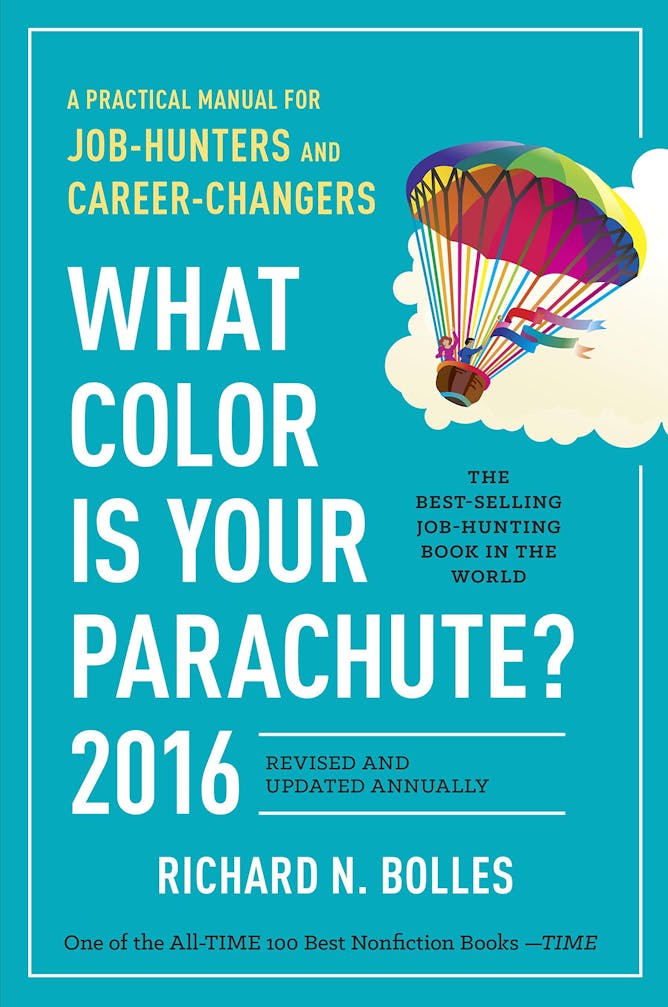
What Color is Your Parachute? by Richard N. Bolles.
(Handout)

What Color Is Your Parachute?

A Practical Manual for Job-Hunters and Career-Changers

by Richard N. Bolles (Non-fiction. Paperback, 2016 and others. Ten Speed Press.)

This is a popular guide for job seekers. Like most such books, it gives advice on the mechanical details of job hunting, such as good ways to organize a resume.

More importantly — and less commonly — it helps people figure out what they want to do with their lives. What kind of career will best fit your personality? Will you be happier working with people or with data?

The book is an obvious fit for graduates seeking their first job. But it could also help teenagers choose the best education to pursue after high school, or adults trying to make their careers more satisfying.


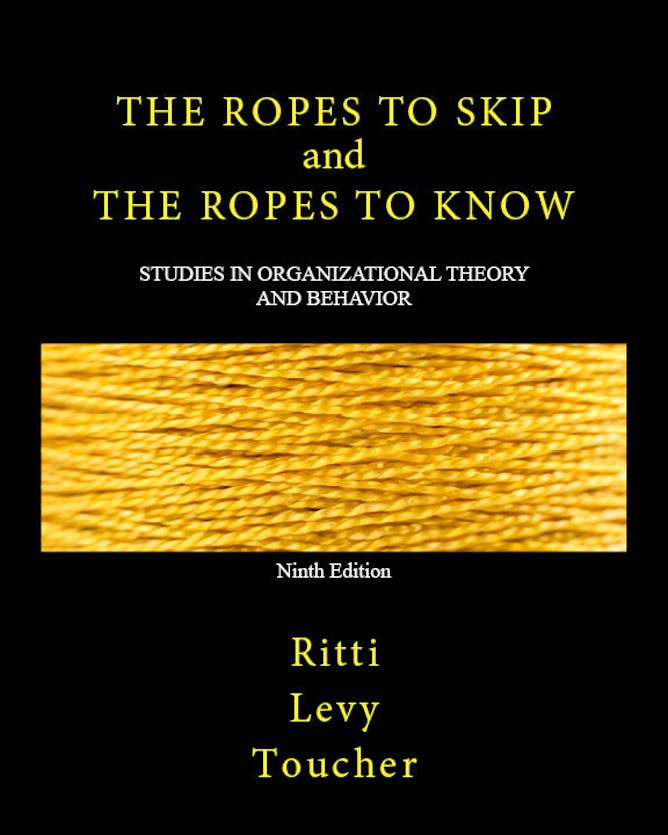
The Ropes to Skip and the Ropes to Know by Ritti, Levy, Toucher.
(Handout)

The Ropes to Skip and the Ropes to Know

Studies in Organizational Theory and Behavior

by R. Richard Ritti, Steve Levy and Neil Toucher (Non-fiction. Hardcover, 2016 and others. Chicago Business Press.)

Don’t let the academic-sounding subtitle deter you. This is a highly readable book. It consists of short stories or parables that illustrate how people behave and interact at work.

Every workplace has an official structure and formal rules. But workplaces contain people with individual personalities and relationships. This book will help you understand the unofficial structures and unwritten rules, before they get you into trouble.

I often recommend The Ropes to Skip and the Ropes to Know to people starting their first job. It would be especially good for someone promoted to their first management or supervisory role.


The Wealthy Barber by David Chilton.
(Handout)

The Wealthy Barber

The Common Sense Guide to Successful Financial Planning

by David Chilton (Non-fiction. Paperback, 2002 and others. Stoddart.)

Once you receive your first paycheque, you’ll want to read this beginner’s guide to personal finance. It covers the basics of investing: retirement savings, mutual funds, etc. It also introduces a lot of other financial topics: savings versus spending, insurance that you do or don’t need, and so on.

This probably isn’t the only financial guide you’ll ever need, but it is a good first one. I typically recommend it to recent graduates starting their careers. But it also suits mature adults dealing with money issues for the first time, perhaps after the death or divorce of their spouse.

The ConversationHave an enjoyable and productive fall!

Michael J. Armstrong, Associate professor of operations research, Brock University

This article was originally published on The Conversation. Read the original article.

Unknown's avatar

How Winnie the Pooh teaches us the importance of play


Eleanor Byrne, Manchester Metropolitan University

He is famous for his love of honey, and being a bear of “little brain”. So Winnie the Pooh might be a little surprised to find himself the subject of a major new museum exhibition.

Winnie the Pooh: Exploring a Classic will explore the creative partnership of writer A.A. Milne and illustrator E.H. Shepard. Together they produced the much-loved whimsical stories featured in Winnie the Pooh (1926) and The House at Pooh Corner (1928).

The decision by the Victoria and Albert museum in London to hold the exhibition proves that the bear and his friends have become establishment figures. As children’s literature expert Peter Hunt notes, they are “part of British culture, passing from generation to generation”.

One element of the incredible success of the Pooh books is that they reflect ideas about childhood that emerged in what is widely known as the “golden age” of children’s literature, spanning from the mid-19th century to World War I.

The golden age view of a child’s world was one that was close to nature – the child an innocent before the imposed horrors of school and education, and a figure of loss and nostalgia for the adult. This was very much the landscape of Winnie’s home in Hundred Acre Wood.

As cultural theorist Stefan Herbrechter said: “Children are supposed to live in a world of their own, which is clearly defined and marked out as the space and time for play and in which toys are the main objects and controlling devices of socialisation.”

However, Milne’s books are more poignant and have a slightly different flavour, than other examples, such as Wind in the Willows (of which Milne was a great fan, writing a stage adaptation). They came after World War I, when many illusions about innocence, the upper class, Englishness and patriotism had reached breaking point.

They contain traces of the experiences in the trenches that marked both Milne and Shepard, whose illustrations of carnage at the Somme and Paschendale were the subject of a separate recent exhibition.

The pastoral paradise of Hundred Acre Wood was one that Milne, who wrote passionately in favour of pacifism, conjured from his own childhood memories – back to a time before the terrifying intrusion and destruction of the war.

As such, Milne’s invented world is also saturated with loss, poignantly embodied in the depressed donkey character of Eyore, who sees no reasons to be cheerful. It is also haunted by the threat of leaving the safe space of the wood for places over the horizon that can’t yet be seen. When Christopher Robin and Pooh organise an “expotition” to the North Pole, they find a large pole in the woods and label it accordingly.

Toys, argues Herbrechter, are intimately concerned with storytelling. They are “like little story machines, narrative catalysers, objects that help make sense of the world”.

This idea is addressed with humour and complexity in Milne’s writing, and beautifully rendered in Shepard’s illustrations that always emphasise the “toyness” of the animals. It explains much about why these books have remained so loved.

Pooh the satirist

Milne shows his real life son Christopher (whom Christopher Robin was named after) how playing with his toys is a kind of writing, just as the playwright makes scenes for his characters. Before he wrote the Pooh stories, Milne worked as a playwright and as a satirist at Punch magazine.

We can detect the specific pleasures of introducing the craft of storytelling to his son from a man who made a living from writing. Milne’s stories gently teach the young credulous reader, who reads literally, that they may be other more rewarding ways of interpreting the world, and what the difference is between what people say and what they mean.

Milne offers the pleasures of word play. The narrator explains that “Winnie the Pooh lived in the forest all by himself under the name of Sanders”, which meant “he had the name over the door in gold letters and lived under it”.

The non-literal reader is invited to find this funny. Similarly, if Piglet says anything “carelessly” he is probably concealing a very important wish. He will say he isn’t afraid when he wants to appear brave.

Although the Pooh books were famously dismissed by fellow satirist Dorothy Parker, who wrote a dismayed and withering review of Winnie-the-Pooh, the success of Milne’s works suggests that he managed to translate his love of making stories into a form that beguiled the child reader. Stories which showed how they too might make an imaginative life for themselves in the world of storytelling and understand how to master words and meanings.

In one notable scene Pooh finds himself stuck on the doorway to Rabbit’s house, and must wait for a week until he is thin enough to be pulled free. Christopher Robin sits down with him and reads him a “sustaining book”, such as would help and comfort a Wedged Bear in Great Tightness.

The ConversationThe comforting presence and companionship of a good book is something all readers of Pooh take away with them. And it is perhaps this which explains the enduring popularity of these stories, which taught us how to read and write in our own way.

Eleanor Byrne, Senior Lecturer in English, Manchester Metropolitan University

This article was originally published on The Conversation. Read the original article.

Unknown's avatar

Tips for Reading Multiple Books at the Same Time


The link below is to an article that looks at 5 tips for reading multiple books at the same time.

For more visit:
https://bookriot.com/2017/09/24/tips-for-reading-multiple-books-at-the-same-time/

Unknown's avatar

From Print to Electronic Books


The link below is to an article that takes a look at the transition from printed books to ebooks.

For more visit:
http://www.mydaytondailynews.com/news/opinion/from-print-books-sadly-but-inevitably/DutwSmb4iMXamcPLRoLPjO/