Unknown's avatar

Betty Crocker turns 100 – why generations of American women connected with a fictional character


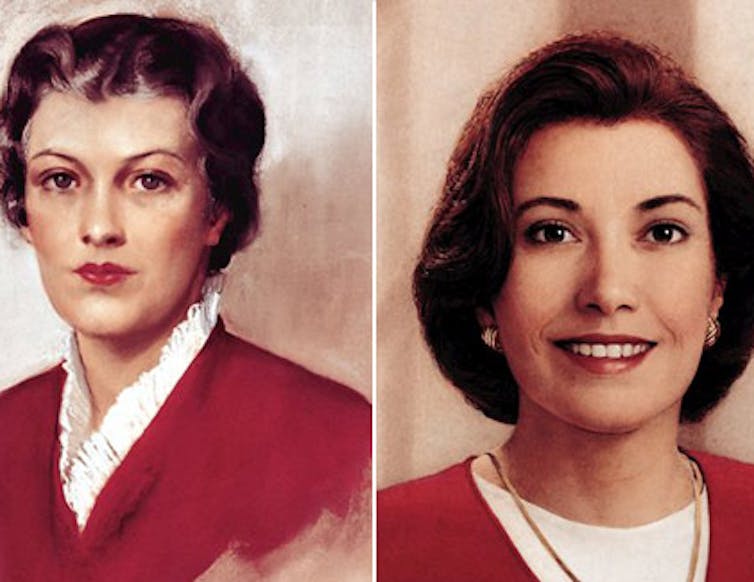
Betty Crocker’s first official portrait, on the left, from 1936. Her most recent portrait, from 1996, is on the right.
BettyCrocker.com

Elizabeth A. Blake, Clark UniversityThough she celebrates her 100th birthday this year, Betty Crocker was never born. Nor does she ever really age.

When her face did change over the past century, it was because it had been reinterpreted by artists and shaped by algorithms.

Betty’s most recent official portrait – painted in 1996 to celebrate her 75th birthday – was inspired by a composite photograph, itself based on photographs of 75 real women reflecting the spirit of Betty Crocker and the changing demographics of America. In it, she doesn’t look a day over 40.

More importantly, this painting captures something that has always been true about Betty Crocker: She represents a cultural ideal rather than an actual woman.

Nevertheless, women often wrote to Betty Crocker and saved the letters they received in return. Many of them debated whether or not she was, in fact, a real person.

In my academic research on cookbooks, I focus primarily on the way cookbook authors, mostly women, have used the cookbook as a space to explore politics and aesthetics while fostering a sense of community among readers.

But what does it mean when a cookbook author isn’t a real person?

Inventing Betty

From the very beginning, Betty Crocker emerged in response to the needs of the masses.

In 1921, readers of the Saturday Evening Post were invited by the Washburn Crosby Co. – the parent company of Gold Medal Flour – to complete a jigsaw puzzle and mail it in for a prize. The advertising department got more than it expected.

In addition to contest entries, customers were sending in questions, asking for cooking advice. Betty’s name was invented as a customer service tool so that the return letters the company’s mostly male advertising department sent in response to these queries would seem more personal. It also seemed more likely that their mostly female customers would trust a woman.

“Betty” was chosen because it seemed friendly and familiar, while “Crocker” honored a former executive with that last name. Her signature came next, chosen from among an assortment submitted by female employees.

As Betty became a household name, the fictional cook and homemaker received so many letters that other employees had to be trained to reproduce that familiar signature.

The advertising department chose the signature for its distinctiveness, though its quirks and contours have been smoothed out over time, so much so that the version that appears on today’s boxes is hardly recognizable. Like Betty’s face, which was first painted in 1936, her signature has evolved with the times.

Betty eventually became a cultural juggernaut – a media personality, with a radio show and a vast library of publications to her name.

The many faces of Betty Crocker.

An outlier in cookbook culture

As I explain to students in my food and literature courses, cookbooks aren’t valued solely for the quality of their recipes. Cookbooks use the literary techniques of characterization and narrative to invite readers into imagined worlds.
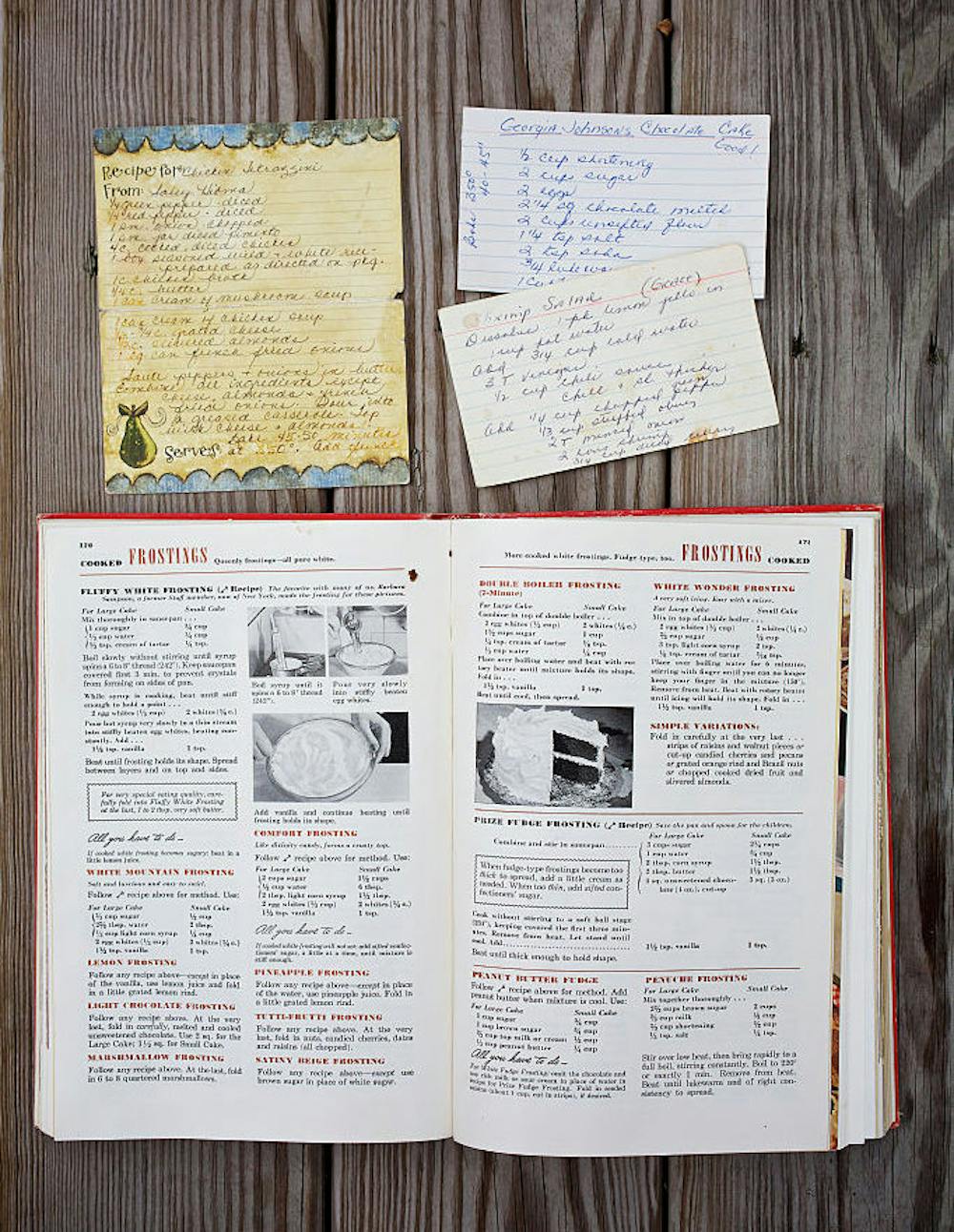
Handwritten recipe cards pictured above an open cookbook.
Recipes can be imbued with nostalgia, personality and aspiration.
Deb Lindsey For The Washington Post via Getty Images

By their very nature, recipes are forward-looking; they anticipate a future in which you’ve cooked something delicious. But, as they appear in many cookbooks – and in plenty of home recipe boxes – recipes also reflect a fondly remembered past. Notes in the margin of a recipe card or splatters on a cookbook page may remind us of the times a beloved recipe was cooked and eaten. A recipe may have the name of a family member attached, or even be in their handwriting.

When cookbooks include personal anecdotes, they invite a feeling of connection by mimicking the personal history that is collected in a recipe box.

Irma Rombauer may have perfected this style in her 1931 book “The Joy of Cooking,” but she didn’t invent it. American publishers started printing cookbooks in the middle of the 18th century, and even the genre’s earliest authors had a sense of the power of character, just as many food bloggers do today.

An American ideal

But because Betty Crocker’s cookbooks were written by committee, with recipes tested by staffers and home cooks, that personal history isn’t quite so personal.

As one ad for the “Betty Crocker Picture Cook Book” put it, “The women of America helped Betty Crocker write the Picture Cook Book,” and the resulting book “reflected the warmth and personality of the American home.” And while books like “Betty Crocker’s Cooky Book” open with a friendly note signed by the fictional homemaker herself, the recipe headnotes carefully avoid the pretense that she is a real person, giving credit instead to the women who submitted the recipes, suggesting variations or providing historical context.
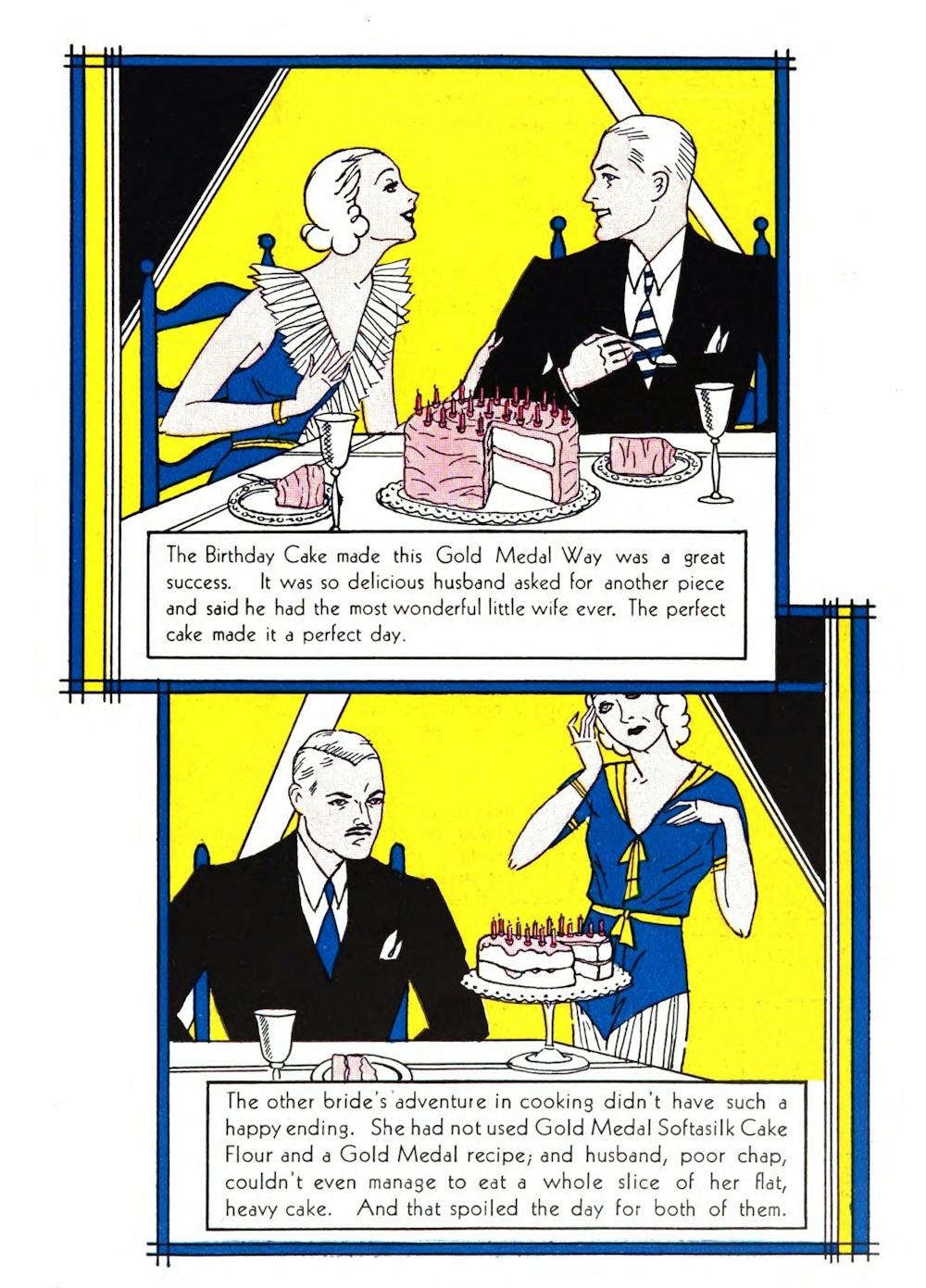
Drawings of two couples eating birthday cakes.
Betty Crocker dispenses advice for becoming ‘the most wonderful little wife ever.’
Hathi Trust Digital Library

Betty Crocker’s books invited American women to imagine themselves as part of a community connected by the loose bond of shared recipes. And because they don’t express the unique tastes of a particular person, Betty Crocker books instead promote taste as a shared cultural experience common to all American families, and cooking as a skill to which all women should aspire.

The “Story of Two Brides” that appears in Betty Crocker’s 1933 pamphlet “New Party Cakes for all Occasions” contrasts the good “little bride” who “has been taking radio cooking lessons from Betty Crocker” with the hapless “other bride” whose cooking and shopping habits are equally careless. The message here isn’t particularly subtle: The trick to becoming “the most wonderful little wife ever” is baking well, and buying the right flour.

Betty today

Despite its charming illustrations, the retrograde attitude of that 1933 pamphlet probably wouldn’t sell very many cookbooks today, let alone baking mixes, kitchen appliances or any of the other products that now bear the Betty Crocker brand, which General Mills now owns.

But if Betty Crocker’s branding in the supermarket is all about convenience and ease, the retro stylings of her newest cookbooks are a reminder that her brand is also a nostalgic one.

Published this year, for her 100th anniversary, the “Betty Crocker Best 100” reprints all of Betty’s portraits and tells the story of her invention. Rather than using the logo that appears on contemporary products, the front cover returns to the quirkier script of the early Betty, and the “personal” note at the opening of the book reminds readers that “it’s always been about recognizing that the kitchen is at the heart of the home.”

As Betty is continually reinvented in response to America’s evolving sense of self, perhaps this means valuing domestic labor without judging women by the quality of their cakes, and building community between all bakers – even those who won’t ever be good little brides.

[You’re smart and curious about the world. So are The Conversation’s authors and editors. You can read us daily by subscribing to our newsletter.]The Conversation

Elizabeth A. Blake, Assistant Professor of English, Clark University

This article is republished from The Conversation under a Creative Commons license. Read the original article.

Unknown's avatar

If you want to publish a truly subversive novel, have a main character who’s fat


Beth Younger, Drake University

Banned Books Week, held this year from Sept. 25 to Oct. 1, is an annual event designed to draw national attention to the harms of censorship. Created in 1982 by the American Library Association in response to a growing number of “challenged” books in schools and libraries, the week is really about celebrating the freedom to read.

Much of the practice of book banning takes the form of challenging a book deemed subversive and objectionable, with profanity or sexual content often the book challengers’ source of ire.

These days, such campaigns can elicit an eye roll: everyone knows that teens are regularly exposed to profanity and sex online and on TV. (Rather than try to ban books, a better approach is to instead teach media literacy so young people are better able to contextualize what they’re exposed to.)

The problem is that when you go after books for swears or sex, you might also be threatening books that are truly subversive: the ones that confront our unconscious biases, whether it’s weight or race, and question the way we tend to think about ourselves and others. One frequently challenged book – Rainbow Rowell’s 2013 young adult novel “Eleanor & Park” – does just that.

Challenged in Minnesota

“Eleanor & Park” is a romance novel about two misfits who become friends, fall in love and endure the cruelties of the world: abusive parents, poverty and bullying.

The same year it was published, a parent group in the Anoka-Hennipin school district in Minnesota tried (and failed) to get the book removed from the curriculum and school libraries. But they did manage to get the author’s visit to Anoka High School canceled.

Citing 227 instances of profanity, the parents alleged that “Eleanor & Park” was “littered with extreme profanity and age inappropriate subject matter that should never be put into the hands and minds of minor children, much less promoted by the educational institutions and staff we entrust to teach and protect our children.”

What are we afraid of?

Banning books in the United States is nothing new, and there’s a long history of trying to prevent people (mostly kids and teens) from reading things some think they shouldn’t read.

It seems that the only thing worse than sex or the “f word” in young adult literature is being a lesbian. Depicting a gay couple got copies of Nancy Garden’s 1982 lesbian romance novel “Annie on My Mind” burned on the steps of the Kansas City School District headquarters in 1993.

Young adult author Judy Blume.
Carl Lender/flickr, CC BY

Judy Blume’s books are famous for pushing the “decency” envelope. Her 1972 novel “Forever…” is also frequently banned for sexual content and for profanity. (Pretty much yearly since its publication, “Forever…” has been challenged by Focus on the Family or The Christian Coalition.)

But there’s another aspect to “Forever…” that’s rarely discussed: It has a fat character who has lots of sex. Sybil is often seen as a foil to the main character Katherine, a rail-thin control freak who loses her virginity deliberately and with purpose.

Sybil is the other side of the body image spectrum: She’s fat and “has been laid” by six guys. At least she gets to have sex, which is pretty uncommon for a fat girl in 1972 young adult fiction. (And there’s a penis named Ralph in the book, yet another reason to read this classic.)

But “Forever…” is an extreme outlier. The way the media depicts fat characters – and fat people – has been a problem for generations. In 2011 NPR aired a piece on fat stereotypes in pop culture. The report dissected the typical fat character in TV shows and films: someone “self-loathing” and “desperate to be loved.”

Of course, the lives of fat people aren’t much different from those of thin people. But you wouldn’t know that from the way fat bodies are portrayed on TV and in film. Research on “weight bias in the media” suggests that most representations of fat people in media are stigmatizing. More research suggests that shows like “The Biggest Loser” and “More to Love” reinforce anti-fat bias rather than fat acceptance.

We were all teenagers once

This is why “Eleanor & Park” is so refreshingly different.

Like many protagonists in young adult novels, Eleanor is a teenager who’s desperate to be an adult so she can escape her awful circumstances. But while the parents trying to ban the book pounced on the profanity, they ignored one of the novel’s biggest triumphs: Eleanor is fat. Yes, Eleanor is a fat female protagonist in a young adult romance novel and she’s in love – she even has a cute boyfriend named Park.

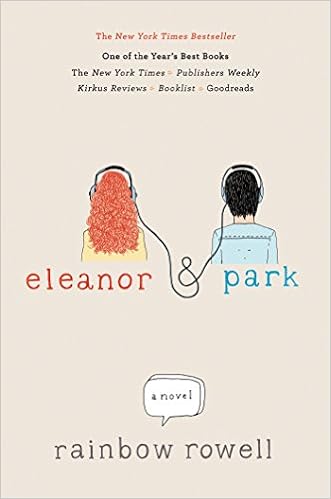
The cover art for Rainbow Rowell’s ‘Eleanor & Park.’
Amazon

As author John Green wrote in a review of the novel, “…the obstacle in ‘Eleanor & Park’ is simply the world. The world cannot stomach a relationship between a good-looking Korean kid and Big Red.” (Big Red is Eleanor’s nickname.)

Last year, Buzzfeed writer Kaye Toal penned a beautiful personal essay about discovering Eleanor in an airport bookstore. Part of what struck Toal as significant about Eleanor is that she is fat yet is not required to become thin or change in order to be loved. Despite the recent increase in fat characters appearing on television and in movies, many of them are required to change in order to be accepted. Not surprisingly, another study published in 2013 connects the prevalence of the “thin ideal” in popular literature to low self-esteem in female readers.

Letting Eleanor be fat and be loved is much needed in today’s climate of “the obesity epidemic” and misplaced concerns with fatness. Park loves Eleanor; she loves him back. A simple story, but with a difference. Eleanor’s fat is not really a crucial aspect of her being. She doesn’t need to be fixed.

That’s what makes this lovely and painful novel subversive – and what makes efforts to ban it all the more misguided.

The Conversation

Beth Younger, Associate Professor of English & Women’s and Gender Studies, Drake University

This article was originally published on The Conversation. Read the original article.

Unknown's avatar

Website: NovelPoster – Literary and Twitter Posters


Here’s a site that may be of interest to bibliophiles who are interested in having artwork that’s a bit different, yet reflects their own unique reading character and personality.

For more visit:
http://www.novelposter.com/

Unknown's avatar

Free Book: A God Entranced Vision of All Things – The Legacy of Jonathan Edwards


The link below is to a Blog where you can get a free ebook copy of this book, which is edited by John Piper and Justin Taylor. This book examines the character and teaching of Jonathan Edwards, a pastor from the era of the Great Awakening in the USA.

How do you get a copy? Simply leave a request in the comments section of the post linked to below.

If you would like other books visit the Blog, subscribe to it to keep up to date on what books are available and tell your friends about the site.

To Obtain a Copy of the Book, Visit:
http://searchandtrace.wordpress.com/2012/03/29/a-god-entranced-vision-of-all-things-the-legacy-of-jonathan-edwards/

Visit the Blog at:
http://searchandtrace.wordpress.com/