
The link below is to an article that takes a look at ebook subscription services.
For more visit:
https://goodereader.com/blog/e-book-news/will-ebook-subscription-services-learn-from-past-mistakes

The link below is to an article that takes a look at ebook subscription services.
For more visit:
https://goodereader.com/blog/e-book-news/will-ebook-subscription-services-learn-from-past-mistakes
The link below is to an article reporting on LibraryThing acquiring Litsy.
For more visit:
https://bookriot.com/2018/03/20/librarything-acquires-litsy/

Colin Kidd, University of St Andrews and Gerard Carruthers, University of Glasgow
Glasgow’s annual book festival, Aye Write!, is getting underway. Now in its 11th year, big name writers making appearances include the philosopher AC Grayling, broadcast journalist Robert Peston, crime writer Val McDermid and the mountaineer Chris Bonington.
The name of the festival is a play on “aye right”, a sarcastic Scottish way of saying no. This encapsulates much about the literary outlook in this part of the world – a vernacular defensiveness, a strident overcompensation in the face of imagined English snootiness about Glaswegian speech. A neutral might conclude that the arts in Scotland exist in a state of perma-froth at presumed metropolitan condescension.
If support for Scottish independence can be considered a proxy for such froth, there is certainly much in evidence. At the time of the 2014 independence referendum, the Scottish literary scene was near unanimously in favour of a Yes vote – nowhere close to the 55-45 split among the wider population.
This normally disputatious crowd felt overwhelmingly that the Union was inimical to Scottish culture and that the literary tradition would best flourish with independence. Little has changed since. Don’t expect much enthusiasm from them about Theresa May’s Britain at this year’s festival.
This mood didn’t begin in 2014, it must be said. In the Thatcher-hating days of 1988, the pro-devolution Campaign for a Scottish Assembly gave this starkly black and white assessment:
The Union has always been, and remains, a threat to the survival of a distinctive culture in Scotland.
Is this right? Most great Scottish writers – Robert Burns, Walter Scott and Robert Louis Stevenson, for example – thrived within the Union between Scotland and England. Indeed, most Scots will know much more about their nation’s literature since 1707 than about previous eras.
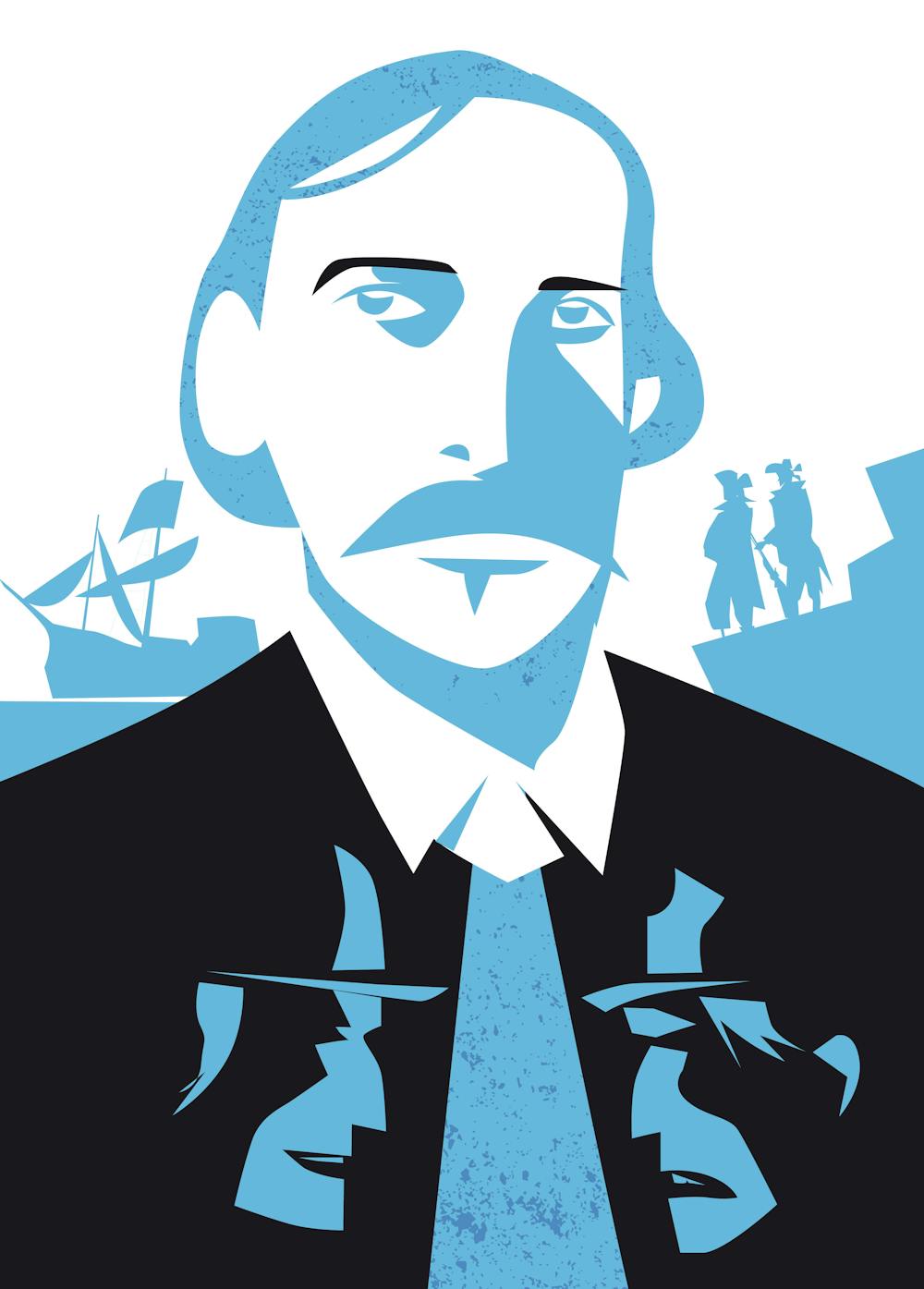
If the Union was such a problem for Scottish writers, why was it invisible in what they had to say? Why is there no tradition of anti-Unionist invective? Aside from Burns’s well-known 1791 poem condemning the “parcel o’ rogues” who “bought and sold” Scotland “for English gold”, the Union is at best an absent presence. Even today it receives little attention from Scottish writers – why?
Scottish literature’s relationship with the Union is the focus of a new book of essays which we have edited, Literature and Union: Scottish Texts, British Contexts. The most compelling explanation for the lack of literary attention to the Union is that until recently, other questions were more important to Scottish writers, especially in the 18th and 19th centuries.
In particular, partisanship and religion long trumped national identity. Indeed, they were deeply interwoven, shaping two distinctive mythical representations of Scotland.
One was Presbyterian and democratic, the myth of Scotland’s godly Covenanting tradition. The other was Episcopalian, royalist and Jacobite, the cause of Bonnie Prince Charlie and the Forty-five Rising. Each reached back to earlier periods – the Covenanters claimed to be the true heirs of the Scottish Reformation; Jacobite sympathisers were entranced by the romantic plight of Mary, Queen of Scots, imprisoned and finally beheaded by a Protestant queen.
Walter Scott’s Waverley (1814) might be the classic example of the Jacobite representation, recounting many of the events of 1745 from a perspective very sympathetic to the Highland rebels. It was followed by a long stream of Jacobite literature – and Scott himself returned to the theme both in Rob Roy (1817) and Redgauntlet (1824).
Depictions of Covenanters are variously positive and negative in Scottish literature. Many 19th-century novels present them as heroes for their democratic outlook, with their roots in the culture of ordinary folk. John Galt’s Ringan Gilhaize (1823) is one example, telling the story of three generations of rural people.
Other writers are repelled by the illiberal and philistine totalitarianism they discern in the tradition. The most notorious example is James Hogg’s 1824 satire, The Private Memoirs and Confessions of a Justified Sinner, whose lead character considers that having attained his place among God’s saved, he has carte blanche to commit terrible crimes.

Nationalism took hold on the Scottish literary scene over the course of the 20th century, primarily under the enduring influence of Hugh MacDiarmid. Even so, he and others held to a view that Scotland’s Reformation had been just as bad, if not worse, than the Union. For McDiarmid, it was the founding of the Protestant church – and not the merger with England – that was the beginning of the repression of Scottish folk and their authentic culture.
Novels and poems about Covenanting and Jacobitism still abound today. James Robertson, for example, who is appearing at this year’s Aye Write!, makes sport with Covenanting fanaticism in The Fanatic (2000) and The Testament of Gideon Mack (2006). Robertson has also written the only novel that has brought Scottish nationhood into focus in recent years: And the Land Lay Still (2010). More generally, the Union remains a submerged and largely invisible feature of the Scottish literary landscape.
While it is true that the Union never enjoyed much of a fanfare among Scottish writers of previous generations, it was rarely if ever the focus of their work. Several even made conspicuous contributions to British – indeed to English – national identities. How else do we account for the fact that the figure of John Bull was the coinage of a Scottish doctor, John Arbuthnot, and Rule, Britannia the work of the Scottish poet, James Thomson?
It is hard to imagine a Scottish writer expressing a similar sentiment in their work today. Yet the reluctance to write about independence has continued, despite writers’ enthusiasm for the cause. It is as if the literary tradition weighs heavy on their shoulders and encourages them to look elsewhere for inspiration.
 In sum, the relationship between Scottish literature and the Union turns out to be much more tangled, ironic and surprising than might have been expected. Today’s nationalists do indeed dominate Scotland’s literary scene, and will undoubtedly be in force at Aye Write!, but they do not have all the best tunes. It will be fascinating to see to what extent this changes in future.
Colin Kidd, Professor of History, University of St Andrews and Gerard Carruthers, Francis Hutcheson Professor of Scottish Literature, University of Glasgow
This article was originally published on The Conversation. Read the original article.
The link below is to an article that takes a look at the importance of the PDF file format.
For more visit:
https://motherboard.vice.com/en_us/article/pam43n/why-the-pdf-is-secretly-the-worlds-most-important-file-format
Emily Reed, University of Sheffield
When learning a new language, what’s the first thing most of us do? If you are like me, you flick through the dictionary to find all the naughty words. And a quick glance on Amazon will reveal a veritable library dedicated to the rigorous pursuit of insulting around the world. We seem to be just a little obsessed – and why the hell not?
But we actually don’t need to reach for the nearest Collins dictionary to pick up some polyglot profanities. Many English swear words have come from different languages over the centuries. For example, the classics – “fuck”, “shit” and “cunt” – are words the language shares with older Germanic and Scandinavian languages. Fuck is likely to be cognate with the Dutch “fokken”, which in the 15th century meant “to mock” – and may also be related to Middle High German “ficken”, meaning “to rub”’. Both words began to be related to sexual intercourse in the 16th century.
The earliest mention we have in English for fuck (in the sense of copulation) is in a Latin-English sermon from 1500. That’s right, a sermon (find it here on page 91). What is particularly fascinating here is the encryption – with each letter representing the one before it in the alphabet, suggesting some level of aversion to the word:
Non sunt in cœli, quia gxddbov xxkxzt pg ifmk.
Decrypting the last four rather incriminating words gives us: “fvccant vvjvys of heli” – which, when translated means: “They [monks] are not in heaven because they fuck the wives of Ely.”. To decipher the code, we have to bear in mind the differences in both the alphabet and spelling between then and now: the letter “w” did not exist, instead, one could use “vv” to represent this sound. You could also use “j” in the place of “i”, and “v” in the place of “u”.
Fuck also appears in Middle English names and place names, often meaning “to strike”. Hence Henry Fuckebegger (on the record in 1286) most likely beat the poor, rather than shagging them. Shit and cunt, which both have cognates in earlier Germanic and Scandinavian languages, have also been used in placenames from the Middle Ages. Skidbrooke in Lincolnshire, for example, appears in the Domesday book as “Schitebroc” – that is: “Shit-brook”. In fact, if you ever walk down a Grape or Grove Lane, chances are it used to be one of the many “Gropecuntlanes”, denoting a medieval red-light district.

So we know that a lot of our favourite swears are loans from the Germanic and Scandinavian language families. Well, yes and no. The words may come from these origins, but where their use comes from is where it can get interesting. I’m about to make the case that one of the most quintessentially British swear words is, in fact, kind of French. The word I’m talking about is “bloody”, as in, every time Harry Potter’s Ron Weasley exclaims “Bloody hell, Harry!”
The origins of this one seem consistent with the rest of the swear words – it’s a Germanic word that appears in Old and Middle English as an adjective meaning “bloodthirsty”, “cruel” and “murderous” alongside the more obvious “bloodstained” sense. But nowhere is it used as a swear word. One could make the case that the swear use comes from contact with Anglo Norman, which was a variety of French that came with the Normans in 1066. This is because it is in Anglo Norman that we find the French word “sanglant” (meaning “bloody”) being used as a swear word.
Sanglant appears twice in a 1396 version of a conversation manual called the Manières de langage, which was essentially the textbook for learning French at the turn of the 15th century. It appears in insults such as “senglant merdous garcion” (“bloody filthy rogue”), and “senglent filz de putaigne” (“bloody son of a whore”). Indeed, sanglant as a swear word seems to have enjoyed a particularly Anglo-Norman flavour.
In the continental French farce Pathelin (1457), the eponymous character attempts to avoid repaying a debt by babbling in various French dialects in an attempt to appear mad. He utters the words “sanglant paillart” (“bloody bastard”) while speaking in the Norman dialect. Moreover, in the Chronique de Charles VII, the French call the “Angloiz et Normans” (Angles and Normans) by the insult “senglans puans mezeaulx porriz” (“bloody putrid rotting lepers”). Here, the French are ironically insulting the English in one of their own tongues, which was at that time a dialect of French.
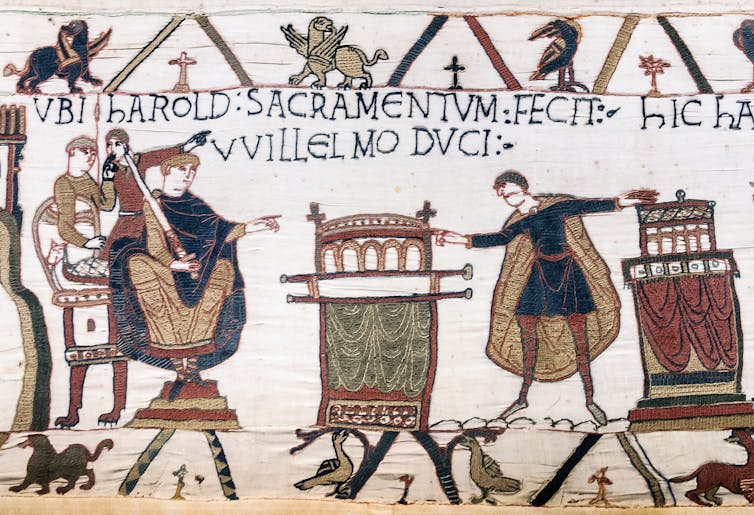
It is only after the appearance of “sanglant” that we then get “bloody” as a swear word – which means that it is very likely that this seemingly Germanic word has assumed a Francophone character.
Research into the English language reveals that the UK shares more with Europe than many realise. The language contact situation is particularly diverse for Britain, with heavy influence from Germanic/Scandinavian languages. As the evolution of the word “bloody” suggests, Anglo Norman also played a fundamental role in how English speakers use words.
 But for Anglo Norman, the key message is that this was a variety of French that was viewed in the Middle Ages as a British language. Hence, English has evolved from a background of significant linguistic diversity that has formed part of the country’s identity for centuries. And the traces of that are sometimes hiding in plain sight.
Emily Reed, Doctoral Researcher in Late-Medieval Linguistics and Literature, University of Sheffield
This article was originally published on The Conversation. Read the original article.
The link below is to an article reporting on copyright issues faced by Project Gutenberg in Germany.
For more visit:
https://teleread.org/2018/03/03/project-gutenberg-blocks-german-users-after-court-rules-in-favor-of-holtzbrinck-subsidiary/
Andreea S. Calude, University of Waikato
My grammar checker and I are on a break. Due to irreconcilable differences, we are no longer on speaking terms.
It all started when it became dead set on putting commas before every single “which”. Despite all the angry underlining, “this is a habit which seems prevalent” does not need a comma before “which”. Take it from me, I am a linguist.
This is just one of many challenging cases where grammar is slippery and hard to pin down. To make matters worse, it appears that the grammar we use while speaking is slightly different to the grammar we use while writing. Speech and writing seem similar enough – so much so that for centuries, people (linguists included) were blind to the differences.
Read more:
How students from non-English-speaking backgrounds learn to read and write in different ways
Let me give you an example. Take sentences like “there is X” and “there are X”. You may have been taught that “there is” occurs with singular entities because “is” is the present singular form of “to be” – as in “there is milk in the fridge” or “there is a storm coming”.
Conversely, “there are” is used with plural entities: “there are twelve months in a year” or “there are lots of idiots on the road”.
What about “there’s X”? Well, “there’s” is the abbreviated version of “there is”. That makes it the verb form of choice when followed by singular entities.
Nice theory. It works for standard, written language, formal academic writing, and legal documents. But in speech, things are very different.
It turns out that spoken English favours “there is” and “there’s” over “there are”, regardless of what follows the verb: “there is five bucks on the counter” or “there’s five cars all fighting for that Number 10 spot”.
This is not because English is going to hell in a hand basket, nor because young people can’t speak “proper” English anymore.
Linguists Jen Hay and Daniel Schreier scrutinised examples of old recordings of New Zealand English to see what happens in cases where you might expect “there” followed by plural, (or “there are” or “there were” for past events) but where you find “there” followed by singular (“there is”, “there’s”, “there was”).
They found that the contracted form “there’s” is a go-to form which seems prevalent with both singular and plural entities. But there’s more. The greater the distance between “be” and the entity following it, the more likely speakers are to ignore the plural rule.
“There is great vast fields of corn” is likely to be produced because the plural entity “fields” comes so far down the expression, that speakers do not plan for it in advance with a plural form “are”.
Even more surprisingly, the use of the singular may not always necessarily have much to do with what follows “there is/are”. It can simply be about the timing of the event described. With past events, the singular form is even more acceptable. “There was dogs in the yard” seems to raise fewer eyebrows than “there is dogs in the yard”.
Read more:
How students from non-English-speaking backgrounds learn to read and write in different ways
The disregard for the plural form is not a new thing (darn, we can’t even blame it on texting). According to an article published last year by Norwegian linguist Dania Bonneess, the change towards the singular form “there is” has been with us in New Zealand English ever since the 19th century. Its history can be traced at least as far back as the second generation of the Ulster family of Irish emigrants.
Editors, language commissions and prescriptivists aside, everyday New Zealand speech has a life of its own, governed not so much by style guides and grammar rules, but by living and breathing individuals.
It should be no surprise that spoken language is different to written language. The most spoken-like form of speech (conversation) is very unlike the most written-like version of language (academic or other formal or technical writing) for good reason.
In conversation, there is no time for planning. Expressions come out more or less off the cuff (depending on the individual), with no ability to edit, and with immediate need for processing. We hear a chunk of language and at the same time as parsing it, we are already putting together a response to it – in real time.
This speed has consequences for the kind of language we use and hear. When speaking, we rely on recycled expressions, formulae we use over and over again, and less complex structures.
For example, we are happy enough writing and reading a sentence like:
That the human brain can use language is amazing.
But in speech, we prefer:
It is amazing that the human brain can use language.
Both are grammatical, yet one is simpler and quicker for the brain to decode.
And sometimes, in speech we use grammatical crutches to help the brain get the message quicker. A phrase like “the boxes I put the files into” is readily encountered in writing, but in speech we often say and hear “the boxes I put the files into them”.
We call these seemingly unnecessary pronouns (“them” in the previous example) “shadow pronouns”. Even linguistics professors use these latter expressions no matter how much they might deny it.
There is another interesting difference between speech and writing: speech is not held up on the same rigid prescriptive pedestal as writing, nor is it as heavily regulated in the same way that writing is scrutinised by editors, critics, examiners and teachers.
This allows room in speech for more creativity and more language play, and with it, faster change. Speech is known to evolve faster than writing, even though writing will eventually catch up (at least for some changes).
 I would guess that by now, most editors are happy enough to let the old “whom” form rest and “who” take over (“who did you give that book to?”).
Andreea S. Calude, Senior Lecturer in Linguistics, University of Waikato
This article was originally published on The Conversation. Read the original article.
The link below is to an article reporting on the rebranding and launch of the Apple iBooks App in September 2018.
For more visit:
https://goodereader.com/blog/e-book-news/rebranded-apple-ibooks-app-will-debut-with-ios-12-this-fall
The link below is to an article that takes a look at the hatred of literature.
For more visit:
https://thebaffler.com/the-immediate-experience/trashing-literature-sturgeon
It seems there is a new report every 5 minutes telling us that ebook use is declining or rising, now there is a new one telling us that audiobook and ebook use is rising in the USA. The link below is to an article reporting on the rise.
For more visit:
https://goodereader.com/blog/e-book-news/new-report-proclaims-audiobook-and-ebook-usage-is-on-the-rise
 At the BookShelf


You must be logged in to post a comment.