Unknown's avatar

How literary censorship inspired creativity in Victorian writers


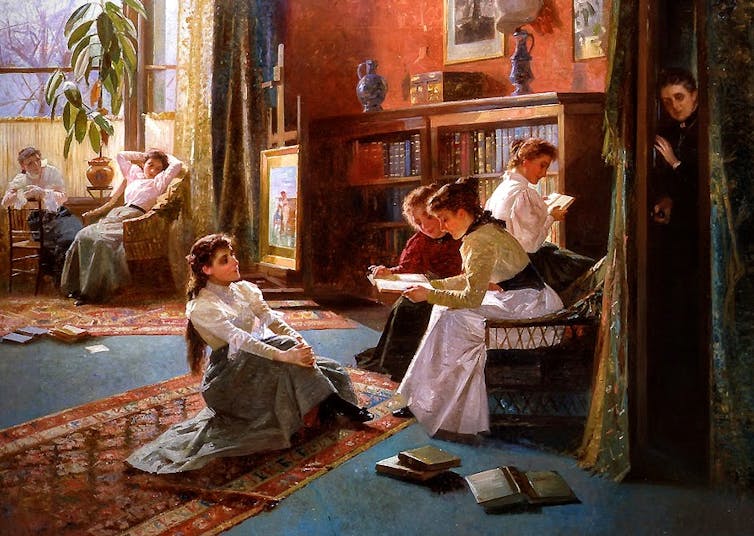
Forbidden Books.
Alexander Mark Rossi

Stephanie Meek, University of Reading

In an open letter published in Harper’s Magazine, 152 writers, including JK Rowling and Margaret Atwood, claim that a climate of “censoriousness” is pervading liberal culture, the latest contribution to an ongoing debate about freedom of speech online.

As we grapple with this issue in a society where social media allows us all to share extreme views, the Victorian writers offer a precedent for thinking differently about language and how we use it to get our point across. How limits of acceptability and literary censorship, for the Victorians, inspired creative ways of writing that foregrounded sensitivity and demanded thoughtfulness.

Not causing offence

There are very few cases of books being banned in the Victorian era. But books were censored or refused because of moral prudishness, and publishers often objected to attacks on the upper classes – their book-buying audience. Writer and poet Thomas Hardy’s first novel, The Poor Man and the Lady, was never published because the publisher Alexander Macmillan felt that his portrayal of the upper classes was “wholly dark – not a ray of light visible to relieve the darkness”.
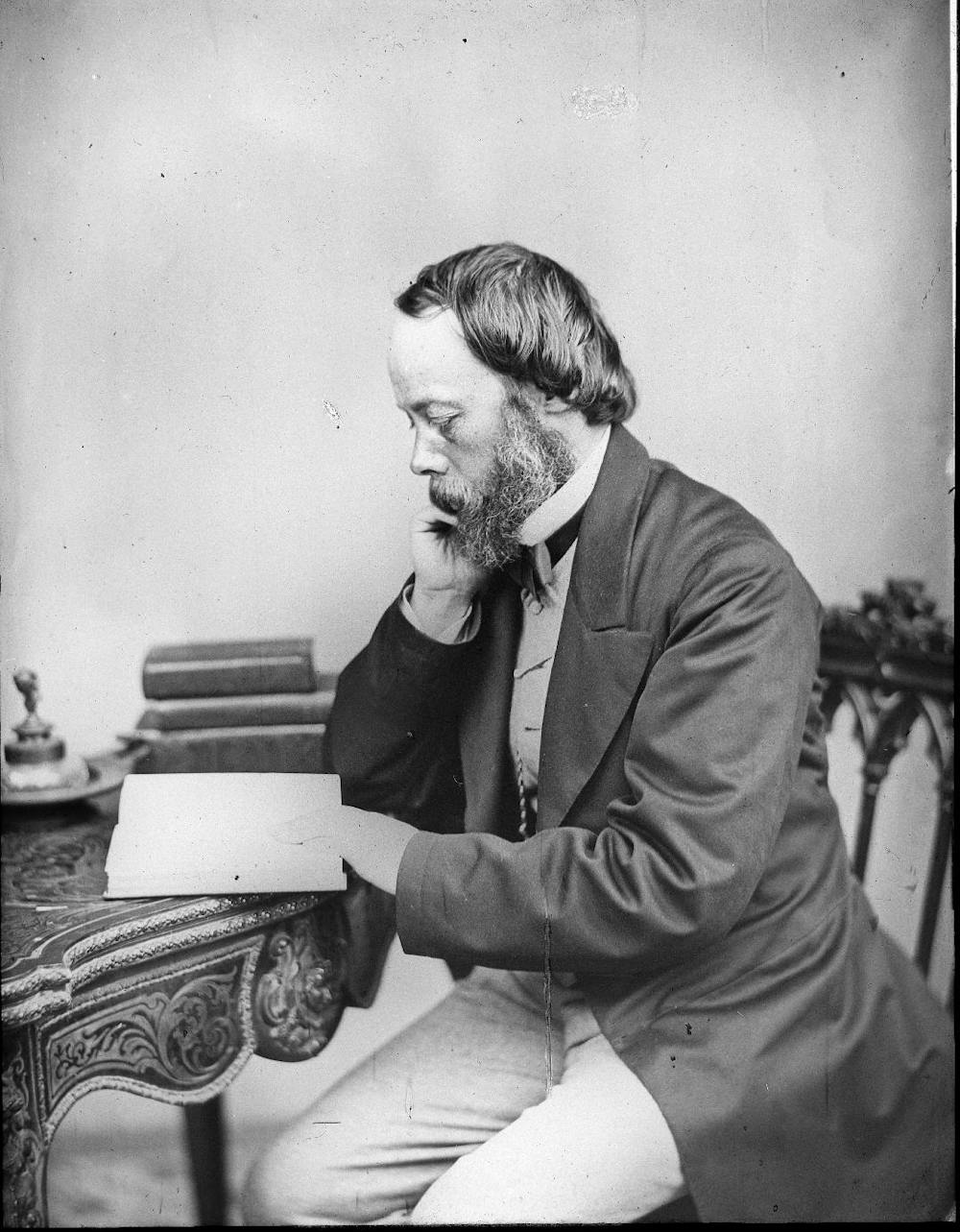
Charles Edward Mudie.
Mudie family archive/Ruth Tillyard

However, more common than publishers turning down books was the refusal of circulating libraries to distribute them. These institutions were an integral part of literary consumerism during the Victorian period as the main means of distributing books.

Most influential of these was Charles Mudie’s Select Library, established in 1842. Mudie’s library was select because he would only circulate books that were suitable for middle-class parents to read aloud to their daughters without causing embarrassment.

This shaped how publishers commissioned and what writers could get away with. Victorian literary censorship, while limiting, managed to inspire writers to develop more creative and progressive ways to get their points across.

Censorship as productive

George Eliot’s publisher, John Blackwood, criticised her work for showing people as they really were rather than giving an idealistic picture. He was particularly uncomfortable when Eliot focused on the difficulties of working-class life.

In Mr Gilfil’s Love Story(1857), Eliot’s description of the orphan girl, Caterina, being subjected to “soap-and-water” raised Blackwood’s censorious hackles:

I do not recollect of any passage that moved my critical censorship unless it might be the allusion to dirt in common with your heroine.
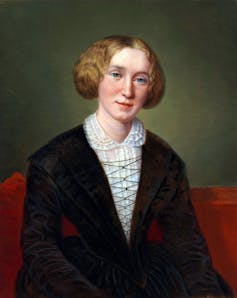
George Eliot.
National Gallery/Wikimedia

As well as dirt, alcohol consumption was also seen as an unwanted reminder of working class problems. Again in Mr Gifil’s Love Story, Eliot describes how the eponymous clergyman enjoys “an occasional sip of gin-and-water”.

However, knowing Blackwood’s views and anticipating she may cause offence galvanised Eliot to state her case directly to the reader within the text itself. She qualifies her unromantic depiction of Mr Gilfil with an address to her “lady” readers:

Here I am aware that I have run the risk of alienating all my refined lady readers, and utterly annihilating any curiosity they may have felt to know the details of Mr Gilfil’s love-story … let me assure you that Mr Gilfil’s potations of gin-and-water were quite moderate. His nose was not rubicund; on the contrary, his white hair hung around a pale and venerable face. He drank it chiefly, I believe, because it was cheap; and here I find myself alighting on another of the Vicar’s weaknesses, which, if I cared to paint a flattering portrait rather than a faithful one, I might have chosen to suppress.

Here, literary censorship enriches Eliot’s writing. Eliot’s refusal to suppress her work becomes part of the story and reinforces her agenda to portray Mr Gilfil as he really is, a vicar who mixes gin with water because he is poor.

Power in not telling

As well as inspiring narrative additions, censorship was also powerful because of what was left out of a text.

One of Hardy’s most loved books, Tess of the D’Urbervilles, highlights the crimes of sexual harassment in the workplace and of rape. Because Hardy had to be careful about the way that he presented the sexual abuse of Tess, his descriptions were very subtle. This is how he portrays the scene where Tess is sexually assaulted by her employer, Alec D’Urberville:

The obscurity was now so great that he could see absolutely nothing but a pale nebulousness at his feet, which represented the white muslin figure he had left upon the dead leaves. Everything else was blackness alike. D’Urberville stooped; and heard a gentle regular breathing. He knelt, and bent lower, till her breath warmed his face, and in a moment his cheek was in contact with hers. She was sleeping soundly, and upon her eyelashes there lingered tears.

The influence of censorship meant that Hardy could not describe this scene in graphic detail. Instead, his depiction is more sensitive and thoughtful. Hardy does not dehumanise Tess by depicting her as a sexual object to entertain the reader.

By focusing on Tess’s “gentle regular breathing” and the poignant image of her tear-stained eyelashes, Hardy avoids gratuitous depictions of violence while at the same time making us painfully aware of the injustice she has suffered. This makes his portrayal of Tess more powerful and poignant. It can be argued that this was achieved because of the limits placed on his writing, not in spite of them.

In these instances, we can see how literary censorship influenced writers to tread more carefully upon difficult territory. It made them think about whether including violence or socially controversial depictions were necessary or gratuitous to their narratives.

For Hardy and Eliot, censorship and its limits inspired creativity, sensitivity and thoughtfulness. These examples can provide food for thought in the debate today about free speech and censorship. As Hardy and Eliot wrestled with as they wrote, can things be said differently and, in some cases, do they need to be said at all?The Conversation

Stephanie Meek, PhD Candidate in English Literature, University of Reading

This article is republished from The Conversation under a Creative Commons license. Read the original article.


Unknown's avatar

What black writers think about the UK’s publishing industry – a survey


Monkeybusinessimagery/Shutterstock

Catherine Harris, Sheffield Hallam University and Bernadette Stiell, Sheffield Hallam University

As people seek to educate themselves in response to Black Lives Matter protests, sales of books by black British authors, such as Reni Eddo-Lodge and Bernadine Evaristo, have topped the UK bestseller lists. Several recent prestigious awards have also been won by black writers, including Candice Carty-Williams who won book of the year for Queenie at the British Book Awards. Although proud of her achievement, she was also “sad and confused” on discovering she was the first black author to win this award in its 25-year history.

While these firsts must be celebrated, they also shine a light on publishing’s systemic practices, which have maintained inequalities and under-representation for black, Asian and minority ethnic writers and diverse books. Despite awareness of its shortcomings and years of debates and initiatives (diversity schemes, blind recruiting practices and manuscript submission processes) the industry has generally failed to achieve lasting change. This is because they fail to address the broader systemic inequalities faced by people of colour, which contribute to ongoing under-representation in the industry.

A substantial market

Our research on diversity in children’s publishing included an online survey of 330 responses and 28 in-depth follow-up interviews with people working across the sector. We found that a key barrier has been the engrained perception among industry decision-makers that there is a limited market for diverse books. This is a belief that books written by black and diverse authors or featuring non-white characters just don’t sell.

This perception is seen across the industry, including in children’s literature. This is despite evidence of substantial markets. For instance, a third of English primary pupils are from a black, Asian or minority ethnic background. However, a report by the Centre For Literacy in Primary Education revealed that although the number of black, Asian and minority ethnic protagonists in children’s books had increased from 1% in 2017 to 4% in 2018, there is still a long way to go to achieve representation that reflects the UK population.

A third of English primary pupils come from Black, Asian or minority ethnic backgrounds, which represents a substantial market for diverse books.
Monkey Business Images/Shutterstock

Similarly, BookTrust reported that only 6% of children’s authors published in the UK in 2017 were from ethnic minority backgrounds, only a minor improvement from 4% in 2007.

What we found was that the lack of role models in the books read by children and young people of colour meant that they were less likely to aspire to careers in the sector. From those we spoke to, this was compounded by the lack of diversity, particularly in senior roles, in publishing. For those who had pursued a publishing career, experiences of everyday racism and microaggressions were widespread. This added to feelings of frustration and a sense that they were not welcome or did not belong in the industry.

Commissioning problems

This all has a knock-on effect on what gets published. Authors of colour that we spoke to expressed frustration about the commissioning process. This included quotas for books by or featuring people of colour, a perceived limited appeal for these books and a feeling that authors of colour could only write about race issues.

Reliance on “traditional routes” to publishing also disadvantages black and working-class authors. Publishers reported receiving high volumes of submissions and heavy workloads led to them relying on established writers rather than seeking out new, diverse talent. This has the impact of narrowing the pool of authors from which books are published.

Our participants – including authors, illustrators, editorial assistants and agents – widely reported that a lack of cultural understanding can also lead to the view that diverse books are a riskier investment. They explained how limited promotion and marketing budgets often resulted in lower sales, reinforcing perceptions of limited demand. From their experience, miscommunication at subsequent points along the supply chain about the demand for and availability of diverse books means that those that are published may not even reach bookshop shelves.

Those interviewed expressed frustration about miscommunication about demands for diverse books leading to many not ending bookshops.
Gary L Hider/Shutterstock

These interconnected factors (among others) create a negative cycle which perpetuates the lack of representation of minorities across all parts of the sector, including the lack of authors of colour being nominated for prizes and awards. Recommendations from our research include ensuring diversity on selection panels for events and awards and some good work is already taking place. However, more systematic collaboration and commitment from the sector will be required to produce lasting and meaningful changes and achieve equality and representation.

Our research participants pointed out that social media was allowing individuals to more effectively come together and raise their voices in support of diversity and representation. They expressed hope that this may help to drive forward meaningful and lasting change in the sector. There are signs that this may be the case with recent campaigns emerging in support of the Black Lives Matter movement.

The #publishingpaidme campaign highlighted racial disparities in publishing advances. The publisher Amistad, an imprint of Harper Collins dedicated to multicultural voices, ran the campaign #BlackoutBestsellerList and #BlackPublishingPower to draw attention to black authors and book professionals and demonstrate the market for these books. The newly formed Black Writers’ Guild, including many of Britain’s best-known authors and poets, wrote an open letter airing concerns and demanding immediate action from publishers. The hope is that these campaigns can focus the industry on bringing about meaningful change.The Conversation

Catherine Harris, Research Associate, Sheffield Hallam University and Bernadette Stiell, Senior research fellow in the Sheffield Institute of Education, Sheffield Hallam University

This article is republished from The Conversation under a Creative Commons license. Read the original article.

Unknown's avatar

On Historical Fiction Writing


The link below is to an article looking at principles of historical fiction writing.

For more visit:
https://www.janefriedman.com/dos-and-donts-of-writing-historical-fiction/

Unknown's avatar

Idioms


The link below is to an article that takes a look at idioms.

For more visit:
https://daily.jstor.org/the-linguistic-case-for-sht-hitting-the-fan/

Unknown's avatar

Collaboration made easy: 6 ways to build a writing relationship


Alexis Brown/Unsplash

Sean Williams, Flinders University

Writing is a pastime best conducted on your own — or so common wisdom would have it. Yet writing teams exist, and in many realms they are expected. Take television, where the writers’ room is the norm. Or the academy: one physics paper has 5,154 authors.

In literature, collaborations are more common than you might realise. For every superstar Neil Gaiman and Terry Pratchett team-up (Good Omens), there might be an F. Scott Fitzgerald and his uncredited wife Zelda, or a “James S. A. Corey” (The Expanse) being the pseudonym for Daniel Abraham and Ty Franck.

Although new writers such as the Brontë siblings may collaborate, the practice seems to fall away with age, perhaps because writing relationships can be as fraught as familial ones, with as many pitfalls to navigate.

Add to this a collaboration nearly always proves to take as long as a solo work and any monies might have to be divided among the contributors. Why would anyone willingly share their art with someone else for little to no benefit?


Read more:
10½ commandments of writing


In my experience, collaborating can be creatively stimulating, educative, motivating, productive, and revitalising. Plus, it’s great to have a friend to keep you company on a publicity tour.

Here are six techniques to help would-be co-writers take their first steps in this direction.

1. The chain

This is the simplest method, one of two that require first settling on what your story will be and then breaking the writing of it into bits completed separately, in chronological order.

There are many ways to serially tackle the discrete tasks that will combine to form a glorious whole. Some teams might choose to write alternate scenes, chapters or sections; others might alternate whole drafts, giving each participant long stretches of time to work on solo projects.

Whichever way you tear it down, every member of the team has a professional obligation to deliver. Break one link in the chain and it falls apart.

The chain method can give each writer long stretches of time to work on solo projects.
Brad Neathery/Unsplash

2. Parallel processing

The second way to devolve an outline requires trust and communication beyond that required of ordinary collaborative relationships.

In parallel processing, you divide characters among authors, so one provides the voice of X, another Y, and so on. Each arc is written separately, then edited together when complete. If X or Y diverge too much from their expected paths, plotting and structural problems can arise, but the powerful juxtaposition of distinct voices can outweigh the risk.

3. The hothouse

An extreme version of serial collaboration, this method used to require being physically in the same room as your writing partner(s). One starts writing and keeps writing until they get stuck. They then tag in the next writer, who takes over. Repeat until done. Food and sleep are optional.

The benefit of this method is the words are guaranteed to keep coming.

These days the “in person” requirement is greatly relaxed. Google Docs is just one platform allowing writers to work on the same document at the same time, no matter where they are.

4. The undertakers

Brainstorming what a story will contain is, for many collaborators, the fun part — providing they can agree on a final project.

One method of achieving this agreement is by giving one of the co-writers a veto to be exercised when consensus can’t be reached.

Another method requires every element of the final project must be agreed to by every collaborator. This can be time-consuming to achieve but avoids any lingering resentment if someone is outvoted or overruled.

To avoid any lingering resentment, every decision can be agreed on by every collaborator.
Toa Heftiba/Unsplash

More generally, every shared undertaking should have a binding agreement in place before serious work commences, covering issues such as whose name goes first, which agent will sell the work, how any resulting IP will be divided, and so on.

It is much better to have these agreements in place and not need them than the other way around.

5. The Marxist Manifesto

Collaborators should have common ambitions but complementary skills, otherwise you might as well work alone. The way roles are divided in the working relationship can reflect those skill sets – which might, of course, lie in non-writerly areas such as business or marketing.

To some, the perfect collaboration is one in which every participant’s weaknesses are covered by strengths in their fellows. Everyone contributes and everyone learns by example.

Not everyone needs to write. Someone on the team might have the perfect brain for business or marketing.
Helena Lopes/Unsplash

6. Resurrection of the dead

Finally, the easiest and safest way to audition a potential co-writer is to give them a failed draft and see what they accomplish with it. If it’s a success, great: the original author gains a new collaborator and a finished work.

Should this (or any of these methods fail) the author is no worse off.

They can just revert to writing alone – for some their natural habitat.The Conversation

Sean Williams, Senior Lecturer, Flinders University

This article is republished from The Conversation under a Creative Commons license. Read the original article.

Unknown's avatar

Why Writers Burn Their Own Work


The link below is to an article that looks at why some writers burn their own work.

For more visit:
https://lithub.com/why-do-some-writers-burn-their-work/

Unknown's avatar

Voices in Their Heads


The link below is to an article that considers the voices in the heads of various authors.

For more visit:
https://www.theguardian.com/books/2020/apr/27/majority-of-authors-hear-their-characters-speak-finds-study

Unknown's avatar

Resources for Writers


The link below is to an article that lists a bunch of free or cheap resources for writers.

For more visit:
https://electricliterature.com/free-or-cheap-resources-for-emerging-writers/

Unknown's avatar

A Surge in Writing


The link below is to an article reporting on the surge in writing during the coronavirus pandemic.

For more visit:
https://www.theguardian.com/books/booksblog/2020/mar/26/novel-writing-during-coronavirus-crisis-outbreak

Unknown's avatar

Writing During the Coronavirus Pandemic


The link below is to an article that looks at writing during the current pandemic.

For more visit:
https://longreads.com/2020/03/19/why-im-giving-myself-permission-to-keep-writing-at-this-time/