
Unknown's avatar

In 20 years of award-winning picture books, non-white people made up just 12% of main characters


Early childhood books shortlisted over the years.
Helen Caple, Author provided

Helen Caple, UNSW and Ping Tian, University of Sydney

A highlight for Australian children’s literature is the announcements of the Children’s Book Council of Australia (CBCA) Book of the Year award winners. This year’s winners will be announced on Friday October 16 — right before the start of CBCA’s Book Week on October 19.

Making the shortlist brings great exposure for the books and their creators. The shortlisted books are put on special display in public school libraries and supermarket shelves. They are even made into teaching resources, suggesting an exploration of the book’s themes, for instance.

Crucially, award lists contribute to the “canon” of literary works that become widely read. This canon is distributed through libraries, schools and homes. Sometimes, benevolent relatives give them as gifts.

We investigated the diversity — including ethnicity, gender and sexuality — of the 118 shortlisted books in the early childhood category of Book of the Year between 2001 and 2020. We also examined diversity among the 103 authors and illustrators who have made the shortlist over the past 20 years.

Our yet unpublished study found most (88%) human main characters in the shortlisted books were white; none of the main characters were Asian, Black or Middle Eastern.

Why diversity matters

The CBCA was formed in 1945, as a national not-for-profit organisation promoting children’s literary experiences and supporting Australian writers and illustrators. The first awards began in 1946.

There were originally three categories for Book of the Year: older readers, younger readers and picture book.

In 2001, “early childhood” was added as a category. This was for picture books for children up to six years old.

Picture books are significant for not only developing early literacy skills, but also for the messages and values they convey about society. They help children learn about their world.


Read more:
Children’s books must be diverse, or kids will grow up believing white is superior


The diversity children see represented in that world affects their sense of belonging and inclusion. At this age, cultural values and bias settle in and become the foundation for how we develop. These values and biases have a profound influence on our successes and struggles in our adult lives.

A positive for gender diversity, but not ethnicity

We used visual content analysis to examine ethnic diversity, we well as gender, disability, sexuality and linguistic variation in the 118 early childhood category shortlisted books — between 2001 and 2020.
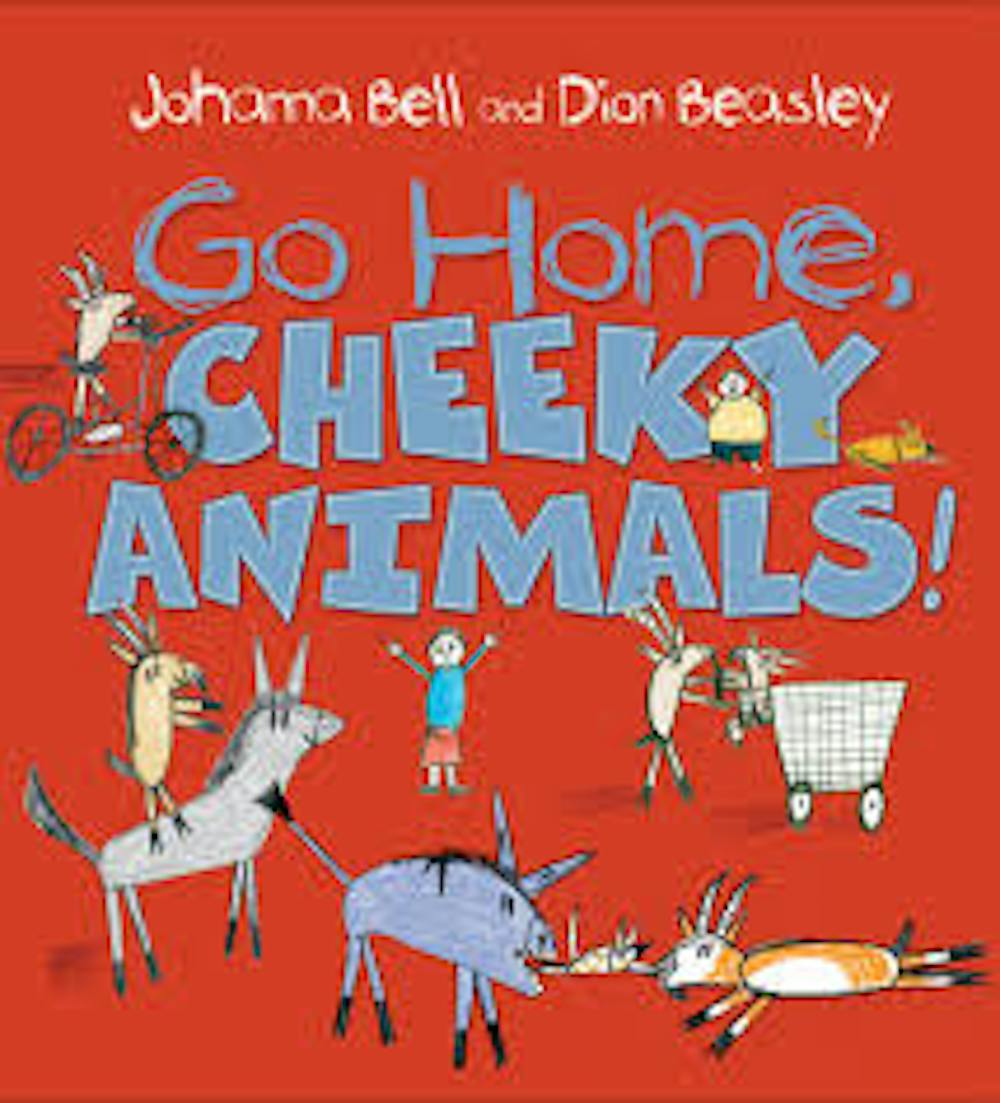
The cover of picture book Go Home Cheeky Animals
Illustrator Dion Beasley.
Allen & Unwin

We also examined diversity among the 103 authors and illustrators who have made the shortlist over the past 20 years. Only one person — Alywarr illustrator Dion Beasley, from the Northern Territory, and winner in 2017 for Go Home Cheeky Animals — identifies as Indigenous.

Female authors and illustrators, however, were more represented (66%) than male (34%).

Looking at the picture books, we first identified four major types of characters: human (52.5%), animal (41.5%), object (4.4%) and imaginary (1.4%).

We then distinguished between main characters and those in supporting roles that make up the story world in which the main characters act.

One of the most encouraging findings was the gender parity among main characters. We identified 52 solo human main characters across all 118 books. Fifty-one of these are children, with 25 boy and 24 girl main characters (two main characters were not identified by gender).


Read more:
Five tips to make school bookshelves more diverse and five books to get you started


This placed boys and girls equally in the role of the protagonist, which stands in contrast to previous research looking at best-selling picture books.

But in terms of ethnicity, the human main characters are overwhelmingly white (88%). There are just two Indigenous main characters and one who is multiracial. There have been no Asian, Black or Middle Eastern main characters.

Looking at the wider story world, supporting characters are still overwhelmingly white. But this world does marginally include characters of Asian, Black and Middle Eastern heritage. Overall, human characters appear in 85 (72%) of the 118 books.

White characters appear in 74 of these books, and only nine books have no white characters. Non-white characters appear in a total of 18 books (21%).

Our results for ethnic diversity don’t correlate well with the latest Australian census data (from 2016). The cultural heritage of Australia’s population is described as: 76.8% white, 10% East and Southeast Asian, 4.6% South Asian, 3.1% West Asian and Arabic, 2.8% Aboriginal and Torres Strait Islander, 1.5% Maori and Pacific Islander, 0.7% African, 0.6% Latin American.
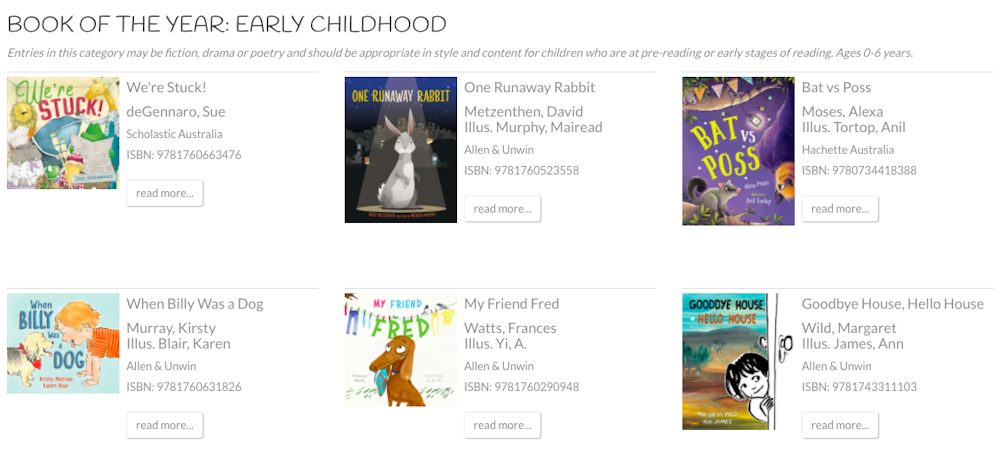
The 2020 Early Childhood Book of the Year shortlist.
CBCA/Screenshot

The CBCA early childhood shortlist minimally represents other forms of diversity. We see only two main characters living with a disability and no characters who are sexually and gender diverse.

Other types of diversity

Linguistic variation is also minimal, in only four books, which does not reflect the linguistic diversity of the wider Australian population.

In response to our queries regarding their judging criteria, the CBCA said:

we do not select books for entry into our awards. It is the publishers and creators who select the books for entry. Our main criterion is literary merit, we do not actively exclude diversity, themes or genre.

Only two of the six 2020 shortlisted books in the early childhood category have human main characters. And these are both white.

The age of zero to six years is a crucial stage of development. It is important for young readers to see people and surroundings that are like their own to cultivate a sense of belonging. It is equally important to see a different world they are not familiar with.


Read more:
5 reasons I always get children picture books for Christmas


If award-winning books sit at the top of reading lists, these books also need to embrace and reflect the full and rich diversity that makes up our country.The Conversation

Helen Caple, Associate Professor, UNSW and Ping Tian, Lecturer , University of Sydney

This article is republished from The Conversation under a Creative Commons license. Read the original article.

Unknown's avatar

Louise Glück: literature Nobel for American lyric poet a healing choice after years of controversy


Nikolai Duffy, Manchester Metropolitan University

Louise Glück is the first poet to win the Nobel Prize in Literature since Tomas Tranströmer in 2011 and the first American to win since Toni Morrison in 1993.

In their preference for the muddiness of everyday life over explicit engagement with their political and social issues, you can see a broad link between Glück and Tranströmer. On the surface, though, Morrison and Glück couldn’t appear to be more different. Morrison’s work lays bare both the lasting scars and the perennial nature of American trauma, whereas Glück’s work is altogether quieter, more local and apparently lacking that broad, socially and politically engaged canvas.

But look past the surface and there are affinities between the two writers. Since her early poems, Glück has been concerned with charting what it means to live as an individual in America. It is a nuanced, controlled form of lyric poetry that is as interested in what it has not been possible to say as what has been said – and the ways the latter haunts and shapes the former.

I dislike being herded into certainty”, Glück has written. We live in an age in which certainty is valued above almost anything else. We appear to want, for instance, the certainty of a vaccine against COVID-19, the certainty that the pandemic will be brought to heel, and the certainty that we will not die, at least not yet and not like this.

But there is something greatly important in remembering that life, in all its forms – social, political, personal – remains incomplete, uncertain, and endlessly revised.

In Parable of the Swans from the 1996 collection, Meadowlands, two swans live: “On a small lake off / the map of the world”. The two swans spend much of their time studying themselves, some of their time studying each other. Ten years later “they hit / slimy water”.

She continues:

Sooner or later in a long
life together, every couple encounters
some emergency like this, some
drama which results
in harm.

It is a parable of domestic life, devastating in its directness, even more so in the way such dramas are repeated interminably behind closed doors only to be shoved aside when the door opens, replaced by a public face that projects only possession and assurance.

Individual becomes universal

The Nobel committee has heralded Glück “for her unmistakable poetic voice that with austere beauty makes individual existence universal”. It is a blanket phrase that might be applied to much lyric poetry.

But what has made Glück’s concern with individual experience resonate over the years is its quiet insistence that that even in the private sphere, everything is touched – and shaped – by the public sphere. No matter what we each might claim to the contrary, we are all the products of the world around us.

And it’s upon these affects and consequences that Glück shines such a clarifying light. It has done so, not by telling us this, but by showing us the ways it can be done.

It is a humble corrective to the discourses of power and authority – so often male – that colour and corrupt great swaths of what we are encouraged to view as important. We are each answerable to how we choose to live, or as the poet puts it in Parable of the Swans: “love was what one did.”

Sidestepping controversy

There is an argument that, after two years of self-inflicted controversies and incomprehensible decisions, the Nobel committee has elected to play it safe this year. Glück is not a polarising poet. In any case, there was an expectation that the prize would be awarded to a non-European female writer.

There is also an argument that in awarding the prize to a white American writer whose work is often characterised by critics as not having an explicit political dimension, the committee has deliberately chosen to sidestep what could have been an important and timely intervention into the necessary debates about diversity and inclusivity – debates which run the risk of being rendered invisible by politicians’ more explicit desire to be seen to be waging war against the pandemic.

No doubt there is something to these arguments. But to criticise the award on both of these fronts is also to neglect the very particular qualities and resonances of Glück’s work. Her preference for the discretion of lyric poetry has something very specific to say about the lives we choose to lead.

As the poet writes in the final lines of the 2008 poem Dawn:

You get home, that’s when you notice the mold.
Too late, in other words.

As though the sun blinded you for a moment.

By drawing back a veil, Glück lets us see what is often overlooked, and the consequences that arise from the recklessness of not paying attention to ourselves and the way we live in the world.The Conversation

Nikolai Duffy, Senior Lecturer, Department of English, Manchester Metropolitan University

This article is republished from The Conversation under a Creative Commons license. Read the original article.

Unknown's avatar

2020 New Zealand Book Industry Awards Winners


The link below is to an article that reports on the winners of the 2020 New Zealand Book Industry Awards.

For more visit:
https://www.booksandpublishing.com.au/articles/2020/09/17/156751/nz-book-industry-awards-2020-winners-announced/

Unknown's avatar

2020 German Book Prize Shortlist


The link below is to an article reporting on the shortlist for the 2020 German Book Prize.

For more visit:
https://publishingperspectives.com/2020/09/the-german-book-prize-names-its-2020-shortlist-covid19/

Unknown's avatar

2020 Carmel Bird Digital Literary Award Winner


The link below is to an article reporting on the 2020 Carmel Bird Digital Literary Award winner, Michalia Arathimos, for ‘Apologia.’

For more visit:
https://www.booksandpublishing.com.au/articles/2020/09/15/156547/arathimos-wins-2020-carmel-bird-digital-literary-award/

Unknown's avatar

The 2020 UK Short Story Award Shortlist


The link below is to an article reporting on the 2020 UK Short Story Award shortlist.

For more visit:
https://lithub.com/heres-the-shortlist-for-the-15000-bbc-national-short-story-award/

Unknown's avatar

2020 National Book Awards Shortlist


The links below are to articles reporting on the shortlists for the 2020 National Book Awards in the USA.

For more visit:
https://publishingperspectives.com/2020/10/us-national-book-awards-announcing-the-2020-shortlisted-finalists-covid19/
https://www.booksandpublishing.com.au/articles/2020/10/07/157689/national-book-awards-2020-shortlists-announced/
https://lithub.com/here-are-the-finalists-for-the-2020-national-book-awards/
https://bookriot.com/2020-national-book-awards-finalists/

Unknown's avatar

2020 Wilbur Smith Adventure Writing Award Winner


The link below is to an article reporting on the 2020 Wilbur Smith Adventure Writing Award winner, Jacob P Avila, for ‘Cave Diver.’

For more visit:
https://www.booksandpublishing.com.au/articles/2020/09/16/156665/avila-wins-2020-wilbur-smith-adventure-writing-prize/

Unknown's avatar

Not the Booker Prize


The links below are to articles/book reviews of works nominated for the ‘Not The Booker Prize.’

For more visit:
https://www.theguardian.com/books/booksblog/2020/oct/05/not-the-booker-hello-friend-we-missed-you-by-richard-owain-roberts-review
https://www.theguardian.com/books/2020/sep/28/not-the-booker-hamnet-by-maggie-ofarrell-a-moving-portrayal-of-grief
https://www.theguardian.com/books/booksblog/2020/sep/21/not-the-booker-akin-by-emma-donoghue-daft-premise-good-writing

Unknown's avatar

2020 Nobel Prize for Literature Winner


The links below are to articles reporting on the 2020 winner of the Nobel prize for Literature, Louise Gluck.

For more visit:
https://www.theguardian.com/books/live/2020/oct/08/nobel-prize-in-literature-2020-follow-the-announcement-live
https://lithub.com/i-feel-like-a-tracker-in-the-forest-following-a-scent-louise-gluck-on-how-she-writes/
https://www.theguardian.com/books/2020/oct/08/louise-gluck-where-to-start-with-an-extraordinary-nobel-winner
https://bookriot.com/2020-nobel-prize-in-literature/
https://www.theguardian.com/books/2020/oct/09/louise-gluck-colm-toibin-on-a-brave-and-truthful-nobel-winner
https://lithub.com/louise-gluck-has-won-the-nobel-prize-for-literature/