
Unknown's avatar

George Saunders’s Lincoln in the Bardo is a genuinely startling novel


File 20171018 32382 1ndxsla.jpg?ixlib=rb 1.1

Man Booker

Adam Kelly, University of York

I am someone who reads, teaches, and writes about contemporary American fiction for a living. Knowing this, you might expect that fresh, experimental novels would constantly be arriving on my desk, that I would be inundated with literary innovation.

But it is in fact rare to come across a book that does something genuinely new and startling with the form of the novel, a form with a long and distinguished history. George Saunders’s Lincoln in the Bardo, which last night won the 2017 Booker Prize, is that rare kind of book. I had read all of Saunders’s short fiction collections, as well as a great many interviews and essays, before opening his first novel. Yet despite what should have been ideal preparation, I was unprepared for what I found there.

As any student of American history knows, the ostensible subject of Lincoln in the Bardo is the most revered of all US presidents. Abraham Lincoln was an autodidact who rose to fame from an inauspicious backwoods upbringing. He became president at what remains the most fraught moment in American history. He led the north to victory in the Civil War, and abolished slavery by signing the Emancipation Proclamation. He thought like a legal scholar but projected the empathy of a statesman. His speeches are among the greatest ever made by a politician. And he was assassinated as the war drew to a close, ensuring his legacy could not be tarnished by any future descent from the height of his powers.

Lincoln is also one of the most written about men in history, a subject of endless fascination. He has been explored by countless scholars, imagined by myriad writers, embodied by numerous actors on stage and screen. How then to write about Lincoln in a new way, to imagine not only the man himself but all he has come to represent in and for American culture?

Abraham Lincoln, 1863.
Wikimedia Commons

Tackling Lincoln

Lincoln in the Bardo answers this question in two surprising ways. First, Saunders does not focus his primary attention on Lincoln, but on the spirits who inhabit the cemetery in which his 11-year-old son Willie has been buried. Reading the novel’s opening line – “On our wedding day I was forty-six, she was eighteen” – we initially assume that we are hearing the voice of Abraham Lincoln, perhaps coming to us from the mysterious space of the bardo, the realm in Buddhist mythology that lies between death and rebirth.

It soon becomes clear, however, that the facts do not fit with this reading, and nor does the tone. On the third page, we discover that the speaker is one “hans vollman”, in conversation with someone called “roger bevins iii”. These are not famous men, nor are they taken up with famous acts. They are discussing the fatal accident experienced by vollmann when he was hit by a beam while in the first flush of sexual arousal with his virgin bride. Echoing the setting and tone of Máirtín Ó Cadhain’s Irish-language classic Cré na Cille, Lincoln in the Bardo begins like a bawdy black comedy.

In building a fictional world from this unexpected opening, the second key decision Saunders makes is to refuse to do what writers of historical fiction have always done, which is to conceal the sources of their research and imagine their subject fresh onto the page. Instead, Saunders quotes a wide range of scholarly passages verbatim, attributing the quotations to their author and text.
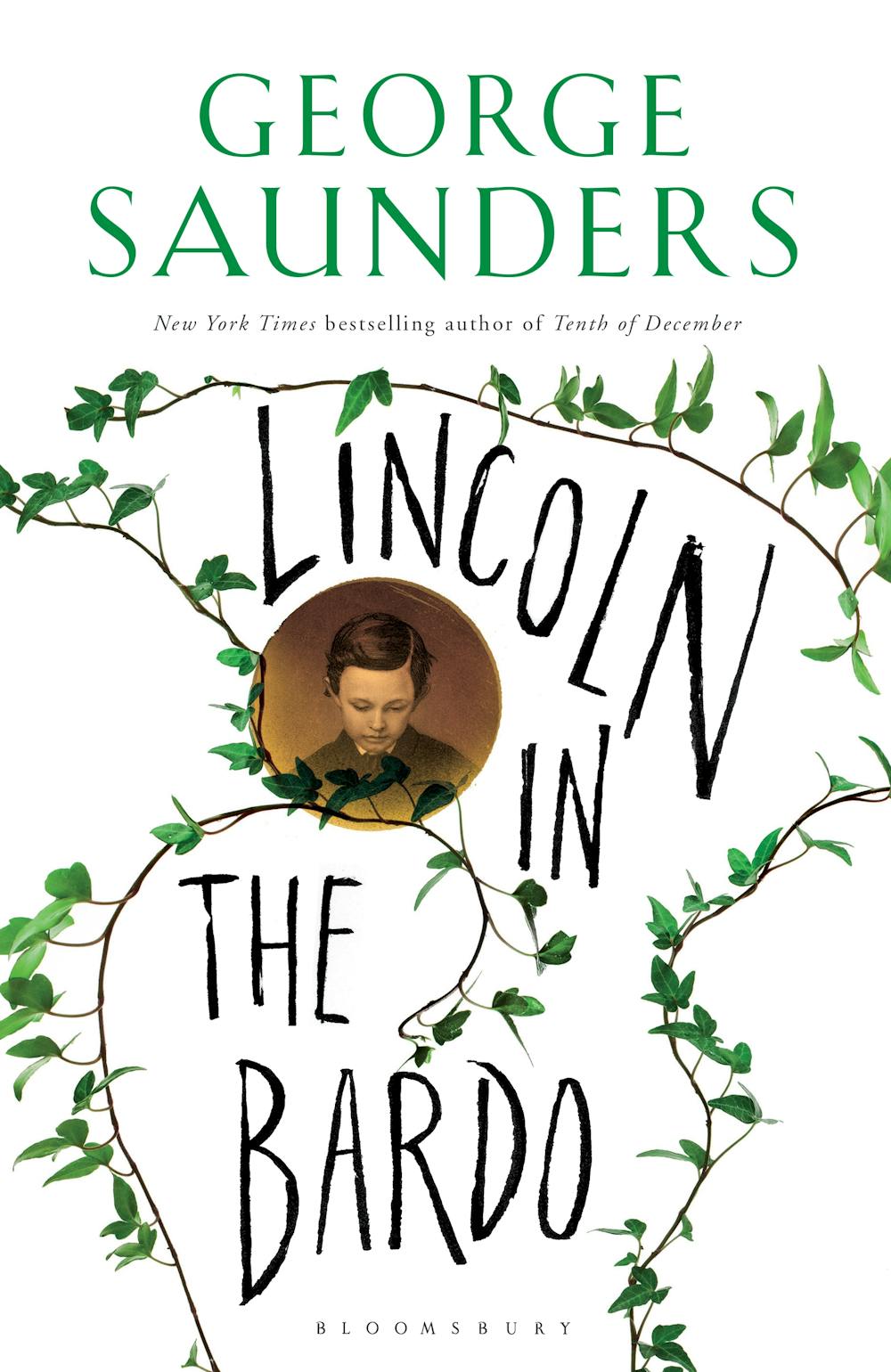

Bloomsbury

These passages are drawn from what historians call primary sources (letters and memoirs from Lincoln’s contemporaries) and secondary sources (scholarly accounts of Lincoln in the 150+ years since his death). Most of these sources are real, some are invented, and it’s not always clear which is which. The result is a novel that powerfully transmits the cumulative and collective effort to write history, to do justice to the past and what it means.

A democracy of contradictions

The mix of these two registers – the comic and the scholarly – shouldn’t work, but it does. Once the reader has settled into the rhythm of alternating chapters dealing with the chaotic world of the spirits and the more sober (but sometimes equally peculiar) scholarship on Lincoln, Saunders’s project gains clarity, purpose and power. Populated with a multitude of voices, the novel addresses the great faultlines of American democracy – race, gender, wealth, sexuality – while keeping its eye firmly on the common ground its characters share in their inevitable confrontation with life and death.

In a creative writing masterclass with Saunders that I attended earlier this year at the University of Liverpool, the author outlined his vision of literary stories as “active systems of contradiction”. In mixing together what we usually think of as opposites – tragedy and comedy, high rhetoric and bawdy farce, private grief and political action, the individual and the collective – stories can challenge our sense that some things must be kept apart. We come to see that these apparent opposites are in fact different faces of a fundamental unity. This is the unity that underpins our connection to one another in a shared world.

In writing Lincoln in the Bardo, Saunders couldn’t have known how directly his themes would speak to an America and a world in which contradictions are becoming increasingly stark and oppositions are being set in stone. The Booker Prize jury has done us a favour by drawing attention to a book that tries to forge a unity among opposites in the most surprising ways.

The ConversationDespite its origins in grief and mourning, Saunders’s message is a refreshingly hopeful one. We can only hope the message is heard by those whose ears it needs to reach.

Adam Kelly, Lecturer in American Literature, University of York

This article was originally published on The Conversation. Read the original article.
Unknown's avatar

George Saunders Booker win: why the British shouldn’t be sore at American literary success


File 20171018 32338 qvchm1.jpg?ixlib=rb 1.1

jannoon028/Shutterstock.com

Andrew Dix, Loughborough University

“In the four quarters of the globe,” asked the British writer and cleric Sydney Smith in 1820: “Who reads an American book?” Smith was a career eccentric, known for odd sayings and doings, such as wearing a self-designed tin helmet as a defence against rheumatism. However, his scorn about the impoverished state of literature in the upstart nation across the Atlantic was no mere individual fancy, but a judgement backed by his nation’s sense of cultural superiority.

But pose the same question now, almost exactly 200 years later, and such complacency is hardly the response you’re likely to get. The most esteemed British literary prize, after all, has now been awarded to an American author two years running.

American writer George Saunders’ victory in the The Man Booker Prize for Fiction, for his debut novel Lincoln in the Bardo, follows on from US novelist Paul Beatty’s 2016 win for The Sellout. Fears of the Americanisation of this piece of British literary heritage are likely to be renewed. Saunders and Beatty face being seen as the high-cultural wing of an ongoing transatlantic takeover of national life that recently took more bone-crushing form in the series of NFL fixtures in London.

Changing the rules

Worries about precisely such literary colonisation by the United States were voiced, in fact, when the organisers of the Booker changed its eligibility rules in 2013. Formerly a prize only for novelists of the United Kingdom, Ireland and the Commonwealth, with winners including such non-UK citizens as Nadine Gordimer and John Banville, the parameters were altered so as to make the language of composition itself the key criterion. The new rules invited submissions of “any novel in print or electronic format, written originally in English and published in the UK by an imprint formally established in the UK.”

A S Byatt, a former judge as well as winner, said at the time she feared such an expansion of the field would result in “good work” going unrecognised. Her qualms were based not on nationalistic unease but in the spectre of unmanageable piles of novels to be sifted. But for literary scholar John Mullan, the risk of the rule change was indeed that the Booker would decline into a series of spectacular US/UK faceoffs. He imagined the new Booker as:

A Ryder Cup of Literature … Toni Morrison versus Hilary Mantel, or Jonathan Franzen against Ian McEwan.

Nevertheless, it is not as if the Booker’s previous criteria for eligibility were beyond criticism. How convincing a defence can be assembled for a prize whose original geographical coverage mapped exactly onto that of Britain’s recent colonial and imperial dominance? These embarrassing parallels were pointedly addressed in 1972 by John Berger, also a Booker winner. On being awarded the prize for G., he remarked that the sponsor, Booker McConnell, had derived much of its wealth from “exploitation” during “extensive trading … in the Caribbean for over 130 years”.

Novels without borders

If writers in English from Durban had always been eligible for the Booker, then why not those from Denver? If Delhi, why not Detroit? While the organisers’ announcement in 2013 triggered expressions of anxiety in the UK that the novelists of Hampstead would be ill-equipped to compete with those from Harlem, others welcomed the prize’s reimagining so as to include writers in English from beyond Britain’s recently relinquished imperial citadels. As the Scottish author A L Kennedy said: fiction is “deeply international, deeply humane. It has no borders. It’s lovely that the Booker is reaching out”.

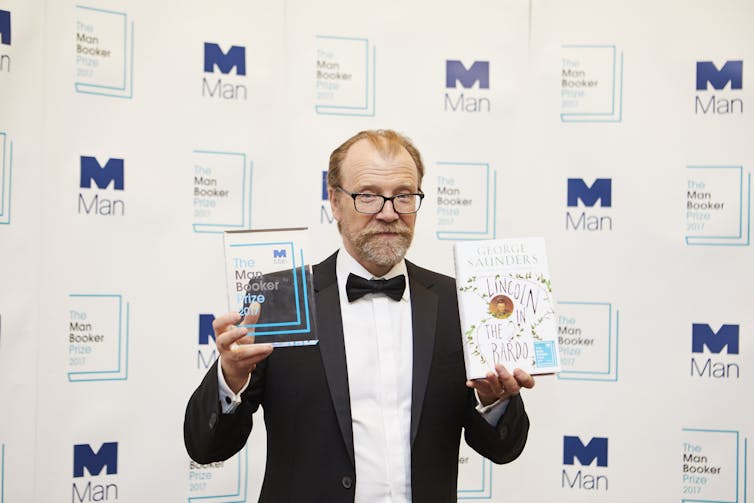
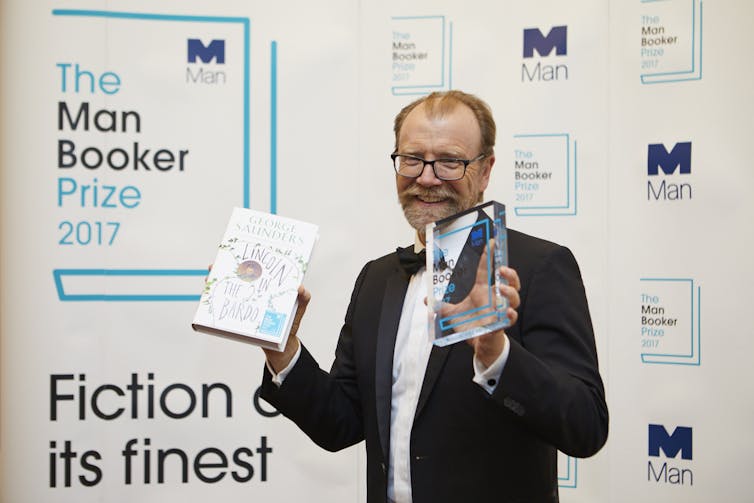
George Saunders with his award.
Man Booker

There are striking affinities, in fact, between Kennedy’s rhetoric and that of George Saunders in his acceptance speech after winning for Lincoln in the Bardo. His novel’s subject could not be more closely affiliated with the national narratives and icons of the US: its key figure, of course, is the grieving President Lincoln. Nevertheless, Saunders’ model of literary composition and reception remains resolutely non-jingoistic:

Well this tonight is culture, it is international culture, it is compassionate culture, it is activist culture.

Two responses, perhaps, are possible in the face of nationalistic concern that the Americans are taking over British literary prizes.

The first is to recall more of Berger’s wise words in what was as much a speech of refusal as acceptance in 1972. Even at a time when coverage of the prize was modest, with the only media “platform” provided by a few broadsheet papers, Berger complained about “the deliberately publicised suspense, the speculation of the writers concerned as though they were horses, the whole emphasis on winners and losers”. The task now, perhaps, is to extricate Saunders, and Beatty before him, from conversations about their passports and instead to give their thematically challenging and formally inventive fictions the serious attention they deserve.

The ConversationBut a second possible response to Saunders’ victory may offer a better cure for the prize envy of the smaller-minded British reader, currently sore at US literary success. Yes, Saunders may have won the Booker. But in Kazuo Ishiguro, Britain currently has the holder of the biggest literary trophy of all.

Andrew Dix, Lecturer in American Studies, Loughborough University

This article was originally published on The Conversation. Read the original article.
Unknown's avatar

Man Booker Prize 2017 Winner is George Saunders


The links below are to articles reporting on George Saunders as the winner of the 2017 Man Booker Prize, for his novel ‘Lincoln in the Bardo.’

For more visit:
https://www.theguardian.com/books/2017/oct/17/man-booker-prize-2017-second-american-author-george-saunders-lincoln-in-the-bardo
https://blog.booktopia.com.au/2017/10/18/george-saunders-wins-2017-man-booker-prize-novel-lincoln-bardo/
https://publishingperspectives.com/2017/10/george-saunders-2017-man-booker-prize-fiction/

Unknown's avatar

Nobel Prize in Literature 2017


The Nobel Prize in Literature has been awarded to Kazuo Ishiguro. The link below is to an article reporting on the announcement.

For more visit:
https://www.theguardian.com/books/2017/oct/05/kazuo-ishiguro-wins-the-nobel-prize-in-literature

Unknown's avatar

Exquisite prose, with rare and subtle insight


Image 20170418 32723 yvfpxt
Heather Rose, the 2017 Stella Prize winner.
The Stella Prize

Camilla Nelson, University of Notre Dame Australia

Heather Rose has won the 2017 Stella Prize for her novel The Museum of Modern Love, a fictional exploration of the power of art to transform individual lives, written in exquisite prose, with rare and subtle insight. The Conversation

Brenda Walker, Chair of the judging panel, said:

It is rare to encounter a novel with such powerful characterisation, such a deep understanding of the consequences of personal and national history, such affection for a city and the people who are drawn to it, and such dazzling and subtle explorations of the importance of art in everyday life.

Rose’s novel centres on Serbian artist Marina Abramović’s The Artist is Present, a 75-day performance piece that took place at the Museum of Modern Art in New York. Throughout the work, Ambramović sat perfectly still at a table in the museum’s atrium, with bright lights shining down and around her, while spectators took turns to sit opposite. As each visitor sat, Abramović lifted her face and maintained eye contact.

Within days, people began crowding the atrium to watch, the lines frequently spilling out onto the street. Some gathered overnight or in the early hours before the museum opened. Occasionally the sitters cried.

Rose’s novel subtly explores the individual lives of fictional characters in the audience, all of whom are transformed by the strange intimacy of the work. At its centre is Arky Levin, a music composer who is emotionally cut off from life.

He wasn’t sure why he needed to keep returning to the sidelines of this strange performance, but he kept finding himself taking the train, walking in the door, climbing the stairs, taking his place by the white line. The atrium was a magnet, or maybe it was Abramović. Something about this was important, but he couldn’t say why.

In Rose’s novel, chance conversations with strangers offer rare and disarming insights not only into the emotional lives of the characters, and their often tragic situations, but also into our own yearning for “some new idea of life” – a more authentic kind of intimacy or connection in our disconnected, media-saturated world.

In a list that included significant and moving books by two writers, Georgia Blain and Cory Taylor, who have both died since the publication of their works, the choice to award Rose’s novel could not have come easily to the judging panel.

The Stella Prize judges, from left to right: Ben Law, Sandra Phillips, Brenda Walker, Di Johnston, Delia Falconer.
Connor Tomas O’Brien

Taylor’s book, Dying a memoir, genuinely broke new ground in writing powerfully and with astonishing clarity about a subject that is rarely treated with such effect. Blain’s novel, Between a Wolf and a Dog, is the final achievement of a mature writer whose work spoke clearly and in a quietly profound way to a whole generation – my generation – of women.

But Blain and Taylor would have been the emotional choice. And objectivity is – perhaps – not possible in the face of such calamity. I am uncertain. But I do think there should be a special place in literature for books that do some real work in the world.

The Museum of Modern Love is Heather Rose’s seventh book. Her previous novels include White Heart (1999), The Butterfly Man (2005) and The River Wife (2009). She is co-author (with Danielle Wood) of the Tuesday McGillycuddy series for children, published under the pen name Angelica Banks. She won the Davitt Award in 2006, and her novels have been shortlisted for the Nita B. Kibble Award and the Aurealis Awards, and longlisted for the IMPAC Award.

Rose joins previous Stella winners including Carrie Tiffany, Clare Wright, Emily Bitto and Charlotte Wood.

Camilla Nelson, Associate Professor of Writing, University of Notre Dame Australia

This article was originally published on The Conversation. Read the original article.

Unknown's avatar

In Amazon/Hachette deal, ebook agency pricing is a winner


Laura Hazard Owen's avatarGigaom

In the deal that Amazon and Hachette Book Group finally reached Thursday after months of bitter negotiations, we don’t really know which side “won,” if one side did. But one survivor — perhaps surprisingly — was agency pricing for ebooks, the practice through which the publisher sets an ebook’s price and the retailer takes a commission.

Hachette said in a letter to authors and agents Thursday:

The new agreement delivers considerable benefits. It gives us full responsibility for the consumer prices of our ebooks. This approach, known as the Agency model, protects the value of our authors’ content, while allowing the publisher to change ebook prices dynamically to maximize sales.

That wasn’t a foregone conclusion. In 2010, [company]Amazon[/company] was vehemently opposed to agency pricing, though it ultimately capitulated. Agency pricing was at the heart of the of the Department of Justice’s lawsuit against Apple and book publishers in 2012, in which…

View original post 759 more words

Unknown's avatar

Article: 2013 Nobel Prize for Literature – Alice Munro


The links below are to articles reporting on the 2013 Nobel Prize for Literature which has been won by Alice Munro.

For more visit:
http://www.mediabistro.com/galleycat/alice-munro-wins-nobel-prize_b78869
http://flavorwire.com/newswire/alice-munro-wins-nobel-prize-for-literature/
http://www.themillions.com/2013/10/canadian-short-story-master-wins-the-nobel-prize-for-literature.html

The link below is to an article that takes a look at the nobel prize winner for literature.

For more visit:
http://www.themillions.com/2012/07/a-beginners-guide-to-alice-munro.html