In recent months, mental health experts have been drawing attention to what they’ve dubbed “quarantine envy.”
Many people, they note, have been sizing up the extent to which they’ve been affected by lockdowns and economic hardship. Who still has a job? Who gets to work from home? Whose home is spacious, light-filled and Instagram-worthy?
The start of the school year adds another layer of comparison. Parents stuck in a small apartment with two kids forced to learn remotely might feel pangs about the fact that their friend’s kids get to attend a private school in person.
What should we do with these unpleasant feelings? Should we repress them or reason them away? Are they too shameful to be shared?
Envy is one of Christianity’s seven deadly sins – the worst of them all, says the Parson in Chaucer’s “Canterbury Tales.” But my research into the long history of envy shows that the emotion has many sides to it.
Some are certainly destructive. But envy can also be useful. The “sin” can help us better understand ourselves and the world around us – and it can be a key driver of social change.
Tales of envy
Envy has a bad reputation. Everyone feels it at one point or another, although we often don’t want to admit to being truly envious of others – harboring the kind of envy that gnaws at us and makes us feel inferior.
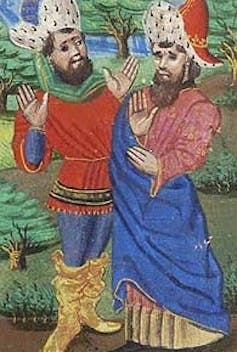
A 15th-century illustration of a classic fable of envy and greed. Morgan Library
Portraits of envy can show it as an astonishingly malicious emotion. One version of a popular fable tells the story of an envious man and a greedy man being given a single wish. The one condition is that the person who does not get to choose the reward will be given double what the other man wishes. The greedy man quickly asks that the envious man be given the choice; the envious man then wishes to be blinded in one eye.
In William Langland’s poem “Piers Plowman,” the personification of Envy confesses that all he wants is for his neighbor, “Gybbe,” to have something bad happen to him; he wants this even more than he wants cheese (which is saying a lot, if you ask me!).
In these stories, envy is typically defined as wanting misfortune for others, longing to feel superior in some way or at least making them just as miserable as you are.
Late medieval literature is also filled with stories that point to envy as a source of violence.
The chronicler Jean Froissart describes the social unrest associated with the Peasants’ Revolt of 1381 as a consequence of the envy the commoners had toward the nobles and the rich.
Here – and elsewhere – envy is a label used to diminish the political claims of a particular group of people. In 2012, Mitt Romney accused Barack Obama of practicing the “bitter politics of envy.” In this way, criticism of the rich or powerful, or wanting the wealthy to be taxed more to fund public services, brings accusations of petty envy and resentment.
When envy spurs social change
Modern understandings of envy are also related to other kinds of negative feelings, like anger that someone has undeserved wealth or frustration that certain groups are hoarding money, power, or privileges.
Here is where envy can take a turn that can lead to better outcomes. Envy can be productive when it is not directed at one person in particular but is instead directed at the way society is structured.
Economists and political scientists increasingly recognize that reducing inequality can be an end in itself. Envy – even the kind of nakedly competitive envy that seeks to damage others for no personal gain – can work to regulate inequality that has grown too wide.
Political scientist Jeffrey Green defends policies driven by a “reasonable envy” that targets the well off, even if there is no expectation of gain for everyone else. For example, he says that capping wealth might lower the material welfare for all, but this would be worth the reduction in inequality, since excessive or unjust inequality can lead to instability and feelings of disempowerment among ordinary citizens.
Economist Robert Frank prefers taxing consumption to reduce “luxury fever,” in which competitive spending escalates wildly, especially among the super-rich, leaving less money for individuals and the government to spend on essential services.
An illustration of the personification of envy from a medieval manuscript. The Morgan Library
In their new book, “The Economic Other,” political scientists Meghan Condon and Amber Wichowsky open with the line, “The human imagination is an engine of comparison.”
In their studies, they show that politics is driven by the social imagination – and Americans have fewer opportunities for comparison because of increasing class segregation in our society. Middle-class and poorer Americans see the wealthy online and on TV but not in everyday life. The authors believe policies might become more just if there were more opportunities for “upward comparison” – if everyday Americans could simply see, in their day-to-day lives, the extent to which the wealthy lead extravagant lives. Their research suggests that envious comparison would lead to more support for government spending on welfare, Social Security and education.
Aristotle has a much more specific – and negative – definition of envy. In his view, the emotion is directed toward our equals. We become envious when our neighbors have something we desire and believe we deserve, and when we feel it is our own fault that we do not have that good thing.
He distinguishes envy from other comparative feelings like emulation, indignation or pity. These kinds of distinctions are helpful, because thinking carefully about emotions can give us information about ourselves and our environment. Some philosophers describe emotions as reasoning tools, a shortcut to filter copious amounts of information.
In a time of quarantine – when comparisons often involve who has the best version of being alone – dwelling with envy can open our eyes to ourselves and the world.
Do these negative feelings say something about ourselves? Are they specific to another person? Or do they reflect an unjust system?
Can these disparities change? If so, what could bring that about?
Trying to manage or avoid envious feelings doesn’t allow us to answer – or even ask – those questions.
The link below is to an article that looks at the latest attempts at Amazon bashing and curbing the power of Amazon in the book industry. Don’t get me wrong here, monopolies are not necessarily a good thing in my opinion, however, has Amazon done anything illegal? I doubt it. Perhaps bookshops and bookstores need to change things up a bit – many still seem to refuse to mail order (I stress many, not all) for example.
If you want to understand anything about the US in the 20th and 21st centuries, you need to know 19th-century American literature. The 19th century was when many, if not most, of the problems and ideologies that define American culture were codified, and literature of the period shows creative responses to this change.
For the first half of the 19th century, a lot of ink was spilt worrying whether the US would ever have a literature of its own. Many famous writers, including Ralph Waldo Emerson and Walt Whitman, urged Americans to leave English literature behind and take up specifically American themes, peoples and spaces.
At the same time, indigenous and enslaved Americans such as Harriet Jacobs, William Apess and Frederick Douglass used their pens and their rhetorical might to urge the US government to end race and ethnicity-based persecution and genocide.
After the American Civil War (1861-1865), writers rarely worried about whether the country had a literature and whether it was any good (it quite obviously was). They had innovated new genres (think of Emily Dickinson’s spare and searing verses) and turned their attention to issues of inequality embedded in American culture, as in Kate Chopin’s proto-feminist novella The Awakening and Charles Chesnutt’s exposure of racism and white supremacy in the post-Reconstruction South.
The following five works embody both the beauty of 19th-century American literature as well as its ability to change hearts and minds.
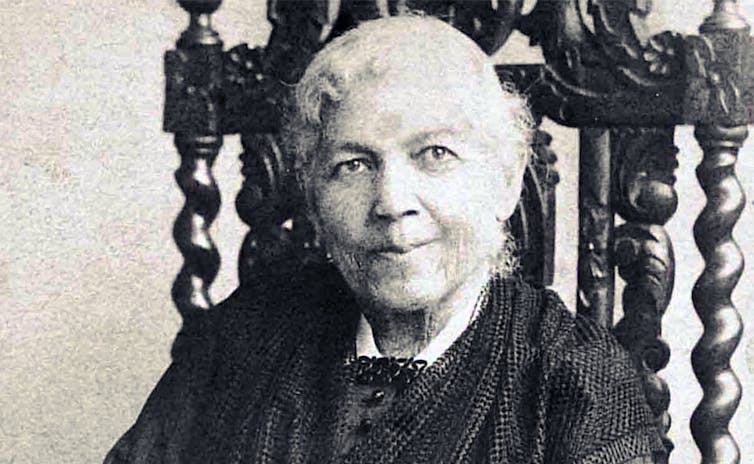
Jacobs’ slave autobiography may not be the earliest written or the most famous, but it’s a devastatingly effective piece of storytelling that reads like a novel. Jacobs’ story of surviving slavery is so remarkable a narrative that sheds a rare light on the female experience of slavery.
Written under a pseudonym (Linda Brent), for a long time scholars assumed it must be fiction written by a white abolitionist. It wasn’t until African-American and feminist scholars unearthed the true identity in 1987 of Harriet Jacobs that the truth of her life story was accepted. Her narrative has since become a classic text of resistance, and it’s an essential read for understanding how white supremacy continues to function in America today.
2. Leaves of Grass by Walt Whitman (1855; last new edition 1881)
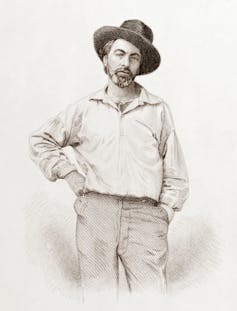
Engraving of Walt Whitman from Leaves of Grass. Wikimedia
Walt Whitman was a virtually unknown journalist and printer when the first edition of Leaves of Grass thundered upon the American literary world. The strange book listed no author and contained a casual engraving of Whitman with hand on hip and head cocked to the side. Most importantly, it included poems like the world had never seen before. Poems with long cascading lines and little rhyme or metre to be found. Whitman continually added to and edited Leaves of Grass over the course of his life, crafting his biography in poetry that we now recognise as revolutionary in both form and content. It made Whitman a touchstone for 20th-century poets like Allen Ginsberg and Adrienne Rich.
If you’ve seen the most recent movie adaptation of Little Women (or any of the many previous adaptations), you’ll know that there’s something about Alcott’s novel (originally two novels, now published as one) that strikes a chord. Written in the shadow of the Civil War, Little Women draws upon Alcott’s own remarkable family life among famous Transcendentalist writers and thinkers in Concord, Massachusetts. It’s a skillfully crafted book about how the dreams of childhood do and, more often, do not come to fruition.
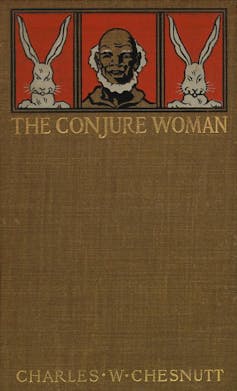
First edition book cover of The Conjure Woman. Wikimedia
In the late 19th centuries, a genre called “local color” dominated American literary magazines. These stories introduced areas of the increasingly expanding United States to those living in urban centres. African-American writer Charles Chesnutt turned this genre on its head in his series of “conjure” stories – tales of magic and cunning told by a formerly enslaved man named Julius to entertain a white northern businessman. Julius’ stories weave together African-American folklore and Southern Gothic ambience to expose white supremacy in the south before the Civil War. These stories indirectly comment on the racism that continued to haunt the post-Civil War US under a different guise.
While these days Melville’s gargantuan 1851 novel Moby-Dick may be more famous (and
you should definitely read that too, when you have a few months to spare), nothing packs a punch quite like the novella Benito Cereno. Based on the story of a real slave revolt on board a ship, the text is paced like a horror story and full of ambivalences and doubled meanings. It reveals the true horror of race-based chattel slavery and anticipates the eruption of violence that would tear apart the United States within a few short years.






 At the BookShelf


You must be logged in to post a comment.