Any social movement needs inspiration. It needs people who can imagine a different future and, more than that, make that future graspable.
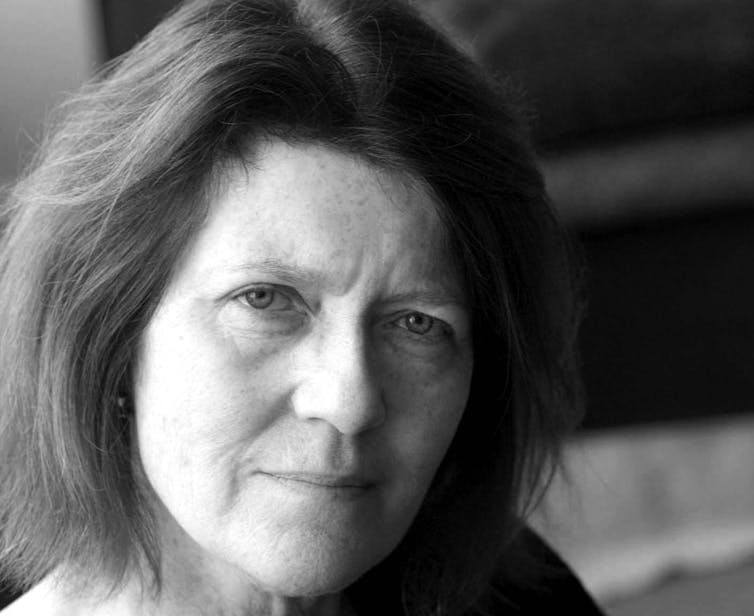
Kate Jennings did that for the Australian women’s movement — with her incandescent anger, her sharp tongue and her courage, ready and able to speak straight into the face of power. Her death, in New York aged 72, offers a moment to reflect on the role of writers and literature as forces of social transformation.
many women are beginning to feel the necessity to speak for themselves, for their sisters.
i feel that necessity now.
When Jennings lined up for her turn to speak at a Vietnam moratorium rally on the lawns of Sydney University in 1970, she was a half-drop-out from Sydney’s English Department, living in Glebe.
With the group of determined women libbers at her back, she perhaps wasn’t clear what her speech would do — that it would effectively inaugurate second-wave feminism in Australia and help it become a movement with its own momentum. A new chapter for the world’s longest revolution. But she did know that the time had come.
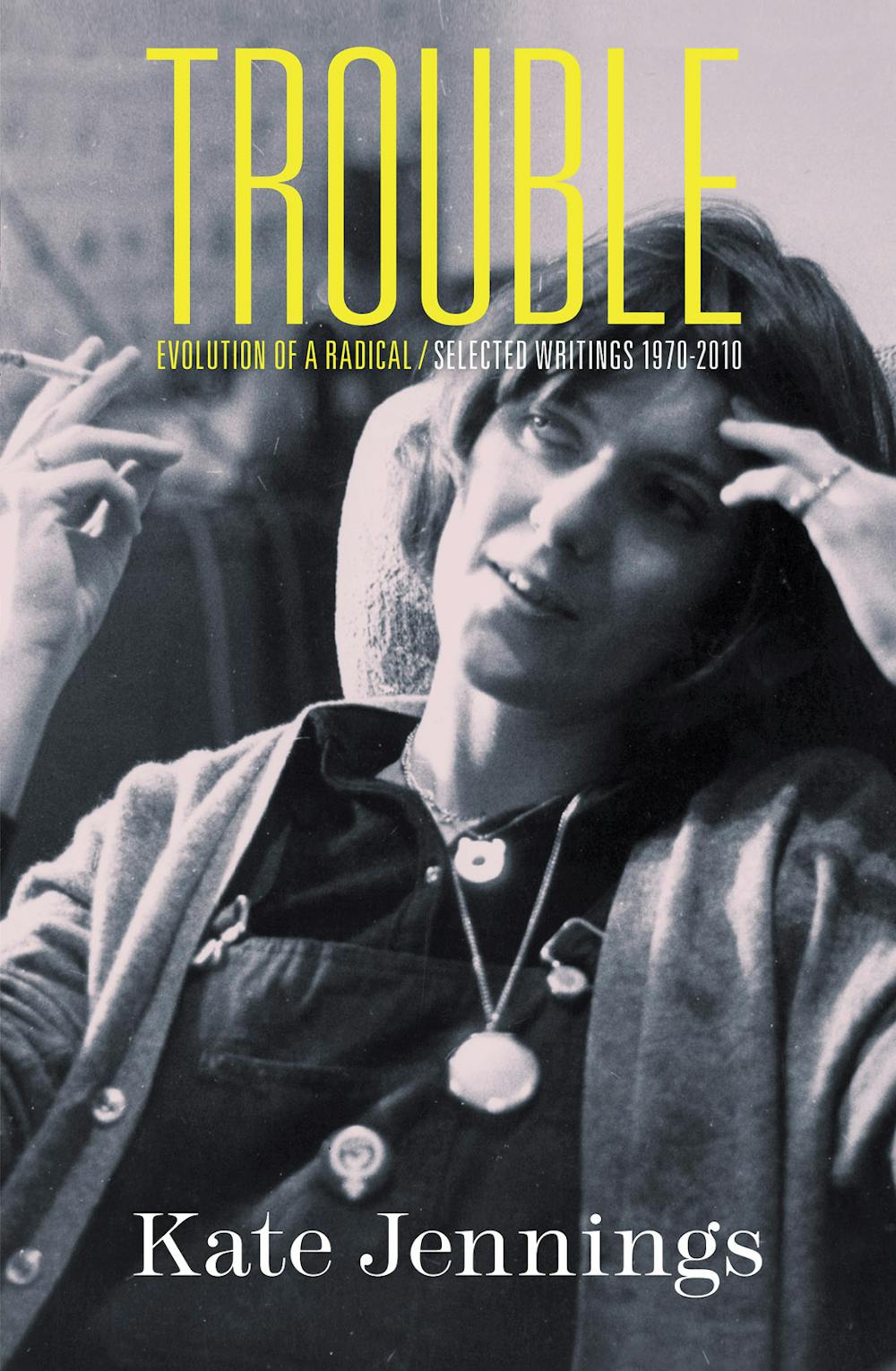
When the speech appeared as a performative poem in her 2010 retrospective collection Trouble: Evolution of a Radical, she recalled that the group had conceived it as deliberately incendiary.
Black Inc
“Call the speech what you like — agitprop, political theatre, over the top, in your face — but we were genuinely angry, famously fed up. I wrote the speech at a boil: we were getting nowhere asking the men in the movement to listen to us.”
Written from within the mix of galvanising struggles then being fought around the world, the speech tore shreds off those for whom women’s issues were secondary or trivial. She compared the number of Australian men who’d died in Vietnam with the number of women who’d died from illegal abortions.
It was a shocking thing to do then: a similar comparison, now, of the victims of domestic violence to the number of Australian soldiers lost to recent conflicts or suicide, would be met with outrage too. The speech was hardline, uncompromising, militant.
okay i’ve stopped trying to understand my oppressor
i know who my enemy is
i will tell you what i feel, as an individual, as a woman
i feel that there can be no love between men and women
And that passion came from poetry. It wasn’t the theorists or social commentators who inspired the radical feminism powering the speech, she recalled, but the eloquence of visionaries.
In 2010, she listed Robin Morgan, Ti-Grace Atkinson, Valerie Solanas’s SCUM (Society for Cutting Up Men) Manifesto as her touchstones. This was writing that was “unafraid to be emotional, luminous with rage,” she recalled. “Manifestos and poems that jumped off the page. I loved it.”
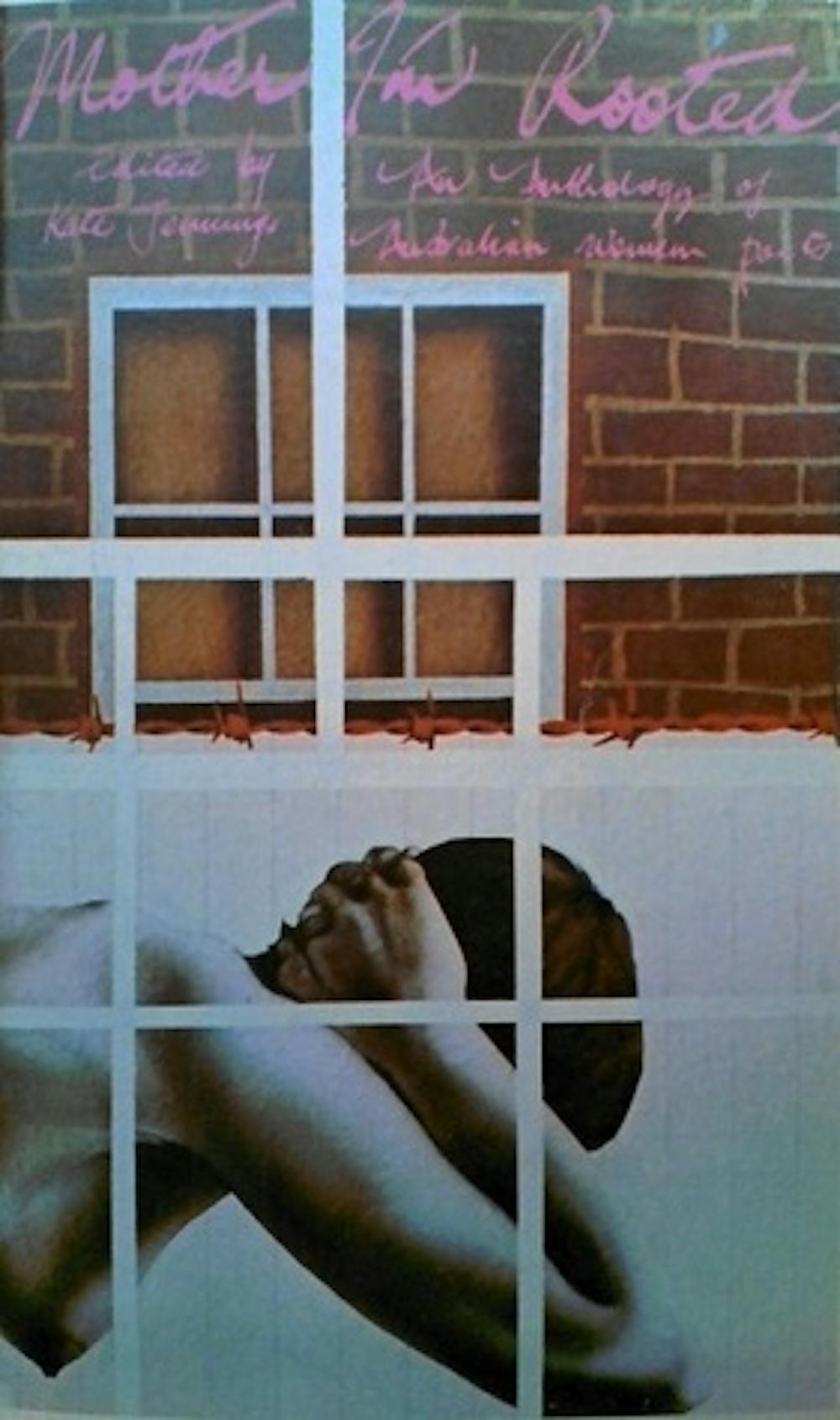
Mother I’m Rooted
Jennings’ other extraordinary contribution to the transformational feminism of the 1970s is one of its most revelatory — the huge, collaborative women’s poetry collection called Mother I’m Rooted, published in 1975.
Its confronting title is a distillation of the protest and exhaustion she saw in the poems. With Alison Lyssa, another poet and activist, she planned an anthology as inclusive as possible and advertised for poems — “trying to reach the women Out There”. Within two months they had over 500 replies.
The final volume lists 152 poets, including established ones, unknowns with new feminist pseudonyms, seasoned activists from the old left and many names that would go on to make their marks. It has experimental, Greek-Australian writers contesting the definition of poetry and forthright, white, working-class women writing about the washing — though no First Nations poetry.
It is a beautiful social document now, broken up by lambent photographs of ordinary women together. And its call for women’s control over not just what counted as poetry but over the publishing process itself was hugely influential, arguably changing the literary landscape in Australia forever.
Fierce honesty
Across her writing life, Jennings produced essays, novels, short stories and journalism, as well as poetry, all written with a fierce honesty and wit, refusing what she saw as cant and sentiment.
After she moved to New York in 1979, she continued to write about and for Australia, but often with an outsider’s cynicism. Women Falling Down in the Street, a collection of short stories from 1990, won a Queensland Premier’s Literary Prize and perhaps typified her interest in revisionary engagement with her part in Australia’s cultural life.
The novel Snake, from 1994, explored with concision and power her country childhood on a farm outside Griffith in NSW, and found an international readership.
In 2002, after her husband’s death from Alzheimer’s disease, she published Moral Hazard, a short but perfectly voiced novel about a writer making a living on Wall Street to support a dying partner. One of the few Australian novels to confront the operations of capital directly, even pre-empting the 2008 global collapse, it won a number of prizes, including the ALS Gold Medal.
The legacy she leaves is complex and multi-voiced, marked often by a reassessment of her younger self by the older Jennings and, perhaps, by a certain distrust of any shared story she couldn’t control.
But that legacy has been transformative and extraordinary, by any measure.
The death of poet Eavan Boland comes as a soft shock to my sense of the world. The creative connections she forged between her richly various poetry, Irish culture and the fierce determinations of feminism were mesmerising. Just as important was her faith in poems as places to think and feel in, where those connections could be offered as intricate gifts to all readers.
She is rightly celebrated for her breakthrough collection, the 1980 In Her Own Image, which pitted itself against the lazy assumptions of a male-dominated poetry world and voiced the bitter extremes of female experience, like the anorexic’s fanaticism (“Flesh is heretic./ My body is a witch. / I am burning it”), the beaten wife’s survivalist plural selving (“I was not myself, myself”), the menstrual visionary (“I leash to her {the moon}, / a sea, / a washy heave, / a tide”), the crazy poetics of the kitchen (“the tropic of the dryer tumbling clothes. / The round lunar window of the washer”).
A true challenger to Yeats
Such poems gave centre stage to female experiences and had a huge impact on the Irish poetry scene in particular, which had taken its time responding to the feminist revolution of the 1960s and 1970s.
Eavan Boland in 1996. Wikimedia
Their accurate representation of the marginalisation of women in history and by history (“still no page / scores the low music / of our outrage” It’s a Woman’s World, 1982) was belied by the poems as public and historical voices. A feminist collection, In Her Own Image showed the world that Boland’s was a powerful voice above all and a real challenge to the Yeatsian tradition of male poetics in Ireland.
The wonderful Mise Eire (1987), meaning “I am Ireland”, for instance, takes on the identity of the many emigrant women travelling from Ireland to the New World, and opens:
I won’t go back to it
my nation displaced
into old dactyls
and the poem is colourfully detailed about the historical record, as routines being played by Boland:
I am the woman –
a sloven’s mix
of silk at the wrists,
a sort of dove-strut
in the precincts of the garrison
The ancestral women whose being she inherits through her matriarchal line and her Irish identity, women under the control of the old dispensation, the women of Irish patriarchal history, molls to the men of power – that is what she won’t go back to. So what reads as a rich imagining of the emigrant glad to be leaving is also Boland’s coded challenge to the Irish lyric tradition with its old dactyls and assumptions about women poets as strutting doves; as well as a specific historical voicing of second-wave feminism – we are not going back to that old world.
Returning to Dublin
On the back of the extraordinarily febrile mind at work on her own culture and in concert with the feminism of her times, she built up a repertoire of voices that constitute some of the finest poetry in English.
Navigating between work in America and a full life in Ireland, she lived out that emigrant dream and made it real, made it her world. Her poems are intimately connected to the dailiness of her own life, to a sense of significances and exfoliations in the ordinary events in her patch of space and time. Equally, she writes poems of extraordinary power and complexity about the history of Ireland, about the Famine, the Troubles (the three-decade conflict between nationalists and unionists), about the acts of violence suffered by her people over time.
She was unafraid to make poetry do the work that once was most resolutely its task: the work of elegy, epic (her lyrics attend to history with the eye of an epic poet), lyric most of all and testimonial witnessing of experience with heart and mind.
For me, one of her tasks was to be the poet of Dublin, the Dublin she loved and cherished, and fought for and against too. Many of her very best poems bring that fabled city to new light. Her poem Anna Liffey (1997), which tussles with James Joyce’s representation of the female principle Anna Livia Plurabelle in Finnegans Wake, is also a hymn of praise to Dublin’s river Liffey:
It rises in rush and ling heather and
Black peat and bracken and strengthens
To claim the city it narrated.
Again, subtly, it is a woman’s story-telling (Anna Liffey narrating) that lays claim to this new post-feminist Dublin. Born abroad, she adopted Dublin as an émigré Irish returnee – but that journey home was also this complex act of kinship and claim:
It has taken me
All my strength to do this.
Becoming a figure in a poem.
Usurping a name and a theme.
Thank goodness for her usurpation! Such a harvest of gifts, as well.
In the incomparably beautiful And Soul (2007), Dublin’s rain is praised at the same time as Boland is battling the cloudburst of her grief for her dying mother. In The Lost Land (1998), her daughters growing up and living faraway reprise her whole life story (“memory itself / has become an emigrant”). Nobody has written so fully and well about the intimate relationship between Ireland and the United States. Ireland has lost its most exquisite chronicler:
The French writer Colette was indifferent and even hostile to the feminist movement in the early 1900s. But both her writing and the way she lived her life represent a vibrant and radical feminism in tune with the #MeToo spirit of today.
Born in rural Burgundy in 1873, Sidonie Gabrielle Colette (the abbreviated pen name came later) belonged to a middle class but unorthodox family. Raised by a mother who was as sceptical of religion as she was of bourgeois respectability, she was 20 when she married Henri Gauthiers-Villars (“Willy”), the 33-year-old charming but dissolute writer son of a family friend.
The marriage was both a good and a bad move for Colette. Willy introduced her to the rich Bohemian culture of the Parisian demimonde, and launched her career by insisting (despite her reluctance) that she write down memories of her schooldays.
But his serial infidelities distressed and depressed her. And as an unscrupulous literary entrepreneur, Willy cheerfully sold his wife’s semi-autobiographical “Claudine” novels under his own name.
The stories of a spirited, tomboyish heroine rapidly became a publishing sensation, with profitable sales of related merchandise including Claudine cigarette holders. But the profits were all Willy’s.
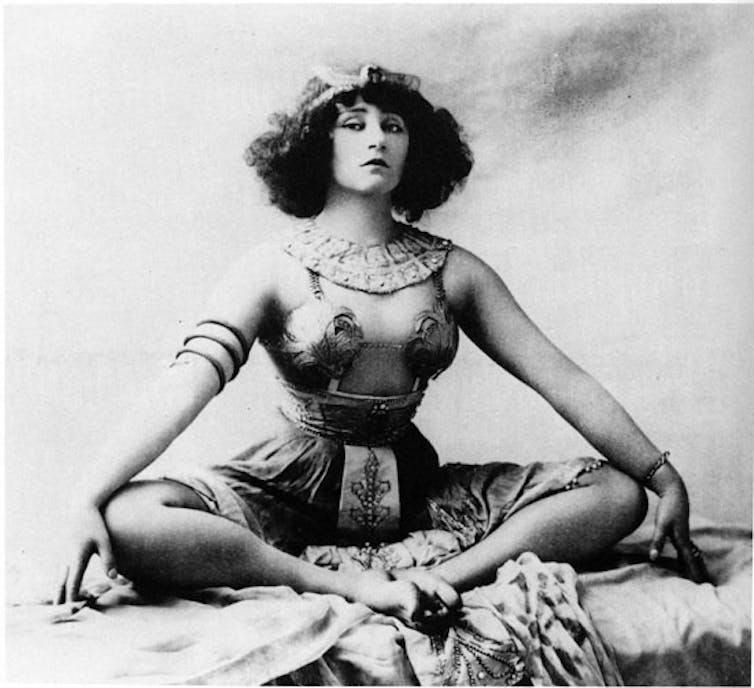
When, in her early 30s, Colette decided to leave the marriage, she had to find a way to support herself. Energetic and resourceful, she began to publish under her own name and took classes in dance and mime. She trained in the gym and went on stage, becoming the only great French author (to my knowledge) to have alternated writing with dancing semi-nude on stages all over France.
She combined her careers, writing both fiction and non-fiction set behind the scenes of the music hall, giving a voice to the underpaid women performers who featured so often from a male perspective in paintings and novels of the time. She also began a passionate affair with a cross-dressing lesbian aristocrat, Missy, and scandalised the nation by sharing a passionate kiss with her on stage.
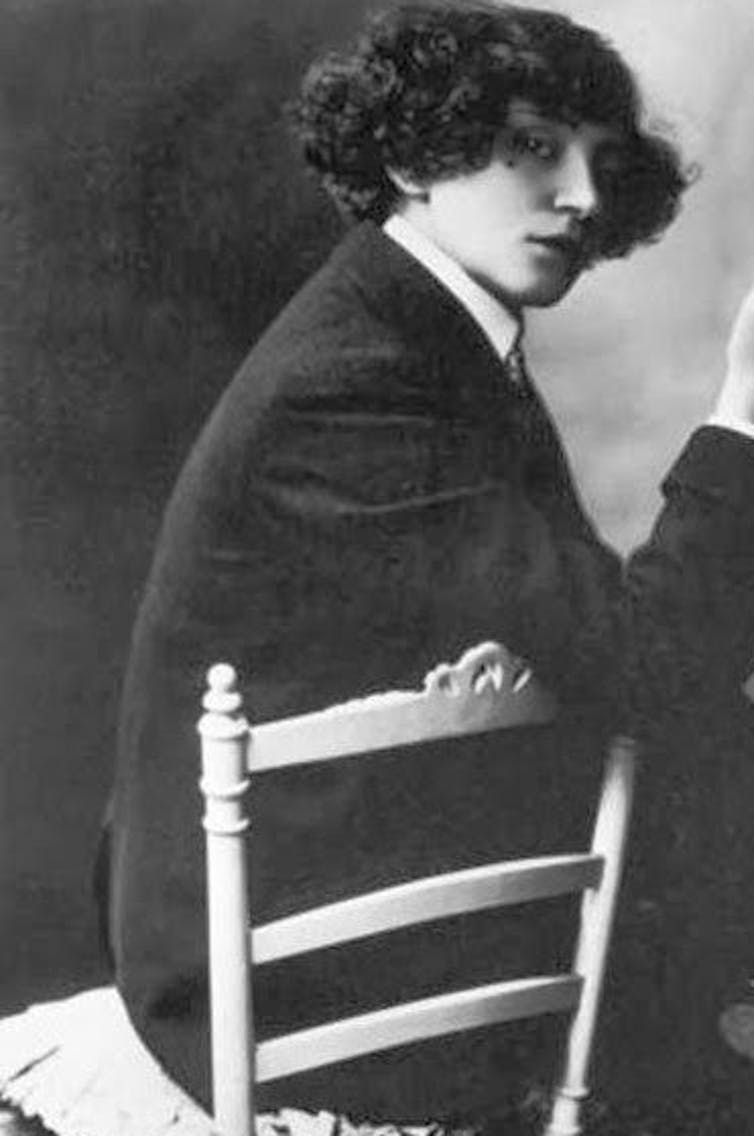
In the 1907 pantomime which included a kiss with a woman. Wikimedia Commons
Director Wash Westmoreland’s recent film about Colette takes us to this point in her colourful career. She would go on to write prolifically as a journalist, novelist, essayist and innovator in the blended genre of “autofiction”.
She would nurse in World War I, marry twice more, bear a daughter at the age of 40, bolster her flagging finances by opening a beauty parlour – and finally become, for the French, “our great Colette”. But a whiff of scandal was still attached to her name, and acceptance of her as a great writer was slow.
The Catholic Church even refused to grant her a religious funeral (although she would have agreed with the Church, for religion formed no part of her passionate love of life.)
Sex and sensuality
Westmoreland’s film, starring the British actor Keira Knightley, shines a deserved spotlight on an important feminist figure. From the Claudine series on, Colette gives us a serenely irreverent perspective on a patriarchal culture.
She reverses the gaze of heterosexual desire to provide sensual, detailed descriptions of male bodies, and writes with equal sensuality and precision of same-sex desire. She writes movingly of romantic love and motherhood but insists, in her novel Break of Day that both are also peripheral to a woman’s life:
Once we’ve left them both behind, we find that all the rest is gay and varied, and that there is plenty of it.
In life, as in writing, she places female friendship centre-stage, sometimes subverting the eternal triangle by making its primary focus the relationship between a man’s wife and his mistress. She often published in women’s magazines, right up to her death in 1954 (Elle serialised her final books), and wrote comically and caustically of trying to make her own robust, food-loving body fit into the willowy fashions of the inter-war years.
In a very public life, as in her fiction, she exemplified financial and social independence and shame-free sexuality – what we would now call “gender fluidity”. She possessed a generous optimism that went against the grain of the angst and despondency which characterised so much male literature of the 20th century.
She remained, throughout, a popular writer. An author read for pleasure, for the sensuality of her prose, the dry note of humour that peppers her eloquence, the lightness of touch that means her seriousness is never heavy or self-important.
One of France’s greatest – and certainly most unconventional – writers, she has been translated – often brilliantly – into other languages. Her appearance on cinema screens should bring her even more readers.
A year and a half ago I gave birth to my first child. A girl named Olive. I’m a writer and a writing teacher so, naturally, our friends and family gave us books.
One after another, we unwrapped picture books and added them to the slightly tattered collection salvaged from our own childhoods. In the early weeks of Olive’s life, I spent a lot of time looking through those pages and thinking about how I wanted to raise her and what ethics I felt strongly about passing on to her. Maybe because I was already asking myself these questions, I noticed something in those books.
Very few featured strong, empowering girl leads.
The same thing was noticed by the authors of a new book called Good Night Stories for Rebel Girls (2017) and captured in an accompanying video that has since gone viral.
The video opens with a mother and daughter in a bookshop. Together they remove books from the shelf based on their representation of female characters. First, they remove the books with “zero male characters”. (Three). Then, they remove the books with “zero female characters”. (Seventy six).
Then, they remove the books where “females don’t speak” (One hundred and forty one).
Next they ask, do these characters have dreams or aspirations? They remove all the books where female characters are waiting for a prince. No number is provided for these. No number is needed. The shelf that was still pretty full is now virtually empty.
The video ends with the young girl turning to a bookseller off camera and asking,
I’m interested in Mars … do you have any books about that?
Princesses and rebels
I’m a feminist. I’m not what I’d call an anti-princess feminist. I see no reason to pit myself against the princess as a person. Princess is, after all, a job like King or Prime Minister. I know there are feminist representations of princess characters in books for children (I discuss a few below) but overall, I, like many feminists, object to the princess as a fictional construct.
Why?
Because the princess common to children’s literature is virtually always seen through the lens of her desirability, her romantic contribution and subsequent morality. She works best when she makes the prince his best possible self. When she fixes him. Over time, this princess may grow, new stuff gets added in and old sexist stuff gets carted out, but she’s still locked to her male counterpart. She’s defined by her “love” story. This construction is used as a way to package girlhood (and womanhood too), and in that packaging, the princess creates limits for real girls.
But girls are interested in Mars. Where are the books on Mars?
Halfway through the Rebel Girls video we are introduced to the authors of Good-Night Stories for Rebel Girls, co-founders of Timbuktu Labs, Elena Favilli and Francesca Cavallo. They say they wrote the book as a response to bedtime stories where the female characters had no agency. Its 100 stories are about real women who did extraordinary things.
There aren’t any pretty pink princesses in this book, but queens are represented. We read about Nefertiti, Hatshepsut, Yaa Asaantewaa, and Elizabeth I. Inventors, olympians, activists, artists, spies, surgeons, scientists. There are women you would expect to see: Frida Khalo, Jane Goodall, Maya Angelou, and Rosa Parks.
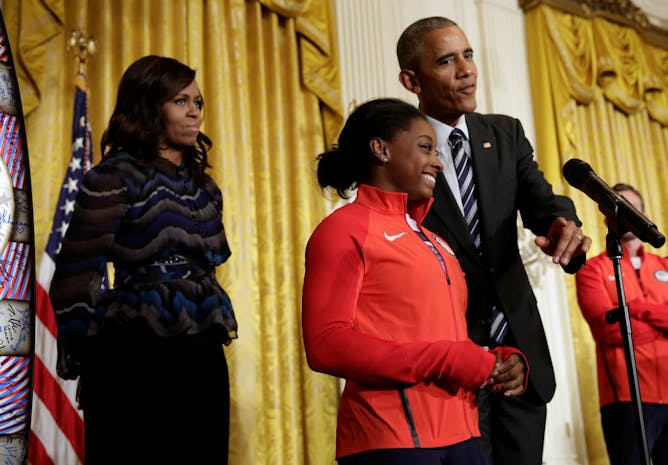
Simone Biles with the Obamas at the White House last year: she features in Good-Night Stories for Rebel Girls. Yuri Gripas/Reuters
There are a few women missing. I wanted to see feminist Gloria Steinem or former President of Indonesia, Megawati Sukarnoputri. I’d have liked an Australian woman included, like former Prime Minster, Julia Gillard, feminist writer Germaine Greer or author Miles Franklin.
But there’s still time and, no doubt, another edition on the horizon.
As a first step, Good Night Stories for Rebel Girls accomplishes what it sets out to do. It takes the frame of the bedtime princess story and populates it with champions, thinkers, artists and activists, but as a social artefact, the book represents so much more. It was funded through Kickstarter to the tune of one million dollars, breaking Kickstarter’s record. Favilli and Cavallo originally set out to raise $400,000 to print 100 books but interest soon swelled.
Since Olive was born, I’ve spent countless hours scouring feminist picture book lists online, stalking A Mighty Girl and Amy Poehler’s Smart Girls on Facebook for book recommendations, asking friends, booksellers, googling, and, overall, I’ve been pleasantly surprised by the number and quality of newish picture books out there for the budding feminist.
Here are some of my favourites…
Feminist princess picture books
I worked as a bookseller for almost 20 years and if there was one thing I heard daily from mothers, it was that they wanted something other than passive Disney princesses to give their daughters. In Don’t Kiss the Frog (2013) by Fiona Waters, Rapunzel would really like to cut off her locks and dye what’s left blue. In The Princess and the Peas (2013) by Caryl Hart and Sarah Warburton, “princess” is a phase, a disease. Ordinary girl, Lily-Rose will not eat her peas and so is diagnosed with “Princess-itus”. She gets sent to a castle where she trains and works – day in and day out – at being a princess.
Meanwhile, in Ian Falconer’s Olivia and the Fairy Princesses (2012), the fashionable, eccentric, Chanelesque Olivia questions what a princess actually is and why she’s always dressed in pink, tiaras and fairy wings. Olivia also confronts the “whiteness” of this aesthetic by dressing in princess costumes from around the world and asking why the default for princess isn’t one from India, or China. In the end, Olivia decides she doesn’t want to be a princess. She’ll be a queen instead.
Lots of other girls in contemporary picture books come to a similar conclusion as Olivia. Some don’t even see the argument as relevant, or part of the story. These girls are often inventors or scientists.
Feminist science and inventor picture books
The original Rosie the Riveter.
Leading the charge here are Rosie Revere Engineer (2013) and Ada Twist, Scientist (2016) by Andrea Beaty (illustrated by David Roberts). In Beaty and Roberts’s series, Rosie Revere is an aspiring inventor and niece of the real Rosie the Riveter. Her classmate, Ada Twist, is a gifted if somewhat mess-making scientist. Another notable book in this category is The Magnificent Thing (2014) by Ashley Spires.
These books position science and inventing as central to the story. The lesson of Rosie Revere Engineer is not that girls should invent, but that you should never let mistakes or failures keep you from inventing. The lesson of Ada Twist, Scientist is not that girls should be scientists, but that parents should accept their children for who they are, no matter how messy it is.
These books don’t argue that girls should be inventors and scientists: they suppose they already are.
Feminist activist picture books
The next category arming young girls with heroes are stories (mostly non-fiction) about activist girls, such as the unstoppable Malala Yousafzai. There’s Malala: Activist for Girls’ Education (2017) by Raphaele Frier and illustrated by Aurelia Fronty, Malala Yousafzai: Warrior of Words (2014) by Karen Leggett Abouraya, illustrated by L.C Wheatley, and a bunch of others detailing her extraordinary story.
Malala Yousafzai, Nobel Peace Prize laureate, meeting Canadian president Justin Trudeau last month. Her story has inspired many books. Chris Wattie/Reuters
There is power in the political picture book to reveal the marginalised stories of women in politics, but only space in this article to mention a few. So I’ll start (of course) with Hillary (2016) by Jonah Winter, a biography of Hillary Rodham Clinton. Winter has had a number of political picture books published, including one about the work of Gertrude Stein and Alice B. Toklas, and Hillary’s daughter Chelsea Clinton has also written a picture book called She Persisted. According to a recent tweet from Clinton, it is about “women who didn’t take no for an answer”.
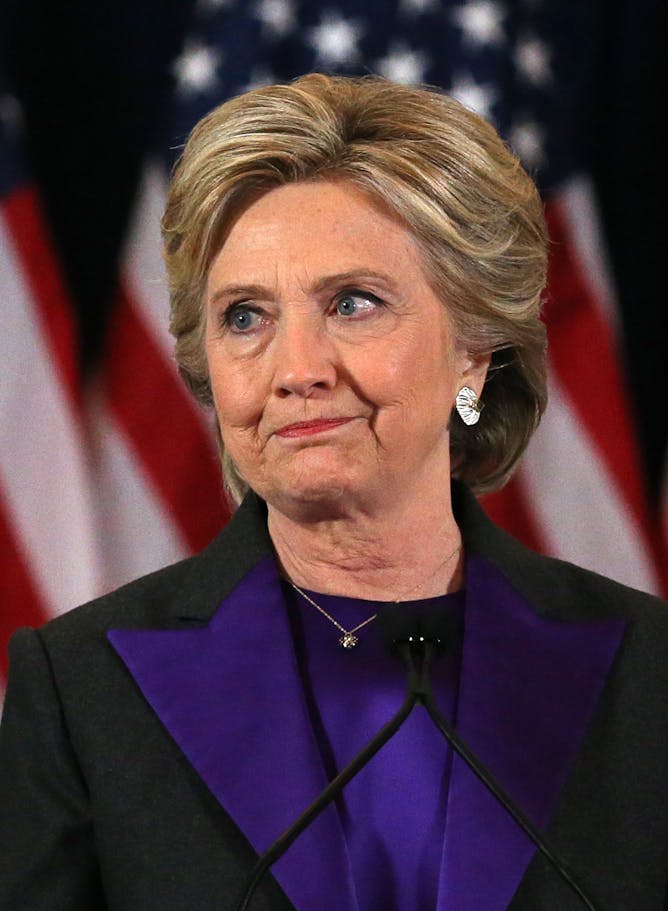
Hillary Clinton. Carlos Barria/Reuters
My favourite in this category is, I Dissent: Ruth Bader Ginsburg Makes her Mark (2016) by Debbie Levy and illustrated by Elizabeth Baddeley. I Dissent uses the Notorious RBG to introduce ideas around working mothers, persistence, shared domestic responsibilities and stay-at-home dads. The book explores the language of dissent while showing the (completely lovable) liberal US Supreme Court justice in her real life, thereby positing the girl with a voice as something special, but nonetheless natural.
We can’t talk about political picture books without also mentioning Madam President (2008) by Lane Smith. This book follows a little girl (in a flared pantsuit!) as she imagines how she would preside over her country and develops the qualities she will need for the job. Qualities like calmness and wisdom, diplomacy and humility.
Feminist non-fiction/history/biography books
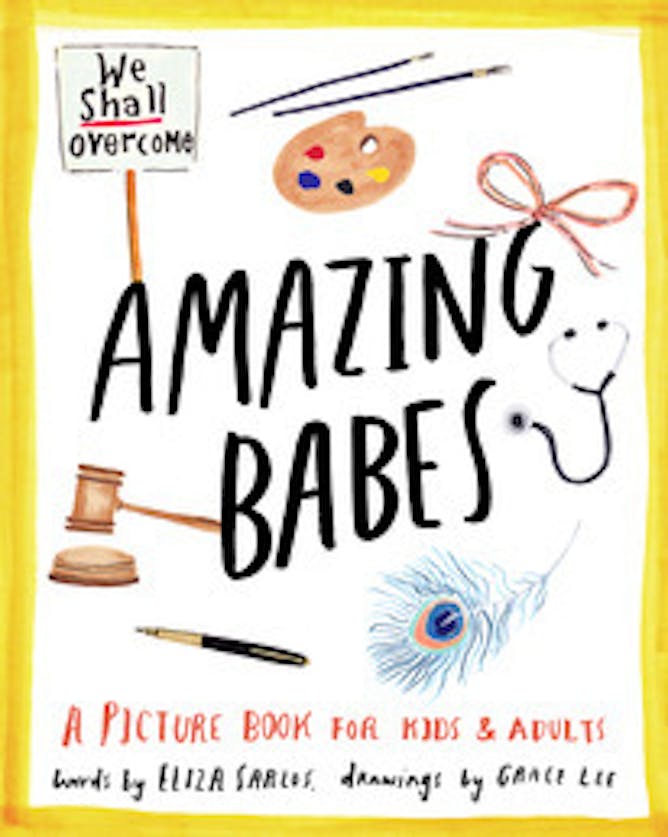
One of my favourite picture books in this category is Amazing Babes (2013) by Eliza Sarlos, illustrated by Grace Lee. Each page introduces us to a famous woman from history with a line such as, “I want the vision of Miles Franklin” or the “compassion and commitment of Mama Shirl”. It also includes unusual women such as fashion blogger, Tavi Gevinson.
If you want to know more about any of the women in the book you can look them up in the index pages (Hedy Lamarr, I discovered, was an inventor!) This book speaks to a long history of women, and its framing device allows for a clear and deep reading of why each woman is important, and what modern girls can take from their lives. It only has one line per page/per illustration and uses repetition throughout, so it’s great for younger readers.
Another recent series Little People, Big Dreams, brings together a writer and illustrator to tell the story of a famous woman. There are six books in the collection – about Frida Kahlo, Marie Curie, Coco Chanel, Agatha Christie, Maya Angelou, and Amelia Earhart – with three more to be published later this year.
A few months ago, meanwhile, I stumbled across a list that introduced me to a treasure trove of recent biography picture books that amplified, uncovered or exposed the stories of women whose work had changed the world.
Australia doesn’t have the same number of overt feminist picture books as, say, the US but that doesn’t mean we don’t have empowering books for girls, about girl characters.
My favourite 2017 CBCA shortlisted book The Patchwork Bike (2016) by Maxine Beneba Clarke and illustrated by Van T. Rudd is a glorious picture book about a girl (and some other kids) living on the edge of the no-go desert. Together the kids build a bike from scraps, while Clarke and Rudd build a story about freedom and creativity and inventiveness.
Another favourite of mine is Molly and Mae (2016) by Freya Blackwood and Danny Parker. This is a story about two very different little girls who meet, become friends, and fall out during a long train ride. It’s a sincere and very realistic look at the often complex relationships and power dynamics between girls, set against a magnificent (moving) Australian backdrop.
My absolutely favourite girl picture book hero is Aaron Blabey’s Sunday Chutney. Stylish, outgoing, funny, resilient and creative, Sunday sometimes feels out of place, and struggles when she has to move and go to a new school. But Sunday has a powerful weapon in her confidence and wry sense of humour.
Finding your own rebel girl
Good Night Stories for Rebel Girls is not just a book. It’s a protest. We wanted it, we funded it, we saw the gap and refused to leave it alone. But the best part of the book, and what really sets it apart from the others I have mentioned, is the last two pages before the acknowledgements. One says “Write Your Story”, the other, “Draw Your Portrait”.
The book invites girls to write themselves into history. To be visible. To be seen. To have their wisdom heard.
I look forward to reading the story my daughter will write in this book one day, and seeing how she will represent herself. I won’t know what kind of rebel Olive will want to be for a few years yet, but until that day I’ll read her these stories, and urge every mother to do the same.












 At the BookShelf