The link below is to an article reporting on ‘reading rooms’ being set up by IKEA in London to celebrate the announcement of the Nam Booker Prize longlist.
He is famous for his love of honey, and being a bear of “little brain”. So Winnie the Pooh might be a little surprised to find himself the subject of a major new museum exhibition.
Winnie the Pooh: Exploring a Classic will explore the creative partnership of writer A.A. Milne and illustrator E.H. Shepard. Together they produced the much-loved whimsical stories featured in Winnie the Pooh (1926) and The House at Pooh Corner (1928).
The decision by the Victoria and Albert museum in London to hold the exhibition proves that the bear and his friends have become establishment figures. As children’s literature expert Peter Hunt notes, they are “part of British culture, passing from generation to generation”.
One element of the incredible success of the Pooh books is that they reflect ideas about childhood that emerged in what is widely known as the “golden age” of children’s literature, spanning from the mid-19th century to World War I.
The golden age view of a child’s world was one that was close to nature – the child an innocent before the imposed horrors of school and education, and a figure of loss and nostalgia for the adult. This was very much the landscape of Winnie’s home in Hundred Acre Wood.
As cultural theorist Stefan Herbrechter said: “Children are supposed to live in a world of their own, which is clearly defined and marked out as the space and time for play and in which toys are the main objects and controlling devices of socialisation.”
However, Milne’s books are more poignant and have a slightly different flavour, than other examples, such as Wind in the Willows (of which Milne was a great fan, writing a stage adaptation). They came after World War I, when many illusions about innocence, the upper class, Englishness and patriotism had reached breaking point.
They contain traces of the experiences in the trenches that marked both Milne and Shepard, whose illustrations of carnage at the Somme and Paschendale were the subject of a separate recent exhibition.
The pastoral paradise of Hundred Acre Wood was one that Milne, who wrote passionately in favour of pacifism, conjured from his own childhood memories – back to a time before the terrifying intrusion and destruction of the war.
As such, Milne’s invented world is also saturated with loss, poignantly embodied in the depressed donkey character of Eyore, who sees no reasons to be cheerful. It is also haunted by the threat of leaving the safe space of the wood for places over the horizon that can’t yet be seen. When Christopher Robin and Pooh organise an “expotition” to the North Pole, they find a large pole in the woods and label it accordingly.
Toys, argues Herbrechter, are intimately concerned with storytelling. They are “like little story machines, narrative catalysers, objects that help make sense of the world”.
This idea is addressed with humour and complexity in Milne’s writing, and beautifully rendered in Shepard’s illustrations that always emphasise the “toyness” of the animals. It explains much about why these books have remained so loved.
Pooh the satirist
Milne shows his real life son Christopher (whom Christopher Robin was named after) how playing with his toys is a kind of writing, just as the playwright makes scenes for his characters. Before he wrote the Pooh stories, Milne worked as a playwright and as a satirist at Punch magazine.
We can detect the specific pleasures of introducing the craft of storytelling to his son from a man who made a living from writing. Milne’s stories gently teach the young credulous reader, who reads literally, that they may be other more rewarding ways of interpreting the world, and what the difference is between what people say and what they mean.
Milne offers the pleasures of word play. The narrator explains that “Winnie the Pooh lived in the forest all by himself under the name of Sanders”, which meant “he had the name over the door in gold letters and lived under it”.
The non-literal reader is invited to find this funny. Similarly, if Piglet says anything “carelessly” he is probably concealing a very important wish. He will say he isn’t afraid when he wants to appear brave.
Although the Pooh books were famously dismissed by fellow satirist Dorothy Parker, who wrote a dismayed and withering review of Winnie-the-Pooh, the success of Milne’s works suggests that he managed to translate his love of making stories into a form that beguiled the child reader. Stories which showed how they too might make an imaginative life for themselves in the world of storytelling and understand how to master words and meanings.
In one notable scene Pooh finds himself stuck on the doorway to Rabbit’s house, and must wait for a week until he is thin enough to be pulled free. Christopher Robin sits down with him and reads him a “sustaining book”, such as would help and comfort a Wedged Bear in Great Tightness.
The comforting presence and companionship of a good book is something all readers of Pooh take away with them. And it is perhaps this which explains the enduring popularity of these stories, which taught us how to read and write in our own way.
A common thread in these hit pieces is the idea that millennials are lazy, shallow and disruptive. When I think of my friends, many of whom were born in the 1980s, and my undergraduate students, most of whom were born in the 1990s, I see something different. The millennials I know are driven and politically engaged. We came of age after the Iraq War, the Great Recession and the bank bailout – three bipartisan political disasters. These events were formative, to an extent that those who remember the Vietnam War might not realize.
The idea that young people are ruining society is nothing new. I teach medieval English literature, which gives ample opportunity to observe how far back the urge to blame younger generations goes.
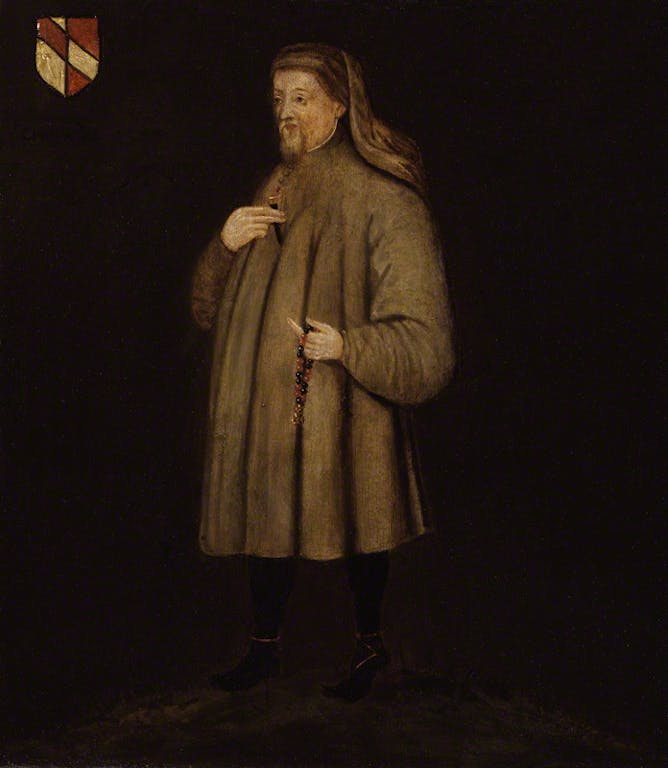
The most famous medieval English author, Geoffrey Chaucer, lived and worked in London in the 1380s. His poetry could be deeply critical of the changing times. In the dream vision poem “The House of Fame,” he depicts a massive failure to communicate, a kind of 14th-century Twitter in which truths and falsehoods circulate indiscriminately in a whirling wicker house. The house is – among other things – a representation of medieval London, which was growing in size and political complexity at a then-astounding rate.
In a different poem, “Troilus and Criseyde,” Chaucer worries that future generations will “miscopy” and “mismeter” his poetry because of language change. Millennials might be bankrupting the napkin industry, but Chaucer was concerned that younger readers would ruin language itself.
“Winner and Waster,” an English alliterative poem probably composed in the 1350s, expresses similar anxieties. The poet complains that beardless young minstrels who never “put three words together” get praised. No one appreciates old-fashioned storytelling any more. Gone are the days when “there were lords in the land who in their hearts loved / To hear poets of mirth who could invent stories.”
William Langland, the elusive author of “Piers Plowman,” also believed that younger poets weren’t up to snuff. “Piers Plowman” is a psychedelic religious and political poem of the 1370s. At one point, Langland has a personification named Free Will describe the sorry state of contemporary education. Nowadays, says Free Will, the study of grammar confuses children, and there is no one left “who can make fine metered poetry” or “readily interpret what poets made.” Masters of divinity who should know the seven liberal arts inside and out “fail in philosophy,” and Free Will worries that hasty priests will “overleap” the text of the mass.
On a larger scale, people in 14th-century England began worrying that a new bureaucratic class was destroying the idea of truth itself. In his book “A Crisis of Truth,” literary scholar Richard Firth Green argues that the centralization of the English government changed truth from a person-to-person transaction to an objective reality located in documents.
Today we might see this shift as a natural evolution. But literary and legal records from the time reveal the loss of social cohesion felt by everyday people. They could no longer rely on verbal promises. These had to be checked against authoritative written documents. (Chaucer himself was part of the new bureaucracy in his roles as clerk of the king’s works and forester of North Petherton.)
In medieval England, young people were also ruining sex. Late in the 15th century, Thomas Malory compiled the “Morte d’Arthur,” an amalgam of stories about King Arthur and the Round Table. In one tale, Malory complains that young lovers are too quick to jump into bed.
“But the old love was not so,” he writes wistfully.
If these late medieval anxieties seem ridiculous now, it’s only because so much human accomplishment (we flatter ourselves) lies between us and them. Can you imagine the author of “Winner and Waster” wagging a finger at Chaucer, who was born into the next generation? The Middle Ages are misremembered as a dark age of torture and religious fanaticism. But for Chaucer, Langland and their contemporaries, it was the modern future that represented catastrophe.
These 14th- and 15th-century texts hold a lesson for the 21st century. Anxieties about “kids these days” are misguided, not because nothing changes, but because historical change cannot be predicted. Chaucer envisioned a linear decay of language and poetry stretching into the future, and Malory yearned to restore a (make-believe) past of courtly love.
But that’s not how history works. The status quo, for better or worse, is a moving target. What’s unthinkable to one era becomes so ubiquitous it’s invisible in the next.
Millennial bashers are responding to real tectonic shifts in culture. But their response is just a symptom of the changes they claim to diagnose. As millennials achieve more representation in the workforce, in politics and in media, the world will change in ways we can’t anticipate.
By then, there will be new problems and a new generation to take the blame for them.
This is not the usual book review I guess, as I haven’t yet read the entire book. I have however started to read this book, which I think is now regarded as a must read on early Australian history. I have read the first 5 chapters or the first 157 pages – it is a 688 page work.
‘The Fatal Shore’ is by Robert Hughes and was first published in Great Britain by Collins Harvill in 1987. My edition is the paperback edition of 1996, published by The Harvill Press in London.
‘The Fatal Shore’ is the story of convict settlement in Australia, from the early history of transportation from England to Australia, including the steps that led to it. It describes in straight forward, matter of fact way, the plight of English convicts being sent to Botany Bay in all of its brutal reality. The reality of the picture painted by Robert Hughes removes any lingering thoughts of pioneering adventure with which the convicts may have been involved in. It is a harsh world, where the punishment dished out far exceeded the crimes involved in many, many cases.
There are individual accounts of convicts and their crimes, with detailed descriptions of the horrors they endured on a voyage to New South Wales or one of the other colonies as they were established around Australia.
It is not just a story of the convicts, it is a story of invasion, as Aboriginal Australia gave way before the steady push of colonial endeavour by the English invaders. It is the story of the red coats, of the sailors, of the governors, etc. In short, it is a history of the convict era in Australia and all that it brought with it.
I am enjoying this account of early Australian history and would recommend it to anyone who has not yet read it – especially those living in Australia. It seems to me to be a more honest account of Australia’s early history than that which we may hear about in school – if we hear much about it at all. A must read.
from the Reformation to the Beginning of the Reign of King George I, by Thomas Crosby
As noted in a previous post, I have been reading ‘The History of the English Baptists from the Reformation to the Beginning of the Reign of King George I,’ by Thomas Crosby. I have also been adding this work to my website (a link to this book appears at the end of this post).
I have now completed reading and adding the preface, table of contents and part of the first chapter.
The preface covers the period from the early church through to the first Baptists in England, tracing the origins of the Baptists and disproving their rise to that of the Anabaptists at Munster and the disaster that occurred in that city as a result of the Anabaptist rebellion.
Though a lengthy preface, it briefly touches on such as the Albigenses, the Waldenses, Wickcliff, Donatists, etc. Crosby goes back through history, from the reformation to the first century finding evidence of Baptistic beliefs and practices. It is a very interesting study, even though it is brief. Another interesting aspect of this study is the evidence for early Baptistic existence, even in the writings of Paedobaptist authors and the evidence against the early practice of infant-baptism in the early church.
To read the preface and further, please follow the link below:
from the Reformation to the Beginning of the Reign of King George I, by Thomas Crosby.
I have just started to read the above titled book – well, at least the first volume anyway. This title is made up of four volumes, all of which are over 500 pages in length. I have also started to add the work to my web site at:
The original work (Volume 1) was first published in 1738 and includes some old English, which in the version I am placing on my web site, I have tried to update without changing the overall sense and flow of the text.
It is generally understood that Crosby deals with a mix of both the Particular Baptists and General Baptists, or if you prefer, the Calvinistic Baptists and the Arminian Baptists.
To follow my progress and to read the book, visit:
I have recently posted on the particularbaptist.com library site ‘The Story of the English Baptists,’ by John C. Carlile. The book can be found at the following link:
I own the 1905 edition which was printed as a hardcover by James Clarke & Co. in London, England. My copy is quite aged and is in quite poor condition. The version I have placed online is of course in pristine condition and will undoubtedly stay that way.
There are a number of illustrations and photographs in the book – all of which can be found in the online version.
The book provides something of an introduction to both the General and Particular Baptists, and as such is probably a useful book in that it whets the appetite to research deeper into the history of Baptists in England – which in my case is especially true of the Particular Baptists (of whom I am one).
There are some very interesting and useful chapters in the book, though the treatments of some of the ‘big’ names in Particular Baptist history are quite brief – as I say, something of an introduction. Perhaps an overview may be a better way to describe the book.
I don’t think everyone will necessarily agree with all of the conclusions and statements made by the author of the book. For example, there is something definitely hinky about his comments regarding possible unification of General and Particular Baptists. I’m not sure that he really grasps the significance of the differences between the two camps.
Out of 5 I’d probably give the book a generous 3. I think the book has merit, but is yet disappointing.


 The comforting presence and companionship of a good book is something all readers of Pooh take away with them. And it is perhaps this which explains the enduring popularity of these stories, which taught us how to read and write in our own way.
 By then, there will be new problems and a new generation to take the blame for them.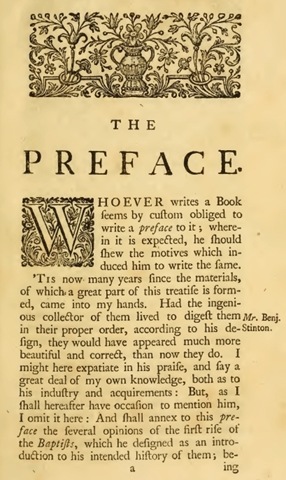
 At the BookShelf
