
Unknown's avatar

8 ways business managers can use fiction to prepare for the uncertain reality of coronavirus


It’s a brave new business world, so turning to novelists can help explore possible future scenarios.
(Shutterstock)

Nada Elnahla, Carleton University and Ruth McKay, Carleton University

Reading fiction has always been, for many, a source of pleasure and a means to be transported to other worlds. But that’s not all. Businesses can use novels to consider possible future scenarios, study sensitive workplace issues, develop future plans and avoid unplanned problematic events — all without requiring a substantial budget.

During the COVID-19 pandemic, many business leaders have learned how important it is for businesses to consider a wide range of possible outcomes and to enhance organizational adaptability. Relying on analyzing or projecting trends and extending what business leaders usually do is no longer enough to assure future success. When management is poorly prepared for the unexpected, businesses start getting into trouble.

Scenario planning, therefore, helps businesses keep themselves flexible and move quickly with market shifts. Scenario planning is a series of potential stories or possible alternate futures in which today’s decisions may play out. Such planning can help managers assess how they or their employees should respond in different potential situations.

How businesses can use novels

Unfortunately, scenario planning requires time and resources. And depending on its use, such as for an investigation, budgeting or legal matters, it can also require collecting sensitive data. That can include employees’ personal experiences of sexual, discriminatory or psychological harassment, suicide, mental health, drug abuse, etc.

The more sensitive the needed data is, the more difficult it is to collect while ensuring employee privacy. This is where literary texts come in.

A person reading at a table.
Novels can offer creative insight and wisdom to business managers.
(Helena Lopes/Unsplash)

As sources for possible future scenarios capable of providing strategic foresight, or producing alternative future plans, novels can also help businesses create dialogue on difficult and even taboo subjects.

Novels are, therefore, capable of helping managers become better, providing them with creative insight and wisdom. Science fiction can provide a means to explore morality tales, a warning of possible futures, in an attempt to help us avoid or rectify that future.

Brave new business world

Our research
uses Aldous Huxley’s 1932 novel Brave New World to explore possible scenarios related to situations that are usually kept confidential, such as employees’ mental health issues and drug use or abuse. We examined how employers encounter uncertainty around the impact that legalizing cannabis could have on the work environment, and ways to consider such potential effects.

Brave New World is set in a dystopian future and has been adapted numerous times, most recently into a 2020 TV series. It portrays a dystopic civilization whose members are shaped by genetic engineering and behavioural conditioning. Their happiness is maintained by government-sanctioned drug consumption. It is a world where countries are protected by walls that keep the undesired away — an eerily familiar scenario to Donald Trump’s promise of building a wall on the U.S.-Mexico border.
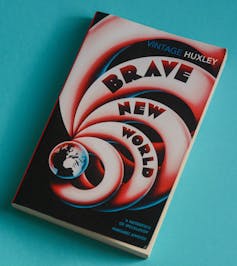
'Brave New World' book
Aldous Huxley’s ‘Brave New World.’
(Shutterstock)

By reading the novel, business managers can compare the world we live in today and the path our countries and corporations are on to the fictional events in the novel. This can help them pay attention to and address less comfortable, and sometimes often neglected, sensitive workplace issues that need to be considered when planning for the future.

For example, in Brave New World, the consumption of the drug “soma” becomes the norm upon which life is founded. When soma is taken away, individuals can no longer face their reality and they end up welcoming death.

Brave New World offers workplace leaders a look at what could happen if employees’ wellness, mental health or drug use are disregarded, and lead to isolation, absence, resignation or, in dire circumstances, suicide.

8-step action plan

To study sensitive workplace issues that could help generate new knowledge, lead to envisioning ways to act appropriately and develop future strategies, business managers can follow these steps:

  1. Form a team of managers and an HR representative who is aware of company policies and ethics protocols, and is in direct contact with employees.
  2. The team then decides which workplace issue(s) the organization needs to study.
  3. The team chooses a literary text, such as a novel, that discusses those issues.
  4. Each member of the team reads the literary text on their own before discussing it together in at least one session.
  5. The team researches the chosen workplace topics inside the organization and outside (for example, laws and regulations related to each issue).
  6. The team identifies insightful sections.
  7. The team analyzes the chosen extracts.
  8. The team writes a report with recommendations on workplace conditions and how best to improve them.

Reading has surged during lockdown. But literary works can provide us with more than a leisurely pastime. For businesses, novels represent a legitimate way to study the workplace, and this is accomplished by comparing the path our countries and corporations are on today to fictional events.The Conversation

Nada Elnahla, PhD Candidate, Sprott School of Business, Carleton University and Ruth McKay, Associate Professor, Management and Strategy, Sprott School of Business, Carleton University

This article is republished from The Conversation under a Creative Commons license. Read the original article.

Unknown's avatar

Summer reading guide from The Conversation’s business & economics writers


Janine Dixon, Victoria University; Beth Webster, Swinburne University of Technology; Gigi Foster, UNSW Australia; Rodney Maddock, Monash University; Ross Guest, Griffith University, and Tim Harcourt, UNSW Australia

Janine Dixon, Economist at Centre of Policy Studies, Victoria University

Black Inc. Books.

In his 2016 book Richard Denniss calls out politicians and vested interests for using “econobabble” – which he defines as “incomprehensible economic jargon and apparently simple words that have been stripped of their normal meanings” – to conceal simple truths from the public. Econobabble was published at the beginning of 2016, but it almost feels as though Denniss knew in advance that “post-truth” would be voted the Oxford Dictionaries 2016 word of the year.

The book teems with examples of econobabble that are both entertaining, because of the way Denniss describes them, and infuriating, because the consequences are so devastating. The discussion of the Adani coal mine, which continues to this day, is particularly enlightening.

Economists themselves are not immune from criticism. As an economic modeller, I was particularly interested in the chapter on economic modelling. In this chapter, continuing with the main themes of the book, Denniss promotes simplicity and openness in the way economic issues should be communicated to the wider community – and I can only agree!


Gigi Foster, Associate Professor, School of Economics, UNSW Australia


Oxford University Press.

Back in September I had the unique experience of attending the Sydney launch of William Coleman’s new edited volume, “Only in Australia” (OUP 2016). I like William and I bought his book mainly out of curiosity and a desire to be entertained.

As an Aussie-loving Yankee transplant who for professional reasons is supposed to have at least a passing familiarity with Australian political and economic history, I have found “Only in Australia” to be enlightening, reaffirming, and most definitely amusing. The enlightenment has been in regard to umpteen little facts and interpretations about Australia’s history as a nation.

Did you know, for example, that in the mid-1800’s, “public schooling in NSW was not as exclusive of religion as Victoria but was still, at its core, secular” (from the chapter by Greg Melleuish and Stephen A. Chavura)? Or that “from the 1850s, Australian governments have been responsible for the financing, construction, and operation of railways – urban, suburban, and rural…[while] in other countries, extensive government railways were initiated later than the 1850s, often beginning with the nationalization of substantial private rail lines or networks” (from the chapter by Jonathan Pincus)? These types of titbits have filled in some of my sometimes patchy understanding of the how and why of modern Australia.

The reaffirmation has mainly been of my impressions of Australian culture. The book itself is a testament to that culture: not a single of the 15 chapters is written or co-written by a woman, and the entire enterprise has a clubbish old-boysy feel to it. That said, as a constant whinger about the Australian cultural cringe, I felt my heart buoyed by many observations rejecting European and particularly British derivations of Australian institutions – both formal and informal. Many of my own observations about those institutions were also confirmed as I turned the pages, such as the observation that “no other significant comparator country has tribunal-determined wages to the extent that Australia does ” (from Phil Lewis’s chapter) and the “absence of domestic corporate strength and financing” of Australian agribusiness (from Nick Carter’s chapter).

I didn’t always agree with the ideological packaging sometimes wrapping the text, and of course the book was far too expensive for reasons we all know too well, but I still enjoyed reading “Only in Australia”.


Ross Guest, Professor of Economics and National Senior Teaching Fellow, Griffith University


Riverhead Books

Tim Harford is one of the best economics writers for a general audience that I have ever read. He shows how economics is everywhere and relevant to our lives in many ways. And he is very entertaining. Besides, this latest book appeals to me because it gives me hope that all of the disorder in my own life might actually be a good thing.


Tim Harcourt, J.W. Nevile Fellow in Economics, UNSW Australia

Penguin.

Last year I read Geoffrey Blainey ‘s history of Indigenous Australia, titled The Story of Australia’s People, subtitled The Rise and Fall of Ancient Australia.

It got me thinking that Australia is 50,000 years old not 230. Geoffrey Blainey tells us, as only he can, the amazing stories of Indigenous history and innovation

This year I am reading the Blainey sequel “The Story of Australia’s people” subtitled The Rise and Rise of a New Australia which takes Australia from the Gold Rush to the present day. Blainey has a unique way of looking at Australia and the world and a unique way of re-looking at it. As he says himself, he has revised a lot of his thinking on Indigenous Australia since his early work The Triumph of the Nomads, written in 1975. He is the master of the historical narrative, a natural born story teller whose words “literally fly off the page”. He is always a pleasure to read regardless of whether you share his view of Australian life.

New South Books.

Another book I’ll be reading, as a self-confessed Australian history junkie, is Stuart McIntyre’s Australia’s Boldest Experiment about the national building efforts of post-war reconstruction in the 1940s. Think of the Snowy Mountains scheme, the Holden car, CSIRO, the ANU, the expansion of the post-migration scheme, all coming out of that innovative policy work undertaken by the war time Curtin-Chifley Labor government and into the long economic boom that Australia enjoyed from the 1950s to the 1970s. The role of the influential economic advisers of the era such as HC Nugget Coombs, JG Crawford and others (known as “The Seven Dwarfs” although no one knows who Snow White was!) is examined in detail by McIntyre. As my own grandfather was an adviser to Prime Minister and Treasurer Ben Chifley in the war years, I am fascinated to see what one of Australia’s most distinguished social historians has to say.


Rodney Maddock, Vice Chancellor’s Fellow at Victoria University and Adjunct Professor of Economics, Monash University

W.W Norton & Company.

My book of the year is The Internet of Us: Knowing More and Understanding Less in the Age of Big Data by Michael P. Lynch. This is quite philosophical work, reflecting on the ways in which we will change and are changing in response to the internet. It explores all the ideas and concerns you would expect and is somewhat pessimistic as is clear from the title. What Lynch underplays is the way in which consideration and debate can and do take place on the web, so that it can assist in active development of knowledge rather than just consumption of facts. A thoughtful read.

HarperCollins.

My novel of the year is Commonwealth by Ann Patchett which I think is her best book since Bel Canto. It is a multigenerational family novel, but written with a light touch and lots of insights into how families function. It is another thoughtful book and one which deserves to be read with time for reflection on its shape and character.


Beth Webster, Director, Centre for Transformative Innovation, Swinburne University of Technology

Princeton University Press.

Joel Mokyr is a smooth read – packed with anecdotes, facts and stories about our economic origins that will surprise even the most crusty scholar. In A Culture of Growth: The Origins of the Modern Economy, Mokyr highlights the persistent fundamentals that are still very much in operation today in the economy. He makes us wonder why no-one studies economic history any more. Are we raising new generations of number crunchers who only have a superficial understanding of data?

The Conversation

Janine Dixon, Economist at Centre of Policy Studies, Victoria University; Beth Webster, Director, Centre for Transformative Innovation, Swinburne University of Technology; Gigi Foster, Associate Professor, School of Economics, UNSW Australia; Rodney Maddock, Vice Chancellor’s Fellow at Victoria University and Adjunct Professor of Economics, Monash University; Ross Guest, Professor of Economics and National Senior Teaching Fellow, Griffith University, and Tim Harcourt, J.W. Nevile Fellow in Economics, UNSW Australia

This article was originally published on The Conversation. Read the original article.

Unknown's avatar

Summer reading guide from The Conversation’s economists


Charis Palmer, The Conversation and Helen Westerman, The Conversation

Challenging, inspiring and funny: a handful of our economics writers share the favourite books they read this year.

Rodney Maddock, Adjunct Professor of Economics, Monash University


W.W. Norton & Company

The Courage to Act by Ben Bernanke

Ben Bernanke’s The Courage to Act gives a wonderful insight into the problems he faced in trying to deal with the crisis, around legislative restrictions, and blame shifting amongst the various regulators.


Penguin Random House

Doing Good Better by William MacAskill

William MacAskill’s Doing Good Better is a great read about the problems with international charities and on ways in which we can do better in providing assistance.


Penguin Random House

The Heart Goes Last by Margaret Atwood

Margaret Atwood’s The Heart Goes Last was my best novel of the year: she is simply a wonderful writer and this one extrapolates ideas about how a prison might be run for profit, posing a possible end state of privatisation.


Echo Publishing

Resurrection Bay by Emma Viskic

Emma Viskic’s Resurrection Bay is the perfect holiday detective story set; perfect for aeroplanes or the beach.


Janine Dixon, Senior Research Fellow, Victoria University


Niche Press

Creating Cities by Marcus Westbury

Marcus Westbury, founder of Renew Newcastle, identified a problem and set about trying to fix it. An economist would hardly credit the idea that the main street in the CBD of a major Australian town could lie mostly empty, while at the same time property owners were declining genuine offers of business. Without being an economics textbook, Creating Cities gives us insight into the market incentives that lead to this sub-optimal allocation of resources. The book takes the reader on a fascinating journey through the process of renewal of an urban centre. Westbury describes the failure of large, centrally-led projects (think monorail) to revive Newcastle, and the surprising success of individuals and small enterprises in breathing life into the once empty shopfronts.


Melbourne University Publishing

City Limits by Jane-Frances Kelly and Paul Donegan

“A higher proportion of Australians live in cities than almost any other country, and most of our national wealth is generated in them.” There is no question that well-functioning cities are a great enabler of economic activity and provide residents with a high standard of living. However, in cities a diverse range of individuals and agencies operate and respond to incentives which are not always in the interests of the greater good. This book gives detailed and informative descriptions of the state of many Australian cities, and explores the many challenges faced by city planners, residents and businesses alike.


Allen & Unwin

The Economics of Just About Everything by Andrew Leigh

I’ve been lucky enough to hear Andrew Leigh speak on a couple of occasions and he tells a great yarn. His message is clear – economics is about incentives – and he illustrates his point over and over with interesting data and stories to go with it. He dispels the myth that economists are only interested in money. I’ve got this one for my 14-year-old nephew for Christmas this year.


Stephen King, Professor, Department of Economics, Monash University


Federation Press

From Protection to Competition by Kerrie Round and Martin Shanahan

I reviewed this book for an international competition law journal earlier this year. It is a great little book that provides a history of Australia’s attitudes to competition and our competition laws from 1788 to 1974 (the end date is when our current competition laws were introduced). It is a comprehensive work of economic history and also a great “story”. It is easy to forget that for most of Australia’s history businesses happily and legally formed cartels to prevent “undesirable” competition and to harm consumers. It is also interesting to see government responses (e.g. having government owned businesses to try and increase competition – they usually failed). It is a gem that I referenced in my most recent article on The Conversation.


Deborah Ralston, Professor of Finance, Monash University


Melbourne University Publishing

Advanced Australia by Mark Butler

Much of my research over recent years has been on post-retirement and I think this book is a really accessible discussion of the issues involved. Although a sitting member, Butler seems to take a pretty balanced view of how the ageing population is impacting on the economy. His track record as Minister for Mental Health and Aged Care through a period of considerable reform to aged care gives him a fairly authoritative point of view. I really enjoyed his speech on this topic to the National Press Club recently.


Ross Guest, Professor of Economics, Griffith University


Cengage Learning

Real-world Economic Policy by Jan Libich

This is the best book for me this year. Succinct contributions on a range of topical themes from economists from various fields and persuasions.


Richard Holden, Professor of Economics, UNSW Australia


Crown Business

Zero to One by Peter Thiel

Paypal founder and noted venture capitalist Peter Thiel discusses how monopoly is essential for innovation, not the terrible thing economists have always told you.


Penguin Random House

Destiny and Power by Jon Meacham

Biography of George Herbert Walker Bush (aka Bush 41).


Simon & Schuster

Crippled America by Donald Trump

Just because…


Penguin Random House

America’s Bank by Roger Lowenstein

How challenging it was to create the US Federal Reserve system.


Catherine de Fontenay, Associate Professor, Melbourne Business School


PublicAffairs

Poor Economics by Abhijit V. Banerjee and Esther Duflo

In the last decade, development economics has undergone a revolution, led primarily by Esther Duflo, an intense young Frenchwoman who is a professor at MIT. The new approach emphasises using randomised control trials (similarly to medicine) to test the efficacy of different policies, and to build a more accurate picture of the economic challenges of the bottom billion (the poorest billion people on earth). The insights garnered are simply amazing, and will lead to changes in policy that will have a profound effect on the condition of the poor for many decades.


Tim Harcourt, J.W. Nevile Fellow in Economics, UNSW Australia


Princeton University Press

Why Australia Prospered by Ian McLean

Ian McLean turns economic history conventional wisdom on its head in this thought provoking book.


Crown Publishing Group

Why Nations Fail by Daron Acemoglu and James Robinson

Why did the USA succeed while Mexico struggled? Same with Argentina or Australia or Botswana and Sierra Leone? The role of institutions matters. A country needs well defined property rights and democratic rights to succeed.


Simon & Schuster

Korea: The Impossible Country by Daniel Tudor

How South Korea went from one of the world’s poorer nations to an OECD nation in five decades.


Penguin Books Australia

Australia’s Second Chance by George Megalogenis

Even better than his first book. Megalogenis looks at the role of immigration in Australian economic development.


Penguin Books Australia

The Story of Australia’s People by Geoffrey Blainey

Australia is 50,000 years old, not 230, and Geoffrey Blainey tells us why. Amazing stories of indigenous history and innovation.

The Conversation

Charis Palmer, Deputy Business Editor, The Conversation and Helen Westerman, Business + Economy Editor, The Conversation

This article was originally published on The Conversation. Read the original article.

Unknown's avatar

Article: Amazon & Money Making – Shock, Horror!!!


There has been plenty of Amazon bashing over the years, with seasons of particular ‘violence’ against the business. I know plenty of people seem to have an issue with Amazon, however I have to confess to being a fan of Amazon (I’m also a fan of Google, Microsoft – Apple not so much). The link below is to an article that reports on another example of Amazon bashing.

For more visit:
http://www.the-digital-reader.com/2013/07/21/the-guardian-discovers-that-amazon-wants-to-make-money-on-books-and-does-not-approve/

Unknown's avatar

Amazon’s fan fiction program Kindle Worlds opens for business


Unknown's avatar

Article: Ebooks are Good


The link below is to an article that looks at the business of ebooks and it is all good.

For more visit:
http://blog.bookbaby.com/2013/05/survey-says-ebooks-are-good-for-the-book-business/

Unknown's avatar

Article: India – Stepping Back Into the Dark Ages


The link below is to an article reporting on the possible closure of Amazon’s Kindle operations in India due to that country’s step back into the dark ages of traditional business legislation.

For more visit:
http://www.the-digital-reader.com/2012/09/20/amazon-may-have-to-close-the-indian-kindle-store/

Unknown's avatar

Article: Ebook Production


The link below is to an article about the business of ebook production.

For more visit:
http://www.huffingtonpost.com/andrew-zack/making-ebooks-is-harder-t_b_1610953.html

Unknown's avatar

No More Bookshops???


The following article from Australia’s newspaper ‘The Australian,’ reports on small business minister Nick Sherry’s opinion that there will be very few offline bookstores in the future. Bookshops will be largely an online business. What do you think?

See the article mentioned above at:
http://goo.gl/tQ8Hu