Unknown's avatar

How to write a love poem


Wikimedia/National Gallery of Art

Hannah Copley, University of Westminster

For many, this year’s Valentine’s Day will be like no other. If you are spending the day apart from your loved ones, and don’t fancy the card selection at your local Tesco, writing a poem can be a more personal way to reach out and connect. Indeed, to paraphrase John Donne, “more than kisses, [poems] mingle souls”.

Here are some poems to take inspiration from, as well as some prompts to help you get that first line on the page.

Make a list

In her sonnet, How Do I Love Thee, Elizabeth Barrett Browning demonstrates the effectiveness of staying power when it comes to writing romance. After setting out to count the ways, the poem sticks determinedly to its opening concept – how do I love thee – answering the question from every possible angle, reaching to “the depth and breadth and height / My soul can reach”.


Read more:
Poems for long distant loves in lockdown


How do I love thee demonstrates how incorporating a list within a poem can make for a persuasive and intimate piece of writing. We see this again, in an altogether sillier way, in Ways of Making Love, by Hera Lindsay Bird. In her poem, Bird unfolds a surprising and decidedly unsexy list of similes to “answer” the instructional title of the poem:

Like a metal detector detecting another metal detector.
Like two lonely scholars in the dark clefts of the Cyrillic alphabet.
Like an ancient star slowly getting sucked into a black hole.

Whether it’s heartfelt or more lighthearted, a list poem is an opportunity to remember the quirks that make up a relationship. Half prayer, half receipt, it can quantify the seemingly unquantifiable, as the need to find the next answer to the opening question forces you to think creatively and explore beyond the obvious.

Why not begin with a title like “Each Thing You Do”, and challenge yourself to at least forty lines. Or perhaps you might want to answer Barrett Browning’s original question in light of our 2021 reality:

I love you further than two metres;
I love you beyond the limits of my daily walk.

Embrace desire

Ways of Making Love might not live up to the eroticism of its title, but Selima Hill’s Desire’s a Desire certainly delivers:

It taunts me
like the muzzle of a gun;
it sinks into my soul like chilled honey
packed into the depths of treacherous wounds;

In this variation of the list poem, Hill takes longing as her starting point and recounts its effects in sensual, almost painful detail. Similarly, in Kim Addionzo’s For Desire, the poet celebrates what it is to want without restraint or guilt, whether that’s “the strongest cheese”, the “good wine”, or “the lover who yanks open the door / of his house and presses me to the wall”. In Fucking in Cornwall, Ella Frears embraces the less-than-glamorous realities of sex and desire:

The rain is thick and there’s half a rainbow
over the damp beach; just put your hand up my top.

It may not be the stuff of the big-budget period drama, but it’s joyful in its nostalgia for the awkward fumbling of first love, as well as of the rainy delights of the English seaside.

Each of these poems celebrates the power of declaring longing and need; of articulating the body and what it wants.

Be playful

Perhaps you’ll notice something familiar about the opening lines of Harryette Mullen’s Dim Lady:

My honeybunch’s peepers are nothing like neon. Today’s special at Red Lobster is redder than her kisser. If Liquid Paper is white, her racks are institutional beige. If her mop were Slinkys, dishwater Slinkys would grow on her noggin.

In this fast-paced ode, Mullen takes Shakespeare’s famous Sonnet 130 (“My mistress’ eyes are nothing like the sun”) — itself a parody — and effectively scribbles all over it. While she maintains the style of the original, she substitutes almost every word with a contemporary reference to mass consumer culture, rendering the whole declaration — and the love industry — joyfully ridiculous.

Dim Lady demonstrates the power of the re-write and celebrates the fact that poetry – like love – can be a playful and adaptable collaboration. Like the Zoom pub quiz and online escape room, Mullen’s word substitution is a game that can be played at whatever distance.

Why not each take Sonnet 130 and come up with your own versions using a different frame of reference. Types of plant? TV programmes? Biscuit brands? Then swap and compare results.

And remember, whatever style you decide to try this Valentine’s Day, keep in mind the poet Les Murray’s sage advice:

The best love poems are known
as such to the lovers alone.

When it comes to writing your own verse, remember, it’s the thought that counts.The Conversation

Hannah Copley, Lecturer in Creative Writing, University of Westminster

This article is republished from The Conversation under a Creative Commons license. Read the original article.
Unknown's avatar

When Black kids – shut out from the whitewashed world of children’s literature – took matters into their own hands


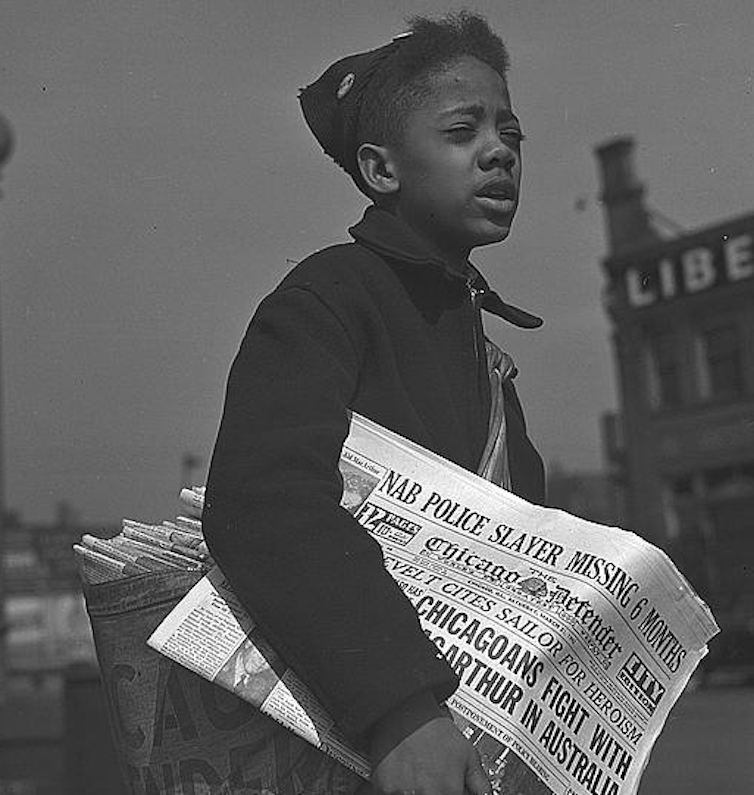
A newspaper boy hawks copies of the Chicago Defender.
Library of Congress

Paige Gray, Savannah College of Art and Design

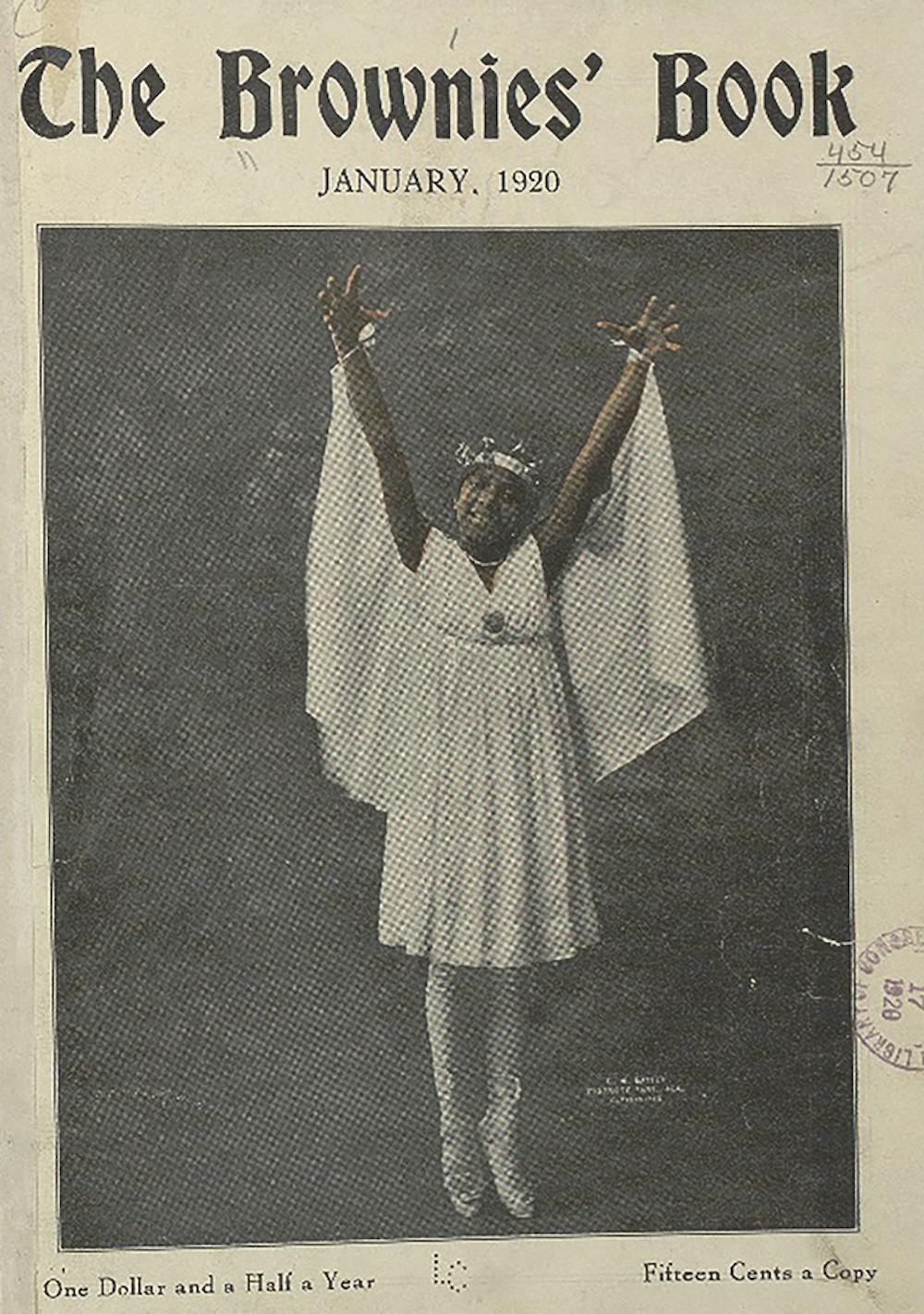
Hanging on the wall in my office is the framed cover of the inaugural issue of The Brownies’ Book, a monthly periodical for Black youths created by W.E.B. Du Bois and other members of the NAACP in 1920.

The magazine – the first of its kind – includes poems and stories that speak of Black achievement and history, while also showcasing children’s writing.

Although much of American children’s literature published near the turn of the last century – and even today – filters childhood through the eyes of white children, The Brownies’ Book gave African American children a platform to explore their lives, interests and aspirations. And it reinforced what 20th-century American literature scholar Katharine Capshaw has described as Du Bois’ “faith in the ability of young people to lead the race into the future.”

Most likely inspired by The Brownies’ Book, several Black weekly newspapers went on to create their own children’s sections. While the children’s publishing industry may have shut out Black voices and perspectives, the editors of these periodicals sought to fill the void by celebrating them, giving kids a platform to express themselves, connect with one another and indulge their curiosities.

A pioneering publication

The cover image of that first issue of The Brownies’ Book, published in January 1920, epitomizes this effort. In it, a young Black girl stands on the tips of her toes, dressed in a ballet costume.

Already, this image represented a radically different vision of Black childhood. Children’s literature of the late 19th and early 20th centuries very rarely focused on African Americans. The few Black children who did appear in print were often written or drawn as variations of Topsy, the enslaved young girl from Harriet Beecher Stowe’s “Uncle Tom’s Cabin,” who is initially considered “naughty” only to be redeemed by Eva, who plays the role of the “white savior.”

A smiling girl dressed in white raises her arms and stands en pointe.
The inaugural issue of ‘The Brownies’ Book.‘
Library of Congress

As children’s literature scholar Michelle H. Martin has noted, “children who wanted to read about black characters in children’s literature could read about buffoons, mammies, Sambos or savages,” but not about “the beauty” of Black children.

The girl on The Brownies’ Book cover offers a vastly different vision of Black childhood than the caricatures seen throughout popular culture of the time. She’s confident, excited and talented. The pages that follow feature an assortment of fiction, commentary, history and news for young readers that honors and extols Black identity.

One of the most compelling recurring sections is titled “The Jury,” which features children’s letters to the editor. In the magazine’s first issue, a boy named Franklin writes to ask about “things colored boys can work at when they grow up.” Eleanor wants the editor to recommend “some books on the Negro” so that she “can learn more about [her] race.” And a 15-year-old girl inquires about possible funding sources so that she can attend a boarding school that accepts African American students.

The Brownies’ Book had a relatively short run – 24 issues from January 1920 to December 1921. But it nonetheless seems to have encouraged a number of other Black newspapers to launch children’s sections in the early 1920s. The Pittsburgh Courier, Baltimore’s Afro-American and the Journal and Guide, published in Norfolk, Virginia, each experimented with children’s sections.

But by far the most successful effort was that of the Chicago Defender, which would launch a periodical section for Black youths that ran for decades.

‘Let us make the world know that we are living’

The Chicago Defender was perhaps the most influential Black newspaper of the 20th century. Its readership extended across the United States, and it helped spur the Great Migration, a time during which millions of African Americans left the South, by promoting job opportunities in Northern industrial cities like Chicago. Roi Ottley, biographer of Defender publisher Robert S. Abbott, wrote that only the Bible was more significant to Black Americans during the first half of the 20th century.

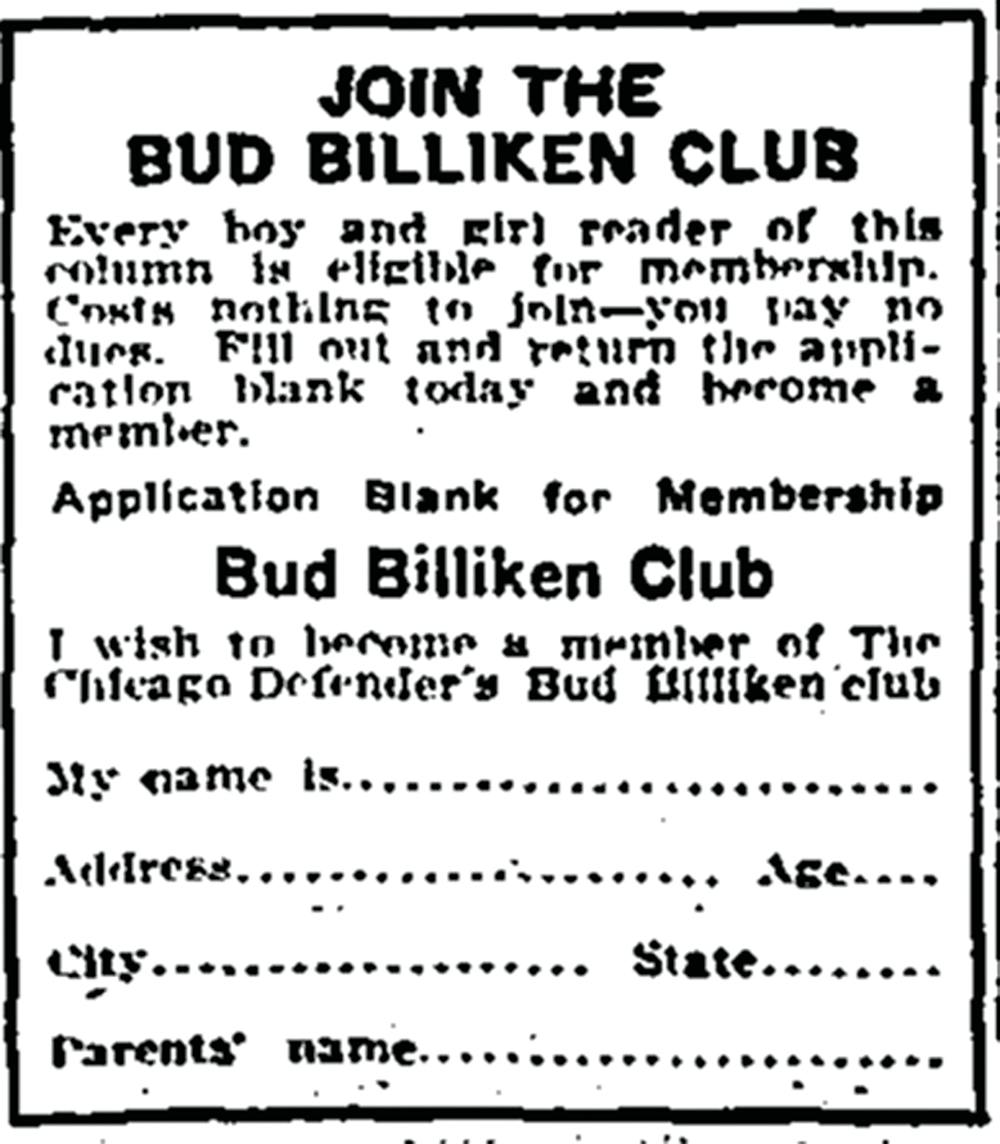
It contains spaces for a child's name, address, age, city and state.
An application form to join the Bud Billiken Club from the April 29, 1922, edition of the Chicago Defender.
ProQuest Historical Newspapers

In 1921, the Chicago Defender started publishing a section called the Defender Junior, run by a fictional editor named Bud Billiken. Billiken was really a 10-year-old boy named Willard Motley, who later became a noted novelist, though sometimes the paper’s adult editors wrote under Billiken moniker. In his first column, Billiken tells readers that he wants to fill “this column with sayings and doings of we little folks,” and implores them to submit their poems, questions and opinions.

Young readers could become members of the Bud Billiken Club by mailing in a form with their name, but they could also mail in letters and poetry as a way to correspond with their fellow Billikens. In June 1921, a girl named Ruth McBride of Oak Hill, Alabama, submitted the following letter to Bud:

“As I was reading the Chicago Defender a lovely paper of our Race, I came across some beautiful poems written by some of the members of your club. It filled my heart with joy to read such sweet poems. I am a little girl 9 years old, and I wish to join your club. If there is any space for me. I go to school and am in the fifth grade. My mother gets the Defender every week. Here is a poem I am sending:

  Down in the sunny South, where I was born,
  Where beautiful flowers are adoring,
  The daisies white and the purple lily.
  This is where the land is hilly."

In July 1921, Juanita Johnson of Washington, D.C., sent the Defender Junior her poem:

  "When you are lonely and don’t know what to do,
  When you must admit that you are feeling blue, 
  Take your pen in hand, my dear child, I entreat,
  And write the B.B. Club something nice and sweet.
  Your blues will depart, I’ll surely guarantee.
  You’ll cheer up at once, for so it is with me."

Black children could find – or at least attempt to find – their voices on the pages of these periodicals. For Bud Billiken, there was no greater urgency. In his introduction to the April 23, 1921, edition, he tells the story of a fly that “sat on the axle of a chariot wheel and said, ‘What a dust I do make.’”

“The fly imagines that he is causing the wheel to go around,” Billiken continues. “Let us not be like the fly, thinking we are doing something when really we only move as the world moves us.”

He concludes by writing, “The world would move on if we were not in it. This paper would be published just the same without our space. Let us make the world know that we are living and helping to make the noise and dust.”

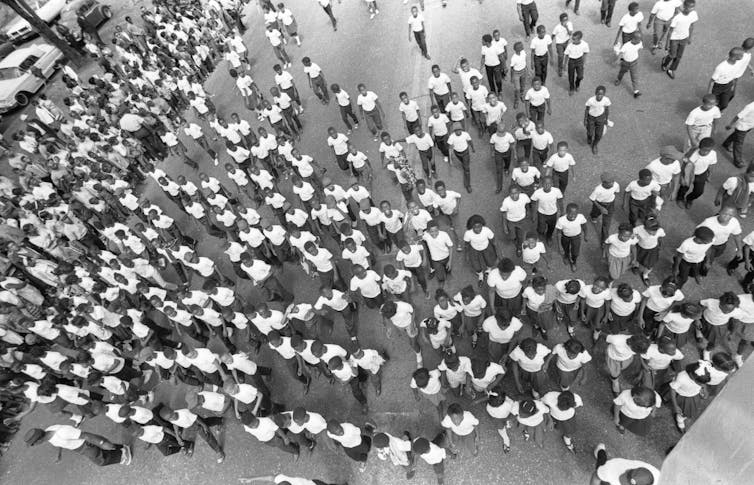
The Defender Junior proved popular – so popular that the newspaper launched the Bud Billiken Parade in 1929 in Chicago’s South Side. By midcentury, the annual parade had become one of the largest gatherings of African Americans in the U.S., attracting national figures such as Duke Ellington and Muhammad Ali. In 2020, the beloved event was canceled for the first time in 91 years due to the COVID-19 pandemic.

A birds-eye view of a throng of kids marching in the parade.
Kids march during the 1967 Bud Billiken Parade in Chicago.
Robert Abbott Sengstacke/Getty Images

The Brownies’ Book, the Defender Junior and the children’s sections of other African American weeklies gave Black children a space to tell their stories, express their anxieties and assert their ambitions.

In that photograph of the ballerina on The Brownie’s Book’s first cover, I imagine her saying something similar to Bud Billiken’s appeal – “Let us make the world know that we are living.”

Or perhaps more simply, “Black lives matter.”

[Like what you’ve read? Want more? Sign up for The Conversation’s daily newsletter.]The Conversation

Paige Gray, Professor of Writing and Liberal Arts, Savannah College of Art and Design

This article is republished from The Conversation under a Creative Commons license. Read the original article.
Unknown's avatar

There’s no such thing as a ‘faithful retelling’ of the Arthurian legend


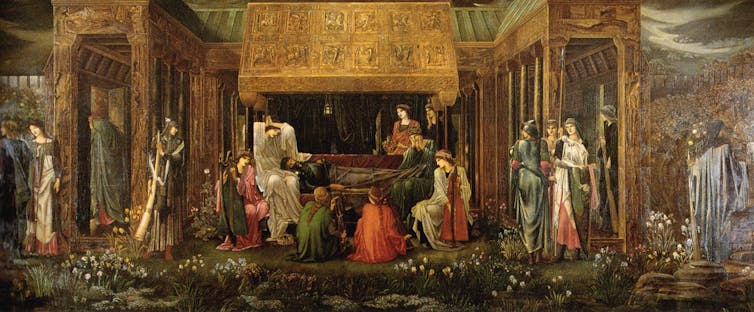
The Last Sleep of Arthur in Avalon by Edward Burne Jones.
Wikimedia

Amy Louise Blaney, Keele University

Justice League director Zach Snyder has said he is interested in working on a “faithful retelling” of Arthurian myth. Cut to a small horde of Arthurian scholars (myself included) entering stage left to loudly proclaim that there is no such thing as a “faithful retelling” of the King Arthur myth. King Arthur is one of the most pervasive legends of all time. What scholars call the “Arthurian mythological concept” has developed over several centuries – and over several cultures. Indeed, what makes the Arthur legend so enduring is its very lack of fidelity.

Although many of us today get our first taste of the Arthurian legend from films such as Guy Ritchie’s King Arthur: Legend of the Sword (2017) or TV shows such as the BBC’s Merlin (2008-2012), the core elements of the story that we recognise remain largely medieval.

Arthur’s name first appears in the work of ninth century Welsh historian Nennius. However, the legend as we know it today – knights in shining armour, damsels in distress, Round Table, Holy Grail etc – gallops into view from around the 12th century onward. This heralds the start of what is now known as the “Romance Tradition”.

Painting of Merlin being seduced.
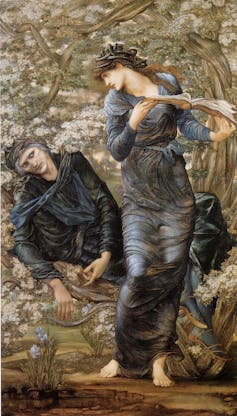
The Beguiling of Merlin by Edward Burne Jones depicts the wizard being seduced by the Lady of the Lake.
Wikimedia

Chances are that if you’ve read a version of the Arthur story today it is likely to be one of these Romances – most likely Thomas Malory’s 15th-century Morte D’Arthur or an early 20th-century re-telling such as TH White’s The Once and Future King. The tradition also proved very popular with the Victorians – especially with the Pre-Raphaelites, whose visual depictions of Arthurian legend frame the way we see the legend today.

For example, their paintings popularised captivating female figures such as the virginal Maid of Astolat (or Shallot), the dangerous enchantress Morgan Le Fay and the beguiling Lady of the Lake, the temptress Nimue.

One thing that remains consistent throughout the centuries however is the Arthurian myth’s ability to remain relevant to the people, countries, and eras in which it is being retold.

Reworkings and re-imaginings

In the late 17th-century, for example, Arthur was enlisted in the wake of the Glorious Revolution of 1688 as a means of bolstering support for the new Protestant regime and their political allies. Physician-poet Richard Blackmore wrote two lengthy epic poems – Prince Arthur (1695) and King Arthur (1697) – comparing the new King William III to Arthur and praising the way in which the monarch’s religious (and, crucially, Protestant) piety would “fresh Life to Albion […] impart”.

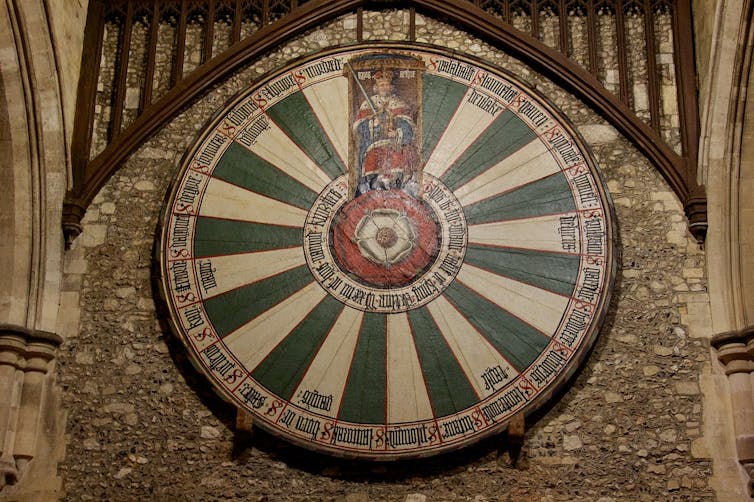
This was certainly not the first time Arthur had been associated with the English throne. Both the Tudors and the Stuarts adopted the mythical king to suit their own political purposes, with Henry VII going so far as to repaint the Winchester Round Table with a Tudor Rose at its centre. The paint job was probably in honour of a state visit by the Holy Roman Emperor Charles V in 1522 and – just to ensure that Charles got the message – Henry also had himself depicted on the table, sitting in Arthur’s place.

The Winchester Round Table, showing Henry VII sitting in Arthur's seat and with a Tudor Rose at its centre.
The Winchester Round Table, showing Henry VII sitting in Arthur’s seat and with a Tudor Rose at its centre.
Wikimedia/Mike Peel, CC BY-SA

Nor was it the last time that Arthur would find himself so conscripted. Elements of the Arthurian story – most notably the figure of Merlin – were used in the early 18th-century by the Hanoverian monarchs and their supporters to bolster their own claims to an inherently “British” identity.

Queen Caroline, a clever and well-informed curator of her own public image, capitalised upon the 18th-century’s rediscovery of its national history through ancient heroes. In collaboration with architect William Kent, she developed Merlin’s Cave – a name suggestive of a grotto but in reality more of a thatched folly (a round house with a thatched roof) designed around the Merlin myth – in the gardens at Richmond in 1735.

Numerous panegyric poems – poems designed to publicly praise and flatter – followed including two by “a lady subscribed Melissa”. The first praises “Her Majesty Queen Guardian” as the inheritor of Merlin’s legacy. The second, entitled Merlin’s Prophecy, envisages Frederick, Prince of Wales as “Ordain’d, to wield the Sceptre Royal […] And rule o’er Britons, Brave, and Loyal”.

As these examples illustrate, the one thing we can really say with any certainty about the Arthurian mythos is that fidelity is – as with any myth – an impossible concept.

Arthur has come a long way since his ninth century origins and our modern interpretations show no signs of altering that trend. Whether it’s making us laugh about the airspeed velocity of an unladen swallow in Monty Python and the Holy Grail (1975) or putting women centre stage in Cursed (2020), the appeal of Arthur’s mythical world is its adaptability.

He might be “The Once and Future King”, but there’s no such thing as faithful in Arthur’s mythical world.The Conversation

Amy Louise Blaney, PhD Candidate and Associate Lecturer in English Literature, Keele University

This article is republished from The Conversation under a Creative Commons license. Read the original article.
Unknown's avatar

James Hogg at 250: the farmhand who became one of Scotland’s greatest storytellers


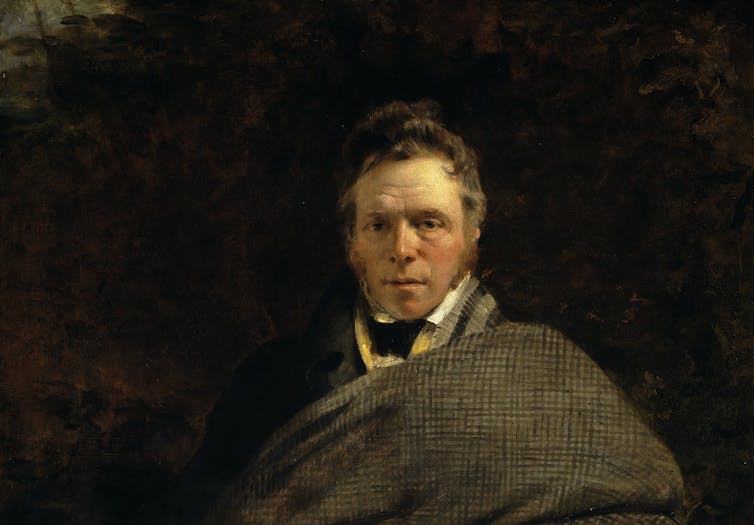
Sir George Watson Gordon, CC BY-SA

Daniel Cook, University of Dundee

James Hogg defied categorisation. A prolific poet, songwriter, playwright, novelist, short story writer and parodist, he wrote with equal skill in Scots and English. Labelled as the Ettrick Shepherd, the former Borders farmhand, whose life spanned the 18th and 19th centuries, befriended many of the great writers of his day, including Walter Scott, John Galt and Allan Cunningham.

Even though he was celebrated off and on in his own lifetime, some details of the author’s life remain unclear. Records place his baptism on December 9, 1770. But Hogg long believed he was born in 1772, on January 25 – Burns’ Night no less. This complicates attempts to commemorate his 250th birthday, unless we embrace his fantastical worldview. Fiction mattered to him more than fact. Besides, Hogg’s sestercentennial will inevitably be overshadowed by Scott’s own such celebration on August 15, 2021.

Despite lacking in formal education, Hogg never lacked in confidence. The Poetic Mirror, or The Living Bards of Britain (1816) purports to be a collection of the leading poets of the age (Hogg included). But actually Hogg, the editor, fabricated the works under the guise of big-name writers. There are moody romances after Byron, mystical musings in the style of Coleridge and ponderous poems for Wordsworth.

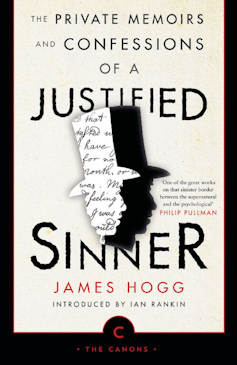
Cover of Canongate's imprint of The Private Memoirs and Confessions of a Justified Sinner by James Hogg feature two silhoutted heads in top hats.
Best work.
Canongate, Author provided

Aside from mimicking medleys, Hogg’s own body of work is made up of mountains of bits and pieces – and must be enjoyed on those terms. Seeking conclusions or definitive statements will only frustrate. Tales can drift off into fragments of poetry both familiar and new. Within stories he flips perspectives with little warning.

Presented as a found document, Hogg’s best work, The Private Memoirs and Confessions of a Justified Sinner (1824) is deliberately left with holes. Dark, humorous, violent, sweet, light, weird, wild, celebratory and cruel, the book has many tones, often all at once.

Hogg was 53 years old when he created his finest and most unsettling work. Drawing on a large box of tricks carefully cultivated over a long if chequered career, he infused Calvinist doctrine with a brooding gothic mood. A mysterious shapeshifting figure, Gil-Martin, goads the fanatical Robert Wringhim into taking extreme measures against the local sinners. Is Gil-Martin a manifestation of madness or the devil himself? Where does evil come from? Denounced by hostile critics at the time as anti-religious, nowhere in literature is the divided self so tantalisingly imagined.

It’s not enough to call Hogg an experimental writer ahead of his time or a genre hopper who challenged the conventions of his day. And he was much more than a born storyteller. Hogg favoured word for this type of art was “intermixing”. He was Scotland’s great intermixer. In hindsight, the Borders bard seemed destined for the make-believe world of literature.

Fairytales and family

Hogg’s mother, Margaret Laidlaw, was an important collector of Scottish ballads and a canny taleteller. His maternal grandfather, known as Will o’ Phawhope, was said to have been the last man in Selkirkshire to speak with fairies. Fairytale figures certainly fill Hogg’s most imaginative stories, most notably in his first collection of prose fiction, The Brownie of Bodsbeck and Other Tales (1818).

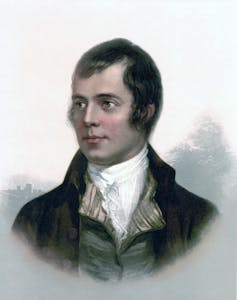
Burns was an early influence on Hogg, who considered himself to be the rightful heir to the Bard of Ayrshire and published his own collection less than four years after his idol’s death. Long before then, the locals dubbed him Jamie the Poeter, and he wrote countless songs for local girls to sing.

Portrait of Scots bard Robert Burns.
Robert Burns inspired James Hogg.
Shutterstock

After writing a popular patriotic song, “Donald Macdonald”, in 1803, Hogg was recruited to collect ballads for Scott’s Minstrelsy of the Scottish Border. He also undertook extensive tours of the Highlands with a view to securing his own farm, but became more interested in the songs he heard along the way.

By 1819, he was recognised as a leading expert on Scottish ballads when the Highland Society of London commissioned him to produce the Jacobite Relics of Scotland, which became the benchmark of Scottish anthologies for many more decades.

He endured many failures on the way. In 1810, at the age of 40, Hogg moved to Edinburgh to settle into the life of a full-time writer. Within a year of starting it, his magazine The Spy folded. Readers weren’t ready for a publication that covered shocking themes such as extramarital sex.

Hogg spent the next few years scribbling more poetry and prose, and in 1817 he helped William Blackwood establish Scotland’s most influential literary periodical, the Edinburgh Monthly Magazine (later, Blackwood’s Magazine). In time, displaced by punchy younger contributors, Hogg eventually became a figure of fun in the same periodical. But he kept writing and writing. Winter Evening Tales (1820), produced in the middle period of his life, is especially rewarding.

Hogg’s literary afterlife

A collected edition of works was published shortly after Hogg’s death in 1835, but the publishers pruned the more indelicate (and inventive) passages, and even entire texts. The great forgetting of Hogg set in.

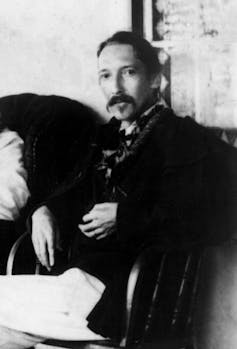
Photograph of Robert Louis Stevenson in black and white.
Hogg’s most famous work preempted Robert Louis Stevenson’s classic Jekyll and Hyde.
Shutterstock

This only began to change in the mid-20th century, when the French writer André Gide championed Justified Sinner in an enthusiastic introduction to a 1947 edition, describing himself as being “voluptuously tormented” by the book.

Only in 1995, when the colossal Stirling–South Carolina Research Edition of the collected works began to appear, would the wider body of Hogg’s works be publicly available in the form they deserved. In recent years, Scottish novelists such as Irvine Welsh and the playwright Marty Ross have proclaimed the importance of Hogg’s fantastical imagination for their own thinking. Before that, Justified Sinner also pre-empted that other great Scottish gothic masterpiece of the divided self, The Strange Case of Dr Jekyll and Mr Hyde by Robert Louis Stevenson.

The University of Dundee recently produced a free online edition of The Private Memoirs and Confessions of a Justified Sinner, which includes explanatory notes and copies of the earliest reviews. Scotland’s great intermixer awaits new readers.The Conversation

Daniel Cook, Reader in Eighteenth-Century and Romantic Literature, University of Dundee

This article is republished from The Conversation under a Creative Commons license. Read the original article.

Unknown's avatar

Poems for long distant loves in lockdown


Olga Strelnikova/Shutterstock

Kate North, Cardiff Metropolitan University

Many people are not lucky enough to be with their loved ones this valentine’s day. If that is the case, or if you simply want suitable words to mark the day, then there are plenty of long-distance love poems that you can reach for, to share or to read for comfort.

Some of them can be found in unexpected places, such as Song of Solomon, also known as Song of Songs, a book found in the Old Testament. But if you want an account of longing at a distance, a celebration of sexual intimacy, praise for lust and passion, then this is where you’ll find it: “How much better is thy love than wine!” declares Solomon, “By night on my bed I sought him…” speaks his lover. The lovers were not married and lived separately, and were perhaps in the early days of their courtship. The verse describes their visits to each other in erotic detail, and their yearning for each other when apart.

A slightly more traditional and obvious source for love poetry in the English language is, of course, William Shakespeare. Sonnet 98 gives us a meditation on love and distance. In it the speaker is so distraught that their lover is not present, they can no longer recognise the beauty of nature, even as spring bursts into bloom around them.

Love lost and changed with time

Distance is not always about a physical measurement of proximity though, it can also relate to the passing of time. Lost love, love that is no longer and first loves are all forms of love that are unreachable through time.

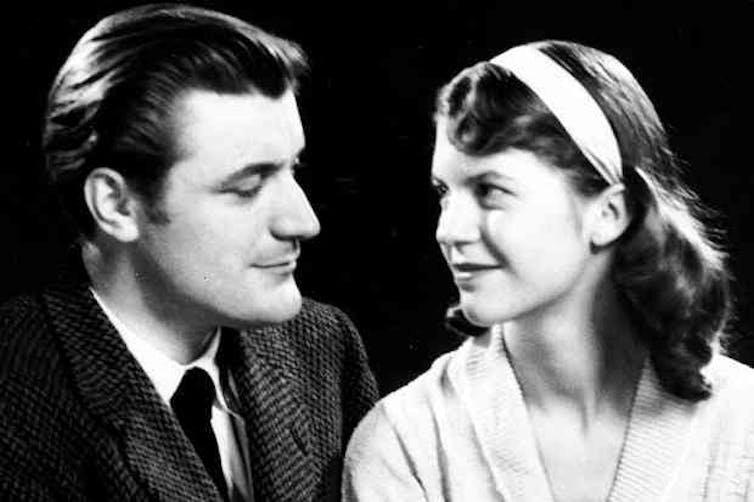
One example that speaks to this kind of love can be found in former Poet Laureate Ted Hughes’s Birthday Letters, his final collection. Hughes’s relationship with his first wife, poet Sylvia Plath, has been much written about. People have long been fascinated with the turbulent trajectory of their relationship and the tragic end to Plath’s life.

Ted Hughes and Sylvia Plath.
Flikr, CC BY

Many years after Plath’s passing, Hughes produced a collection of poems that he wrote throughout the decades after her death. It was published months before his own death and it can be read as an homage, a marking, an exploration and a final word on his passionate relationship with Plath:

I look up – as if to meet your voice

With all its urgent future

That has burst in on me.

For a more contemporary take on past love, I recommend reading Kim Addonizio, who has previously won the Pushcart Prize, a Guggenheim Foundation award and many other accolades. Love is a topic she returns to in her work time over. In her poem Stolen Moments she takes the reader back to the early throes of love, to an instance where it feels like love will never end, in which she finds a perfect memory of what it is to feel in love:

Now I get to feel his hands again, the kiss

That didn’t last, but sent some neural twin

Flashing wildly through the cortex.

Alice Willitts’ recent publication With Love is a collection in which every single title begins with the word “love”. In her poem love / couples who sleep in separate rooms live longer, she refuses to trade possible health benefits for the joy of being able to:

…open a dozy eye

right into your precious face


Read more:
How to write a love poem


Love from afar and in the moment

Another former poet laureate, Carol Ann Duffy, explores the complete arc of a romantic relationship, from the heady beginnings to the crashing end, in her collection Rapture. The opening poem, Text takes us through feelings of anticipation, excitement and desire as experienced in a brand new relationship. The moment of waiting for a lover’s message to appear on your phone, the thrill of the ring tone as it is received, the compulsion to read and reread it, over and over.

I tend the mobile now

like an injured bird.

We text, text, text

our significant words.

In the past year Duffy has invited poets from around the globe to write directly of their time during the pandemic. This has resulted in a large body of poetry, which will act as a record of lived experience from the pandemic’s earliest stages.

In the scores of poems on the project website, it is interesting to see how the themes of distance and relationships have shone through. For the poet Kim Moore:

now distance is a physical thing

that has crept into my heart

One of the most thought-provoking poems on the site draws on our primal need for intimacy as humans. It’s a need that cuts through familial, platonic and romantic relationships. In her poem Harbour Grace Nichols is willing to trade all, “for the simple harbour of a hug”. If you are unable to reach for a hug this Valentine’s Day, then finding one in a poem could be the next best thing.The Conversation

Kate North, Reader in Creative Writing, Cardiff Metropolitan University

This article is republished from The Conversation under a Creative Commons license. Read the original article.
Unknown's avatar

The chattering classes got the ‘Hillbilly Elegy’ book wrong – and they’re getting the movie wrong, too


Lisa R. Pruitt, University of California, Davis

Film critics have had nary a good word to say about Netflix’s new movie “Hillbilly Elegy.”

Reviewers varyingly called it “Oscar-Season B.S.,” “woefully misguided,” “Yokel Hokum,” “laughably bad” and simply “awful.”

I admit to delight when I read professional critics trashing the film, which is
based on J.D. Vance’s widely praised memoir detailing his dramatic class migration from a midsize city in Ohio to the hallowed halls of Yale Law School. I was expecting the worst based on my dislike of the book, and these reviews confirmed my expectations.

But once I saw the film, I felt it had been harshly judged by the chattering classes – the folks who write the reviews and seek to create meaning for the rest of us. In fact, the film is an earnest depiction of the most dramatic parts of the book: a lower-middle-class family caught in the throes of addiction.

Everyday viewers seem to find the film enjoyable enough – it has solid audience reviews on IMDB and Rotten Tomatoes.

So why the big gap between the critical response and audience reaction? Could it be yet another sign of the country’s steadily growing class divide?

A bootstrap manifesto

The film’s negative reviews are an about-face from critics’ warm embrace of the book, which was published in 2016, when Vance was just 31.

In telling his story of overcoming his mother’s addiction and attendant familial and economic precarity, Vance credits his Mamaw and Papaw, along with luck and hard work.

Fair enough. But he gives no nod to the government structures – K-12 schools, the military and the GI bill, the public university where he earned his B.A – that greased the skids of his sharp ascension into the ruling class. Worse still, Vance expressly blames laziness as the culprit of those left behind, with only cursory attention to the impact of policies that encouraged the offshoring of manufacturing jobs and weakening of the social safety net.

The book is not subtle in its message: Working-class grunts are to blame for their own struggles. If they’d just get off their duffs, go to church and stay married, everything would be OK.

J.D. Vance talks on a cell phone.
J.D. Vance’s memoir was a sensation when it was published.
Drew Angerer/Getty Images

Yet commentators from across the political spectrum greeted the book with a big wet kiss. Published months before Donald Trump’s election, it was perfectly timed for the zeitgeist, and Vance’s extended personal anecdote suddenly became the authoritative text about enigmatic working-class whites, all presumptive Trump supporters. The New York Times fawned over its “discerning sociological analysis,” overlooking Vance’s one-sided invocation of data and scholarly literature, while prestigious think tanks like the Brookings Institution elevated Vance to expert status.

I was one of few progressive elites to push back against the media’s early, broad embrace of the book. Admittedly, I was moved by Vance’s compelling biography, which featured many of the hallmarks of my own: hillbilly roots, addicted parent, family violence and – ultimately – a dramatic class leap into elite legal circles.

But I was put off by Vance’s singular focus on personal responsibility and use of his story to advance an agenda antagonistic to the social safety net. Many of Vance’s positions run contrary to my own scholarly work about the white working class and rural America.

Vance also suggests that his family – in both its best and worst manifestations – is representative of Appalachia. Yet like all families, Vance’s is typical in some ways but not in others. And that’s what got so many Appalachians up in arms when the book came out. Not all of them are drug addicted any more than they’re all coal miners. Further, not all Appalachians are white. Many lead boring lives.

From curiosity to disdain

I wasn’t happy when Ron Howard and Netflix paid US$45 million for the movie rights, because I didn’t want the book to get an even wider audience. But the film leaves Vance’s politics aside and instead focuses on three generations worth of Vance family saga. That means the positive potential I saw in the book is at the heart of the film.

For one, working-class white people can see themselves on screen. When I read the book, I initially laughed out loud – but also cried – over the ways Vance’s hillbilly grandparents reminded me of my own extended family. I also related to his “fish out of water” experiences in elite law firms.

Second, the story is a reminder that white skin is no magic bullet. Folks where I live and work in California often use “white privilege” as synonymous with “you’re white, you’ll be all right.” Members of the Vance family are white, but they are clearly not all right. The movie has the potential to foster empathy between the two worlds J.D. Vance straddles – the ones I also straddle – between working class and professional class.

Yet to some critics, the film amounted to no more than “poverty porn.” They lamented a lack of complexity, nuance, motivation and internal conflict in the film’s characters.

Really? Those reviewers must have looked right past the trauma both Mamaw and Bev experienced in their early lives – the former as a child bride, the latter as a child raised in the violent home of that child bride. J.D. is a product of both.

There are surely other reasons, too, that the film world has turned a cold shoulder to this cinematic packaging of Vance’s book. I suspect that it has something to do with the fact that the four-year span between the book and the film neatly coincided with the beginning and end of Trump’s presidency. During that same period, what started as progressive elites’ curiosity about the white working class gave way to bald disdain and fury.

Nowadays, my Twitter feed is awash with resentment every time “mainstream media” run a story about white Trump supporters.

The woke whine that such coverage implies that these are the “real Americans” who we should try to understand, while overlooking other marginalized subsets of the population. Film critic negativity about “Hillbilly Elegy” may reflect similar attitudes – a mix of exasperation and boredom with a pet topic for media outlets since the 2016 election.

[Deep knowledge, daily. Sign up for The Conversation’s newsletter.]

Audiences have a different response

To me, the real pity is that so many coastal elites know so few working-class folks of any color, let alone the hillbilly subset of them. Indeed, studies show that, increasingly, people from different socioeconomic strata no longer mix even within the same metro areas.

The crummy reviews ultimately evince this profound and persistent disconnect between those who write the reviews and “regular” folks.

A week after its release, the film’s critic score on Rotten Tomatoes was 27, while its audience score was 82. That’s a massive spread, and one that may align with the yawning chasm cutting across our national electorate.

The cosmopolitan set can’t believe viewers would want to watch “those people” – and may even be able to relate to them – any more than we can believe so many people voted for Donald Trump.

When critic Sarah Jones, an Appalachian by upbringing, argues that “Hillbilly Elegy” wasn’t made for hillbilly viewers, I’m not convinced. Jones places “Hillbilly Elegy” among “an old and ignoble genre” that “caricatures the hillbilly for an audience’s titillation.”

Maybe. But there are far worse depictions of rural folks and other hillbilly types. Look no further than this appalling scene from “Planes, Trains and Automobiles” or the 1972 classic “Deliverance.”

Howard and screenwriter Vanessa Taylor certainly took liberties in condensing and dramatizing decades of Vance family dysfunction, but we shouldn’t pretend that families like these don’t exist. I know people like them – heck, I’m even related to some.

Many viewers will relate to “Hillbilly Elegy” simply because addiction is such a shockingly common phenomenon, one that touches many families and every community. Others will appreciate the film because it presents J.D. Vance achieving the “American dream.” It’s an ideal many find irresistible in spite of the fact that – or, indeed, because – upward mobility is more elusive than ever.

With Vance’s politics tucked out of sight, can we simply judge the film for its entertainment value? Can we acknowledge that we don’t all like the same things?

After all, there may be a few things elites don’t “get.” And that could be because the movie wasn’t made for them in the first place.The Conversation

Lisa R. Pruitt, Martin Luther King, Jr., Professor of Law, University of California, Davis

This article is republished from The Conversation under a Creative Commons license. Read the original article.
Unknown's avatar

John Keats: how his poems of death and lost youth are resonating during COVID-19


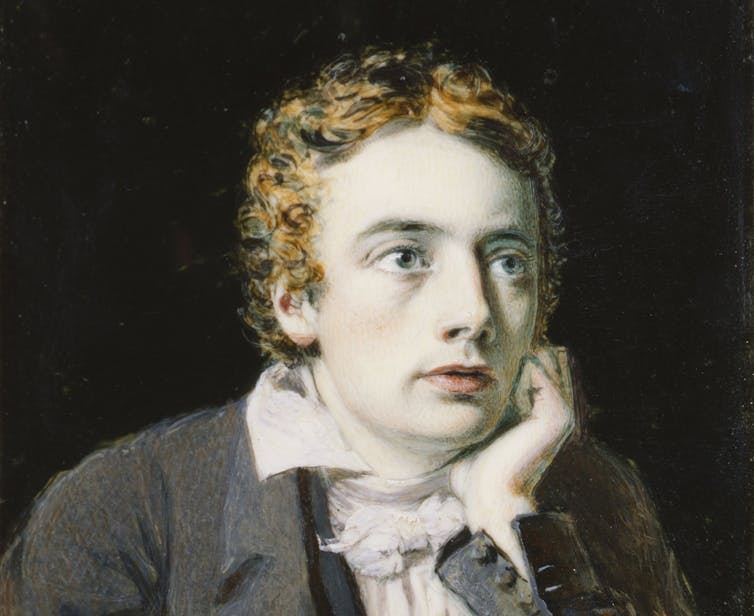
John Keats by Joseph Severn (1819).
National Portrait Gallery

Richard Marggraf-Turley, Aberystwyth University

In John Keats’ poems, death crops up 100 times more than the future, a word that appears just once in the entirety of his work. This might seem appropriate on the 200th anniversary of the death of Keats, who was popularly viewed as the young Romantic poet “half in love with easeful death”.

Death certainly touched Keats and his family. At the age of 14, he lost his mother to tuberculosis. In 1818, he nursed his younger brother Tom as he lay dying of the same disease.

After such experiences, when Ludolph, the hero of Keats’ tragedy, Otho the Great, imagines succumbing to “a bitter death, a suffocating death”, Keats knew what he was writing about. And then, aged just 25, on February 23 1821, Keats himself died of tuberculosis in Rome.

Life sliding by

His preoccupation with death doesn’t tell the whole story, however. In life, Keats was vivacious, funny, bawdy, pugnacious, poetically experimental, politically active, and above all forward-looking.

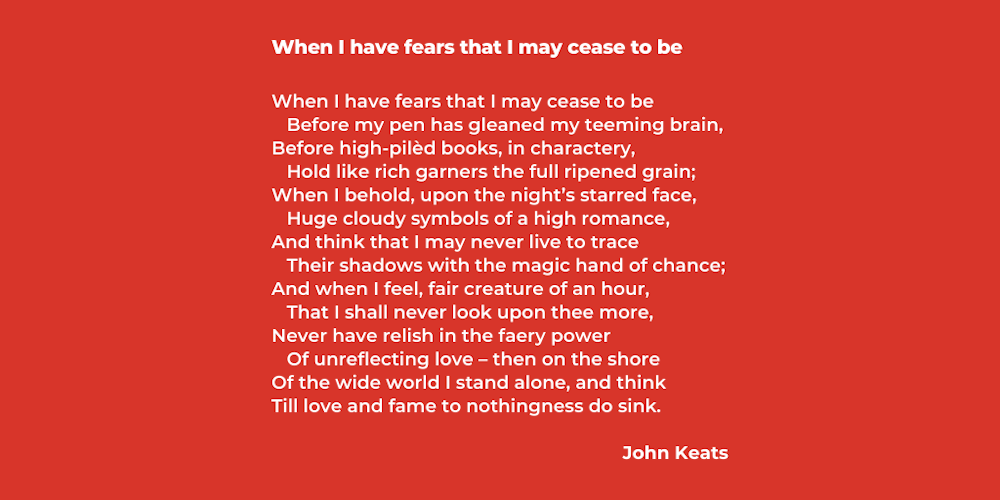
He was a young man in a hurry, eager to make a mark on the literary world; even if – as a trained doctor – he was all too conscious of the body’s vulnerability to mortal shocks. These two very different energies coalesce in one of his best loved poems, written in January 1818 when the poet was in the bloom of health:

When I Have Fears That I May Cease to Be is a poem of personal worry, according to biographer Nicholas Roe. In it, Keats is anxious that he won’t have time to achieve poetic fame or fall in “unreflecting love”, and these fears and self-doubts take him to the brink.

But as brinks go, this one doesn’t seem all that bad. The poem is romantic with a small “r” – wide-eyed, dramatic, sentimental – its vision of finality, of nothingness, gorgeous in its desolation, and all-importantly painless. Who can read those final lines without themselves feeling a pull to swooning death, half in love with it, as Keats professed to be?

That’s what I used to think, at any rate. Lately, in the pandemic, I’ve begun to read this poem rather differently. Lensed through long months of lockdown, the sonnet’s existential anxieties seem less abstract, grand and performative, and more, well, human.

It’s a poem that will resonate with the youth who are cooped up indoors, physically isolated, unable to meet and mingle, agonisingly aware of weeks slipping by, opportunities missed, disappointments mounting. This poem has made me almost painfully empathetic towards their plight.

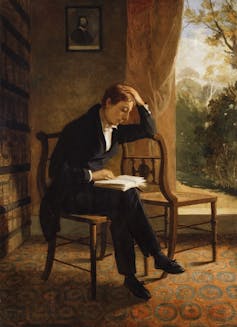
Painting of a young John Keats reading a book.
John Keats by Joseph Severn, painted posthumously (1821-1823).
National Portrait Gallery, London

The sonnet’s fears of a future laid to waste are shared by whole generations whose collective mental health is under siege. In his last surviving letter, written two years after the sonnet while dying in Rome, Keats records a “feeling of my real life having past”, a conviction that he was “leading a posthumous existence”. How many of us are experiencing similar thoughts at the moment?

Illness and isolation

Of all the Romantics, Keats perhaps knew most about mental suffering. He grew up in Moorgate, just across from Bethlem Hospital, which was known to London and the world as Bedlam. Before he turned to poetry, Keats trained at Guy’s hospital, London, where he not only witnessed first-hand the horrors of surgery in a pre-anaesthetic age but also tended to patients on what was called the lunatic ward.

It was all too much for him. Traumatised by the misery and pain he felt he could do little to alleviate, in 1816 he threw medicine in for the pen. His experiences at Guy’s, though, and the empathy he developed there, found their way into his writing. For instance, in Hyperion, his medical knowledge helps him to inhabit the catatonic state of “gray-hair’d Saturn”, who sits in solitude, “deep in the shady sadness of a vale”, despairing after being deposed by the Olympian gods. The vignette is a moving image of isolation and enervation that speaks to us today:


https://www.poetryfoundation.org/poems/44473/hyperion

As for lockdown, Keats was no stranger to its pressures and deprivations. During periods of illness in Hampstead in 1819 – precursor symptoms of tuberculosis – he was reluctant to venture out, isolating himself. In October 1820, he set sail for Italy in the hope warmer climes would save his lungs. On arrival, his ship was put into strict quarantine for ten days. In letters to his friends, Keats described being “in a sort of desperation”, adding, “we cannot be created for this sort of suffering”.

Keats was a poet of his age, his own social, cultural and medical milieu. And yet, on the bicentenary of his death, he’s also – more than ever, perhaps – a poet of ours. A poet of lockdown, frustration, disappointment, fears … and even hope.

Because even in those last, scarcely imaginable weeks in Rome, 200 years ago, holed up in a little apartment at the foot of the Spanish Steps, he never quite gave up on the future, never relinquished his dreams of love and fame.The Conversation

Richard Marggraf-Turley, Professor of English Literature, Aberystwyth University

This article is republished from The Conversation under a Creative Commons license. Read the original article.
Unknown's avatar

Humour in poetry should be taken seriously


Vectorium/Shutterstock

Christina Thatcher, Cardiff Metropolitan University

As a child, I remember laughing out loud while reading Shel Silverstein’s poetry book A Light in the Attic (1981). I loved it so much that I started reciting the poem Skin Stealer every day, to the great annoyance of my little brother. Even now, these lines still come knocking:

This evening I unzipped my skin

And carefully unscrewed my head,

Exactly as I always do

When I prepare myself for bed.

As a teenager, I was taught that poetry should be more serious. It was art – and art took itself seriously. Even now, poems designed to make us laugh are often dismissed as frivolous. This seems strange given that many of our earliest poems are comic ones. The limerick, for instance, is thought to have originated during the Middle Ages and has been used to great humorous effect by thousands, from Shakespeare to Roald Dahl.

Perhaps the crime here isn’t that funny poems have been sidelined in favour of serious ones, but that funny poems are not also considered to be serious. Humour, after all, has the power to disarm us and promote reflective thinking.

Although there are innumerable ways in which poets can be funny in their work, I have chosen pieces here which employ three different types of humour to demonstrate how poetry can make us both laugh and think.

Sexy humour

Sometimes called dirty, naughty, rude or cheeky, this type of humour works because it violates social norms. After all, it is not polite to talk about sex. But, poetry which pokes fun at bodies and desire is centuries old.

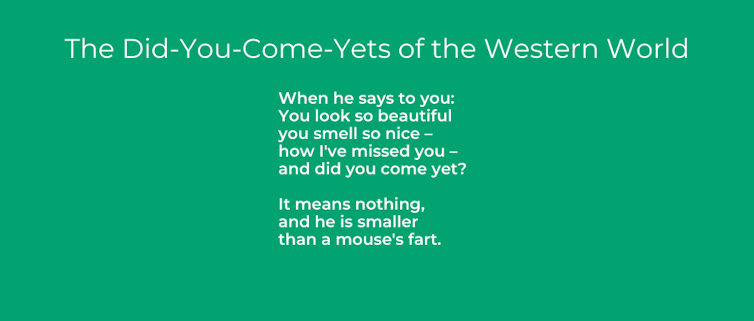
Poems in this category can range from titillating to obscene. But, beyond the tee-hees, these pieces can reveal deeper truths about sex and relationships. Take a look at the opening of The Did-You-Come-Yets of the Western World by Rita Ann Higgins:

Absurdist humour

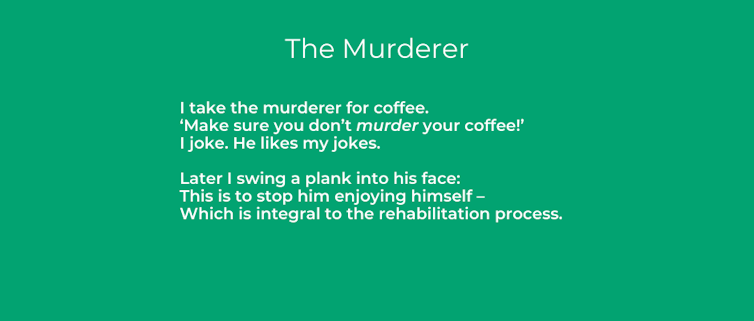
Poets who use absurdity in their work tend to operate under the assumption that implausibility is essential to comedy. Absurd humour highlights the ridiculousness of life, pushing normally accepted realities to extremes to give the audience a fresh perspective. This can be seen in Luke Kennard’s darkly funny poem The Murderer, which opens:

In his correspondence with writer Paul McDonald, Kennard discussed how this poem works to reveal the shortcomings of both characters, opening up a chance for readers to reflect on moral relativism.

Satirical humour

Satire is an excellent way for poets to respond to social trends and current events. Often, this type of humour relies on ridicule and exaggeration to expose and criticise people’s stupidity or vices. Satirical poems play an important role when it comes to challenging political, cultural and aesthetic oppression. According to the poet Matthew Rohrer, satire is a tool by which the oppressed get to make fun of their oppressors.

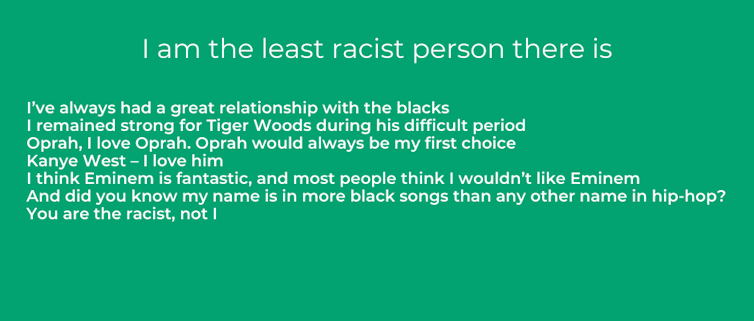
Satirical poetry takes many forms but one of my personal favourites is the cento – a patchwork poem made up of words or phrases directly from the person at the butt of the joke. Rob Sears’ The Beautiful Poetry of Donald Trump does this brilliantly, particularly this piece:

There are, of course, huge swathes of humour that I haven’t even touched on here. For instance, surrealism, dark humour and observational humour can provoke important discussions, launch taboos into the light and straddle the fine line between “haha” and “oh no”.

Because humour is also highly personal, you may not find any of the poems I’ve chosen to be funny. To remedy this, I also asked poets on Twitter to share the pieces which made them laugh and, wow, did they deliver. In this thread alone, the power of humour in poetry is self-evident.The Conversation

Christina Thatcher, Creative Writing Lecturer, Cardiff Metropolitan University

This article is republished from The Conversation under a Creative Commons license. Read the original article.

Unknown's avatar

What’s next for Amazon after Jeff Bezos? No dramatic changes, just more growth and optimisation


Louise Grimmer, University of Tasmania; Gary Mortimer, Queensland University of Technology, and Martin Grimmer, University of Tasmania

Jeff Bezos has announced he will stand down as chief executive of Amazon in the third quarter of 2021. The founder of the online retail behemoth will hand the reins to Andy Jassy, who currently leads Amazon’s cloud computing wing.

The announcement comes after an enormously successful 2020 for Amazon despite (or perhaps because of) the COVID-19 pandemic, with operating cashflow up 72% from the previous year to US$66.1 billion, and net sales increasing 35% to US$386.1 billion.

Amazon has its share of detractors, with critics highlighting concerns around working conditions, tax minimisation, anti-competitive practices and privacy. But its enormous size and continuing phenomenal growth make it a force to be reckoned with.

How did Amazon get to this position, and what does the future hold under new leadership?

How it all started

Almost 27 years ago, in 1994, Bezos left his job as a senior vice-president for a hedge fund and started an online bookstore in his garage. At the time, using the internet for retail was in its infancy.

Bezos decided that books were an ideal product to sell online. Originally the new business was named Cadabra, but Bezos soon changed it to Amazon and borrowed US$300,000 from his parents to get things off the ground.


Read more:
Amazon is turning 25 – here’s a look back at how it changed the world


Books proved popular with growing numbers of online buyers, and Bezos began to add other products and services to the Amazon inventory – most notably e-readers, tablets and other devices. Today Amazon predominantly makes its revenue through retail, web services and subscriptions.

The rise and rise of Amazon

Amazon is now one of the most valuable companies in the world, valued at more than US$1.7 trillion. That’s more than the GDP of all but 10 of the world’s countries. It’s also the largest employer among tech companies by a large margin.

The key to Amazon’s dominance has been constant expansion. After moving into e-readers and tablets, it extended more broadly into technology products and services.

The expansion has not yet stopped, and Amazon’s product lines now include media (books, DVDs, music), kitchen and dining wares, toys and games, fashion, beauty products, gourmet food and groceries, home improvement and gardening, sporting goods, medications and pharmaceuticals, financial services and more.

More recently Amazon has expanded into bricks-and-mortar, heralded by its purchase of the Whole Foods chain in 2017, the creation of its own high tech stores such as Amazon Go, and its sophisticated distribution and delivery services such as Amazon Prime.


Read more:
Fear not, shoppers: Amazon’s Australian geoblock won’t cramp your style


Amazon has become increasingly vertically integrated, meaning it no longer simply sells others’ product but makes and sells its own. This gives the company a position of extreme market dominance.

Criticism

Amazon is hugely popular with customers, but has attracted criticism from supplier advocates, workers unions and governments.

Industrial relations matters, such as fair wages, unsafe work practices and unrealistic demands, appear the most common area of concern. A 2019 UK report found:

Amazon have no policy on living wage and make no mention of wages being enough to cover workers’ basic needs in their supplier code.

Other concerns relate to alleged unsafe working conditions and “whistleblower” policies.

In March 2020, as COVID-19 began to take hold, workers claimed they were fired for voicing concerns about safe working conditions. Amazon vice president and veteran engineer Tim Bray resigned in solidarity and nine US senators issued an open letter to Bezos, seeking clarity around the sackings.

More general criticisms of the company culture have surfaced over the years, relating to insufficient work breaks, unrealistic demands, and annual “cullings” of the staff – referred to as “purposeful Darwinism”.

Another strand of criticism relates to Amazon’s market size and antitrust laws. Antitrust laws exist to stop big companies creating monopolies. Amazon presents a challenge, as it is a manufacturer, an online retailer, and a marketplace where other retailers can sell products to consumers.

Privacy concerns have also plagued Amazon products like Echo smart speakers, Ring home cameras, and Amazon One palm-scanning ID checkers.

The Amazon Web Services privacy policy says all the right things.


Read more:
Amazon Echo’s privacy issues go way beyond voice recordings


Finally, the amount of company tax Amazon pays in Australia has been brought into question. The company has used a range of tactics to legally reduce the income taxes it pays around the world.

What does the future hold for Amazon in a post-COVID world?

What will change at Amazon when Bezos steps down? We’re unlikely to see a dramatic shift in the short term. For one thing, Bezos is not departing entirely – he will stay involved as “executive chairman”. For another, his successor, Andy Jassy, has been with Amazon since 1997.

Jassy is the head of Amazon Web Services (AWS) and already one of the most important people in the tech industry. AWS has been at the forefront of simplifying computing services, driving the cloud computing revolution and influencing how organisations purchase technology.

Jassy’s long history, intimate knowledge of the organisation, and technological expertise will no doubt stand Amazon in good stead.

However, he faces a monumental undertaking. Jassy will inherit responsibility for more than a million employees, selling millions of different products and services.

His expertise in AI and machine learning at AWS will be increasingly important as these play a greater role in Amazon’s operations – for everything from optimising warehouses and giving better search results to business forecasting and monitoring warehouse staff and delivery drivers.

The physical lockdowns and online acceleration driven by the COVID-19 pandemic provided the ideal conditions for a company that has been called “the everything store”. Supporters and critics will watch with interest to see if this is still true in a post-COVID environment.The Conversation

Louise Grimmer, Senior Lecturer in Retail Marketing, University of Tasmania; Gary Mortimer, Professor of Marketing and Consumer Behaviour, Queensland University of Technology, and Martin Grimmer, Professor of Marketing, University of Tasmania

This article is republished from The Conversation under a Creative Commons license. Read the original article.
Unknown's avatar

Highlighter Apps


The link below is to an article that takes a look at 5 highlighter apps.

For more visit:
https://www.makeuseof.com/highlighter-apps-to-annotate-online-text-videos-or-podcasts/