Unknown's avatar

Ten novels to help young people understand the world and its complexities


File 20181217 185237 jfzyov.jpg?ixlib=rb 1.1

Nataliia Budianska via Shutterstock

Fiona Shaw, Northumbria University, Newcastle

In this confusing and often conflicted world, children’s author Gillian Cross has summed up what it is about reading fiction that is so important: “Good stories help us make sense of the world. They invite us to discover what it’s like being someone completely different.”

As the author of a children’s novel myself, I’m going to double down on this and say that if this is important for adults, it’s 100 times more important for children.

Children passionately want to understand what’s going on – and fiction is a potent way for them to do this. A study by education professor Maria Nikolajeva found that “reading fiction provides an excellent training for young people in developing and practising empathy and theory of mind, that is, understanding of how other people feel and think”.

In the wealth of recent fiction for children and young adults, here are ten powerful stories for young people, addressing some of the most important, and troubling, questions we face today.

1. The Bone Sparrow by Zana Fraillon (Orion)

Imagine being imprisoned for your whole life. Imagine growing up like Subhi.
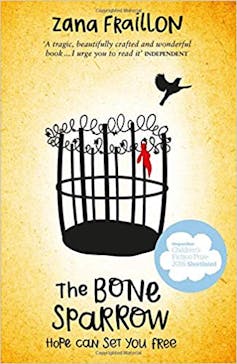
Life in a refugee camp. Source=Orion.

The nine-year-old’s world ends at the diamond-shaped fence – the outer edge of the detention centre he is detained in with his Rohingya family in Australia.

Fraillon draws a vivid picture of life inside the fence – vulnerable people fleeing persecution, only to find – instead of the peace and sanctuary they so desperately need – indifference and hostility.

But Subhi finds hope in his friendship with an Australian girl from outside the fence. (Age: 11+)

2. The Big Lie by Julie Mayhew (Red Ink)

What if Germany had won World War II and the UK was now part of a Third German Reich? This is a coming-of-age story with a difference – 16-year-old Jessika is a talented ice-skater in a high-ranking REICH?family.

But her friendship with subversive, courageous and desirable Clem threatens everything: her family, her future, and her very life. This is a story that paints the dangers of totalitarianism in vivid language. (Age: 12+)

3. Boy 87 by Ele Fountain (Pushkin Press)

Fourteen-year-old Shif lives in a country that conscripts its children into the army. The country isn’t named, but may be in Africa. He wants to play chess with his best friend Bini and race him home from school. But the army comes calling and the two must flee.

Shif experiences at first hand the brutality of a totalitarian government, then the trauma of migration and trafficking. Despite this, the story manages to be hopeful. (Age: 12 +)

4. The Jungle by Pooja Puri (Ink Road)

Sixteen-year-old Mico is surviving his life in the Jungle refugee camp in Calais. Without anyone to look out for him, he must look out for himself, living on his wits and his luck. Using careful research, Puri shows us what life is like as a refugee, owning nothing, not even the clothes on your back or the blanket you sleep beneath.

She shows us the desperation and terrible lengths refugees will go to, to try to find a home. But when Mico meets Leila, we see, too, the hope – and the risk – that friendship brings. (Age: 12+)

5. After the Fire by Will Hill (Usborne)

Moonbeam has lost her mother and she only knows life inside The Fence – it’s a life controlled by cult leader Father John.

Life in a cult.
Usborne

But one night a devastating fire burns that life to the ground – the buildings, the people, the leader are all gone and only Moonbeam and a handful of children survive. Moonbeam and the others must now discover the world beyond the fence.

Can she do this when Father John has told her to trust no one outside? Using the WACO siege as his source material, Hill explores the power of brainwashing and cult identity.

Moonbeam’s search is for a truth she can stand by now, and for the mother she thinks must be dead. (Age: 12+)

6. I Am Thunder by Muhammad Khan (Macmillan)

Written in the voice of its smart and self-deprecating heroine, British Muslim Pakistani teenager Muzna, this is both a coming-of-age novel and a thriller. Muzna navigates her life at home and at school, working out how to have her own identity and her own ambitions, not those imposed by her parents, religion, school or friends.

And, as her relationship with Arif develops, the story becomes a thriller, and the stakes become very high. (Age: 13+)

7. The Territory trilogy by Sarah Govett (Firefly Press)

What happens when the sea levels rise? Govett imagines a flooded world with dwindling resources and not enough dry land for everyone. Choices have to be made, about who stays on the dry territory, and who is banished beyond the fence, to the dreaded Wetlands. But when 15-year-old Noa finds herself beyond the fence, she discovers that not everything the adults have been telling her is true. (Age: 13+)

8. Night of the Party by Tracey Mathias (Scholastic)

Following Britain’s withdrawal from Europe, a far-right Nationalist party has come to power.

Living in a far-right Britain.
Scholastic

Only those born in Britain (or BB as they are known) are allowed to live legally – everyone born outside the country is subject to immediate arrest and deportation and failing to report illegals is a crime.

Mathias has set her thriller in a British dystopia that is more scarily plausible than ever.

The young protagonist Zara is an illegal living in this scary new Britain – and falling in love with Ash might be the most dangerous thing she could do. (Age: 13+)

9. Moonrise by Sarah Crossan (Bloomsbury)

It’s ten years since Joe saw his brother Ed – and now Ed is on death row, facing execution for the murder of a police officer. What do they know of each other now? Ed says he’s innocent of the murder, but everyone else believes he’s guilty.

Crossan’s verse novel explores a single summer, perhaps Ed’s last, as 17-year-old Joe struggles to understand what has been done to his brother – and to himself. (Age: 13+)

10. The New Neighbours by Sarah McIntyre (David Fickling Books)
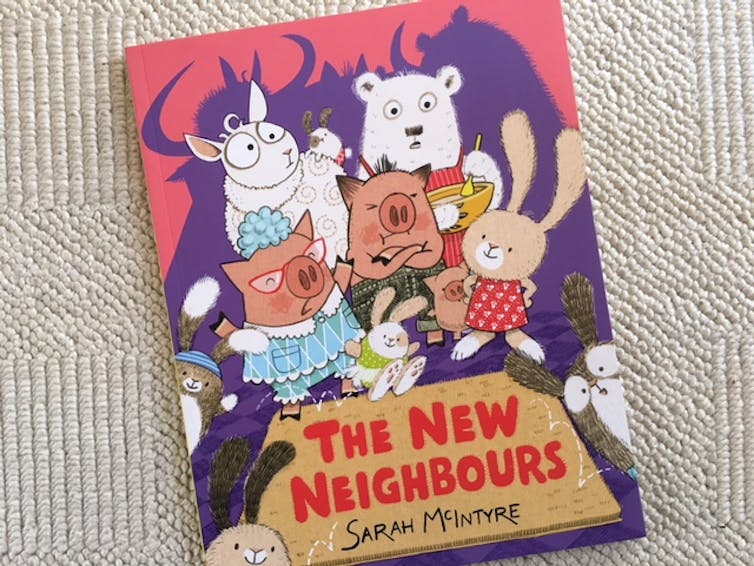
What will the neighbours think?
Fickling Books

The only picture book in the list, McIntyre’s delightfully illustrated story explores how intolerance and scaremongering can run like a mad fever through a community. When new neighbours move in to the tower block, hysteria builds quickly, until finally the other animals discover the truth about their newest neighbours. (Age: 2+)The Conversation

Fiona Shaw, Senior Lecturer, Northumbria University, Newcastle

This article is republished from The Conversation under a Creative Commons license. Read the original article.
Unknown's avatar

Guide to the Classics: Juvenal, the true satirist of Rome


File 20181126 140537 1j9fc4w.jpg?ixlib=rb 1.1
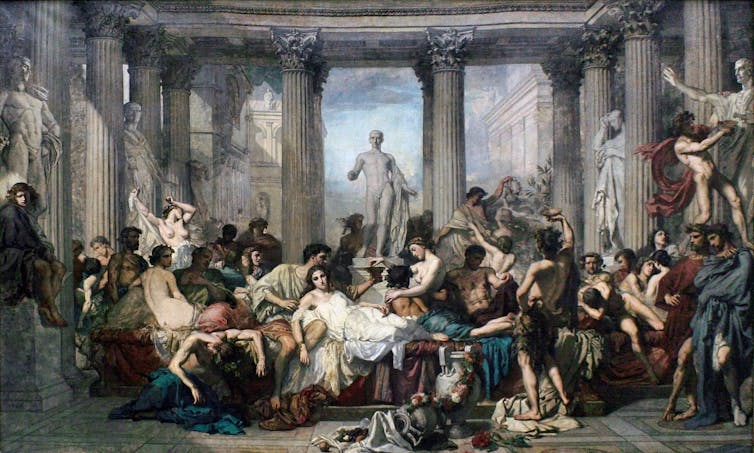
Thomas Couture, The Romans and their Decadence, 1847.
Wikimedia

Robert Cowan, University of Sydney

An angry man stands at the crossroads and rails against the moral cesspit around him, teeming with sexual deviants and jumped-up immigrants. This is the image which the Roman poet Juvenal paints of the satirist castigating the vices of contemporary Rome.

Juvenal’s Satires provide a fascinating window onto the social melting-pot that was early second century CE Rome. But they also hold up a mirror to those whose feelings of alienation and disempowerment produce a bitter distortion of that society.

Juvenal wrote 16 satires, divided into five books. Most are between 150 and 300 lines in length, except for the monstrous sixth satire attacking women and marriage, which rants on for over 650 lines and takes up a whole book on its own. Each satire has its own theme or target, ranging from decadent aristocrats and hypocritical moralists to giant turbots (a fish) and Egyptian cannibals, but this theme only loosely constrains a free-flowing structure which follows the satirist’s fulminating stream of consciousness.

Contradiction is the essence of these poems. The satirist indignantly condemns Rome’s vices as he pruriently lingers on their salacious details. The sheer force of his outrage and the vigour of his rhetoric sweep the reader along at the same time as she recoils from his bigotry. In Juvenal’s own words, it’s difficult not to write satire, and once you are sucked into its twisted world, it is difficult not to read it. But working out what to make of it is really difficult.

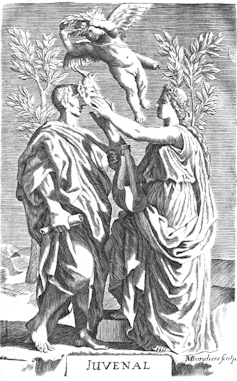
Frontispiece from the 1711 publication of Juvenal’s Satires.
Wiki Commons

The beginning of Roman satire

Roman satire bears only a distant family resemblance to the modern idea of satire. Instead of John Clarke parodically impersonating an incompetent politician, Juvenal and his predecessors take direct aim at the follies and vices of their day, lambasting any who deviate from social norms with moralizing fervour, scathing mockery, and stomach-turning obscenity.

The Romans admitted that they inherited all other genres of poetry — epic, tragedy, comedy, pastoral, and the rest — from the Greeks, but they proudly declared that satire was “totally ours”. It was written in hexameters, the lofty metre of epic poetry, but it always sets itself up as epic’s “evil twin”. Instead of heroes, noble deeds, and city-foundations recounted in elevated language, satire presents a hodgepodge of scumbags, orgies, and the breakdown of urban society, spat out in words as filthy as the vices they describe.

The first great Roman satirist was Lucilius, writing in the latter half of the second century BCE at the height of the free Republic. Only tantalising fragments of his work remain, but his reputation among later generations was unambiguous: a fearless exponent of extreme free speech who would lay into the powerful, stripping away the skin of respectability to reveal the foulness beneath.

Every later satirist lamented his inability to live up to Lucilius’ freedom and aggression. During the rise of the first emperor Augustus, as the free Republic gives way to the monarchical Empire, the poet Horace wrote satire whose buzzword was moderation, a contradiction in terms if ever there was one. Self-consciously playing it safe, his satirist chooses not to see — he even blames conjunctivitis — and not to talk about the death of political freedom.

Ninety years later, under Nero, the reclusive poet Persius turned satire inwards, boiling it down to dense, almost unreadable Latin which he doesn’t care if anyone reads. His image of the satirist is the barber whispering into a hole in the ground, “Midas has ass’s ears!” You can tell the truth, as long as you don’t need let anyone hear it.

Chariots of ire

With Juvenal, another half-century later, satire seemed to get its balls back. He dismisses epic and tragedy as tedious and irrelevant. Satire is the only possible response to the swamp that is Rome. Indignation is his Muse and the vices of Rome flow unmediated from the crossroads into his notebook. This is barely poetry at all. It is the unvarnished truth about Rome there on the page in front of you.

What folks have done ever since — their hopes and fears and anger,
their pleasures, joys, and toing and froing — is my volume’s hotch-potch.
Was there, at any time, a richer harvest of evil?

Except, of course, it isn’t. Juvenal goes through the same crisis as Horace and Persius. This isn’t the Republic and he isn’t Lucilius. It isn’t safe to tell it like it is when the rich and powerful can silence you. Juvenal’s solution is that he will only criticise the dead. The fearless satirist is compromised before he has even begun.

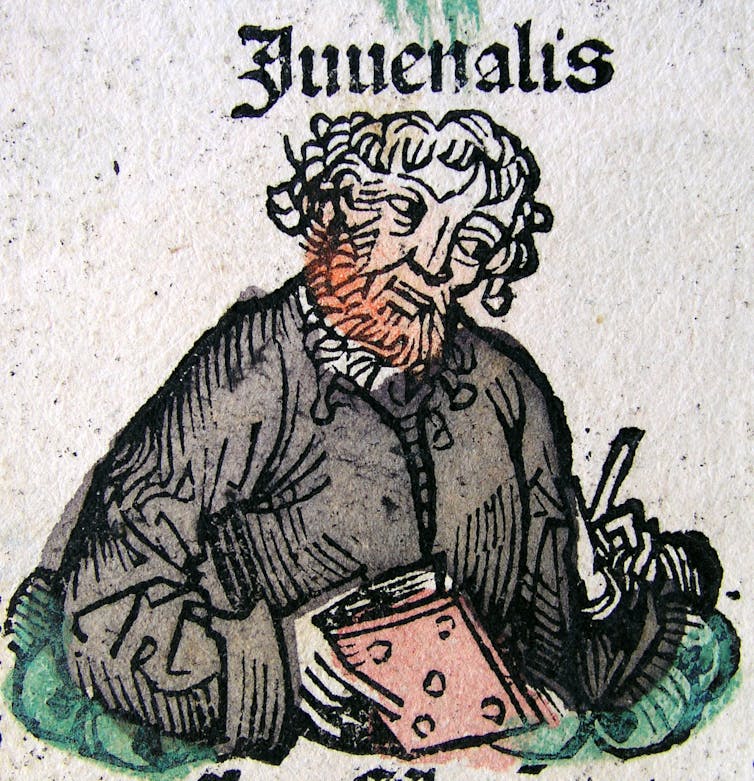
A depiction of Juvenal in the Nuremberg Chronicle, late 1400s.
Wiki Commons

Yet it isn’t just his caginess about causing offence which problematises the satirist’s voice. His strident attacks on women, on homosexuals, on Greek and Egyptian immigrants are often put in the mouths of characters who sound remarkably like the satirist himself.

Satire 3’s panoramic view of a decadent Rome is presented through the skewed vision of Umbricius, “Mr Shady”, about to abandon the city because Greek immigrants take all the jobs.

I now proceed to speak of the nation specially favoured
by our wealthy compatriots, one that I shun above all others.
I shan’t mince words. My fellow Romans, I cannot put up with
a city of Greeks; yet how much of the dregs is truly Achaean?
The Syrian Orontes has long been discharging into the Tiber,
carrying with it its language and morals and slanting strings,
complete with piper, not to speak of its native timbrels.

But his main complaint is that they get away with the same things he tries.

We, of course, can pay identical compliments; yes, but
they are believed.

This isn’t moralising, or even simple bigotry, but sour grapes.

Readers take the first-person voice of the satires as reflecting Juvenal’s personal opinion in a sort of autobiographical confession. Indeed, we know nothing about him except what we can try to deduce from his poems. More recently, the satirist’s voice has been seen as a persona, a mask, a character just like Umbricius.

Is Juvenal satirising immigrants or the bigots who rail against them? The latter is certainly the more comfortable reading, but we need to be careful not to make the Romans too like us. Satire is meant to be uncomfortable.

Beyond Anger


biblioteca de humanidades/flickr

Juvenal’s satirist doesn’t only “punch down” against easy targets. He also “punches up” and fights the corner of the little guy oppressed by the rich and powerful. Satire 5 condemns a rich patron for the humiliation he heaps on his poor client, though he acutely criticises the client for his complicity. Throughout, Juvenal’s main targets are hypocrites from all levels of society. The satirist stands outside and inveighs against what is wrong with Rome, but he has few suggestions on how to improve it.

In his later satires, Juvenal moves away from indignation altogether and adopts a new model. He will not be the philosopher Heraclitus, weeping at the state of the world, but another philosopher, Democritus, ironically laughing at it with a sense of detachment.

This is the spirit of satire 10, on the dangers of getting what we wish for. The satirist is not angry, but mockingly – and sometimes pityingly – amused by Sejanus, who got the power he wanted but was dragged through the streets on a meat-hook.

Now the flames are hissing; bellows and furnace are bringing
a glow to the head revered by the people. The mighty Sejanus
is crackling. Then, from the face regarded as number two
in the whole of the world, come pitchers, basins, saucepans, and piss-pots.
Frame your door with laurels; drag a magnificent bull,
whitened with chalk, to the Capitol. They’re dragging Sejanus along
by a hook for all to see.

Or the man whose prayer for long life is answered with impotent, incontinent senility.

The poor old fellow must mumble his bread with toothless gums.
He is so repellent to all (wife, children, and himself),
that he even turns the stomach of Cossus the legacy-hunter.
He loses his former zest for food and wine as his palate
grows numb. He has long forgotten what sex was like; if one tries
to remind him, his shrunken tool, with its vein enlarged, just lies there,
and, though caressed all night, it will continue to lie there.

The angry satirist hurls unconstructive abuse, but this new version has a suggestion for self-improvement:

Pray for a healthy mind in a healthy body.

Juvenal unbound

Juvenal is the greatest Roman satirist. He, far more than Horace or Persius, defined what satire meant for most of the early modern period and it is translations and imitations of him by Pope, Dryden, Jonson, and others – not to mention Hogarth’s paintings – which dominate the great era of English Augustan satire.

His satires give us a ground-level view of a Rome we could barely guess at from the heroism of the Aeneid, the drinking-parties of Horace’s Odes, or even the histories of Tacitus. We cannot trust satire, but we can allow ourselves to enjoy it.

Recommended translation: Juvenal, The Satires, Oxford World’s Classics translation by Niall Rudd with introduction and notes by William Barr (1992).The Conversation

Robert Cowan, Senior Lecturer in Classics, University of Sydney

This article is republished from The Conversation under a Creative Commons license. Read the original article.
Unknown's avatar

What we can learn from reading Sylvia Plath’s copy of ‘The Great Gatsby’


File 20181204 34154 1i44dcg.jpg?ixlib=rb 1.1
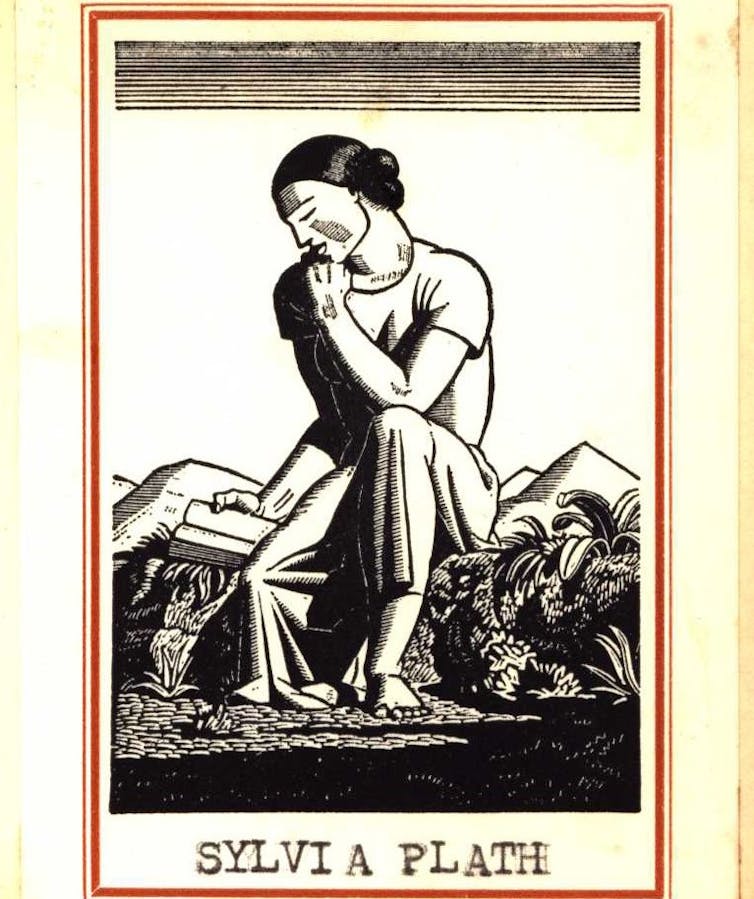
Sylvia Plath stuck this bookplate into the front cover of her copy of ‘The Great Gatsby.’
Source, Author provided

Jeanne Britton, University of South Carolina

As a rare books curator, I get to interact with first editions of novels I love, illustrated versions of my favorite poets’ works, and lavish editions of historical engravings.

In 2015, I started using the University of South Carolina’s first edition of “Lyrical Ballads” in my survey of British literature courses. Written by William Wordsworth and Samuel Taylor Coleridge, this collection of poems is commonly thought to have launched British Romanticism.

I would bring the volume to class to discuss its visual appearance as a printed text. But each time I shared the volume with a new group of students, we found ourselves drawn to the comments written in the book’s margins by its early owner, John Peace.

Peace was, I learned, an acquaintance of Wordsworth. And some of his comments in the margins of one of the volume’s most well-known poems, “Tintern Abbey,” explore the poem’s themes of memory, place and return.

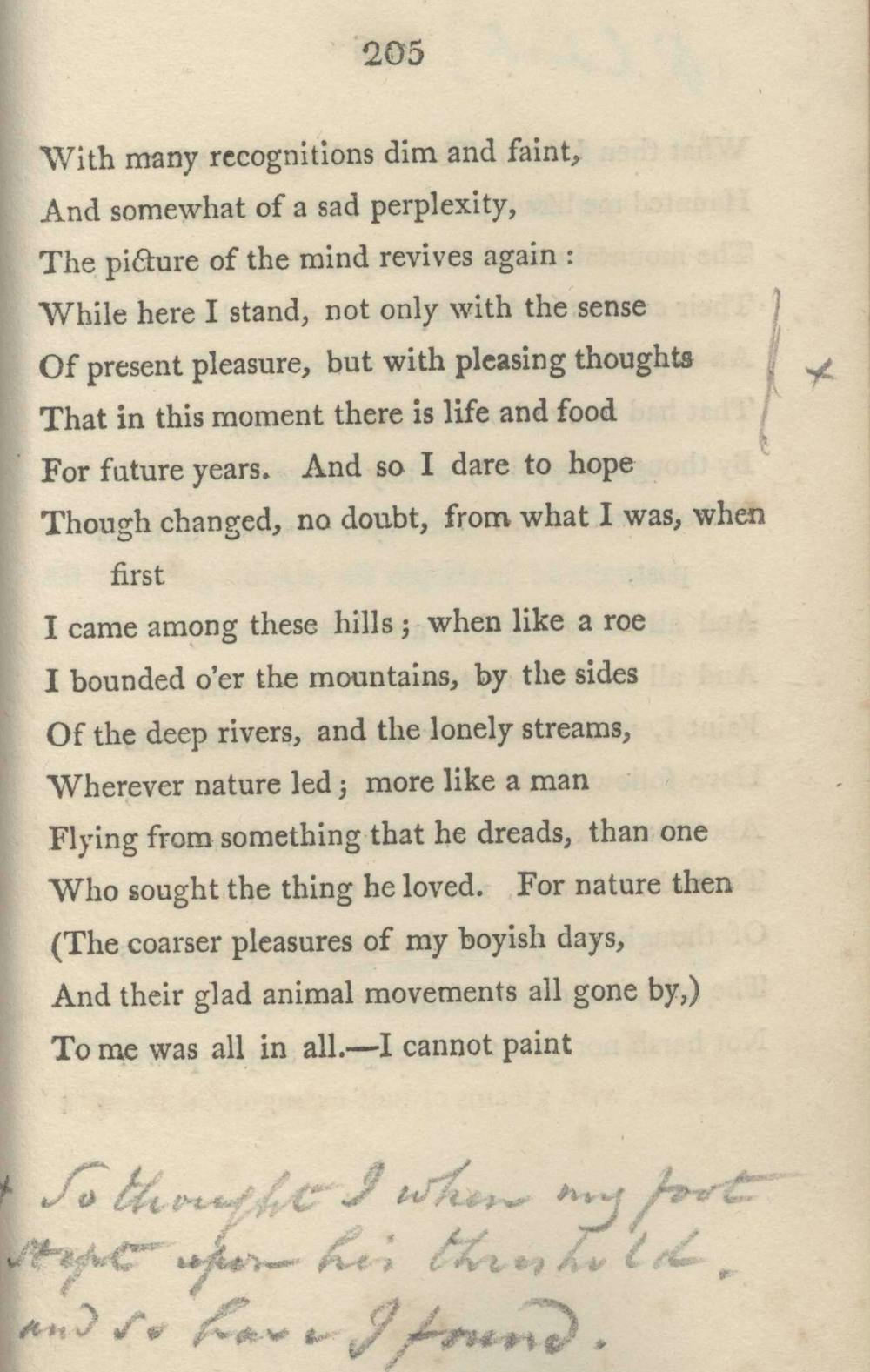
‘So thought I… and so have I found,’ John Peace writes, reacting to ‘Tintern Abbey.’
Source, Author provided

In this poem, Wordsworth describes his return to the Wye River valley after an absence of five years. He also recalls his memories of his first visit to the valley and looks forward to the memories this second visit will create.

“In this moment,” he writes, “there is life and food / For future years.”

When Peace responds to these lines, he describes a different kind of experience – visiting the poet in his home – in a similar way: “So thought I when my foot first step’t upon his threshold, and so have I found.”

It is a singular piece of literary history, and it’s one example of how the study of words written in the margins of historic texts – called “marginalia” – can illuminate the history of reading in new ways.

As prominent book historian Roger Chartier has noted, marginalia can reconstruct past reading experiences through the “sparse and multiple traces” ordinary readers left behind.

One particularly vivid example that is far from ordinary is Sylvia Plath’s copy of “The Great Gatsby.”

Reading ‘Gatsby’ with Sylvia Plath

Acquired by the University of South Carolina in 1994 from a former professor, the Matthew J. & Arlyn Bruccoli Collection of F. Scott Fitzgerald includes Fitzgerald’s personal ledger, a flask from his wife Zelda, and early drafts of his works.

It also includes an inexpensive 1949 edition of “The Great Gatsby.” Compared to other items in this collection, it might not seem like anything special.

But the book’s owner – and the words she wrote in its margins – are quite noteworthy.

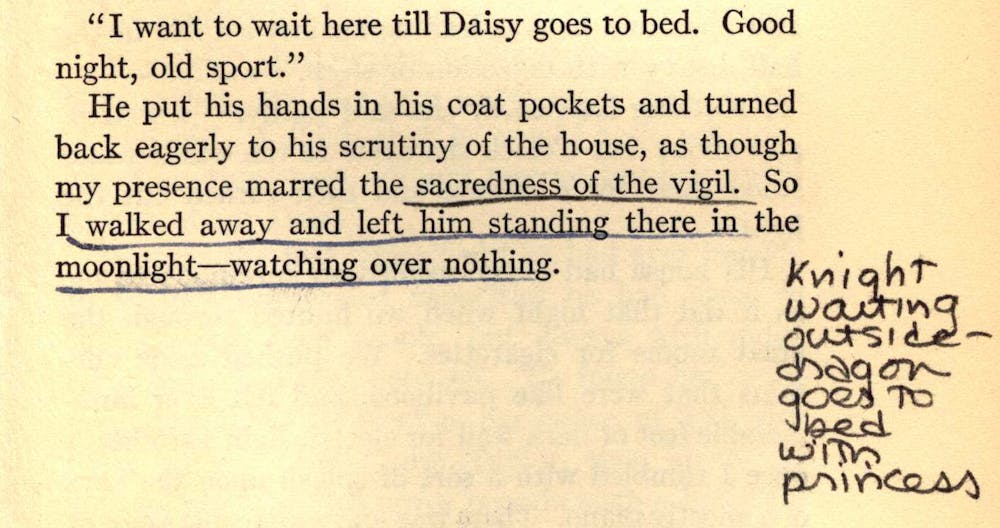
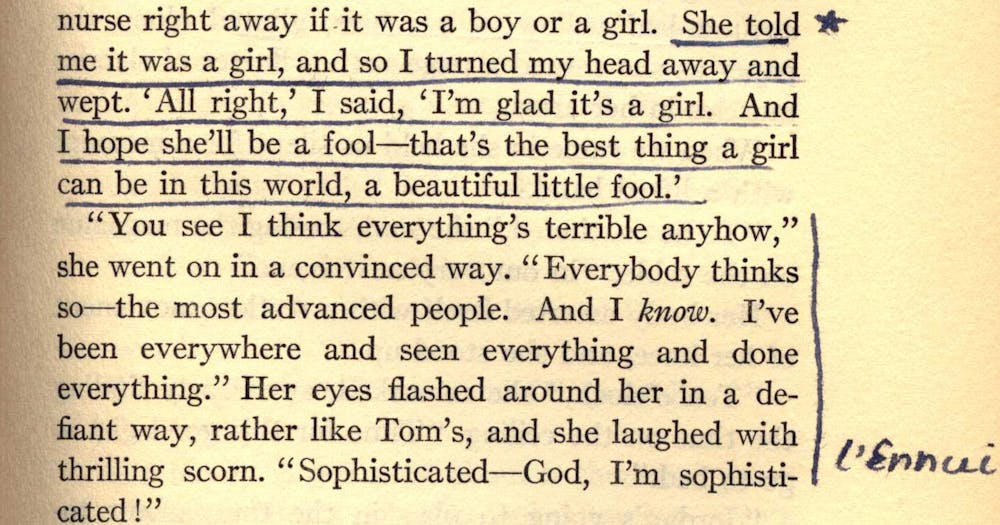
The bookplate identifies Sylvia Plath as the owner of this copy, which she most likely read as an undergraduate at Smith College. Some marginal comments were probably notes she took during lectures about the novel. But others show the way Fitzgerald’s novel sparked her imagination and inspired her own work.

She wrote on almost every page, underlining passages in black and blue ink, drawing stars beside her favorites and occasionally writing notes – some quite arresting – in the margins.

Plath wrote “L’Ennui” – a French word that describes a feeling of listlessness and boredom – next to a description of the character Daisy’s world-weary view of life: “I’ve been everywhere and seen everything and done everything.” “L’Ennui” would become the title of a poem Plath is thought to have written shortly after reading this novel.

Sylvia Plath wrote ‘L’Ennui’ – the title of a future poem of hers – in the margins of ‘The Great Gatsby.’
Source, Author provided

Other notes are, in the context of Plath’s painful life and tragic suicide, haunting.

She writes that Daisy shows a “desire for a secure future” – a longing that seems to have struck a chord for Plath.

On another page, she hints at masculine aggression when she comments, as Gatsby watches the Buchanans from outside their home, “knight waiting outside – dragon goes to bed with the princess.” This was a motif that would reappear in her own life: In her recently published letters, Plath details the physical and emotional abuse her husband, the poet Ted Hughes, inflicted upon her in the months before her death.

Some of Plath’s notes are poignant, given what would transpire over the course of her life.
Source, Author provided

Sylvia Plath’s copy of “The Great Gatsby” speaks to the value of marginalia. As Makenzie Logue, a student of mine who is currently studying the volume, put it, preserving these notes means that you can “read The Great Gatsby with Sylvia Plath.”

Making marginalia accessible

In recent years, marginalia left by ordinary readers has become a subject of large-scale data collection efforts.

At the University of Virginia, English professor Andrew Stauffer leads a team that has made a book’s annotations, inscriptions and insertions discoverable as part of UVA’s online library catalog. Any user will be able to find such markings through a simple online search.

At the University of California, Los Angeles, librarians are developing ways to discover marginalia digitally – and quickly – across large digital collections.

Using the methods developed at the University of Virginia, my colleague Michael Weisenburg and I have organized searches for historical markings in library books at the University of South Carolina. Student workers and library staff have enhanced records for annotated volumes in the school’s online catalog.

While digital technology has made marginalia more accessible, digital reading has made the actual habit of writing in books much less common.

What would Sylvia Plath and John Peace have done if they had a Kindle? Would they have still left traces of their reactions to the texts – so valuable to scholars today – behind?The Conversation

Jeanne Britton, Curator, Irvin Department of Rare Books and Special Collections, University of South Carolina

This article is republished from The Conversation under a Creative Commons license. Read the original article.
Unknown's avatar

With a limited on-screen presence, autistic characters have emerged in another medium: fan fiction


Jonathan Alexander, University of California, Irvine and Rebecca Black, University of California, Irvine

In one Harry Potter fan fiction story, Hermione Granger anxiously awaits the results from a recent test.

It isn’t her performance on an exam in a potions course that she’s concerned about. Instead, the higher-ups at Hogwarts had ordered she undergo some psychological tests. They had noticed how quickly she talked, along with her nervous tics.

Hermione eventually sees the results: “I stared at my parents, blinking my eyes. I knew the results would be here today, but I didn’t think the outcome would be like this. Asperger, the paper said.”

In this piece of fan fiction, Hermione Granger has been diagnosed with autism spectrum disorder.

As scholars of fan fiction and young adult literature, we started noticing how some fan fiction authors were incorporating autism into their stories – sometimes through new characters and other times by rewriting existing ones.

Since then we’ve been collecting and analyzing fan fictions in which young writers have created characters with autism.

These amateur writers seem to be eager to create the kinds of characters they aren’t regularly seeing in the media. The Harry Potter universe, in particular, has emerged as a popular setting.

The importance of autistic characters

According to the Centers for Disease Control and Prevention, approximately 1 in 59 children is diagnosed with autism, a word that covers a spectrum of conditions that psychologists refer to as autism spectrum disorder.

How autism manifests can vary greatly from person to person. Some experience significant disability, while others experience milder forms of cognitive difference and social discomfort.

But one thing is clear: Diagnoses have increased in the past 20 years, with the National Autism Association identifying autism as the “fastest growing development disorder.”

At the same time – outside of a couple of notable examples, like Dustin Hoffman’s character in “Rain Man” and Julia from “Sesame Street” – there continues to be a dearth of autistic characters in books, television shows and films.

Yet these media portrayals are extremely important: Accurate portrayals of autism can help people understand the complexities of this condition. Nonexistent depictions – not to mention misleading ones – foster misinformation and bias.

In 2015, Sonya Freeman Loftis, an assistant professor of English at Morehouse College, published “Imagining Autism: Fiction and Stereotypes on the Spectrum,” one of the few academic studies to take up the representation of autism in fiction.

Loftis critiques stereotypical depictions of autism in a range of fictional narratives, such as the character of Lennie in Steinbeck’s “Of Mice and Men,” a figure whose disability is linked to sexual violence.

But she also points out that positive representations of autism spectrum disorder can actually highlight some of the strengths that those with autism possess: attention to detail, high levels of concentration, forthrightness, dedication and strong memory skills.

Activists and scholars like Loftis have argued that people diagnosed with autism spectrum disorder should be more justly and accurately understood as “neurodiverse”: If neurological faculties exist on a continuum, theirs could simply be thought of as “different” from the statistical norm.

Young writers take the lead

If major studios and publishing companies express little interest in telling stories about people with autism, who can fill the void?

Fan fictions and other forms of do-it-yourself media-making are an outlet for people to explore issues that are often missing from mass market and popular entertainment.

Some of the most famous examples from fan fiction take place in the Star Trek universe, particularly those that imagine a gay relationship between Captain Kirk and Mr. Spock. In doing so, fans were able to integrate queer plots and themes into Gene Roddenberry’s science fiction universe at a time when few gay relationships were appearing on TV.

Given the paucity of mass media representation of autism, we wondered if young people might be using fan fiction to explore this complex topic.

Beginning in 2016 – and working with University of California, Irvine graduate student Vicky Chen – we started analyzing the writings that have appeared on a hugely popular fan fiction clearinghouse.

After selecting for categories such as “neurodiverse” and “differabilities,” we noticed that a number of stories set in the Harry Potter universe seemed to have autistic or neurodiverse characters. We collected and coded these stories, and are set to publish our findings in a forthcoming essay in the Journal of Literacy Research.

Most of the stories were written by young people who have siblings, relatives or friends with autism spectrum disorder. We concluded that, while some of these characters occasionally slip into stereotypes, most of them affirm the ability of people with autism spectrum disorder to confront bigotry and speak about their own conditions.

By extension, the stories promote an understanding of autism as something that isn’t scary or horrific.

In one story, for instance, the writer creates a new character, Albus Potter, the son of Harry Potter, who is autistic and newly enrolled in Hogwarts. In the story, Albus initially has difficulty forming relationships. But he ultimately finds friends in houses as diverse as Gryffindor and Slytherin.

His overprotective mother tries to shield him from ridicule by students and even some biased faculty. But she’s challenged by others, including her husband, who suggests that “Albus can do a great many things that people have said he couldn’t.”

The ‘magic’ of autism

Why the Harry Potter universe?

We reasoned that many of these young writers are still in school and likely huge fans of Harry Potter, so the choice of Hogwarts as a common setting isn’t surprising.

But many of the young authors also linked autism to a kind of “magic” or ability that could be understood at Hogwarts as special – even advantageous – in ways that “muggles,” or normal people, wouldn’t see. In all of the stories we analyzed, everyone with autism also has magical abilities.

In other cases, autism isn’t depicted as an impairment or a challenge to overcome. Instead, it simply appears as a “difference” – a portrayal that’s aligned with the goals of those who argue that autism should be thought of as a form of neurodiversity, not as an illness or disability.

Perhaps most significantly, this research points to the ways in which young people can craft complex representations of autism that the media shies away from.

We can’t say when positive representations of autism will move from fandom to the mainstream.

But until then, these young writers are quietly doing the work to help dispel stereotypes and generate understanding – perhaps even appreciation.The Conversation

Jonathan Alexander, Chancellor’s Professor of English and Gender & Sexuality Studies, University of California, Irvine and Rebecca Black, Associate Professor of Education, University of California, Irvine

This article is republished from The Conversation under a Creative Commons license. Read the original article.

Unknown's avatar

Ten great Australian beach reads set at the beach


File 20181219 45419 1xarcf5.jpg?ixlib=rb 1.1
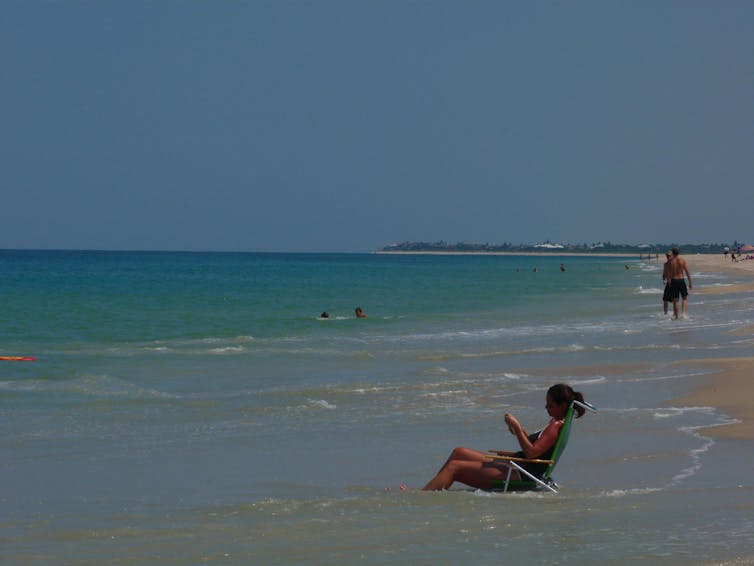
The beach is a common setting for Australian novels, which often capture its darker side.
boxer_bob/flickr, CC BY-NC-ND

Liz Ellison, CQUniversity Australia

Australians flock to the beach over the summer holidays: Bondi alone had 2.9 million visitors in 2017 – 2018. But while tourism campaigns often portray the beach as an idyllic, isolated haven, many of our beach stories depict it as a darker, more crowded and complex place.

Here are ten Australian beach stories (in no particular order) worth reading this summer.

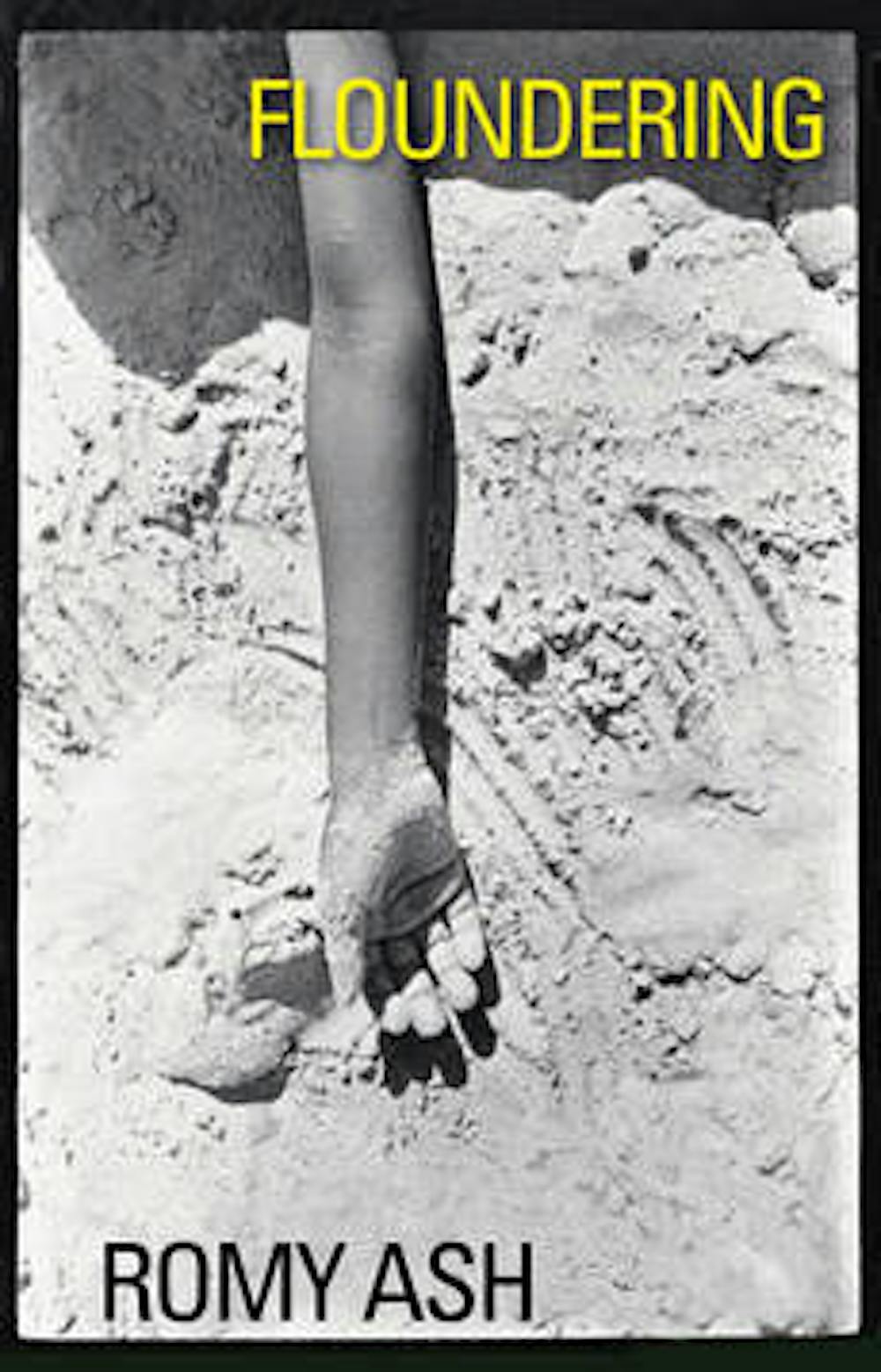
Floundering by Romy Ash

Romy Ash’s debut novel Floundering, shortlisted for the 2013 Miles Franklin award, is a captivating, sometimes chilling story of two young boys who are taken, without warning, by their mother to a beachside caravan park.

Left to their own devices, the boys must make the most of their time by the beach without anything but their school bags and uniforms.

The un-named regional beach in this novel is uncomfortable, “a location of risk and danger” as author Robert Drewe once described it, and sometimes reveals the worst ways in which nature and humanity meet. It’s a refuge for people looking to escape from city life, a stark comparison to more urbanised beaches.

Puberty Blues by Kathy Lette and Gabrielle Carey

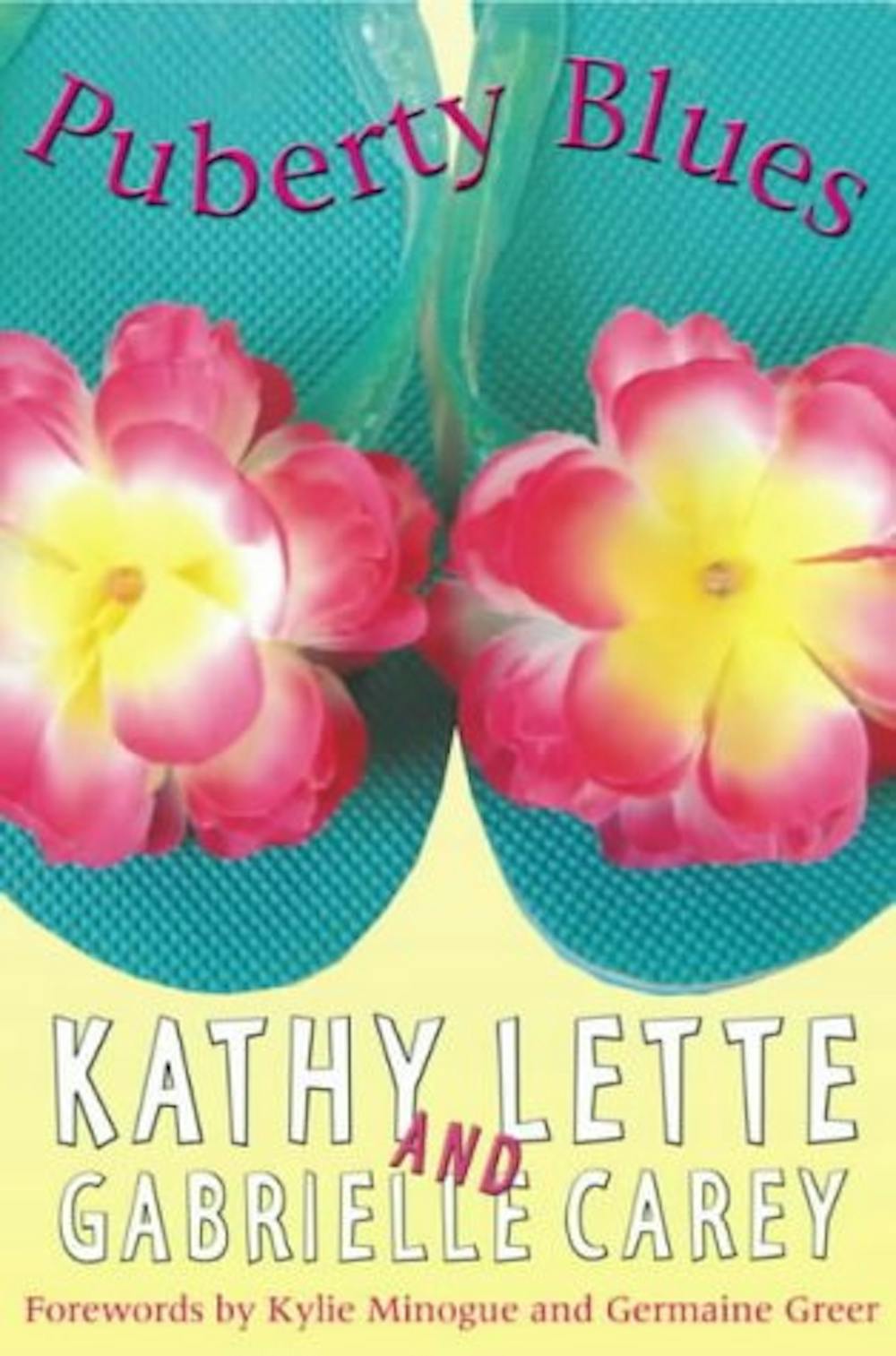
When I tell people that I research the Australian beach, often their first response is to ask if I’ve watched Puberty Blues. Perhaps Australia’s most iconic beach text, the book (first published in 1979) is the story of two friends growing up in beachside suburbs of Sydney. It was adapted for film by Bruce Beresford in 1981.

Both the book and film, with their characteristic colloquialisms and Australian slang, capture a sense of Australian coastal identity while revealing uncomfortable truths about gender, sex, and drugs for the teenagers they depict.

Australian stories about the beach are often male-centred and written by men. Puberty Blues is an important contribution to beach literature because of Debbie and Sue, its female protagonists, and their perspectives on a blokey world.

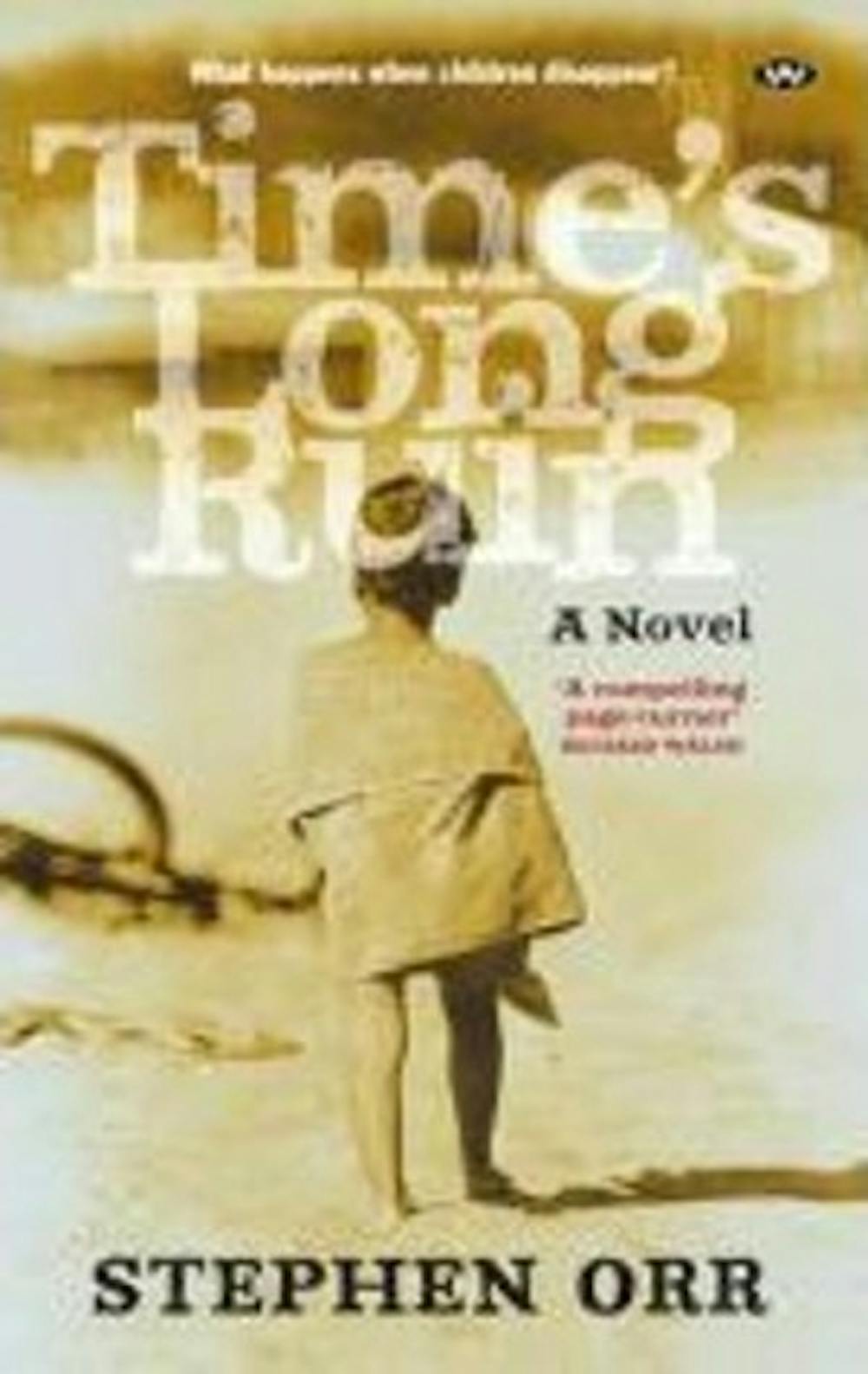
Time’s Long Ruin by Stephen Orr

In 1966, the three Beaumont children disappeared from Glenelg Beach near Adelaide. They were last seen in the company of a tall, blond man. Despite continued searching, even earlier this year, they have never been found.

Time’s Long Ruin (2010) is a fictionalised account of the disappearance of three children as told through the eyes of their young neighbour. Loosely based on the Beaumont story, Orr captures the dread of the aftermath for those left behind who knew and loved the children, the challenge of dealing with false leads and unreliable information, and the growing realisation that they will likely never be found.

The case of the Beaumont children had an enormous impact on Australian culture. My mother, who was a young girl when they disappeared, still recalls how her parents would worry about her momentarily being out of sight at the beach at this time.

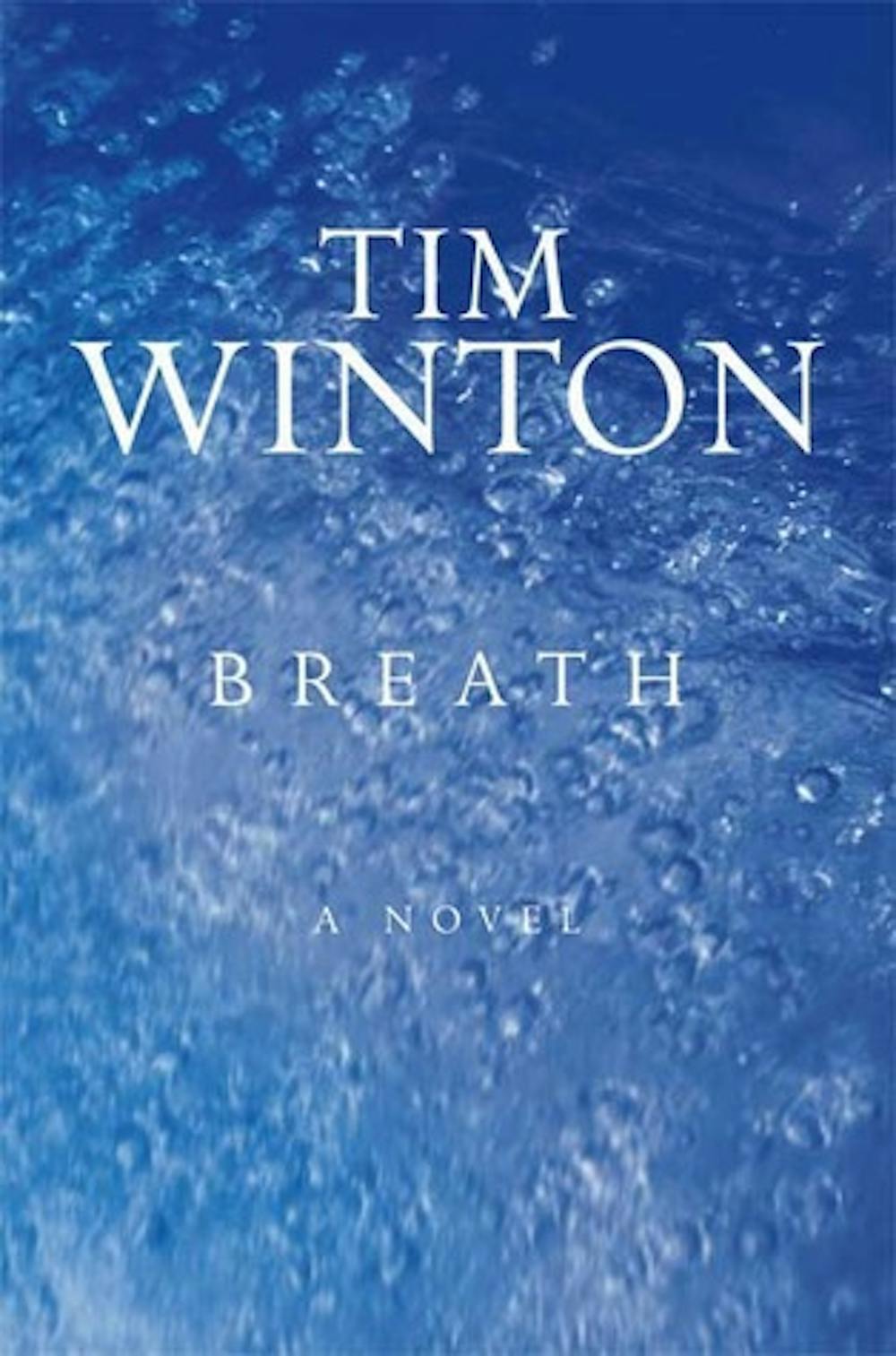
Breath by Tim Winton

Breath, published in 2008, earned Tim Winton his fourth Miles Franklin award and was recently adapted into a film, directed by and starring Simon Baker.

On the surface, this novel is about surfing. But it asks deep questions about masculinity, and boys’ attitudes towards sex, while capturing the feel of Australian coastal life in the 1970s.

Winton’s writings often engage with the ocean, the coast, and the beach – usually in West Australia, where he lives. His memoirs have revealed his love for the coastal landscape. As he writes in Land’s Edge (1993): “There is nowhere else I’d rather be, nothing else I’d rather be doing. I am at the beach looking west with the continent behind me as the sun tracks down to the sea. I have my bearings”.

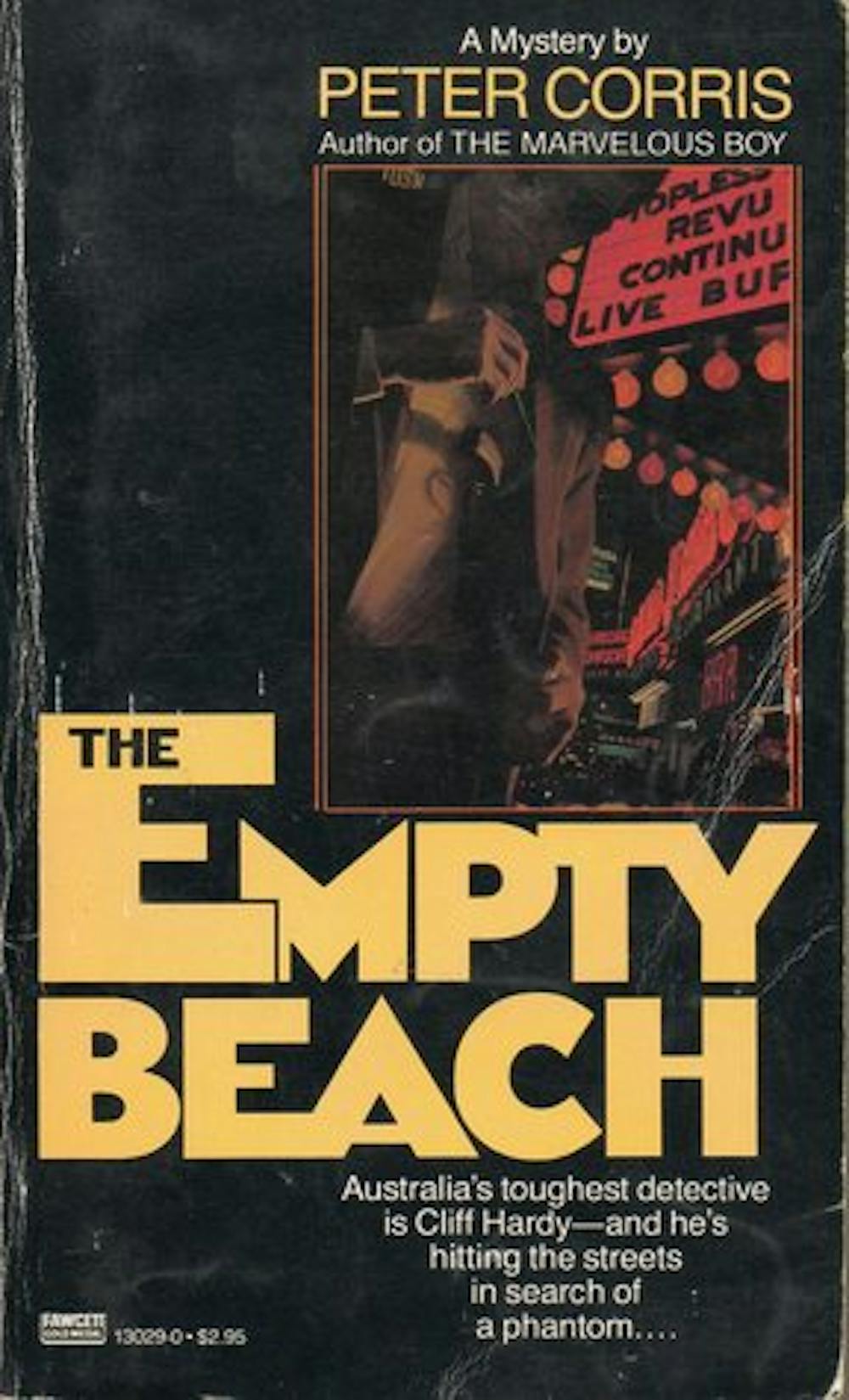
The Empty Beach by Peter Corris

Peter Corris died in August, after publishing 102 novels. The Empty Beach (1983) was released early in his career and is the fourth novel featuring the private investigator Cliff Hardy – a homegrown, hard-boiled detective, firmly located in Sydney. It was adapted for film in 1985.

In this book, Hardy is investigating the disappearance of John Singer, missing and presumed dead. He begins his probe in the rough, working class Bondi of the early 1980s. Corris captures Bondi Beach through the eyes of his protagonist, depicting it as a seedy extension of the city.

Hassled by junkies, threatened by mobsters; Hardy spends much of the novel embroiled in the corrupt underbelly of Sydney’s criminal kingpins, never far from the now infamous shoreline.

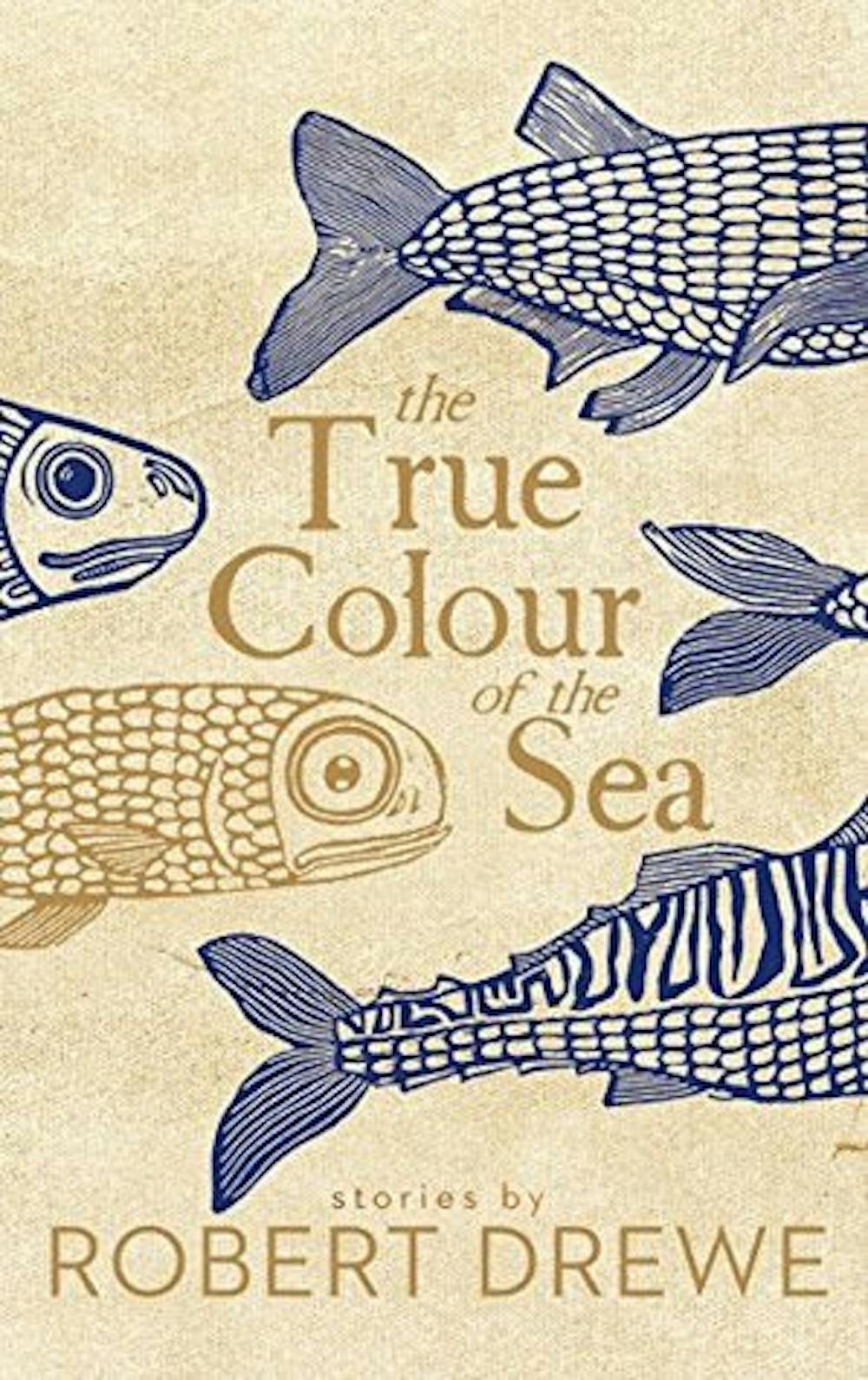
The True Colour of the Sea, by Robert Drewe

Having lived in many coastal spots across the country, including Perth, Sydney, and Byron Bay, Robert Drewe’s stories regularly capture that very familiar, domestic sense of a beachside life.

Drewe’s The Bodysurfers (1987), a collection of short stories, became a bestseller.

His memoirs and short stories are all infused by the beach landscape, and this latest collection is no different.

As the narrator writes in Dr Pacific, the opening story in his new collection:
“One thing’s for sure – it’s my love of the ocean that keeps me going. You know what I call the ocean? Dr Pacific. All I need to keep me fit and healthy is my daily consultation with Dr Pacific.”

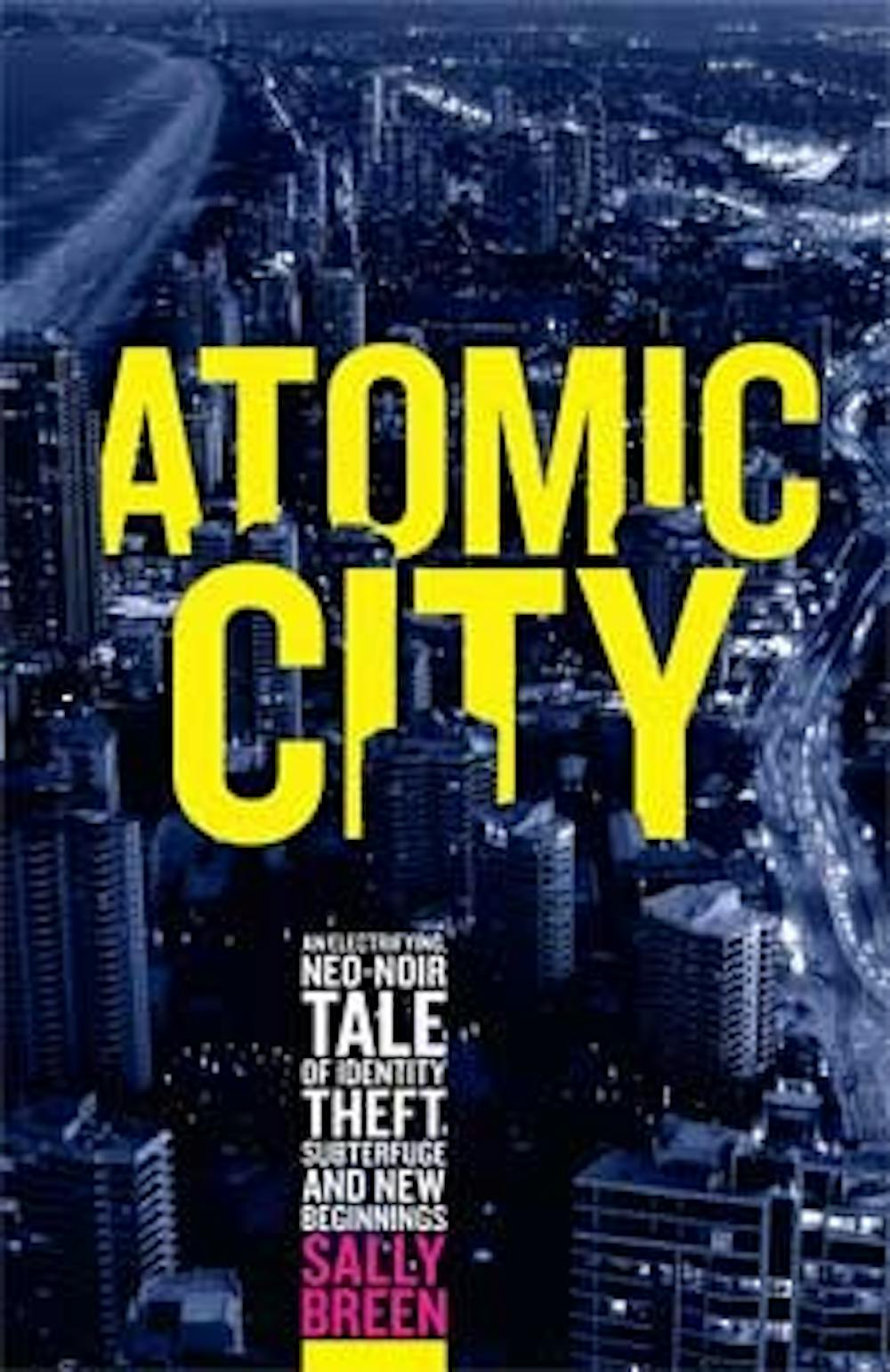
Atomic City by Sally Breen

Sally Breen lives and works on the Gold Coast, and that strip of high density development on the beach works its way into much of her writing.

With its high rise skyline under a big sky, Surfers Paradise has been called a “pleasure dome” by Frank Moorhouse. But Atomic City (published in 2013), set largely in the lofty apartment buildings and businesses that abut, and look out on, the beach, captures perfectly the grift and graft of this place.

Jade arrives on the Gold Coast to make herself over and get rich. Together with shady croupier “The Dealer” this is a beach tale of cons, scams and identity theft.

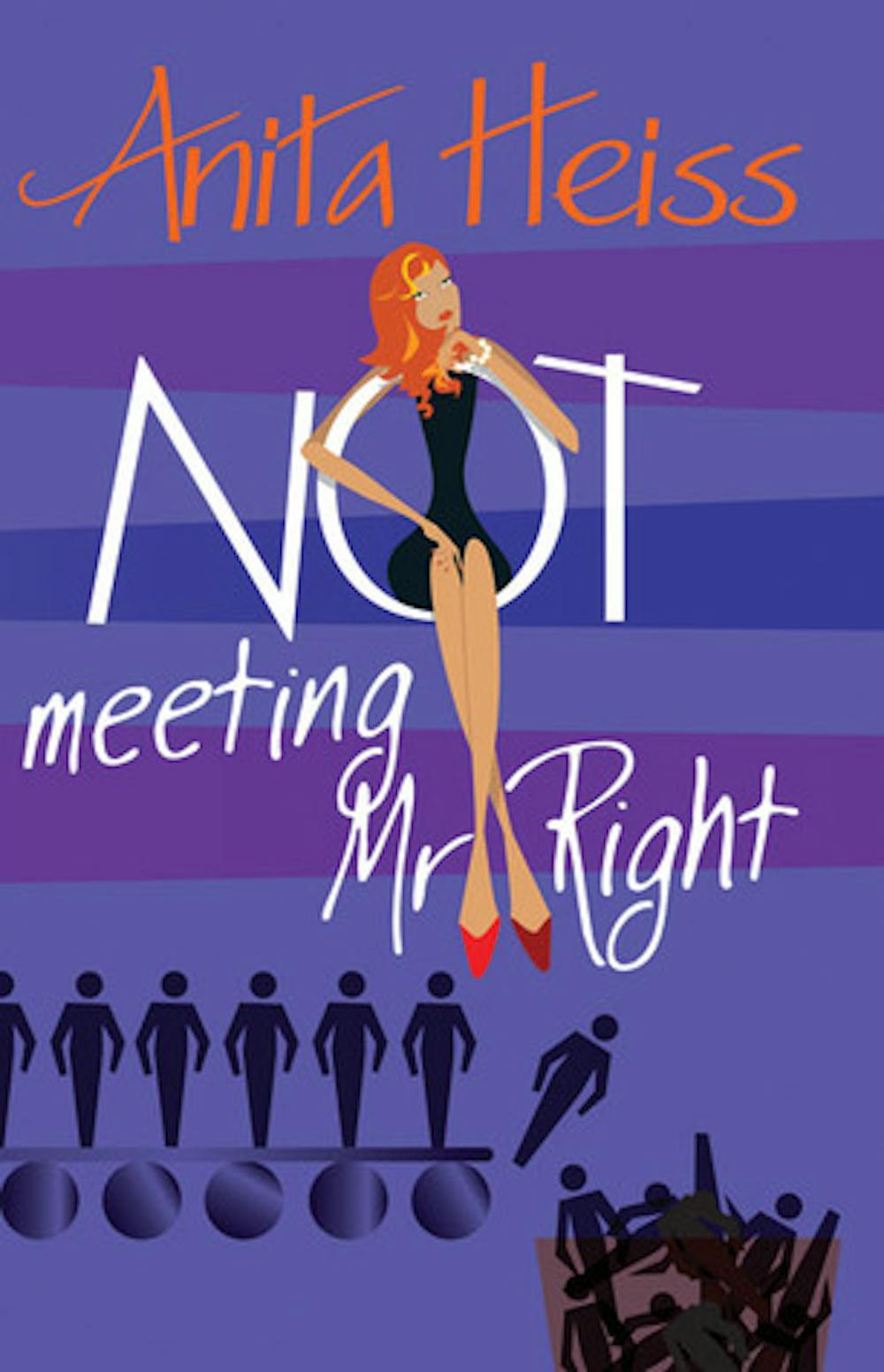
Not Meeting Mr Right by Anita Heiss

Prominent Australian Indigenous author Anita Heiss straddles both fiction and non-fiction, with her work often grounded in ideas around Indigenous identity. Her series of “chick lit” novels includes Not Meeting Mr Right (first published in 2007).

In the novel, Alice lives beachside in Coogee and regularly walks the coastal path between it and Bondi. A proudly single, Indigenous woman, Alice has a change of heart about marriage and decides to get serious about settling down – which means embarking on the rocky road towards finding love. In contrast to the challenges – including racism – she encounters along the way, the beach is a comfortably ordinary presence in this novel. However, Heiss also parodied the white Australian beach experience in an earlier book Sacred Cows (1996).

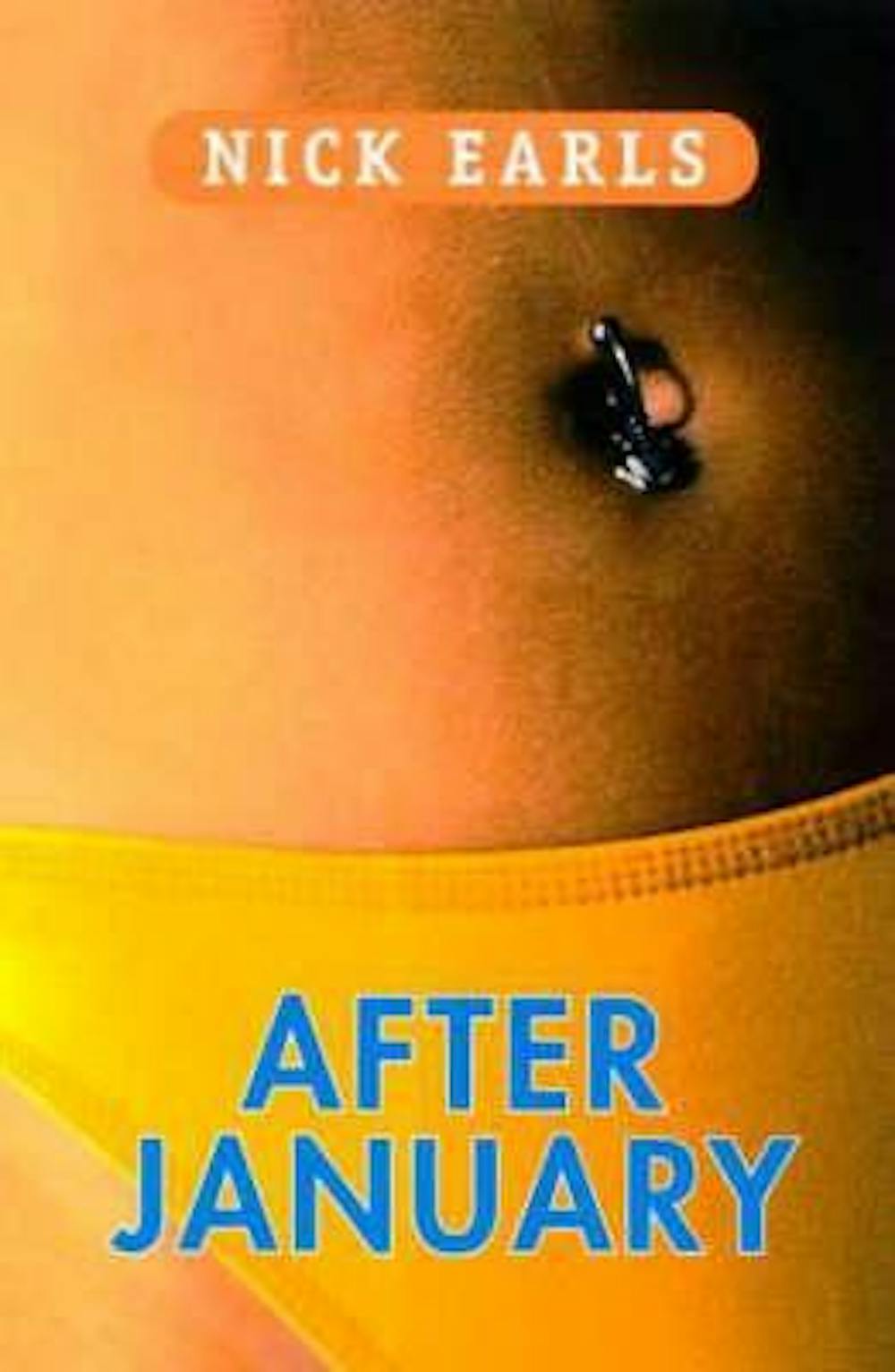
After January by Nick Earls

If you grew up in Brisbane when I did, there was a high chance you were reading a Nick Earls novel or seeing one adapted into a play. After January (first published in 1996) is one of Earls’ first works for young adult readers, and is set in the long break after finishing high school.

Alex is on holidays at Caloundra in his family’s beach house, a teenage boy uncomfortable in his skin but comfortable in the ocean. Although now more than 20 years old, this story still captures the uncertainty of burgeoning adulthood and the comfort the ocean can bring.

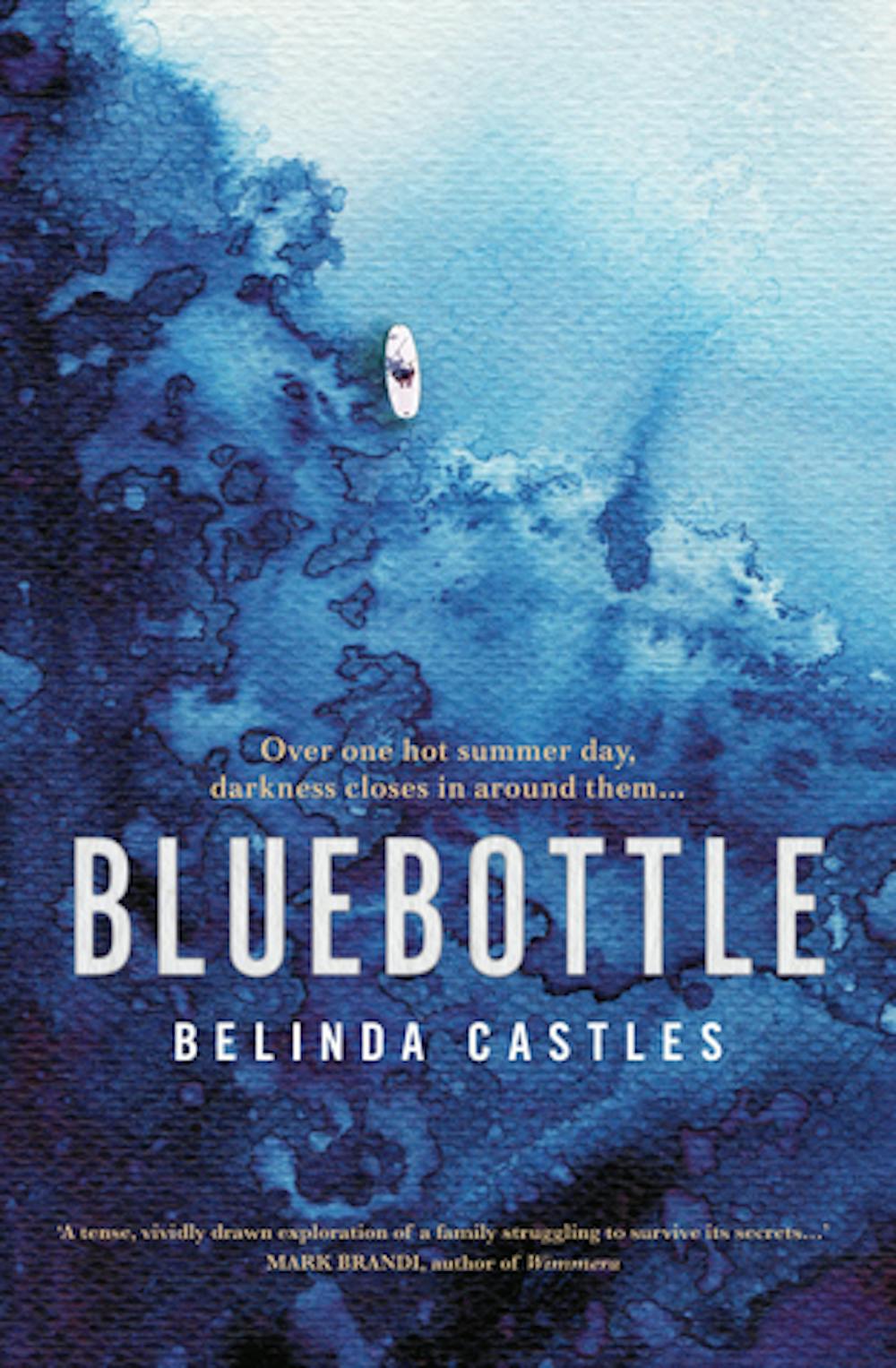
Bluebottle by Belinda Castles

For many Australians, the beach can be wrapped up in childhood memory. These memories can blend and blur. In my mind, my summers spent at the beach with my grandparents were never-ending, from the moment school finished until the day before I was set to return. In reality, we spent some time there, often weekends, and certainly never the entire school holidays.

Belinda Castles’ Bluebottle tells the story of the Bright family, and is filled with that uncomfortable tension that arises when we realise memory is fallible. Siblings Jack and Lou recount key moments from their childhood, starting with the disappearance of a local school girl and their father’s unpredictable purchase of a beachside property in Bilgola, Sydney. However, they learn that growing older can change perspectives on the past and, like the beach, it can be hard to tell what’s under the surface while the waves distort our view.The Conversation

Liz Ellison, Lecturer in Creative Industries, CQUniversity Australia

This article is republished from The Conversation under a Creative Commons license. Read the original article.
Unknown's avatar

How the rise of veganism may tenderise fictional language


File 20181120 161624 11s60ix.jpg?ixlib=rb 1.1
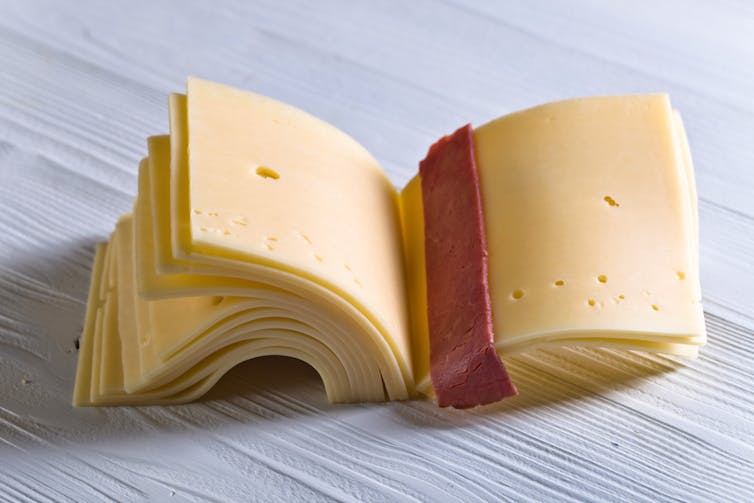
A cheesy book.
Igor Normann/Shutterstock

Shareena Z. Hamzah, Swansea University

For countless generations, meat has been considered the single most important component of any meal. But meat is more than just a form of sustenance, it is the very king of all foods. It’s a source of societal power.

Historically, the resources required to obtain meat meant it was mainly the preserve of the upper classes, while the peasantry subsisted on a mostly vegetarian diet. As a result, the consumption of meat was associated with dominant power structures in society, its absence from the plate indicating disadvantaged groups, such as women and the poor. To control the supply of meat was to control the people.

In fiction, meat has long had a powerful role, too. As Jeanette Winterson, food writer and author of Oranges Are Not the Only Fruit and Sexing the Cherry, says, “Food, like language, is a basic everyday necessity. We need to communicate. We need to eat.”

It is not surprising that food metaphors, often meat-based, infuse our daily speech. There is invariably a gastronomically themed way of expressing almost any situation. Having money troubles? Then your goose is cooked if you don’t bring home the bacon.

Winterson – who sparked internet outrage a few years ago by catching and cooking a rabbit – is noted for her meaty metaphors. She uses meat as an important and recurring presence in her fiction. In her novel The Passion, the production, distribution, and consumption of meat symbolises the unequal forces at large in the Napoleonic era. The main female character, Villanelle, sells herself to Russian soldiers in order to have some of their scarce and valuable supply of meat. The female body is just another type of meat for these men and carnivorous desire leads to carnal pleasure. In contrast, Napoleon’s obsession with devouring meat symbolises his desire to conquer the world.

Time to devour a new edition.
Lapina/Shutterstock

Of course, Winterson is not the only writer who has shown in fiction that meat has meaning beyond its nutritional value. To The Lighthouse by Virginia Woolf describes a beef stew that takes three days to make. This meal dominates the domestic setting and requires much effort from the cook, Matilda. When it is finally ready for the table, the hostess Mrs Ramsay’s first thought is she “must take great care … to choose a specially tender piece for William Bankes.” Despite all the female labour poured into the dish, the patriarchal mindset of the early 20th century is so powerfully ingrained that a man’s right to eat the best meat is unquestioned. Woolf may not be writing about an emperor conquering most of Europe, but the message is the same as Winterson’s: meat is power, meat is for men.

Out of the frying pan

In today’s reality, meat is repeatedly the subject of much socially and politically charged discussion, including about how the demand for meat is contributing to climate change and environmental degradation. Studies have indicated the negative effects of meat-eating on the human body. When concerns about animal welfare are added to the broth, the growth of vegetarianism and veganism threatens to dethrone meat from its position at the top of the food hierarchy.

Given that fiction often reflects on real world events and societal issues, it may very well be that down the line powerful meat metaphors are eschewed. While its unlikely we’ll start saying that someone has been overlooked like “chopped cabbage”, some shift in language is inevitable.

The increased awareness of vegan issues will filter through our consciousness to produce new modes of expression – after all, there’s more than one way to peel a potato. At the same time, metaphors involving meat could gain an increased intensity if the killing of animals for food becomes less socially acceptable. The image of “killing two birds with one stone” is, if anything, made more powerful by the animal-friendly alternative of “feeding two birds with one scone”. If veganism forces us to confront the realities of food’s origins, then this increased awareness will undoubtedly be reflected in our language and our literature.

However, that is not to say that meaty descriptions will be done away with immediately – after all, it can take language a long time to change. And who is to say that even those who choose a vegan or vegetarian diet even want to do away with the meaty descriptions? It is interesting to note that a range of vegetarian burgers have been made to “bleed” like real meat. Although the animal components of such foods are substituted, attempts are made to replicate the carnivorous experience. Beetroot blood suggests the symbolic power of meat may well carry into the age of veganism, in which case the idea of meat as power will also remain in literature for some time to come.The Conversation

Shareena Z. Hamzah, Postdoctoral Researcher, Swansea University

This article is republished from The Conversation under a Creative Commons license. Read the original article.
Unknown's avatar

Gerald Murnane’s Prime Minister’s Literary award is long overdue


File 20181205 186064 2dy2nk.jpg?ixlib=rb 1.1
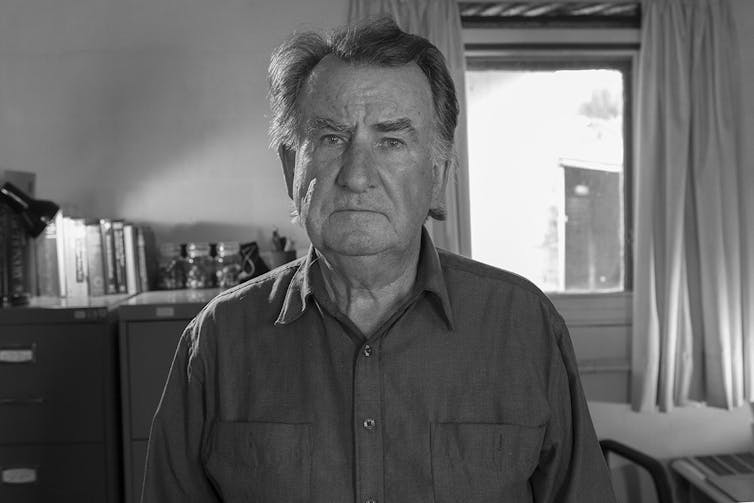
Gerald Murnane has long been recognised as one of Australia’s finest writers.
Ben Denham

Anthony Uhlmann, Western Sydney University

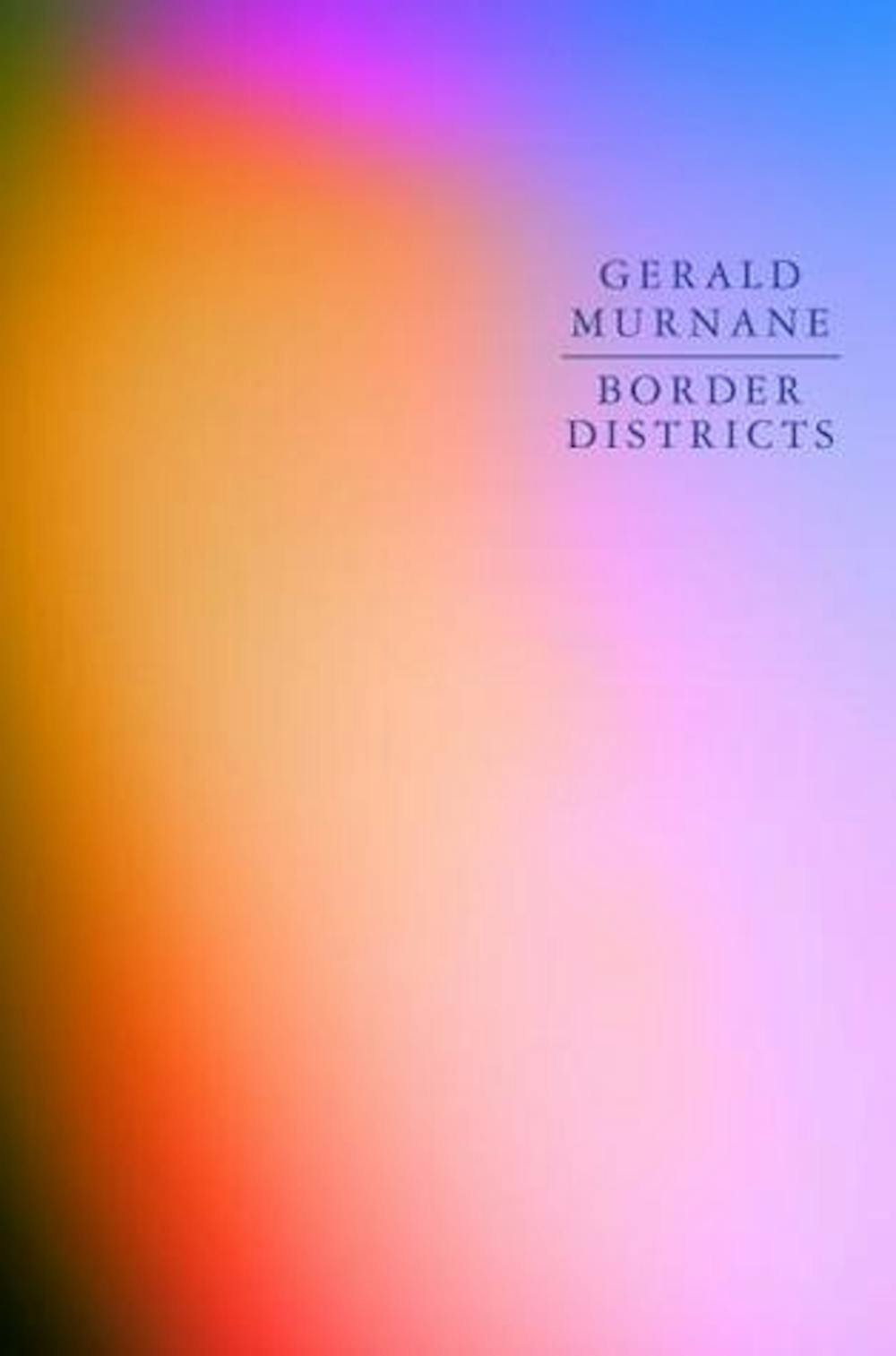
I first came to Border Districts through a brief description of it given to me by Gerald Murnane when I first met him three years ago. I thought he had told me that he did not think it was as complex as another work he wrote around the same time, A Million Windows.

I clearly misunderstood the insight Murnane was offering into this book, which he also claimed would be his last. The more I read and reflect on Border Districts, the more profound and difficult it becomes.

Murnane, who has long been recognised as one of Australia’s finest writers, has also long been neglected. The Prime Minister’s Literary Award is the first major award a book of his has received. The recognition is long overdue and just in time. It shows that there is still a place in Australian life for works of art that challenge us to think; that unapologetically ask us to think about what things, the things we live among and perceive, mean.

The novel is situated within a framing setting much like present day Goroke in the border districts of Victoria and South Australia where Murnane now lives. Within this frame, the narrator moves between scenes of a remembered life, using motifs and images to draw these fragments together.

In Border Districts, the narrator claims that the work he is writing is not a work of fiction; rather it is “a report of actual events and no sort of work of fiction”.

He continues:

As I understand the matter, a writer of fiction reports events that he or she considers imaginary. The reader of fiction considers, or pretends to consider, the events actual. This piece of writing is a report of actual events only, even though many of the reported events may seem to an undiscerning reader fictional.

What comprise actual events, however, are the images that occur within the mind of the writer. In the passage just cited the narrator is imagining what it might be like to be within the mind of a long dead maiden “aunt” or cousin of a friend at whose house he stays when visiting the capital city of his state.

He imagines he might be sleeping in the room she slept in. He knows certain things about her, most tellingly, that she was being courted by a young man who went to fight in world war one and never returned. He pictures her associating images that concern a narrative of a possible life she might have led if her suitor had not died, if she had instead married him and moved with him to a farming district to work for a landowner.

The story he imagines would, in anyone else’s terminology, be called a fictional story, and yet the narrator insists that all of these image-events are actual. The heart of the matter is the feeling of understanding, or meaning, that is given to the reader. The narrator questions whether “feeling” is adequate to this process, and so uses the word “essence”.

Fragments into patterns

The narrator of Border Districts speaks of the images with which meaning is created as fragments that are drawn together as a kaleidoscope draws together its fragments of colour.

The narrator sees his mind as drawing together these fragments into patterns, which then become meaningful to him, and this includes beliefs that once gave his life meaning, which he no longer believes in:

He might have begun to understand that even the images that he claimed no longer to believe in — even these were necessary for his salvation, even if they were not more than evidence of his need for saving imagery.

“Saving imagery” might mean “imagery that relates to salvation” or it might mean “imagery that is preserved”.

While unfashionable to do so, then, Murnane charges fiction with a heavy responsibility and claims immense value for it. Fiction needs to preserve or guard images that give our lives a sense of meaning.The Conversation

Anthony Uhlmann, Director, Writing and Society Research Centre, Western Sydney University

This article is republished from The Conversation under a Creative Commons license. Read the original article.
Unknown's avatar

Children Reading Children’s Classics?


The link below is to an article that questions the ‘need’ for children to read classic children’s books.

For more visit:
https://bookriot.com/2018/11/13/do-we-have-to-read-childrens-classics/

Unknown's avatar

Free Design Tools for Writers


The link below is to an article that takes a look at 5 free design tools for writers.

For more visit:
https://indiereader.com/2018/11/5-free-and-awesome-design-tools-for-writers/

Unknown's avatar

2018 Goldsmiths Prize for Fiction


The links below are to articles reporting on the 2018 Goldsmiths Prize for Fiction, including the shortlist and winner. The chronology of articles runs from top to bottom.

For more visit:
https://www.theguardian.com/books/booksblog/2018/sep/26/novel-senses-of-new-the-2018-goldsmiths-prize-for-fiction-shortlist
https://www.theguardian.com/books/2018/nov/14/robin-robertson-wins-goldsmiths-prize-innovative-fiction-long-take
https://www.gold.ac.uk/goldsmiths-prize/