Unknown's avatar

Sylvia Plath’s new short story was never ‘lost’ – so why is the media saying it was ‘just discovered’?


File 20190124 196244 wsoh70.jpg?ixlib=rb 1.1
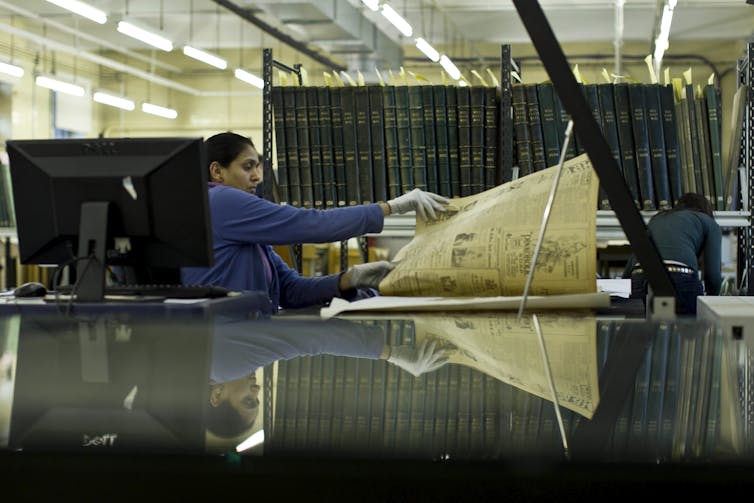
Archivists put an immense amount of work into organizing, digitizing and maintaining repositories.
AP Photo/Matt Dunham

Bethany Anderson, University of Virginia

The recent publication of Sylvia Plath’s short story “Mary Ventura and the Ninth Kingdom” has been met with much fanfare, with the media eager to highlight that the story had been “lost,” only to have recently been “found.”

The Boston Globe described the work as “recently discovered” in its headline. A Vox article evoked a scene of abandonment and deterioration – the story had “languished in her archives for decades.”

And a recent New Yorker article, “A Lost Story by Sylvia Plath Contains the Seeds of the Writer She Would Become,” noted that “not even the author’s estate had known the story existed until the critic and academic Judith Galzer-Raymo stumbled over it while doing research in Plath’s archives.”

But was Plath’s story really “lost”? For years, “Mary Ventura and the Ninth Kingdom” has been preserved – and has been accessible to the public – at Indiana University’s Lilly Library, thanks to the work of archivists and other cultural stewards.

As an archivist, I bristle at this sort of misleading coverage, which is only the latest example of the media ignoring the work of archivists in order to highlight something found in archives as “newly discovered.”

What’s behind this media impulse and why do these mischaracterizations persist?

Archival tropes

I’ve become all too accustomed to seeing headlines about “long-lost” manuscripts that have been found.

For example, in 2012 two articles in The Atlantic debated whether a medical report relating to Abraham Lincoln’s assassination amounted to a “discovery.”

As another example, The Chronicle of Higher Education reported a “long-lost letter” by René Descartes that had “lain buried in the archives [at Haverford College] for more than a century.” The public also recently learned of letters from interned Japanese-Canadians during the Second World War that had been “long-forgotten in the bowels of Library and Archives Canada.” In all these examples, the documents were already preserved and accessible in archival repositories.

And on the rare occasions that archives are featured in the press or in popular culture, they’re usually characterized as old, secluded and dusty places.

For example, in 2013 The New York Times published an article titled “Leaving Cloister of Dusty Offices, Young Archivists Meet Like Minds.”

If the headline alone didn’t convey this sentiment, the text drove it home: The archivists, it read, had “long spent their careers cloistered, like the objects they protected.”

Any archivist reading this story knows that nothing could be further from the truth. In a letter to the editor, Helen W. Samuels, a former archivist at MIT, responded, “While I was delighted that your article focused attention on the talented archivists now employed by so many institutions, I was saddened that it perpetuated the outdated image of archivists as preservers of dusty, precious artifacts maintained in a cloistered environment.”

Innovators versus maintainers

For the record, “dusty” doesn’t characterize any of the repositories I’ve worked in or visited. For example, the Albert and Shirley Small Special Collections Library at the University of Virginia is clean with an open layout, and its spaces are filled with natural light. Similarly, the University of Michigan’s William L. Clements Library spaces do not fit the “dusty” stereotype.

Perhaps the media finds these tropes appealing because they evoke the romance and mystery of unearthing, discovering and rescuing rare books, documents or artifacts, as if they’re hidden treasures. After all, who doesn’t want to feel like Indiana Jones? And by representing archives as dusty, cloistered places, the materials appear to be on the verge of disappearing into obscurity – that is, unless a researcher comes to the rescue.

Another reason these tropes persist could have to do with the way our society privileges innovators over maintainers. Maintainers, according to scholars Andrew Russell and Lee Vinsel, are “those individuals whose work keeps ordinary existence going rather than introducing novel things.”

Archivists are maintainers: They perform the “ordinary” work of acquiring, appraising and arranging archival materials. They respond to the inquiries of students and researchers, and work to preserve materials for posterity.

As members of the archival community have pointed out, this sort of work is generally ignored and misunderstood. Instead, when it comes to stories about archival research, stories will focus on the “innovators” – the scholars who write about the rare manuscript or old letter and, in doing so, rescue these materials from obscurity.

In almost every case, these stories gloss over the fact that these items exist in publicly accessible collections and are described in finding aids and databases.

Giving credit where credit’s due

This is not to take anything away from the work of researchers. Archival research is a process that often involves an intense commitment of time and energy. A researcher can see value or significance in a letter or manuscript that might have otherwise gone unnoticed outside of the archives.
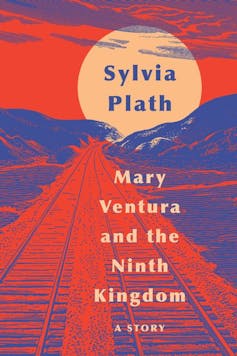
Much of the media coverage of ‘Mary Ventura and the Ninth Kingdom’ describe it as a work that was ‘lost’ and then ‘found.’
Harper Collins

Nonetheless, while a researcher might be the first researcher to read a document, they may not be the first person to have encountered it – not when archivists, curators, librarians and other staff work with materials on a daily basis.

Interestingly, the researcher featured in The New Yorker article about the Plath short story doesn’t appear to have been the first scholar to have “discovered” that “lost” Sylvia Plath story. As Rebecca Baumann, Head of Public Services at the Lilly Library, noted, “Many people have written about [“Mary Ventura and the Ninth Kingdom”] … There’s published scholarship that discusses [it].“

But that doesn’t always make for the best story.The Conversation

Bethany Anderson, University Archivist, University of Virginia

This article is republished from The Conversation under a Creative Commons license. Read the original article.

Unknown's avatar

Tintin: as the eternal youth turns 90, he’s still teaching children about the world


File 20190109 32124 1orf4n0.jpg?ixlib=rb 1.1
Tintin: one of Belgium’s great gifts to the children of the world.
catwalker via Shutterstock

Paul Aleixo, Sheffield Hallam University

For such a perennially young man, always in a hurry to right the world’s wrongs, it may be strange to hear that Tintin has spent nine decades fighting bad guys around the world. From his earliest adventures in January 1929, as he journeyed into the Soviet Union to report on the excesses of Stalinism, the young journalist’s exploits with his friend Captain Haddock have been translated into more than 70 languages and, at last count sold more than 230m copies around the world..

Tintin, the creation of Belgium cartoonist Georges Remi – also known by his pseudonym Hergé (his initials R.G. in reverse) – first appeared in the youth section of the Catholic newspaper Le Vingtième Siècle. Pretty soon, the serialised adventures were published as books (or “albums”) of which Hergé completed 23 by his death in 1983 (a 24th, unfinished, adventure was posthumously published in 1986). There has also been a cartoon series and several movies – the most recent of which, The Secret of the Unicorn (2011), was directed by Steven Spielberg.

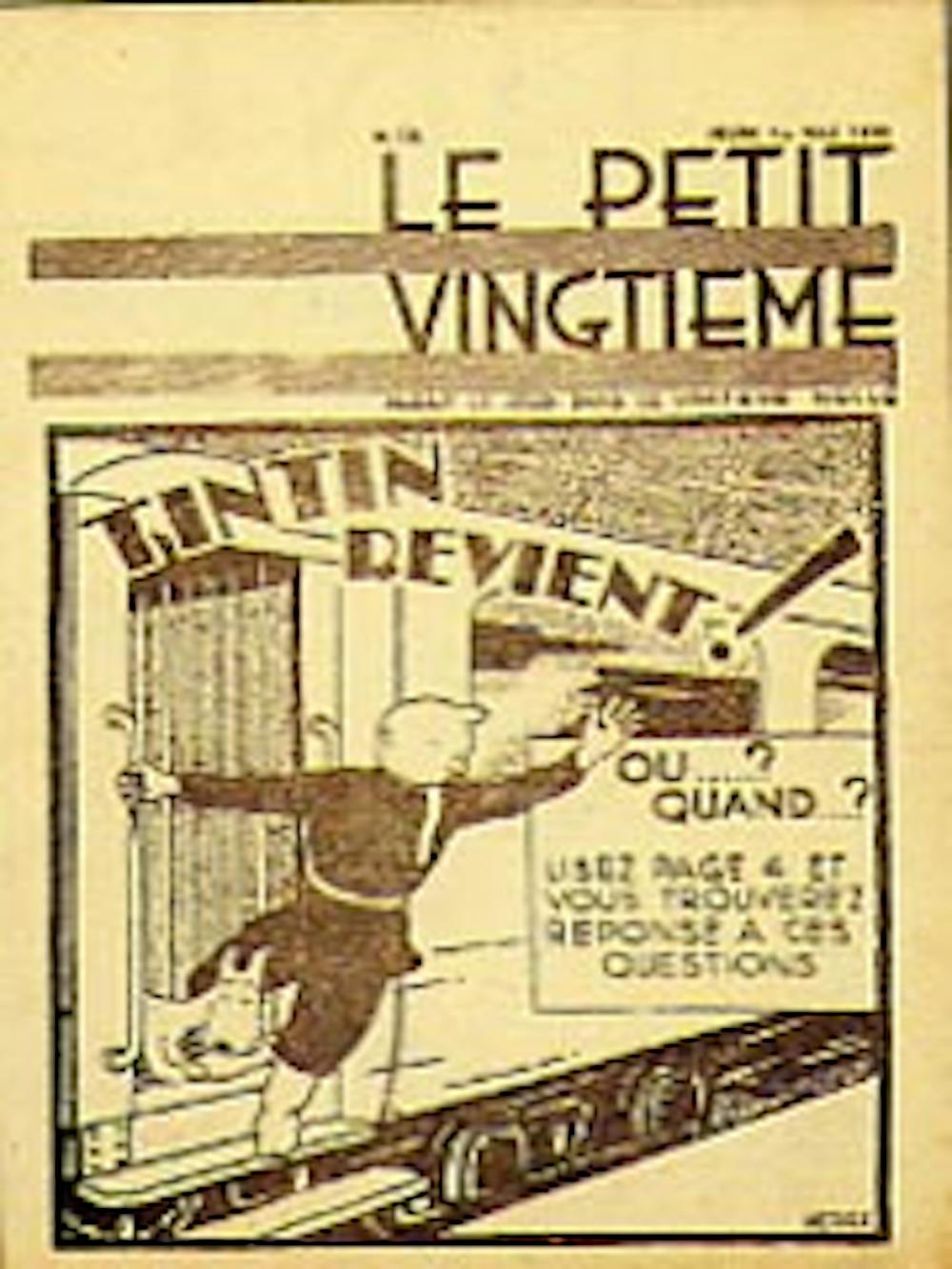
Le Petit Vingtième in May 1930, celebrating Tintin’s safe return from his first adventure in the Soviet Union.
Wikimedia Commons

There are a number of reasons we should celebrate Tintin. From a comic book perspective, Tintin had a number of important firsts: Tintin was the first successful comic book series in Belgium and led directly to the beginning of the comic book industry there. In France, meanwhile, Hergé’s style (known as the ligne claire or “clear line”: (a very clearly drawn style with little shading) was hugely influential on comic book artists. Hergé was an innovator in terms of using word and thought balloons – as far as current research has found, Hergé pioneered their use in Belgium, he also developed and expanded the use of symbols such as “speed lines” (the little lines that denote movement) in comics to give further meaning to his drawings.

However, more generally, The adventures of Tintin are important in an educational sense. I have previously suggested that comics should be encouraged as reading materials in schools because they are a way of getting children reading more generally. Reading comics also helps the development of visual literacy which is becoming increasingly important in modern society.

For these reasons I think it’s really important to encourage children to read Tintin. Tintin has the advantage of being designed for children in the first place – they’ve never been dumbed down and the stories also appeal to many adults. And the storylines themselves encourage a number of positive core values: doing good, supporting the underdog, resisting unfairness and fighting for justice.

Magic, but realistic too

More specifically, The adventures of Tintin also have the advantage of allowing the possibility of more specific learning opportunities. Many of the stories (particularly those produced after World War II) were meticulously researched and include factual knowledge that is likely to be important in the development of a child’s general understanding of the world.

More history than meets the eye.
Hergé Foundation

This includes geographical and cultural knowledge given that Tintin travels to many different parts of the world as well a some more specific historical knowledge about for example, the Japanese invasion of north-eastern China in 1931 which featured in the fifth Tintin adventure, The Blue Lotus (1936).

In terms of history many have claimed that the 24 Tintin adventures are documents of the times in which they were created, reflecting issues in history either directly or in allegorical terms.

Tintin teaches

But if you are still sceptical that anyone might learn anything from comics, let me recount an anecdote from my own personal experience. I was born in Portugal to an English mother and Portuguese father and moved to the UK for secondary school. My mother always encouraged my reading but was a little concerned to see me reading so many comics. Portugal followed the European tradition that comics were a legitimate reading source not just limited to children – and indeed adults could regularly be seen reading in public places such as the bus and the metro.

Family legend describes an interaction between my mother and me where I mentioned some factual nugget of information (alas, history no longer recalls what this fact was, only that it existed) which my mother was surprised I knew. When questioned where I had picked up said nugget, I replied: “It was in a Tintin book.” This proved to be a turning point. She claims that from then on, she had no worries about comics – clearly they were educational. Mum later read them and insists to this day they have helped her with many a pub quiz.

So, for my mother and me at least, Tintin is incredibly important and, I would argue, beneficial for children. But at their heart they are carefully crafted, beautifully illustrated rollicking adventure stories, filled with colourful characters, intrigue, suspense, humour and – above all – good cheer. If you have never read the stories, or it is a while since you have, give them a whirl, I guarantee you will be entertained – and informed.The Conversation

Paul Aleixo, Senior Lecturer in Psychology, Sheffield Hallam University

This article is republished from The Conversation under a Creative Commons license. Read the original article.

Unknown's avatar

Ten ways teacher librarians improve literacy in schools


Margaret Kristin Merga, Edith Cowan University

Australian schools constantly strive to improve the literacy outcomes of their students. Supporting literacy achievement for struggling readers is particularly important because these readers have their disadvantage compounded: capable students develop “richer” skills through continued exposure to reading, and the gap between them and struggling readers widens.

The number of Australian students deemed “low performers” in reading literacy proficiency has been rising over time. Our percentage of high performers is shrinking – nearly one in five adolescents are in the low performer category.


Read more:
Six things you should do when reading with your kids


With school about to start for the year, we should consider how we can optimise support for struggling readers. Young people’s literacy attainment significantly shapes their academic, vocational and social potential. More than seven million adult Australians have their opportunities limited by their literacy level.

Research suggests the presence of qualified library staff in school libraries is associated with better student performance in literacy. But until now, little was known about what specifically they do to achieve this. My new research gives us insight into these key practices.

What do they do?

In 2018, I visited 30 schools in urban and rural sites as part of the Teacher Librarians as Australian Literature Advocates in Schools project. I interviewed teacher librarians to explore a range of questions, including the role they play as literacy educators.

For some children, silent reading time is the only time they have to read.
from http://www.shutterstock.com

There are 40 recurring literacy support strategies used by teacher librarians. But my recent paper focuses on ten strategies that have a particularly strong link to supporting struggling readers:

1. Identification of struggling readers. Teacher librarians support the timely identification of struggling readers through the data they collect on student performance. The sooner struggling readers are identified, the sooner the school can help them.

2. Providing age and skill-appropriate materials for struggling readers. Teacher librarians match students with age-appropriate materials they can manage and topics and genres they prefer. The more a student enjoys and is interested in reading, the more likely they are to keep it up.

3. Teaching students how to choose books they like. Both children in primary and secondary schools have suggested they would read more if it were easier to choose books that appeal to them. Teacher librarians teach students how to do this.

4. Support for students with special needs and readers at risk. For example, Hannah, a teacher librarian, described working with “a young boy who is dyslexic, and I was reading to him and made a dyslexic error, and went back and explained what I’d done and he said, ‘Yeah, I do that, too.’” She then connected him with age and skill-appropriate materials, and he went on to read “an enormous amount”.

5. Matching struggling readers to appropriate books for their skill level. Research suggests when struggling readers have texts matched appropriately with their ability and personal interest, they are more persistent, invested, and use more cognitive skills. Teacher librarians show expertise in making good matches.

6. Promoting access to books. Access to books is positively related to reading motivation, reading skills, reading frequency and positive attitudes toward reading. Teacher librarians make their books accessible. Francesca described regular use of a pop-up library:

We take [it] out into the wilds. And you know, kids will come up and go, ‘oh, what have you got, what have you got.’”

7. Making books and reading socially acceptable. Where young people believe books are socially acceptable, they’re more likely to read and have a positive attitude toward reading. Reading frequency is associated with literacy benefits, so this is ideal. Teacher librarians use a variety of strategies to enhance how books are viewed socially in their schools, including facilitating peer recommendations.

8. Reading to students beyond the early years. Reading aloud offers a range of benefits in the early years and beyond, including an increased enjoyment of reading and increased motivation. Libba described reading aloud to the teenage boys in her classes as a wonderful experience that was very well received. One boy even stated: “that was beautiful”.


Read more:
Research shows the importance of parents reading with children – even after children can read


9. Facilitating silent reading time. Though opportunities for silent reading at school may be limited, for some struggling readers, it’s the only book reading they do. Teacher librarians act as keen advocates for silent reading in their library and more broadly in the school. And something is better than nothing, especially for readers who struggle.

10. Preparing students for high stakes literacy testing. Achievement on high-stakes literacy tests is essential for graduation in Western Australia, a controversial move which has seen graduation rates slide. A similar initiative has been explored but rejected in NSW.

Teacher librarians supported struggling readers to achieve this essential academic goal through a range of initiatives. For example, teacher librarian Stephanie supported students to use practice online testing programs in her library, which gave students the practice they needed to sit both NAPLAN and online literacy and numeracy assessment (OLNA) tests.

Why does this matter?

Teacher librarians in Australian schools are a valuable resource often taken for granted. They have faced significant budgetary cuts in recent times, despite a 2011 government inquiry into school libraries. Teacher librarians noted they play an important educative role in our schools.


Read more:
Six things you can do to get boys reading more


Recent findings suggest teacher librarians’ morale and related sense of job security may be low. If schools and policy-makers wish to improve students’ literacy outcomes, they should invest in school libraries and our dual-qualified teacher librarians.The Conversation

Margaret Kristin Merga, Senior Lecturer in Education, Edith Cowan University

This article is republished from The Conversation under a Creative Commons license. Read the original article.

Unknown's avatar

Stolen By the Nazis


The link below is to an article that takes a look at the stolen books of Europe – stolen by Nazi Germany and sitting in libraries.

For more visit:
https://www.nytimes.com/2019/01/14/arts/nazi-loot-on-library-shelves.html

Unknown's avatar

Celeste Ng


The link below is to an article that takes a look at Celeste Ng.

For more visit:
https://www.nytimes.com/2018/12/20/books/celeste-ng-everything-i-never-told-you-little-fires-everwhere.html

Unknown's avatar

Sally Rooney


The link below is to an article that takes a look at Sally Rooney.

For more visit:
https://www.newyorker.com/magazine/2019/01/07/sally-rooney-gets-in-your-head

Unknown's avatar

Delayed Entrance to the Public Domain


The link below is to an article that considers works entering the public domain in the USA after a 20 year delay.

For more visit:
https://www.theverge.com/2018/12/31/18162933/public-domain-day-2019-the-pilgrim-jacobs-room-charleston-copyright-expiration

Unknown's avatar

The Rising Popularity of Audio Books


The link below is to an article that takes a look at the rising popularity of the audio book.

For more visit:
https://www.theguardian.com/books/2019/jan/01/edoardo-ballerini-narrator-of-133-hour-audiobook-on-his-evolving-art

Unknown's avatar

Entering the Public Domain


The link below is to an article that considers what happens when a work enters the public domain.

For more visit:
https://blog.okfn.org/2012/10/08/do-bad-things-happen-when-works-enter-the-public-domain/

Unknown's avatar

Ma Jian


The link below is to an article that takes a look at dissident Chinese author Ma Jian.

For more visit:
https://www.nytimes.com/2018/12/14/books/ma-jian-china-dream-hong-kong-propaganda-censorship-orwell.html