
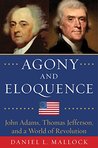
 Agony and Eloquence: John Adams, Thomas Jefferson, and a World of Revolution by Daniel L. Mallock
My rating: 3 of 5 stars


Nathan Hollier, Monash University
There was genuine positivity at this year’s Australian Booksellers’ Association Conference in Melbourne in June. The mood was one of camaraderie and optimism at the sharing of good news. And it only brightened with the news that our National Bookshop Day was to be rebranded this year as Love Your Bookshop Day. Why not?
Saturday is that day. Expect to see your local bookshop buntinged, postered, streamered and perhaps offering special bargains. Assuming, of course, you have a local bookshop.
Store numbers have steadied in recent years and, as was reported at the conference, both independent and chain or franchise booksellers are expanding. Children’s book sales in particular are performing well. (“The bookshop is dead. Long live the bookshop,” reads a plaque at Embiggen Books in Melbourne’s CBD.)
But over the past couple of decades the sector has wrestled with the challenges of superstores, GST, the GFC, one-sided international post deals, ebooks and online-only undercutters.
Now the greatest of these online stores, certainly in terms of market share, will soon be competing with Australian bookstores from a new base here. Amazon has secured a massive distribution centre site near Dandenong in outer-eastern Melbourne. Dire predictions for parts of the Australian retail sector have already been made.
Local booksellers too will need to adjust to this new environment, in which Amazon will likely reduce its delivery time and charges significantly. This will place downward pressure on book prices, and thus booksellers’ margins and capacity to survive.
Amazon has itself experimented with physical bookstores in recent times, to underwhelming reviews, but its primary focus has, of course, been on being able to offer “everything” at the “everyday low prices” of its American precursors (and sometime role models), Walmart and Costco.
Today’s booksellers must choose what to put on their shelves from around 7,000 new releases each month. As all of these will be on the “shelves” of Amazon, local booksellers will need to maintain an intimate knowledge of what will appeal to their customer base.
This curatorial role, which has always been part of what good booksellers do, takes on extra importance in the digital age. Curating, one might say, is the opposite approach to that of Amazon, which instead expertly removes barriers to purchasing, encouraging impulse buying. The extra services local booksellers provide, in addition to low prices and the range of stock, will likely need beefing up also. Community building will be the order of the day.
The current shrinkage of review pages of broadsheet newspapers will also hurt many bookshops, as they depend on a degree of consensus as to what is important and valuable to read.
Price instability may well grow in Australia with the arrival of Amazon. Publishers have argued over the decades that this instability also discourages consumer confidence.
The Productivity Commission doesn’t accept arguments in favour of maintaining price levels for some products in order to keep the costs of others down. But regulatory bodies have special challenges when confronted with large, diverse conglomerates, such as Amazon. It has the capacity to drop prices for products in one category (such as books) to maximise competitiveness, while the overall bottom line is propped up by more profitable parts of the business (such as Amazon Web Services).
In the face of aggressive price cutting from firms like … well, Amazon … regulatory bodies concerned with fair prices for consumers are yet to find an effective means of properly accounting for the fact that its success has been partly based on exploiting publicly developed (and funded) technology and infrastructure, determined strategies of tax minimisation, aggressive use of IP and patent law, and sustained intransigence towards its workforce’s self-organisation and unionisation.

On Tuesday morning this past week, a crowd of parents and kids waited in the cold out the front of our local suburban bookshop till, at 9 o’clock, they could rush in and buy the latest Treehouse book, by Andy Griffiths. The bookseller handed out free copies of a quality cookbook to parents. Community spirit, human connectedness and customer loyalty all bloomed nicely.
As the legendary Collins bookseller, Michael Zifcack, recalled in his memoirs,
“I realised early on that customer service was the secret of successful bookselling.”
I’ll be heading to that local shop on Saturday, but can also, of course, appreciate the access to more or less every available product that online shopping provides. No doubt there is room for both retail models within our society.
What remains most important, when thinking about the health of the book industry here, is that no matter how cheap we make these products, there won’t be effective demand for them unless people have the time and desire to read.
 This desire, in turn, rests most powerfully on the belief that what one knows and says matters; that democracy, its public sphere, and reason, evidence and logic are the driving forces of one’s society. For all of us, that challenge is ongoing and, broadly speaking, we will get the books and bookshops we deserve.
Nathan Hollier, Director, Monash University Publishing, Monash University
This article was originally published on The Conversation. Read the original article.
The link below is to a book review of ‘The Interesting Narrative of the Life of Olaudah Equiano,’ by Olaudah Equiano.

Malavika Binny, Jawaharlal Nehru University
Wearing two hats at once can be an uncomfortable fit, but it does not seem to bother the author Arundhati Roy, who for most of her life has railed against state excesses and corporate exploitation while also wielding the pen.
Maybe she does not think of these two jobs as different, but rather as extensions of each other.
This, at least, is the impression Roy gives her readers in her latest novel, The Ministry of Utmost Happiness (Hamish Hamilton), which came out in early June. Two decades in the making, the book records the story of India as it transpired over those 20 years.
This contemporary history is told and retold by myriad voices: those of hijras, people who identify themselves as belonging to the third gender or as transgender; of a dalit man (of the lowest castes) who pretends to be Muslim; of Kashmiris, of Indian civil servants, cold-blooded killers and puppet journalists; of adivasis (tribal populations) and of artists, of owls and kittens and of a dung beetle named Guih Kyom.

Locales are similarly wide-ranging. Roy takes readers from a graveyard in Old Delhi to civil war-torn Kashmir and to central Indian forests, where Maoist insurgents fight India’s army. Some of the book transpires too in the 18th-century astronomical site, Jantar Mantar, the only place in Delhi where people are allowed to protest.
Those are just a few of the backdrops in this panoramic novel, which touches on the various Indian social movements that have captured global attention in recent years, from the 2011 anti-corruption Anna Hazare protests to the 2016 Una dalit struggle.
Roy uses the internal contradictions of the movements and the locales to mirror her meandering plotlines, which knit all these skeins together into a kaleidoscopic larger narrative.
It’s an uneasy fit, and the book often feels like it is about to burst at the seams. Still, Roy somehow holds it all together, clumsily yet passionately, leaving no one and nothing out.

Both the margins and the marginalised speak in the Ministry of Utmost Happiness, a feat Roy has also sought to achieve with both her activism and her non-fiction work.
The story follows two characters: Anjum, nee Aftab, a hijra who rejects the politically correct term “transgender”, and Tilo, a Delhi-based architect turned graphic designer who kidnaps a baby from Jantar Mantar.
Anjum’s life is a lens onto an alternate duniya, or world, one where hijras live and learn together, cloistered, following their own rules, regulations and hierarchies.
That changes forever when Anjum travels to Gujarat, a western Indian state that is known for its recent history of religious violence between Hindus and Muslims, and witnesses a massacre. Shortly thereafter, Anjum moves to a graveyard in Old Delhi.
As always, Roy’s brilliance shines most in her choice of locales and the imagery they invoke.

In The God of Small Things (1997), the banks of the Meenachil River in southern Kerala served as the space of deviance for the protagonists, where Ammu and Velutha have their escapades and Estha and Rahel get up to mischief.
In The Ministry of Utmost Happiness, the author gives us two contrasting, contradictory settings: a graveyard that becomes a place of life and the verdant Kashmir valley, a space of death and misery.
Anjum starts a guesthouse in the old graveyard, with each room enclosing a grave. Holding feasts for festivals, she invites her friends over to dine regularly at the graveyard-guest house. Later, Tilo moves in permanently with the baby.
The reader understands this resplendent graveyard, which features not just living humans but an impressive stock of animals too, as an ode to tolerating (or, more correctly termed, to accommodating) plurality, a blunt contrast to the truth of modern-day India, with its increasing intolerance towards religious and social differences.
For this, for trying to etch out a semblance of hope, for showing broken things and shattered people coming together to carve out a niche of their own, Roy deserves applause.
//platform.twitter.com/widgets.js
At times all these voices, places and problems escalate into a dissonant cacophony that leaves the reader perplexed, exhausted and grasping at the multiple threads of the plot. But the novel’s brilliance lies in how it captures subtle moments, with attention to detail and sharp compassion.
For instance, the Ustad (master) Kulsoom Bi takes Anjum and the other newly initiated hijra residents to a light and sound show at the Red Fort in Delhi just so they can hear the fleeting but distinct coquettish giggle of a court eunuch. She explains to them that they, the hijras, were not “commoners, but members of the staff of the Royal Palace in the medieval period.”

These nuggets of everyday history and poetry keep readers hooked, gradually lowering us through each of the story’s many layers and offering moments of clarity in an otherwise tangled mesh.
Some have called Roy’s novel a “fascinating mess”, but frankly when one decides to write a shattered story about all things, the narrative(s) is bound to get fuzzy.
The book may be difficult for those who have not been following Roy and her causes in the long years since God of Small Things. But those who get her intellectual moorings and understand her role as a voice of dissent in today’s climate of “saffronisation” – the spread of extreme-right Hindu values across India, a nation veering hazardously towards authoritarianism, know that the author and her work are one.
Roy’s novel, much like her role as a public intellectual, is a reminder that the world we inhabit is a composite one – a duniya of duniyas – where invisible people, their unrepresented struggles and their unacknowledged yearnings have the right to exist.
 The Ministry of Utmost Happiness tells their story, extolling everyone’s right to be heard, even if only fleetingly, in the coquettish giggle of a court eunuch.
Malavika Binny, Researcher, Jawaharlal Nehru University
This article was originally published on The Conversation. Read the original article.

Norma Dunning, University of Alberta
I am Norma Dunning. I am a beneficiary of Nunavut; my ancestral ties lie in the village of Whale Cove. I have never been there. My folks left the North shortly before my birth. I am southern Inuk, born and raised.
I am a writer. I have always been a writer. I would dream of publishing my writing, but it was easier and safer not to. I kept all of it in a drawer. I would think about publishing, and then I would think about the process of publishing. As an Indigenous, female writer I didn’t want to take it. I didn’t want to take the criticism.
I didn’t want to take the reworking of my words into a form that is standard Western format, or into the practices that are expected and accepted within literary work. I know that I do not write in the ways that most non-Indigenous writers do. I didn’t want my work re-colonized.
I have a small reputation of being a poet, and my poetry manuscript is usually rejected twice a year. Over the last seven years, I am often invited to read my poetry at various local events. I am very honoured to have been asked, but I am the poet who shows up without her book of published poems. I am the poet with her work attached to a clipboard. I am surprised that my first published work, Annie Muktuk and Other Stories, is a book of short stories. There’s irony in that.
Writing for me is not a hobby. Writing is a part of my being, a part of daily living. It is for me what breathing is for others. It is physical in that if I am not creating a story or a poem, I do not feel well. I know that of myself. It is spiritual and emotional. Producing the written word is the only place where I can be who I am, without expectations, without criticism and without someone looking over my shoulder telling me that I am wrong.
Inuit peoples do not read and write and ingest culture the way non-Inuit Canadians do. I believe Inuit Canadians do not place a high value on the written word. Instead, we come from a culture with roots that lie within the passing on of stories orally; this is what lies within our blood and genetic memories. When I operate outside of my own circle of family and friends, I operate in a different fashion. It is not compromise. It is survival.
When I was studying for my BA degree, my minor was in creative writing. I have since taken many university creative writing courses and I received two prestigious awards for my efforts through the University of Alberta. Creative thinking is a requirement for my doctoral work, and taking writing courses has helped me. However, the other students in the writing classes were not always supportive. I heard their criticisms every week.
While not every class was good or productive, I was exposed to the writing of non-Inuit poets and writers from long ago. I enjoyed their old works, which were new to me. I thought about how they could spend time running up hill and down dale and always remain writing in their predictable and trained writing format. I cannot write about butterflies or bumblebees. In time, I published the odd poem here and there, but never a story. The stories were mine. It took many years to decide to share them.
Until one winter afternoon, close to Christmas. I was standing in a lineup at a post office. It was a long line, filled with people wanting their packages to exotic places to be stamped “Express!” I held my thick, brown envelope addressed to the University of Alberta Press close to my chest. I thought I could do this another day, but I knew that if I stepped out of the lineup, I would never send that envelope out anywhere. When I was asked if I wanted a rush delivery, I gasped, “No!”
The longer it took for anyone to read my work, the longer I was safe. The longer the characters that I had created could stay only mine. If no one ever read it, I didn’t have to explain who these people were. The longer the envelope took to deliver, the longer my creative world belonged to only me. I didn’t hear back from the press for over a year. I kept telling myself that was OK. Things take time. Inuit are patient.
When I was told that the press accepted my work, I was stunned. Perhaps part of being an Indigenous writer is the expectation of rejection. I did not get what I was used to. I was assigned to my editor, who is a Namibian man, born and raised. He knows colonialism very well. He lives it, like me. The path to publishing became less complicated. I knew one thing; my words were safe with him. He got it.
However, there was one long discussion over the use of a comma or a period. I had written the sounds of two Inuit women throat singing. I had written it without any grammar. I knew how the song sounded in my head, but what I had to think about was a non-Inuit readers’ understanding.
I sang it to myself for 45 minutes. Was it “Oooma” insert period or “Oooma” insert comma? There were emails and phone calls around two simple sentences. I learned to think about how grammar shapes understanding. What if I was a foreigner reading this passage; how would it sound in my head? We worked it through because my editor took the time to build a good working relationship with me. He didn’t dive in and try to make me or my words “right.” He didn’t push for the quick fix that I know all too well. When non-Inuit do that, it is a signal for me to run.
As Aboriginal artists, we inherently analyze the people around us, because we walk inside two worlds. Aboriginal artists do the hard work, the heavy lifting. We put out into the world the truth of Canada’s grand narrative. Aboriginal artists take the whispered secrets and put them onto paper. It is not easy work.
 If my book does any one thing, I hope it brings other Inuit writers to a publisher. I hope other Inuit writers realize that they can do this too. They can put their work out there. They can publish. Be fearless. Stand by your words, and believe that no matter where you stand, you are Inuk.

Norma Dunning, PhD candidate, Department of Educational Policy Studies, Indigenous Peoples Education, University of Alberta
This article was originally published on The Conversation. Read the original article.
 At the BookShelf


You must be logged in to post a comment.