
Unknown's avatar

Millennial bashing in medieval times


File 20170626 29085 1kzq3gv
In Sir Thomas Malory’s ‘Le Morte d’Arthur,’ a character complains that young people are too sexually promiscuous.
The British Library

Eric Weiskott, Boston College

As a millennial and a teacher of millennials, I’m growing weary of think pieces blaming my generation for messing everything up.

The list of ideas, things and industries that millennials have ruined or are presently ruining is very long: cereal, department stores, the dinner date, gambling, gender equality, golf, lunch, marriage, movies, napkins, soap, the suit and weddings. In true millennial fashion, compiling lists like this has already become a meme.

A common thread in these hit pieces is the idea that millennials are lazy, shallow and disruptive. When I think of my friends, many of whom were born in the 1980s, and my undergraduate students, most of whom were born in the 1990s, I see something different. The millennials I know are driven and politically engaged. We came of age after the Iraq War, the Great Recession and the bank bailout – three bipartisan political disasters. These events were formative, to an extent that those who remember the Vietnam War might not realize.

The idea that young people are ruining society is nothing new. I teach medieval English literature, which gives ample opportunity to observe how far back the urge to blame younger generations goes.

The most famous medieval English author, Geoffrey Chaucer, lived and worked in London in the 1380s. His poetry could be deeply critical of the changing times. In the dream vision poem “The House of Fame,” he depicts a massive failure to communicate, a kind of 14th-century Twitter in which truths and falsehoods circulate indiscriminately in a whirling wicker house. The house is – among other things – a representation of medieval London, which was growing in size and political complexity at a then-astounding rate.
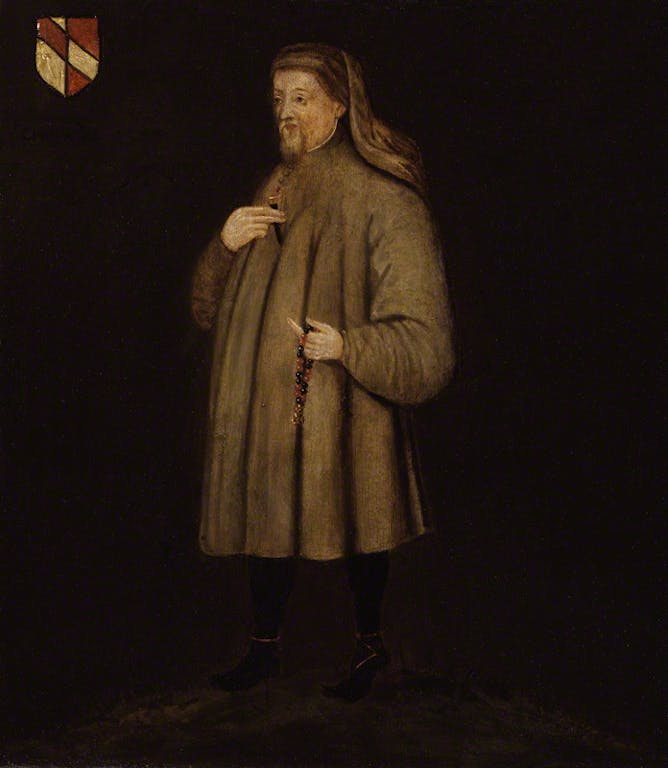
Geoffrey Chaucer.
Wikimedia Commons

In a different poem, “Troilus and Criseyde,” Chaucer worries that future generations will “miscopy” and “mismeter” his poetry because of language change. Millennials might be bankrupting the napkin industry, but Chaucer was concerned that younger readers would ruin language itself.

Winner and Waster,” an English alliterative poem probably composed in the 1350s, expresses similar anxieties. The poet complains that beardless young minstrels who never “put three words together” get praised. No one appreciates old-fashioned storytelling any more. Gone are the days when “there were lords in the land who in their hearts loved / To hear poets of mirth who could invent stories.”

William Langland, the elusive author of “Piers Plowman,” also believed that younger poets weren’t up to snuff. “Piers Plowman” is a psychedelic religious and political poem of the 1370s. At one point, Langland has a personification named Free Will describe the sorry state of contemporary education. Nowadays, says Free Will, the study of grammar confuses children, and there is no one left “who can make fine metered poetry” or “readily interpret what poets made.” Masters of divinity who should know the seven liberal arts inside and out “fail in philosophy,” and Free Will worries that hasty priests will “overleap” the text of the mass.

On a larger scale, people in 14th-century England began worrying that a new bureaucratic class was destroying the idea of truth itself. In his book “A Crisis of Truth,” literary scholar Richard Firth Green argues that the centralization of the English government changed truth from a person-to-person transaction to an objective reality located in documents.

Today we might see this shift as a natural evolution. But literary and legal records from the time reveal the loss of social cohesion felt by everyday people. They could no longer rely on verbal promises. These had to be checked against authoritative written documents. (Chaucer himself was part of the new bureaucracy in his roles as clerk of the king’s works and forester of North Petherton.)

In medieval England, young people were also ruining sex. Late in the 15th century, Thomas Malory compiled the “Morte d’Arthur,” an amalgam of stories about King Arthur and the Round Table. In one tale, Malory complains that young lovers are too quick to jump into bed.

“But the old love was not so,” he writes wistfully.

If these late medieval anxieties seem ridiculous now, it’s only because so much human accomplishment (we flatter ourselves) lies between us and them. Can you imagine the author of “Winner and Waster” wagging a finger at Chaucer, who was born into the next generation? The Middle Ages are misremembered as a dark age of torture and religious fanaticism. But for Chaucer, Langland and their contemporaries, it was the modern future that represented catastrophe.

These 14th- and 15th-century texts hold a lesson for the 21st century. Anxieties about “kids these days” are misguided, not because nothing changes, but because historical change cannot be predicted. Chaucer envisioned a linear decay of language and poetry stretching into the future, and Malory yearned to restore a (make-believe) past of courtly love.

But that’s not how history works. The status quo, for better or worse, is a moving target. What’s unthinkable to one era becomes so ubiquitous it’s invisible in the next.

Millennial bashers are responding to real tectonic shifts in culture. But their response is just a symptom of the changes they claim to diagnose. As millennials achieve more representation in the workforce, in politics and in media, the world will change in ways we can’t anticipate.

The ConversationBy then, there will be new problems and a new generation to take the blame for them.

Eric Weiskott, Assistant Professor of English, Boston College

This article was originally published on The Conversation. Read the original article.

Unknown's avatar

A Fuller Picture on UK Ebook Sales


The link below is to an article that looks a little more on the decline of ebook sales in the United Kingdom, as reported in a post on this Blog yesterday.

For more visit:
http://the-digital-reader.com/2017/04/27/damn-facts-ebook-sales-narrative-must-maintained-costs/

Unknown's avatar

Ebooks in Decline?


Ebooks sales are in decline, or that is what many would have us believe. I don’t know that I believe that at this stage. In all markets, sales go up and down and I think it far too early to call this a trend. None-the-less, the links below are to two articles that look at the decline in ebook sales in the United Kingdom.

For more visit:
https://www.theguardian.com/books/2017/apr/27/screen-fatigue-sees-uk-ebook-sales-plunge-17-as-readers-return-to-print
https://www.theguardian.com/books/2017/apr/27/how-ebooks-lost-their-shine-kindles-look-clunky-unhip-

Unknown's avatar

For the Edwardians, bookplates were as rebellious as modern day tattoos


Image 20170222 1358 1p1q12p
Bookplates held a special place in the heart of the Edwardians.
POP/Flickr

Lauren O’ Hagan, Cardiff University

For countless young people, and even the odd deeply defiant older person, tattoos are the ultimate way to express your identity. The Conversation

Go back just over 100 years, however, and revealing your personality to the world was a very different matter. Though tattoos and intimate piercings were had by people at all levels of society – even King Edward’s son, George V, was said to have had a tattoo during his time in the Royal Navy – the slightly more conservative Edwardians turned to something very different: bookplates.

The small decorative labels used to denote book ownership which date back to the 1500s, became hugely popular across the Western world at start of the 1900s, fading into obscurity just before World War I. But they offer a fascinating insight into the people who used them.

The early 20th Century saw a boom in book publishing: literacy levels were on the rise as were family incomes. Numerous public libraries were also established, along with Workers’ Educational Associations and book clubs. The stories published ranged widely in subject matter: this was the era of PG Wodehouse, HG Wells, JM Barrie, Saki and Rudyard Kipling.

In their time, bookplates were the physical embodiment of their owners, featuring bold, lavish and striking designs. They were seen as a decorative expression of a person’s tastes, temperaments and dispositions.

Edwardian readers were expected to share books from their own library with others, and so very special attention was paid to the plate design, to indicate the type of person that the owner was. While the wealthy were able to afford privately commissioned plates by famous artists, the average Edwardian depended on stationers or booksellers for mass-produced plates, or something from a pattern book. For the bibliophile, choosing a bookplate was a delicate process and the purchase commanded quite a price, varying from £2 to £50 – roughly £220-£5,500 today.

Personalised plates

Like the tattoo trends of the 21st Century, bookplates followed style trends, too. The more conscious would choose a socially acceptable design, aware that they may be judged by family and friends. But there was plenty of room for rebellion.

The bookplate of Sir John Forrest, explorer.
Wikimedia

Each illustration or image used in the bookplate was tied to a particular aspect of the owner’s identity. Popular designs related to social class involved coats of arms, for example, or library interior scenes that showed a replica of the owner’s own reading room. Other common identity markers involved maps of the owner’s birthplace, pictures of the family house, and symbols representing the family surname. Biblical landscapes or local churches were also used to reflect religious beliefs, while images of the owner’s occupation or hobbies were other favoured choices.

However, knowing that the book would enter into the hands of other people, owners often used bookplates to portray themselves as funny and likeable, featuring a caricature of themselves or some other funny sketch. Like the more quirky tattoos of today, their reception would have undoubtedly been subjective.

Bookplates could also tell of the intimacy or distance between a husband and wife. Though it may seem a curious way to display such sentiments, the display of unity shown by the couple using a joint design showed that the two people were together. They could tell of other family changes, too, expressing relationship status – a woman marking a bookplate with her new surname following marriage, for instance – or signalling the birth or death of a family member.

Fantasy and insults

Like the novels of the time, the Edwardians also portrayed utopian images of faraway places or exotic landscapes in their personalised plates. These locations were often taken directly from fairy tales or other popular fantasy lands of the era, such as Atlantis and Avalon. These were often accompanied by Chinese or Latin philosophical quotes; for example, resurgam (“I shall rise again”), fac et spera (“Do and hope”) and pro patria (“For the fatherland”).

Pegasus flies through the night sky on this plate from 1904.
Wikimedia

There was a more serious side to bookplates, too. Many designs were intended to make a statement, through striking images or more direct text. This could be political, pledging allegiance to a particular party, religion, or something more personal, relating to family members or friends. One man openly used his bookplate to “name and shame” a friend who ruined his books when helping to move them to his new house. Whatever the context, the declarations were made to shock and surprise.

The Edwardians came out of an era of inequality and poverty, and into a time where imaginations were allowed to soar. And yet, this was still the early 1900s, where social life was much more reserved than it is today. It might not seem like the most rebellious way to express one’s identity now, but then it truly could have been.

Lauren O’ Hagan, PhD Student in Language and Communication, Cardiff University

This article was originally published on The Conversation. Read the original article.

Unknown's avatar

Fiction by Northern Irish women is booming – leading the way against misogyny


Caroline Magennis, University of Salford

Arlene Foster, the first minister of Northern Ireland, faced calls to resign over the “RHI scandal”, a renewable energy incentive scheme which failed. Allegations of mismanagement cost the public purse almost £500m. Foster labelled the pressure for her resignation “misogynistic” and suggested that a man in a similar position might not face such opprobrium.

Doubtless, much of the language aimed at female politicians has a deeply sexist dimension, but writers were quick to point out in the New Statesman, The Belfast Telegraph and The Irish News that Foster’s own Democratic Unionist Party has an ingrained culture that fosters inequality.

There is an acute lack of female voices in Northern Irish politics, undoubtedly a legacy of decades of militarised conflict, that has left the region with the lowest amount of women of the devolved parliaments. Of the 18 MPs for the region, only two are female. But the recent appointments of Michelle O’Neill (Sinn Féin) and Naomi Long (Alliance) to lead their respective parties suggest things might be slowly, gradually beginning to change.

Short stories new and old

This lack of political representation is mirrored in the arts where, for years, women were anthologised and written about as exceptional cases in a literature that was overwhelmingly concerned with literary responses to violent events. In her pivotal work, The Living Stream (1994), Edna Longley detailed the distinctly male atmosphere that hangs over Irish literary coteries. But, as with the political changes noted, women’s voices are increasingly being heard in this sphere, too.

Generations of female novelists have written about Northern Ireland since its inception but have been largely ignored. This writing spans genres and all shades of political opinion since the 1920s, and has offered glimpses into lives that rarely make the evening news. Janet McNeill wrote a number of significant novels in the 1960s which capture this “in-between” period with a sharp, sympathetic eye for the dissatisfaction of some women with home and hearth. The reissuing of her novels The Small Widow, As Strangers Here and The Maiden Dinosaur show a continue appetite for and relevance of her novels.

But despite this history, 2016 was a landmark year for Northern Irish women’s fiction – short fiction, in particular. It saw the digital reissue of the vital anthology The Female Line (1985) and the publication of Sinéad Gleeson’s award-winning collection The Glass Shore, which features both classic stories and newly commissioned work from some of the north’s most vital writers. 2016 also saw new collections of stories from Lucy Caldwell (Multitudes), Jan Carson (Children’s Children) and Roisin O’Donnell (Wild Quiet).

Fictional responses

Northern Irish fiction has often been criticised for relying on realism and not being as formally experimental as its United Kingdom or US counterparts. But recently, women have been leading the way in offering depictions of Northern Ireland that are ripe for critical speculation.

The work of Jan Carson, in particular, is marked by a playful, experimental sensibility as her writing plays with the possibilities of the short story genre. Her strange, deft prose is a much-needed counterpoint to the wealth of weighty Troubles tones. An equal tonic is Roisin O’Donnell’s magical work, which spans continents and species to continually surprise and delight. Bernie McGill’s sensual, visceral writing brings the body back into Northern Irish writing in her painful, beautiful writing.

And Lucy Caldwell has never been afraid to write about complicated topics, such as the Troubles and mental health (Where They Were Missed, 2006), missionary work and sexuality in the Middle East (The Meeting Point, 2011) and double lives (All the Beggars Riding, 2013). Her recent short fiction has seen this impulse continue, as she directly confronts the taboos of “post”-conflict Northern Irish society, such as racism, abortion and homosexuality.

Northern Irish women’s voices have been largely overlooked by critics and readers in favour of novels and short stories which centred male experiences of being perpetrators and victims of violence. But the new political moment has cleared space for new fictional representations.

Looking forward

Looking to the future, there are several exciting works for 2017. Following her heart-wrenching debut, Ghost Moth (2013), Michele Forbes will publish Edith and Oliver in March 2017. And the scapel-like wit of June Caldwell can be revisited in Room Little Darker, published later this year. We await new work from the women featured in The Glass Shore across genres and forms.

If all you know of Northern Ireland is the turmoil of political institutions, you could do worse than to pick up some of this fiction. For decades, Northern Irish women have been writing about their lives with bravery and skill but they have also been imagining different worlds and stretching their imaginations in the most trying of circumstances. To see these generations of women continue to resist established ways of writing and thinking has been galvanising as we seek to find stories outside of the standard narratives of truth and recovery.

This writing does not simply conform to the Troubles narrative so often replicated in fiction and film. Rather, it challenges it, sometimes directly, but often in subtle, wry acts of fictional insubordination.

The Conversation

Caroline Magennis, Lecturer in 20th and 21st Century Literature, University of Salford

This article was originally published on The Conversation. Read the original article.

Unknown's avatar

Seven academic books that helped to shape modern Britain


Diarmaid MacCulloch, University of Oxford; Ian Kershaw, University of Sheffield; Richard English, Queen’s University Belfast; Ruth Lister, Loughborough University; Simon Frith, University of Edinburgh, and Veronika Fikfak, University of Cambridge

To celebrate the diversity, innovation and influence of academic books over the course of modern history, seven specialists share the book they believe has been most influential on modern British culture and society, as part of Academic Book Week.

1. The Law of the Constitution, by A.V Dicey

Veronika Fikfak, lecturer and fellow in law, University of Cambridge

It is a measure of A.V.Dicey’s influence that more than 132 years after the first publication, the relevance of his writing is at the core of the UK’s departure from the European Union.

While students and scholars have read Dicey for more than a century as a basic constitutional text, the general public will have become familiar with his arguments on parliamentary sovereignty and the primacy of parliament only recently – with Gina Miller, the lead claimant in the legal fight to get parliament to vote on whether the UK can start the process of leaving the EU.

Dicey argued that the British parliament is an “absolutely sovereign legislature” and had the “right to make or unmake any law”. His legacy in the UK constitutional sphere is unrivalled, and to this day he is referred to as “the great constitutional lawyer”, whose writings have not only shaped the constitutional landscape of the UK until now but are also very likely to decide our future.

2. The Uses of Literacy: Aspects of Working-Class Life, by Richard Hoggart

Simon Frith, Tovey professor of music, University of Edinburgh

When it was first published in 1957, Richard Hoggart’s book made sense of the upheavals in post-war ways of life by referring back to working-class culture – and Hoggart’s own childhood – in pre-war Britain.

What is clear now though, is how important the book became for our understanding of what came next: consumer culture. The book was both a founding text for the academic fields of media and cultural studies, and an inspiration for a new generation of novelists, dramatists and film makers – not least for the team behind Coronation Street, launched in 1960.

3. Modern Ireland 1600-1972, by Roy Foster

Richard English, professor of politics, Queen’s University Belfast

At a difficult point in Anglo-Irish politics, this book brought to a very wide audience the insights of the latest and most important academic scholarship on Ireland. And it considered “Irishness” in terms of a layered and inclusive sense of identities which was then less widely accepted than it has subsequently become.

As the Northern Irish Troubles began to be transformed into a much more benign peace process, and as relations between the Republic of Ireland and the UK continue to be shaped in ways that are significant for both islands, this book heralded a more inclusive and subtle interpretation of how properly to understand Ireland. Indirectly, it made it possible to know a fuller reality of British experience too.

4. The Invention of Tradition, by Eric Hobsbawm and Terence Ranger

Diarmaid MacCulloch, professor of the history of the church, University of Oxford

As the UK began to come to terms with its retreat from imperial narcissism, Eric Hobsbawm and Terence Ranger’s book was a dose of common sense. These essays edited in 1983 concentrate on the creation of the UK and its empire, and nationalist reactions against those developments. It is still just as relevant now as it was when it was published, posing many questions for the understanding of our history.

5. The English and their History, by Robert Tombs

Ian Kershaw, emeritus professor of modern history, University of Sheffield

As its title suggests, Robert Tombs’ magnificent book published in 2014 focuses on English, not British, history. However, England’s history was – long before the union with Scotland in 1707 – deeply entwined with that of Wales, Scotland and Ireland. Tombs’ book not only incorporates these interrelationships but is greatly enlightening about them. It is a book that cannot be ignored by anyone wishing to know more about the history of the isles.

6. Poverty in the United Kingdom, by Peter Townsend

Ruth Lister, emeritus professor of social policy, Loughborough University

Published in 1979, this is a monumental work, which helped modern Britain better to understand itself. Not only did it provide the most comprehensive in-depth picture of what modern poverty means for those affected, it also represented a milestone in developing our understanding of poverty.

Its opening words provided a relative definition of poverty, rooted in a concept of relative deprivation, which still resonates nearly 40 years later and which has influenced subsequent research and policy. As predicted at the time, it ranks as the modern day successor to the classic works of Charles Booth and Seebohm Rowntree.

7. The General Theory of Employment, Interest and Money, by John Maynard Keynes

John Kay, supernumerary fellow in economics, University of Oxford

In a letter to George Bernard Shaw, Keynes wrote: “I believe myself to be writing a book on economic theory, which will largely revolutionise … the way the world thinks about economic problems.” The author’s assessment of its impact was correct. The analysis of the book was the dominant influence on macroeconomic policies in the 30 years that followed World War II, and we still debate, and employ, Keynesian policies today.

The Conversation

Diarmaid MacCulloch, Professor of the History of the Church, University of Oxford; Ian Kershaw, Emeritus Professor of Modern History, University of Sheffield; Richard English, Professor of Politics, Queen’s University Belfast; Ruth Lister, Emeritus Professor of Social Policy, Loughborough University; Simon Frith, Tovey Chair of Music, University of Edinburgh, and Veronika Fikfak, Lecturer in Law, University of Cambridge

This article was originally published on The Conversation. Read the original article.

Unknown's avatar

Top Ten Books on the British in India


The link below is to an article that lists what it believes to be the top ten books on the British in India.

For more visit:
http://www.theguardian.com/books/2015/apr/15/top-10-books-about-the-british-in-india

Unknown's avatar

United Kingdom: Rare Shakespeare First Folio Returned


Unknown's avatar

United Kingdom: Print Book Sales Fall


The link below is to an article that looks at falling book sales in the United Kingdom – no surprise there I wouldn’t have thought.

For more visit:
http://www.theguardian.com/books/2015/jan/13/sales-printed-books-fell-150m–five-years

Unknown's avatar

United Kingdom: Book Publishing Crisis Leads to Closures


The link below is to an article that reports on the closure of some 98 book publishers in the United Kingdom in the last 12 months.

For more visit:
http://www.theguardian.com/books/2013/nov/04/ebooks-discounts-98-publishers-closure