As readers and followers of this Blog will know, I have been an avid reader of the Patrick O’Brian novels in the Aubrey/Maturin series. So when I came across this article concerning the unknown poetry of Patrick O’Brian it caught my attention. Next year, probably in March 2019, this collection of Patrick O’Brian poetry will be published as ‘The Uncertain Land and Other Poems.’
Culturally, poetry is used in varied ways. Haikus, for example, juxtapose images of the everyday, while lyric poetry expresses the personal and emotional. Similarly, poets themselves come in a range of guises. Think of the Romantic poet engaging with the sublime, the penniless artist in their garret, the high-brow don, the bard, the soldier on the frontline, the spoken word performer, the National Poet, the Poet Laureate or the Makar.
As an educator I sometimes encounter a fear of poetry in new students who have previously been put off by former teachers. Such teachers are, perhaps, intimidated by verse themselves, presenting it as a kind of algebra with an answer to be uncovered through some obscure metric code. This fear disperses, however, when students are given the confidence to interpret and engage with poetry on their own terms.
In creative writing classes we often talk about students needing to “find their own voice” and the best poems I read are written in the writers’ own particular voice, rather than in some inhabited “poetic” register. This is because poetry, for the writer and the reader, is about relevance.
Poetry is as relevant now as ever, whether you are a regular reader of it or not. Though chances are, at some point in your life, you will reach out to poetry. People look to poems, most often, at times of change. These can be happy or sad times, like birthdays, funerals or weddings. Poetry can provide clear expression of emotion at moments that are overwhelming and burdensome.
Markers of change
Poetry is also used to mark periods of change which are often celebrated through public events. In these instances the reading and writing of poetry can be transformative. At Remembrance Sunday, for example, verse is used to reflect upon and process the harsh realities of loss, as well as commemorate the military service of those who have passed.
In the wake of the shocking Manchester Arena bombing, Tony Walsh’s This is the Place gave the city a voice that was unifying, defiant and inspiring. It was important that Walsh is a Mancunian himself, just as David Jones fought in the trenches and at Mametz Wood which gives his In Parenthesis the weight of experience, while Holly McNish’s written experience in her book Nobody Told Me rings with the truth of a mother.
The communication of personal experiences like these in poetry, using direct and immediate terms, came to the fore with the early confessional poetry movement through poets like Robert Lowell, Anne Sexton and Sylvia Plath. Their use of the personal and private as the basis for their poems was once considered shocking but is now an embedded part of the contemporary poetry world.
That is not to say that poetry can only communicate direct experiences, however. Some poems are spaces in which broad questions are grappled with and answers sought. For example, in Shakespeare’s The Tempest we are told death is a transformation rather than an end:
Poetry is also used to explore the potential for change in the future, carrying with it the fears or hopes of the poet. Take Interim by Lola Ridge for example, a poem which holds particular relevance at this time. Ridge was a prominent activist and an advocate of the working classes. In Interim, change is yet to happen. We encounter the moment before change, the build up to change, the pause to take stock, consider and prepare for what is next. In it she anticipates a future movement or event. At a time of political uncertainty, as Brexit is being wrangled with, when opinions on all sides appear fragmented rather than unified, I find Ridge’s words a particular comfort. She describes the world as:
A great bird resting in its flight
Between the alleys of the stars.
This idea of the resting world is powerful. The world is waiting for its inhabitants to come to order perhaps, or to evolve even, before moving on to who knows where. But that is just me and my interpretation. Another reader will disagree and that is one of the most satisfying things about reading poetry. Your interpretation is yours alone and it can change the way you think or feel about something. It can help in times of challenge and it can bolster in periods of unease.
Today, poetry has never been more immediately accessible. With websites like The Poetry Archive and The Poetry Foundation one can summon a poem in the palm of one’s hand. Whether you are a regular reader of poetry or person who encounters it only at moments of change, there is no denying the ongoing relevance and power of it.
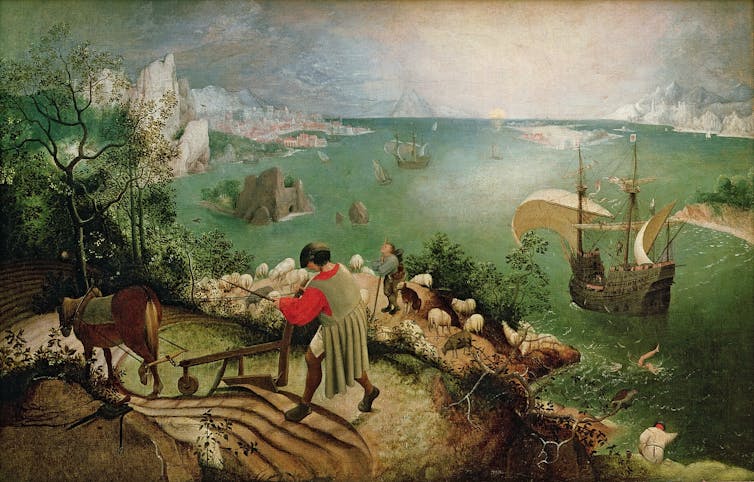
Landscape with the Fall of Icarus, attributed to Pieter Bruegel the Elder, c. 1555. Rosemary Dobson addressed the painting in her poem Painter of Antwerp. Wikimedia
In the first century BCE the Roman poet Horace proposed that, “A poem is like a picture”, meaning that, like painting, poetry engages in mimesis by imitating life, copying it in a fixed medium. But what happens when art imitates art, as in Australian poet Rosemary Dobson’s poem, For the Painter Ben Nicholson, about the work of the British modernist?
Finding and learning
the inner essence,
making and showing
by signs and symbols
that a tree like a glass
contains its tree-ness
and frost is white
on the rim of darkness.
Even more ancient than Horace is the concept of ekphrasis, the poetic description of a work of visual art: painting, sculpture, architecture. In other words, ekphrasis is a kind of translation of one art form into another. Dobson’s poem is a meditation on how a picture can reveal more by suggesting what’s not there – at least to the physical eye – as much as what is.
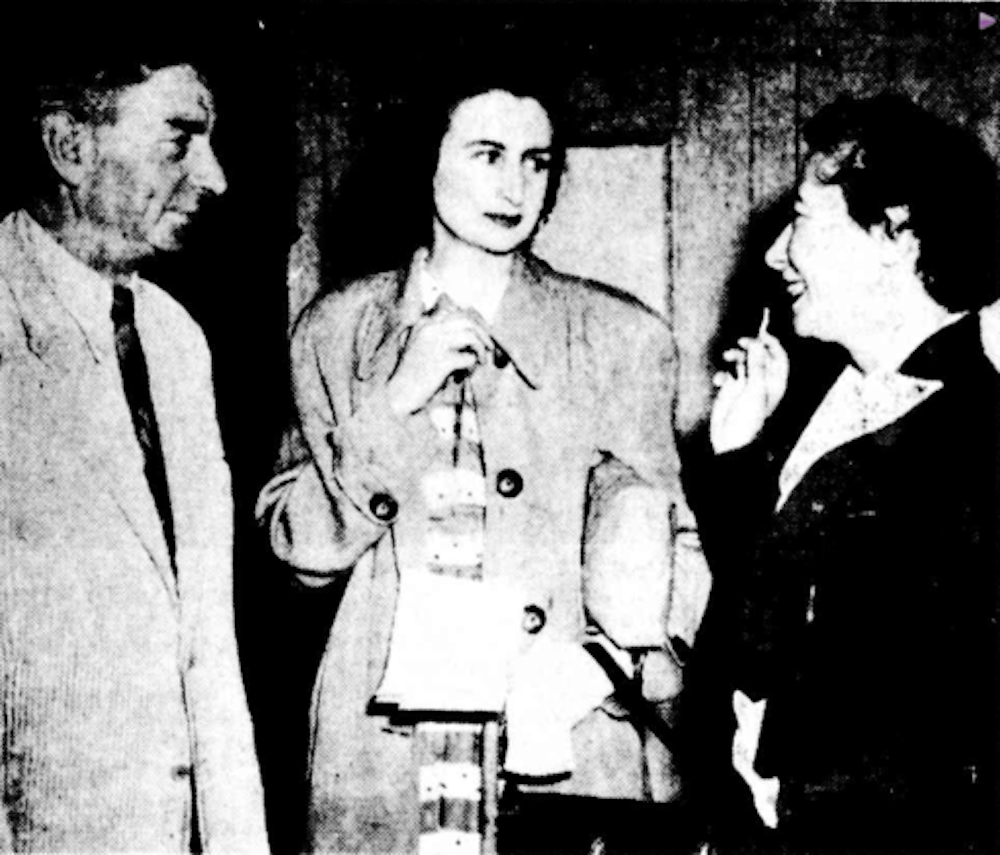
The poet Rosemary Dobson (centre) in 1953. Wikimedia
Across her long career, Dobson was celebrated as a poet who could take the reader beyond the immediate image to another insight. From early on her skill with traditional forms was balanced by a willingness to loosen them in more conversational ways, so she responded better than some of her postwar peers to the cultural shifts of the 1960s and beyond.
At Frensham School in Mittagaong, NSW, where her widowed mother was employed as a house mistress, Dobson’s interest in both poetry and art was actively encouraged. Later, while a non-degree English student at Sydney University, Dobson also studied painting with the artist Thea Proctor.
During the 1940s she worked in the editorial department of the publisher Angus & Robertson, where she met her husband Alec Bolton. Bolton would set up Brindabella Press in 1972 to print fine editions of poems, often including Dobson’s illustrations.
Dobson was fascinated by the ways in which poetry and the visual arts might speak to each other, and late in life described how learning visual design helped her write her poems:
I mean that as one strives for balance of light and shade, weight and airiness in painting, so one can use words and phrases to the same effect in writing poetry.
‘The Arnolfini Portrait’, Jan van Eyck, 1434. Wikimedia
The title poem of her earliest collection, In a Convex Mirror (1944) seems to be inspired by Jan van Eyck’s Arnolfini Portrait (1434), and addresses a poignant irony about all representation: that art, in order to capture life, must inevitably still its pulse:
Shall we be fixed within the frame,
This breathing light to clear-cold glass
Until our images are selves
And words to wiser silence pass?
A painting may preserve the moment, offering a “wiser silence”, but it can’t account for the ravages of time that will inevitably “rive the two of us apart”.
Dobson’s many poems about European paintings are among the finest modern experiments in the ekphrastic mode. Painter of Antwerp evokes Pieter Brueghel’s Landscape with the Fall of Icarus (c. 1555), a work also treated by W.H. Auden and William Carlos Williams.
Dobson reads the painting from the artist’s earthy Flemish point-of-view as he returns north, bemused rather than impressed by the glories of the Italian Renaissance, as symbolised by the classical figure of Icarus fallen from the sky, a minor detail in the picture:
At the top of the Alps he paused perhaps, looked backwards,
Rejecting the fanciful, and took for a painting
Ploughman, fisherman, and moon-faced shepherd,
The furrow cut cleanly, the sheep contented;
Put thumb to nose with neither pride nor envy
At soaring wings – a Southerner’s invention –
Icarus sprawling, two feet out of the sea.
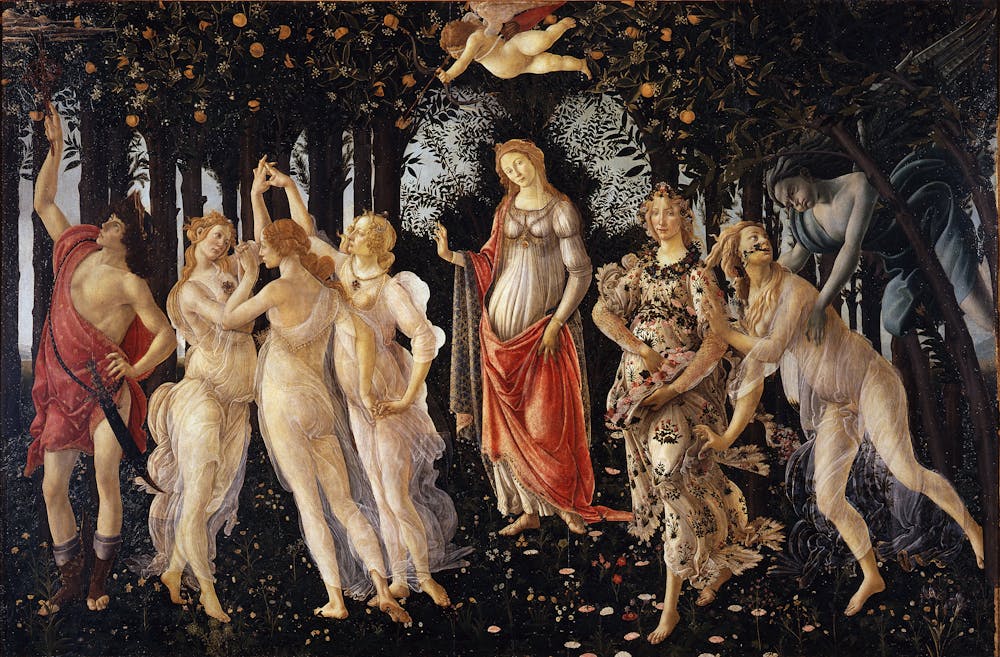
In contrast, the classical world is welcomed in Landscape in Italy, which expresses wonder at the way a painting – here Botticelli’s Primavera (1477-1482) – can re-enchant the everyday world:
One can overemphasise Dobson’s poems about paintings at the expense of the variety of her achievement, along with its distinctly Australian elements. A major reason she gave for writing so little while in England with her husband and family in 1966-71 was: “one needs to write where one’s roots are. Away from one’s country one is taking in rather than giving out”.
During this time her work became more immediately personal – it was an era for “confessional” poetry – and, by becoming so, more elegiac, more concerned with the passing of time and with loss.
The landscape of Dry River offers an “objective correlative”, to use T.S. Eliot’s term, for state of the poet’s mind. Though in a freer form, note the emphasis on dactyls (a poetic foot that starts with one stressed syllable followed by two unstressed), creating a falling cadence:
It was my river. My spirit’s destination.
Abstract of water, a dried depression,
Holed and bouldered and raked with fissures
Where the idea of water channelled
Irresistibly over and under
Endlessly forcing down to the sea.
The poems of Dobson’s middle-age are often more explicitly concerned with women’s experience. In Cock Crow, the responsibility of being a writer, of “Wanting to be myself, alone”, conflicts with the responsibilities owing to “One life behind and one before”, her mother and daughter, whose sleeping forms are unaware that she has fled the house. But morning brings the sound of the crowing cock, that biblical symbol of betrayal, and the poet returns, “Thinking I knew his meaning well”.
In later life, Dobson collaborated with fellow poet David Campbell to produce translations – what they called “imitations” – of the work of several 20th-century Russian poets, which were published alongside more literal renderings of the same poems.
As poet Simon West has remarked, such an exercise is both rare, and rarely celebrated, in a “largely monolingual” literary culture such as ours. But in a way Dobson’s contributions are also like her ekphrastic poems: renderings of the original work in another medium; here, another language.
Poet James McAuley described Dobson’s work as “pellucid”: a highly appropriate word for a poet so invested in painting, which depends on light. But McAuley was also referring to a translucent quality in Dobson, what he called “a meaning within the meaning, or haunting the meaning, a feeling that what the poem says or does is only a way of conveying something else which is ineffable”.
The last of a series of short elegies to David Campbell, The Continuance of Poetry, offers an example, showing as well the influence of Chinese poetry:
Not being able to find the hermit he wanted to visit
Li Po looked deeper into the landscape.
Like Li Po we lean against a pine-tree;
And looking into the landscape find your poems.
For Dobson, in translating the world for us, art necessarily bears the trace of the translator.
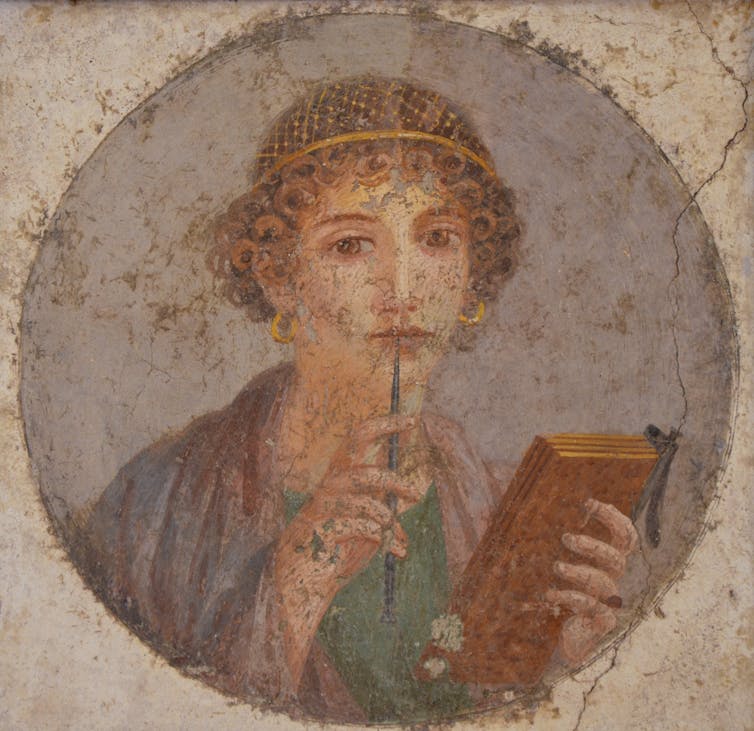
For those who have read the fragmented remains of the Greek poet, Sappho the loss of most of her poetic corpus is something to regret. With a mere two complete poems extant from nine books of verse, much is left to the imagination in the reconstruction of the output (and life) of this most mysterious of ancient poets.
In a world dominated by male voices whose view of life, the universe and everything was the loudest and most respected, Sappho’s songs were regarded as extraordinary. So revered was she that the ancients called her the Tenth Muse, and her songs were passed down over centuries, inspiring generations of poets, none of whom managed to replicate her command of metre and sensual artistry.
How Sappho managed to acquire the educational acumen to compose her masterpieces has sometimes baffled both ancient and modern scholars. Women lived quiet and controlled lives in ancient Mediterranean cultures with limited, if any, access to formal education. If there were any perceived need to teach a girl basic skills in reading, writing and arithmetic, it was only to equip her to run a household once she was married-off.
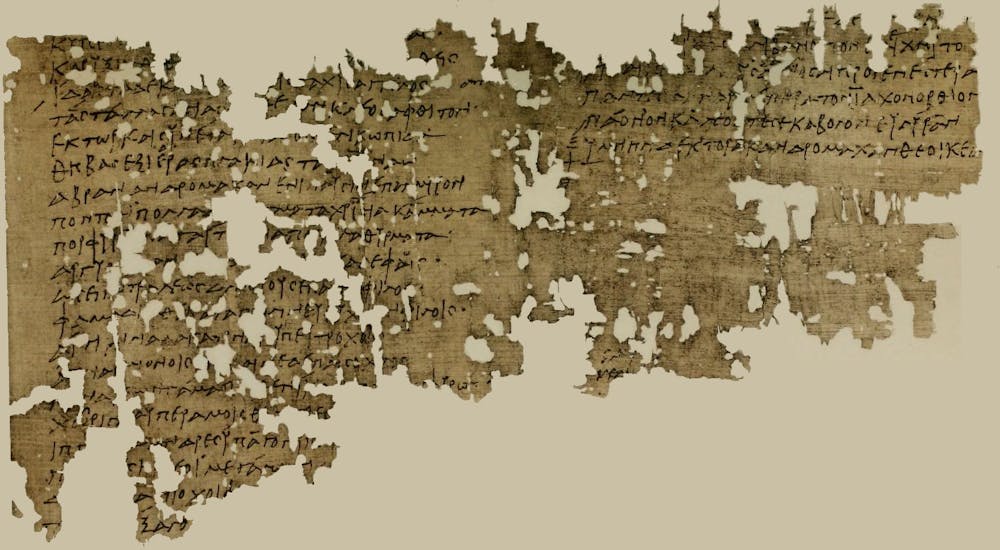
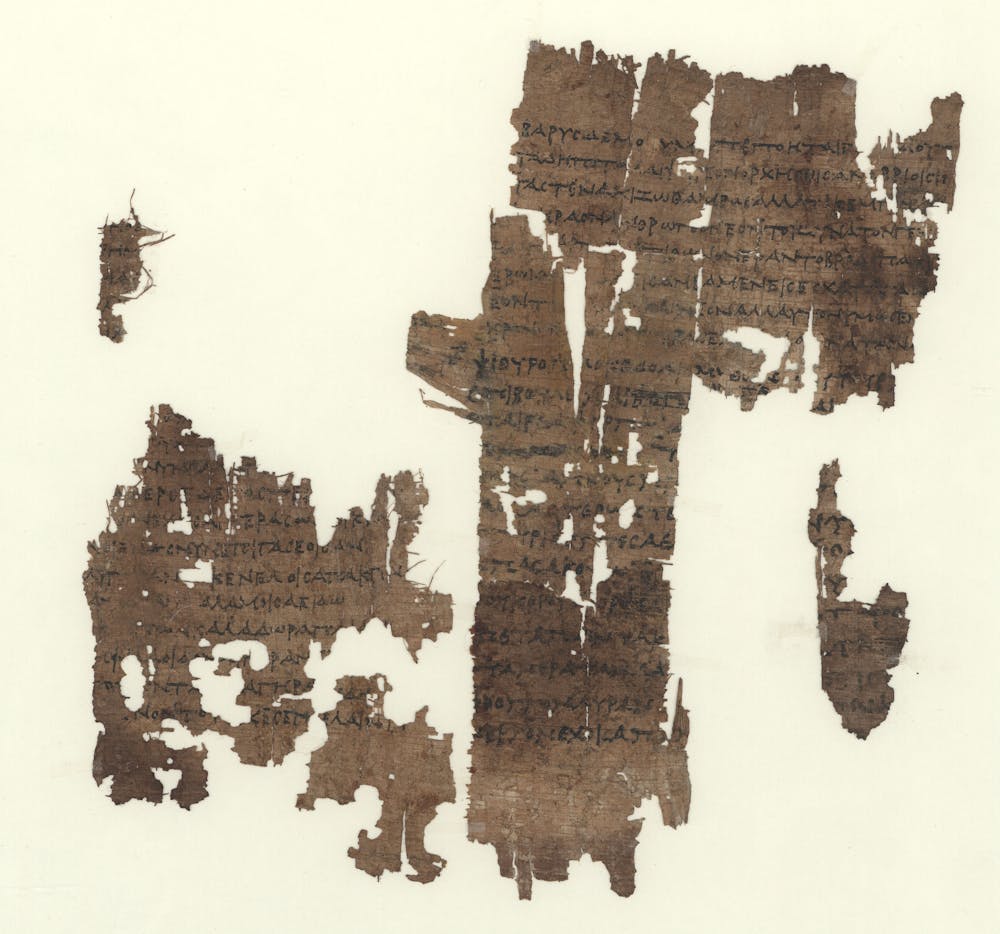
Fragment of a Sappho poem, The Oxyrhynchus Papyri: Part X. Wikimedia Commons
Even if a girl demonstrated extraordinary artistic skills, there was usually no avenue to express them, as the aspirations of women were limited to marriage and motherhood. Females who displayed a talent were normally suppressed and regarded with suspicion. Why? Because men were the artists, intellects and leaders. Ergo, for a woman to possess such qualities meant she also possessed a masculinity that set her apart from nature.
So, where did Sappho come from? What strange land or culture gave her birth and permitted her extraordinary skills to flourish? While we know little that is certain of her life, we do know Sappho was born in the city of Mytilene on the Greek island of Lesbos, off the coast of Turkey in the late 7th Century BC. Mytilene appears to have been an enlightened society compared to other communities in Archaic Greece. Sappho’s works clearly indicate that women – at least from her privileged social standing – had access to a formal education that included training in choral composition, musical accomplishment and performance.
Her estimated birth date places her sometime after the composition and transmission of the works of the Homeric poets, which told the stories of the Trojan War and are preserved in the epics known as the Iliad and the Odyssey.
But Sappho was no epic poet, rather she composed lyrics: short, sweet verses on a variety of topics from hymns to the gods, marriage songs, and mini-tales of myth and legend. She also sung of desire, passion and love – mostly directed towards women – for which she is best known. And it is for such poems that Sappho has come down to us as history’s first lesbian.
Was Sappho a lesbian? An answer depends on how one is defined. If love of women, even in a non-sexual sense, and an exclusive focus on the needs and lives of women define a woman as a lesbian, then – yes – Sappho was a lesbian. However, if a lesbian is defined more narrowly as a woman who has sex with another woman, then evidence to define Sappho as one is harder to establish.
Of course, these two binaries are inherently artificial and without nuance. They are also ignorant of social constructionism, which insists on understanding an individual in her or his historical environment, its values, and its cultural specificities. And, in the society of Archaic Mytilene, Sappho was not defined as a lesbian. After all, the word “lesbian” was not invented until the Victorian age.
Sappho’s contemporaries were not responsible for her synonymy with women-loving. That began with the Greeks and Romans of later centuries, who tended to interpret her skill as stemming from a perverted form of masculinity, which sometimes found expression in representations of her through the lens of a hyper-sexuality. Sappho’s reputation for sexual proclivity initially linked her to passionate relations with men, which later morphed into a stronger association with women.
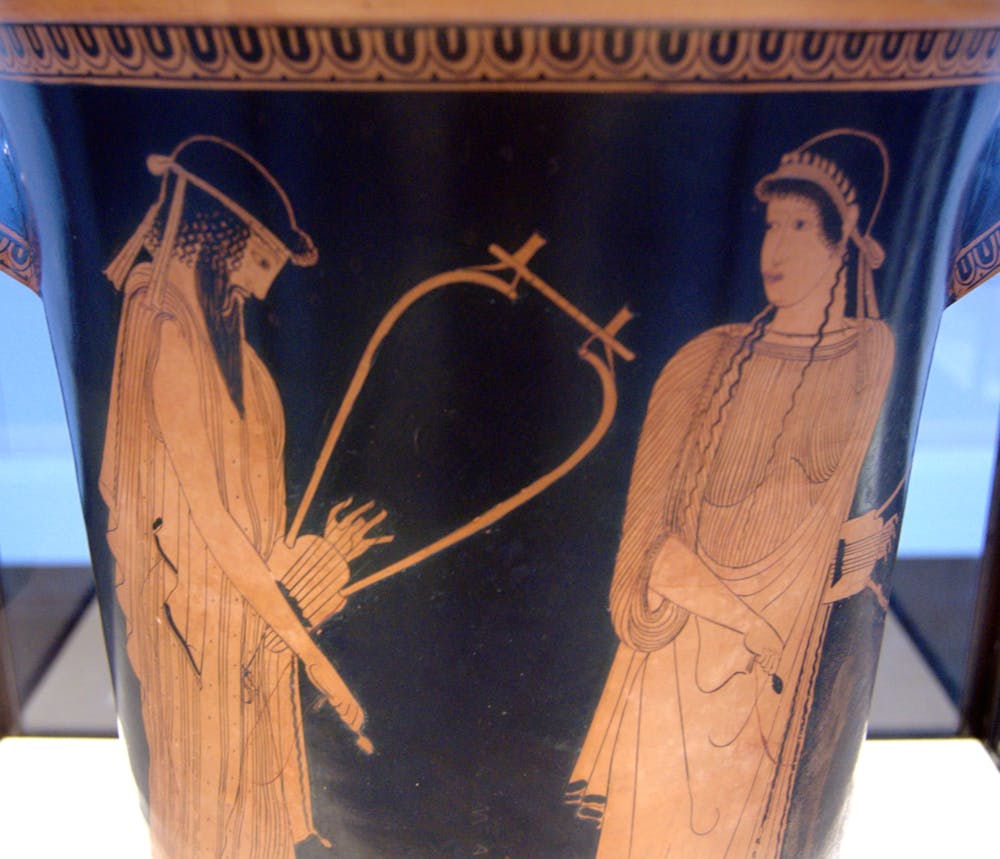
Alcaeus (left) and Sappho. Side A of an Attic red-figure kalathos, circa 470 BC. Wikimedia Commons
The Sappho mystique is further confounded by later testimonies such as the 10th century Byzantine encyclopedia called the Suda (or the Stronghold), which chronicled the history of the ancient Mediterranean. In one of two entries on Sappho, readers are informed that she was in love with a ferryman by the name of Phaon whose rejection of her caused her to leap to her death from the Leucadian Cliff.
This apocryphal history, which emerged in antiquity, went on to inspire artists, poets and playwrights for hundreds of years, despite the strange origins of Phaon as a figure of myth and legend. In the second entry on Sappho in the Suda, it is stated that Sappho was married, had a daughter by the name of Cleis, and was also a lover of women.
Turning to the fragments and scant number of complete poems from Sappho’s canon, there are references to her daughter, and to her close female companions – even her brothers – although the extant verses do not sing of a husband. In Fragment 132, for example, Sappho sings of Cleis:
I have a beautiful child whose face is like
golden flowers, my beloved Cleis …
Beauty, caresses and whispers
Sappho, following the poetic traditions of Archaic Greece, tended towards floral and natural imagery to depict feminine beauty and youth. Elsewhere, she evokes images of garlands, scents and even apples to convey feminine sensuality. Hers was largely a world of beauty, caresses, whispers and desires; songs sung in honour of the goddess Aphrodite, and tales of mythical love.
In Fragment 16, arguably Sappho’s most sublime poem, fortunately well preserved albeit a little tattered, her definition of beauty anticipates the maxim of the philosopher, Protagoras that “man is the measure of all things”:
Some say a host of cavalry, others of infantry,
and others of ships, is the most beautiful
thing on the dark earth, but I say it is
whatever a person loves.
It is perfectly easy to make this
understood by everyone: for she who far
surpassed mankind in beauty,
Helen, left her most noble husband
and went sailing off to Troy with no thought at all
for her child or dear parents,
but [love?] led her astray …
lightly …
[and she]
has reminded me
now of Anactoria
who is not here;
I would rather see her
lovely walk and the bright sparkle of her
face than the Lydians’ chariots and armed
infantry …
Sappho’s definition of beauty – that which a person loves – privileges the individual over the community. She extends her dictum with the example of the mythical figure of Helen of Troy, renowned in antiquity as the most beautiful woman in the world. As testimony to Sappho’s unique interpretation of the story, she removes the standard figures of blame for Helen’s role in the Trojan War – Paris, the Trojan prince who abducted her or, in other versions, Aphrodite who forced her to go with him – and gives agency to Helen herself. In Sappho’s world, where love is all, it is Helen who decides to leave her husband and elope with Paris. Consequences be damned!
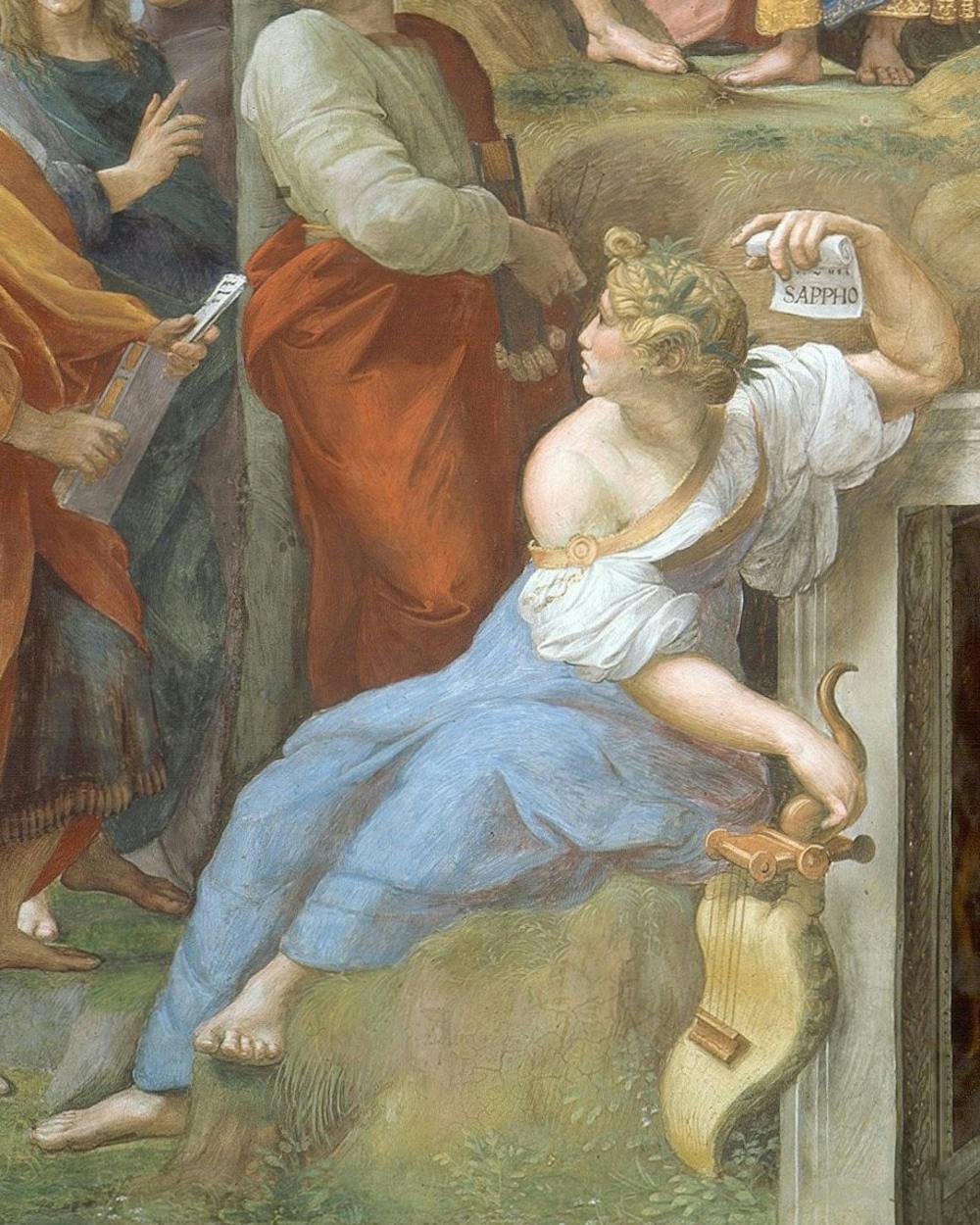
A cropped version of Raphael’s 1511 fresco Parnassus, showing the figure of Sappho. Wikimedia Commons
Sappho’s thoughts on love and desire extend to a personal reverie on a woman by the name of Anactoria. Sappho reveals that Anactoria is gone and is missed. She compares her, indirectly, to Helen and then evokes her beauty, namely her gait and her sparkling face. Sappho’s lyrics are sensual, gentle, intense. But they are also powerful, as she rejects the world of masculine warfare in preference for beauty and desire.
‘A tremor shakes me’
In another well-preserved piece, Fragment 31, Sappho evokes the sensations she experiences as a result of being seated opposite a beautiful woman:
He seems to me equal in good fortune to the
whatever man, who sits on the opposite side to you
and listens nearby to your
sweet replies
and desire-inducing laugh: indeed that
gets my heart pounding in my breast.
For just gazing at you for a second, it is impossible
for me even to talk;
my tongue is broken, all at once a soft
flame has stolen beneath my flesh,
my eyes see nothing at all,
my ears ring,
sweat pours down me, a tremor
shakes me, I am more greenish than
grass, and I believe I am at
the very point of death.
The power of the fragment, and indeed the meaning, are substantially derived from the Greek pronouns that denote three players in Sappho’s drama: Sappho, the man, and the woman.
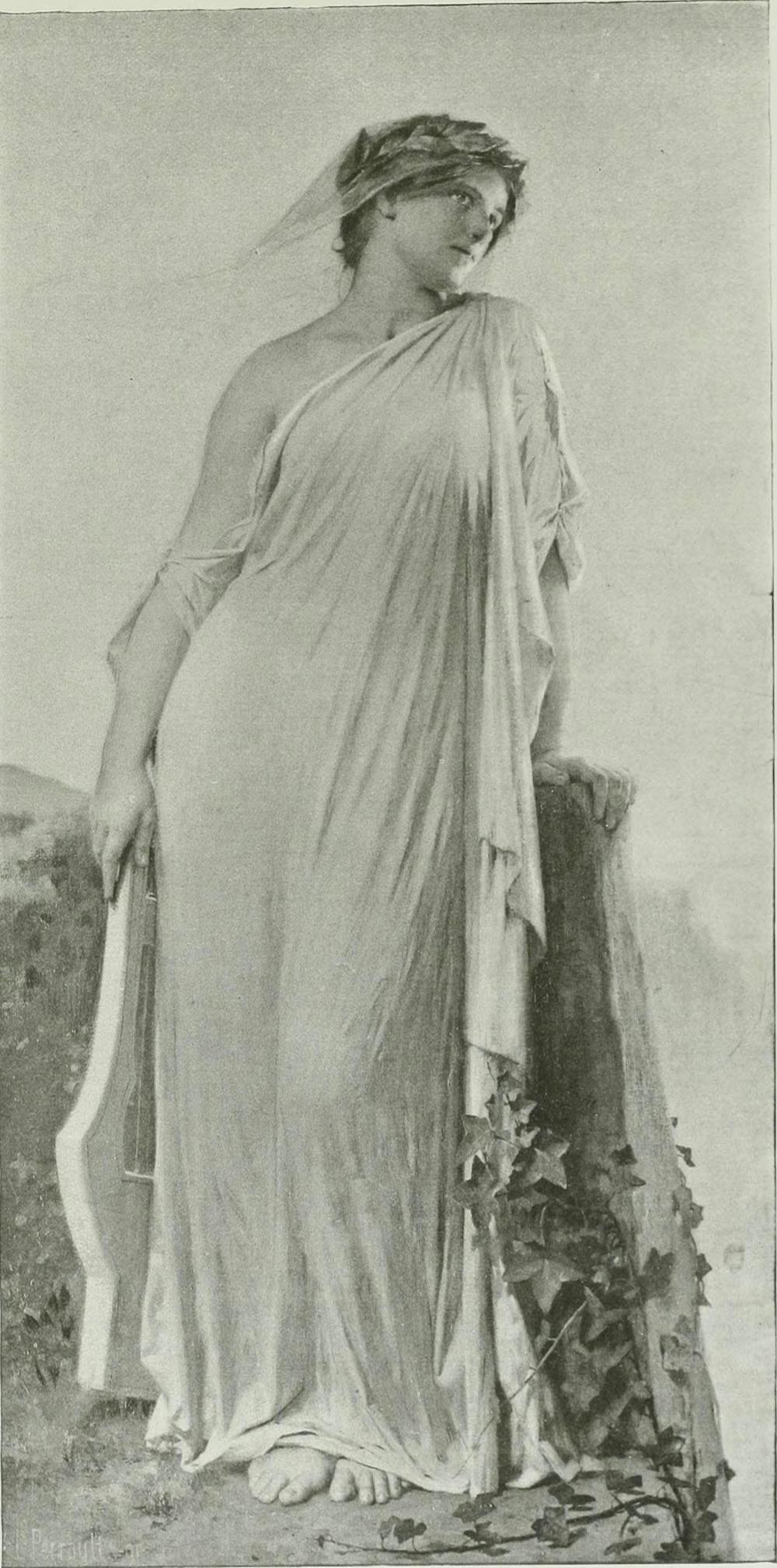
Portrait of Sappho by Léon Jean Bazille Perrault, 1891. Wikimedia Commons
The man is god-like because he can be in the presence of the woman and remain unaffected. Sappho, in contrast, is a physical, mental and emotional wreck. The fragmented condition of the piece includes a few words that indicate at least one more stanza followed.
Such was the power of Sappho’s poem that it went on to inspire various intellectuals and poets who followed her. The Roman poet, Catullus was so enamoured of Sappho’s work that he reworked Fragment 31, which he would have known in its complete form, into his own version that even rendered the original Sapphic hendecasyllabic metre into Latin [Poem 51].
Translating Sappho is no mean feat. Most of the work is in poor condition, pieced together by papyrologists to make readable texts for scholars to work from. Confronted with the Aeolic Greek of the poet, printed neatly on a page, the translator is immediately drawn into emendations, conjectures, broken lines, missing words, incomplete words, hypothetical punctuation and, in short, a philological headache.
And, after persisting, the translator is always dissatisfied. It is impossible to capture the poet’s genius in another language, especially if the translator is simultaneously striving for a metrical equivalent. Catullus, too, was a poetic genius – an artist with complete control over style, metrics and meaning – yet he was humble enough not to replicate Sappho’s words but to imitate them, to compose a response to them, to make them his own as a homage to the Tenth Muse.
New discoveries
But despite the hurdles and the intellectual heartache, there are rewards in recent discoveries that continue to add more words, more lines, more stanzas and sometimes even new poems to the canon. In 2004, the discovery of piece of papyrus that completed an existing fragment – thereby making a new poem by Sappho – received international media coverage. The process of repair resulted in Poem 58, which deals with the themes of youth and old age.
Sappho’s poem An Old Age (lines 9-20) LB 58. Papyrus from third century BC. Wikimedia Commons
Sappho mourns the passing of her youth, and reminds her audience of the myth of Tithonos, one of the few mortals to be loved by a goddess. Struck by the beauty of the young man, the goddess Eos asks Zeus to permit her to take the young man to live with her eternity. But Eos forgets to ask that Tithonos be granted a second gift: eternal youth. And so, she is left with a lover she quickly finds hideous and repellent, and Tithonos is left alone, trapped in a never-ending cycle of ageing.
More and more of Sappho is emerging. In 2013, more new fragments were discovered that have assisted in reconstructing existing pieces, and bringing to light four previously unknown pieces. One relatively complete poem, Brothers Song is the most significant of the find because of its hitherto unknown status.
The piece is also important because it further develops the image of the poet as an artist whose themes extended beyond the sensual and romantic. While previously extant fragments and details in works such as the Suda reference Sappho’s brothers, the poem provides more insight into Sappho’s familial world. While the first three stanzas are missing, there are five complete ones, the subject of which is a speaker’s concerns for the safe return of her two brothers, Charaxos and Larichos from a maritime trading venture.
The discoveries of this century are testimony to the fascinating and random nature of such finds. Rather than being hidden away in obscure manuscripts in dusty archives or included in elaborate scrolls, the fragments have sometimes come from less salubrious environments.
For example, much of Sappho’s work, along with pieces from poets and writers ranging from Homer, the Greek playwrights, Plato and Saint Paul came from Oxyrhynchus – an ancient garbage dump in Egypt.
And while other pieces were preserved as quotations in more respectable formats, such as books on grammar, composition and philosophy, the 2004 poem originally came from the cartonnage of an Egyptian mummy.
Indeed, cartonnage – a plaster-like material made from material scraps, including papyri that was wrapped around mummified bodies and then decorated – has yielded rich results, Sappho’s fragments being just one example. Hopefully more garbage will be excavated to reveal more of Sappho’s poetic diamonds.
For a recent, reliable edition of Sappho’s works, see Sappho: A New Translation of the Complete Works, translated from the ancient Greek by Diane J. Rayor, with an introduction and notes by André Lardinois (Cambridge University Press).
The joke among poets is that it’s never a good thing when poetry makes the news. From plagiarism scandals to prize controversies, casual readers would be forgiven for thinking the so-called “poetry world” exists in a state of perpetual outrage. In a recent article, The Guardian reported that an essay published in the magazine PN Review “has split the poetry establishment”.
Rebecca Watts’ contentious essay, The Cult of the Noble Amateur, first appeared in the magazine’s print edition in December. In it, she laments social media’s “dumbing effect” on recent poetry, and a “rejection of craft” that is fuelling the success of what she calls “personality poets”. In particular, Watts criticises Rupi Kaur, whose bestselling verse initially found an audience on Instagram, and Hollie McNish and Kate Tempest, whose performances have garnered millions of YouTube views.
To some extent, the only surprise in this latest debate is the wider media interest. Within days, what might have passed like so many online squabbles had prompted further coverage in The Guardian and Bookseller, a segment on Radio 4’s World at One, and an interview with Watts herself on BBC’s Front Row. It’s with no small irony, of course, that the essay’s viral spread came only after it was posted on PN Review’s website, then shared on Facebook and Twitter.
But by focusing on the false opposition of quality and popularity, both sides have been reluctant to see the debate itself as a symptom of the media’s growing interest in the art form. As Watts’ essay admits, poetry is more popular than ever. And over the past few years, news of scandals has increasingly been replaced by celebrations of its renewed relevance.
Within days of the 2016 US presidential election, for instance, the LA Times, CNN, Buzzfeed, Vox and dozens of other outlets were offering what The Guardian called “poems to counter the election fallout”. The Atlantic declared “Still, Poetry Will Rise”, and Wired warned: “Don’t Look Now, But 2016 is Resurrecting Poetry.”
The political impetus for poetry’s media “resurrection” has also fed into a more general sense of its coolness. In the same week that inspired so many election poems, “London’s new generation of poets” were seen “storming the catwalks of Fashion Week”. Meanwhile, Teen Vogue offered a slideshow of young poets who “are actually making the genre cool again” and a Guardian columnist who has written in the past about coconut water trends assured us that poetry is now “the coolest thing”.
For some, this visibility might seem to justify Watts’ worry that poetry like Kaur’s (which featured among The Guardian’s “coolest things”) has become a form of “consumer driven content”. Like some jazz or comic book devotees, certain poetry lovers remain uncomfortable with its widening fanbase. Indeed, in his mapping of the cultural field, the French sociologist Pierre Bourdieu suggested that poetry’s economic priorities are “reversed”, and that relative obscurity has long been part of its caché.
Desperate to preserve that, perhaps, Watts begins her attack by suggesting that poetry’s “highest ever” sales over the past two years are to blame for declining standards. But she’s not the only one to bristle at poetry’s growing currency, or to assume it proves that “artless poetry sells”.
After Patricia Lockwood’s Rape Joke went viral in 2013, Adam Plunkett, writing for the New Yorker, sneered at her “crowd-pleasing poetry” for its appeal to the “lowest common denominator” online. A similar cycle of praise and censure was repeated last month, when Kristen Roupenian’s short story Cat Person earned a seven-figure book-deal after going viral in the New Yorker itself.
Celebrities trying their hand at verse have been another easy target for the preservationists. The Independent declared that Kristen Stewart had written the “worst poem of all time”, after her piece appeared in Marie Claire in 2014. And in November 2016, Cosmopolitan called on Harvard professor Stephanie Burt to explain why the poems included in Taylor Swift’s new album didn’t really work for her as poems.
Yet, beyond poetry’s appearances at Fashion Week or in financial adverts, there are signs that hang ups over its popular appeal are losing their grip. Beyoncé’s use of Warsan Shire‘s work in 2016’s Lemonade, for example, was met with few claims that it was dumbing anything down. Just as tellingly, the week that saw such heated battles over the PN Review essay also saw the singer Halsey’s moving Women’s March poem go viral to unanimous praise. And there was hardly a peep from the “poetry world”.
In the Edinburgh World Heritage website’s story about Scotland’s bard, it notes that when Robert Burns “the ploughman poet” came to the city in 1787, he was “a new boy in town and a great looking heart throb”. It’s a familiar description, dating back to the writer Henry Mackenzie’s review of the iconic Kilmarnock edition of Burns’ poetry in The Lounger for December 1786, describing him as “the heaven-taught ploughman”.
The comparison Mackenzie intends is one with Shakespeare as portrayed by Milton in L’Allegro, whose “wood-notes wild” derive not from education but from inspiration: Burns is to be for Scotland what Shakespeare was for England.
But it was the ploughman label that stuck. Burns is often seen as a “peasant poet”, aligned with the likes of English writer John Clare – and he probably wouldn’t have had it any other way.
Farmer glories
During his lifetime, Burns presented himself as “nature’s bard”, ignorant and free of the “rules of Art”. He walked round Edinburgh in farmer’s boots, portraying a deliberately rustic air.
Yet Burns was well read and reasonably educated: he knew the work of Dryden, Fielding, Goldsmith, Milton, Pope, Sterne and many others. He appears to have been influenced both by French bawdy poetry and the troubadour tradition of Provence. In the preface to his Poems (1786), Burns identifies himself as “obscure” and “nameless”, yet cites Virgil and Theocritus.
And Burns certainly wasn’t living in deprivation. He earned much the same from his Edinburgh edition of Poems in 1787 as Adam Smith did from The Wealth of Nations, and in the 1790s his income was as high or higher than Jane Austen’s. It was similar, in fact, to those ministers of the Kirk he liked to bait so much.
He was supported by many wealthy Freemasons. He was the regular correspondent of gentlemen in a strongly class-segregated era, and dined with them. Yet Burns is still often remembered as if he was living on the margins.
This image absolutely suited him: his greatness appeared to be a mystery – and mystery is a lasting source of power. He seemed to have sprung from the soil with no visible means of support. A “celebrity” in the modern sense of a famous person is a 19th-century word: Burns was arguably the first poet to think of himself as a brand.
Brand Burns
This self-creation helped to bring him both national and international recognition. In Germany, he came to be seen as both representing the progressive universalism of the radical Enlightenment and a one-stop shop for the folk tradition.
In America he was perceived as the good European, the man of “independent mind” who was a foe to tyrants and an adoptive son of the United States. In the British Empire, he represented the sentiment, communitarianism, egalitarianism and humanitarianism on which many Scots liked to congratulate themselves.
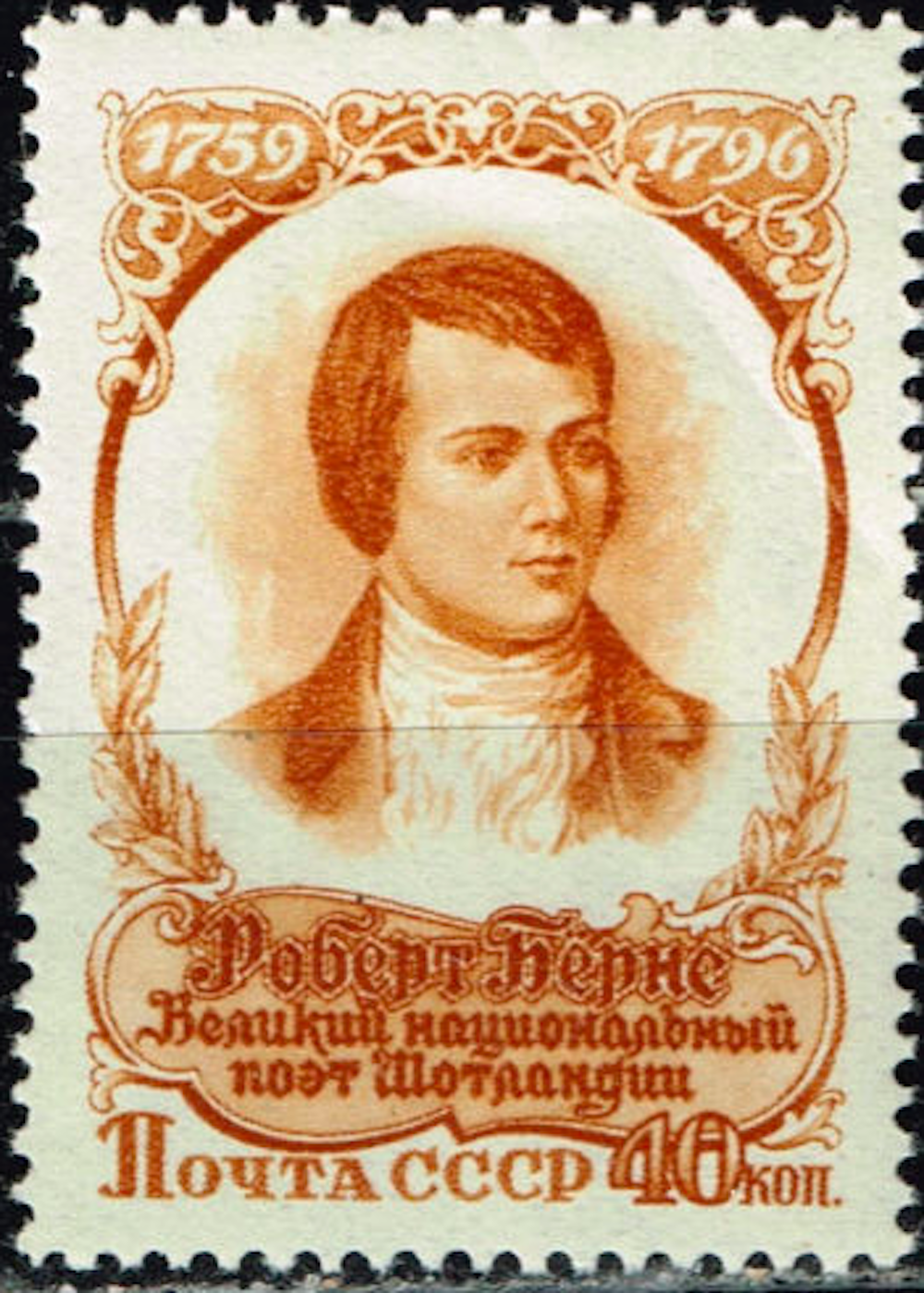
Comrade Rabbie. Wikimedia
In the USSR, he came to be the “good kulak” (peasant) who would have understood the benefits of collective farming, and the Soviets became the first to issue a commemorative stamp for the poet in 1956.
In China during the Cultural Revolution, he represented the lack of contradiction between the agricultural and intellectual; for Kofi Annan in an United Nations address in 2004, he was the supreme internationalist, the advocate of harmonious neighbourliness worldwide.
Much of this affection stems from the fact that Burns is in many respects the supreme poet of sentiment, certainly in the Anglophone world. We overlook that his paeans to the routine life of rural poverty are distanced by education: in The Cottar’s Saturday Night, he quotes Alexander Pope’s Windsor Forest; in Tam o’ Shanter, he knowingly celebrates sex, drink and dancing in the narrative voice of the Romantic collector of tradition, in a story he invents and sends to such a Romantic collector.
When Burns is knowingly sophisticated, he sometimes appears transparently simple: in Auld Lang Syne the praise of a vanished past, the persisting nature of relationships despite the transience of life, the sugaring of nostalgia, all deflect us from the lack of any promised future. Again we see what we want to see: from It’s A Wonderful Life to When Harry Met Sally and beyond, Hollywood has recognised the song’s extraordinary evocation of sentimental intensity.
Similarly, people often project a political agenda onto Burns that is hard to justify. In To a Mouse, for example, the ploughman does nothing to help the mouse.
Nor is the nature of “Man’s dominion” changed really, despite the ploughman being “sorry” for it. Sorry doesn’t cut the mustard, but the sentiment buttered Burns’s bread and still does worldwide. Most of his supposed politics turns out to be more feeling.
Supper man
The other element that has done much for the poet’s reputation is the Burns Supper. The first was in Alloway in Ayrshire on July 21, 1801 – celebrations switched from his date of death to his birth later, possibly influenced by the adjacent date of dinners on January 24 for the great British Whig Charles James Fox.
To a cola.
The custom of the Burns dinner or supper spread rapidly. We see it in London in 1804, India in 1812, New York in 1836, and Copenhagen, Paris and Madrid by 1859.
Today, some nine million people attend official Burns Suppers each year alone, and 100,000 Immortal Memories are given. Scotland’s Year of Homecoming was built around Burns in 2009, and in 2018, Scottish Nationalist MSP Joan McAlpine’s parliamentary motion on Burns’ importance to the Scottish economy gained cross-party support.
Burns has been translated several times as often as Byron; he has more statues than any secular figure except Queen Victoria and Christopher Columbus; and is the only person to have appeared on a Coca Cola bottle. He’s a synecdoche of the way Scotland wants to be perceived: humane, egalitarian, caring, international.
“O wad some Pow’r the giftie gie us/ To see oursels as ithers see us!” The memory of Robert Burns is indeed immortal. And he knew what he was doing all along.
Dorothea MacKellar’s My Country, with its paen to a sunburnt landscape, excoriated Australians for their nostalgic love of English ‘grey-blue’ countryside and English weather. Mark Wassell/flickr, CC BY-NC
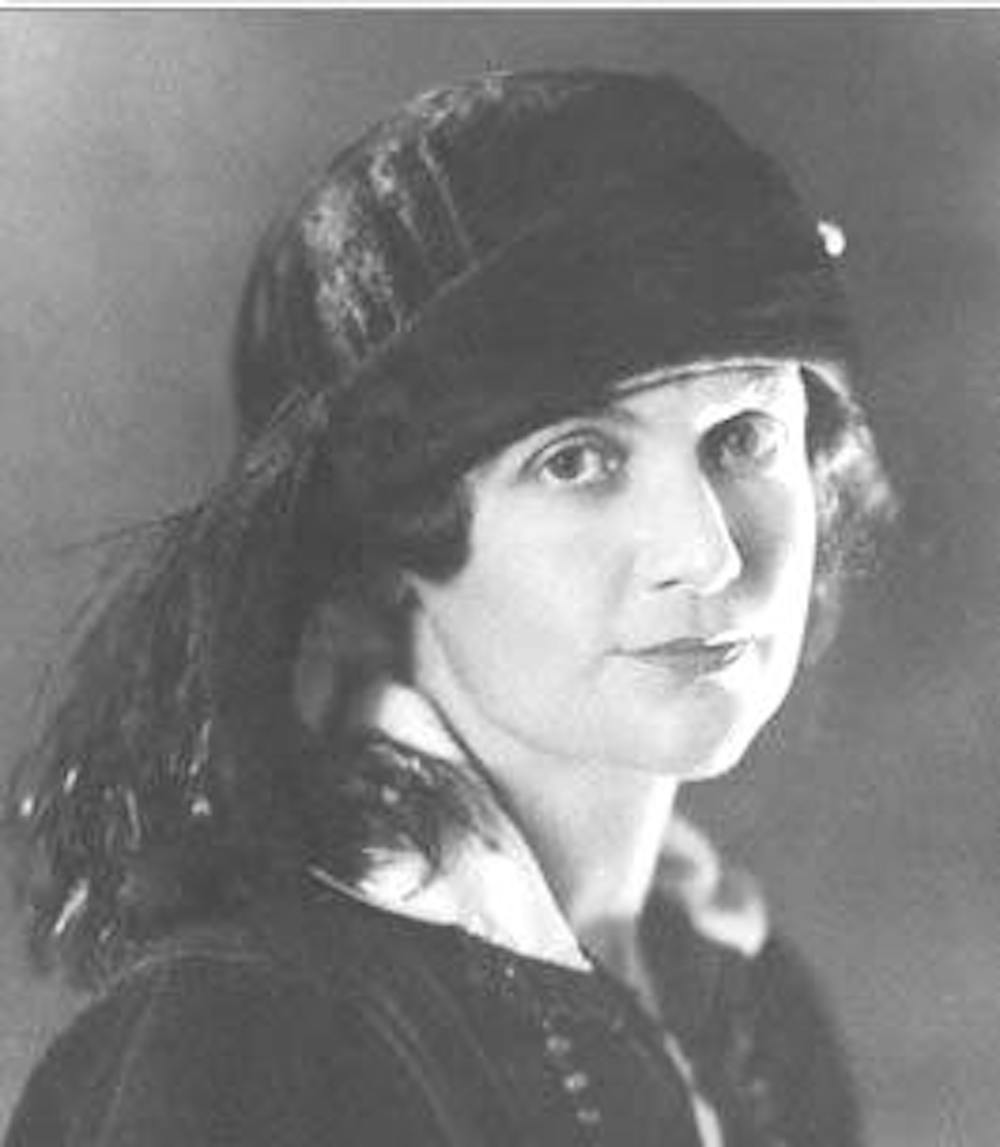
A young woman of 23, Dorothea MacKellar (1885-1968), had a poem published in the London Spectator in 1908, titled Core of My Heart. She was the daughter of a wealthy pastoral family, educated privately, a graduate of the University of Sydney. She is said to have written the first draft of the poem in 1905 in response to the breaking of a prolonged drought on the family cattle and tobacco farming property, Torryburn, near Maitland in NSW. The poem was also written in protest against the anti-Australianism of many Australians at that time, excoriating them for their nostalgic love of English “grey-blue” landscapes and English weather.
Dorothea Mackellar. Wikimedia commons
Later, she re-titled the poem My Country and its second stanza remains the best known most quoted stanza of poetry in Australia, beginning with that belligerent, youthful and anthemic cry of “I love a sunburnt country”. She declared she could not share a love of “coppice”, “field”, “ordered woods” or “soft dim skies” because “My love is otherwise”.
She was in effect working to create not only pride at being here in such a raw and dramatic and vast place, but to make a new vernacular against the prissiness of English idioms of paradise. She even declared, defiantly, a love for the “stark white ring-barked forest” so common to Australia’s landscapes. We have forgotten how much of a rant this anthemic poem was in its time. It was a poem openly turning truisms on their head, giving a new generation its new native voice.
And of course, the poem exaggerated its argument, and opened itself to ongoing arguments over what it might mean to be in Australia, to be Australian, to find an identity in triumphant harmony with this place.
Kevin Gilbert (1933-1993), born on the banks of the Lachlan (Kalara) River at Condobolin, the youngest of eight children, found himself on the receiving end of, as he put it, “White Australia’s apartheid system”. In hospitals, Kevin Gilbert and his people were confined to verandahs and given blankets with “Abo” stamped on them. In his New True Anthem, he found his own moment of protest in the undiminished arguments over nationalism:
Despite what Dorothea has said
about the sun scorched land
you’ve never really loved her
nor sought to make her grand
you pollute all the rivers
and litter every road
Your barbaric graffiti
cut scars where tall trees grow
the beaches and the mountains
are covered with your shame
injustice rules supremely
despite your claims to fame
the mud polluted rivers
are fenced off from the gaze
of travellers and the thirsty
for foreign hooves to graze
a tyranny now rules your soul
to your own image blind
a callousness and uncouth ways
now hallmarks of your kind
Australia oh Australia
you could stand proud and free
we weep in bitter anguish
at your hate and tyranny
the scarred black bodies writhing
humanity locked in chains
land theft and racial murder …
It’s not so much MacKellar he had in his sights, for she was a fellow poet of protest, and a fellow poet in love with the land, but it was the profiteers, the racist systems, polluters and exploiters of every kind he wanted to expose. How that word “grand” has been mis-used and degraded, how far we are from being “proud and free”. No punches are pulled in this anti-anthem, and all the necessary questions are asked. Kevin Gilbert’s poem participates in the tradition of the corrective poem of insult, adopting the anthem as an anti-starting point.
Anti-anthems
Alec Hope (1907-2000) similarly used the moment of Australia’s commitment of troops to the Second World War to write his famous poem, Australia, allowing himself to speak over the top of Dorothea MacKellar to paint Australia as “drab green and desolate grey”.
Her rivers of water drown among inland sands,
The river of her immense stupidity
Floods her monotonous tribes from Cairns to Perth.
In them at last the ultimate men arrive
Whose boast is not: ‘we live’ but ‘we survive’.
A type who will inhabit the dying earth.
And her five cities like five teeming sores,
Each drains her: a vast parasite robber-state
Where second-hand Europeans pullulate
Timidly on the edge of alien shores.
There is nothing in Australia to celebrate and very little to admire in European modernism. Our only hope (Hope?), he ends gloomily, from a place we might call “love-hate”, is to remember that from such deserts as we have in abundance, prophets do come.
And now, the new voices of new poets come to this troubled tradition and make a claim to a voice, a language, an imagery that might wake us up to who we are and where we might be going. Omar Musa, raised as a Muslim, whose heritage is Irish-Malaysian, inspired by his poet father and the example of Muhammed Ali, is more famous as a novelist, a rapper, a slam performer and a You Tube sensation than as a poet to be read in a slim volume of verse.
His new book, Millefiori, is a solid and powerful and sometimes heartfelt incursion into poetry publishing, a book quickly read, but one that needs to be lived with and read over a number of times if the inner voice is to come through and the imagery work on its reader.
The longest poem in the book is Ranthem, an anti-anthemic poem in the tradition of Dorothea MacKellar’s and Alec Hope’s outspoken, youthful defiance and Kevin Gilbert’s hard won anger:
The people tell me love it or leave it. Fuck that.
How about love-hate it and stay? I’ll carry the flame.
They try to disqualify everything that I say
Cos I’m a big brown brother with an Arabic name.
They call me ungrateful and unpatriotic.
Sheeeeit! That attitude is straight idiotic.
If loving your country means wanting change for the better
That means criticizing the ugly
Side of society ASAP.
We need this kind of poetry to be published, to be happening, to be out there provoking us and projecting images of ourselves that might push us, in Musa’s phrases, to be “nuanced, shift the lens, be brave and consider again”. There might be more accomplished poets, more worthy commentators, but it’s clear that this one’s got a voice that says a lot of what needs to be said just now, and we’re interested.
Musa comes to his poems as both himself and, like Hope and MacKellar and Gilbert, as a voice made by a generation:
But do I have the right to commentate at all?
A middle-class Aussie man, that’s a lot of gall.
Cos this isn’t about me, so maybe adding my voice
Is just making the debate more cloudy …
but part of me feels it’s way worse if I don’t say shit.
You can’t help but admire the ways he catches phrases and phrasing, but you listen too to what he’s saying, hearing the reframing of the whole country going on inside those Ranthems.






 For a recent, reliable edition of Sappho’s works, see Sappho: A New Translation of the Complete Works, translated from the ancient Greek by Diane J. Rayor, with an introduction and notes by André Lardinois (Cambridge University Press).

 Yet, beyond poetry’s appearances at Fashion Week or in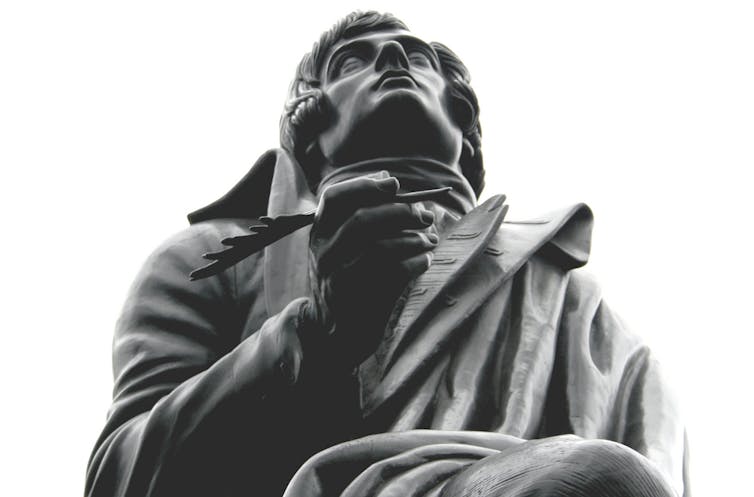

 “O wad some Pow’r the giftie gie us/ To see oursels as ithers see us!” The memory of Robert Burns is indeed immortal. And he knew what he was doing all along.

 You can’t help but admire the ways he catches phrases and phrasing, but you listen too to what he’s saying, hearing the reframing of the whole country going on inside those Ranthems.
 At the BookShelf


You must be logged in to post a comment.