
Unknown's avatar

‘The Reformers and Their Stepchildren,’ by Leonard Verduin


I have been reading ‘The Reformers and Their Stepchildren,’ by Leonard Verduin, in the last week or so. It is not the first time that I have read this book, having read it some time ago – probably 10 years ago now I would say.

This is a book that I would recommend to any believer, but particularly to a Reformed believer, whether he be Paedobaptist or Baptist. Verduin seeks to analyse the Reformation and the relationship between the Reformers and their ‘stepchildren’ from a Biblical standpoint, rather than any particular denominational standpoint. Though he does defend the stepchildren, he does so only when they are in line with Scriptural teaching on the point being discussed within that particular chapter.

Who are the stepchildren? The stepchildren or the ‘second front,’ as Verduin also describes them, are those believers who sought a complete reforming of the church. In fact, it may be fair to say that these believers sought a complete break from the Romish church, and a new church built on the teachings of Scripture and modelled on the New Testament church alone.

The frustration for these nonconformist believers was that the reform movement only went so far and did not result in the complete renewal that they desired and that the situation required.

Thus far I have read only the first two chapters of the book and once again I am finding it a very worthwhile read. I find myself in substantial agreement with the position of many of the stepchildren and with Verduin. With as much respect as I have for the Reformers, such as John Calvin, Martin Luther and John Knox, I too would have found myself frustrated at the level of reform achieved by them (though they were better men than I). A complete break and renewal would have been the way forward I believe.

The first two chapters deal with the joint secular-religious church-state that was set up at both the time of Constantine and then at the Reformation in the various Protestant nations that embraced the Reformation. They deal with the all-embracing religion that was constructed in such centres as Geneva and the ‘unified’ approach to it, as well as the reaction of the stepchildren and their withdrawal from it.

This book is as close to a must read for believers as there is I think – especially of the Reformed persuasion.

My copy of the book (paperback) is by William B. Eerdmans Publishing Co. and was printed in 1964.
Unknown's avatar

The History of the English Baptists – Update


from the Reformation to the Beginning of the Reign of King George I, by Thomas Crosby

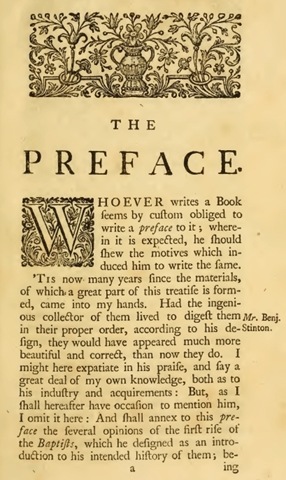
Preface_Image001 As noted in a previous post, I have been reading ‘The History of the English Baptists from the Reformation to the Beginning of the Reign of King George I,’ by Thomas Crosby. I have also been adding this work to my website (a link to this book appears at the end of this post).

I have now completed reading and adding the preface, table of contents and part of the first chapter.

The preface covers the period from the early church through to the first Baptists in England, tracing the origins of the Baptists and disproving their rise to that of the Anabaptists at Munster and the disaster that occurred in that city as a result of the Anabaptist rebellion.

Though a lengthy preface, it briefly touches on such as the Albigenses, the Waldenses, Wickcliff, Donatists, etc. Crosby goes back through history, from the reformation to the first century finding evidence of Baptistic beliefs and practices. It is a very interesting study, even though it is brief. Another interesting aspect of this study is the evidence for early Baptistic existence, even in the writings of Paedobaptist authors and the evidence against the early practice of infant-baptism in the early church.

To read the preface and further, please follow the link below:

http://particularbaptist.com/library/Crossby-Thomas_Vol1_HistoryEnglishBaptists_contents.html

Unknown's avatar

The History of the English Baptists


from the Reformation to the Beginning of the Reign of King George I, by Thomas Crosby.

I have just started to read the above titled book – well, at least the first volume anyway. This title is made up of four volumes, all of which are over 500 pages in length. I have also started to add the work to my web site at:

 http://particularbaptist.com 

The original work (Volume 1) was first published in 1738 and includes some old English, which in the version I am placing on my web site, I have tried to update without changing the overall sense and flow of the text.

It is generally understood that Crosby deals with a mix of both the Particular Baptists and General Baptists, or if you prefer, the Calvinistic Baptists and the Arminian Baptists.

To follow my progress and to read the book, visit:

http://particularbaptist.com/library/Crossby-Thomas_Vol1_HistoryEnglishBaptists_contents.html

Unknown's avatar

THE STORY OF THE ENGLISH BAPTISTS: John C. Carlile


I have recently posted on the particularbaptist.com library site ‘The Story of the English Baptists,’ by John C. Carlile. The book can be found at the following link:

http://particularbaptist.com/library/englishbaptists_john-carlile.html

I own the 1905 edition which was printed as a hardcover by James Clarke & Co. in London, England. My copy is quite aged and is in quite poor condition. The version I have placed online is of course in pristine condition and will undoubtedly stay that way.

There are a number of illustrations and photographs in the book – all of which can be found in the online version.

The book provides something of an introduction to both the General and Particular Baptists, and as such is probably a useful book in that it whets the appetite to research deeper into the history of Baptists in England – which in my case is especially true of the Particular Baptists (of whom I am one).

There are some very interesting and useful chapters in the book, though the treatments of some of the ‘big’ names in Particular Baptist history are quite brief – as I say, something of an introduction. Perhaps an overview may be a better way to describe the book.

I don’t think everyone will necessarily agree with all of the conclusions and statements made by the author of the book. For example, there is something definitely hinky about his comments regarding possible unification of General and Particular Baptists. I’m not sure that he really grasps the significance of the differences between the two camps.

Out of 5 I’d probably give the book a generous 3. I think the book has merit, but is yet disappointing.