I guess there are many reasons for choosing what books to collect – for me, there seems no point unless I’m actually interested in the content of the said books. I guess for some it may be simply a means to gain some financial advantage over time, and for others because these ones look good in my living room (so designer reasons). The link below is to an article that looks at how to choose what books to collect – I would suggest it is up to the reader to decide if any of this is valid.
If you want to understand anything about the US in the 20th and 21st centuries, you need to know 19th-century American literature. The 19th century was when many, if not most, of the problems and ideologies that define American culture were codified, and literature of the period shows creative responses to this change.
For the first half of the 19th century, a lot of ink was spilt worrying whether the US would ever have a literature of its own. Many famous writers, including Ralph Waldo Emerson and Walt Whitman, urged Americans to leave English literature behind and take up specifically American themes, peoples and spaces.
At the same time, indigenous and enslaved Americans such as Harriet Jacobs, William Apess and Frederick Douglass used their pens and their rhetorical might to urge the US government to end race and ethnicity-based persecution and genocide.
After the American Civil War (1861-1865), writers rarely worried about whether the country had a literature and whether it was any good (it quite obviously was). They had innovated new genres (think of Emily Dickinson’s spare and searing verses) and turned their attention to issues of inequality embedded in American culture, as in Kate Chopin’s proto-feminist novella The Awakening and Charles Chesnutt’s exposure of racism and white supremacy in the post-Reconstruction South.
The following five works embody both the beauty of 19th-century American literature as well as its ability to change hearts and minds.
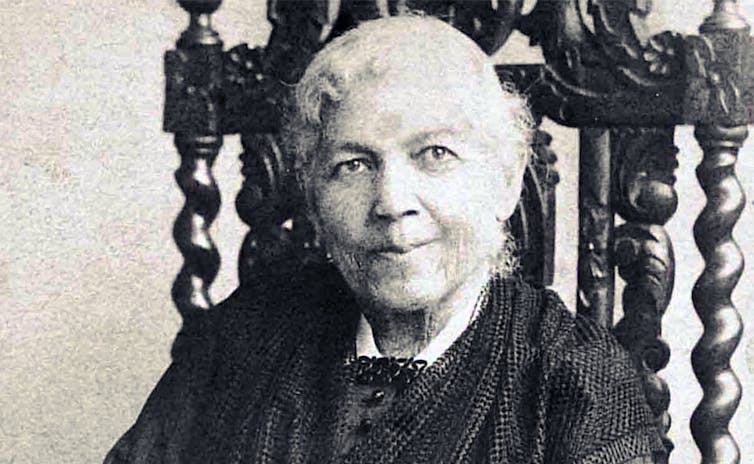
Jacobs’ slave autobiography may not be the earliest written or the most famous, but it’s a devastatingly effective piece of storytelling that reads like a novel. Jacobs’ story of surviving slavery is so remarkable a narrative that sheds a rare light on the female experience of slavery.
Written under a pseudonym (Linda Brent), for a long time scholars assumed it must be fiction written by a white abolitionist. It wasn’t until African-American and feminist scholars unearthed the true identity in 1987 of Harriet Jacobs that the truth of her life story was accepted. Her narrative has since become a classic text of resistance, and it’s an essential read for understanding how white supremacy continues to function in America today.
2. Leaves of Grass by Walt Whitman (1855; last new edition 1881)
Engraving of Walt Whitman from Leaves of Grass. Wikimedia
Walt Whitman was a virtually unknown journalist and printer when the first edition of Leaves of Grass thundered upon the American literary world. The strange book listed no author and contained a casual engraving of Whitman with hand on hip and head cocked to the side. Most importantly, it included poems like the world had never seen before. Poems with long cascading lines and little rhyme or metre to be found. Whitman continually added to and edited Leaves of Grass over the course of his life, crafting his biography in poetry that we now recognise as revolutionary in both form and content. It made Whitman a touchstone for 20th-century poets like Allen Ginsberg and Adrienne Rich.
If you’ve seen the most recent movie adaptation of Little Women (or any of the many previous adaptations), you’ll know that there’s something about Alcott’s novel (originally two novels, now published as one) that strikes a chord. Written in the shadow of the Civil War, Little Women draws upon Alcott’s own remarkable family life among famous Transcendentalist writers and thinkers in Concord, Massachusetts. It’s a skillfully crafted book about how the dreams of childhood do and, more often, do not come to fruition.
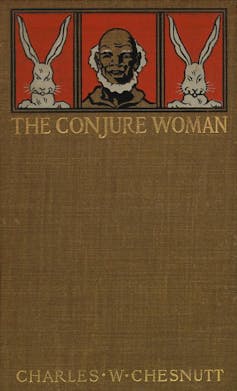
First edition book cover of The Conjure Woman. Wikimedia
In the late 19th centuries, a genre called “local color” dominated American literary magazines. These stories introduced areas of the increasingly expanding United States to those living in urban centres. African-American writer Charles Chesnutt turned this genre on its head in his series of “conjure” stories – tales of magic and cunning told by a formerly enslaved man named Julius to entertain a white northern businessman. Julius’ stories weave together African-American folklore and Southern Gothic ambience to expose white supremacy in the south before the Civil War. These stories indirectly comment on the racism that continued to haunt the post-Civil War US under a different guise.
While these days Melville’s gargantuan 1851 novel Moby-Dick may be more famous (and
you should definitely read that too, when you have a few months to spare), nothing packs a punch quite like the novella Benito Cereno. Based on the story of a real slave revolt on board a ship, the text is paced like a horror story and full of ambivalences and doubled meanings. It reveals the true horror of race-based chattel slavery and anticipates the eruption of violence that would tear apart the United States within a few short years.
People love creating words — in times of crisis it’s a “sick” (in the good sense) way of pulling through.
From childhood, our “linguistic life has been one willingly given over to language play” (in the words of David Crystal). In fact, scientists have recently found learning new words can stimulate exactly those same pleasure circuits in our brain as sex, gambling, drugs and eating (the pleasure-associated region called the ventral striatum).
We’re leximaniacs at heart and, while the behaviour can occasionally seem dark, we can learn a thing or two by reflecting on those playful coinages that get us through “dicky” times.
Tom, Dick and Miley: in the ‘grippe’ of language play
In the past, hard times birthed playful rhymes. The 1930s Depression gave us playful reduplications based on Australian landmarks and towns – “ain’t no work in Bourke”; “everything’s wrong at Wollongong”; “things are crook at Tallarook”.
Wherever we’re facing the possibility of being “dicky” or “Tom (and) Dick” (rhyming slang for “sick”), we take comfort in language play. It’s one thing to feel “crook”, but it’s another thing again to feel as “crook as Rookwood” (a cemetery in Sydney) or to have a “wog” (synonymous with “bug”, likely from “pollywog”, and unrelated to the ethnic slur “wog”).
Remedies may be found in language’s abilities to translate sores into plasters, to paraphrase William Gouge’s 1631 sermon on the plague. New slang enables us to face our fears head-on — just as when the Parisians began calling a late-18th century influenza “la grippe” to reflect the “seizing” effect it had on people. The word was subsequently taken up in British and American English.
In these times of COVID-19, there are the usual suspects: shortenings like “sanny” (hand sanitizer) and “iso” (isolation), abbreviations like BCV (before corona virus) and WFH (working from home), also compounds “corona moaner” (the whingers) and “zoombombing” (the intrusion into a video conference).
Plenty of nouns have been “verbed” too — the toilet paper/pasta/tinned tomatoes have been “magpied”. Even rhyming slang has made a bit of a comeback with Miley Cyrus lending her name to the virus (already end-clipped to “the Miley”). Some combine more than one process — “the isodesk” (or is that “the isobar”) is where many of us are currently spending our days.
Slanguage in the coronaverse: what’s new?
What is interesting about COVID-lingo is the large number of creations that are blended expressions formed by combining two existing words. The new portmanteau then incorporates meaningful characteristics from both. Newly spawned “coronials” (corona + millennials) has the predicted baby boom in late 2020 already covered.
“Blursday” has been around since at least 2007 but originally described the day spent hung over — it’s now been pressed into service because no one knows what day of the week it is anymore. The official disease name itself, “COVID”, is somewhere between a blend and an acronym because it takes in vowels to make the abbreviation pronounceable (CO from corona, VI from virus and D from disease).
True, we’ve been doing this sort of thing for centuries — “flush” (flash + gush) dates from the 1500s. But it’s never been a terribly significant method of coinage. John Algeo’s study of neologisms over a 50-year period (1941–91) showed blends counting for only 5% of the new words. Tony Thorne’s impressive collection of over 100 COVID-related terms has around 34% blends, and the figure increases to more than 40% if we consider only slang.
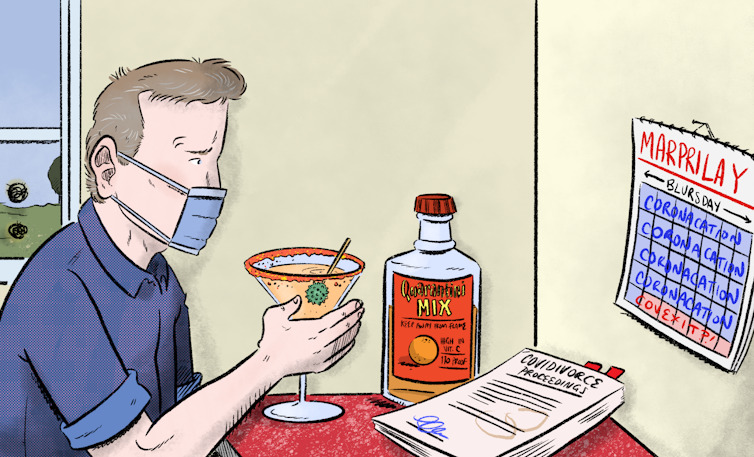
Not only have blends become much more common, the nature of the mixing process has changed too. Rather than combining splinters of words, as in “coronials”, most of these corona-inspired mixes combine full words merged with parts of others. The “quarantini” keeps the word “quarantine” intact and follows it with just a hint of “martini” (and for that extra boost to the immune system you can rim the glass with vitamin C powder). Many of these have bubbled up over the past few weeks — “lexit” or “covexit” (the strategies around exiting lockdown and economic hardship), “coronacation” (working from home) and so on.
Humour: from the gallows to quarantimes
Humour emerges as a prevailing feature of these blends, even more so when the overlap is total. In “covidiot” (the one who ignores public health advice and probably hoards toilet paper), both “covid” and “idiot” remain intact. There’s been a flourishing of these types of blend — “covideo party”, “coronapocalypse”, “covidivorce” to name just a few.
Clearly, there is a fair bit of dark comedy in the jokes and memes that abound on the internet, and in many of these coinages too — compounds like “coronacoma” (for the period of shutdown, or that deliciously long quarantine sleep) and “boomer remover” (used by younger generations for the devastation of the baby boomer demographic).
Callous, heartless, yes. But humour is often used as a means of coming to terms with the less happy aspects of our existence. People use the levity as a way of disarming anxiety and discomfort by downgrading what it is they cannot cope with.
Certainly, gallows humour has always featured large in hospital slang (diagnoses like GOK “God only knows” and PFO “pissed and fell over”). For those who have to deal with dying and death every day, it is perhaps the only way to stay sane. COVID challenges us all to confront the biological limits of our own bodies – and these days humour provides the much-needed societal safety valve.
So what will come of these creations? The vast majority will fall victim to “verbicide”, as slang expressions always do.
Australia’s literary journals are produced in a fragile ecosystem propped up by a patchwork of volunteer labour, generous patrons and, with any luck, a small slice of government funding.
The Sydney Review of Books, the Australian Book Review and Overland were among a group of publications who sought four-year funding from the Australia Council in 2020 but were unsuccessful.
These publications join the ranks of many others – among them Meanjin and Island – defunded by state or federal arts funding bodies in recent years.
These magazines are vital for today’s publishing industry. For many authors literary magazines provide the first opportunity for publication. For editors and arts administrators, they provide a training ground for life-long careers in Australia’s creative sector.
The past decade has seen a steady decline in arts funding going to individuals and organisations. According to Chairman of the Copyright Agency and former media executive, Kim Williams, writing in the Sydney Morning Herald:
[…] if funding for literature had been maintained as in the mid-70s, considering inflation and population growth, it should be at $12 million, at least. Today, it stands at just $5 million (compared with $4.2 million 30 years ago).
The list of defunded writing-focused organisations in the most recent multi-year funding round is stark. Those losing their multi-year status include Artlink, Eyeline, Art Monthly, the Australian Script Centre, Playwriting Australia, Sydney Writer’s Festival and Brisbane Writers Festival.
Without securing medium-term support, these organisations face an uncertain future.
Vital discourse
In response to the 2020 funding announcement, editor of Australian Book Review, Peter Rose, stated the decision demonstrates
little understanding of [the magazine sector’s] contribution to the literary ecology, and no appreciation of the dire consequences for readers, authors, contributors and publishers.
The cultural discussions within the pages of literary journals set the agenda for the more higher-profile but slower-moving institutions such as publishers, prizes and festivals.
Literary magazines are often the first place authors are published. Against the backdrop of an industry largely staffed by white, middle-class people, small magazines are at the forefront of bringing more Australian writing to the surface from writers of colour, First Nations writers, disabled writers, trans writers and working-class writers, challenging those who hold power at the top of the sector.
Writing in 2015 about the position magazines such as Island or Overland occupy, Emmett Stinson noted these publications:
[…] are essential to contemporary literary culture: they showcase new and emerging writers; […] offer more extended literary debates and discussions than the broadsheets; comprise a venue for journalism that contains views outside of the liberal mainstream; serve as rallying points for different communities of readers and coteries of authors […]
Ben Etherington’s essay about the parallel lives and deaths of Mudrooroo and Les Murray, Cher Tan’s exposition and critique of taste production on the internet, and Blak Brow – which was written, edited, illustrated, curated and performed by First Nations creators – are among countless examples of the ways literary magazines carve out space for critique, expression, consideration and reflection.
In shifting funding away from small magazines, we lose the place for these discussions.
Not a competition
Uncertainty, instability and fragility are perhaps the defining characteristics of small magazines.
The decisions to not fund literary magazines not only have a significant impact on the individual publications, but also to Australian cultural discourse.
What gets published within the pages of these magazines can entertain us, it can inspire us to critically examine the world around us, and can help us understand culture that moves us.
Vibrant discussion about culture, society and the arts does not happen by accident. It must be carefully nurtured and requires financial support.
The Australia Council make extremely difficult decisions about what gets funded and what doesn’t.
Not every organisation and publication and festival can receive funding. Those who don’t secure funding are no more or less worthy than those who do. Reduced financial support for Australia’s creative endeavours encourages artists to turn against one another in judgement of what should and should not receive funding.
Australian artists entertain us, challenge us and allow us to see things from different perspectives. Fulfilling a capitalist desire for competition, however, only distracts from the importance of Australian artists and the contribution the creative sector makes to our lives.
Correction: a reference to the Wheeler Centre has been removed as they did not apply for funding in 2020.






 At the BookShelf


You must be logged in to post a comment.