Keorapetse Kgositsile, the South African-born poet who passed away in 2018, lived in exile in the US from 1962 to 1975 and was at the centre of the country’s 1960s and ’70s Black Arts Movement. Informed by his South African and Tswana background, the poet makes a case for multiple inflections of voices, geographies, and histories in the making of transnational black modernity.
Analysing his work offers ways in which African poetry can disrupt dominant thinking on Black Atlantic studies, particularly Paul Gilroy’s
1993 text The Black Atlantic: Modernity and Double Consciousness. The Atlantic world referred to by Gilroy tells the histories of Europe, Africa and the Americas, two hemispheres joined by the Atlantic ocean and exchanging influence. Kgositsile’s poetry can be read as challenging the direction of influence from north to south.
Uhuru Phalafala considers the rich oral traditions passed on from Kgositsile’s grandmother and mother as a key system of knowledge that informed and shaped his black radical imagination. Aretha Phiri interviewed her.
Aretha Phiri: Your colloquium paper situates the celebrated poet-in-exile at the centre of and as uniquely influential to the Black Arts Movement?
Uhuru Phalafala: It was a time when African Americans were seeking to define their identities, with Africa as key metaphor. Kgositsile happened to not only come from that continent, but also used his mother tongue, Setswana, spiritual practices, and music from southern Africa in his work. By interweaving Tswana vernacular with the black diaspora parlance, he affirmed African America’s legitimate affiliation to the continent, as seen in the example of his influence on “the grandfather of rap music”, The Last Poets.
He also came from a mass liberation movement that was experienced in politics of armed confrontation, generated solidarities with other liberation organisations, and adept in decolonial politics. His work became a resource for his contemporaries. Today, when we look at, for example, Kendrick Lamar’s influential album, To Pimp A Butterfly, and the number of references to South Africa in it, we must understand it as grounding itself in the foundation that people such as Kgositsile laid in the sixties and seventies. South Africa will always have an enduring place in the African American imagination.
This is diaspora consciousness. He also admired Nina Simone’s sound, which he called “future memory” to signal that it is not new or emergent, but reminiscent of the protest tradition of South Africa.
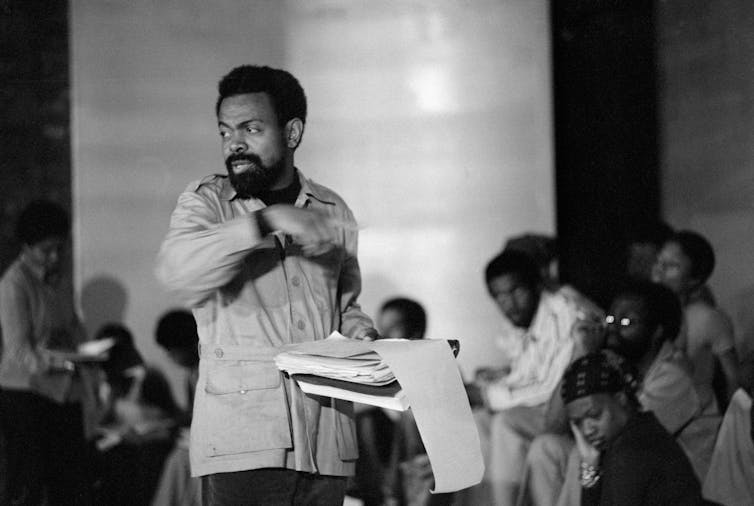
Amiri Baraka (Leroi Jones), 1975, best known member of the Black Arts Movement that embraced Kgositsile. Bettmann/Getty Images
Aretha Phiri: In focusing on the oral traditions inherited from his female lineage, you make a case for the specific use in his poetry of a “matriarchal archive”?
Uhuru Phalafala: The colonised come from different conceptions of time (temporalities). Colonial temporality is not only racialised but also gendered. The arrogant coloniser inaugurated the beginning of history in his assumption that we did not have a history before he arrived. “History” began with the arrival of the coloniser, and marched forward in a linear fashion. With time, black men accessed modernity’s time – through missionary education and working in the mines – at a different period than women.
We now know that when anti-colonial wars were fought they were primarily and solely about the emergence of the black race from subjugation. When women and queer people attempted to bring the particularities of their oppression to the agenda they were told to wait. When independence was achieved those doubly and triply marginalised did not attain their independence at the same time with their countries because they continued to fight against black patriarchy.
If we backtrack we can then make certain observations. A type of double location of time was constructed when the colonisers’ history was instituted: theirs and ours. Because of lack of contact with missionary education and industrialisation, loosely speaking – of course there were women who accessed modernity – women occupied a different temporality. One of continuity from precolonial to colonial time, with its attendant way of life, philosophies, worldview, oratory practices, etcetera.
Aretha Phiri: In describing this archive, how do you guard against potential accusations of advancing a gendered essentialist claim?
Uhuru Phalafala I do not wish to rehash gendered essentialist claims. This is just historical process. My grandmother never set foot in a classroom but has a world of knowledge, so to say. Men who were later ferried to missionary schools, or those who went to work in the mines en masse, existed in a double location of time. The flow from precolonial to colonial time was interrupted by modernity’s time, fashioning a coexistence of the two.
These men came face to face with the colonial alienation and “first exile” from their home cultures which were denigrated by colonial assumptions of superior culture. This is how temporality is also gendered. The women who suffered the blows of this history, mostly in the rural countryside, continued to live life on their own terms, without their men. They continued to practise their indigenous ways of knowing – which are not an event but an ongoing process.
These knowledges evolved with time and did not freeze in some dark past. They progress, transform, and evolve as humans do. Today when we call for decolonisation we are actually wanting to retrieve this knowledge that was silenced and erased by the multiheaded hydra of colonialism. Where can we find it if not from those who had little contact with this hydra? In my view black women, in the context of southern Africa, are that “matriarchive”.
The book Black Radical Traditions From The South: Keorapetse Kgositsile and the Black Arts Movement by Uhuru Phalafala will be published shortly.
Writing is a pastime best conducted on your own — or so common wisdom would have it. Yet writing teams exist, and in many realms they are expected. Take television, where the writers’ room is the norm. Or the academy: one physics paper has 5,154 authors.
In literature, collaborations are more common than you might realise. For every superstar Neil Gaiman and Terry Pratchett team-up (Good Omens), there might be an F. Scott Fitzgerald and his uncredited wife Zelda, or a “James S. A. Corey” (The Expanse) being the pseudonym for Daniel Abraham and Ty Franck.
Although new writers such as the Brontë siblings may collaborate, the practice seems to fall away with age, perhaps because writing relationships can be as fraught as familial ones, with as many pitfalls to navigate.
Add to this a collaboration nearly always proves to take as long as a solo work and any monies might have to be divided among the contributors. Why would anyone willingly share their art with someone else for little to no benefit?
In my experience, collaborating can be creatively stimulating, educative, motivating, productive, and revitalising. Plus, it’s great to have a friend to keep you company on a publicity tour.
Here are six techniques to help would-be co-writers take their first steps in this direction.
1. The chain
This is the simplest method, one of two that require first settling on what your story will be and then breaking the writing of it into bits completed separately, in chronological order.
There are many ways to serially tackle the discrete tasks that will combine to form a glorious whole. Some teams might choose to write alternate scenes, chapters or sections; others might alternate whole drafts, giving each participant long stretches of time to work on solo projects.
Whichever way you tear it down, every member of the team has a professional obligation to deliver. Break one link in the chain and it falls apart.
The chain method can give each writer long stretches of time to work on solo projects. Brad Neathery/Unsplash
2. Parallel processing
The second way to devolve an outline requires trust and communication beyond that required of ordinary collaborative relationships.
In parallel processing, you divide characters among authors, so one provides the voice of X, another Y, and so on. Each arc is written separately, then edited together when complete. If X or Y diverge too much from their expected paths, plotting and structural problems can arise, but the powerful juxtaposition of distinct voices can outweigh the risk.
3. The hothouse
An extreme version of serial collaboration, this method used to require being physically in the same room as your writing partner(s). One starts writing and keeps writing until they get stuck. They then tag in the next writer, who takes over. Repeat until done. Food and sleep are optional.
The benefit of this method is the words are guaranteed to keep coming.
These days the “in person” requirement is greatly relaxed. Google Docs is just one platform allowing writers to work on the same document at the same time, no matter where they are.
4. The undertakers
Brainstorming what a story will contain is, for many collaborators, the fun part — providing they can agree on a final project.
One method of achieving this agreement is by giving one of the co-writers a veto to be exercised when consensus can’t be reached.
Another method requires every element of the final project must be agreed to by every collaborator. This can be time-consuming to achieve but avoids any lingering resentment if someone is outvoted or overruled.
To avoid any lingering resentment, every decision can be agreed on by every collaborator. Toa Heftiba/Unsplash
More generally, every shared undertaking should have a binding agreement in place before serious work commences, covering issues such as whose name goes first, which agent will sell the work, how any resulting IP will be divided, and so on.
It is much better to have these agreements in place and not need them than the other way around.
5. The Marxist Manifesto
Collaborators should have common ambitions but complementary skills, otherwise you might as well work alone. The way roles are divided in the working relationship can reflect those skill sets – which might, of course, lie in non-writerly areas such as business or marketing.
To some, the perfect collaboration is one in which every participant’s weaknesses are covered by strengths in their fellows. Everyone contributes and everyone learns by example.
Not everyone needs to write. Someone on the team might have the perfect brain for business or marketing. Helena Lopes/Unsplash
6. Resurrection of the dead
Finally, the easiest and safest way to audition a potential co-writer is to give them a failed draft and see what they accomplish with it. If it’s a success, great: the original author gains a new collaborator and a finished work.
Should this (or any of these methods fail) the author is no worse off.
They can just revert to writing alone – for some their natural habitat.
Ernest Hemingway was affectionately called “Papa,” but what kind of dad was he?
In my role as Associate Editor of the Hemingway Letters Project, I spend my time investigating the approximately 6,000 letters sent by Hemingway, 85% of which are now being published for the first time in a multivolume series. The latest volume – the fifth – spans his letters from January 1932 through May 1934 and gives us an intimate look into Hemingway’s daily life, not only as a writer and a sportsman, but also as a father.
During this period, Hemingway explored the emotional depths of fatherhood in his fiction. But his letters show that parenting could be a distraction from what mattered most to him: his writing.
‘No alibis’ in the writing business
Hemingway had three sons. His oldest, John – nicknamed “Bumby” – was born to Ernest and his first wife, Hadley, when Ernest was 24 years old. He had Patrick and Gregory with his second wife, Pauline.
Hemingway initially approached fatherhood with some ambivalence. In her 1933 memoir “The Autobiography of Alice B. Toklas,” Gertrude Stein recalls that one evening Hemingway came to visit and “announced…with great bitterness” that he was “too young to be a father.”
As the fifth volume of letters opens in January 1932, Hemingway is trying to finish “Death in the Afternoon,” his nonfiction account of bullfighting, in a household with a six-week-old baby, a three-year-old who ingests ant poison and nearly dies, a wife still recovering from a C-section, along with all the quotidian problems of home ownership, from a leaky roof to faulty wiring.
Ernest Hemingway and Pauline Pfeiffer Hemingway, with Gregory, Patrick and Bumby in Key West, 1933. Princeton University Library, Author provided
Hemingway explained to his mother-in-law, Mary Pfeiffer, that if his latest book fell short, he couldn’t simply take readers aside and say, “But you ought to see what a big boy Gregory is…and you ought to see our wonderful water-work system and I go to church every Sunday and am a good father to my family or as good as I can be.”
There are “no alibis” in the writing business, Hemingway continued, and “a man is a fool” to allow anything, even family, to interrupt his work. “Taking refuge in domestic successes,” he added, “is merely a form of quitting.”
For Hemingway, work didn’t simply entail sitting at a desk and writing. It also included the various adventures he was famous for – the fishing, hunting, traveling and socializing with the people he met along the way. Though he would teach the boys to fish and shoot when they were older, when they were very young he didn’t hesitate to leave them with nannies or extended family for long stretches of time.
This separation was particularly hard on the youngest, Gregory, who, from a very young age, was left for months in the care of Ada Stern, a governess who lived up to her last name. Patrick sometimes joined his parents on their travels or stayed with other relatives. Bumby, the oldest, divided his time between his father and his mother in Paris. The children’s lives were so peripatetic that at the Letters Project we maintain a spreadsheet to keep track of their whereabouts at any given time.
‘Papa’ explores fathers and sons in his fiction
However, it would not be accurate to say that Hemingway did not care about his children. In the latest volume of letters, three are addressed to Patrick, two of them decorated with circled dots, a Hemingway family tradition called “toosies,” which represented kisses.
In his letters to his kids, Hemingway would sometimes draw dots called ‘toosies,’ which represented kisses. Princeton University Library, Author provided
In Hemingway’s fiction, we can see the depth of that paternal feeling, and in his letters, the domestic moments that inspired him.
In November 1932, with his two youngest sons ill with whooping cough and being cared for by their mother at their grandparents’ home in Arkansas, Hemingway postponed a trip to New York to stay in Key West with Bumby.
“He is a good kid and a good companion,” Hemingway wrote his editor, Maxwell Perkins, “but I do not want to drag him around the speakies [bars] too much.”
That same month Hemingway worked on the story of a father and son traveling together that would become “Fathers and Sons” in the collection “Winner Take Nothing.” It’s one of the only stories in which Nick Adams – a semi-autobiographical recurring character – is portrayed as a parent, and the reflective, melancholy piece was written just three years after Hemingway’s own father had died by suicide.
In the story, Nick is driving along a stretch of highway in the countryside with “his son asleep on the seat by his side” when he starts thinking about his father.
Nick recalls many details about him: his eyesight, good; his body odor, bad; his advice on hunting, wise; his advice about sex, unsound. He reflects on viewing his father’s face after the undertaker had made “certain dashingly executed repairs of doubtful artistic merit.”
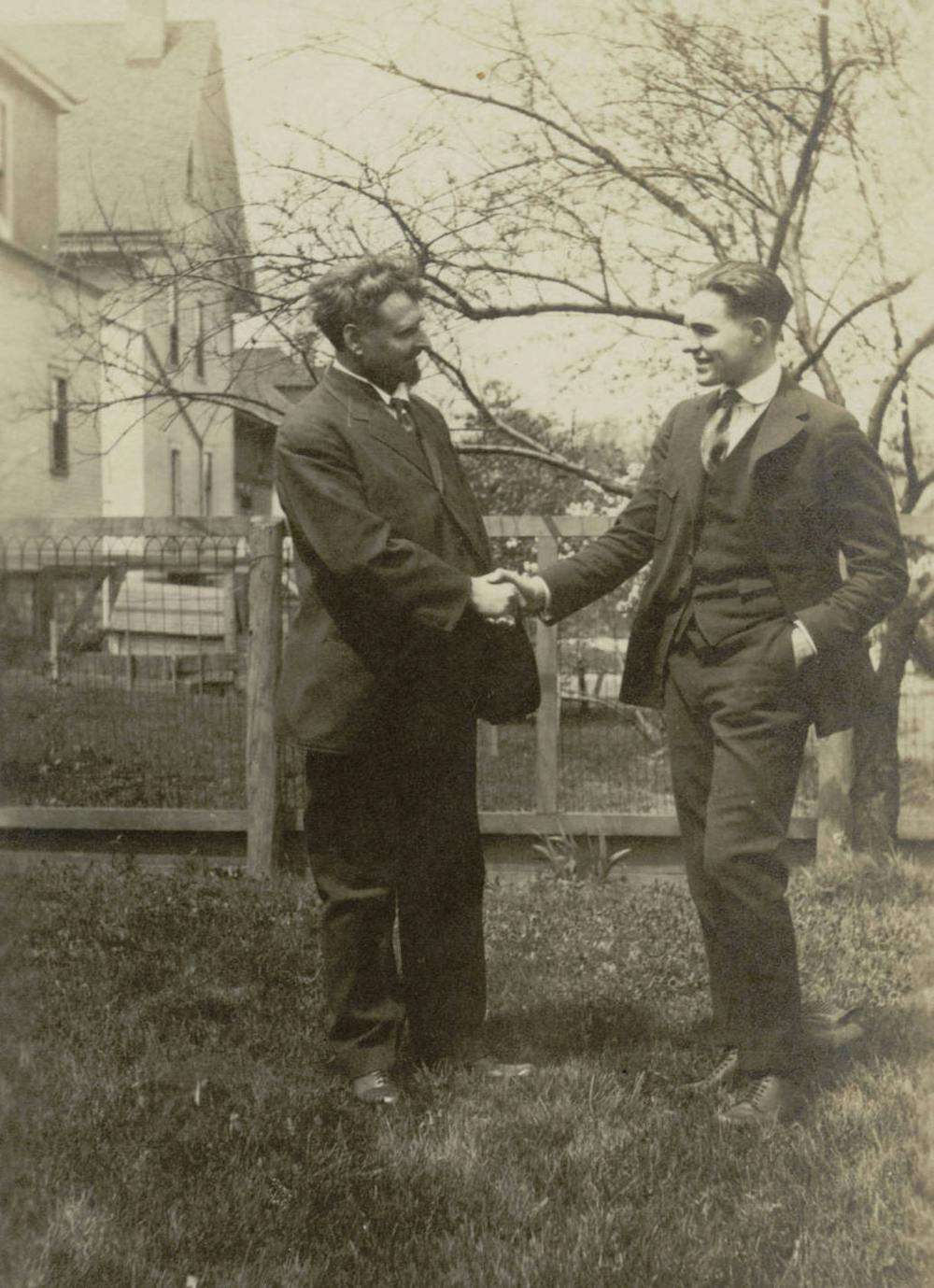
Clarence Edmonds Hemingway and Ernest Hemingway in Oak Park, Illinois, circa 1917-1918. Ernest Hemingway Foundation of Oak Park/Oak Park Public Library, Oak Park, Illinois., Author provided
Nick is surprised when his son starts to speak to him because he “had felt quite alone” even though “this boy had been with him.” As if reading his father’s thoughts, the boy wonders, “What was it like, Papa, when you were a little boy and used to hunt with the Indians?’”
Hemingway’s letters show that another story in the collection, “A Day’s Wait,” was inspired by Bumby’s bout with influenza in the fall of 1932. It is a seemingly lighthearted story about a young boy’s misunderstanding of the differences between the centigrade and Fahrenheit scales of temperature. Like Bumby, the protagonist, “Schatz” – one of Bumby’s other nicknames, a term of endearment in German – attends school in France but is staying with his father when he becomes ill. Schatz had learned at school that no one can survive a temperature of 44 Celsius, so, unbeknownst to his father, he spends the day waiting to die of his fever of 102 Fahrenheit.
But there is more to this story than the twist. “You don’t have to stay in here with me, Papa, if it bothers you,” the boy tells him. “It doesn’t bother me,” his father replies. He unwittingly leaves his son to believe, for an entire day, not only that the boy is going to die, but that his death is of no importance to his father.
In this slight story – one of those stories he told Perkins was written “absolutely as they happen” – we find an unexpected Hemingway hero in the form of a nine-year-old boy who bravely faces death alone.
Though he once wrote that he wanted “Winner Take Nothing” to make “a picture of the whole world,” Hemingway also seemed to understand that no one ever truly knows the subjective experience of another, not even a father and son.










 At the BookShelf
You must be logged in to post a comment.