

Unknown's avatar

From Twitterbots to VR: 10 of the best examples of digital literature


The computer offers a wealth of possibilities to the writer.
Shutterstock

David Thomas Henry Wright, Murdoch University

These days all text is digital. From writing an email to publishing a new edition of War and Peace, text nearly always exists on a computer first. Yet there are writers who take full advantage of the computer’s possibilities, utilising new technologies to broach complex subject matter.

Electronic or digital literature does not refer to e-books, but to works that depend on electronic “code” to exist. Put simply, you can print an e-book, but you cannot print electronic literature.

Within the field there is emphasis on experimentation. Many works are the result of authors simply trying new things out and seeing what happens. Here, then, are ten significant works of electronic literature you should know about.


Read more:
When books go digital: The Kills and the future of the novel


A digital love story

Alan Bigelow’s How to Rob a Bank reinvents Bonnie and Clyde for the digital age. It can be viewed on a smart phone or in-browser. Users swipe the touchscreen or hit the space bar to reveal a narrative told through iPhone web searches, text messages, and app activities.

Critiquing a classic

Digital poet Benjamin Laird wrote Core Values in response to Dorothea Mackellar’s classic Australian poem My Country. Laird’s work is displayed in a three-dimensional box, viewed in-browser or using a virtual reality headset.

Text is broken, animated, and infused with geographical coordinates and data.
Unlike Mackellar’s “sweeping plains”, “mountain ranges”, and “flooding rains”, Laird’s poem evokes claustrophobia. It critiques Mackellar’s poem, creating an Australia where the reader feels trapped.
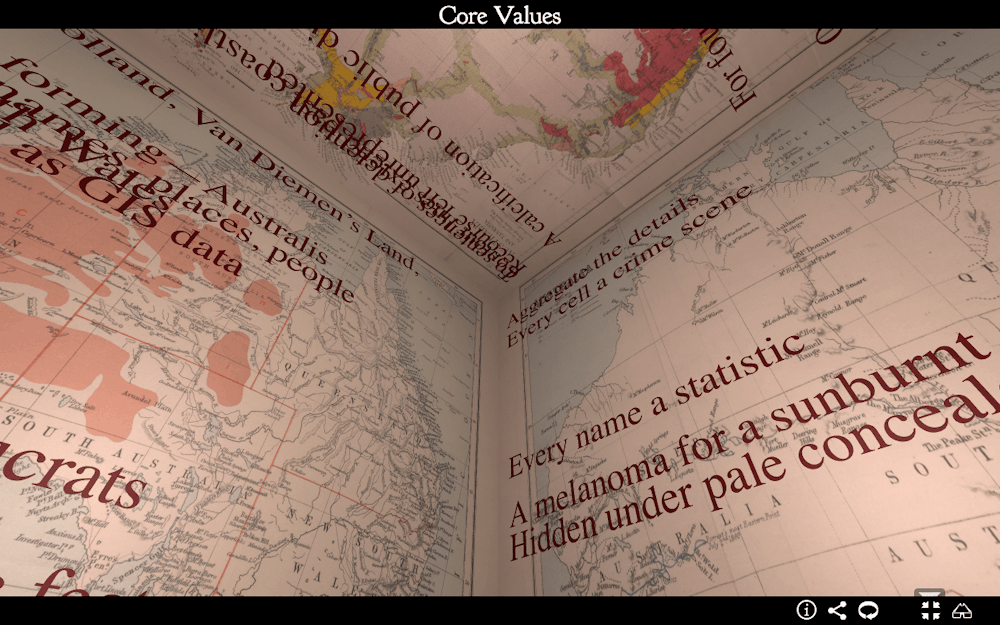
Benjamin Laird’s Core Values critiques the classic Australian poem My Country.
Courtesy the artist

Rewriting AI

Montréal-based David Jhave Johnston produced ReRites, using artificial intelligence trained to imitate contemporary poetry. The AI generates text which is then edited by Jhave. Recordings show this process in real time.

Jhave’s ReRites.

Twitterbots

Piotr Marecki’s Cenzobot is a Twitter “bot” (an automatically generated Twitter account) that tweets fragments from real Polish censors’ reviews of publications from the communist era.

Marecki conceived of this project following the Twitter Bot Purge of February 2018. He suspects Cenzobot will also be purged. Indeed, it is the goal of his work.

An environmental statement

T⁠h⁠e⁠ ⁠t⁠e⁠r⁠m⁠ “c⁠l⁠o⁠u⁠d⁠”⁠ computing ⁠emerged⁠ ⁠b⁠e⁠c⁠a⁠u⁠s⁠e⁠ ⁠⁠c⁠l⁠o⁠u⁠d⁠s⁠⁠ ⁠a⁠r⁠e⁠ ⁠p⁠e⁠r⁠c⁠e⁠i⁠v⁠e⁠d⁠ ⁠t⁠o⁠ ⁠b⁠e⁠ ⁠i⁠n⁠f⁠i⁠n⁠i⁠t⁠e⁠ ⁠r⁠e⁠s⁠o⁠u⁠r⁠c⁠e⁠s⁠. However, neither type of cloud is infinite, and few people acknowledge the energy used by large data centres. J.R. Carpenter’s The Gathering Cloud tackles the environmental impact of “cloud” computing by calling attention to the clouds above us.

Fragments from Luke Howard’s 1803 Essay on the Modifications of Clouds are pared down to produce Carpenter’s poetic verses with hypertext links that users can interact with.

The poetry is accompanied by animations of animals, which bridge the link between clouds in the sky and “cloud” computing. A cumulus cloud weighs as much as 100 elephants. By indicating 100 elephants in animation, the full weight of “cloud” computing’s environmental impact is evoked.
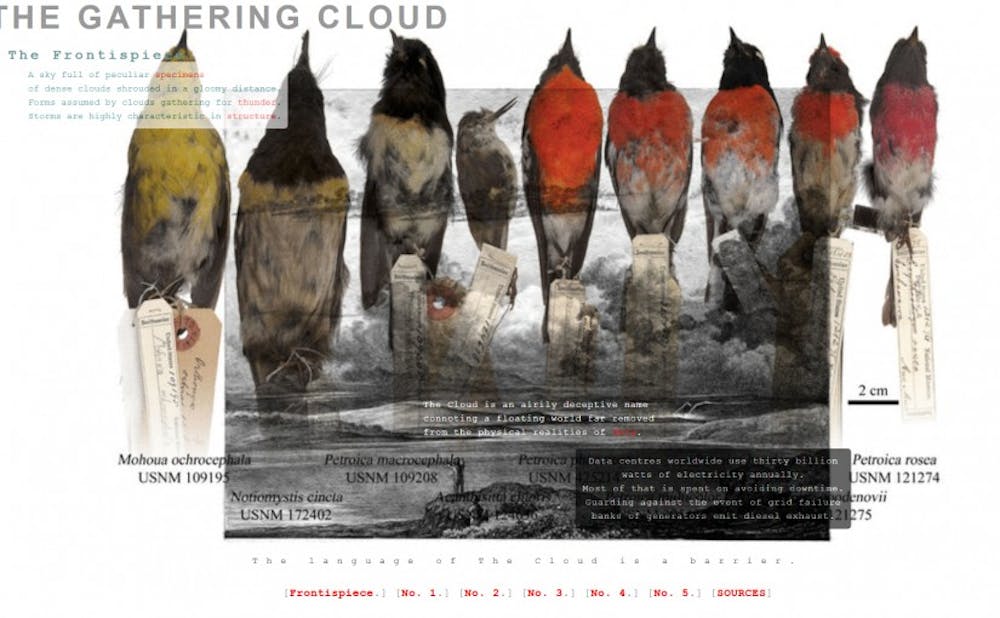
J.R. Carpenter’s The Gathering Cloud explores the environmental impact of cloud computing.
Courtesy the artist

Political speech

A Dictionary of the Revolution by Amira Hanafi is an experiment in multi-vocal storytelling. Hanafi created a vocabulary box containing colloquial Egyptian words. Hundreds of voices were then asked to define the evolving language of the Egyptian revolution.

Choosing cards from the box, subjects discussed what the words meant to them and how the words’ meanings had changed. This research informed the project that includes woven imagined dialogues around each term.

Users click on the word to learn the story behind its meaning. Each word is connected to several others, forming a linguistic maze users are encouraged to get lost in. A Dictionary of the Revolution is available in both Arabic and English.
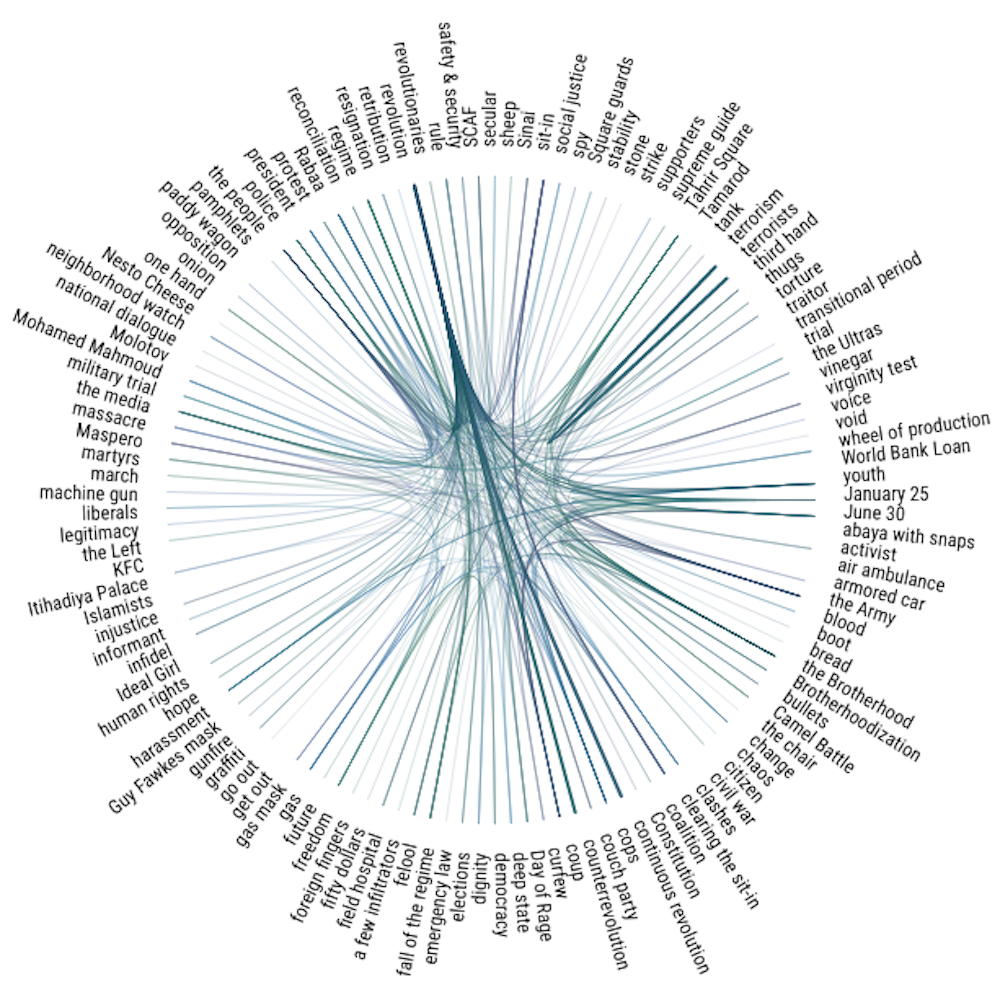
Amira Hanafi’s A Dictionary of the Revolution explores the language of the Egyptian revolution.
Courtesy the artist

A novel idea

novelling by Will Luers, Hazel Smith, and Roger Dean is a novel combining text, video, and audio, available to read on a computer.

The work arranges media fragments in six-minute cycles to suggest a narrative between four characters. The interface changes every 30 seconds, or whenever the user clicks the screen, creating an ever-evolving story.

Robot interaction

The Listeners by John Cayley is a third-party app that creates a work of spoken, interactive literature. It builds on the infrastructure of the domestic robot “Alexa” (it is also possible to experience The Listeners using a smartphone and the Alexa app).

The user begins by addressing Alexa, saying: “Alexa, ask The Listeners.” The Listeners responds, listening and speaking in its own way. The user may extend the performance by saying “Continue” or “Go on” or “I am filled with anger”. This work explores themes of surveillance, and the very notion of allowing a domestic robot such as Alexa into one’s home.

Poetry/fiction hybrids

Jason Nelson’s Nine Billion Branches is a poetic narrative accessed online. Each page has numerous arrows, poems, and highlighted areas to read, play, and explore.

Nine Billion Branches is preoccupied with the poetry of the immediate world. Poetry exists beside photographs of escalators, garbage bins, and bedside tables. Much of Nelson’s recent work exists beyond the web, sometimes projected onto real buildings or landscapes.

Virtual reality

In the past decade, Mez Breeze has merged digital literature with virtual reality. In 2017, she created the virtual reality Poem/Experience Our Cupidity Coda, which can be viewed online or with a virtual reality headset.

This work emulates the conventions of early cinema. Just as early motion picture devices had the viewer look through a peephole window, the viewer (or reader) of Our Cupidity Coda is encouraged to treat the virtual reality headset in the same way.The Conversation

David Thomas Henry Wright, PhD Candidate, Murdoch University

This article is republished from The Conversation under a Creative Commons license. Read the original article.

Unknown's avatar

A Look at Some Bookshelves


The link below is to an article that takes a look at 28 unique bookshelves currently on the market.

For more visit:
https://bookriot.com/2019/06/10/unique-bookshelves/

Unknown's avatar

Kindle Update


The links below are to articles reporting on the latest updates to the Kindle firmware/software.

For more visit:
https://blog.the-ebook-reader.com/2019/07/09/kindle-software-update-5-12-1-released/
https://the-digital-reader.com/2019/07/09/kindle-firmware-update-5-12-1-released/

Unknown's avatar

Merky Books Awards


The link below is to an article that takes a look at the winners of new #Merky Books Awards.

For more visit:
https://www.theguardian.com/books/2019/jun/06/stormzys-prize-for-new-writers-reveals-inaugural-winners

Unknown's avatar

Barnes and Noble to Be Sold


The link below is to another report on Barnes and Noble agreeing to be sold.

For more visit:
https://goodereader.com/blog/bookselling/barnes-and-noble-agrees-to-be-sold

Unknown's avatar

Kobo Online Community


The link below is to an article that reports on Kobo developing an online community which should launch in 2020.

For more visit:
https://goodereader.com/blog/kobo-ereader-news/kobo-is-developing-an-online-community-that-will-launch-in-2020

Unknown's avatar

2019 Watty Awards


The link below is to an article reporting on the 10th anniversary of the Watty Awards.

For more visit:
https://goodereader.com/blog/indie-author-news/wattpads-10th-anniversary-watty-awards-now-open

Unknown's avatar

2019 IndieReader Discovery Awards


The link below is to an article reporting on the winners of the 2019 IndieReader Discovery Awards.

For more visit:
https://goodereader.com/blog/indie-author-news/indiereader-announces-winners-of-9th-annual-ir-discovery-awards

Unknown's avatar

The English language is evolving – here’s how it will change after Brexit


shutterstock

Emma Seddon, Newcastle University

Britain is facing an uncertain future and an uneasy relationship with Europe after Brexit. Among other things, the country’s woeful inability to learn languages has been raised as a key stumbling block – with the decline in foreign language learning among school and university students across the UK also raising alarm.

English is one of the official languages of the EU, along with 22 others, and also one of the three working languages of its institutions (with German and French). On top this, English is the most commonly taught foreign language in Europe, which is a major factor in why it is the most commonly used working language. Although not everyone is happy about this, including the French EU ambassador who recently walked out of a meeting on the EU budget when the Council decided to use only English translations.

So, even if Britain leaves the EU, English will remain not only an official language –- because of the member status of Malta and Ireland –- but it will likely also remain the principal working language of the EU institutions.

English is also often used globally as a common language between speakers of different languages. In other words, conversations are happening in English that do not involve native English speakers. This, of course, has a long and fraught colonial past – as the British Empire forced English on its colonies. But the decline of the Empire did not mean the decline of English. On the contrary, as the US rose to be a global economic power, globalisation drove the spread of English across the world – and continues to do so. And the European Union is no exception.

‘EU English’

As part of my ongoing PhD research on the translation profession, I interviewed some British translators working at the European Commission. From their perspective, English will remain the principal working language following Brexit, as switching to only French and German, or adding another language would be unrealistic and require a huge investment in training by the EU. Instead, they report that English will continue to be used, and will simply evolve and change in these settings.

So-called “EU speak” is an example of this. Non-native speakers’ use of English is influenced by their native languages, and can result in different phrasing. For example, within the EU institutions, “training” is often used as a countable noun, meaning you can say: “I’ve had three trainings this week”. In British English, however, it is uncountable, meaning you would probably say something like: “I’ve had three training sessions this week”.

This is a minor linguistic point, but it shows how English is changing within the EU institutions due to the influence of non-native speakers. For the time being, native English speaking translators and editors limit the extent of these changes – particularly in documentation intended for the public.

But if Britain leaves the EU, there will be a dramatically reduced pool of native English speakers to recruit from, because you need to have an EU passport to work in the institutions. As people retire, fewer native speakers will work in the EU, meaning they will have less and less influence on and authority over the use of English in these contexts. This means “EU English” will likely move away from British English at a faster pace.

Englishes and linguistic change

Such change is nothing new – especially with English. “Singlish” or Singaporean English has its roots in colonial rule and has since become independent from British English, integrating grammar and vocabulary from languages that reflect Singapore’s immigrant history – including Malay, Cantonese, Mandarin, and Tamil among others. Singlish has developed its own words and expressions out of this hybrid of languages and has evolved and shifted in response to the migrations of peoples and cultures, new technologies and social change.

Only time will tell whether “EU English” will ever move so far from its moorings. But, according to one translator I spoke to, even if Britain were to stay in the EU, English would continue to change within the institutions:

English doesn’t belong to us anymore as Brits, as native speakers, it belongs to everyone.

And the frequent exposure to and use of English in daily life means other language communities are increasingly gaining a sense of ownership over the language.

The ubiquity of English is sometimes touted as a demonstration of the enduring importance of Britain – and the US – on the world stage. From what I have seen researching translation, this assumption in fact shows how complacent English speaking countries have become.

This does not mean the economic, cultural, and military power of these countries should be dismissed. But this doesn’t change the fact that English is used as a common language in interactions that do not involve any of those countries – take, for example, a Slovenian cyclist being interviewed in English by a French journalist about his performance in the Italian cycling event Giro d’Italia.

Linguistic diversity certainly needs to be championed to ensure we do not lose humanity’s great variety of languages and dialects, and some great work is being done on this. Nevertheless, it is clear that English has developed a role distinct from its native speakers as a shared language that facilitates communication in an increasingly globalised world.The Conversation

Emma Seddon, PhD Candidate in the School of Geography, Politics and Sociology, Newcastle University

This article is republished from The Conversation under a Creative Commons license. Read the original article.

Unknown's avatar

Calibre Now Supports the Nook Glowlight Plus


The link below is to an article reporting on Calibre now supporting the Nook Glowlight Plus.

For more visit:
https://goodereader.com/blog/barnes-and-noble-nook-ereader-news/calibre-now-has-support-for-the-nook-glowlight-plus-7-8