Unknown's avatar

Nawal El Saadawi’s intellectual life reflected eight decades of Arab society and culture


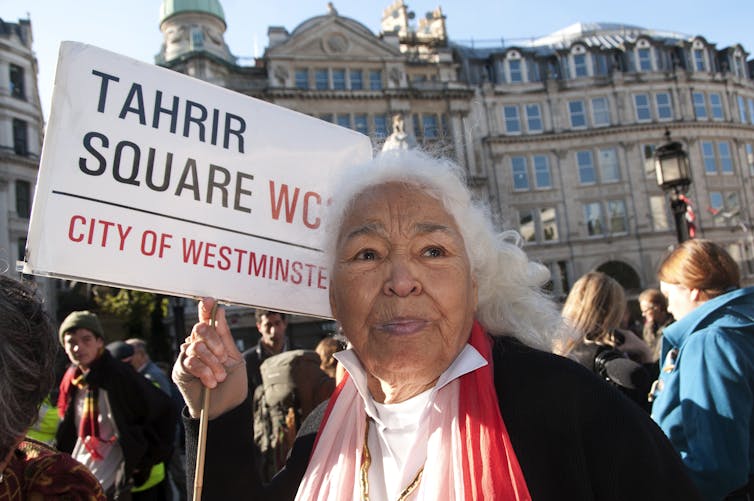
El Saadawi protesting on her 80th birthday.
In Pictures Ltd./Corbis via Getty Images

Amal Amireh, George Mason University

Egypt’s Nawal El Saadawi was the foremost Arab feminist thinker of the past 50 years. Her ideas inspired generations of Arab women, but also provoked controversy and criticism.

She was prolific, publishing over 50 books of fiction and non fiction in Arabic, many translated and receiving global attention.

Focusing on sex, politics, and religion, El Saadawi believed that patriarchy, capitalism and imperialism are intertwined systems that oppress Arab women and prevent them from reaching their full potential.

The trajectory of El Saadawi’s intellectual life follows major developments in Arab society and culture from the 1940s to the present. To understand her contribution, it’s important to see her in the context of the historical moment that made her work possible, necessary and provocative.

Born into change

Born in 1931 in the village of Kafr Tahla near Cairo, into a middle class family, El Saadawi was the second of nine children. She came of age at the cusp of key changes such as the drive for girls’ education pioneered by an earlier generation of activists. She, in fact, attended a school established by Nabawyya Mousa, an activist for women’s education.

Supported by a father who believed in the importance of education for social mobility, El Saadawi attended the British School. Her academic excellence allowed her to evade early marriage and receive a scholarship to study medicine at the University of Cairo. She graduated in 1955 with a specialisation in psychiatry.


Read more:
Nawal El Saadawi: Egypt’s grand novelist, physician and global activist


At university she was exposed to nationalist, anti-colonialist politics. She participated in student demonstrations against the British and married a fellow activist. They had a daughter but divorced. Her second marriage ended in divorce after her husband stipulated she stops writing. Her third marriage, to Sherif Hetata a novelist and former political prisoner, lasted over 40 years but also ended in divorce. They had a son.

After medical school, El Saadawi returned to her village. Working as a countryside physician exposed her to class and gender inequities that further shaped her thinking. She witnessed first hand the harmful consequences of entrenched patriarchal practices such as female genital cutting and defloration inflicted on the bodies of poor village women, detailing some of her experiences in Memoirs of a Woman Doctor (1958).

Travels around the world

In 1963, she was appointed director general for public health education and was able to travel to international forums and conferences. These travels, documented in My Travels Around the World (1991), gave her perspective on the struggles of other women. She always asserted that patriarchy is a universal system of oppression, not only restricted to Arab or Muslim societies.

Thus while she did not hesitate to call female genital cutting “barbaric” she also resisted its sensationalisation in the West as a mark of difference between first world and third world women. She insisted that all women are circumcised if not physically then “psychologically and educationally”. She rejected the idea that western women are needed to help liberate their Arab or African sisters.

But it was the 1967 Six-Day War that pushed El Saadawi to a more radical public position regarding gender. This crushing Arab military defeat by Israel created a crisis for Arab intellectuals generally, compelling them to take a surgical look at their societies.

Feminist manifestos

El Saadawi believed that patriarchy and gender inequalities are root causes for Arab defeatism. She rose to fame in the 1970s with a series of feminist manifestos that put her on the map. Women and Sex (1971) was the first. In it, she condemned the violence committed against women’s bodies including virginity tests, honour killings, wedding night defloration and genital cutting.

A woman looks directly to camera, her white hair done in dramatic fashion, her lips appear to be talking.
El Saadawi in 1986.
Anthony Lewis/Fairfax Media via Getty Images

She exposed her society’s ignorance and double standards regarding women’s bodies and sexuality. Her first chapter, for instance, was focused on the clitoris and its importance for women’s sexual pleasure. She argued that exploitative marriages are no different from prostitution.

Using her medical knowledge, she argued that differences between the sexes are not natural but socially constructed by patriarchal practices – and can therefore be changed through legislation and education. However, she insisted that gender justice will not be possible under a capitalist society. Soon after publication, she lost her job and the magazine she had founded was closed down.

But the positive reception of her work among the public encouraged her to write other polemics including The Female is the Origin (1974), Woman and Psychological Struggle (1976), Man and Sex (1976) and The Hidden Face of Eve (1977). Combining anecdotes of patients, her biography, medical and social research and polemic against gender injustice, she spoke with the authority of a physician, the knowledge of an intellectual and the passion of an injured woman.

The power of fiction

El Saadawi viewed herself first and foremost as a novelist, using fiction to express many of her ideas regarding sex and society. Her first novel to attract attention, for example, was Woman at Point Zero (1983). Her main character, working class Firdaus, experiences sexual exploitation and assault and eventually is executed by the state for killing her pimp.

While she made significant contributions to the Arab feminist novel, El Saadawi’s fiction was received less enthusiastically than her other work, criticised for being repetitive and her female characters dismissed as one-dimensional.

Religious backlash

But the creativity of fiction allowed a space to critique another taboo in Arab society – religion. Her later works were written in response to a religious backlash that had taken over public life in Egypt and beyond.

In The Fall of the Imam (1987), for instance, she condemns the patriarchal regime of President Anwar el-Sadat for using the authority of religion to shore up political legitimacy and marginalise dissidents. The novel was banned by Al Azhar, Egypt’s highest religious authority. In it and God Dies by the Nile (1985), the El Saadawian heroine kills the male authority figures who use religion to oppress them.

In The Innocence of the Devil (1994), El Saadawi goes further: she makes God and the Devil characters in a mental asylum and directly indicts both Islam and Christianity as oppressive of women. Her critique of religion made her an easy target for fundamentalists in Egypt. Her hostility to political Islam was rooted in the personal experience of censorship and death threats.

Her critiques also alienated two other kinds of readers: self-identified Muslims and liberal western academics. As religion was playing a more prominent role in public life in Egypt, many found her views too radical.

For her dissent, she paid a price. In 1981 she was thrown in jail by the Sadat regime along with a thousand other intellectuals. There she wrote Memoirs from the Women’s Prison (1986) using an eye pencil smuggled to her by a sex worker on toilet paper given to her by a murderer.

After her release, she formed The Arab Woman Solidarity Association. It was closed down by Hosni Mubarak’s government in 1991. Unwaivering, she ran against Mubarak in the 2004 presidential elections. During the 2011 uprising that deposed Mubarak, El Saadawi, in her 80s, held seminars in tents in Tahrir Square to radicalise a new generation.

This article is based on Amireh’s chapter in the book Fifty-One Key Feminist Thinkers (Routledge).The Conversation

Amal Amireh, Associate professor, George Mason University

This article is republished from The Conversation under a Creative Commons license. Read the original article.
Unknown's avatar

Nawal El Saadawi: Egypt’s grand novelist, physician and global activist


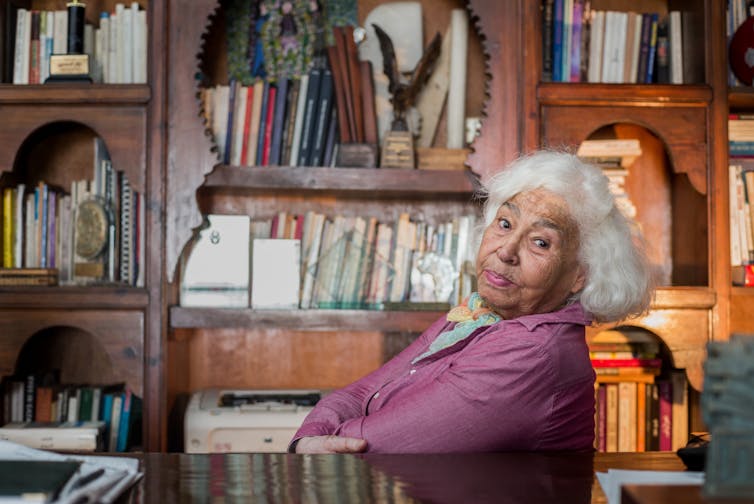
Nawal El Saadawi at home in 2015.
David Degner/Getty Images

Adele Newson-Horst, Morgan State University

Egyptian novelist, physician, sociologist and global activist Nawal El Saadawi died on 21 March 2021 at the age of 89. The author of more than 50 books, she told me in one of our many interviews, in 2007, that she self-identified as

an African from Egypt, not from the Middle East … I am not from the third world. There is one world, that is a racist, capitalist economic world. I became a feminist when I was a child – when I started to ask questions to become aware that women are oppressed and feel discrimination.

Although her autobiography A Daughter of Isis (1986) is among the best known of her publications world-wide, she identified her vocation as that of a novelist: “I am mainly a novelist. Most of my books are novels.”

The novelist

In fact, she was always writing a novel. Her 2004 work titled The Novel begins: “The novel caused tremendous outrage … Her life became her first novel.”

Arguably, the place to start in the evaluation of her works is what she deemed the function and perimeters of the novel. She wrote all her novels in Arabic. When asked about the translations of her works, she responded:

Can you translate music? So you can’t translate novels. At least 30% of of the spirit of the work goes. Language is body, spirit, mind … You dream in your (native) language.

Yet she conceded that she wrote essays in English.

El Saadawi was a global iconoclast in the best sense of the phrase. In a world that has become compartmentalised, tribal, overtly racist, anti-science and unashamedly sexist, her novels espoused truths that made her unpopular with many in government and in the so-called establishment. Asked if there was one politician she respected, she explained, “In a system based on oppression, an angel will be corrupted. I don’t have in mind anyone who kept his promise.”

Her penchant for looking at a situation and calling out its components – even though they were shrouded in deceptive marketing – was remarkable. She once confessed to me, “If I don’t tell the truth, I don’t deserve to be called a writer.” She admitted in her autobiography:

Memory is never complete. There are always parts of it that time has amputated. Writing is a way of retrieving them, of bringing the missing parts back to it, or making it more holistic. If memory involves the recall of the things that happened, then the way to render a thing is to draw on creative thoughts.

A scientist and an artist

El Saadawi believed that to be whole – to recover the missing parts – one must embrace the science as well as the artistic and creative. She said:

I am a medical doctor … immersed in blood. I’d rather be with healthy people. I wanted to be a dancer. My father said, ‘Dancing means prostitution.’

Learning from such contradictions early on, El Saadawi became subversive in life and distinctly political in her writings. People have identified her works as political fiction and biographical fiction. To do so is to ignore the art or creativity of her writing. A more prudent evaluation would rest with the marriage of the politics of her life and the creativity that inspired her soul.

An elder woman in pigtails waves at the camera, standing in front of a sports field.
El Saadawi in her US years, at Morgan State University.
Courtesy Adele Newson-Horst

There is a clinical aspect to her writings. She relentlessly focuses on the issues without the trappings of romantic love and sentimentality. That is the key to evaluating and enjoying her works.

She admitted that she had been nominated for the Nobel Prize in Literature a couple of times, “but people don’t like my politics”. In a 2012 interview in Baltimore, El Saadawi told me:

I’m proud of myself. Not because I did fantastic things, but because I never changed. People usually compromise. I’m proud because I didn’t compromise.

This insistence on sharing her view of the truth on the condition of women, religion and politics is the key to the continued interest in her works. She never compromised because in many ways the condition of women globally has not much changed and because there is an ethos that persistently governs women, that, she believed, demanded unequivocal attention.

The life

El Saadawi was born in 1931 in a village outside of Cairo. She refused to accept the limitations imposed on her by the religious, gender and colonial oppression most women of rural origin experienced.

She attended the University of Cairo and graduated in 1955 with a degree in psychiatry and rose to become Egypt’s Director of Public Health. Since she began to write over 50 years ago, her books – including the play God Resigns at the Summit Meeting (2006) have concentrated on women, specifically on Arab women, their sexuality and legal status.

In 1972, her first work of non-fiction Women and Sex evoked the antagonism of highly placed political and theological authorities in Egypt and the Ministry of Health was pressured into dismissing her. Under similar pressures, she lost her post as chief editor of a health journal and as assistant general secretary in the Medical Association of Egypt.

Fame and jail

From 1973 to 1976 El Saadawi researched women and neurosis. In 1977, she published her most famous work The Hidden Face of Eve, which covered a host of topics relative to Arab women such as aggression against female children and genital mutilation, prostitution, sexual relationships, marriage and divorce and Islamic fundamentalism.

From 1979 to 1980 she was the United Nation’s advisor for the women’s program in North Africa and the Middle East. Later in 1980, as a culmination of the long war she had fought for Egyptian women’s social and intellectual freedom, she was imprisoned under the Anwar Sadat regime. She was released in 1982 and in 1983 she published Memoirs from the Women’s Prison in which she continued her bold attacks on the repressive Egyptian government. The year 1983 also marked the year that the English version of Woman at Point Zero was published after appearing in Arabic in 1975.

Two women, one younger and one older, stand facing the camera, smiling.
The author, right, with El Saadawi.
Courtesy Adele Newson-Horst

Even after her release from prison, El Saadawi’s life was threatened by those who opposed her work, mainly Islamic fundamentalists. Armed guards were stationed outside her home in Giza for several years until she left the country to be a visiting professor at European and North American universities.

She devoted her time to being a writer, journalist and worldwide speaker on women’s issues. In 2002, officials tried to forcefully divorce her from her husband, but international solidarity helped her to win her case. In 2004 she presented herself as a candidate for presidential election in Egypt. Then in 2007, the controversy of her play God Resigns at the Summit Meeting erupted. She said that those who condemned her hadn’t even read the play.

This was the power of Nawal El Saadawi, that her books – coldly scientific and endlessly creative – were seen as weapons in a war that is still to be won.

Newson-Horst has published two edited volumes on Nawal El Saadawi. They are The Dramatic Literature of Nawal El Saadawi (2009) and The Essential Nawal El Saadawi: A Reader (2010).The Conversation

Adele Newson-Horst, Professor, Morgan State University

This article is republished from The Conversation under a Creative Commons license. Read the original article.

Unknown's avatar

How a mass suicide by slaves caused the legend of the flying African to take off


Like the best myths, the tale of Igbo Landing and the flying African seems to transcend boundaries of time and space.
Victor_Tongdee/iStock via Getty Images

Thomas Hallock, University of South Florida

In May 1803 a group of enslaved Africans from present-day Nigeria, of Ebo or Igbo descent, leaped from a single-masted ship into Dunbar Creek off St. Simons Island in Georgia. A slave agent concluded that the Africans drowned and died in an apparent mass suicide. But oral traditions would go on to claim that the Eboes either flew or walked over water back to Africa.

For generations, island residents, known as the Gullah-Geechee people, passed down the tale. When folklorists arrived in the 1930s, Igbo Landing and the story of the flying African assumed a mythological place in African American culture.

Though the site carries no bronze plaque and remains unmarked on tourist maps, it has become a symbol of the traumatizing legacy of trans-Atlantic slavery. Poets, artists, filmmakers, jazz musicians, griots, novelists such as Toni Morrison and pop stars like Beyoncé have all told versions of the tale.

They’ll often switch up the story’s details to reflect different times and places. Yet the heart of the original tale, one of longing for freedom, beats through each of these retellings. The stories continue to resonate because those yearnings – whether they’re from the cargo hold of a sloop or the confines of a prison cell – remain just as intense today.

Sourcing the story

As an academic trained in literary history, I always look for the reasons behind a story’s origins, and how stories travel or change over time. Variations of the flying African myth have been recorded from Arkansas to Canada, Cuba and Brazil.

Yet even as the many versions cut across the Black diaspora, the legend has coalesced around a single place: St. Simons. An entry in the Georgia Encyclopedia makes a direct correlation between the 1803 rebellion mass suicide and the later, literary folkloric tradition.

Why? One reason is geographic.

St. Simons, part of the archipelago that stretches from Florida to North Carolina, long remained separate from the mainland United States. This isolation allowed African customs to survive, where elsewhere they were assimilated or vanished. Historian Melissa L. Cooper describes the Gullah-Geechee people as cultural conservators, tasked in popular culture with the duties of preservation.

A sticker celebrating the Geechee heritage is seen on a pickup truck as passengers board a ferry.
The Gullah-Geechee are descendants of enslaved people who reside on the Southeast coast of the U.S.
AP Photo/David Goldman

Serendipity also played a role in siting the story. When a causeway from mainland Brunswick to St. Simons was built in 1924, folklorists literally followed a paved route into the past. During the New Deal, the Works Project Administration funded an oral history project that involved interviewing formerly enslaved people, and the flying African story was recorded in “Drums and Shadows,” the classic volume that published interviews from the project.

One Works Project Administration interviewer recorded St. Simons raconteur Floyd White asking, “Heahd about Ibo’s Landing. Das duh place weah dey bring duh Ibos obuh in a slabe ship.”

They “staht singing and de mahch right down in duh ribbuh” – Dunbar Creek – and “mahch back tuh Africa.” But they never get home, White adds: “Dey gits drown.”

Floyd White is a key source on the flying African, though as the hackneyed written transcription of his interview suggests, questions linger. The Ebos, by his account, walk, rather than fly, across the water. White allows that he does not personally believe the myth; he says they drowned.

Stories change, song remains the same

The flying African, despite a genealogy rooted in St. Simons, has no single point of origin. A shifting present continues to rewrite the past. These differences across versions only underscore the strength of the myth’s central core.

Take how music is used. In almost every account of Igbo Landing, the Africans sing before they fly. They chant in a dialect of Bantu, one of Africa’s 500 languages: “Kum buba yali kum buba tambe, / Kum kunka yalki kum kunka tambe.” Those words don’t have a direct translation; the words, more often, get described as secret, magical or lost.

But since the 1960s, in many retellings, the Bantu has been updated to the hymn “Oh Freedom,” an anthem first recorded after the Civil War and later popularized during the civil rights movement.

The storyteller Auntie Zya recounts the Igbo Landing legend in a YouTube post. To make the tale more relevant to children today, she launches into the familiar refrain, “And before I’d be a slave,” using the hymn to bridge the myth and a long struggle for civil rights.

And then there’s Toni Morrison’s novel “Song of Solomon,” the very title of which links music and flight. In the story, the novel’s main character, Milkman Dead, pieces together mysterious lyrics to recover a hidden past. Once he understands the song, he leaps from a Virginia cliff and flies away. Or is it suicide? The ending is famously ambiguous.

Toni Morrison talks about how, as a child, she was inspired by stories of enslaved African people flying home to their freedom.

Healing through flight

Like all powerful myths, Igbo Landing and the flying African transcend boundaries of time and space.

Experimental filmmaker Sophia Nahli Allison perceives memories from Dunbar Creek as an “ancestral map.” In a poetic narrative she lays over a dance montage, she muses: “Dreams are reality, time is relative, and the past, present, and future are melding together.” Allison suggests that the cross-generational continuity of the myth nurtures her, sustaining her voice through centuries of violence.

Children’s author Virginia Hamilton, likewise, offers the flying African as a script for healing. Her most famous story, “The People Could Fly,” broaches the difficult subject of the Middle Passage, the leg of the slave trade in which Africans, tightly packed in slave ships, were transported across the Atlantic Ocean.

[You’re smart and curious about the world. So are The Conversation’s authors and editors. You can read us daily by subscribing to our newsletter.]

Hamilton explains why some Africans had to leave their wings behind when forced to America. “They couldn’t take their wings across the water on the slave ships,” she writes. “Too crowded, don’t you know.”

How does a culture get those wings back?

Where some storytellers linger over haunting images, such as the chains supposedly still heard in Dunbar Creek, artists such as Morrison, Allison and Hamilton look forward. Their stories lay the groundwork for recovery.

Hamilton presents “The People Could Fly” as a direct form of hope. In a preface to her collection of that title, she explains how tales “created out of sorrow” carry Black America forward. She reminds readers: “Keep close all the past that was good, and that remains full of promise.” A painful past must be summoned in order to be redeemed.

Igbo Landing starkly illustrated, in 1803, how the choice between slavery and death was not a choice at all. Slavery, sociologist Orlando Patterson wrote, was also social death.

But it’s important to remember that joy doubles as a form of decolonization. Music threads through every version of the flying African legend. Magic words propel fieldworkers into the sky, “Kum yali kum buba tambe.” In song, our spirits lift.

And who among us does not dream of flight?The Conversation

Thomas Hallock, Professor of English, University of South Florida

This article is republished from The Conversation under a Creative Commons license. Read the original article.

Unknown's avatar

A tribute to J.P. Clark, Nigeria’s nature poet


J. P. Clark was one of Nigeria’s most eco-conscious writers.
Ommoclark2020/Wikimedia

Chinonye Ekwueme-Ugwu, University of Nigeria

Everyone dies. Everything that has life must someday relinquish it. But that exit is never final. Plants and animals are generally converted into new states and reabsorbed into nature. Human beings remain alive in people’s memories for varying degrees of time. And if you leave a legacy behind, your life will truly begin after your physical death.

The passing of Nigeria’s foremost poet and playwright, Professor J.P. Clark on 13 October, 2020, has reinforced this belief.

Thousands of scholars and and readers who encountered him through his literature retain him in their memories. They also transfer his existence to future generations looking for excellence in the arts.

Throughout his exemplary life, Clark touched on various issues affecting the globe. He displayed a thorough knowledge of his world through his poems.

His writing explored politics, arts and the socio-cultural character of humans. His intimacy with nature, conveyed via his poems, has made him a favourite of eco-conscious readers.

Rich ecological imagery

Clark’s exploration of the intersection between our natural environment and literature is an inspiration to writers and critics. He often found ways to accommodate nature, even when he addressed the mundane issues within politics and academia. His viewpoints can be found in his poetry collections The Casualties and Incidental Songs for Several Persons. His poem, The Usurpation, is a great example.


Read more:
J.P. Clark: the ‘pepper’ of the Niger Delta activism stew


Clark’s constant ecological imagery shows great knowledge of, and strong attachment to, natural entities. In all their dealings, human beings operate within the natural realm, interacting with other non-human entities.

I read Clark’s poems in the 1980s. My favourites were Night Rain, Streamside Exchange and Abiku. The stories in those poems often excited feelings of empathy with the human characters.

I revisited those poems 35 years later and realised the crucial influence of the natural environment in his work. Many of his poems set in the riverine areas of Nigeria’s Niger Delta, “embody environmental metaphors, capable of projecting authentic African eco-lit” according to a study of “natural trajectories” in the poems.


Read more:
John Pepper Clark-Bekederemo: Nigeria’s bard, playwright and activist


His exploration of nature in his poems stimulates a romantic awareness of the African ecosystem, that goes beyond the current agitations of environmental justice in Nigeria. They project 21st century African literary traditions beyond the domains of activism.

Clark’s works are multifaceted. His attachment to his home region, coupled with his training in the arts and the humanities may have conditioned him towards exploring nature in his works. And he did so alongside other nagging socio-political and economic themes that he equally projected.The Conversation

Chinonye Ekwueme-Ugwu, Lecturer, University of Nigeria

This article is republished from The Conversation under a Creative Commons license. Read the original article.

Unknown's avatar

African science fiction: rereading the classic Nigerian novel The Palm-wine Drinkard


Shutterstock

Nedine Moonsamy, University of Pretoria

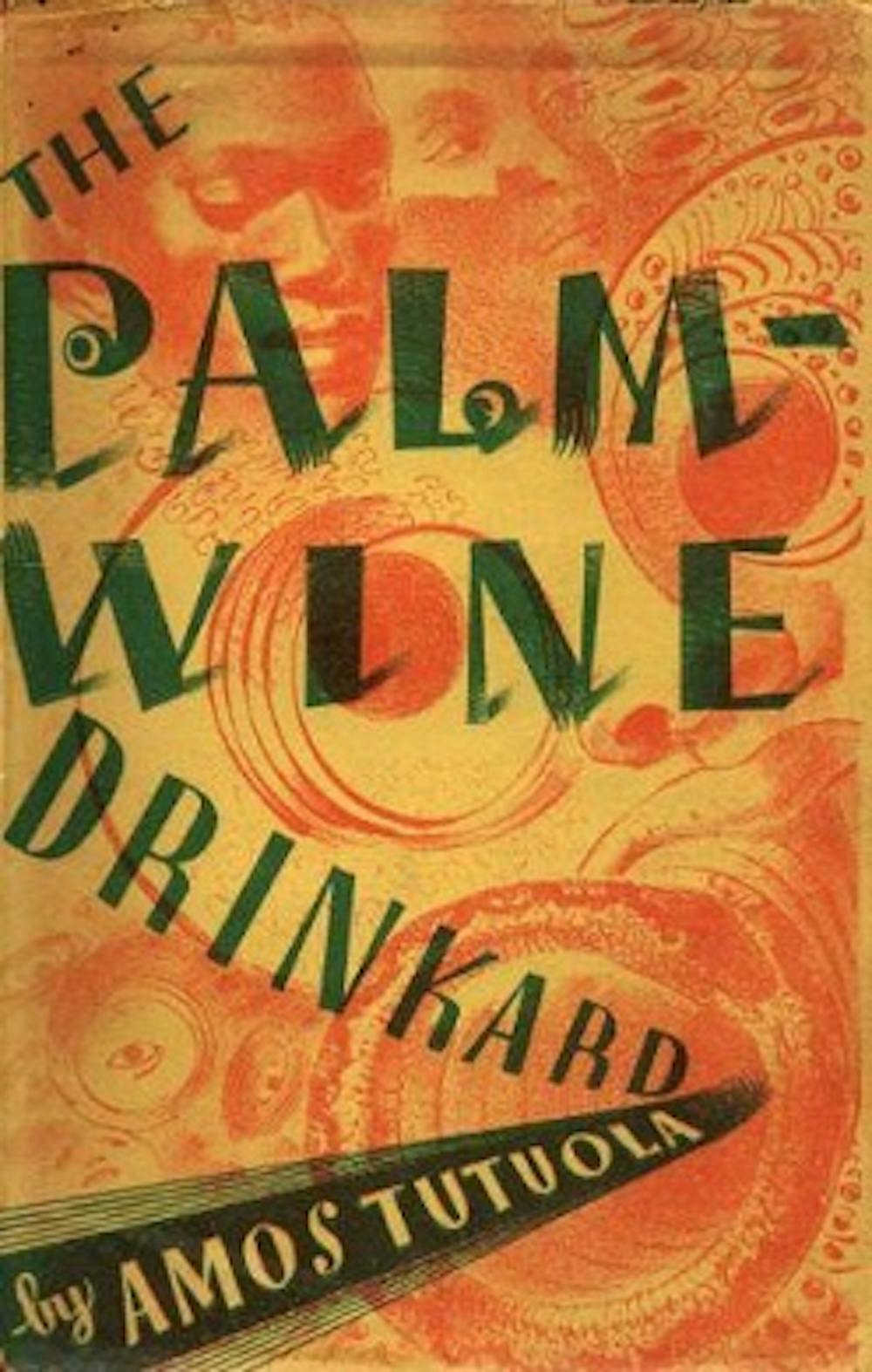
In 1952 The Palm-wine Drinkard became the first West African novel written in English to be published internationally. That it was written by Amos Tutuola, an unknown Nigerian clerk who took to writing to alleviate boredom, meant the book caused a stir. To this day, it’s celebrated as a key example of African fantasy.

But more recent analysis suggests that the Western view of Tutuola as a fantasy writer is slightly patronising, because it overlooks how seriously his work engages with African reality on its own terms.

Similarly, my reading of the novel explores how it is more suitably classified as a pioneering work of African science fiction than of fantasy. And a lot of that has to do with the way Tutuola uses language. Fantasy deals in the mythic and supernatural. Science fiction is an invention more grounded in reality. I suggest that the lazy appeal to African fantasy and folklore is in line with a longstanding dismissal of Africans as technological beings and, by extension, writers of science fiction.

What the book’s about

The Palm-wine Drinkard introduces us to the Drinkard, who passes his time drinking palm wine with his friends. The alcoholic drink is made from the sap of palm trees, collected by a tapster.

Then his beloved tapster dies after falling from a tree. No longer able to access palm wine, the Drinkard soon loses favour with his friends.

He resolves to bring the tapster back from the place where all dead souls go – Deads’ Town. He passes through many strange towns, meeting bizarre creatures on his journey before finally reuniting with his tapster. Only to learn that a dead person cannot leave Deads’ Town.

In black and white, a balding dark-skinned man looks frankly and openly at the camera.
Amos Tutuola.
Marcoslampert/Wikimedia Commons, CC BY-SA

Bereft, the Drinkard returns home. Having matured on his journey, he is no longer a nonchalant drunkard and demonstrates his newfound sense of civic duty by bringing an end to a famine in his village.

Western critics hailed The Palm-wine Drinkard as inventive and avant-garde. But Nigerian critics were puzzled and even embarrassed by Tutuola’s use of English. They argued no such English existed, even in a purely spoken form.

Putting the debate of literary quality aside, Tutuola’s striking use of language is undoubtedly sublime, able to transport the reader in ways that are necessary and expected for science fiction. He takes great pains to place his narrative within lived and believable African experience that is more in line with science fiction than fantasy.

Creating a sci-fi world

Samuel R. Delany is a luminary African-American science fiction writer and critic. For him, science fiction is able to “generate the infantile wonder” of the reader through language.

In his hallmark essay About 5,750 Words, he gives an insightful explanation of how science fiction is distinct from other types of fiction. Where realism tells what “could have happened” and fantasy explores what “could not have happened”, science fiction opens up space for events “that have not happened” yet.

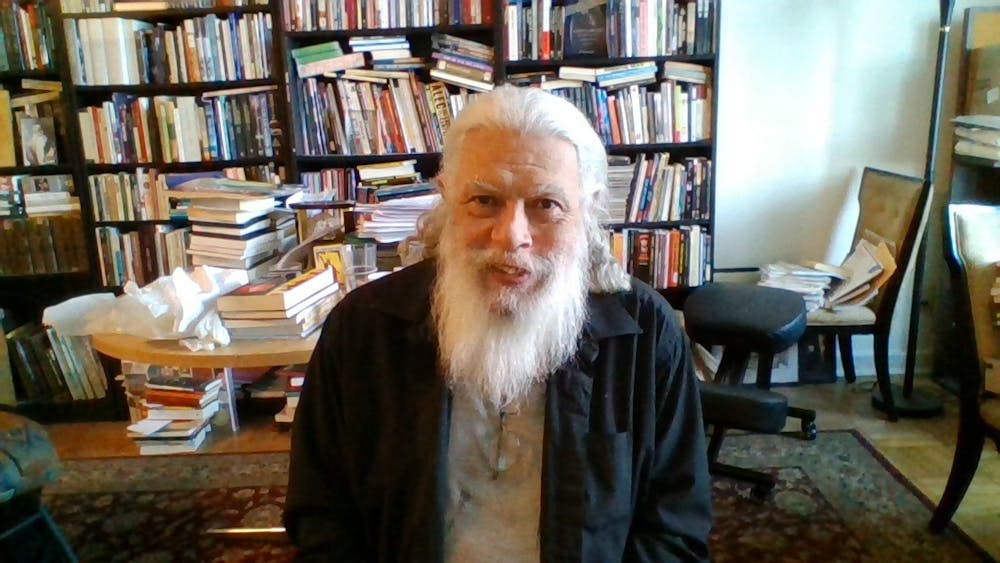
An older man with a huge white beard sits looking at camera, behind him a study and shelves of books.
Samuel R. Delaney, a self-portrait.
Samuel R. Delaney/Wikimedia Commons, CC BY-SA

Fantasy can travel anywhere, but science fiction approaches the world with an inventive attitude rather than a fanciful one. Science fiction can stretch outside our current world, but never to the extent of fantasy. As Delany explains, science fiction writers very carefully use language as part of a process that helps the imagination make the leap from our world into an alternative one.

Tutuola is invested in this balancing act: he stretches the limits of realism but also reins in the unlimited possibilities of fantasy. For example, the Drinkard explains that he and his wife became immortal because they “had ‘sold our death’ to somebody at the door for the sum of £70: 18: 6d and ‘lent our fear’ to somebody at the door as well on interest of £3: 10: 0d per month, so we did not care about death and we did not fear again”.


Read more:
Science fiction offers a useful way to explore China-Africa relations


Tutuola imagines a refreshing option where states of existence like death and anxiety – much like everything else in our consumerist culture – can be traded or rented and “worn” like clothing. Giving the exact amounts in British pounds marries something as familiar as shopping with the wondrous potential that we may one day discard existential inconveniences as easily.

A swirling orange and gold graphic book cover. In the background, African women's faces, with green lettering reading 'The Palm-wine Drinkard by Amos Tutuola.'
The 1952 edition.
Faber and Faber UK

For every fantastic suggestion, Tutuola provides a real-world equivalent. He places the most bizarre creatures within the limits of our current experience.

In the forest the Drinkard meets a creature whose two large eyes “were as big as bowls” and feet as “long and thick as a pillar of a house”. This reliance on similes or mundane comparisons is part of an effort to weave the fanciful into the reader’s reality.

The Palm-wine Drinkard uses language in ways that critics like Delany insist are universally crucial to science fiction.

African sci-fi and fable

Some contemporary appraisals of science fiction in Africa argue that the genre is rooted in indigenous fable and folklore and should be read on unique – exceptionalist – terms.

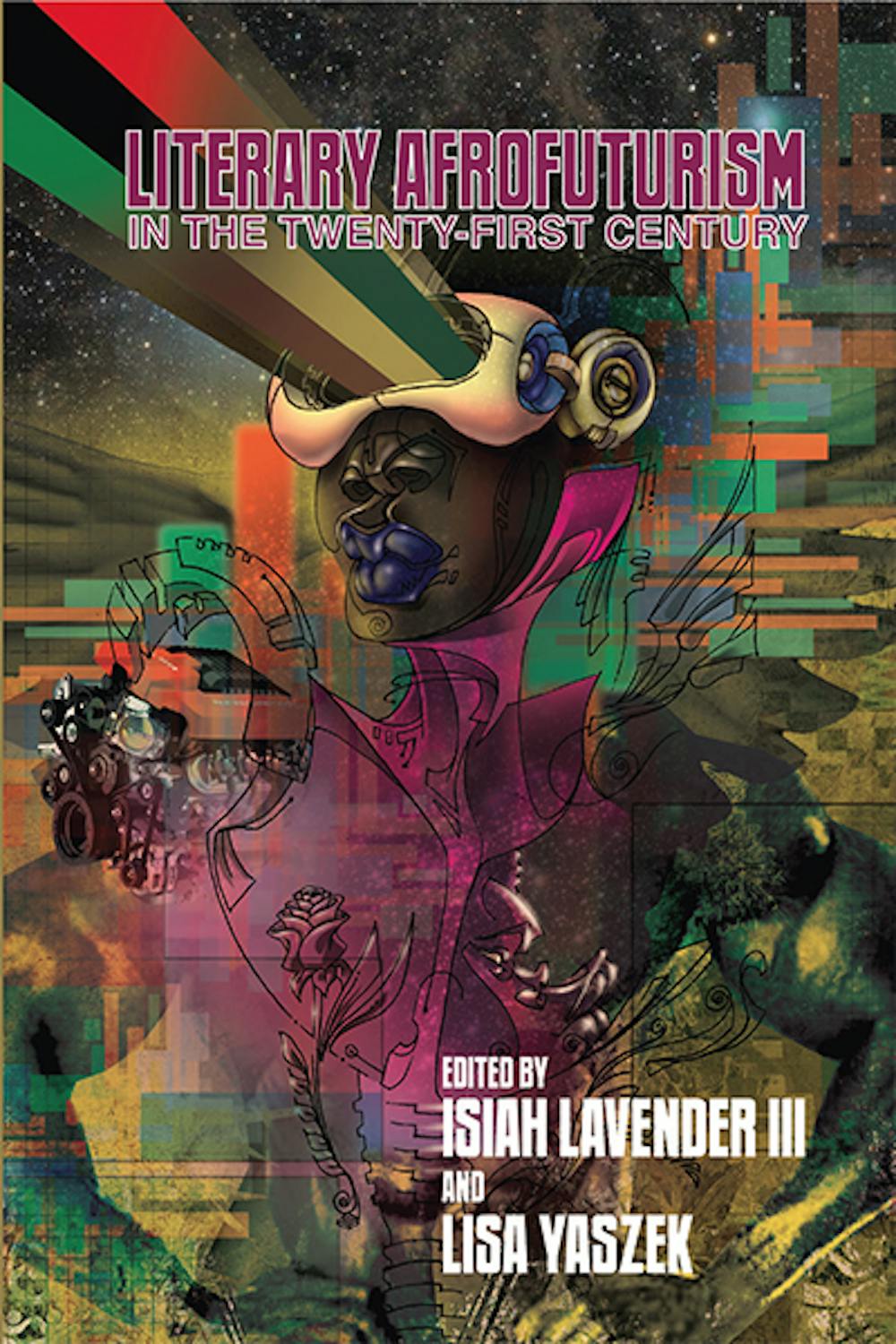
A dense graphic book cover featuring an African figure with high tech glasses on shooting out beams of coloured light, the title reading 'Literary Afrofuturism in the Twenty-First Century'

The Ohio State University Press

Yet reading African science fiction as an exclusive – and even resistant – form of science fiction, we lose sight of the globalising spirit that’s central to understandings of popular culture in Africa.

Wielding language as the ultimate form of technology, Tutuola has reassembled it and built a vocabulary for his pioneering work of African science fiction that can easily be read as a worthy participant on the global stage of popular genre fiction.

This article is based on Moonsamy’s chapter in the new book Literary Afrofuturism in the Twenty-First Century from The Ohio State University Press.The Conversation

Nedine Moonsamy, Senior Lecturer, University of Pretoria

This article is republished from The Conversation under a Creative Commons license. Read the original article.

Unknown's avatar

Remembering Achmat Dangor, the South African novelist who redefined identity


Leonardo Cendamo/Getty Images

Ronit Frenkel, University of Johannesburg

In his 71 years, Achmat Dangor was many things to many people, both in South Africa and across the world. He was a lifelong activist and social justice advocate. He was once banned for his political activities in resistance to apartheid. He was a cultural leader at the centre of the Congress of South African Writers, a tireless development organiser and, for six years, the chief executive of the Nelson Mandela Foundation. For me, he was above all an extraordinary novelist and poet who expanded how I think.

I was a graduate student when, quite by chance, I picked up a copy of Dangor’s 1997 novel Kafka’s Curse in Exclusive Books in Johannesburg. It was 2001 and I was starting to write my dissertation proposal. I read Kafka’s Curse and realised that I had to change topics, such was the impact of the novella on my intellectual life.

It remains a formative novel in my understanding of South African culture, and a favourite novel due to the sheer pleasure to be found in its writing, in its gorgeous prose and magical, mythical landscape.

The complexity of culture

In Kafka’s Curse the characters shift and transform. The protagonist Oscar Kahn is revealed to be Omar Khan, both coloured and Muslim, who has passed as Jewish and white by changing two letters of his name. His wife leaves him as his illness progresses, an illness which poisons his lungs and turns his skin into bark just as Nelson Mandela becomes South Africa’s first democratically elected president.

In many ways, Dangor’s fiction represented the shifts that South African literature and culture underwent in the early days of the country’s transition to democracy. His was a focus on the relationship between race, memory and apartheid constructions.

Both the form and the content of his novels highlight the ambiguous character of identity and history. They offer a complex and nuanced alternative to dominant understandings of South Africa, ones that moved away from a logic of black and white, good and bad, past and present, and into a textured and intricate conception of the country’s culture.

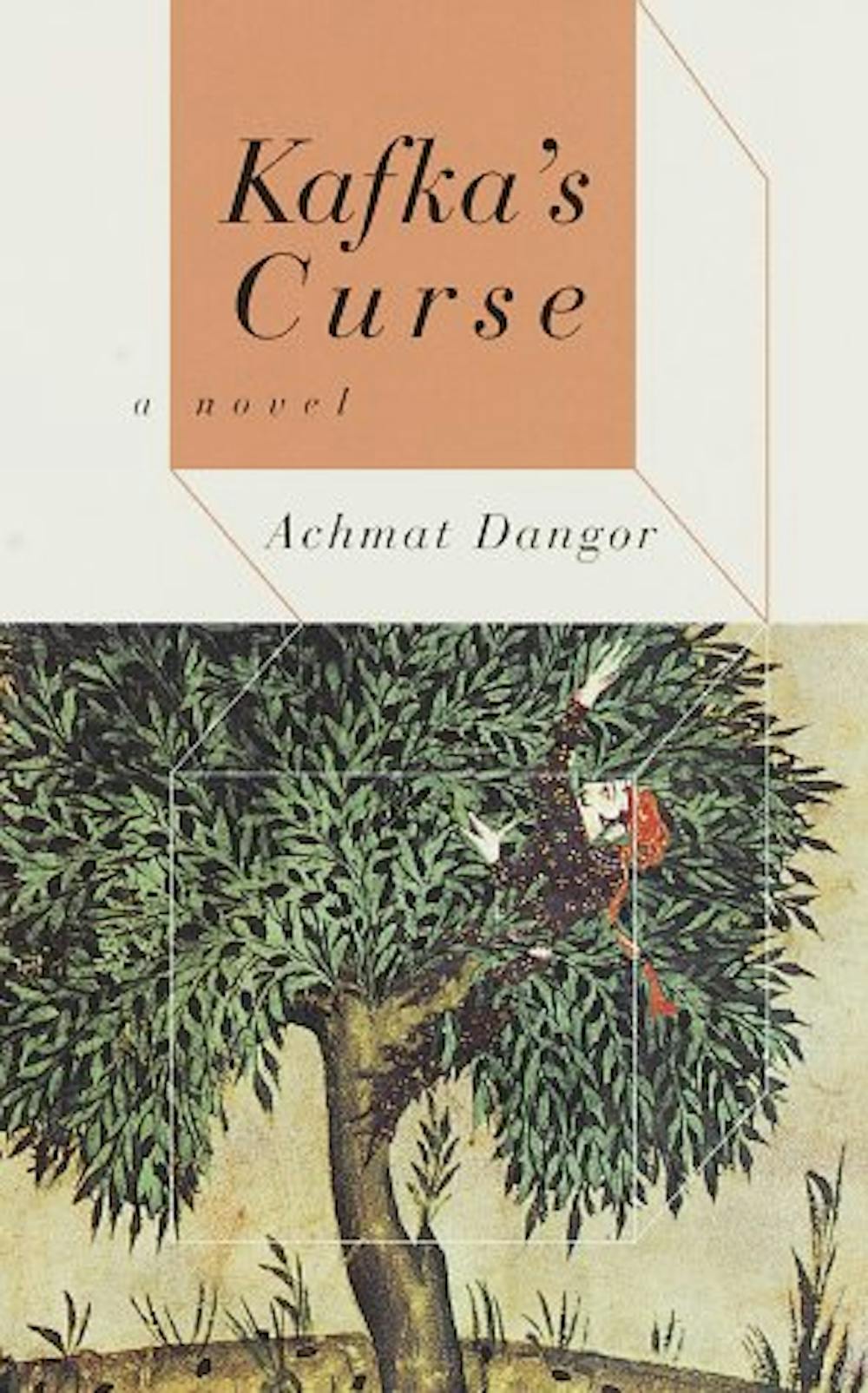
An illustration of a tree with an orange fruit in its branches.

Pantheon Books

They certainly changed my own understandings of my world. Kafka’s Curse showed me that South Africans were not always one thing or another, but had to deny the complexities of identity in order to fit into apartheid’s system of racial categorisation.

In a post-apartheid context, Dangor’s characters reveal the irrepressible mix of South African identities. In Kafka’s Curse he applied the legend of Majnoen to South African culture in a short novel written of rich prose that is often described as magical realist in terms of genre. In an interview with Bold Type magazine, he himself described it as follows:

The ancient Arabic legend of Leila and Majnoen (‘a name as well as a madness’) is a cautionary moral tale: tamper with the hierarchy of a society’s structure and you threaten its orderliness, and hence its very existence.

Ask the Caliph who caused his daughter Leila and her lover Majnoen so much suffering: his caliphate probably did not endure as long as their legend.

The legend of Majnoen in South Africa becomes a story of enduring love that defies despotic rule. Apartheid meanings are interrogated from the points that it denied existed – the ambiguities or overlaps between its lines of racial categorisation. This is embodied by the figure of Oscar/Omar.

Like when I first read it, these ambiguities unravel what my own graduate students think they know when I teach this book today. Kafka’s Curse muddies the line between the imagined and the lived reality of racial constructions.

The uncertainty of the past

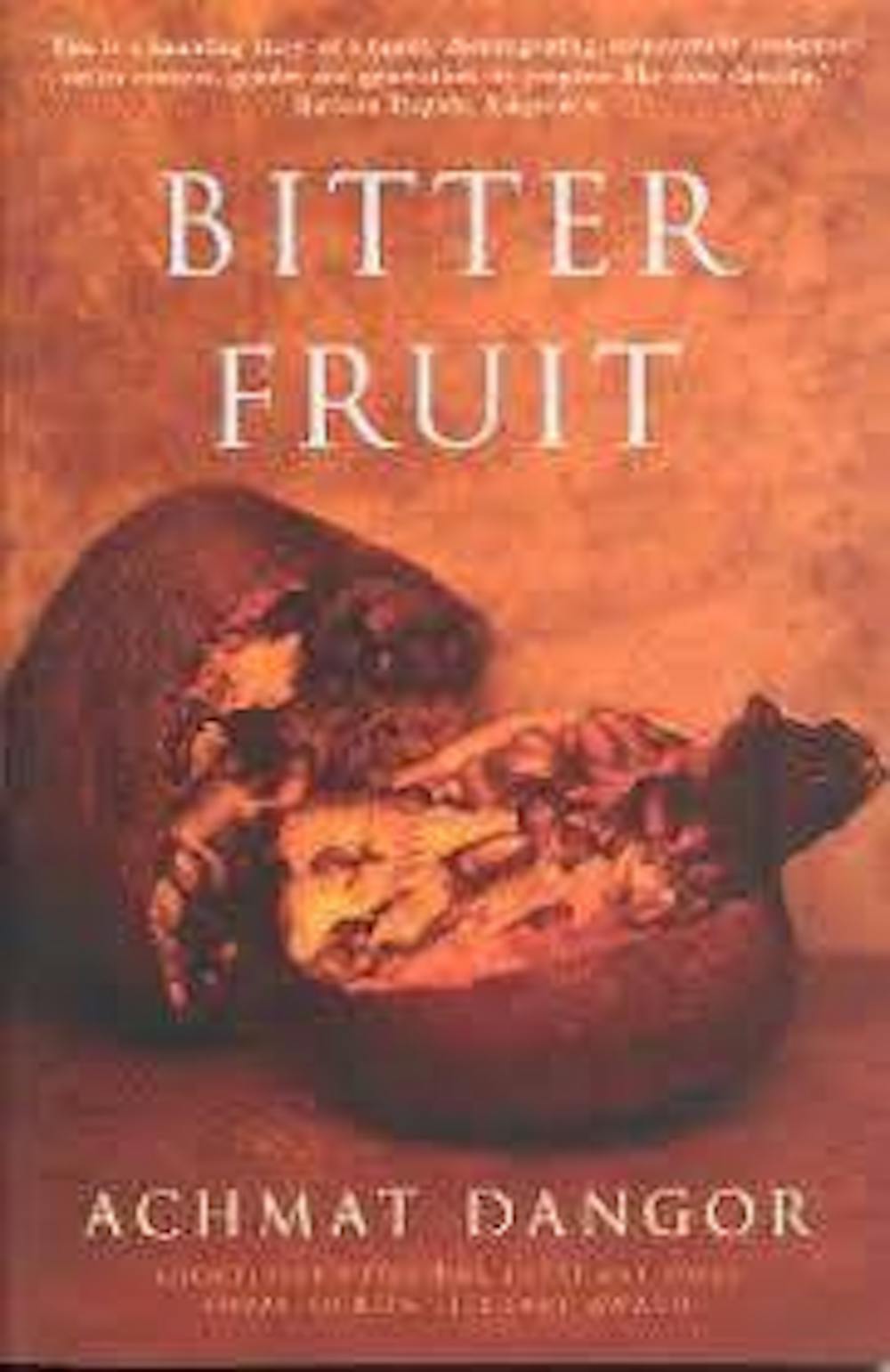
In his internationally acclaimed 2001 novel Bitter Fruit, Dangor continued his investigation of ambiguity by exploring the line between silence and speaking up. He did this by looking at the impact of the Truth and Reconciliation Commission (TRC), set up by the Mandela government to deal with the atrocities of apartheid. While Kafka’s Curse explored these issues around South Africa’s first democratic election in 1994, Bitter Fruit dealt with similar issues around the second election in 1999. Its focus was the uncertainties of history and memory.

A painting of a pomegranate torn open on the cover of a book.

Atlantic Books

Bitter Fruit was shortlisted for the Booker Prize in 2004 and is probably Dangor’s best-known work. Set in urban Johannesburg, the narrative focuses on Silas and Lydia Ali and their son Mikey. As their relationships begin to unravel at the end of the Mandela presidency, silence surrounds the characters’ pasts as a counterpoint against which to examine the impact of the TRC as a form of cultural articulation.

How do we deal with our past and the uncertainties of history, Dangor asks, in a novel that floats back and forth between present and past, speech and silence, public and private.

Bitter Fruit’s three sections – memory, confession and retribution – act as counterpoints against which the TRC’s processes of speak, grieve and heal are situated. He doesn’t offer any neat solutions, but traces different ways of dealing with our past. In much the same way that the TRC could not construct a unified idea of South African history but merely offered one piece of a fragmentary story, Dangor illustrated the ambiguity inherent in the various ways we synthesise that past as individuals and as a society as a whole.

In each of his books, he explored questions that shifted these sorts of cultural debates. Dangor’s last novel, Dikeledi (2017), sits on my bedside table and I wonder what new knowledge lies within its pages for me to discover, what questions will be explored that I cannot articulate myself.

Rest in peace Achmat Dangor, my teacher in novelistic form.The Conversation

Ronit Frenkel, Professor of English, University of Johannesburg

This article is republished from The Conversation under a Creative Commons license. Read the original article.

Unknown's avatar

2020 Caine Prize Winner


The links below are to articles reporting on the winner of the 2020 Caine Prize for African writing – Irenosen Okojie for ‘Grace Jones.’

For more visit:
https://lithub.com/nigerian-british-writer-irenosen-okojie-has-won-the-caine-prize-for-a-story-about-a-grace-jones-impersonator/
https://www.theguardian.com/books/2020/jul/27/irenosen-okojie-wins-the-caine-prize-for-stunning-short-story-grace-jones

Unknown's avatar

Dennis Brutus: South African literary giant who was reluctant to tell his life story


Dennis Brutus’s life is synonymous with South Africa’s freedom struggle.
@mjb/Flickr

Tyrone August, Stellenbosch University

This is an edited extract from a new biography about Dennis Brutus, the anti-apartheid activist, poet and author. Brutus died in 2009. The extract records Brutus’s reluctance to write about his life when he was still alive. But as Tyrone August, author of the biography, writes, it was inevitable that his life story would eventually be told: “Brutus’s life is woven far too deeply into the fabric of the recent history of South Africa.”


Dennis Brutus, the South African poet and veteran anti-apartheid activist, lived in Port Elizabeth, in the Eastern Cape, during the first half of the twentieth century. This tumultuous period saw the emergence of apartheid, a legally codified system of racial segregation and discrimination. It was followed by the development of a ruthless state apparatus designed to systematically eliminate any resistance.

It was in these grim circumstances that Brutus, who was classified as coloured – a term used to refer to people of mixed European (“white”) and African (“black”) or Asian ancestry – under the Population Registration Act of 1950, distinguished himself as a student, teacher, poet, journalist, sports administrator and anti-apartheid activist.

Yet, despite this range of achievements, there was not a single biography on him – until now. Nor did he publish any extended autobiographical work in a single volume. In a letter to the South African writer and academic Es’kia Mphahlele in November 1970, he confirmed his ambivalence about

get (ing) that mess of autobiographical material out of my system.

He expressed a similar sentiment in a tape recording in October 1974, and attributed his reluctance to embark on a full-scale autobiography to his belief that there was no coherent or unifying narrative in his life.

I fail to see in my life any kind of cohesion or pattern or unifying thread which would justify an autobiography … It seems to me that autobiographies need organisation of one’s knowledge of one’s life in such a way that a pattern emerges, some kind of intelligibility is made of the mass.

He added emphatically that he saw no such pattern in his life. And, until he could impose some such order on what had happened to him, it didn’t seem to him that he was entitled to write about it. He thought that, although some instances in his life might be exciting or flattering to him, they did not justify a book.

Aversion and ambivalence

Despite his aversion to writing an autobiography, Brutus conceded in the same tape recording that he was beginning to find the prospect “less repellant” than before. He went on to entertain the possibility of at least writing what he described as fragments of an autobiography in the form of essays.

So, by the time Hal Wylie, a University of Texas academic, approached him in 1988 about working towards an autobiography, he was more amenable to the idea. Wylie offered to assist with “spade-work and organising, etc”.

He tried to persuade Brutus that an autobiography would be preferable to an academic work on his life as it would be enriched by certain poetic and literary qualities. It could focus on existential details, memories, personal aspects that would not be appropriate for an official biography, but would be more striking, interesting, with greater human interest.

In an admittedly subjective work one would have more choice and editorial focus. It would be more direct and forceful.

In addition, Wylie submitted that Brutus’s life was closely interlinked with the rise of apartheid and, at the same time, offered “a new way of looking at the anti-apartheid struggle”. He drew particular attention to Port Elizabeth and the Eastern Cape as major sites of this struggle. In response, Brutus wrote encouragingly: “I like the project.”

Nevertheless, Brutus expressed concern about the amount of work required by an autobiography. Instead, he advised, he would still prefer a biography written by Wylie or, alternatively, a biography “as told to Hal Wylie”. Despite his reservations about writing a fully fledged autobiography, Brutus started working with Wylie on a rough draft. This effort was provisionally titled – in a handwritten addition – The Autobiography of the South African Troubadour (or, alternatively, The Story of a Troubadour/Griot).

Wylie recalled in personal correspondence how this draft was created: “It was based on tapes that Dennis recorded, which I then transcribed and typed up. It was then supplemented with additions he wrote in by hand and responses he gave me in response to my questions.”

However, this collaboration eventually collapsed. “When we got to late adolescence and adulthood he clammed up and wouldn’t respond to further questions, so it was abandoned at that point”, Wylie stated.

He then passed the project to another biographer, whose name has since escaped him, but it did not get any further. This is not surprising.

A simple lust

Although initially Brutus felt sufficiently comfortable about working with Wylie on an autobiography, he continued to harbour deep suspicions about the intrusive nature of biographical writing.

His discomfort with the possibility of potential biographers invading his private life is clearly reflected in an untitled poem published in 1973 in his collection, A Simple Lust:

Finding this rubbish,

this debris,

of mine after

I am dead,

when they come to pry

mouse-rustling in my papers,

ghoulishly-hopeful in my things,

what rubbish they will find!

Will I shrivel, inanimate, in my shame?

Will the dead flesh curl up in protest

being assessed by curious strangers’ hands?

A life woven in history

But, in the long run, renewed interest from potential biographers was probably inevitable. Brutus’s life is woven far too deeply into the fabric of the recent history of South Africa. This is true especially of the first four decades of his life, which, as the most important period in his personal, literary and political development, is the particular focus of Dennis Brutus, The South African Years, published by Best Red, an imprint of HSRC Press. Brutus died of prostate cancer at his home in Cape Town on 26 December 2009.The Conversation

Tyrone August, Research fellow, Stellenbosch University

This article is republished from The Conversation under a Creative Commons license. Read the original article.
Unknown's avatar

2020 Caine Prize for African Writing Shortlist


The link below is to an article reporting on the shortlist for the 2020 Caine Prize for African Writing.

For more visit:
https://bookriot.com/2020-caine-prize-for-african-writing-shortlist/

Unknown's avatar

Women and African Publishing


The link below is to an article that takes a look at women and African publishing.

For more visit:
https://lithub.com/how-women-are-changing-the-face-of-african-publishing/