Unknown's avatar

How literary censorship inspired creativity in Victorian writers


Forbidden Books.
Alexander Mark Rossi

Stephanie Meek, University of Reading

In an open letter published in Harper’s Magazine, 152 writers, including JK Rowling and Margaret Atwood, claim that a climate of “censoriousness” is pervading liberal culture, the latest contribution to an ongoing debate about freedom of speech online.

As we grapple with this issue in a society where social media allows us all to share extreme views, the Victorian writers offer a precedent for thinking differently about language and how we use it to get our point across. How limits of acceptability and literary censorship, for the Victorians, inspired creative ways of writing that foregrounded sensitivity and demanded thoughtfulness.

Not causing offence

There are very few cases of books being banned in the Victorian era. But books were censored or refused because of moral prudishness, and publishers often objected to attacks on the upper classes – their book-buying audience. Writer and poet Thomas Hardy’s first novel, The Poor Man and the Lady, was never published because the publisher Alexander Macmillan felt that his portrayal of the upper classes was “wholly dark – not a ray of light visible to relieve the darkness”.
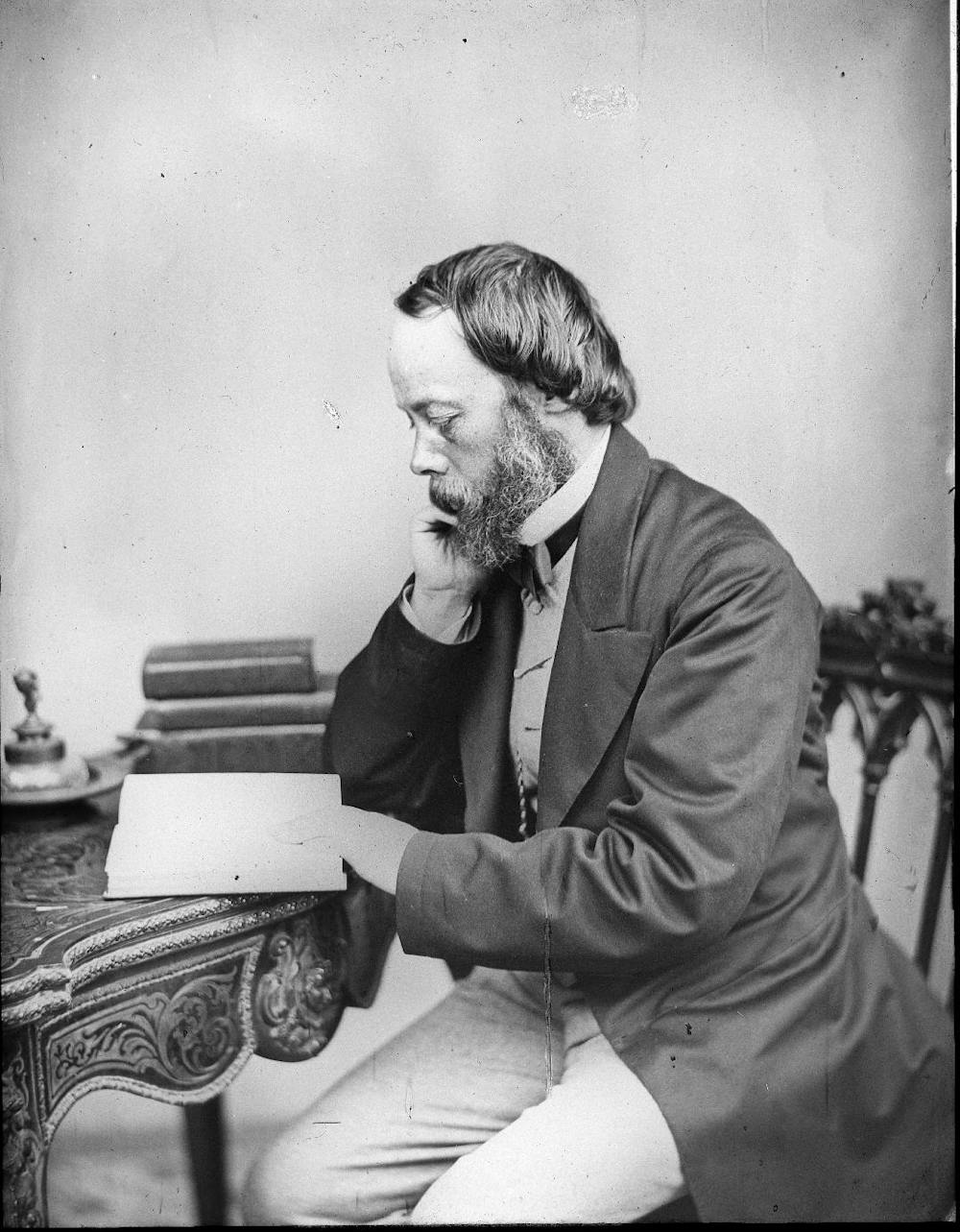
Charles Edward Mudie.
Mudie family archive/Ruth Tillyard

However, more common than publishers turning down books was the refusal of circulating libraries to distribute them. These institutions were an integral part of literary consumerism during the Victorian period as the main means of distributing books.

Most influential of these was Charles Mudie’s Select Library, established in 1842. Mudie’s library was select because he would only circulate books that were suitable for middle-class parents to read aloud to their daughters without causing embarrassment.

This shaped how publishers commissioned and what writers could get away with. Victorian literary censorship, while limiting, managed to inspire writers to develop more creative and progressive ways to get their points across.

Censorship as productive

George Eliot’s publisher, John Blackwood, criticised her work for showing people as they really were rather than giving an idealistic picture. He was particularly uncomfortable when Eliot focused on the difficulties of working-class life.

In Mr Gilfil’s Love Story(1857), Eliot’s description of the orphan girl, Caterina, being subjected to “soap-and-water” raised Blackwood’s censorious hackles:

I do not recollect of any passage that moved my critical censorship unless it might be the allusion to dirt in common with your heroine.
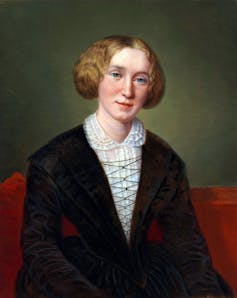
George Eliot.
National Gallery/Wikimedia

As well as dirt, alcohol consumption was also seen as an unwanted reminder of working class problems. Again in Mr Gifil’s Love Story, Eliot describes how the eponymous clergyman enjoys “an occasional sip of gin-and-water”.

However, knowing Blackwood’s views and anticipating she may cause offence galvanised Eliot to state her case directly to the reader within the text itself. She qualifies her unromantic depiction of Mr Gilfil with an address to her “lady” readers:

Here I am aware that I have run the risk of alienating all my refined lady readers, and utterly annihilating any curiosity they may have felt to know the details of Mr Gilfil’s love-story … let me assure you that Mr Gilfil’s potations of gin-and-water were quite moderate. His nose was not rubicund; on the contrary, his white hair hung around a pale and venerable face. He drank it chiefly, I believe, because it was cheap; and here I find myself alighting on another of the Vicar’s weaknesses, which, if I cared to paint a flattering portrait rather than a faithful one, I might have chosen to suppress.

Here, literary censorship enriches Eliot’s writing. Eliot’s refusal to suppress her work becomes part of the story and reinforces her agenda to portray Mr Gilfil as he really is, a vicar who mixes gin with water because he is poor.

Power in not telling

As well as inspiring narrative additions, censorship was also powerful because of what was left out of a text.

One of Hardy’s most loved books, Tess of the D’Urbervilles, highlights the crimes of sexual harassment in the workplace and of rape. Because Hardy had to be careful about the way that he presented the sexual abuse of Tess, his descriptions were very subtle. This is how he portrays the scene where Tess is sexually assaulted by her employer, Alec D’Urberville:

The obscurity was now so great that he could see absolutely nothing but a pale nebulousness at his feet, which represented the white muslin figure he had left upon the dead leaves. Everything else was blackness alike. D’Urberville stooped; and heard a gentle regular breathing. He knelt, and bent lower, till her breath warmed his face, and in a moment his cheek was in contact with hers. She was sleeping soundly, and upon her eyelashes there lingered tears.

The influence of censorship meant that Hardy could not describe this scene in graphic detail. Instead, his depiction is more sensitive and thoughtful. Hardy does not dehumanise Tess by depicting her as a sexual object to entertain the reader.

By focusing on Tess’s “gentle regular breathing” and the poignant image of her tear-stained eyelashes, Hardy avoids gratuitous depictions of violence while at the same time making us painfully aware of the injustice she has suffered. This makes his portrayal of Tess more powerful and poignant. It can be argued that this was achieved because of the limits placed on his writing, not in spite of them.

In these instances, we can see how literary censorship influenced writers to tread more carefully upon difficult territory. It made them think about whether including violence or socially controversial depictions were necessary or gratuitous to their narratives.

For Hardy and Eliot, censorship and its limits inspired creativity, sensitivity and thoughtfulness. These examples can provide food for thought in the debate today about free speech and censorship. As Hardy and Eliot wrestled with as they wrote, can things be said differently and, in some cases, do they need to be said at all?The Conversation

Stephanie Meek, PhD Candidate in English Literature, University of Reading

This article is republished from The Conversation under a Creative Commons license. Read the original article.
Unknown's avatar

‘Expect sexism’: a gender politics expert reads Julia Gillard’s Women and Leadership


`
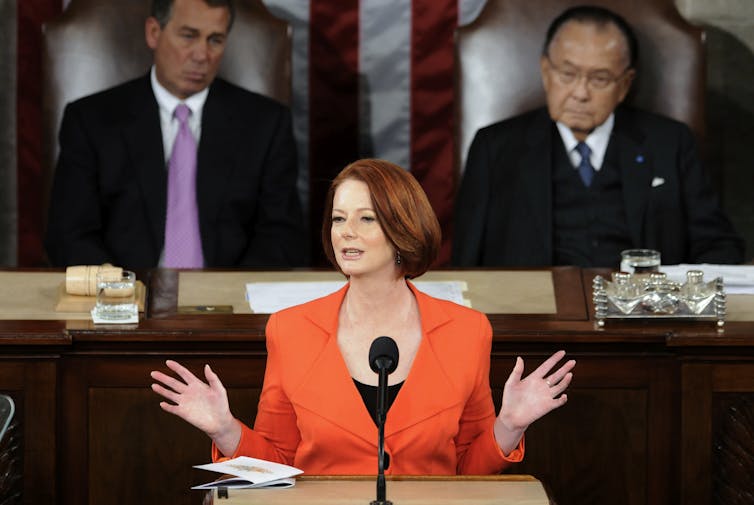
Jonathan Ernst/AAP

Blair Williams, Australian National University

Why are there so few women at the top levels of politics?
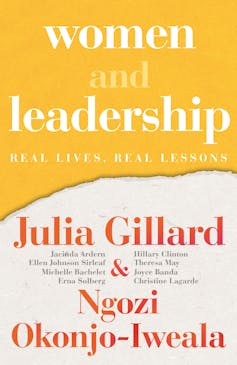
This question is at the centre of the new book, Women and Leadership, co-authored by Australia’s first woman prime minister, Julia Gillard, and former Nigerian finance minister, Ngozi Okonjo-Iweala.

Using their personal experiences and interviews with an impressive group of eight women leaders – including Theresa May, Hillary Clinton, Jacinda Ardern and Christine Lagarde – Gillard and Okonjo-Iweala test various academic studies to see if their findings are reflected in reality.


Penguin Books Australia

Theses studies include media coverage of women’s leadership, as well as perceptions of women’s “power-seeking” and gender norms around leadership.

What results is both a sobering reminder that sexism isn’t going away anytime soon and an empowering message about women’s strength and resilience.

As an academic researching women’s political leadership, this book acts as a crucial point between scholarly studies and public debate. It also offers a fresh perspective of the many issues women in leadership face.

Here are four key messages:

1. The fashion police are everywhere

Gillard and Okonjo-Iweala find women leaders are heavily judged for their appearance. This was a problem faced by all leaders interviewed, despite their diverse experiences and locations.

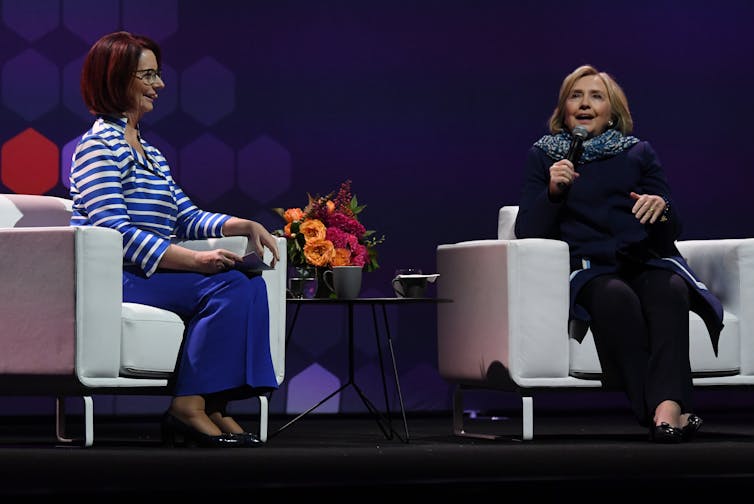
However, there were still differences across the world. Clinton, a former US presidential candidate and secretary of state, was known for her pant suits – which she said helped her feel professional and “fit in”. But former Liberian president Ellen Johnson Sirleaf noted how she “would have got some eyes as a woman wearing pant suits” and traditional dress worked best for her.

Hillary Clinton has said her pantsuits made her feel ‘ready to go’.
David Moir/AAP

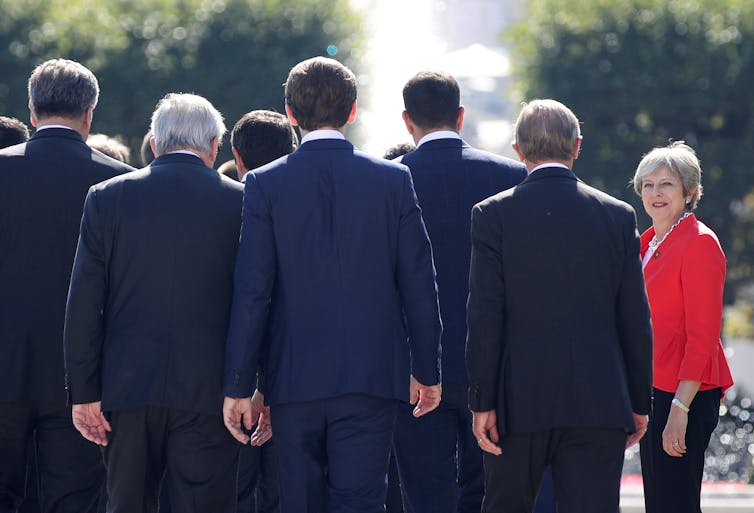
There can also be power in clothing. For example, New Zealand’s Ardern was seen to show compassion, empathy and solidarity when she wore a hijab after the Christchurch terrorist attack. As Gillard and Okonjo-Iweala write,

it became a symbol of love in the face of hate. There was a transcendent power in appearance.

2. Prepare to be judged for your reproductive choices

The book also explores how women leaders are judged for their reproductive choices. While fatherhood increases perceptions of male leaders as affable, relatable and conventional, public motherhood is a far more problematic experience.


Read more:
How Julia Gillard forever changed Australian politics – especially for women


As the authors note, women leaders with young children are frequently asked, “who’s minding the kids?”

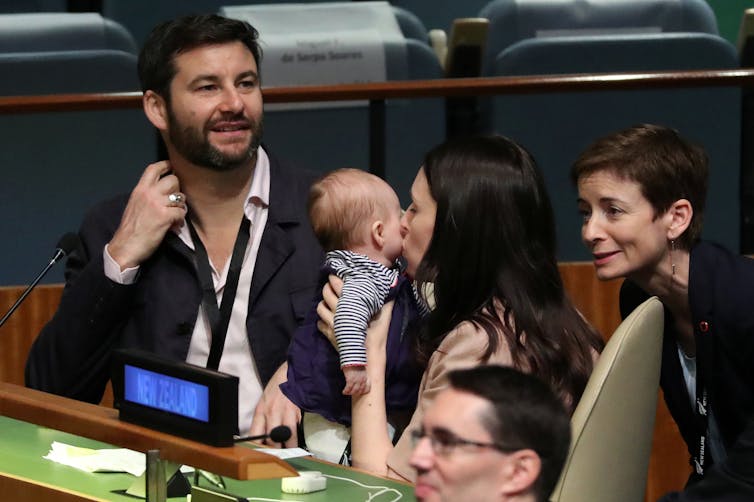
Seven hours after her election, Ardern was asked on national television about her plans for having children. When she had her daughter, there was intense media scrutiny about how she would juggle her leadership role and her baby. Yet male leaders, such as former UK prime minister Tony Blair, who welcome babies in office, are not questioned about who will be looking after them.

Jacinda Ardern has taken her daughter Neve to the UN General Assembly.
Carlo Allegri/ AAP

And what about women leaders who don’t have children? Gillard is intrigued by the respectful treatment of former British prime minister May’s childlessness, as she had a polar opposite experience in Australia (who could forget the frenzy sparked by her empty fruit bowl).

Gillard makes a thought-provoking point here about choice. May wanted, but was unable, to have children, while Gillard was deliberately child-free. Perhaps this was the cause of the criticism she faced. As Gillard writes,

in being seen to offend against female stereotypes, is there anything bigger than not becoming a mother by choice?

3. The situation is not getting better

The book makes the point that despite the focus on women in politics, the experience for those at the top is not necessarily improving.

As someone whose research found media reaction to May in 2016 was more gendered than for Margaret Thatcher in 1979, I wasn’t shocked to read this. However, it was still surprising to learn that Michelle Bachelet – Chile’s president from 2006-10 and 2014-18 – noticed things were worse in her second term.


Read more:
Women leaders and coronavirus: look beyond stereotypes to find the secret to their success


Initially assuming the pressure of gendered expectations had improved the second time around, Bachelet realised,

it was the same or worse. I think politics is getting more complicated these days and more vicious. There is less respect. It’s more personalised now.

All leaders interviewed said they were conscious of the difficulties of finding a balance in leadership style. If they were too strong or assertive, they could be seen as “cold”, “robotic” or “bitchy”.

4. ‘Be aware, not beware’

The experiences and advice of these eight high-profile women leaders reveal how sexism is par for the course.

This message is hammered home in the final chapter, in which Gillard and Okonjo-Iweala note “Be aware, not beware”. They argue that they want to inspire women to pursue politics and leadership roles, but glossing over the challenges would be dishonest and insulting.

Gillard and Okonjo-Iweala say women leaders should expect sexist commentary.
Lisi Niesner/AAP

Summarising the insights gleaned from previous chapters, Gillard and Okonjo-Iweala offer some stand-out lessons that will aid aspiring women leaders. These include:

  • expect sexism and sexist commentary relating to your appearance, family and leadership style and figure out early on how you will respond to this

  • support other women, whether through network-building, mentoring, role-modelling or general solidarity

  • persevere.

A reality check

Women and Leadership is, at times, a depressing reality check that feminism still has a long way to go. However, readers should not come away from this feeling hopeless or disheartened.

Rather, they can appreciate the respect the authors have given them by speaking plainly about the realities women leaders face.

Perhaps more consideration could have been given to the experiences of women in less senior positions. Do we need to hear from the success stories when we talk about the struggles of women in leadership, or could we perhaps also learn from those whose glass ceilings were just too thick?


Read more:
Fiction, fact and Hillary Clinton: an American politics expert reads Rodham


While this book might be less useful for women – and men – without leadership aspirations, its general analysis of gender stereotypes and double standards still makes it a worthwhile read.

This is also problem that women cannot fix alone. Men need to do their bit, by calling out sexism and supporting women. The media must also be more active in combating sexism and misogyny.

One enduring message of this book is that progress and equality are not linear.

Sexism doesn’t just one day magically disappear. Rather, it can only be dismantled through constant pressure and the actions of those who persevere.The Conversation

Blair Williams, Associate Lecturer, School of Political Science and International Relations, Australian National University

This article is republished from The Conversation under a Creative Commons license. Read the original article.
Unknown's avatar

Finished Reading: Kings of Georgian Britain by Catherine Curzon


Kings of Georgian BritainKings of Georgian Britain by Catherine Curzon
My rating: 2 of 5 stars

View all my reviews

Unknown's avatar

2020 Miles Franklin Literary Award Winner


The links below are to articles reporting on the winner of the 2020 Miles Franklin literary Award, Tara June Winch for ‘The Yield.’

For more visit:
https://www.theguardian.com/books/2020/jul/16/tara-june-winch-wins-2020-miles-franklin-award-for-her-book-the-yield-it-broke-my-heart-to-write-it
https://www.booksandpublishing.com.au/articles/2020/07/16/153760/winch-wins-2020-miles-franklin-for-the-yield/

Unknown's avatar

What black writers think about the UK’s publishing industry – a survey


Monkeybusinessimagery/Shutterstock

Catherine Harris, Sheffield Hallam University and Bernadette Stiell, Sheffield Hallam University

As people seek to educate themselves in response to Black Lives Matter protests, sales of books by black British authors, such as Reni Eddo-Lodge and Bernadine Evaristo, have topped the UK bestseller lists. Several recent prestigious awards have also been won by black writers, including Candice Carty-Williams who won book of the year for Queenie at the British Book Awards. Although proud of her achievement, she was also “sad and confused” on discovering she was the first black author to win this award in its 25-year history.

While these firsts must be celebrated, they also shine a light on publishing’s systemic practices, which have maintained inequalities and under-representation for black, Asian and minority ethnic writers and diverse books. Despite awareness of its shortcomings and years of debates and initiatives (diversity schemes, blind recruiting practices and manuscript submission processes) the industry has generally failed to achieve lasting change. This is because they fail to address the broader systemic inequalities faced by people of colour, which contribute to ongoing under-representation in the industry.

A substantial market

Our research on diversity in children’s publishing included an online survey of 330 responses and 28 in-depth follow-up interviews with people working across the sector. We found that a key barrier has been the engrained perception among industry decision-makers that there is a limited market for diverse books. This is a belief that books written by black and diverse authors or featuring non-white characters just don’t sell.

This perception is seen across the industry, including in children’s literature. This is despite evidence of substantial markets. For instance, a third of English primary pupils are from a black, Asian or minority ethnic background. However, a report by the Centre For Literacy in Primary Education revealed that although the number of black, Asian and minority ethnic protagonists in children’s books had increased from 1% in 2017 to 4% in 2018, there is still a long way to go to achieve representation that reflects the UK population.

A third of English primary pupils come from Black, Asian or minority ethnic backgrounds, which represents a substantial market for diverse books.
Monkey Business Images/Shutterstock

Similarly, BookTrust reported that only 6% of children’s authors published in the UK in 2017 were from ethnic minority backgrounds, only a minor improvement from 4% in 2007.

What we found was that the lack of role models in the books read by children and young people of colour meant that they were less likely to aspire to careers in the sector. From those we spoke to, this was compounded by the lack of diversity, particularly in senior roles, in publishing. For those who had pursued a publishing career, experiences of everyday racism and microaggressions were widespread. This added to feelings of frustration and a sense that they were not welcome or did not belong in the industry.

Commissioning problems

This all has a knock-on effect on what gets published. Authors of colour that we spoke to expressed frustration about the commissioning process. This included quotas for books by or featuring people of colour, a perceived limited appeal for these books and a feeling that authors of colour could only write about race issues.

Reliance on “traditional routes” to publishing also disadvantages black and working-class authors. Publishers reported receiving high volumes of submissions and heavy workloads led to them relying on established writers rather than seeking out new, diverse talent. This has the impact of narrowing the pool of authors from which books are published.

Our participants – including authors, illustrators, editorial assistants and agents – widely reported that a lack of cultural understanding can also lead to the view that diverse books are a riskier investment. They explained how limited promotion and marketing budgets often resulted in lower sales, reinforcing perceptions of limited demand. From their experience, miscommunication at subsequent points along the supply chain about the demand for and availability of diverse books means that those that are published may not even reach bookshop shelves.

Those interviewed expressed frustration about miscommunication about demands for diverse books leading to many not ending bookshops.
Gary L Hider/Shutterstock

These interconnected factors (among others) create a negative cycle which perpetuates the lack of representation of minorities across all parts of the sector, including the lack of authors of colour being nominated for prizes and awards. Recommendations from our research include ensuring diversity on selection panels for events and awards and some good work is already taking place. However, more systematic collaboration and commitment from the sector will be required to produce lasting and meaningful changes and achieve equality and representation.

Our research participants pointed out that social media was allowing individuals to more effectively come together and raise their voices in support of diversity and representation. They expressed hope that this may help to drive forward meaningful and lasting change in the sector. There are signs that this may be the case with recent campaigns emerging in support of the Black Lives Matter movement.

The #publishingpaidme campaign highlighted racial disparities in publishing advances. The publisher Amistad, an imprint of Harper Collins dedicated to multicultural voices, ran the campaign #BlackoutBestsellerList and #BlackPublishingPower to draw attention to black authors and book professionals and demonstrate the market for these books. The newly formed Black Writers’ Guild, including many of Britain’s best-known authors and poets, wrote an open letter airing concerns and demanding immediate action from publishers. The hope is that these campaigns can focus the industry on bringing about meaningful change.The Conversation

Catherine Harris, Research Associate, Sheffield Hallam University and Bernadette Stiell, Senior research fellow in the Sheffield Institute of Education, Sheffield Hallam University

This article is republished from The Conversation under a Creative Commons license. Read the original article.
Unknown's avatar

The Yield wins the Miles Franklin: a powerful story of violence and forms of resistance


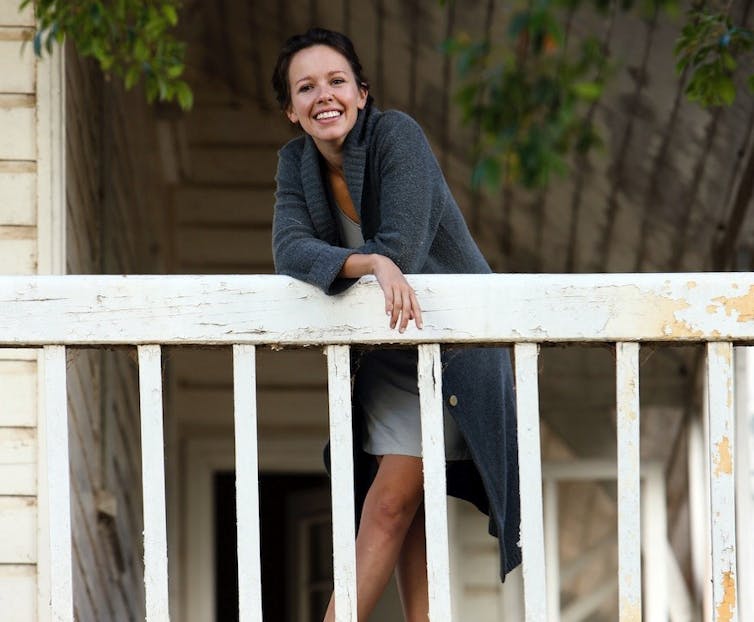
Tara June Winch, author of The Yield.

Jen Webb, University of Canberra

This remarkable novel opens and closes in the voice of Albert Gondiwindi, the recently deceased grandfather of one of the main characters, August.

Albert was born, he says in the first sentence, on Country known as Ngurambang; and he explains how to pronounce the word. “Ngu-ram-bang. If you say it right it hits the back of your mouth and you should taste the blood in your words”.

Throughout the novel, his voice keeps re-emerging as he steadily builds a body of Wiradjuri words, and the memories that ground their definitions.

His is one of three main stories that weave their way through Tara June Winch’s The Yield, this year’s Miles Franklin winner. A second story is that of Albert’s granddaughter, August, who comes home for his funeral. August has been living in England for ten years with her “terrible inheritance” (the elements of which unpack across the novel); she provides a key point of focalisation.


Read more:
Trauma, resilience, sex and art: your guide to the 2020 Miles Franklin shortlist


The third story comes out of history, and is presented in the form of notes, reports and letters written by the Reverend Ferdinand Greenleaf, who positions himself as the defender of what he terms “the decent Natives whom I have lived amongst”, residents of the Mission he established in 1880 “to ameliorate the condition of the Native tribes”.

While Greenleaf does take a stand against the brutality of the police and townspeople, his compassion is predicated on paternalism, rather than respect. Consequently, his “contributions” play a role in the colonisation of the region, and in Albert’s life.

Albert was born, as he says, on Ngurambang, but he started life in a temporary fringe area called Tent Town before he “and all the other kids were taken away”, stolen from family and culture.

The Yield: the violent history of the region is salted throughout the novel.
tc

The violent history of the region is salted throughout the novel: cloaked, in Rev Greenleaf’s writings; expressed vividly in Poppy Albert’s stories; painfully in August’s memories and contemporary experiences and shamefully in the names of local places.

There is the ironically named Prosperous Mission; it stands near the town of Massacre Plains, close to Poisoned Waterhole Creek. The town itself is reached by way of the Broken Highway; the sick and dying of the region find themselves in Broken Hospital and Broken Hospice.

The deployment of such names contains a bitter truth, because although these are fictional places, there are locations right across Australia that unblushingly retain the evidence of racism and genocide. It is writers like Winch, and artists like Julie Gough, who draw attention to this practice and to the history that lies behind it.


Read more:
Julie Gough’s ‘Tense Past’ reminds us how the brutalities of colonial settlement are still felt today


History seldom remains tidily in the past, as so many writers have observed; and Poppy Albert too makes it clear: “there are a thousand battles being fought every day because people couldn’t forget something that happened before they were born”. And also, arguably, because what happened before we were born continues to have consequences.

The processes of colonisation that began in the 18th century; the impact of what led to the establishment (and naming) of Massacre Plains; the building of the mission and farm – all combine to shape and (attempt to) limit August’s life, and that of her family.

And these she must experience again when she returns to Australia, to the continuing absence of her disappeared sister Jedda, to Eddie – ex-schoolfriend and scion of Prosperous Farm – and to the testing family relationships she had left behind. Once back, she finds herself involved not just in piecing together her past, but also in a battle to protect her grandmother’s home, and the remnants of the beloved and deeply damaged river, from the depredations of Rinepalm mining company.

That battle itself highlights the very different communities cohabiting. For the urban protesters, it is about the broad problem of environmental destruction. For cousin Joey, it is about resistance to the original act of invasion. (“They want to take land that wasn’t theirs to take, land was given that wasn’t theirs to give!”)

And for August, it seems to offer a point of resolution: “As they walked August thought that grief’s stint was ending. She whispered to Jedda and to Poppy: I am here”.

I won’t say any more about the story; it is, after all, not mine to tell. But I will say that it is a powerful and a deeply moving book. While it is unstinting in its critical gaze at sociopolitical disasters, it also shows the forms resistance can take.

Albert’s dictionary is part of this resistance: it is in language that culture and memory and ways of seeing and thinking function, and survive. Albert’s work to recover language, to set out words and definitions, provides a memorial to those who were steamrollered by history, and a reminder that “we are here still”.The Conversation

Jen Webb, Dean, Graduate Research, University of Canberra

This article is republished from The Conversation under a Creative Commons license. Read the original article.
Unknown's avatar

Standard Ebooks


The link below is to an article that takes a look at the free ebooks site, ‘Standard Ebooks.’

For more visit:
https://goodereader.com/blog/e-book-news/standard-ebooks-is-a-great-place-to-download-free-content

Unknown's avatar

Dennis Brutus: South African literary giant who was reluctant to tell his life story


Dennis Brutus’s life is synonymous with South Africa’s freedom struggle.
@mjb/Flickr

Tyrone August, Stellenbosch University

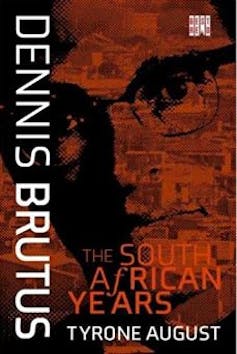
This is an edited extract from a new biography about Dennis Brutus, the anti-apartheid activist, poet and author. Brutus died in 2009. The extract records Brutus’s reluctance to write about his life when he was still alive. But as Tyrone August, author of the biography, writes, it was inevitable that his life story would eventually be told: “Brutus’s life is woven far too deeply into the fabric of the recent history of South Africa.”


Dennis Brutus, the South African poet and veteran anti-apartheid activist, lived in Port Elizabeth, in the Eastern Cape, during the first half of the twentieth century. This tumultuous period saw the emergence of apartheid, a legally codified system of racial segregation and discrimination. It was followed by the development of a ruthless state apparatus designed to systematically eliminate any resistance.

It was in these grim circumstances that Brutus, who was classified as coloured – a term used to refer to people of mixed European (“white”) and African (“black”) or Asian ancestry – under the Population Registration Act of 1950, distinguished himself as a student, teacher, poet, journalist, sports administrator and anti-apartheid activist.

Yet, despite this range of achievements, there was not a single biography on him – until now. Nor did he publish any extended autobiographical work in a single volume. In a letter to the South African writer and academic Es’kia Mphahlele in November 1970, he confirmed his ambivalence about

get (ing) that mess of autobiographical material out of my system.

He expressed a similar sentiment in a tape recording in October 1974, and attributed his reluctance to embark on a full-scale autobiography to his belief that there was no coherent or unifying narrative in his life.

I fail to see in my life any kind of cohesion or pattern or unifying thread which would justify an autobiography … It seems to me that autobiographies need organisation of one’s knowledge of one’s life in such a way that a pattern emerges, some kind of intelligibility is made of the mass.

He added emphatically that he saw no such pattern in his life. And, until he could impose some such order on what had happened to him, it didn’t seem to him that he was entitled to write about it. He thought that, although some instances in his life might be exciting or flattering to him, they did not justify a book.

Aversion and ambivalence

Despite his aversion to writing an autobiography, Brutus conceded in the same tape recording that he was beginning to find the prospect “less repellant” than before. He went on to entertain the possibility of at least writing what he described as fragments of an autobiography in the form of essays.

So, by the time Hal Wylie, a University of Texas academic, approached him in 1988 about working towards an autobiography, he was more amenable to the idea. Wylie offered to assist with “spade-work and organising, etc”.

He tried to persuade Brutus that an autobiography would be preferable to an academic work on his life as it would be enriched by certain poetic and literary qualities. It could focus on existential details, memories, personal aspects that would not be appropriate for an official biography, but would be more striking, interesting, with greater human interest.

In an admittedly subjective work one would have more choice and editorial focus. It would be more direct and forceful.

In addition, Wylie submitted that Brutus’s life was closely interlinked with the rise of apartheid and, at the same time, offered “a new way of looking at the anti-apartheid struggle”. He drew particular attention to Port Elizabeth and the Eastern Cape as major sites of this struggle. In response, Brutus wrote encouragingly: “I like the project.”

Nevertheless, Brutus expressed concern about the amount of work required by an autobiography. Instead, he advised, he would still prefer a biography written by Wylie or, alternatively, a biography “as told to Hal Wylie”. Despite his reservations about writing a fully fledged autobiography, Brutus started working with Wylie on a rough draft. This effort was provisionally titled – in a handwritten addition – The Autobiography of the South African Troubadour (or, alternatively, The Story of a Troubadour/Griot).

Wylie recalled in personal correspondence how this draft was created: “It was based on tapes that Dennis recorded, which I then transcribed and typed up. It was then supplemented with additions he wrote in by hand and responses he gave me in response to my questions.”

However, this collaboration eventually collapsed. “When we got to late adolescence and adulthood he clammed up and wouldn’t respond to further questions, so it was abandoned at that point”, Wylie stated.

He then passed the project to another biographer, whose name has since escaped him, but it did not get any further. This is not surprising.

A simple lust

Although initially Brutus felt sufficiently comfortable about working with Wylie on an autobiography, he continued to harbour deep suspicions about the intrusive nature of biographical writing.

His discomfort with the possibility of potential biographers invading his private life is clearly reflected in an untitled poem published in 1973 in his collection, A Simple Lust:

Finding this rubbish,

this debris,

of mine after

I am dead,

when they come to pry

mouse-rustling in my papers,

ghoulishly-hopeful in my things,

what rubbish they will find!

Will I shrivel, inanimate, in my shame?

Will the dead flesh curl up in protest

being assessed by curious strangers’ hands?

A life woven in history

But, in the long run, renewed interest from potential biographers was probably inevitable. Brutus’s life is woven far too deeply into the fabric of the recent history of South Africa. This is true especially of the first four decades of his life, which, as the most important period in his personal, literary and political development, is the particular focus of Dennis Brutus, The South African Years, published by Best Red, an imprint of HSRC Press. Brutus died of prostate cancer at his home in Cape Town on 26 December 2009.The Conversation

Tyrone August, Research fellow, Stellenbosch University

This article is republished from The Conversation under a Creative Commons license. Read the original article.

Unknown's avatar

Fiction, fact and Hillary Clinton: an American politics expert reads Rodham


Library of Congress

Brendon O’Connor, University of Sydney

Curtis Sittenfeld has a knack of putting her readers in uncomfortable places in her fiction. In her short story Gender Studies she puts you in the middle of a hotel tryst between a Clinton-supporting professor and a Trump-supporting shuttle bus driver. In The Nominee, a journalist vomits on Hillary Rodham Clinton.

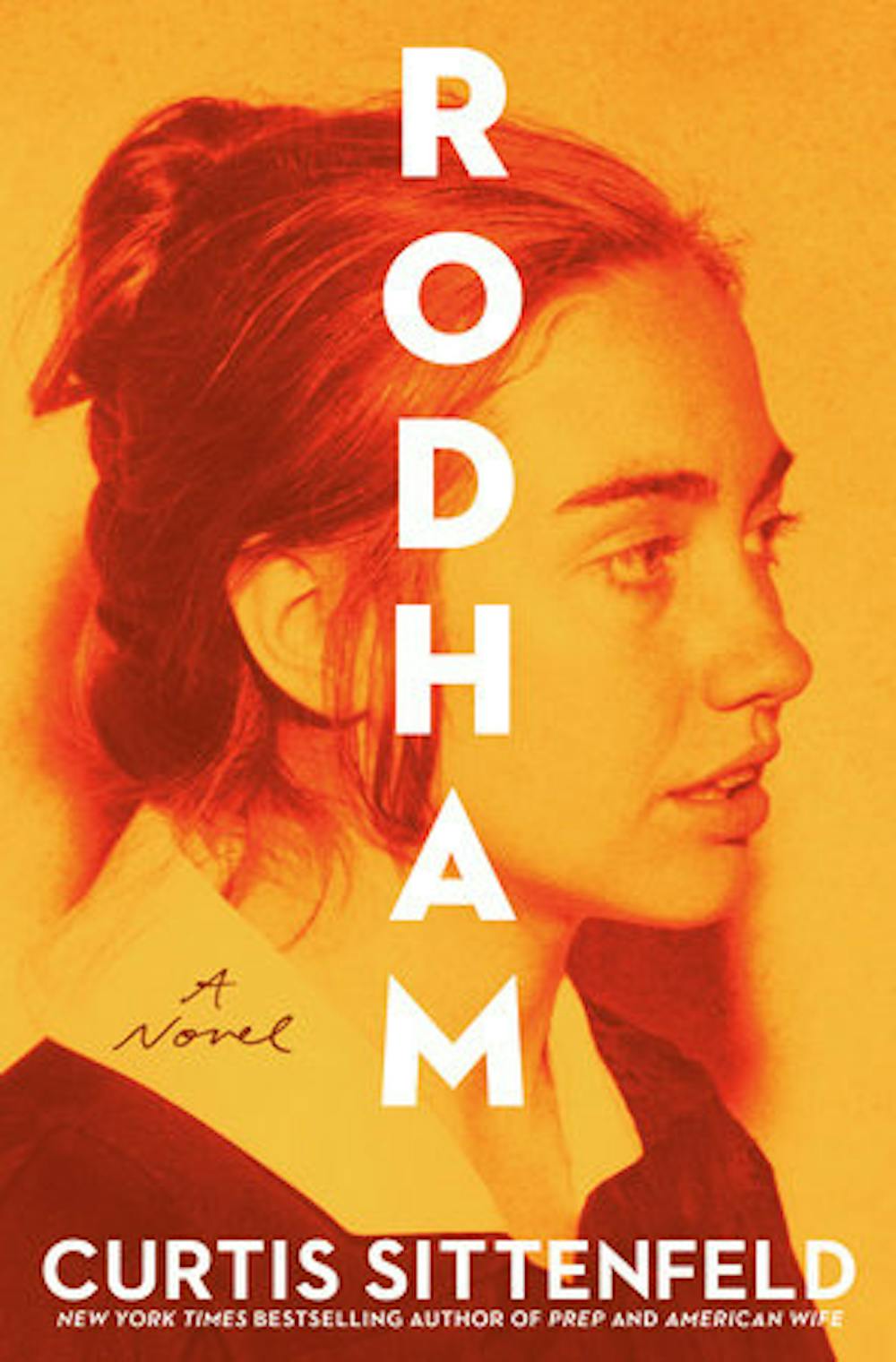
In Rodham, Sittenfeld returns to the former First Lady, but with a twist. An imagined memoir, Rodham is propelled by a “what if” thought experiment: what if, in 1975, Hillary left Bill?

It is an alternative reality page turner, and a welcome escapist read in these difficult times.

But how does the book play with the historical record?

Year of the Woman

Sittenfeld’s first turning point in Hillary’s political career is while she watches the 1991 Clarence Thomas Senate confirmation hearings from her colleague’s office at Northwestern University.

In both the true and imagined histories — despite clear evidence Thomas had sexually harassed his former employee Anita Hill — a predominantly male Senate confirmed Thomas’s appointment.

The backlash against these widely watched hearings led to 1992 being dubbed the “Year of the Woman” when a record number of women ran and were elected to the US Congress.

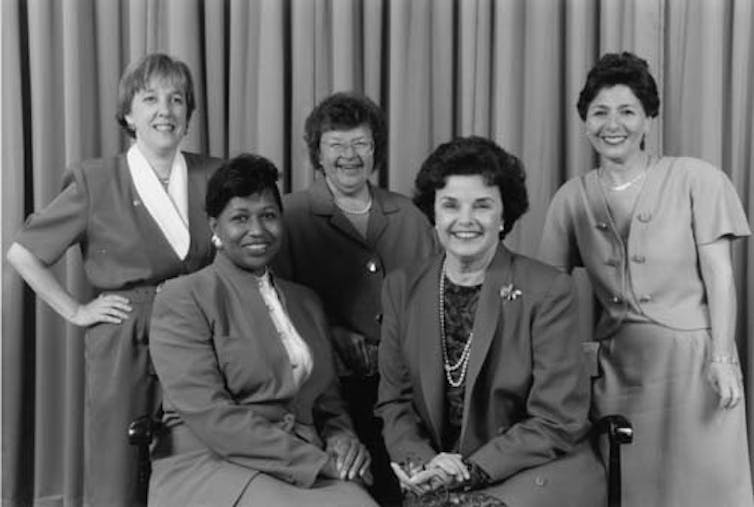
The Senate Democratic women in 1993, Carol Moseley-Braun is second from right. In Rodham, Hillary takes Braun’s place.
Wikimedia Commons

In the novel, Hillary runs and defeats Carol Moseley Braun in the Democrat primary. In real life, Braun won this race to become the first ever black female Senator.

The 60 Minutes interview

It is credibly claimed Hillary’s strength in 1992’s infamous 60 Minutes interview saved Bill’s candidacy.

I have watched the real interview with Hillary many times with my students. Questioned about Bill’s alleged affair with Gennifer Flowers, the interview was a watershed moment in the changing attitude of the media towards politicians’ sex lives.

The interview is tough to first watch: why should any couple’s most private affairs be discussed on television like this? What good does it serve?

On re-watching the interview, I am struck by the effective way in which Bill and Hillary talk down the interviewer and control the narrative. Hillary particularly does this with her famous statement:

I’m not sitting here, some little woman standing by my man like Tammy Wynette. I’m sitting here because I love him, and I respect him, and I honour what he’s been through and what we’ve been through together. And you know, if that’s not enough for people, then heck — don’t vote for him.

In Sittenfeld’s imagined interview, Bill’s publicity-shy wife, Sarah Grace, breaks down and cries, effectively ending Bill’s run for presidency.

Sexism in politics

Rodham does an excellent job at detailing the many forms of sexism women face in academia and politics. In the first part of the novel, Professor Rodham is a successful law academic whose male students and colleagues say things they would never say to male academics.

Such double standards are also highlighted by the fictional Hillary once she enters politics as a Senator for Illinois. She laments:

The extra time female politicians were expected to spend on our appearance, known as the pink tax, amounted to an hour a day for me, but I’d learned the hard way that this was necessary. In the past, whenever I didn’t have my hair and makeup professionally done, the media would speculate about whether I was ill or exhausted.

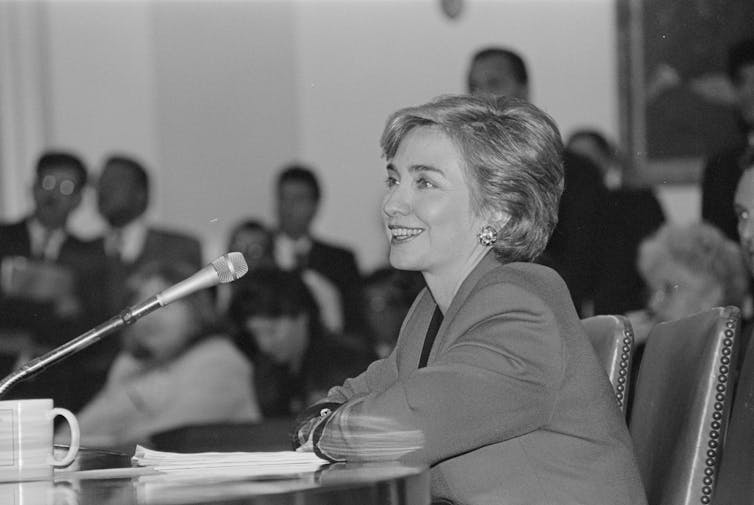
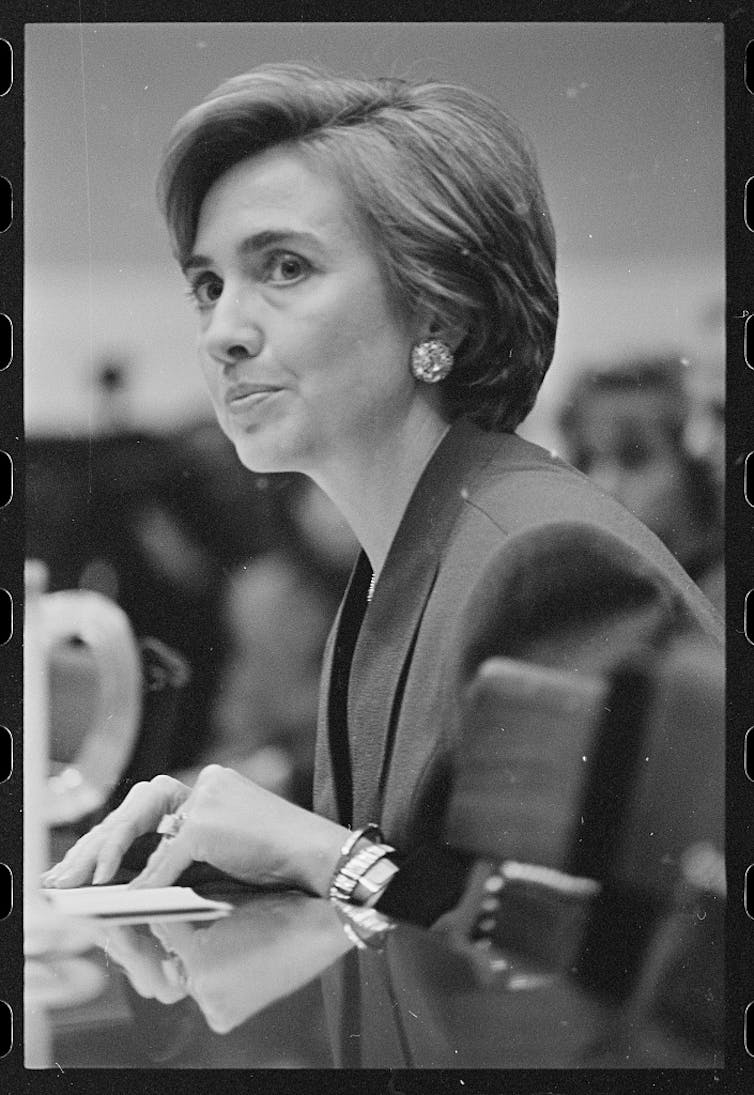
Hillary Clinton in 1993.
Library of Congress

In a delicious plot line, Bill and Hillary end up competing against each other in the 2016 Presidential primaries which leads Hillary to ask: “You know when true equality will be achieved? When a woman with these kinds of skeletons in her closet has the nerve to run for the office.”

Truths and half-truths

The novel draws on the rumours published in Vanity Fair and elsewhere of Bill Clinton’s affairs and involvement in sex parties, as well as discussing the long-standing allegation he raped a female campaign volunteer in the 1970s.


Read more:
Weiner’s erotic mediation: Bill Clinton’s sex vs Anthony Weiner’s sexting


In the novel Hillary’s long-time mentor Gwen Greenberger, an African American children’s right advocate, is stand-in for a few significant figures in Hillary’s actual life, including the very impressive Marian Wright Edelman, the founder of the Children’s Defense Fund.

The novel also features James, a stand in character for Hillary Clinton’s friend and fellow partner at the Rose Law Firm in Arkansas, Vince Foster, who died by suicide leading to conspiracy theories against the Clintons.

An appeal to experience

Throughout Rodham, Sittenfeld dissects the question of Hillary’s “likeability” by the press and the American people. In a killer debate response (that I wish she had given in 2016) she says:

[I]f you want someone to look out for the interests of the American people, for your family, for you – someone who understands the economy and education and health care and foreign policy … then vote for me.

In the real election in 2016, too many Americans ignored this appeal to experience and competence and tragically they have ended up with a president that cares little about governing or even the rising death toll of his own people.

The truth has turned out to be more unbelievable than Sittenfeld’s fiction.The Conversation

Brendon O’Connor, Associate Professor in American Politics at the United States Studies Centre, University of Sydney

This article is republished from The Conversation under a Creative Commons license. Read the original article.

Unknown's avatar

Shortlists for 2020 ABA Bookseller of the Year


The link below is to an article reporting on The Australian Booksellers Association’s (ABA) shortlists for 2020 ABA Bookseller of the Year.

For more visit:
https://www.booksandpublishing.com.au/articles/2020/06/25/152566/aba-2020-bookseller-of-the-year-shortlists-announced/