
Unknown's avatar

South Africa’s copyright bill is good for digital archives. Here’s why


Digital archives.
Shutterstock

Denise Rosemary Nicholson, University of the Witwatersrand

To fulfil their mission in the 21st century, libraries, archives, museums and galleries must engage in a wide variety of new activities.

Libraries, for example, house collections of printed works but must now also provide access to online journals, e-books, multimedia, Africana and archival treasures, images, government publications and legal material, posters and artworks. Collection, development, cataloguing, lending, preservation and replacement must take place online as well as in hard copy.

Academic libraries – and even some school ones – are now embedded in core teaching programmes. They support education and innovation and provide services for people with disabilities. Library services include teaching, literacy programmes, research support, data management, and copyright and plagiarism awareness training.

As knowledge hubs, libraries must meet the various information needs of a country’s citizens. In addition, they promote authors and publishers by purchasing, collecting and preserving their works for perpetuity.

Without access to library and archival collections, creativity and innovation would be almost impossible.

But South Africa’s current copyright law dates back to 1978, and is completely inadequate, outdated and irrelevant in a digital world. It has been a barrier to access to information for far too long.

South Africa’s Copyright Amendment Bill is waiting for President Cyril Ramaphosa’s signature. The bill has been strongly contested. Academic Sanya Samtani, for example, supports the bill with an argument based on her PhD research. For its part, the Coalition for Effective Copyright strongly opposes it.

There is merit in all these arguments. But my view is that there is positive news in the Bill’s provisions for libraries, archives, museums and galleries. For example, it will ensure that valuable documentary records and cultural heritage can be preserved for future generations.

What has been missing

The current Copyright Act has no provisions for libraries, archives, galleries and museums. As an afterthought, limited provisions were included in Section 13 regulations for libraries and archives.

Digitisation is the main form of preserving material in the 21st century. Yet the country’s copyright law doesn’t permit it. This causes serious problems for libraries, archives, museums and galleries. They are currently unable to digitise any of their works without first having to get copyright permission, and to pay high copyright fees.

Such entities have large collections of fragile material which can no longer be handled. The only way to preserve this material – and to make it accessible – is to digitise the content. For example, there are media libraries full of Beta and VHS video tapes, film reels and other material that can no longer be accessed as the technologies are obsolete.

To convert these works to current technologies, libraries and related entities must first get copyright permission. In many instances, rights-holders ignore the requests, or are impossible to trace (making them orphan works). In some cases permission is denied. Collections end up with gaps in them.

These issues affect access to archives, which are used for research, teaching and learning, creating and innovating and sharing information. They get in the way of the civic right to access information provided in the South African Constitution.

Lack of adequate and appropriate copyright limitations and exceptions for libraries, archives, museums and galleries have inhibited or prevented them from carrying out their statutory mandates. They have large collections of valuable documents, posters, artworks, artefacts, newspapers, recordings, and images that cannot be reproduced or even accessed. Often this is because the rights-holders cannot be traced, and there are no provisions for orphan works in the current law.

On top of this, restrictive licences and contracts often prevent libraries and similar entities from carrying out their duties. Cross-border exchanges aren’t permitted. Interlibrary loans are permitted in the current law, but this does not extend to digital sharing.

Positive news

The new Copyright Amendment Bill takes cognisance of existing international conventions and treaties, treaty proposals and foreign laws. It also draws on the country’s Constitution and the excellent EIFL Model Copyright law, drafted by information specialists in various countries, including South Africa. This document is a practical guide to assist librarians, as well as their legal advisors and policy-makers, when national laws are being updated. It is designed to support access to knowledge and the public interest mission of libraries.

The Bill also implements the principles of the 2015 Cape Town Declaration, signed by South Africa and 12 other African countries. This includes the commitment

to encourage the implementation of fair and balanced copyright laws to facilitate access to information for all.

The Bill doesn’t use the word “digitisation” specifically. But it will allow libraries, archives, museums and galleries to engage in preservation, digital curation and format-shifting. This will ensure their collections are preserved and made accessible for future generations.

They will be able to share information and replace lost or stolen works. They will also be able to provide information, images, recordings or other media for historical events, exhibitions and educational purposes.

Legal deposit libraries will also finally be able to carry out their statutory mandates. These include that they collect, preserve and make accessible the country’s cultural heritage and historical documentary records in the digital space.

The Bill has been given the thumbs up by the International Federation of Library and Institutions – the leading international body representing the interests of library and information services and their users. It represents over 2.3 million libraries worldwide, serving over a billion users. It has labelled the Bill both progressive and practical. The International Council of Archives, the umbrella organisation that promotes international cooperation for archives and archivists, has also formally supported the Bill.

This suggests that South Africa is about to have a copyright law that could serve as a precedent for other countries.The Conversation

Denise Rosemary Nicholson, Scholarly Communications Librarian, University of the Witwatersrand

This article is republished from The Conversation under a Creative Commons license. Read the original article.

Unknown's avatar

The Gunpowder Plot: torture and persecution in fact and fiction


After the main plotters of the Gundpowder plot were tortured and executed, accusations of treason, heresy, and witchcraft were used to persecute other enemies of the Crown.
Crispijn van de Passe the Elder/ Wikimedia

Shareena Z Hamzah, Swansea University

In 1605, England’s parliament was sitting on a powder keg, literally. Like now, the country was bitterly divided between two factions, with religion at the heart of the schism after the Reformation pitted Protestants and Catholics against each other in a life or death struggle. History tells us that instead of seeking a political solution such as an election, a group of 13 Catholic conspirators plotted to blow up parliament.

The conspiracy aimed to assassinate King James I and the Protestant establishment with a massive explosion under the House of Lords. Every “fifth of November” since then, what is now known as the Gunpowder Plot is remembered in Britain through bonfires, fireworks and the burning of effigies of one of the conspirators, Guido (Guy) Fawkes. Following the torture and execution of Fawkes and his co-conspirators, accusations of treason, heresy, and witchcraft were used to persecute many of the perceived enemies of the crown.

The process of arrest, torture, trial and execution was widespread, as the king sought to rid the country of his twin hatreds: Catholicism and witchcraft. This purge caused many Catholics, especially priests, to flee northwards to escape the king’s revenge. Lancashire came to be perceived by the royal court as a lawless area where Catholicism and witchcraft thrived – and it was there that the infamous Pendle witch trials of 1612 took place.

Though evidence remains from the actual trials, one of the most intriguing accounts didn’t come until 400 years after the events, when author Jeanette Winterson published her work of fiction, The Daylight Gate. In this story, the fates of a group of vagrant women and a Catholic nobleman, Christopher Southworth, converge when the attention of the law turns towards them. Winterson uses the genuine names of the women who were tried for witchcraft – though freely fictionalising their lives. Southworth was also a real person, a Jesuit priest from one of the oldest families in Lancashire.

An illustration of Ann Redferne and Chattox, two of the ‘Pendle witches’.
William Harrison Ainsworth/Wikimedia Commons

As in real life, the women in the novel are charged with murder by witchcraft. Whether they committed acts of witchcraft or not, that is not their true crime here. These women have too much power and liberty for the patriarchal Protestant society in which they live. Southworth, meanwhile, is hunted in the novel for his involvement in the Gunpowder Plot. Captured previously, he had escaped from prison and fled to France, before returning to England to save his sister from her own witch trial.

There is no evidence to show the real Southworth was a part of the Gunpowder Plot. But historical record shows us Southworth was accused of coaching a young girl to make false accusations of witchcraft against her family – possible because the family had renounced Catholicism and converted to Protestantism. Given this, it’s likely he would have supported at least the aims of the Gunpowder Plot.

Monstrous marks

The fictional women’s bodies are sites onto which the men of the law project both their fears and desires. “Look her over for the witch marks – go on, Robert, run your hands across her. Do you like her breasts?”, remarks a constable’s assistant. But these are bodies made monstrous by the effects of poverty. The feet of the appropriately named Mouldheels are described as stinking “of dead meat … wrapped in rags and already beginning to ooze”. Yet despite this monstrosity, these women are still raped by their captors as desire, disgust and domination merge.

Southworth’s status in the novel is initially different from the women. He was born and raised with the twin privileges of being male and wealthy. With no marks on his body to denote his Catholic faith, he could not be identified as an “other” without specific knowledge of his religious divergence from the ruling class. But, following the failed Gunpowder Plot, his torture at the hands of the king’s jailers results in his body being made monstrous. Attempts to blind Southworth leave scars on his eyelids and cheeks, and pictures are carved into his chest with knives.

Like the women, he is raped by his jailers. He is then literally emasculated when his penis and testicles are cut off. Perhaps luckily for the real-life Southworth, there is no evidence of an arrest, although his historical records are very scant. By comparison, the archives indicate the torture of Fawkes at the hands of the king’s inquisitors.

In this febrile, paranoid society of post-Gunpowder Plot England, the connection between Catholics and witches is stated explicitly. As Potts, the prosecutor sent by the royal court to seek out heretics, says: “Witchery popery, popery witchery. What is the difference?”. The outcomes are certainly very similar. And the burning of the womens’ bodies after their execution mirrors the ritual bonfires and immolation of Guy Fawkes effigies that have celebrated the failure of the Catholic plotters ever since.

Winterson’s novel forces the reader to consider what a monster is and what they might look like. Elizabeth Device, one of the supposed witches, is described as follows: “The strangeness of her eye deformity made people fear her. One eye looked up and the other looked down, and both eyes were set crooked in her face.” But her disfigured appearance had not saved her from being raped nine years before the novel’s setting. Throughout the book, fear and disgust mix dangerously with desire and power to produce awful crimes.

The real monsters are the men who savagely abuse and oppress the unfortunate – whether women or Catholics. Yet, they are not represented as physically repulsive. One of the torturers even has a “pleasant voice” as he questions his victims. In the end, The Daylight Gate reveals that monstrous desires produce and prey on monstrous bodies, and all those subjected to the burning heat of the king’s revenge eventually turn to ash. While the political situation in Britain today has moved away from the Catholic/Protestant schism of 1605, it is worth remembering the human tragedies behind the celebration of Bonfire Night.The Conversation

Shareena Z Hamzah, Honorary Research Associate, Swansea University

This article is republished from The Conversation under a Creative Commons license. Read the original article.

Unknown's avatar

Why French poet Charles Baudelaire was the godfather of Goths


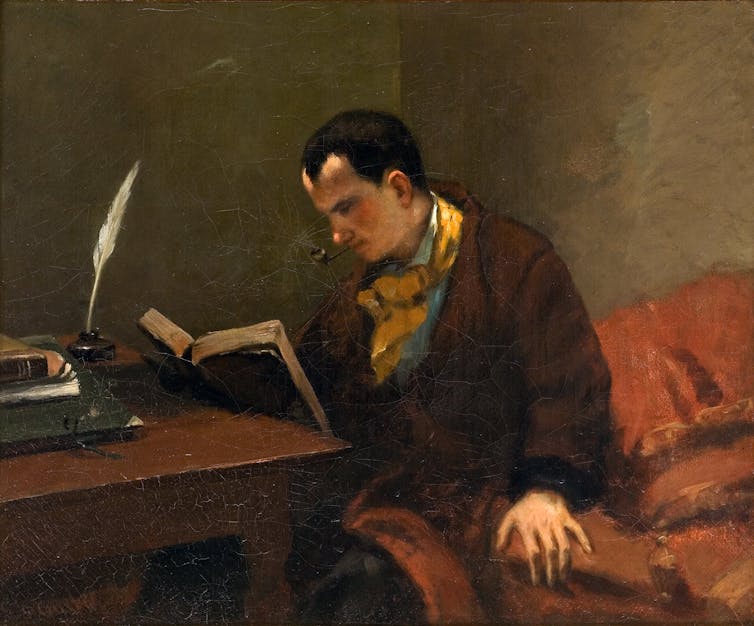
The poet in a picture by Gustave Courbet.
Wikimedia Commons

Nick Freeman, Loughborough University

Goths are typically regarded as being on the fringes of society – members of a subculture which finds beauty in the darker elements of human experience. And while their dress code is much imitated – and celebrated – over Halloween, they have a proud history that stretches far beyond a seasonal horror festival.

In fact, the French poet Charles Baudelaire (1821-67) could easily qualify as the template goths (and other bohemians) aspire to. He often dressed in black, dyed his hair green, and rebelled against the conformist, bourgeois world of mid-19th century Paris in both his personal life and his art.

His first collections of poems, Les Fleurs du Mal (The Flowers of Evil, 1857), was prosecuted for offending public morals, challenging its audiences with its startling treatments of sex, Satanism, vampirism and decay. No wonder his words would one day be set to music by The Cure.

Aside from his writing, Baudlaire’s dissolute life was a checklist of boho credentials. He fell out with his family. He went bankrupt. He pursued reckless sexual experiments and contracted syphilis. He developed a drug habit. He associated with artists, musicians, writers and petty criminals rather than “respectable” people.

He outraged his family by having a mistress who was mixed race and probably illiterate. He refused conventional employment and made a precarious living as a writer, critic and occasional art dealer.

He wrote poetry which was prosecuted for obscenity and was adored by like-minded souls throughout Europe while being hated, even feared, by “straight” society. And then he died young, after years of serious illness and addiction, at the age of 46.

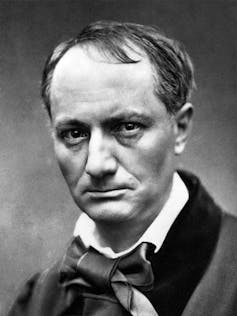
Baudelaire, photographed by Étienne Carat in 1863.

Baudelaire was also a dandy, clean-shaven in an age of whiskers and dressed immaculately despite squalid domestic circumstances. Never ostentatious, he wore sombre black in mourning for his times.

Considering nature to be tyrannical, he championed everything which fought or transcended it, while being, like many of his contemporaries, overtly misogynistic. “Woman is natural. That is to say, abominable,” he wrote.

Nevertheless, he recognised how both genders were trapped within their fleshly prisons and urged resistance to such incarceration through costume and cosmetics, recreational sex, drugs and alcohol.

Baudelaire sounds like many later writers, actors and rock stars, but it is unfair to suggest his cultural importance resides only in his delinquent mannerisms. What makes Baudelaire so significant, and so relevant today, is his recognition in Les Fleurs du Mal, his prose poetry, and essays, that the urbanised, industrial and increasingly godless modern world is radically different from any earlier epoch.

Artists responding to these new conditions of existence cannot cling to outworn traditions. They need instead to cast off convention and rethink their relationship to their culture and surroundings.

Baudelaire’s translations of Edgar Allan Poe brought the American writer to a new audience – and the morbidity of many Baudelaire poems suggests the two men were kindred spirits. In Une Charogne (A Carcass, 1857) for example, he recounts finding a woman’s maggot-infested body, cataloguing her obscene decay in hideous detail before telling his lover that one day, she too will be rotten and worm-eaten.

Like his contemporary, Gustave Flaubert, Baudelaire felt stifled and alienated by the bombastic hypocrisy of Napoleon III’s Second Empire. He despaired at the gulf between public morality and private vice, and was sickened by the rise of bourgeois respectability, the protestant work ethic, and the sweeping modernisation of Paris itself.

Disdaining realism’s preoccupation with appearances, his writing examined the mental states his surroundings produced: boredom, an aggressive self-lacerating melancholy, and ennui – the listlessness and depression which left sufferers joyless and blasé.

He depicted himself as being like the king of a rainy country gripped by an unending despair, prematurely aged, impotent and sorrowful with no clear cause. “Life is a hospital,” he wrote, “in which all the patients are obsessed with changing their beds. One would prefer to suffer beside the fire, another thinks he’d recover sooner if placed by the window.”

A series of unfortunate events

More than 150 years after his death, Baudelaire remains a challenging figure – not least for his sexual attitudes. Nevertheless, his influence is undeniable. T.S. Eliot hailed him in The Waste Land (1922), borrowing his line: “Hypocrite lecteur – mon semblable – mon frère!” (Hypocrite reader, my likeness, my brother), for his dissection of the post-1918 world.

More recently, English author Angela Carter’s Black Venus (1985) gave a voice to Baudelaire’s mistress, Jeanne Duval, who rages at how “his eloquence denied her language”. And How Beautiful You Are, by Gothic rockers The Cure (1987) adapted his prose-poem Les Yeux des Pauvres (The Eyes of the Poor).

Baudelaire’s rich musical heritage is being currently documented by the Baudelaire Song Project. His notion of the “flaneur”, the aimless urban idler, influenced the German philosopher Walter Benjamin and the explorations of modern psychogeographers. His presence even lurks in the young adult fiction of Lemony Snicket, where the Baudelaire children suffer a series of unfortunate events.

Meanwhile, black remains one of the uniforms of teenage disaffection from London to Tokyo, shaping the subcultures of the past four decades. Baudelaire’s existential anxieties and refusal to capitulate to the forces of conformity make him a continued inspiration.The Conversation

Nick Freeman, Reader in Late Victorian Literature, Loughborough University

This article is republished from The Conversation under a Creative Commons license. Read the original article.
Unknown's avatar

Ghana’s copyright law for folklore hampers cultural growth


Ghana is very protective of its cultural heritage.
Wikimedia Commons

Stephen Collins, University of the West of Scotland

Ghana has a rich folkloric tradition that includes Adinkra symbols, Kente cloth, traditional festivals, music and storytelling. Perhaps one of Ghana’s best known folk characters is Ananse, the spider god and trickster, after whom the Ghanaian storytelling tradition Anansesem is named.

Ghana also has some of the world’s most restrictive laws on the use of its folklore. The country’s 2005 Copyright Act defines folklore as “the literary, artistic and scientific expressions belonging to the cultural heritage of Ghana which are created, preserved and developed by ethnic communities of Ghana or by an unidentified Ghanaian author”.

This suggests that the legislation, which is an update of a 1985 law, applies equally to traditional works where the author is unknown and new works derived from folklore where the author is known.

The rights in these works are “vested in the President on behalf of and in trust for the people of the republic”. These rights are also deemed to exist in perpetuity. This means that works which qualify as folkloric will never fall into the public domain – and will never be free to use.

The 1985 Act only restricted use of Ghana’s folklore by foreigners. The 2005 Act extended this to Ghanaian nationals. In principle, this means that a Ghanaian artist wishing to use Ananse stories, or a musician who wants to rework old folk songs or musical rhythms must first seek approval from the National Folklore Board and pay an undisclosed fee.

This is deeply problematic. Following independence in 1957, many artists have explicitly and habitually drawn on Ghana’s folk traditions to develop today’s creative industries. The 2005 Act means that the current generation of cultural practitioners must either seek permission to use and rework their cultural heritage, or look elsewhere for inspiration.

There is clearly a balance to be struck between safeguarding and access when it comes to the protection of a state’s cultural heritage. However, it is important to acknowledge that while Ghana’s legislation appears to tip towards protection at the expense of access, it restricts growth in the creative industries by discouraging artists from engaging with their national cultural heritage.

History of protection

Ethnomusicologist and musician John Collins has noted that the development of the 2005 Act was partly in response to US singer Paul Simon’s use of a melody taken from the song ‘Yaa Amponsah’ for his 1990 album ‘The Rhythm of the Saints’.

Simon attributed this melody to the Ghanaian musician Jacob Sam and his band the Kumasi Trio. But on further investigation the Ghanaian government asserted that the melody was a work of folklore and so, belonged to the state.

From this, two things are clear. Firstly, in Ghana folklore belongs to the state and not the originating communities that predate the modern state. Secondly, Jacob Sam received no recompense for Simon’s use of the work, with all royalties owed on the work flowing back the government.

There are a number of issues here that set Ghana apart from other African states.

Many states allow for the use of folklore by nationals and if a fee is applicable then it is paid as a royalty based on revenue raised. This is the case in all three states bordering Ghana: Togo, Burkina Faso and Cote d’Ivoire. Consequently, if an artist in one of these countries reworks folklore but makes no money, then no money is paid for that use. If the work becomes successful then the artist and the rights holder benefit.

However, in Ghana, the law states that payment is paid prior to use and so prior to any profits made. This potentially adds to the cost of production and so discourages use of folklore.

The other issue here is who owns the rights in national heritage. In many countries, such as Kenya, the originating communities retain the rights to their expressions of cultural heritage.

However, in Ghana the rights are vested in the office of the president. This means that any moral or financial benefit that results from uses of folklore flow to the office of the president, rather than being used to support continued safeguarding and growth of cultural heritage within communities.

Guarding against exploitation

Though Ghana’s present regime may appear draconian, there are compelling reasons why such protective measures are required.

Firstly, Ghana’s cultural heritage – its traditional knowledge and traditional cultural expressions – have been and continue to be exploited by non-Ghanaians in international markets with no beneficial interest flowing either to the state or to the originating community.

To give this some context, Simon’s use of Yaa Amponsah was only one use of Ghana’s cultural heritage in the developing of a new, and commercially successful, work. More recently, there were a number of press reports in Ghana that the Ghana Folklore Board intended to sue the producers of Marvel’s Black Panther for the unauthorised use of kente cloth in some of the characters’ costumes.

The Folklore Board clarified these reports in a press release, saying it did not intend to sue – but rather, wished to discuss attribution. Kente is specifically named as an object of protection under the 2005 Act and the current proliferation of unauthorised cheap kente designs entering global markets from China presents a significant challenge. Attribution, in this case, would ensure that cinema goers across the world would associate kente with Ghana, bringing a traditional craft to a global audience.

The board faces a particularly complex challenge. It must balance safeguarding traditional heritage with allowing creative artists room to reuse and rework elements of that heritage in a way that does not add to the cost or complexity of production.

Though the threat of unfair exploitation is real, equally real is the potential threat to the creative industries and the future development of Ghana’s living heritage if the country’s artists move away from their cultural heritage.The Conversation

Stephen Collins, Lecturer, University of the West of Scotland

This article is republished from The Conversation under a Creative Commons license. Read the original article.
Unknown's avatar

Not My Review: There There by Tommy Orange


Unknown's avatar

2019 PEN International Writer of Courage


English PEN in London has named Ethiopian writer, blogger, and democracy activist Befeqadu Hailu, the 2019 PEN International Writer of Courage.

For more visit:
https://publishingperspectives.com/2019/10/lemn-sissay-designates-befeqadu-hailu-as-pen-writer-of-courage-2019/

Unknown's avatar

Author: Megan Bannen


Unknown's avatar

Not My Review: The Trials of Apollo (Book 3) – The Burning Maze by Rick Riordan


Unknown's avatar

Best Ebook Readers Ever Made?


The link below is to an article that looks at what the article’s writer considers the best ebook readers ever made – what do you think?

For more visit:
https://goodereader.com/blog/electronic-readers/the-best-e-readers-ever-made

Unknown's avatar

Infographic Tools


The link below is to a listing of 100 infographic tools and resources.

For more visit:
https://milkwhale.com/resources/tools/