For many people, most of what they know about the futility, sacrifice and tragedy of World War I, they learned through reading the poetry of Wilfred Owen. But what they may not be aware of is how close the Armistice was when Owen was killed at the age of 25.
On November 4 1918, the 2nd Manchester Regiment received orders to cross the Sambre and Oise Canal near the village of Ors to capture German positions at the opposite side. But as the troops attempted to build a pontoon bridge, they came under heavy machine gun fire. Against the odds, they forced a crossing and routed the enemy, but in so doing they suffered more than 200 casualties.
The attack was one of multiple attempts made up and down the canal to push back the Germans, all with similar consequences. But what made the crossing at Ors different however was the death of its most celebrated officer – Lieutenant Wilfred Owen – who was hit while helping the men who were building the bridge.
The tragedy of Owen’s end, just seven days before the guns fell silent, stands out in the cultural memory ahead of the thousands of men who died – or were yet to die – during the final moments of World War I. As a poet, Owen understood the irony of heroism very well. He resisted giving concrete identities to the soldiers who populate his poems to stop their experiences from becoming mere anecdotes. One man’s suffering is not more tragic than that of another.
In a provisional preface, written for a collection of his verse he would never see published, he set down his belief in what poetry could do – or could not do – to appropriately remember the atrocity of war:
This book is not about heroes. English poetry is not yet fit to speak of them. Nor is it about deeds, or lands, nor anything about glory, honour, might, majesty, dominion, or power, except War.
Above all I am not concerned with Poetry.
My subject is War, and the pity of War.
The Poetry is in the pity.
Yet these elegies are to this generation in no sense consolatory. They may be to the next. All a poet can do today is warn.
The sentiment here echoes a shift in war poetry, away from the jingoistic tenor of Rupert Brooke’s sonnets from 1914 about “some corner of a foreign field/That is for ever England” and the men that gave their life for “immortality” to Siegfried Sassoon’s defiant denunciations of the evils of war.
The “big” words “War” and “Poetry” were ultimately not important for Owen – the more humane invocation of “pity” was poignantly written in lowercase. What the country needed, what the world needed, was empathy and regret, not hero worship – there was nothing glorious in being dead. But the time for this was not now. He disbelieved whether his own generation would ever be able to deal truthfully with the trauma. He was probably correct.
Early promise
Owen had aspired to become a poet since boyhood. His early lyric verse written before the war showed promise, but it didn’t set him apart. The effects of war, and of his reading Sassoon, would change all that. Traditional lyricism gave way to starker rhythms, direct imagery and extensive use of assonance and half rhyme, which at once created sonic cohesion within a broken, phantasmagoric world. The protagonists in Owen’s poems are often no more than a spectre of themselves, mere voices who have lost all sense of their surroundings –- “unremembering” souls “[o]n dithering feet” who have “cease[d] feeling | Even themselves or for themselves”.
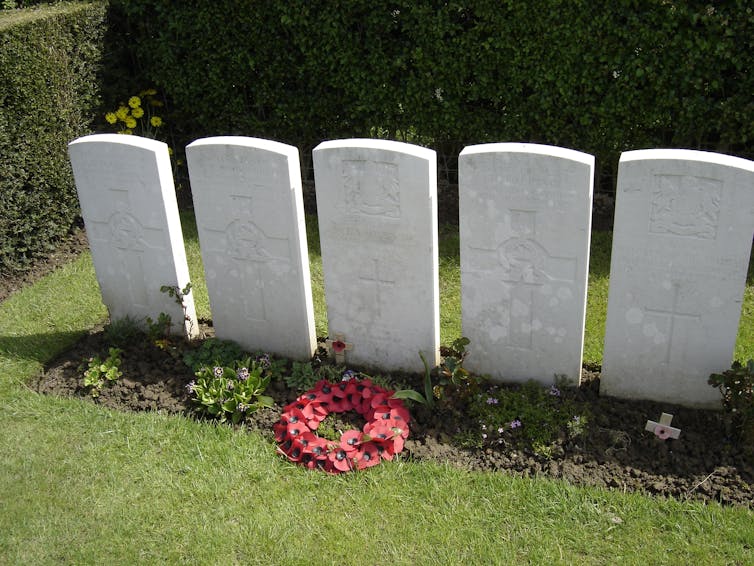
Wilfred Owen’s grave at Ors Cemetery in France. Hektor via Wikimedia Commons, CC BY-ND
These poetic phantoms, spectres, ghosts were not shaped by the fighting alone; more than the trenches, it was Owen’s experiences at the Craiglockhart War Hospital for Officers, near Edinburgh, that coloured his vision. The four months spent there convalescing from shell shock would prove highly significant. Not only did he meet Sassoon there, who encouraged his poetic sensibilities, it was conducive to his creativity.
As part of their treatment, patients were subjected to ergotherapy, a behavioural therapy developed by Dr Arthur Brock, who believed that through useful work and activity patients would regain healthy links with the world around them. Owen was put in charge of The Hydra, the hospital’s literary magazine, and encouraged to write poetry. But his surroundings also furnished Owen with something more valuable: a space to process the suffering he had seen and was seeing around him. This emotion, recollected in tranquillity, is crystallised in the subject matter of some of his best known poems – characterised by an evocation of the sick, the wounded and the dying.
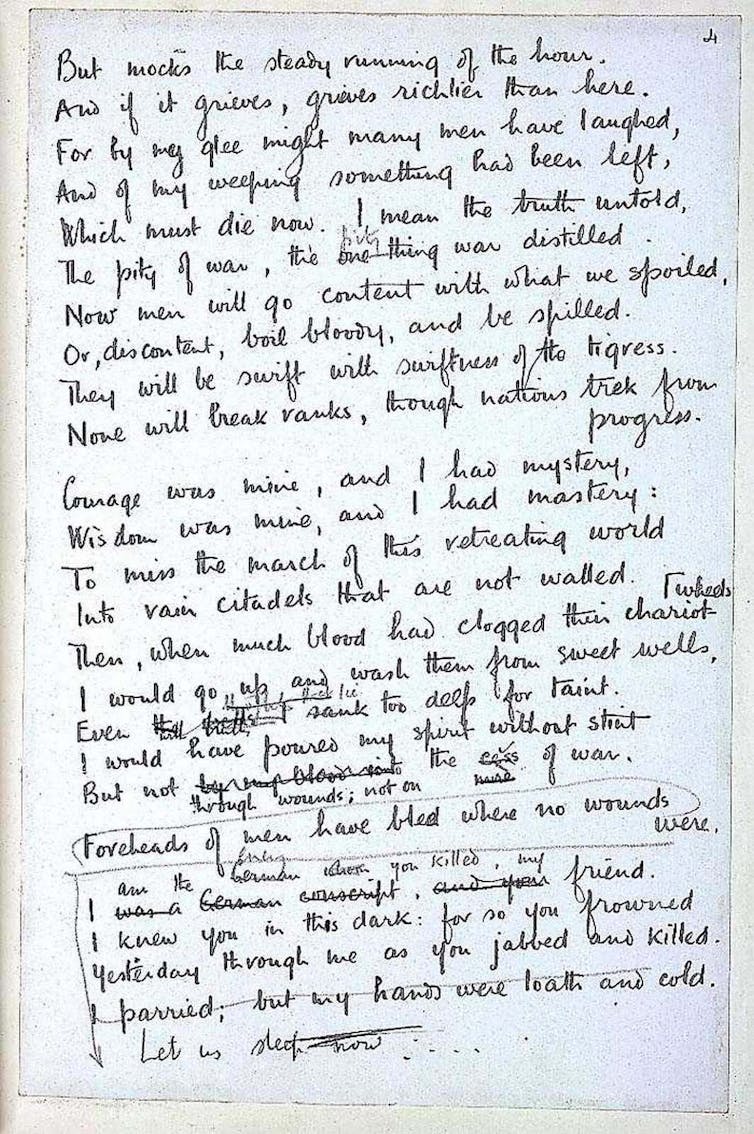
His manuscripts reflect that state of mind. Composition for Owen was neither frenzied nor easy, but rather it involved a steady process of probing words and phrases from which he manufactured the emotional intensity in his poetry. Differences in pen and ink show how Owen revisited his drafts and touched them up at different moments in time, at Craiglockhart and also afterwards when awaiting medical clearance at Scarborough Barracks.
In May 1918, C K Scott-Moncrief, who had tried and failed to secure Owen a Home posting as cadet instructor, told the young poet he ought to send his work to the publisher Heinemann. Owen was enthused by the encouragement. He drafted his Preface and hastily drew up a table of contents.
But it is likely that getting his work in order led to more writing and rewriting. Two poems, Hospital Barge and Futility (one revised, the other new), appeared in The Nation a month later – in August he received his embarkation orders to return to France. On September 17, at 7.35am, he boarded a military train to Folkestone from where he crossed the English Channel. With the exception of just five poems published in magazines, he never prepared any of his poems for the press, leaving the bulk of his work in various stages of completion.
Reluctant posthumous hero
In 1920, his friend Sassoon published a slim volume from the surviving manuscripts with Chatto & Windus, soon followed by a reprint in 1921, which indicates reasonable sales. (A more complete edition appeared in 1931.) The critical response, however, was mixed. Writing in The Athenaeum, John Middleton Murray praised Owen for achieving “the most magnificent expression of the emotional significance of the War”.
The hidebound Basil de Selincourt, on the other hand, dismissed Owen’s “soothing bitterness” in the Times Literary Supplement. He countered that “[t]he only glory imperishably associated with war is that of the supreme sacrifice which it entails; the trumpets and the banners are poor humanity’s imperfect tribute to that sublime implication”.
Owen’s posthumous reputation, however, owes much to the way that first volume introduced his work to the public. “All that was strongest in Wilfred Owen survives in his poems”, Sassoon wrote in his introduction. Unwittingly, perhaps, that phrase – and the frontispiece of Owen in his regimental uniform – entailed an act of monumentalisation that went against Owen’s preface that his book was “not about heroes”.
Owen’s legacy is inscribed into a culture of remembrance (that persists to this day) which seems to go against his own views. By 1920 the nation was in the grip of commemoration as it began the erection of monuments to the war dead all across the country – and the language adopted was the language of glory, honour, dominion and power which Owen had found repugnant:
The old Lie: Dulce et decorum est
Pro patria mori.
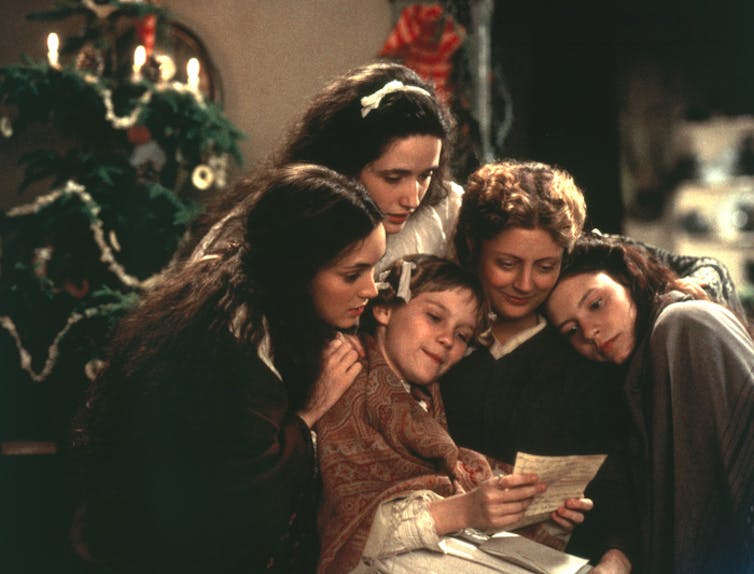
Kirsten Dunst (centre), Winona Ryder (left), Trini Alvarado, Susan Sarandon and Clare Danes in Little Women (1994). The book is now being made into a film by director Greta Gerwig. Columbia Pictures Corporation,DiNovi Pictures
It’s 150 years since Little Women by Louisa May Alcott was published and in the time since, the book has never been out of print. The story of the March sisters struck a chord with readers – especially young girls – early on, and continues to resonate today.
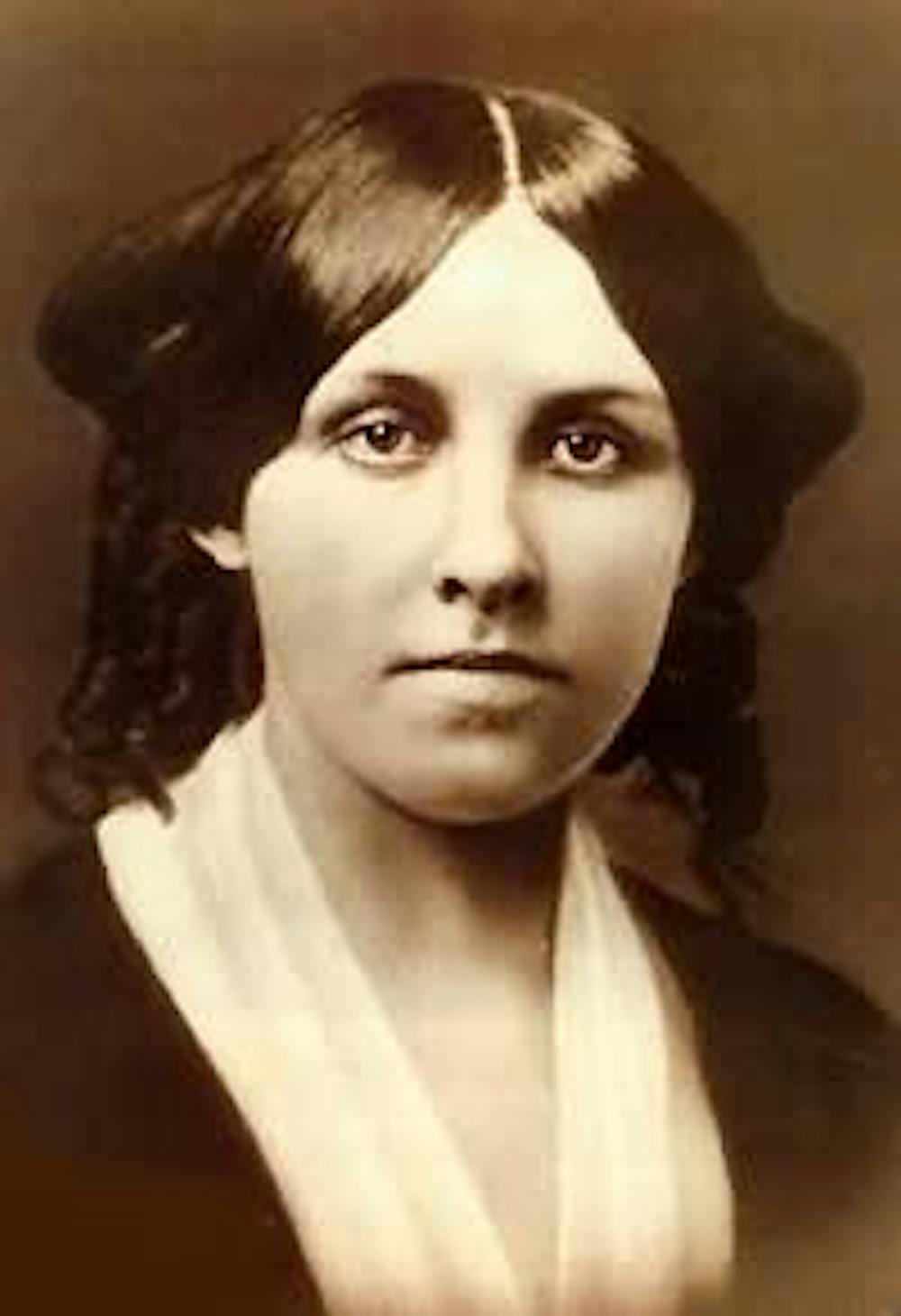
Louisa May Alcott aged 20. Wikimedia Commons
The book’s continuing popularity is evident in the many film, theatre and TV adaptations. In 2018 alone, it was adapted into a film set in our modern-times and a heavily stylised TV mini-series, starring Emily Watson and Maya Thurman-Hawke. It is scheduled for yet another major Hollywood adaptation in 2019, directed by Greta Gerwig and starring Meryl Streep, Emma Watson and Saoirse Ronan.
Little Women follows the lives of the four March sisters, Meg, Jo, Beth and Amy, as they endure hardships, learn life lessons and build enduring bonds on their passage from childhood to womanhood. The first part of the book depicts the girls’ childhoods – their struggles with poverty and their own personalities and faults and how they overcome these obstacles. The second part is about them entering womanhood, marrying and becoming good wives, mothers and women.
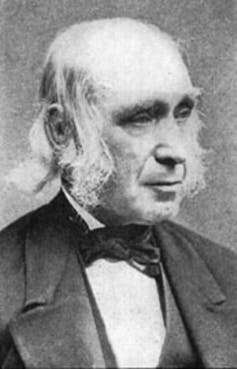
The genteel poverty the March family endures is based on the real poverty the Alcott family experienced. The difference is that the poverty of the Alcott family was mostly imposed on them by Louisa’s father, Amos Bronson Alcott, a famous Transcendentalist educational reformer in his day.
Amos Bronson Alcott. Wikimedia Commons
In stark contrast to the book, and at a time when social conventions actively discouraged and frowned upon women undertaking paid employment, Bronson Alcott’s noble willingness to, as he put it, “starve or freeze before he will sacrifice principle to comfort” resulted in him not supporting his family financially. This forced his wife and daughters to provide for the family, and in Louisa’s case to write for money.
Bronson was wholly supported and encouraged by his wife, Abigail (Marmee in Little Women), to the complete bafflement and increasing frustration of Louisa. One of Alcott’s biographers suggests that the familiar sentimental tone in Little Women of poverty being dictated by circumstance, and something we should learn to bear, comes from her trying to cope with, and somehow justify her father’s outrageous lack of concern for the family’s financial well-being.
Louisa Alcott was devoted to and dominated by her parents, especially her father. His worldview was based on the romanticised and spiritual idea of inherent goodness and perfection of human beings. For many years, Bronson Alcott insisted to his daughter on the need for simple stories for boys and girls about how to overcome selfishness and anger, faults which he constantly pointed out in Louisa. Eventually, Bronson’s ideas made their way into Little Women, where the March sisters strive to achieve their perfect “womanliness”.
Louisa was a problem and a disappointment to her father – she was impatient and energetic, always “subject of her instinct” and showing, what Bronson called early signs of “impending evil”. Alcott made the choice to remain unmarried, yet, against her wishes, but mainly due to the demands of her publisher and her growing fan base, she did make Jo marry in the end.
Alcott may never have written Little Women at all, had she been more financially successful in the types of gothic fiction she excelled at and enjoyed writing. But she dreaded debts “more than the devil”. And her publisher pressured her with continuous requests for a book for girls – and a promise to publish her father’s book, Tablets, if she wrote one.
The death of Jo’s younger sister Beth is a memorable and tragic event in Little Women. Beth is the shyest of the sisters and lives a very secluded life. Her death is portrayed by Alcott as a sort of “self-sacrifice” as she gives up her life knowing that it has had only private, domestic meaning.
Alcott’s sister Elizabeth or “Lizzie”, did in fact die due to complications of scarlet fever. Beth’s death in the book is written to resemble a typical trope of Victorian literature – the sentimental, suffering, pathetic yet angelic “ideal” child. But Lizzie died in 1858, aged 22: in pain, angry and frightened, resenting the invisible, stifling life that was imposed on her largely by her parents. She may also have suffered from anorexia. Alcott witnessed the death of her sister in horror.
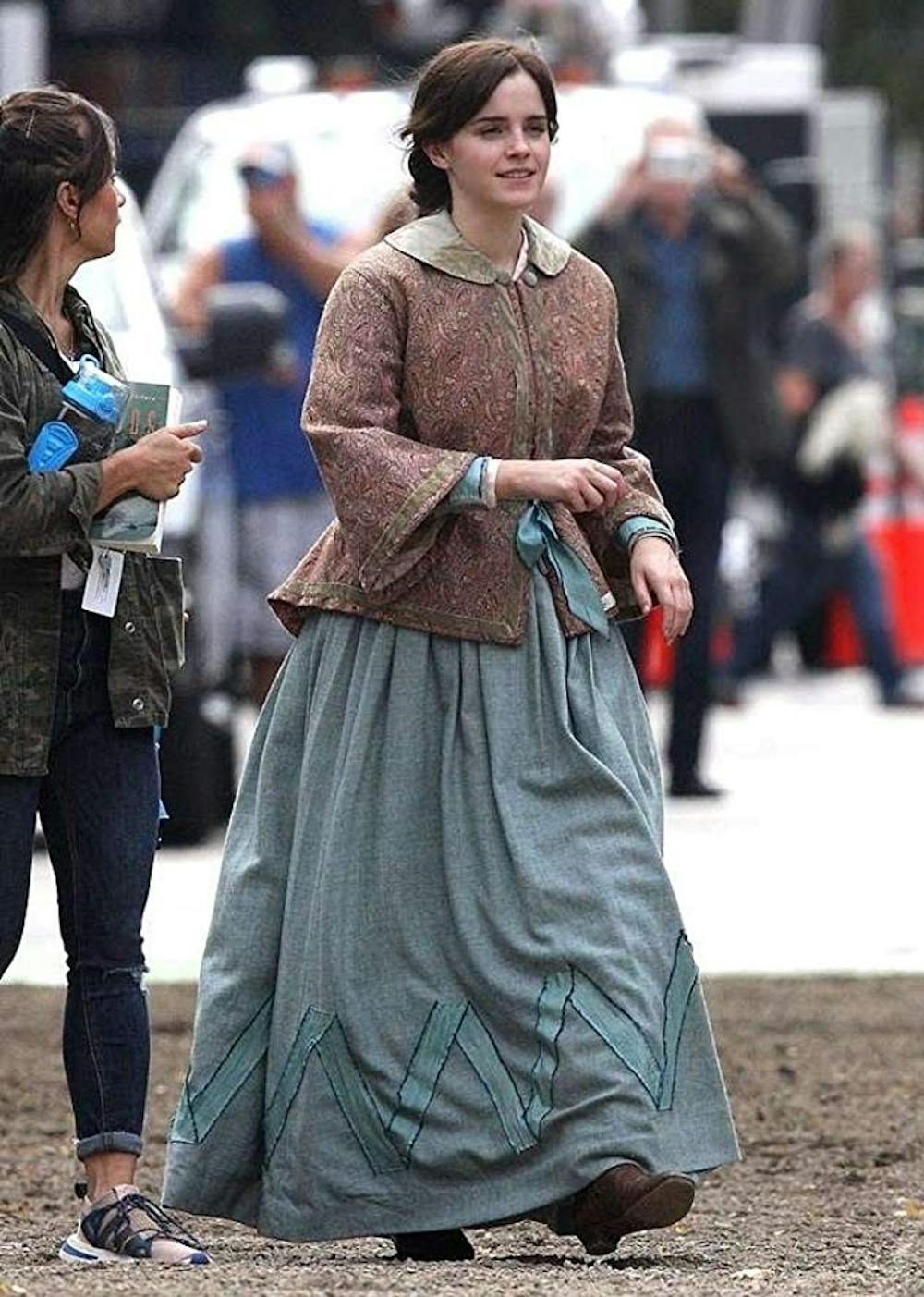
Emma Watson in Little Women. idmb
Ultimately, Little Women’s themes of love, grief and sisterly bonds still appeal to us. As Robin Swicord, who will produce the upcoming 2019 film adaptation says: “It’s really taking a look at what it is for a young woman to enter the adult world”. (She adds that “given the material, it’s always going to be romantic.”)
Yet many of the themes and morals of this book are sentimentalised and outdated today. They were inserted for reasons of convention, in order to provide moral instruction, or to appeal to the requests of a publisher.
Alcott wrote Little Women because her father wanted her to, and he dictated its terms, morals and lessons. It was an instant and enduring success, even though she did not want to write it, and it forced her to relive some of the most difficult years of her life. For readers (and viewers) today, understanding these circumstances enables a much more authentic, multi-layered and complex interpretation.
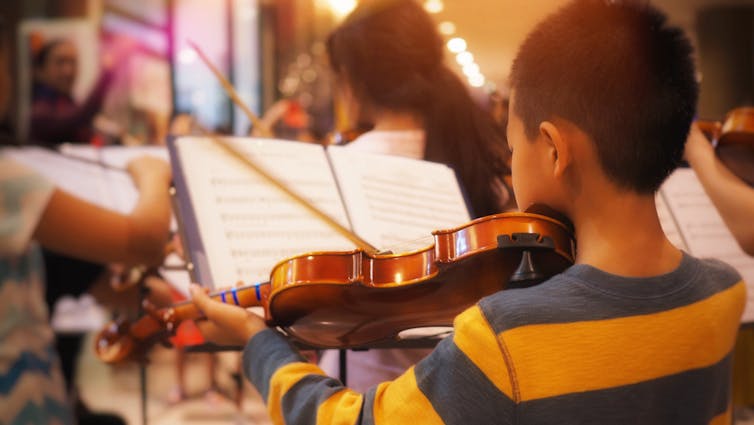
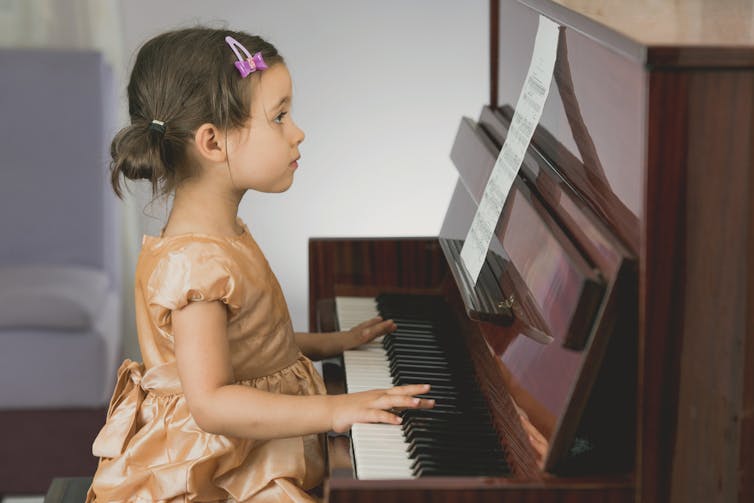
As we look to improve the reading outcomes of our young children, more music education in our preschools and primary schools could be the answer. http://www.shutterstock.com
Neuroscience has found a clear relationship between music and language acquisition. Put simply, learning music in the early years of schooling can help children learn to read.
Music, language and the brain
Music processing and language development share an overlapping network in the brain. From an evolutionary perspective, the human brain developed music processing well before language and then used that processing to create and learn language.
At birth, babies understand language as if it was music.
They respond to the rhythm and melody of language before they understand what the words mean.
Babies and young children mimic the language they hear using those elements of rhythm and melody, and this is the sing-song style of speech we know and love in toddlers.
Musically trained children are better readers
The foundation of reading is speech and to learn how to speak, children must first be able to distinguish speech from all other sounds. Music helps them do this.
Reading is ultimately about making meaning from the words on the page. A number of skills combine to help us make those meanings, including the ability to distinguish between the sounds in words, and fluency of reading.
Fluency includes the ability to adjust the the patterns of stress and intonation of a phrase, such as from angry to happy and the ability the choose the correct inflection, such as a question or an exclamation. These highly developed auditory processing skills are enhanced by musical training.
Music can also give us clues about a child’s struggles with reading. Research has found three- and four-year-old children who could keep a steady musical beat were more reading-ready at the age of five, than those who couldn’t keep a beat.
Children should be taught to read music as well, which reinforces the symbol to sound connection crucial for learning to read. from http://www.shutterstock.com
What parents and teachers can do
Language learning starts from day one of life with parents talking and singing to their babies. Babies bond with their parents and community primarily through their voice, so singing to your baby both forms a bond with them and engages their auditory processing network.
Taking toddlers to a well-structured, high quality music class each week will build the musical skills that have been found to be so effective in learning to read. It is vital to look for classes that include movement activities, singing, and responding to both sound and silence. They should use good quality music-making toys and instruments.
As they head into preschool, a crucial time for language development, look for the same well-structured music learning programs delivered daily by qualified educators. The songs, rhymes and rhythm activities our children do in preschool and daycare are actually preparing them for reading.
Music programs should build skills sequentially. They should encourage children to work to sing in tune, use instruments and move in improvised and structured ways to music.
Children should also be taught to read musical notation and symbols when learning music. This reinforces the symbol to sound connection which is also crucial in reading words.
Importantly, active music learning is the key. Having loud music on in the background does little for their language development and could actually impede their ability to distinguish speech from all the other noise.
This isn’t to say children need silence to learn. In fact, the opposite is true. They need a variety of sound environments and the ability to choose what their brains need in terms of auditory stimulation. Some students need noise to focus, some students need silence and each preference is affected by the type of learning they are being challenged to do.
Sound environments are more than just how loud the class is getting. It’s about the quality of the sounds. Squeaky brakes every three minutes, loud air-conditioning, background music that works for some and not others and irregular bangs and crashes all impact on a child’s ability to learn.
Teachers can allow students to get excited in their lessons and make noise appropriately, but keep some muffled headphones in your classroom for when students want to screen out sound.
Music for all
Our auditory processing network is the first and largest information gathering system in our brains. Music can enhance the biological building blocks for language. Music both prepares children for learning to read, and supports them as they continue their reading journey.
Unfortunately, it’s disadvantaged students who are least likely to have music learning in their schools. Yet research shows they could benefit the most from music learning.
As we look to ways to improve the reading outcomes of our young children, more music education in our preschools and primary schools may be one way clear way forward.
A new book of poetry is offered to a world of readers where very few of us have or take the time to read poetry. Most of us are skeptical about it, suspicious of it for asking of us so much of our time and attention, and possibly giving us little back but puzzles.
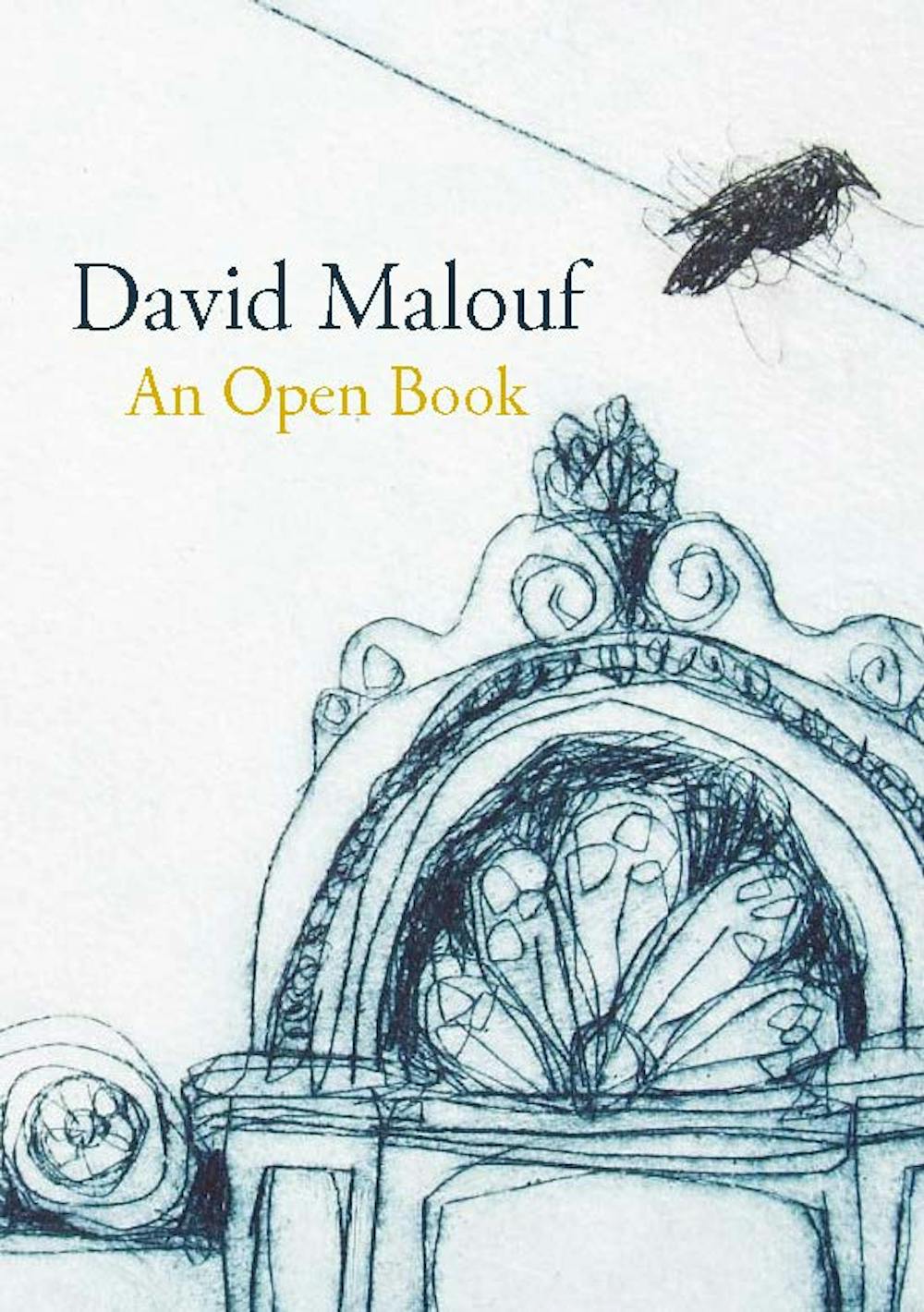
Nevertheless I open the book. The first word of the book is “Parting”, printed twice: once as the title of the book’s first poem and again as that poem’s opening word. Parting, of course, doesn’t necessarily mean an ending, for it is essentially what every new life requires.
“All things new/move us”, David Malouf observes part way through this opening poem (playing again on a word that carries several layers of conflicted meaning), uniting reader and poet in a common understanding of partings as beginnings. This is a clever, wise and benign manner of reminding the reader that they have left something in order to arrive here where this very act of holding an open book becomes an aspect of the rhythms of a wider cosmos.
UQP
The stance of the poem is characteristic of Malouf, with its poised consciousness of a speaking self on display through reference to the poem’s presence on the page and the poem’s witness to the act of writing. In a Malouf book it is rare to find the direct personal pronoun, “I”, but there is always somewhere the presence of a writer, a voice, a reflection of someone present at the occasion of the poem.
This reticence about saying “I” might be coyness, it might be a natural shyness, it might be to do with a conviction, along with T.S. Eliot and many before him, that the poetry in a poem is rarely best served by making the poem personal. Or it might be the realization that so much more is possible by way of allusion, insinuation, investigation and imagination if one comes at the truth in a poem slant — as Emily Dickinson demonstrated so well.
Lessons for a destructive world
The neat couplets of this first poem move confidently through free verse lines constructed sometimes on the swing of the phrasing, sometimes on the drama of the imagery, or on a turning thought. Gentle rhyming and near-rhyming run through the poem (e.g. distinction-perfection, moon-room, lost in-begin), along with repetitions of certain words when the rhetoric lifts a little towards what might be an utterance meant to be heard across the room.
This quiet neatness of execution too is characteristic of Malouf’s poetry, and perhaps increasingly so recently. Even a more ragged poem in this collection, such as Aubade.com, reminiscent of From the Book of Whispers in Malouf’s Typewriter Music, comes to the page with a coherent grace, wit and rhythm. The impression of control — of never putting a foot wrong — might have to do with Malouf’s superb feel for bringing a poem to its point, often through a sensual gesture.
I read on. The fourteen poems following, titled Kinderszenen — scenes from childhood — are named after Robert Schumann’s 1838 melodies, which he called “small droll things” composed in response to his wife observing that he could be like a child. These poems are brief and mostly playful reflections on childhood, on imagery in language, and on the possible stances of poetry towards a wider world where poetry can, perhaps, hear what is not yet here —
From a clear sky
the whine, beyond human ears,
of a long-distance missile. History. (from Eavesdropping)
History is a ‘long-distance’ missile in Malouf’s poem Eavesdropping. Shutterstock
From this series, Dancing with a Giant is as much about reading with a child’s engaged imagination as it is about being a child in a grown-up world — a world where, in a game of “gleeful terror”, each child will soon enough find themselves “Already/in up to the neck.”
It might be that in a Maloufian world every object and phenomenon of nature takes on a human face just as in ancient Greece the Gods were as human in their impulses, rages and jealousies as any of us are; or it might be that in the Maloufian world we manage to share with nature its relentless, rhythmical inhuman moods. Whichever way one turns these poems to the light, there is in them a sense of connection between all things (a poetry that can “span a Beurre Bosch pear/in a fruit bowl to the planet”), and that is perhaps the great lesson poetry offers to our fragmented and catastrophically destructive contemporary world.
Yearning for permanency
Still with this series, Fifth Column shares a sensibility with Sylvia Plath’s famous Mushrooms, though in this case it is time not the cloned mushroom that arrives as a sly invader sending its agents out. The poem begins with a childhood wartime memory (Malouf was five or six when the second world war began) and quickly dances through decades of change, then back like Plath’s poem to the ironic solidity of domestic details.
Less political than Plath’s poem, Malouf’s (like hers) is buoyant and hopeful:
… Time, that sly
invader who sent his agents
out, who looked
like us and talked like us,
through all the rooms of
the house to change the coins
in our pockets, the oaths we sealed
with spit or blood, the weights,
the measures. On kitchen shelves,
and tables, set for lunch
and dinner, the plain thick serviceable
crockery for china.
Where Plath’s poem breathes foreboding and prophecy, Malouf’s is one that opens awareness to an ongoing unheeded upheaval within everything. He notes that what we have recourse to when we yearn for permanency is whatever seems “serviceable”. Here too, there is a place for the poem, particularly those that are at least on first appearances serviceable — or as Wallace Stevens put it, are at least “what will suffice”. I think that this is the kind of poem Malouf is trying to find himself writing as he goes.
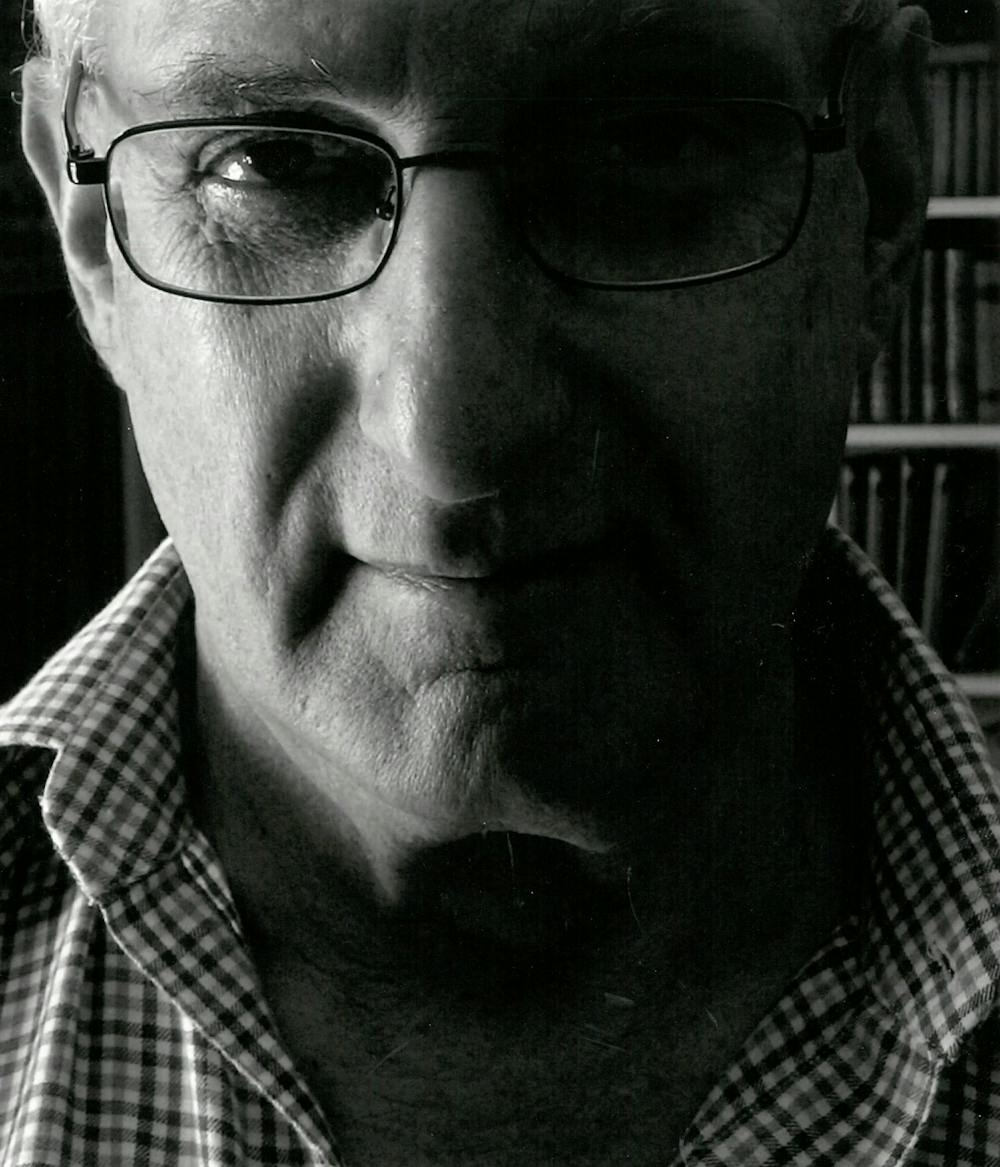
David Malouf has authored three recent poetry collections. Conrad Del Villar
Malouf’s poetry is not quite an open book, for “books/like houses have their secrets”, as he notes in a poem that responds to his mother’s claim that she could read him “like a book”. This poem is one his rare first-person poems, though it slips into the third person before the ending. Fittingly enough it is focused upon his attempt not to be simply the “open book in his mother’s lap” but rather to be one who is far enough apart to see and dream and wait for the plot to thicken.
Another first-person poem much later in the book seems to me to bring into itself most of the themes and images and preoccupations of the entire collection. And on top of that it is a charming, spellbinding poem, one that deserves to be anthologized well into the future. Incident on Myrtle Street brings scents, scariness, night, death’s angel, domestic attention to detail, and self-consciousness over the act of writing all together in a narrative that is not only charming but hauntingly told. I will leave you to purchase the book, or browse it in a shop, and go straight to it (it’s on page 56).
The power of presence
I can’t leave the book without noting that the words “presence” and “present” recur across the poems. One is even titled In the Presence. Among these poems of presence, The New Loaf is one that fills its moment with a presence that includes somehow all of human history and all the knowledge we might need to be kin, while offering us a loaf of bread in such light that Vermeer might be considering painting it. It’s another poem worth the price of the book, and that’s a bargain really — two poems in one book that make the purchase worthwhile, and promise an abundant return in pleasure for your time spent reading in that strange art of poetry.
Malouf’s poem The New Loaf offers a loaf of bread good enough to paint. Shutterstock
If poetry served Malouf as an apprenticeship on his way to becoming a novelist, then this late return to poetry in three recent collections seems to bring him back in a new way to steadying poems that do justice to the open gaze, the sly wit, the swift imagination and the poise he has in spades.
This might be a quiet kind of poetry with little bitter irony, little engagement with the world of technology and social media, few linguistic pyrotechnics, and no confessional stripping of the self, but it is something special to have read it and found in it much that is genuine, graceful, true, surprising and delightful.
I read the poems through for the second time (I confess to reading the book three times now) at a table in a café with a group of deaf children and women beside me. They were surprisingly noisy, tapping the table, slapping parts of their bodies in exclamation, letting out brief bursts of involuntary laughter, and moving around, leaning into each other, touching each other, lifting an eyebrow at each other or sticking out a chin.
I was distracted by them and convinced by them all over again that we are creatures of deep abilities when we want to communicate with each other. I love poetry that moves towards the kinds of inchoate communications words and text can’t usually manage. Malouf’s poetry has this quality, if a reader can sit with it for a little while.
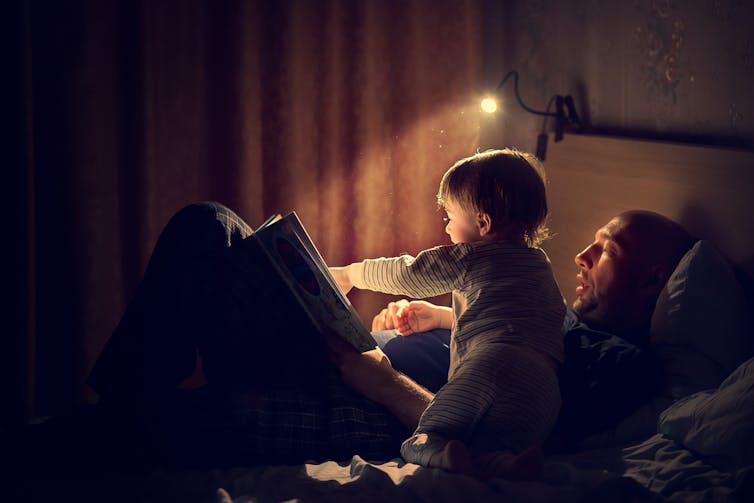
We often hear about the benefits of reading storybooks at bedtime for promoting vocabulary, early literacy skills, and a good relationship with your child. But the experts haven’t been in your home, and your child requests the same book every single night, sometimes multiple times a night. You both know all the words off by heart.
Given activities occurring just before sleep are particularly well-remembered by young children, you might wonder if all this repetition is beneficial. The answer is yes. Your child is showing they enjoy this story, but also that they are still learning from the pictures, words, and the interactions you have as you read this book together.
A preference for familiarity, rather than novelty, is commonly reported at young ages, and reflects an early stage in the learning process. For example, young infants prefer faces that are the same gender and ethnicity as their caregiver.
But even three-day olds prefer looking at a novel face if they’re repeatedly shown a picture of their mother’s face. So once infants have encoded enough information about an image, they’re ready to move on to new experiences.
Your child’s age affects the rate at which they will learn and remember information from your shared book-reading. Two key principles of memory development are that younger children require longer to encode information than older children, and they forget faster.
Two dimensional information sources, like books and videos, are however harder to learn from than direct experiences. Repeated exposure helps children encode and remember from these sources.
Blues Clues was created to harness learning from repetition. Screenshot/Youtube
Repetition aids learning complex information by increasing opportunities for the information to be encoded, allowing your child to focus on different elements of the experience, and providing opportunities to ask questions and connect concepts together through discussion.
You might not think storybooks are complicated, but they contain 50% more rare words than prime-time television and even college students’ conversations. When was the last time you used the word giraffe in a conversation with a colleague? Learning all this information takes time.
The established learning benefits of repetition mean this technique has become an integral feature in the design of some educational television programs. To reinforce its curriculum, the same episode of Blue’s Clues is repeated every day for a week, and a consistent structure is provided across episodes.
Five consecutive days of viewing the same Blue’s Clues episode increased three to five year olds’ comprehension of the content and increased interaction with the program, compared to viewing the program only once. Across repetitions, children were learning how to view television programs and to transfer knowledge to new episodes and series. The same process will likely occur with storybook repetition.
How parents can support repetitive learning
The next time that familiar book is requested again, remember this is an important step in your child’s learning journey. You can support further learning opportunities within this familiar context by focusing on something new with each retelling.
One day look more closely at the pictures, the next day focus on the text or have your child fill in words. Relate the story to real events in your child’s world. This type of broader context talk is more challenging and further promotes children’s cognitive skills.
You can also build on their interests by offering books from the same author or around a similar topic. If your child currently loves Where is the Green Sheep? look at other books by Mem Fox, maybe Bonnie and Ben rhyme again (there are sheep in there too). Offer a wide variety of books, including information books which give more insight into a particular topic but use quite different story structures and more complex words.
Remember, this phase will pass. One day there will be a new favourite and the current one, love it or loathe it, will be back on the bookshelf.
Review: Unfettered and Alive by Anne Summers (Allen and Unwin)
Years ago, when I was young, I lived in an apartment in Sydney’s Potts Point that looked straight down into Anne Summers’ house. Summers had recently published her “Letter to the Next Generation” – and it’s likely that any discomfort not arising from the strange proximity of our urban views was directly attributable to this.
In the “Letter”, Summers famously wrote that she was “horrified” and “mortified” by the antics of women like my younger self – the wayward daughters of the revolution who had failed to measure up on the long tough march to gender equality.
The “Letter” drew its inspiration from years Summers spent as editor of Ms. magazine. Oddly enough, Summers’ new autobiography, Unfettered and Alive, is also shot through with the upheaval of these years and the aftermath of her falling out with US feminists Gloria Steinem and Susan Faludi.
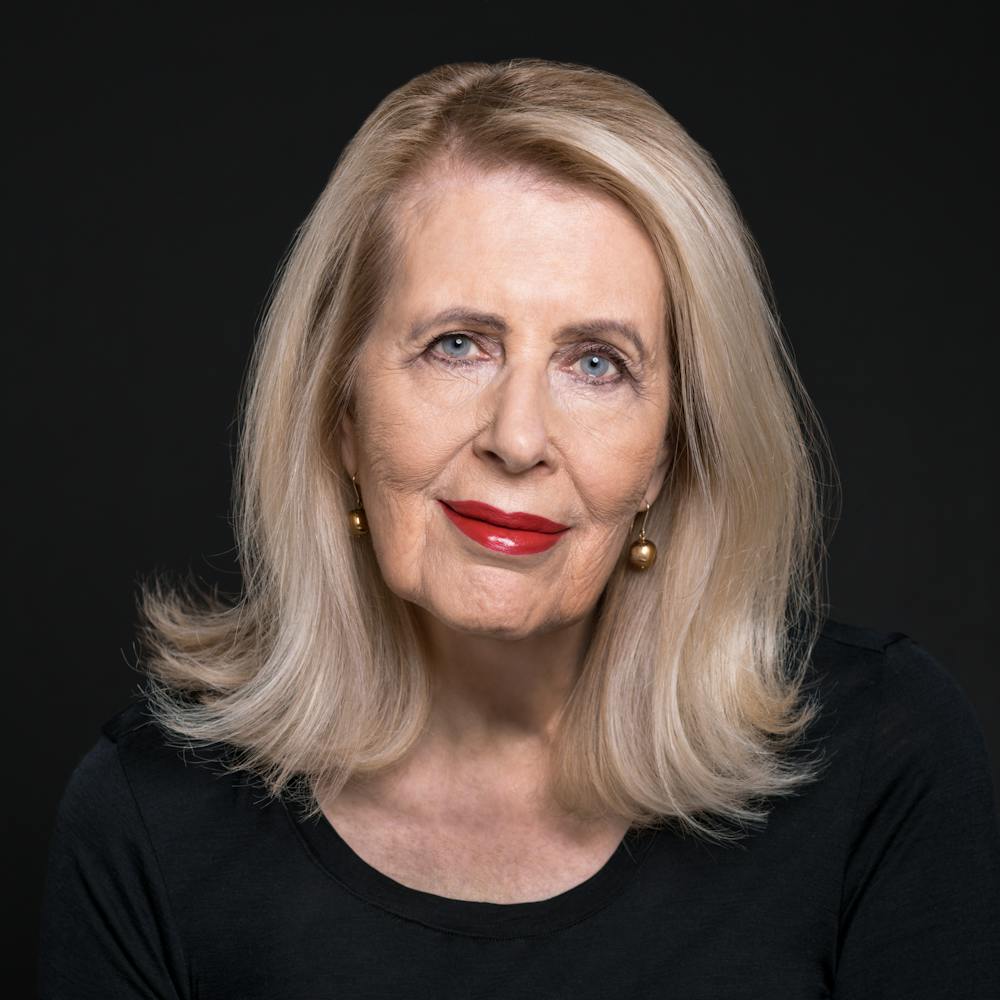
Anne Summers. Kevin McDermott
Many harsh things are said in this book. It’s difficult to decide whether to praise its “breathtaking honesty” – as critics undoubtedly will – or draw back like a witness to some gruesome accident.
These are bitter struggles over the memory narratives of feminism.
Unfettered and Alive picks up where Summers’ earlier autobiography, Ducks on the Pond, leaves off. It’s the 1970s, a time when women’s choices are startlingly limited. Women earn just 65.2% of men’s salaries. The employment ads are divided into men’s and women’s jobs. Women are not allowed to drink in the front bar at pubs – they are banished to the ladies lounge.
Summers, age 30, is already a leading figure in the Women’s Liberation Movement that puts an end to all this. She is the author of one of the most significant early works of Australian feminist history, Damned Whores and God’s Police, and a co-founder of the inner-city women’s refuge, Elsie.
Later, she will be remembered as the head of the Office of the Status of Women, and a significant figure in the passage of the Anti-Discrimination Act and the battles over affirmative action, though only a chapter of the book is devoted to this.
Summers starts her story in 1975, when she answers an advertisement for an “energetic self-starter” at The National Times, then under the “wily” editorship of Max Suich. Here, she quickly sets to work on the multi-feature series that gave fresh impetus to the royal commission into the state of NSW prisons, and wins her a Walkley.
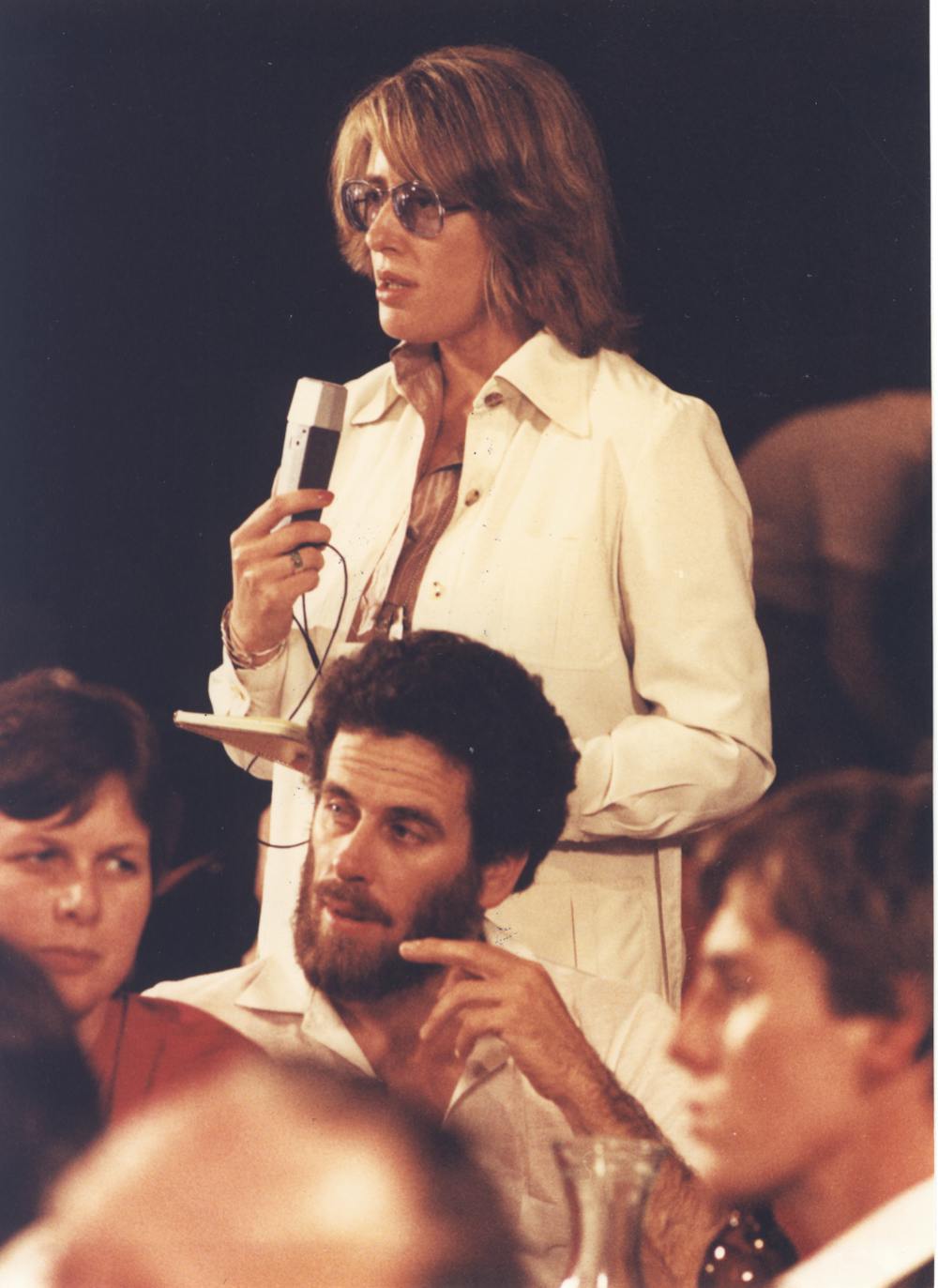
Summers at the National Press Club during the 1980 CHOGM meeting in Australia directing a question at British Prime Minister Margaret Thatcher. Allen and Unwin
Other more woman-focused stories follow. There’s the “gang bang” of a teenage girl at St Paul’s College, Sydney University. Another story, “How women are trained: if it’s not rape what is it?” reports on events in the Far North Queensland town of Ingham, where police openly acknowledge that 30 or 40 local women and children have been raped. “I reported it to police,” one girl told Summers, recollecting the first time she was gang-raped by five men at the age of 13. “But I didn’t have enough evidence. I wasn’t bruised enough.”
Working in Canberra as a political correspondent in the Fraser years, Summers is painfully honest about her fear of not doing the job well. “I can see the absolute terror in your eyes,” a reporter from a rival newspaper told her.
She reports walking out of a media conference held by Bill Hayden, in which the “alternative prime minister” decided to kick things off with a rape joke. “My colleagues didn’t seem bothered by such things,” Summers writes. Sexist behaviour went unchallenged and unnoticed because “it was the way things were back then”.
But Summers is also judgmental about other women in her memoir. In an atmosphere in which cabinet ministers chase female reporters around their desks, Summers recollects telling off a female reporter for wearing a “sexy outfit”. “I was very tough on a woman in my bureau who came to work one day with a dress that was slit practically to the waist.”
Confessions tumble across the pages: her breast-reduction surgery, the weight-loss regime that saw her drop 10kg and her pride in her “brand new body”. She talks about being brought up on a DUI charge when she took up her appointment at the Office of the Status of Women. She reveals her fondness for Robert Burton suits – it’s the era of the “femocrats” and big hair, shoulder pads and flats are in.
The 1980s are a time of epic change for women. New legislation and policy frameworks are put into place. Not everybody appreciated it. “One morning I found flung across the windscreen of my car a life-size plastic sex doll … ” Summers is alarmed, “not because this tawdry piece of plastic could hurt me but because whoever put it there could”.
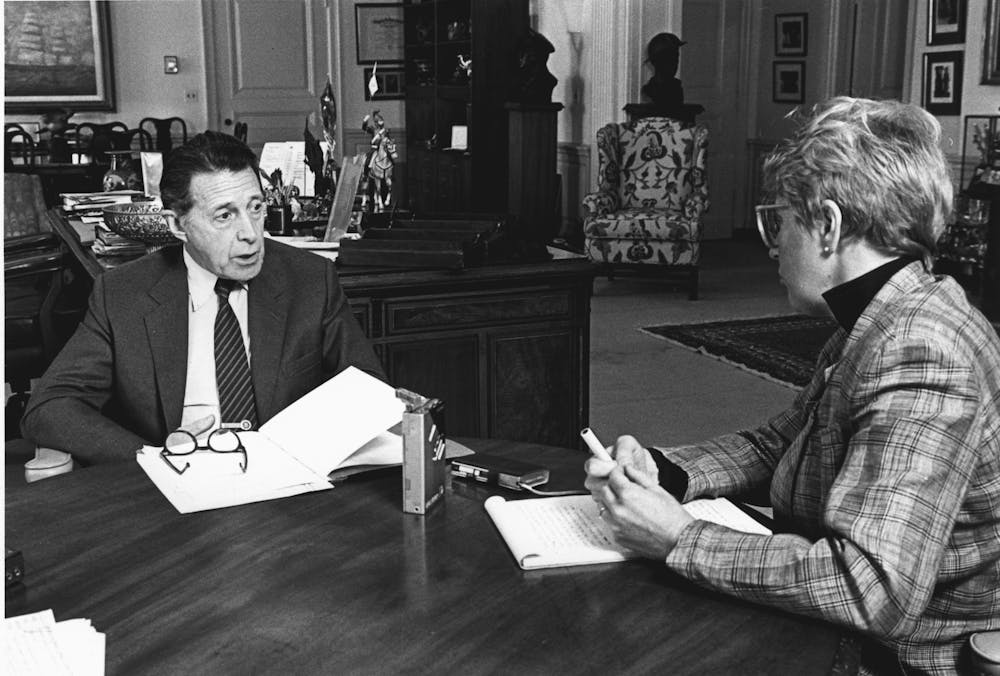
‘I was the first Australian journalist to interview a US Secretary of Defence when I sat down with Caspar Weinberger in his office at the Pentagon in June 1986.’ Allen and Unwin
The Ms. Years
Summers arrived at the “shambolic offices” of Ms. magazine, on West 40th Street, New York, following the unexpected purchase of the iconic feminist publication by Fairfax in 1987. Summers calls the magazine “chaotic”. It operated like a feminist collective, she writes, in which “everyone appeared to be equal” and everybody had to do their own “shitwork”.
According to Summers, this “might have been okay for the women’s movement” but it was “no way to run a magazine”. But Ms. did not understand itself as just another media outlet. It was the printed vanguard of US feminism. It was – and still is – synonymous with the name of US feminist Gloria Steinem.
Summers put the entire staff on 60 days’ probation and fired three. But later in the chapter she adds: “I … should have cleared out the whole place.”
Summers set about giving the magazine an “80s lift”. This included increasing the focus on fashion, makeup advertisements, and the inclusion of a gardening page.
She also embarked on a total redesign, including a new logo, masthead and an advertising campaign with the tagline, “We’re not the Ms. we used to be”. The ad featured a string of photographs showing an old hippie morphing into a young woman with a “glamorous 1980s look”.
It can’t have been an easy time. Steinem lost editorial control over the magazine as part of the financial arrangement. But, according to Summers, the magazine remained “almost neurotically dependent on Steinem”.
The relationship between the two women quickly became strained. Summers says she constantly questioned “the gap between Steinem’s rhetoric and the way she conducted herself”. The contents of Steinem’s apartment are said to be “disturbing”, including the covers on Steinem’s loft bed, which was draped in “flimsy white fabric” and a “set of physician’s weighing scales” in her kitchen, all of which are said to be “strange stuff for a feminist”.
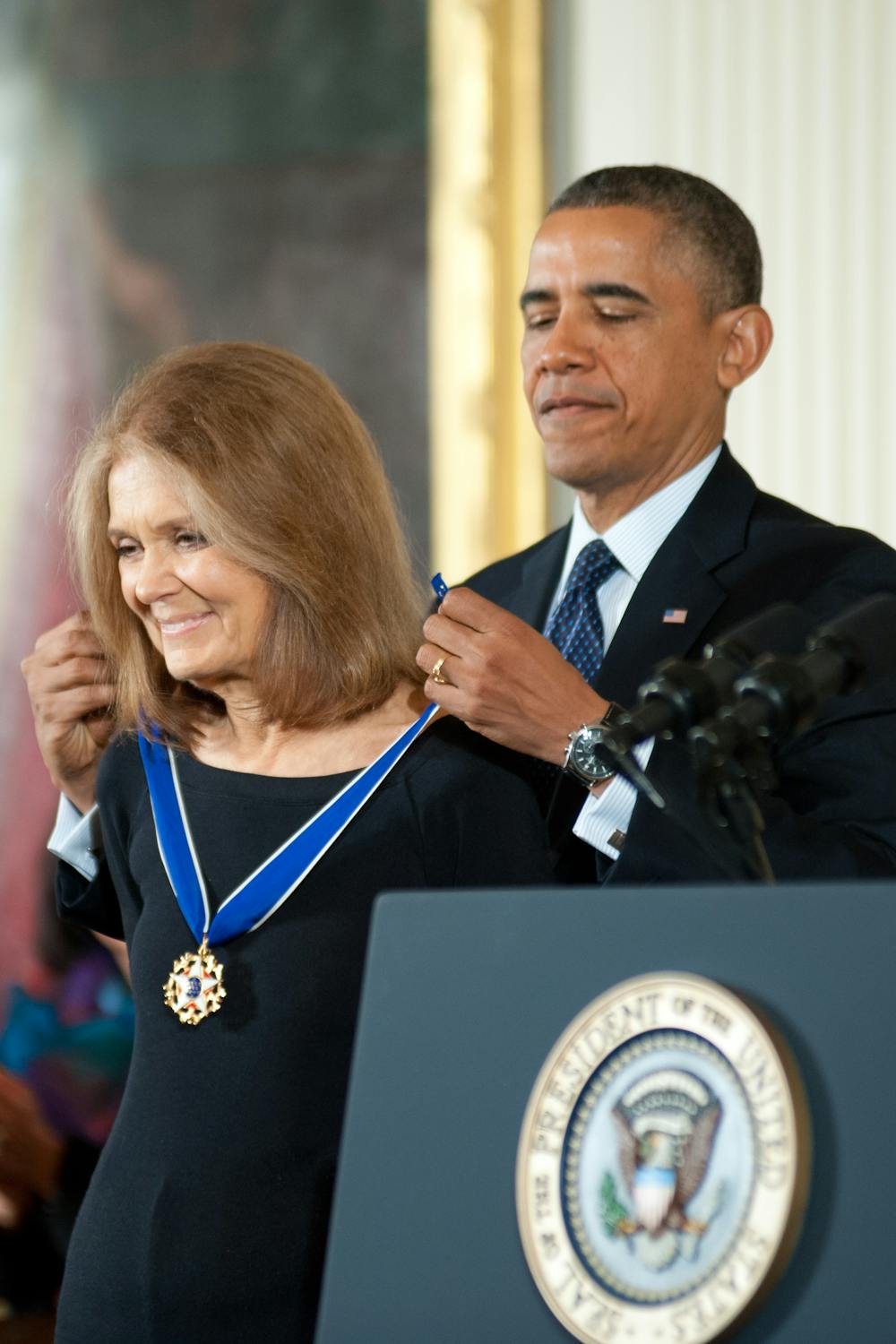
Gloria Steinem receives the Presidential Medal of Freedom from then US President Obama in 2013. Shutterstock
It was the Hedda Nussbaum case that brought matters at Ms. to breaking point. When Joel Nussbaum murdered his six-year-old daughter and bashed his wife Hedda, debates raged in feminist circles as to whether Hedda should have been treated as an accomplice to her daughter’s death. Summers and Steinem took up opposed positions. Summers argued it was time to “stop excusing the behaviour of all battered women”. Steinem argued that Hedda was a “total victim” and believed the coverage was a “betrayal of everything Ms. had ever stood for”.
The decision to pull a close-up image of the heavily beaten Hedda off Ms’s cover remains a matter of controversy today. Summers writes that the photo was removed on the advice of her head of advertising sales who said: “We’ve just cracked the beauty category. You can’t do this to me.”
There was a lot of pressure around revenue. Summers and Australian colleague Sandra Yates had recently engaged in an audacious management buyout, after Warwick Fairfax announced his untimely decision to sell. According to Summers, Ms. advertisers wanted their customers to be “happy” not “challenged or confronted”. “… our only chance of survival was to meet or, if possible, exceed our advertising budget.”
Fraught decisions followed. “I was stricken when Barbara Ehrenreich proposed her next column be a satire on fast cars,” writes Summers. “I explained to her how sensitive and demanding these advertisers were, how we could not afford to lose them. Would she be willing to change topics?”
Ehrenreich, the acerbic social critic, refused.
The first edition of Susan Faludi’s global bestseller Backlash: the Undeclared War Against Women carried several pages attacking the editorial direction of Ms. under Summer’s leadership. Back in Australia, following the forced sale of the publication, Summers was “stunned”. There was “a tone to the writing that made it sound almost malicious”. She initiated a “tough” exchange of lawyer’s letters, demanding a rewrite of all subsequent editions of the book.
The entry now stands at around one page, which Summers quotes. Faludi writes:
The magazine that had once investigated sexual harassment, domestic violence, the prescription drug industry and the treatment of women in third world countries now dashed off tributes to Hollywood stars, launched a fashion column, and delivered the real big news – pearls are back.
An air of anxiety
Women who do not conform to certain gender ideologies fare badly in Summers’ book. Stay-at-home mums are berated for pushing baby buggies, young women are berated for “baking and doing craftwork”.
An air of anxiety runs through the remaining chapters. The months on Paul Keating’s staff end with Summers “sobbing with humiliation and rage” at the notorious “True Believer’s Dinner” that wound up costing $35,000. She had wanted Bob McMullan to be minister for women, and he had refused. She also didn’t think the unions at Parliament House ought to be paid for working through the $100 per ticket event.
Her period as editor of The Sydney Morning Herald’s Good Weekend magazine was also clouded when the MEAA took action to “protest my management style”, after Summers fired her deputy for “disloyalty” over a sexual harassment allegation. “I was not a mother, so I must be a whore,” writes Summers, explaining the ferocity of the attacks.
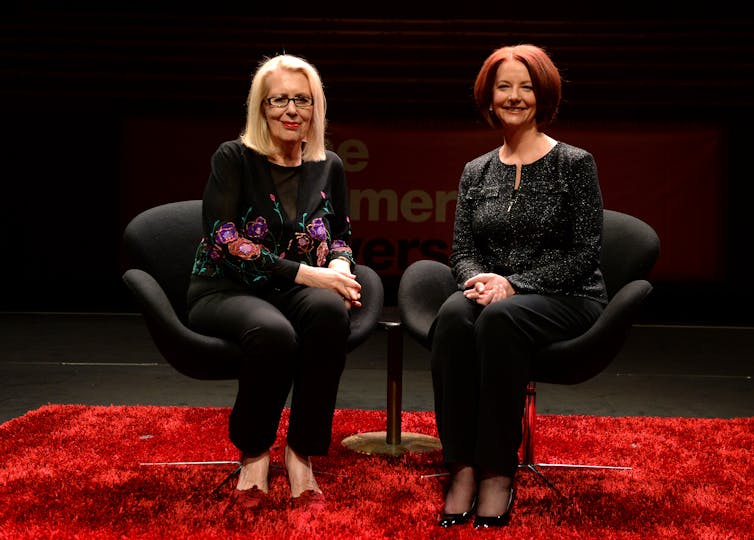
In 2013, Summers returned to address this same “widespread hostility towards women”, which had prominently manifested itself in the “woman-shaming” of the prime minister, Julia Gillard. In a new book, and a series of articles and interviews, she situated Gillard’s treatment as part of a continuing cultural pattern of “malicious and mendacious slurs” against high-achieving women.
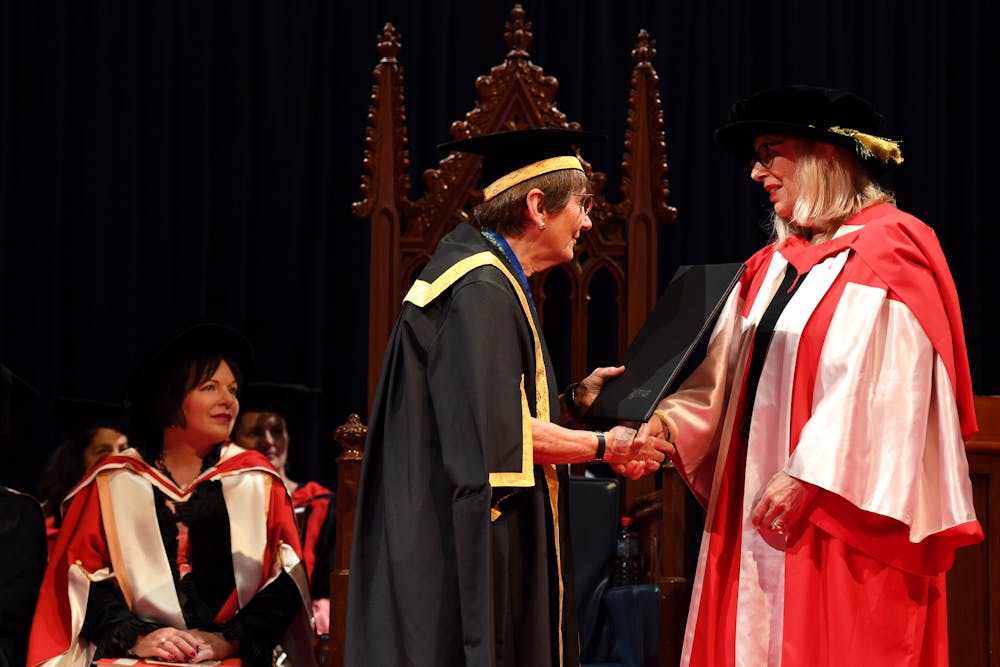
Anne Summers (right) receives an honorary Doctorate of Letters from Pro-Chancellor Dorothy Hoddinott at the University of Sydney in 2017. Paul Millar/AAP
Women are immeasurably better off for the achievements set out in Summers’ book, despite some frightening backwards steps since, not to mention a failure to gain ground on childcare policy and the gender wage gap. Feminism has also become more flexible, opening itself up to longstanding critiques around class and race.
But it remains difficult for women to have their voices heard. Women in Australia who have spoken up on #MeToo are almost immediately threatened with defamation action – and some of them are being sued. Women of all ages still name family and domestic violence, workplace sexual harassment and street violence and harassment close to the top of their list of concerns.
Next to this, “doing craftwork”, wearing a split skirt, or covering your bed in “flimsy white fabric” – as Gloria Steinem undoubtedly did – doesn’t seem like much to worry about.
Biologists are gathering evidence of green algae (pictured here in Kuwait) becoming carbohydrate-rich but less nutritious, due to increased carbon dioxide levels. As science fiction becomes science fact, new forms of storytelling are emerging. Raed Qutena
I count myself lucky. Weird, I know, in this day and age when all around us the natural and political world is going to hell in a handbasket. But that, in fact, may be part of it.
Back when I started writing, realism had such a stranglehold on publishing that there was little room for speculative writers and readers. (I didn’t know that’s what I was until I read it in a reader’s report for my first novel. And even then I didn’t know what it was, until I realised that it was what I read, and had always been reading; what I wrote, and wanted to write.) Outside of the convention rooms, that is, which were packed with less-literary-leaning science-fiction and fantasy producers and consumers.
Realism was the rule, even for those writing non-realist stories, such as popular crime and commercial romance. Perhaps this dominance was because of a culture heavily influenced by an Anglo-Saxon heritage. Richard Lea has written in The Guardian of “non-fiction” as a construct of English literature, arguing other cultures do not distinguish so obsessively between stories on the basis of whether or not they are “real”.
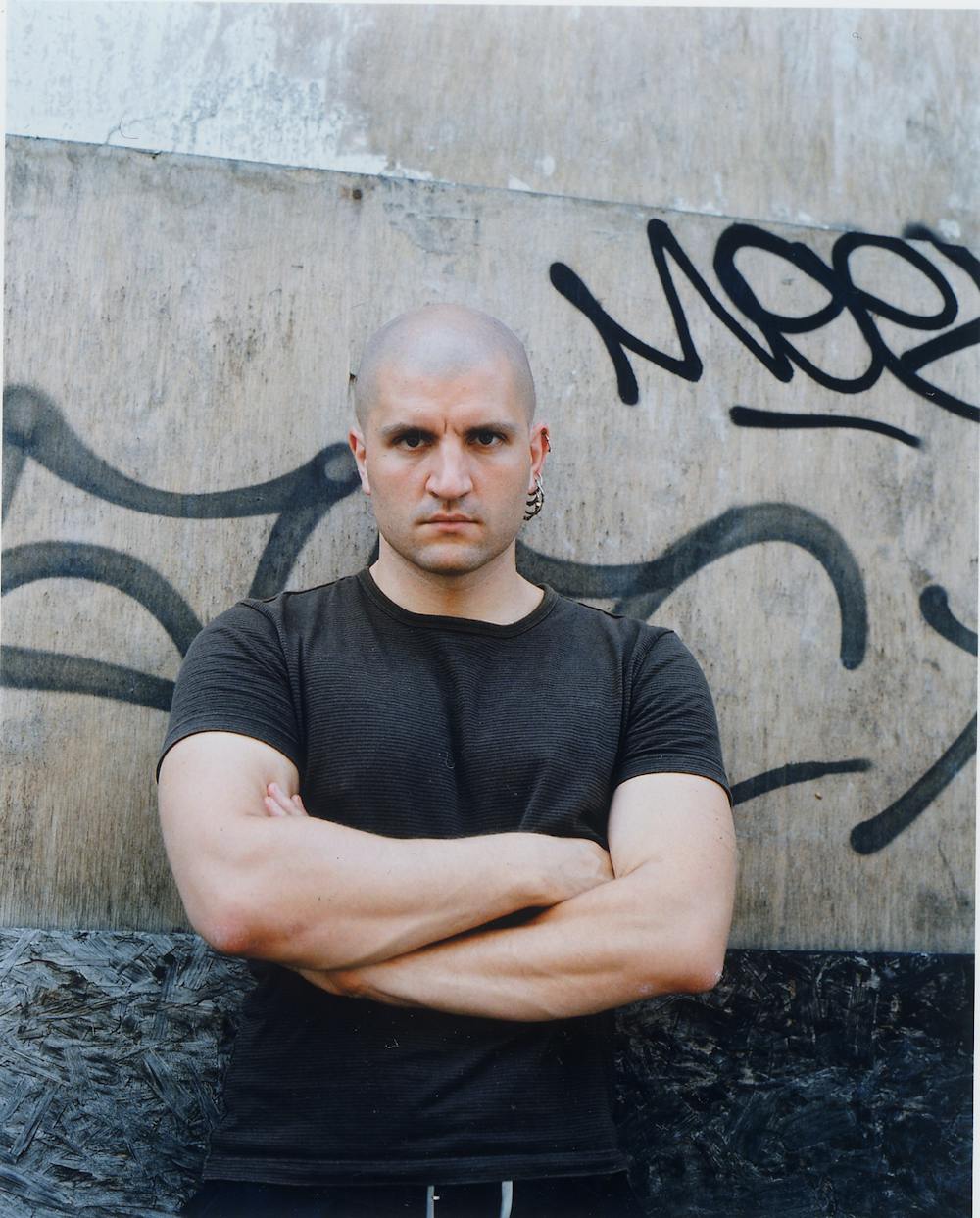
China Miéville in 2010. Pan MacMillan Australia/AAP
Regardless of the reason, this conception of literary fiction has been widely accepted – leading self-described “weird fiction” novelist China Miéville to identify the Booker as a genre prize for specifically realist literary fiction; a category he calls “litfic”. The best writers Australia is famous for producing aren’t only a product of this environment, but also role models who perpetuate it: Tim Winton and Helen Garner write similarly realistically, albeit generally fiction for one and non-fiction for the other.
Today, realism remains the most popular literary mode. Our education system trains us to appreciate literatures of verisimilitude; or, rather, literature we identify as “real”, charting interior landscapes and emotional journeys that generally represent a quite particular version of middle-class life. It’s one that may not have much in common these days with many people’s experiences – middle-class, Anglo or otherwise – or even our exterior world(s).
Like other kinds of biases, realism has been normalised, but there is now a growing recognition – a re-evaluation – of different kinds of “un-real” storytelling: “speculative” fiction, so-called for its obviously invented and inventive aspects.
a much larger collective conviction about who’s entitled to tell stories, what stories are worth telling, and who among the storytellers gets taken seriously … not only in terms of race and gender, but in terms of what has long been labelled “genre” fiction.
Closer to home, author Jane Rawson – who has written short stories and novels and co-authored a non-fiction handbook on “surviving” climate change – has described the stranglehold realistic writing has on Australian stories in an article for Overland, yet her own work evidences a new appreciation for alternative, novel modes.
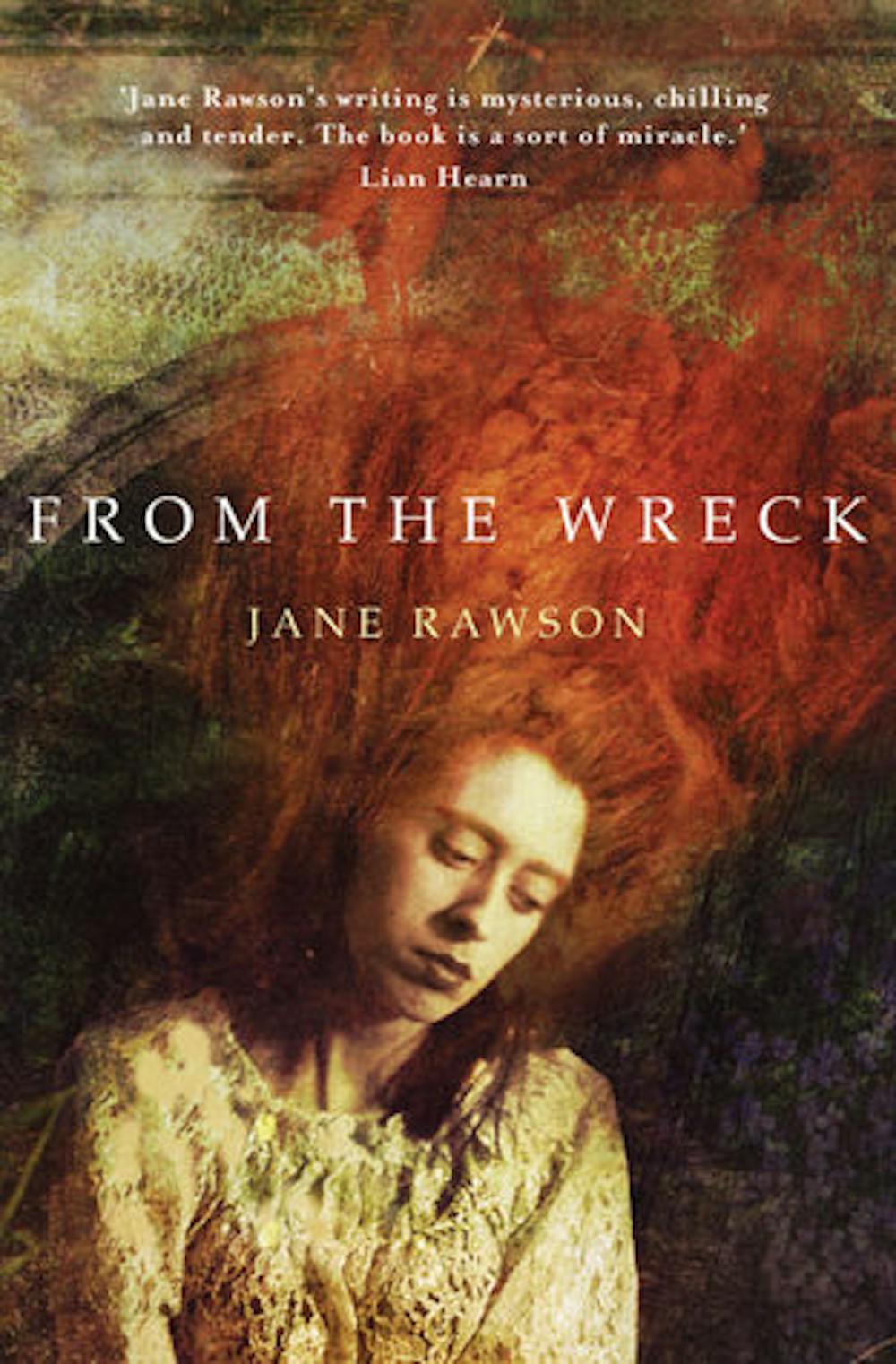
Rawson’s latest book, From the Wreck, intertwines the story of her ancestor George Hills, who was shipwrecked off the coast of South Australia and survived eight days at sea, with the tale of a shape-shifting alien seeking refuge on Earth. In an Australian first, it was long-listed for the Miles Franklin, our most prestigious literary award, after having won the niche Aurealis Award for Speculative Fiction.
The Aurealis awards were established in 1995 by the publishers of Australia’s longest-running, small-press science-fiction and fantasy magazine of the same name. As well as recognising the achievements of Australian science-fiction, fantasy and horror writers, they were designed to distinguish between those speculative subgenres.
Last year, five of the six finalists for the Aurealis awards were published, promoted and shelved as literary fiction.
A broad church
Perhaps what counts as speculative fiction is also changing. The term is certainly not new; it was first used in an 1889 review, but came into more common usage after genre author Robert Heinlein’s 1947 essay On the Writing of Speculative Fiction.
Whereas science fiction generally engages with technological developments and their potential consequences, speculative fiction is a far broader, vaguer term. It can be seen as an offshoot of the popular science-fiction genre, or a more neutral umbrella category that simply describes all non-realist forms, including fantasy and fairytales – from the epic of Gilgamesh through to The Handmaid’s Tale.
While critic James Wood argues that “everything flows from the real … it is realism that allows surrealism, magic realism, fantasy, dream and so on”, others, such as author Doris Lessing, believe that everything flows from the fantastic; that all fiction has always been speculative. I am not as interested in which came first (or which has more cultural, or commercial, value) as I am in the fact that speculative fiction – “spec-fic” – seems to be gaining literary respectability.
(Next step, surely, mainstream popularity! After all, millions of moviegoers and television viewers have binge-watched the rise of fantastic forms, and audiences are well versed in unreal onscreen worlds.)
One reason for this new interest in an old but evolving form has been well articulated by author and critic James Bradley: climate change. Writers, and publishers, are embracing speculative fiction as an apt form to interrogate what it means to be human, to be humane, in the current climate – and to engage with ideas of posthumanism too.
These are the sorts of existential questions that have historically driven realist literature.
According to the World Wildlife Fund’s 2018 Living Planet Report, 60% of the world’s wildlife disappeared between 1970 and 2012. The year 2016 was declared the hottest on record, echoing the previous year and the one before that. People under 30 have never experienced a month in which average temperatures are below the long-term mean. Hurricanes register on the Richter scale and the Australian Bureau of Meteorology has added a colour to temperature maps as the heat keeps on climbing.
Science fiction? Science fact.
A baby Francois Langur at Taronga Zoo in June. François Langurs are a critically endangered species found in China and Vietnam. AAP Image/Supplied by Taronga Zoo
There is an infographic doing the rounds on Facebook that shows sister countries with comparable climates to (warming) regions of Australia. But it doesn’t reflect the real issue. Associate Professor Michael Kearney, Research Fellow in Biosciences at the University of Melbourne, points out that no-one anywhere in the world has any experience of our current CO2 levels. The changed environment is, he says – using a word that is particularly appropriate for my argument – a “novel” situation.
Elsewhere, biologists are gathering evidence of algae that carbon dioxide has made carbohydrate-rich but less nutritious. So the plankton that rely on them to survive might eat more and more and yet still starve.
Fiction focused on the inner lives of a limited cross-section of people no longer seems the best literary form to reflect, or reflect on, our brave new outer world – if, indeed, it ever was.
Whether it’s a creative response to catastrophic climate change, or an empathic, philosophical attempt to express cultural, economic, neurological – or even species – diversification, the recognition works such as Rawson’s are receiving surely shows we have left Modernism behind and entered the era of Anthropocene literature.
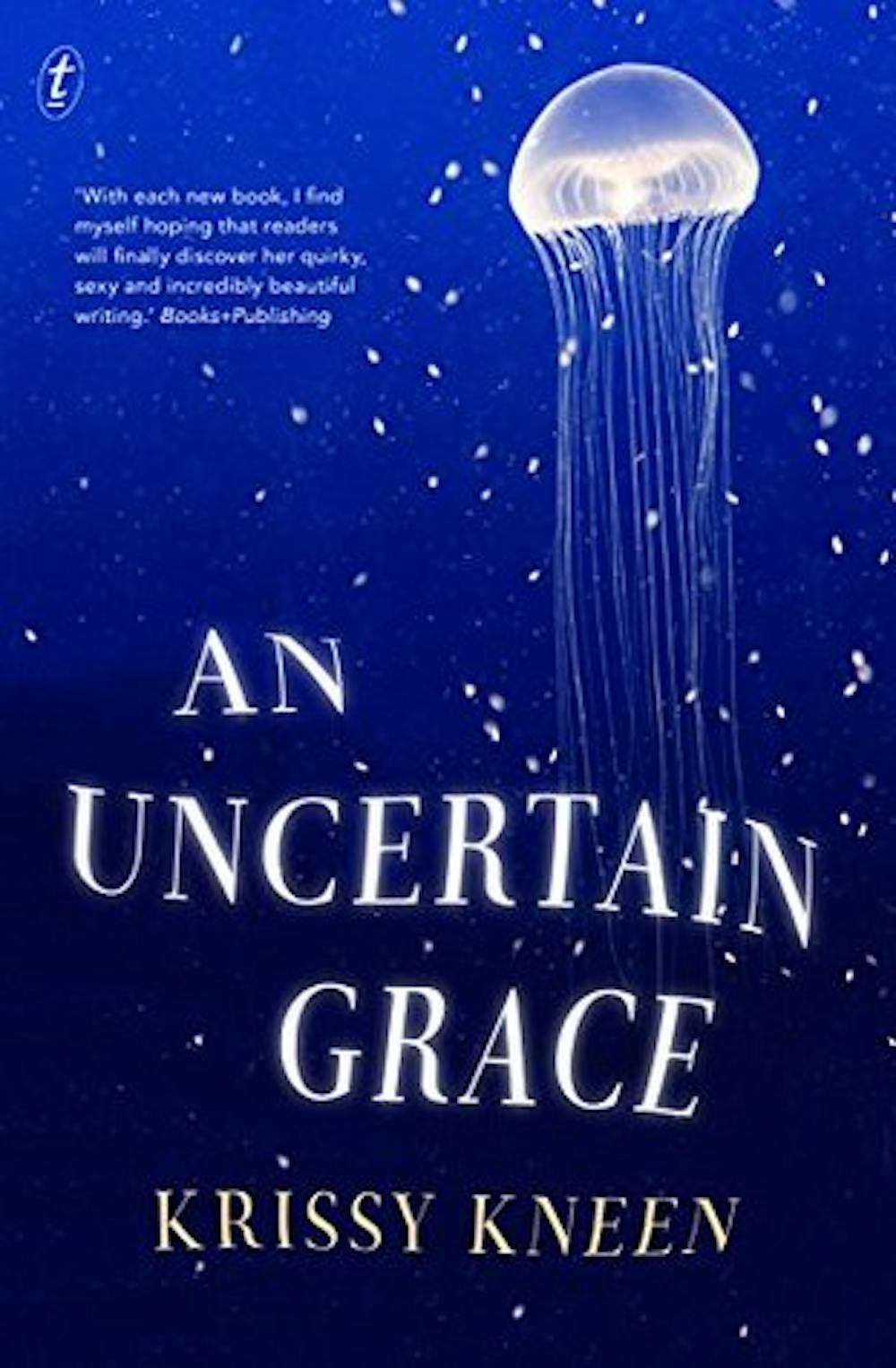
And her book is not alone. Other wild titles achieving similar success include Krissy Kneen’s An Uncertain Grace, shortlisted for the Aurealis, the Stella prize and the Norma K. Hemming award – given to mark excellence in the exploration of themes of race, gender, sexuality, class or disability in a speculative fiction work.
Kneen’s book connects five stories spanning a century, navigating themes of sexuality – including erotic explorations of transgression and transmutation – against the backdrop of a changing ocean.
Earlier, more realist but still speculative titles (from 2015) include Mireille Juchau’s The World Without Us and Bradley’s Clade. These novels fit better with Miéville’s description of “litfic”, employing realistic literary techniques that would not be out of place in Winton’s books, but they have been called “cli-fi” for the way they put climate change squarely at the forefront of their stories (though their authors tend to resist such generic categorisation).
Both novels, told across time and from multiple points of view, are concerned with radically changed and catastrophically changing environments, and how the negative consequences of our one-world experiment might well – or, rather, ill – play out.
Catherine McKinnnon’s Storyland is a more recent example that similarly has a fantastic aspect. The author describes her different chapters set in different times, culminating – Cloud Atlas–like, in one futuristic episode – as “timeslips” or “time shifts” rather than time travel. Yet it has been received as speculative – and not in a pejorative way, despite how some “high-art” literary authors may feel about “low-brow” genre associations.
Kazuo Ishiguro in 2017. Neil Hall/AAP
Kazuo Ishiguro, for instance, told The New York Times when The Buried Giant was released in 2015 that he was fearful readers would not “follow him” into Arthurian Britain. Le Guin was quick to call him out on his obvious attempt to distance himself from the fantasy category. Michel Faber, around the same time, told a Wheeler Centre audience that his Book of Strange New Things, where a missionary is sent to convert an alien race, was “not about aliens” but alienation. Of course it is the latter, but it is also about the other.
All these more-and-less-speculative fictions – these not-traditionally-realist literatures – analyse the world in a way that it is not usually analysed, to echo Tim Parks’s criterion for the best novels. Interestingly, this sounds suspiciously like science-fiction critic Darko Suvin’s famous conception of the genre as a literature of “cognitive estrangement”, which inspires readers to re-view their own world, think in new ways, and – most importantly – take appropriate action.
A new party
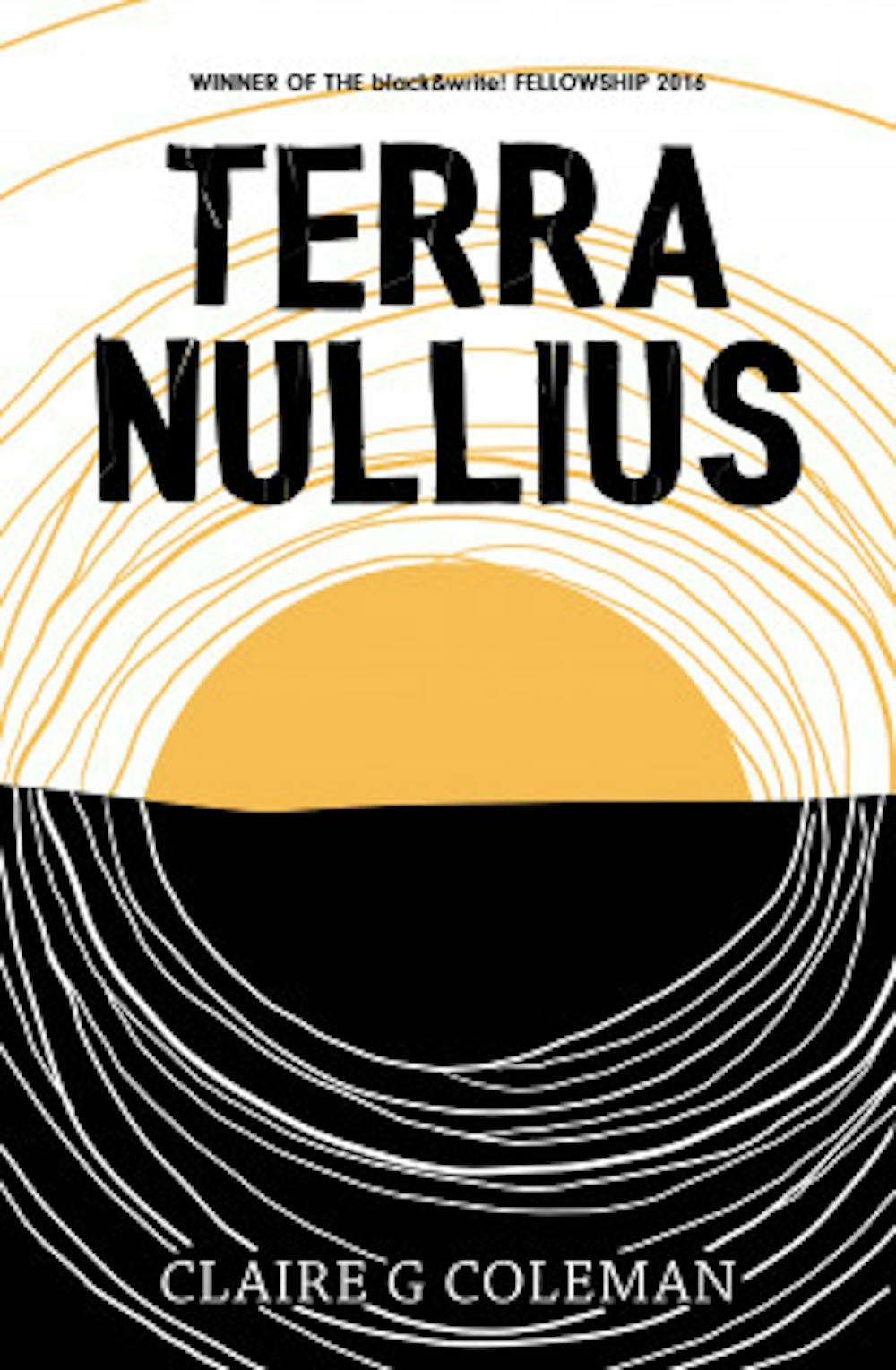
Perhaps better case studies of what local spec-fic is or does – when considering questions of diversity – are Charlotte Wood’s The Natural Way of Things and Claire Coleman’s Terra Nullius.
The first is a distinctly Aussie Handmaid’s Tale for our times, where “girls” guilty by association with some unspecified sexual scenario are drugged, abducted and held captive in a remote outback location.
The latter is another idea whose time has come: an apocalyptic act of colonisation. Not such an imagined scenario for Noongar woman Coleman. It’s a tricky plot to tell without giving away spoilers – the book opens on an alternative history, or is it a futuristic Australia? Again, the story is told through different points of view, which prioritises collective storytelling over the authority of a single voice.
“The entire purpose of writing Terra Nullius,” Coleman has said, “was to provoke empathy in people who had none.”
This connection of reading with empathy is a case Neil Gaiman made in a 2013 lecture when he told of how China’s first party-approved science-fiction and fantasy convention had come about five years earlier.
Neil Gaiman. Julien Warnand/EPA
The Chinese had sent delegates to Apple and Google etc to try to work out why America was inventing the future, he said. And they had discovered that all the programmers, all the entrepreneurs, had read science fiction when they were children.
“Fiction can show you a different world,” said Gaiman. “It can take you somewhere you’ve never been.”
And when you come back, you see things differently. And you might decide to do something about that: you might change the future.
Perhaps the key to why speculative fiction is on the rise is the ways in which it is not “hard” science fiction. Rather than focusing on technology and world-building to the point of potential fetishism, as our “real” world seems to be doing, what we are reading today is a sophisticated literature engaging with contemporary cultural, social and political matters – through the lens of an “un-real” idea, which may be little more than a metaphor or errant speculation.



















 At the BookShelf
You must be logged in to post a comment.