The latest TV adaptation of Thackeray’s 1848 novel Vanity Fair has polarised audiences expecting a traditional period drama. The first two episodes of Vanity Fair, co-produced by ITV and Amazon, received a mixed response on Twitter where viewers commented using the hashtag #VanityFair.
Comments seemed to broadly fall into two camps: those who admired the adaptation for its “fresh, modern take” on a period drama, and those who didn’t like what they saw as the needless modernisation of a period drama.
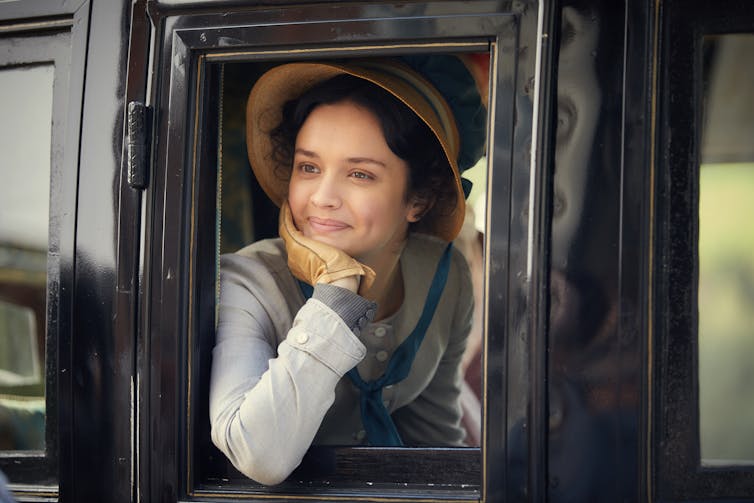
Interestingly, some of the features most identified as modernisations were actually from the original 1848 text: elements such as Becky Sharp throwing from her coach a dictionary she’d been given by her hated headmistress as she rode away from the school. Others took offence at Becky Sharp’s description of herself as a “secretary” – women were not secretaries at that time, one tweet protested. Meanwhile the frequent breaking of the fourth wall (Olivia Cooke, playing Becky Sharp, looks knowingly at the camera for dramatic effect) also caused a fair bit of angst.
These were not features that viewers associated with the genre of “period drama” and unfavourable comparisons were made with the popular BBC period drama Poldark (based on Winston Graham’s novels from the mid-20th century). That some viewers should so easily confuse historical accuracy with genre conventions is a striking example of the power of those genre conventions.
It is ironic, too, given that Thackeray subverted and satirised the conventions and tropes of his own time. This was true across his writing. In Pendennis, for example, a novel about the titular young gentleman making his way in London, Thackeray writes in his preface:
Perhaps the lovers of “excitement” may care to know, that this book began with a very precise plan, which was entirely put aside. Ladies and gentlemen, you were to have been treated, and the writer’s and the publisher’s pocket benefited, by the recital of the most active horrors.
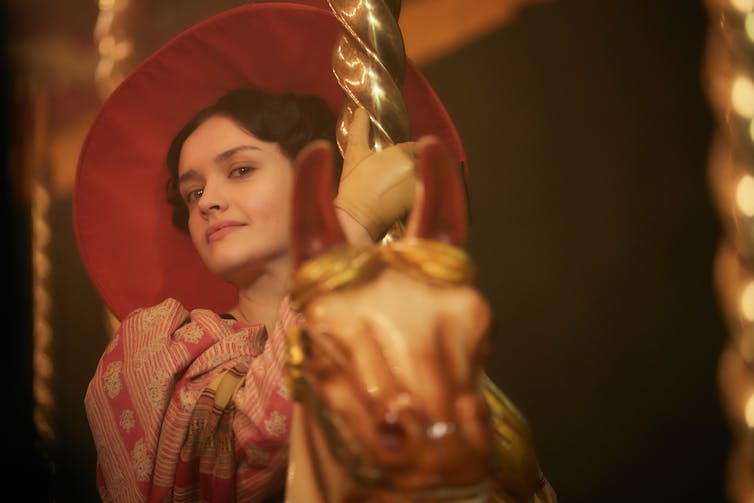
In Vanity Fair, such subversions are frequent. In the first episode of the new adaptation, Becky Sharp – attempting to charm the wealthy and credulous Jos Sedley into proposing marriage – attends the Vauxhall pleasure gardens. This takes place in chapter six of the book, which Thackeray introduces satirically:
We might have treated this subject in the genteel, or in the romantic, or in the facetious manner … Or if, on the contrary, we had taken a fancy for the terrible … we should easily have constructed a tale of thrilling interest, through the fiery chapters of which the reader should hurry, panting. But my readers must hope for no such romance, only a homely story, and must be content with a chapter about Vauxhall, which is so short that it scarce deserves to be called a chapter at all.
Within the full version of that quoted passage, Thackeray offers suggestions of how the story might have been written in these different “manners”. He plays with these kinds of conventions to set up readers’ expectations, only to subvert and parody them. One of the century’s other great novelists, Anthony Trollope, wrote that Vanity Fair raised the fundamental question of “what a novel should be.” Trollope takes issue with some of the same things as modern viewers:
There are absurdities in it which would not be admitted to anyone who had not a peculiar gift of making even his absurdities delightful. No schoolgirl who ever lived would have thrown back her gift-book, as Rebecca did the ‘dixonary’, out of the carriage window as she was taken away from school. But who does not love that scene with which the novel commences? How could such a girl as Amelia Osborne have got herself into such society as that in which we see her at Vauxhall? But we forgive it all because of the telling.
Same story, different flavours
Like Thackeray, Lewis Carroll, the Victorian author of Alice in Wonderland, was also highly attuned to the way stories become categorised via genre, satirising this in an 1855 short story entitled Photography Extraordinary. Carroll’s story, presented like a newspaper article, reports an invention which literally transcribes narrative fiction directly from the human brain. Not only can Carroll’s machine “develop” a story onto paper directly from the brain, but the story can then be redeveloped into different genres. Story writing, Carroll seems to suggest, was a question of mechanically adjusting language to fit the conventions of distinct genres and meet readers’ expectations.
Becky Sharpe at Vauxhall Pleasure Gardens. Mammoth Screen for ITV
As 21st-century readers and viewers, we still consume media in this way. Our genres have changed – we are not likely to talk about “silver fork” novels, for instance – but our use of genres has not. If anything, we have only become more reliant on them as we create more and more sophisticated algorithms for organising our digital media.
We also risk letting our expectations shape our understanding of the past. One of the big divergences between Thackeray’s book and the ongoing adaptation is that the series’ producers have elected to depict the Battle of Waterloo. When his military characters depart for the battlefield, Thackeray lets them drift out of view, writing: “We do not claim to rank among the military novelists. Our place is with the non-combatants.”
Thackeray, in other words, is willing to disappoint and frustrate readers’ expectations – he does not feel the need to conform to expectations. It is – as the book’s subtitle warns us – a “novel without a hero” (and in its serial form, not even a novel, simply “pen and pencil sketches of English society). But, of course, to adapt for television is to adjust the story to meet a different set of expectations. In that sense, adapting Vanity Fair is a bit like churning it through Carroll’s fiction machine one more time.
More spelling problems came in when French scribes introduced new spelling conventions — their own of course, and not always helpful. Shutterstock, CC BY
This is an article from Curious Kids, a series for children. The Conversation is asking kids to send in questions they’d like an expert to answer. All questions are welcome – serious, weird or wacky! You might also like the podcast Imagine This, a co-production between ABC KIDS listen and The Conversation, based on Curious Kids.
Why does English have so many different spelling rules? – Melania P, age 12, Strathfield.
English spelling has been evolving for over a thousand years and the muddle we’re in today is the fall-out of many different events that have taken place over this time.
It was a rocky beginning for English spelling. Quite simply, the 23-letter Roman alphabet has never been adequate — even Old English (spoken 450-1150) had 35 or so sounds, and our sound system is now even bigger.
More spelling problems came in when French scribes introduced new spelling conventions — their own of course, and not always helpful. Using “c” instead of “s” for words like city was messy because “c” also represented the “k” sound in words like cat.
And then printing arrived in the 15th century — and with it more mess. William Caxton (who set up the presses in the first place) liked Dutch spellings and so established the “gh” in ghost and ghastly. Some printers were European and they introduced favourite spellings too from their own languages. Not terribly helpful either!
Those pesky silent letters
One of the biggest problems for English spelling has always been changes in pronunciation. Printing helped to stablise the spelling of words, but then some sounds changed their shape, and others even disappeared altogether. Think of those silent letters in words such as walk, through, write, right, sword, know, gnat — these were once pronounced.
If only the printer Caxton had been born a couple of centuries later, or if these sound changes had occurred a couple of centuries earlier, our spelling would be much truer to pronunciation.
And now comes another little wrinkle in this story – there’s a bunch of silent letters that were never actually pronounced. They appeared because of linguistic busybodies who wanted to make the language look more respectable. This caused some serious mess.
Take how we spell the word rhyme. When we swiped the word from French, it had a much more sensible look — rime. But this was changed to rhyme to give it a more classy classical look (like rhythm) – an interesting idea, but hardly helpful for someone trying to spell the word!
The 16th and 17th centuries saw many extra letters introduced in this way. Think of the “b” added to debt to make a link to Latin debitum. Now, the “b” might be justified in the word debit that we stole directly from Latin, but it was the French who gave us dette.
The “b” consonant was a mistake, and now we accuse poor old debt of having lost it through sloppy pronunciation!
Let’s make spelling more sensible
And so it is from this haphazard evolution that we end up with the spelling system we have.
But you know, there are in fact over 80% of words spelled according to regular patterns. So wholesale change is not what we want. However simple improvements could certainly be made without any major upheaval.
We could iron out inconsistencies such as humOUr versus humOrous. To introduce uniform -or spellings would be a painless reform (well, perhaps not painless, since many people are quite attached to the -our in words like humour)
We could also restore earlier spellings like rime and dette, and while we’re at it give psychology and philosophy a sensible look by spelling them sykology and filosofy.
So now, you can see the problem. No matter how silly spellings are, people get attached to them, and new spellings – even sensible ones – never seem to get a foot in the door.
Please tell us your name, age and which city you live in. You can send an audio recording of your question too, if you want. Send as many questions as you like! We won’t be able to answer every question but we will do our best.
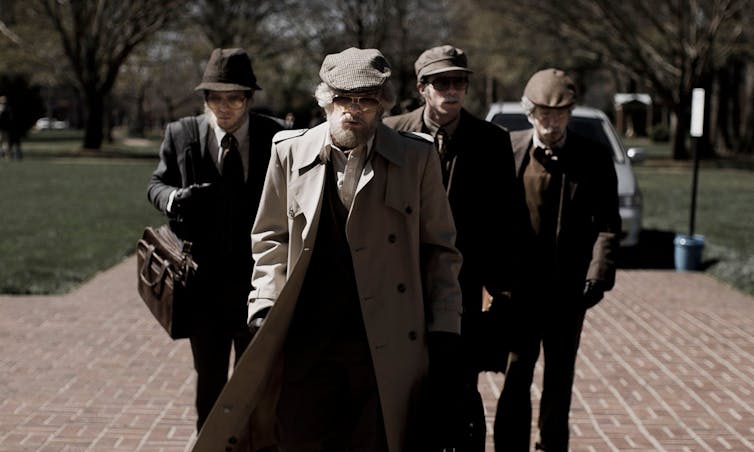
American Animals, a film recounting the true story of a 2004 rare book theft, was recently released in cinemas across the UK. The film is a dramatic retelling of events based on director Bart Layton’s interviews and written correspondence with the convicted book thieves – interactions which began while the thieves were serving seven-year prison sentences following their guilty pleas.
After a year in the planning, the heist involved the men disguising themselves as elderly, shooting librarian Betty Jean Gooch with a stun gun and simply shoving valuables into backpacks. When the day came, the men managed to escape with approximately US$750,000 worth of books in their backpacks, including a first edition of Charles Darwin’s On the Origin of Species, an illuminated medieval manuscript, and a copy of John James Audubon’s A Synopsis of Birds of North America.
Rushing from Lexington to New York, the men attempted to appraise their loot at Christie’s, but never managed to sell their ill-gotten gains. They returned home with the books and were tracked down by the FBI within a matter of months. The entire ordeal was so poorly organised that Vanity Fair deemed it “one part Oceans 11, one part Harold & Kumar”.
Light fingers
But this was by no means the only notable rare book heist in living memory. Earlier in 2018, an audit of the special collections of the Carnegie Library of Pittsburgh uncovered a series of thefts of rare books and book pages with a total value of around US$8m over a period of more than 20 years. It turned out that the former manager of the Carnegie Library’s rare book room, Gregory Priore, and bookseller John Schulman had been working together to sell the stolen goods through the rare book trade and auction houses.
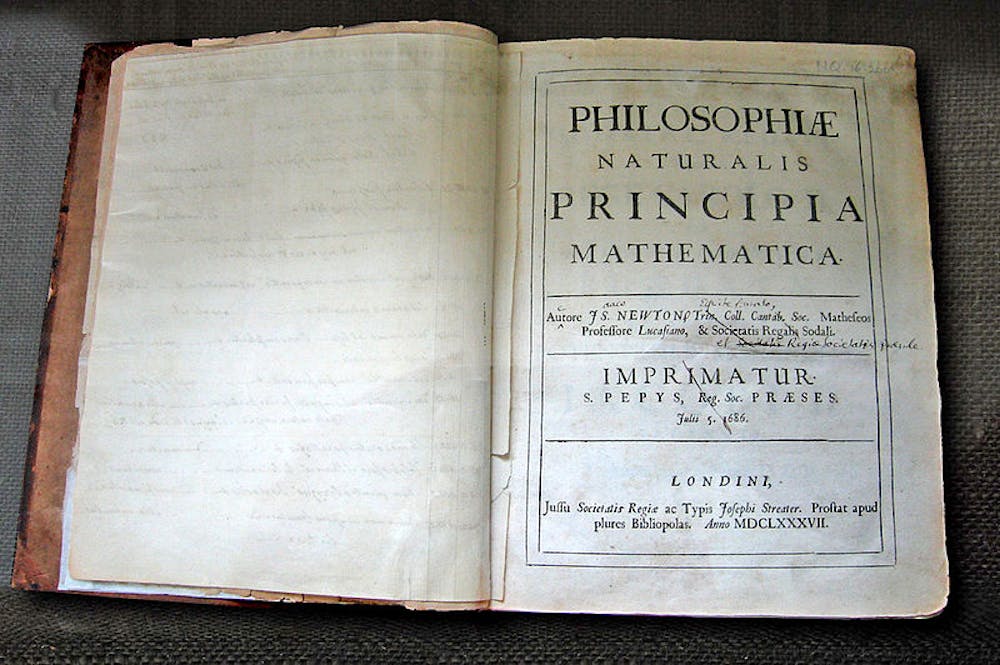
The books stolen from Carnegie included Isaac Newton’s Philosophiæ Naturalis Principia Mathematica, a first edition of The Journal of Major George Washington, and a first edition of Adam Smith’s The Wealth of Nations. Unaware of where these books came from, booksellers from across the globe bought and sold them on to their own private and institutional customers.
Sir Isaac Newton’s own first edition copy of his Philosophiae Naturalis Principia Mathematica with his handwritten corrections for the 20th edition. Andrew Dunn via Wren Library, Trinity College, Cambridge, CC BY-SA
These sales can be difficult to track on such a large scale and, while some works have been recovered (often at the booksellers’ own expense), hundreds of the stolen items remain missing. An up-to-date list of those items believed to have been stolen is provided by the Antiquarian Booksellers’ Association of America.
Library thefts are nothing new. Throughout the 1840s, Italian count Guglielmo Libri Carucci dalla Sommaja stole approximately 30,000 items in his job as chief inspector of French Libraries (he later made a comfortable living selling this loot in England).
More recently, in 1990, American bibiomaniac Stephen Blumberg was arrested for stealing more than 20,000 books valued at more than US$5m from more than 200 universities and museums across North America.
The Great Library of Alexandria, O. Von Corven, 19th century. Wikimedia commons, CC BY-NC
He served four years in prison and became known as the “Book Bandit”.
But on a more systemic and institutional level one could go as far back as the ancient Library of Alexandria, which supposedly seized any books found on ships arriving at the port. These books were copied by professional scribes who then deposited the original works into the library and gave the copies to the books’ owners.
Book ‘em
While library thefts are commonplace, the release of American Animals and the news of the recent Carnegie Library thefts have made this crime front page news. After all, the sheer value of some of these books makes them a very attractive proposition for thieves. But it’s not always just about money – the young men in American Animals fantasise about getting their hands on culturally revered items, while Guglielmo Libri and Blumberg were bibliomaniacs with a recognised condition. And the Library of Alexandria had a larcenous ambition to become a “universal library”, gathering all of the known world’s knowledge under a single roof.
The rare book trade is lucrative, certainly. Individuals and institutions are willing to spend healthy amounts to enhance their collections. But books represent more than just profit. They are cultural artefacts that span space and time to carry the voices of those who have meaningfully contributed to the world’s knowledge. As the primary means of communication for thousands of years, books reflect and perpetuate cultural heritage and – ultimately – help us understand what it means to be human.
Whether someone is stealing books for financial gain, the thrill of the game, or the overwhelming love of these objects, library theft is always underpinned by an understanding of books as valuable cultural artefacts. The young men in the American Animals heists are animals because they tried to plunder these relics of human development.
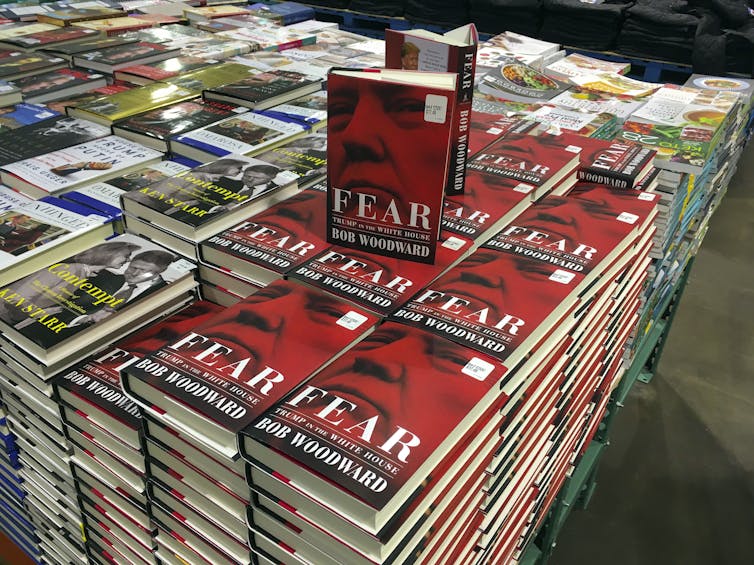
Like Michael Wolff’s “Fire and Fury: Inside the Trump White House,” it portrays President Donald Trump as an “emotionally overwrought, mercurial and unpredictable leader,” whose senior staff struggle to contain his most dangerous impulses.
This same view of Trump was reiterated in a Sept. 5 anonymous New York Times op-ed, which, as Nebraska Sen. Ben Sasse observed, is “just so similar to what so many of us hear from senior people around the White House, you know, three times a week.”
But whether “Fear” tells us something new matters less than the fact that the book is yet another broadside against Trump’s image. It adds more fuel to the suspicions many have about the president’s behind-the-scenes behavior.
In fact, Woodward’s “Fear” – together with Wolff’s “Fire and Fury,” Omarosa Manigault’s “Unhinged” and the anonymous op-ed – is part of a long tradition of political “secret histories,” a genre that recounts salacious and scandalous details about the dealings, relationships and temperaments of those in power. It’s a practice that goes back centuries, and it’s one that my co-editor and I explore in our book “The Secret History in Literature, 1660-1820.”
Secret histories tend to take two forms. There is the plain-spoken, just-the-facts approach, similar to Woodward’s “Fear.” Then there are novelistic accounts with major figures depicted using pseudonyms, as in “Primary Colors,” a lightly fictionalized dramatization of the Clinton White House.
But the secrets unveiled in these works usually don’t come out of nowhere. Instead, they contain anecdotes that have long been whispered or suspected. The goal of secret histories is to emphasize embarrassing stories about a ruler or government – to propel the drumbeat of negative coverage in order to strengthen the opposition and, in some instances, to even topple governments.
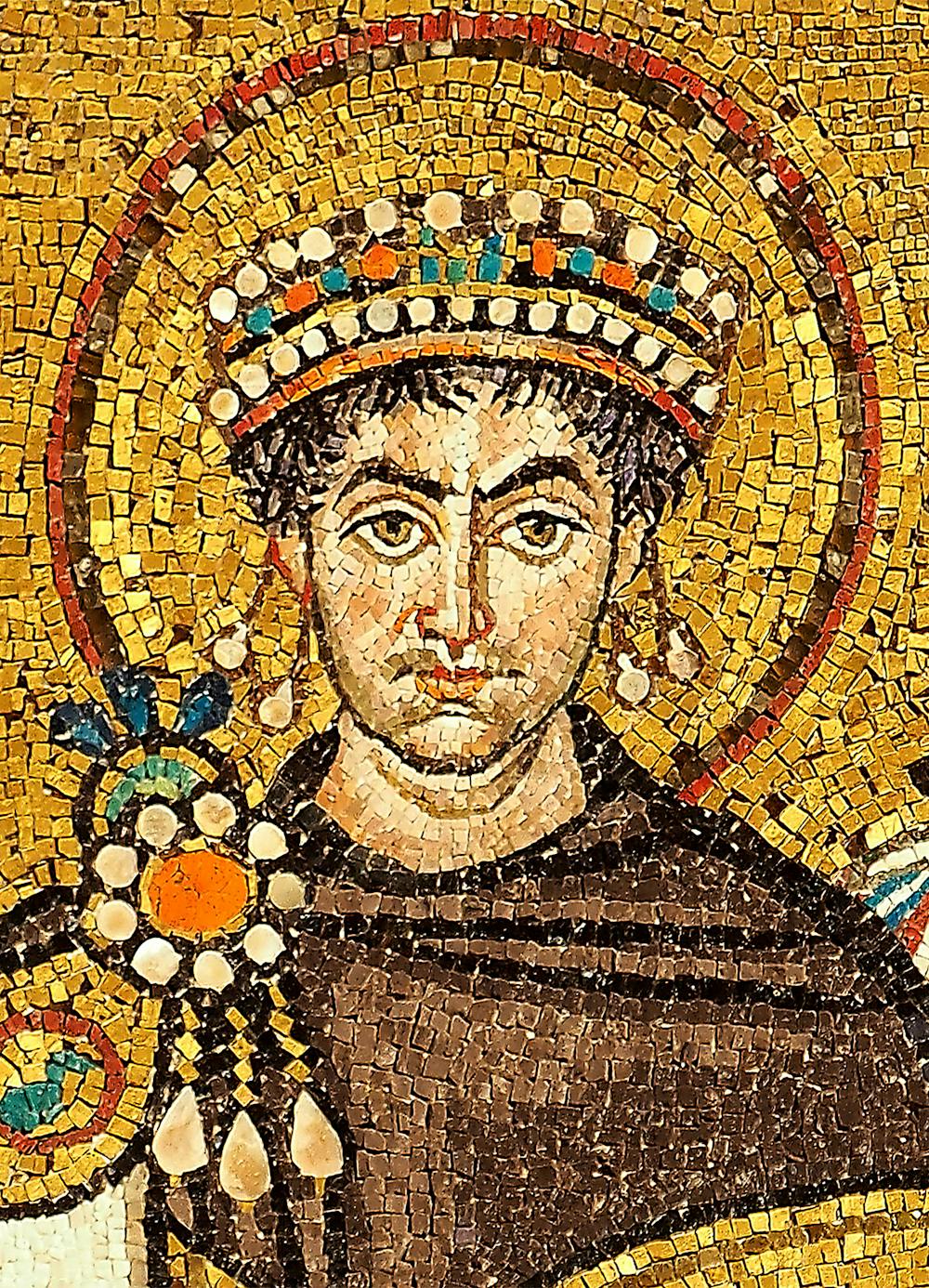
Justinian was the subject of a secret history circulated by the military historian Procopius. Petar Milošević
Secret histories date back at least to the sixth century, when the military historian Procopius wrote down sordid anecdotes about Byzantine Emperor Justinian and his wife, Theodora, in a work that became known as “Anekdota,” which translates to “unpublishable things.” Ten centuries later, it appeared in Latin as “Historia Arcana,” or “Secret History.”
As a military historian, Procopius had helped create the myth of Justinian’s greatness in his eight-book treatise “The Wars of Justinian.” But in his “Anekdota,” Procopius finally told the ugly backstory of Justinian’s reign: his lust, his seizure of others’ property, his petty vengefulness and his persecution of non-Christians. The work was almost certainly circulated in manuscript scroll among Justinian’s enemies. While it probably damaged his standing, Justinian was nonetheless able to retain his grip on power.
After French and English translations of Procopius’ “Anekdota” appeared in 1669 and 1674, secret histories in the same style began to appear about King Charles II of England.
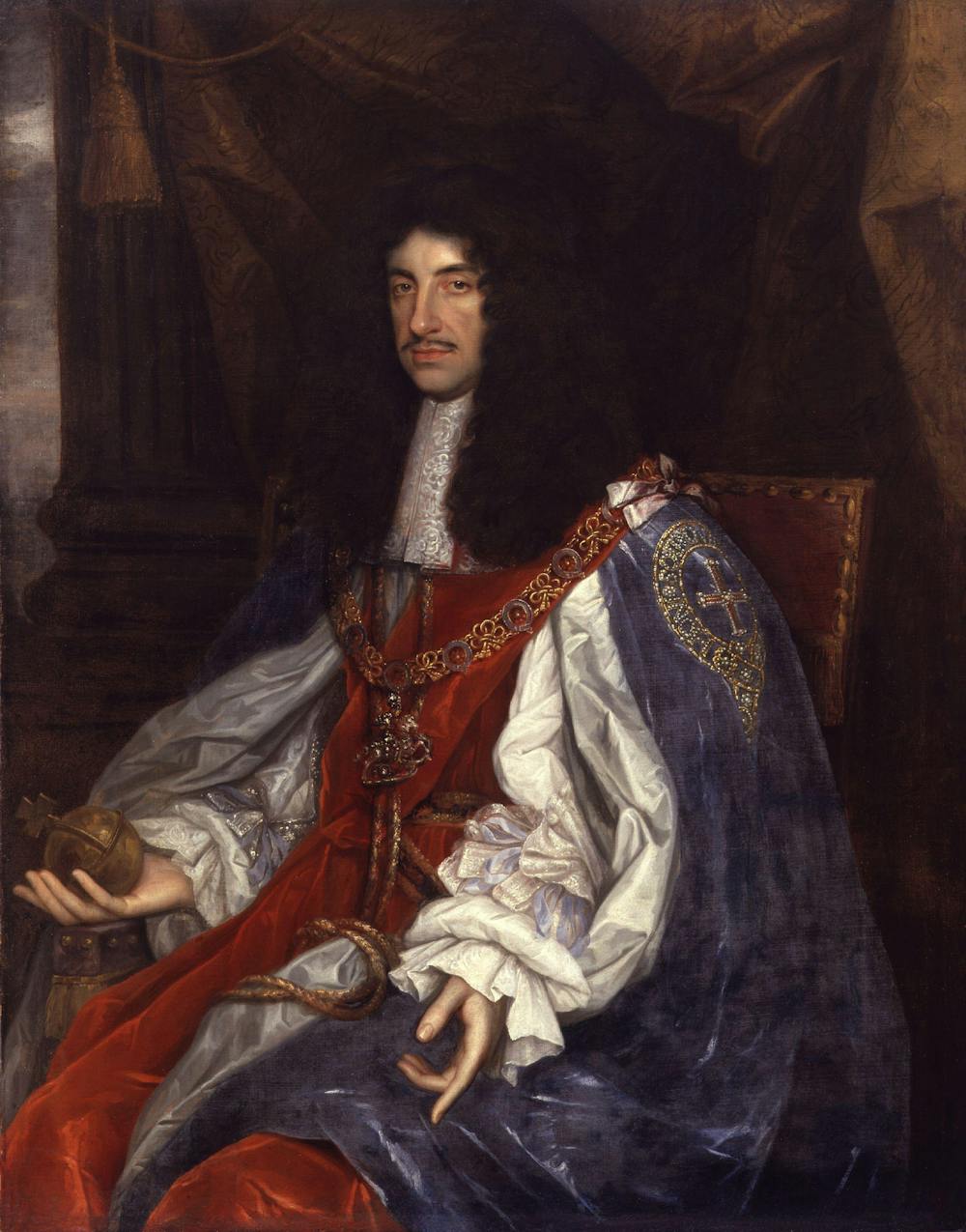
These tended to focus on his mistresses – particularly the infamous Duchess of Cleveland, who manipulated Charles for over a decade, persuading him to grant her land and money and bestow titles of nobility on their illegitimate children.
Speculation over King Charles II’s relationship with the Duchess of Cleveland was rampant during his reign. National Portrait Gallery
These reports, which read like tabloid-style gossip, were never just about sex.
Readers of one account, titled “The Amours of the King of Tamaran,” likely realized that if the king could be duped and controlled by his powerful mistress, he was also susceptible to being influenced by England’s adversaries.
These publications didn’t bring down the politically skilled Charles II, who was glad to take Louis XIV’s money but savvy enough to decide against changing his country’s religion.
They did, however, sow suspicion towards Charles II and his family. After Charles II’s death, his openly Catholic younger brother, James, ascended the throne in 1685, instilling fear that England would return to Catholicism. Seven Englishmen wrote to Prince William of Orange – who was a Protestant – pleading that he invade England. In the Glorious Revolution that ensued, James II fled to France, and Parliament declared William and his wife, Mary, joint monarchs of England.
The Glorious Revolution of 1688 helped inspire American colonists to rebel against another British monarch, with the not-so-secret history of George’s III’s “repeated injuries and usurpations” enshrined in the Declaration of Independence.
Some might disparage Woodward’s book as “anonymously-sourced gossip.”
But gossip has always been important to humankind. As Israeli historian Yuval Noah Harari notes in “Sapiens,” his best-selling account of early human history:
“It is not enough for individual men and women to know the whereabouts of lions and bison. It’s much more important for them to know who in their band hates whom, who is sleeping with whom, who is honest, and who is a cheat.”
Those who dismiss Woodward’s book underestimate the power that gossip and behind-the-scenes revelations wield over politics – and the way it has shaped the course of human history.









 At the BookShelf


.jpg)

You must be logged in to post a comment.