
Unknown's avatar

How to write a love poem


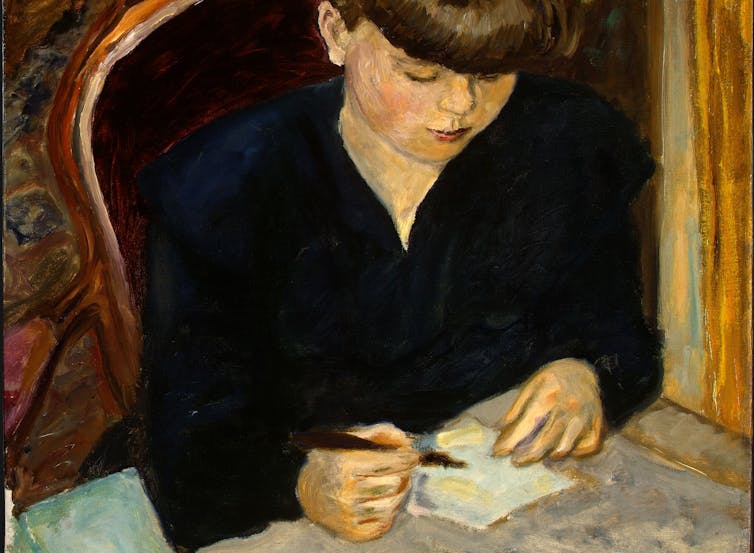
Wikimedia/National Gallery of Art

Hannah Copley, University of Westminster

For many, this year’s Valentine’s Day will be like no other. If you are spending the day apart from your loved ones, and don’t fancy the card selection at your local Tesco, writing a poem can be a more personal way to reach out and connect. Indeed, to paraphrase John Donne, “more than kisses, [poems] mingle souls”.

Here are some poems to take inspiration from, as well as some prompts to help you get that first line on the page.

Make a list

In her sonnet, How Do I Love Thee, Elizabeth Barrett Browning demonstrates the effectiveness of staying power when it comes to writing romance. After setting out to count the ways, the poem sticks determinedly to its opening concept – how do I love thee – answering the question from every possible angle, reaching to “the depth and breadth and height / My soul can reach”.


Read more:
Poems for long distant loves in lockdown


How do I love thee demonstrates how incorporating a list within a poem can make for a persuasive and intimate piece of writing. We see this again, in an altogether sillier way, in Ways of Making Love, by Hera Lindsay Bird. In her poem, Bird unfolds a surprising and decidedly unsexy list of similes to “answer” the instructional title of the poem:

Like a metal detector detecting another metal detector.
Like two lonely scholars in the dark clefts of the Cyrillic alphabet.
Like an ancient star slowly getting sucked into a black hole.

Whether it’s heartfelt or more lighthearted, a list poem is an opportunity to remember the quirks that make up a relationship. Half prayer, half receipt, it can quantify the seemingly unquantifiable, as the need to find the next answer to the opening question forces you to think creatively and explore beyond the obvious.

Why not begin with a title like “Each Thing You Do”, and challenge yourself to at least forty lines. Or perhaps you might want to answer Barrett Browning’s original question in light of our 2021 reality:

I love you further than two metres;
I love you beyond the limits of my daily walk.

Embrace desire

Ways of Making Love might not live up to the eroticism of its title, but Selima Hill’s Desire’s a Desire certainly delivers:

It taunts me
like the muzzle of a gun;
it sinks into my soul like chilled honey
packed into the depths of treacherous wounds;

In this variation of the list poem, Hill takes longing as her starting point and recounts its effects in sensual, almost painful detail. Similarly, in Kim Addionzo’s For Desire, the poet celebrates what it is to want without restraint or guilt, whether that’s “the strongest cheese”, the “good wine”, or “the lover who yanks open the door / of his house and presses me to the wall”. In Fucking in Cornwall, Ella Frears embraces the less-than-glamorous realities of sex and desire:

The rain is thick and there’s half a rainbow
over the damp beach; just put your hand up my top.

It may not be the stuff of the big-budget period drama, but it’s joyful in its nostalgia for the awkward fumbling of first love, as well as of the rainy delights of the English seaside.

Each of these poems celebrates the power of declaring longing and need; of articulating the body and what it wants.

Be playful

Perhaps you’ll notice something familiar about the opening lines of Harryette Mullen’s Dim Lady:

My honeybunch’s peepers are nothing like neon. Today’s special at Red Lobster is redder than her kisser. If Liquid Paper is white, her racks are institutional beige. If her mop were Slinkys, dishwater Slinkys would grow on her noggin.

In this fast-paced ode, Mullen takes Shakespeare’s famous Sonnet 130 (“My mistress’ eyes are nothing like the sun”) — itself a parody — and effectively scribbles all over it. While she maintains the style of the original, she substitutes almost every word with a contemporary reference to mass consumer culture, rendering the whole declaration — and the love industry — joyfully ridiculous.

Dim Lady demonstrates the power of the re-write and celebrates the fact that poetry – like love – can be a playful and adaptable collaboration. Like the Zoom pub quiz and online escape room, Mullen’s word substitution is a game that can be played at whatever distance.

Why not each take Sonnet 130 and come up with your own versions using a different frame of reference. Types of plant? TV programmes? Biscuit brands? Then swap and compare results.

And remember, whatever style you decide to try this Valentine’s Day, keep in mind the poet Les Murray’s sage advice:

The best love poems are known
as such to the lovers alone.

When it comes to writing your own verse, remember, it’s the thought that counts.The Conversation

Hannah Copley, Lecturer in Creative Writing, University of Westminster

This article is republished from The Conversation under a Creative Commons license. Read the original article.


Unknown's avatar

Writing Tips from Margaret Atwood


The link below is to an article that looks at writing tips from Margaret Atwood.

For more visit:
https://writingcooperative.com/margaret-atwoods-top-13-writing-tips-a6530863fa6a

Unknown's avatar

Writing Tools


The link below is to an article that takes a look at 9 writing tools.

For more visit:
https://www.almostanauthor.com/9-writing-tools-to-become-more-productive-as-a-writer/

Unknown's avatar

WriteSmoke Grammar Checker


The link below is to an article that takes a look at WriteSmoke Grammar Checker, a tool for writers.

For more visit:
https://www.makeuseof.com/improve-writing-writesmoke-grammar-checker-tool/

Unknown's avatar

Saying more with less: 4 ways grammatical metaphor improves academic writing


Vinh To, University of Tasmania

Young children often write as they speak. But the way we speak and the way we write isn’t quite the same. When we speak, we often use many clauses (which include groups of words) in a sentence. But when we write – particularly in academic settings — we should use fewer clauses and make the meaning clear with fewer words and clauses than if we were speaking.

To be able to do this, it’s useful to understand specific written language tools. One effective tool in academic writing is called grammatical metaphor.

The kind of metaphor we are more familiar with is lexical metaphor. This is a variation in meaning of a given expression.

For example, the word “life” can be literally understood as the state of being alive. But when we say “food is life”, metaphorically it means food is vital.

Grammatical metaphor is different. The term was coined by English-born Australian linguistics professor Michael Halliday. He is the father of functional grammar which underpins the Australian Curriculum: English.

Halliday’s concept of grammatical metaphor is when ideas that are expressed in one grammatical form (such as verbs) are expressed in another grammatical form (such as nouns). As such, there is a variation in the expression of a given meaning.

There are many types of grammatical metaphor, but the most common is done through nominalisation. This is when writers turn what are not normally nouns (such as verbs or adjectives) into nouns.


Read more:
4 ways to teach you’re (sic) kids about grammar so they actually care


For example, “clever” in “she is clever” is a description or an adjective. Using nominalisation, “clever” becomes “cleverness” which is a noun. The clause “she is clever” can be turned into “her cleverness” which is a noun group.

“Sings” in “he sings”, which is a doing term or a verb, can be expressed by “his singing”, in which “singing” is a noun.

In these examples, the adjective “clever” and the verb “sings” are both expressed in nouns — “cleverness” and “singing”.

Grammatical metaphor, which is often done through nominalisation like in the examples above, typically features in academic, bureaucratic and scientific writing. Here are four reasons it’s important.

1. It shortens sentences

Grammatical metaphor helps shorten explanations and lessen the number of clauses in a sentence. This is because more information can be packed in noun groups rather than spread over many clauses.

Below is a sentence with three clauses:

When humans cut down forests (clause one), land becomes exposed (2) and is easily washed away by heavy rain (3).

With grammatical metaphor or nominalisation, the three clauses become just one.

Deforestation causes soil erosion.

“When humans cut down forests” (a clause) becomes a noun group – “deforestation”. The next two clauses (2 and 3) are converted into another noun group – “soil erosion”.

2. It more obviously shows one thing causing another

Grammatical metaphor helps show that one thing causes another within one clause, rather than doing it between several clauses. We needed three clauses in the first example to show one action (humans cutting down forests) may have caused another (land being exposed and being washed away by heavy rain).

A pencil drawing a bridge between two chasms, with people running over it.
Grammatical metaphor shortens sentences and makes room for more information.
Shutterstock

But with grammatical metaphor, the second version realises the causal relationship between two processes in only one clause. So it becomes more obvious.

3. It helps connect ideas and structure text

Below are two sentences.

The government decided to reopen the international route between New Zealand and Hobart. This is a significant strategy to boost Tasmania’s economy.

Using grammatical metaphor, the writer can change the verb “decided” to the noun “decision” and the two sentences can become one.

The decision to reopen the international route between New Zealand and Hobart is a significant strategy to boost Tasmania’s economy.

This allows the writer to expand the amount and density of information they include. It means they can make further comment about the decision in the same sentence, which helps build a logical and coherent text. And then the next sentence can be used to say something different.

4. It formalises the tone

Using grammatical metaphor also creates distance between the writer and reader, making the tone formal and objective. This way, the text establishes a more credible voice.

While there have been some calls from academics to make writing more personal, formality, social distance and objectivity are still valued features of academic writing.


Read more:
We should use ‘I’ more in academic writing – there is benefit to first-person perspective


It’s taught, but not explicitly

Nominalisation — as a linguistic tool — is introduced in Year 8 in the Australian Curriculum: English. It implicitly appears in various forms of language knowledge from Year 1 to Year 10.

It becomes common across subject areas in the upper primary years. And it is intimately involved in the increasing use of technical and specialised knowledge of different disciplines in secondary school.

But the term “grammatical metaphor” is not explicitly used in the Australian Curriculum: English and is less known in school settings. As a result, a vast majority of school teachers might not be aware of the relationship between grammatical metaphor and effective academic writing, as well as how grammatical metaphor works in texts.


Read more:
Writing needs to be taught and practised. Australian schools are dropping the focus too early


This calls for more attention to professional learning in this area for teachers and in Initial Teacher Education (ITE) programs. This will help equip student teachers and practising teachers with pedagogical content knowledge to teach and prepare their students to write effectively in a variety of contexts.The Conversation

Vinh To, Lecturer in English Curriculum and Pedagogy, University of Tasmania

This article is republished from The Conversation under a Creative Commons license. Read the original article.

Unknown's avatar

Writing Dystopian Fiction in Dystopian Times


The link below is to an article that takes a look at writing Dystopian novels during Dystopian times.

For more visit:
https://blog.bookbaby.com/2020/10/writing-dystopian-novels/

Unknown's avatar

Tools for Writers


The link below is to an article that includes a Twitter chat that looks at tools for writers – something like 100 of them.

For more visit:
https://selfpublishingadvice.org/twitterchat-the-top-100-tools-for-authors/

Unknown's avatar

5 Writing Mistakes


The link below is to an article that takes a look at 5 writing mistakes.

For more visit:
https://blog.bookbaby.com/2020/10/five-writing-mistakes/

Unknown's avatar

2020 UNSW Press Bragg Prize Shortlist


The link below is to an article reporting on the shortlist for this year’s UNSW Press Bragg Prize for Science Writing.

For more visit:
https://www.booksandpublishing.com.au/articles/2020/10/08/157751/bragg-prize-for-science-writing-2020-shortlist-announced/

Unknown's avatar

How Long Does it Take to Write a Novel?


The link below is to an article that looks at how long it takes to write a novel.

For more visit:
https://blog.bookbaby.com/2020/10/how-long-does-it-take-to-write-a-novel/