Unknown's avatar

How literary censorship inspired creativity in Victorian writers


Forbidden Books.
Alexander Mark Rossi

Stephanie Meek, University of Reading

In an open letter published in Harper’s Magazine, 152 writers, including JK Rowling and Margaret Atwood, claim that a climate of “censoriousness” is pervading liberal culture, the latest contribution to an ongoing debate about freedom of speech online.

As we grapple with this issue in a society where social media allows us all to share extreme views, the Victorian writers offer a precedent for thinking differently about language and how we use it to get our point across. How limits of acceptability and literary censorship, for the Victorians, inspired creative ways of writing that foregrounded sensitivity and demanded thoughtfulness.

Not causing offence

There are very few cases of books being banned in the Victorian era. But books were censored or refused because of moral prudishness, and publishers often objected to attacks on the upper classes – their book-buying audience. Writer and poet Thomas Hardy’s first novel, The Poor Man and the Lady, was never published because the publisher Alexander Macmillan felt that his portrayal of the upper classes was “wholly dark – not a ray of light visible to relieve the darkness”.
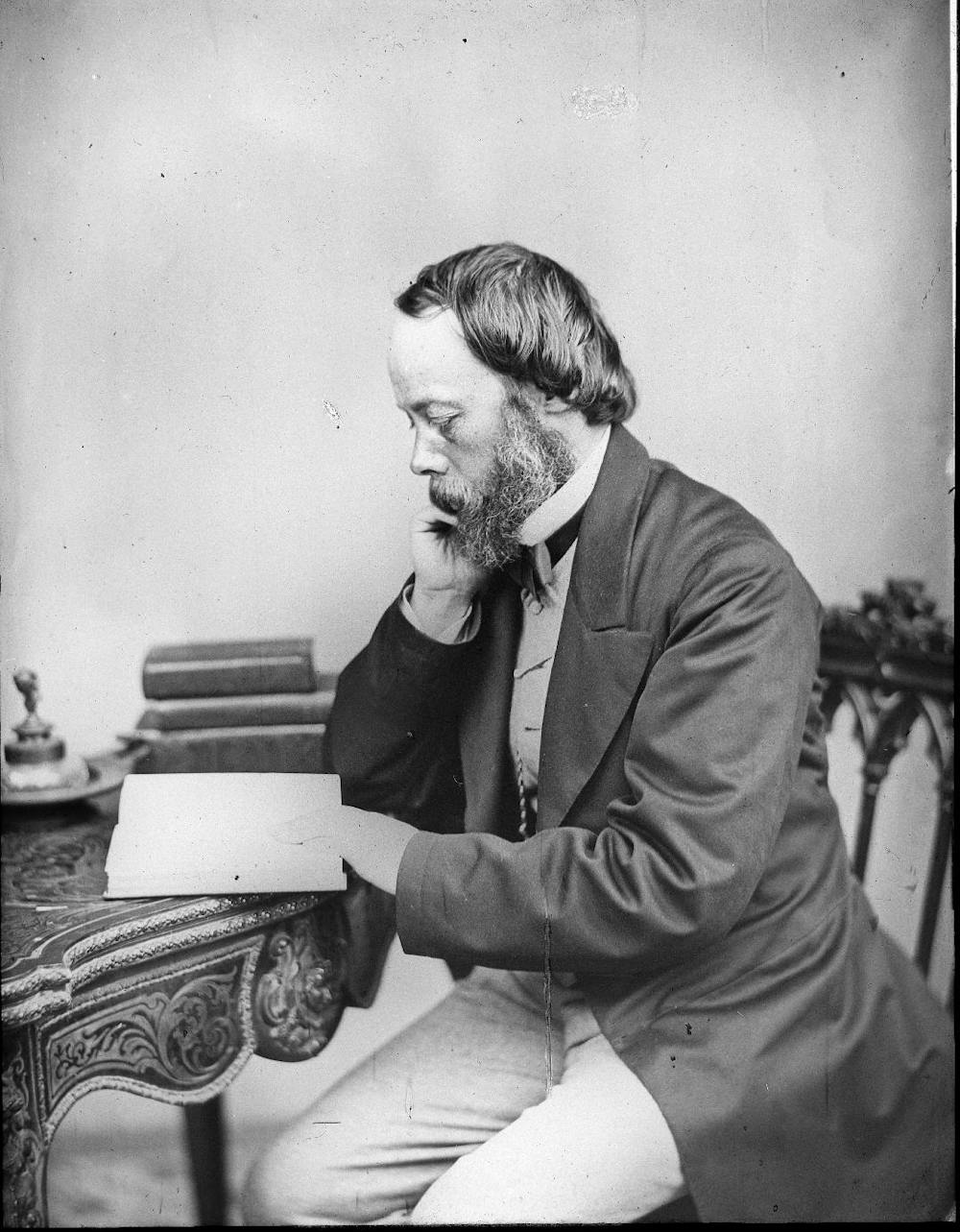
Charles Edward Mudie.
Mudie family archive/Ruth Tillyard

However, more common than publishers turning down books was the refusal of circulating libraries to distribute them. These institutions were an integral part of literary consumerism during the Victorian period as the main means of distributing books.

Most influential of these was Charles Mudie’s Select Library, established in 1842. Mudie’s library was select because he would only circulate books that were suitable for middle-class parents to read aloud to their daughters without causing embarrassment.

This shaped how publishers commissioned and what writers could get away with. Victorian literary censorship, while limiting, managed to inspire writers to develop more creative and progressive ways to get their points across.

Censorship as productive

George Eliot’s publisher, John Blackwood, criticised her work for showing people as they really were rather than giving an idealistic picture. He was particularly uncomfortable when Eliot focused on the difficulties of working-class life.

In Mr Gilfil’s Love Story(1857), Eliot’s description of the orphan girl, Caterina, being subjected to “soap-and-water” raised Blackwood’s censorious hackles:

I do not recollect of any passage that moved my critical censorship unless it might be the allusion to dirt in common with your heroine.
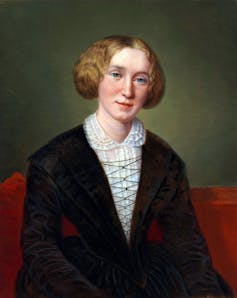
George Eliot.
National Gallery/Wikimedia

As well as dirt, alcohol consumption was also seen as an unwanted reminder of working class problems. Again in Mr Gifil’s Love Story, Eliot describes how the eponymous clergyman enjoys “an occasional sip of gin-and-water”.

However, knowing Blackwood’s views and anticipating she may cause offence galvanised Eliot to state her case directly to the reader within the text itself. She qualifies her unromantic depiction of Mr Gilfil with an address to her “lady” readers:

Here I am aware that I have run the risk of alienating all my refined lady readers, and utterly annihilating any curiosity they may have felt to know the details of Mr Gilfil’s love-story … let me assure you that Mr Gilfil’s potations of gin-and-water were quite moderate. His nose was not rubicund; on the contrary, his white hair hung around a pale and venerable face. He drank it chiefly, I believe, because it was cheap; and here I find myself alighting on another of the Vicar’s weaknesses, which, if I cared to paint a flattering portrait rather than a faithful one, I might have chosen to suppress.

Here, literary censorship enriches Eliot’s writing. Eliot’s refusal to suppress her work becomes part of the story and reinforces her agenda to portray Mr Gilfil as he really is, a vicar who mixes gin with water because he is poor.

Power in not telling

As well as inspiring narrative additions, censorship was also powerful because of what was left out of a text.

One of Hardy’s most loved books, Tess of the D’Urbervilles, highlights the crimes of sexual harassment in the workplace and of rape. Because Hardy had to be careful about the way that he presented the sexual abuse of Tess, his descriptions were very subtle. This is how he portrays the scene where Tess is sexually assaulted by her employer, Alec D’Urberville:

The obscurity was now so great that he could see absolutely nothing but a pale nebulousness at his feet, which represented the white muslin figure he had left upon the dead leaves. Everything else was blackness alike. D’Urberville stooped; and heard a gentle regular breathing. He knelt, and bent lower, till her breath warmed his face, and in a moment his cheek was in contact with hers. She was sleeping soundly, and upon her eyelashes there lingered tears.

The influence of censorship meant that Hardy could not describe this scene in graphic detail. Instead, his depiction is more sensitive and thoughtful. Hardy does not dehumanise Tess by depicting her as a sexual object to entertain the reader.

By focusing on Tess’s “gentle regular breathing” and the poignant image of her tear-stained eyelashes, Hardy avoids gratuitous depictions of violence while at the same time making us painfully aware of the injustice she has suffered. This makes his portrayal of Tess more powerful and poignant. It can be argued that this was achieved because of the limits placed on his writing, not in spite of them.

In these instances, we can see how literary censorship influenced writers to tread more carefully upon difficult territory. It made them think about whether including violence or socially controversial depictions were necessary or gratuitous to their narratives.

For Hardy and Eliot, censorship and its limits inspired creativity, sensitivity and thoughtfulness. These examples can provide food for thought in the debate today about free speech and censorship. As Hardy and Eliot wrestled with as they wrote, can things be said differently and, in some cases, do they need to be said at all?The Conversation

Stephanie Meek, PhD Candidate in English Literature, University of Reading

This article is republished from The Conversation under a Creative Commons license. Read the original article.

Unknown's avatar

Five novels from the Victorian era to give comfort in troubled times


Tennessee Witney via Shutterstock

Pam Lock, University of Bristol

The evolution of the novel and short story in the 19th century brought us one of the greatest human sources of comfort, besides food and a nice hot bath. When someone tells me they are planning to “curl up with a good book”, I am filled with a sense of peace on their behalf – of quiet enjoyment, perhaps accompanied by a little soft music and the crackle of a fire.

Regular solitary time is becoming the norm for many. Many of us are already tired of the enjoyable inanity of Netflix and Amazon Prime and are ready for something to lose ourselves in completely.

In the 19th century, the novel boomed as literacy and leisure time increased. Novels were frequently published in weekly parts, one to three chapters at a time. They had to be long enough to fill the required number of issues, and interesting enough to ensure readers kept buying the magazine or periodical (or run the risk of being cancelled mid-series). It is this combination that makes them a great resource for times like today.

Human beings are designed to love stories. Our brains seek narratives to help us make sense of the world. We communicate using stories to exchange knowledge and gain understanding. As Robert Louis Stevenson wrote: “fiction is to the grown man what play is to the child” – through fiction we learn by imaginative experience.

Stories help us gain insight into things we cannot or should not experience. They also keep us safe – we tell each other cautionary tales all the time. So let’s do as our NHS doctors and nurses ask and learn from their stories of the virus – while also tucking ourselves away with some great old novels:

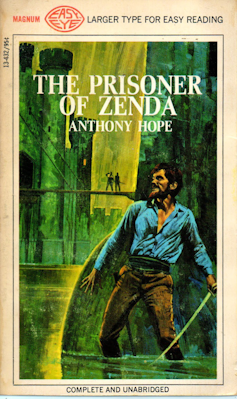
Anthony Hope: The Prisoner of Zenda (1894)

An exciting and funny adventure story about a man who goes on holiday and ends up as temporary king of Ruritania.

Rollicking Victorian adventure story.
Magnum

London-born adventurer Rudolf Rassendyll is persuaded to pretend to be the king after the real king is kidnapped by his evil half-brother on the eve of his coronation. A distant relation of the royal family, Rudolf is the king’s spitting image.

Beautifully written and filled with energy, the story romps across the beautiful scenery of Ruritania to the mysterious castle of Zenda. Rudolf is one of the most vibrant and positive characters I have come across and will fill you with hope. But what will he do when he falls in love with the king’s beautiful fianceé?

Read it for free on Project Gutenberg.

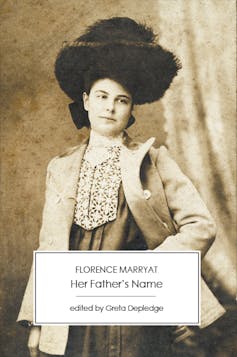
Florence Marryat: Her Father’s Name (1876)

Cross-dressing, swashbuckling adventuress Leona Lacoste journeys from Rio de Janeiro to London to clear her father’s name.

Cross-dressing derring-do.
Amazon

Unknown to her until his death, he has been in hiding in their Brazilian home, having escaped some scandal or crime in England. To get to the bottom of the mystery, Leona must stop at nothing.

Disguised as a man to make the journey possible in the 1870s, she proves herself onboard a ship in a dramatic duel and seduces the daughter of a rich industrialist. But what will she uncover about her unknown family history?

Read it for free on Internet Archive, or buy from Victorian Secrets.

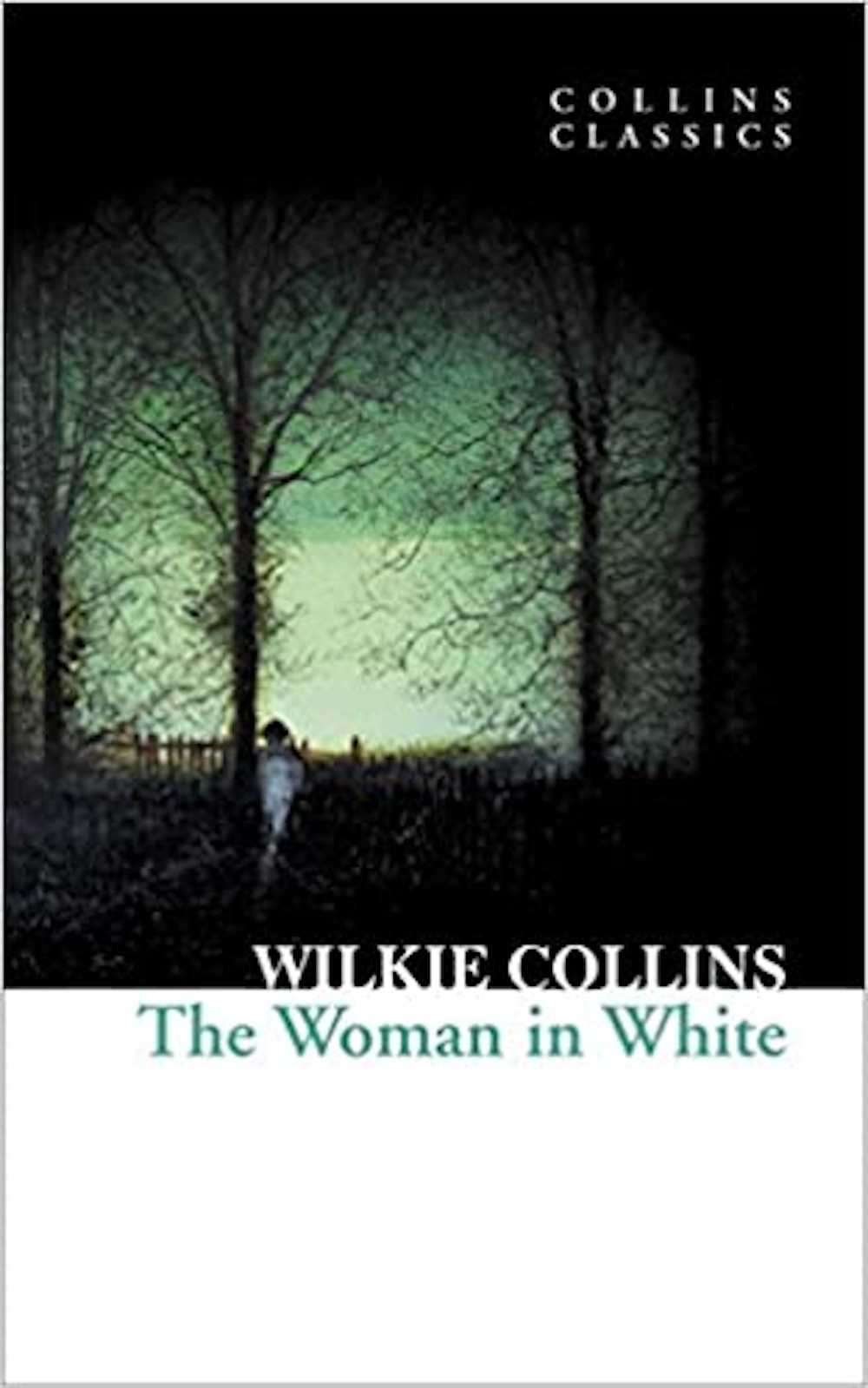
Wilkie Collins: The Woman in White (1859)

The celebrated mystery which launched a new type of story known as the sensation or enigma novel.

One of the first classic thrillers.
Amazon

Walter Hartright is startled by the sudden appearance of a mysterious woman dressed in white walking on the road to London late at night. She asks him for directions and he decides to see her safely to a cab.

On the way, he discovers that she is from the very town to which he is about the journey to start work as an art teacher. Little does he know how this mysterious woman and the family in Limeridge will change his life forever.

Read it free on Project Gutenberg.

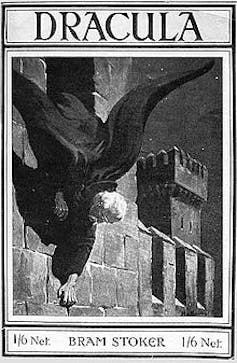
Bram Stoker: Dracula (1897)

This may seem an unlikely choice but don’t let the TV and film adaptations fool you. This is a seriously good book. The adventurers who track and foil Count Dracula, led by Mina Harker and Abraham Van Helsing, are the epitome of organised and resourceful Victorian society.

Sink your teeth into this classic read.
Wikipedia

This book is all about creating order from chaos: a reassuring ideal at the moment. Mina Harker’s way of life is doubly threatened by Dracula as he endangers both her fiancé, Jonathan Harker, whom he imprisons in his castle; and her best friend, Lucy Westenra, who is tormented by sleepwalking and mysterious illnesses.

Mina acts as the lynchpin for the five men who join together to defeat the count. The story that we are treated to is her collection of their accounts, creating a magnificent and lucid whole from diaries, cuttings, reports and letters. How will these rational beings thwart the supernatural power of the count?

Read it free on Project Gutenberg.

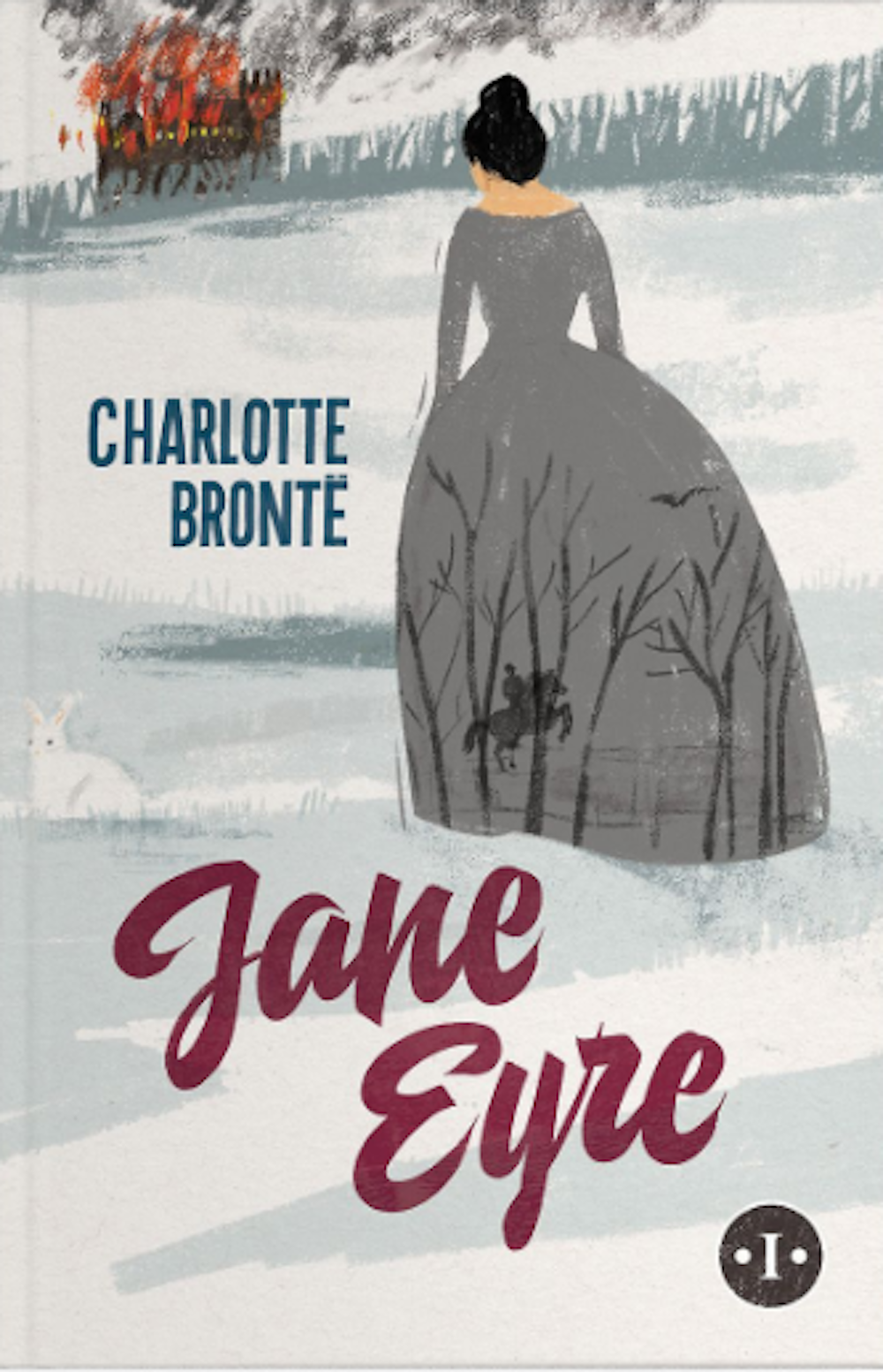
Charlotte Brontë: Jane Eyre (1847)

Jane Eyre fights for what she believes to be right. She stands up to those more powerful than herself, whether it be for her own rights or the good of others.

Romantic melodrama at its best.
Amazon

Orphaned and rejected by her guardian aunt, Jane trains to become a teacher at a charity school and then becomes governess to Adele, the ward of the wealthy and seemingly misanthropic Mr Rochester.

Slowly and unwillingly she falls in love with her master but he has a certain secret in his attic. What will this determined woman do to save herself from the temptations of his love?

Read it free on Project Gutenberg:.

You’ll have noticed that I have stuck to books with happy endings, or at least tidy ones. There is no Thomas Hardy (you must take broadcaster Andy Hamilton’s advice and read Hardy’s novels backwards to get a happy ending), and no George Eliot, whose wonderfully complex characters are very real and intriguing but not often comforting.

Some are old, familiar favourites, others lesser known but equally enjoyable. The list is by no means complete. It is intended to be the beginning of a journey back to familiar friends and an exploration of new ones. They are shared with love and care in the hope they will make you feel a little better for their company.The Conversation

Pam Lock, Lecturer, English Literature (Specialist in Victorian Literature and Alcohol), University of Bristol

This article is republished from The Conversation under a Creative Commons license. Read the original article.
Unknown's avatar

The Plight of Women Librarians in the Victorian Era


The link below is to an article that takes a look at the health implications of being a female librarian in the Victorian era.

For more visit:
https://daily.jstor.org/being-librarian-dangerous/