The links below are to articles reporting on the shock joint winners of the Booker Prize for 2019, Margaret Atwood for The Testaments and Bernardine Evaristo for Girl, Woman, Other.
The latest big news in the book world, following on from the controversy surrounding the 2019 winner of the Nobel Prize in Literature, are the dual winners of the 2019 Booker Prize. The links below are to articles reporting on the joint winners of the 2019 Booker Prize – Margaret Atwood (The Testaments) and Bernardine Evaristo (Girl, Woman, Other).
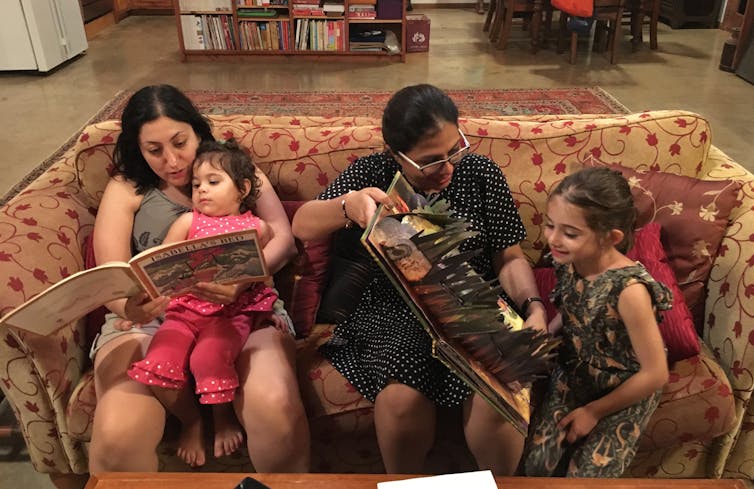
Reading to children is beneficial in many ways. Books offer a unique opportunity for children to become familiar with new vocabularies; the type of words not often used in day-to-day conversation. Books also provide a context for developing knowledge of abstract ideas for children. When an adult reads a book to a child, they often label pictures, talk about activities in the book, solve problems together and teach them new words and concepts.
Reading to very young children can have long-lasting benefits for their later school success, not only in literacy but also in mathematics. Adding to this, early shared reading particularly helps children from disadvantaged families defy limitations associated with their socio-economic status. So, if there is only one thing you have time to do with your children, it should be reading to and with them.
Read your way to the top
Parents have long been encouraged to read more to their children. There have been many initiatives, challenges, and programs aiming to increase individual reading time and shared reading time between parents and children. These include the Australian Reading Hour Campaign, the Premier’s Reading Challenge, Let’s Read, and others.
What’s still not clear is which specific skills improve while parents read to their children, and whether the benefit of shared reading is due to other things parents do that help their children thrive at school and beyond.
That is: is it really book reading that’s beneficial or is it because parents who read more to their children also provide a lot of other resources, and engage in a range of other activities with their children?
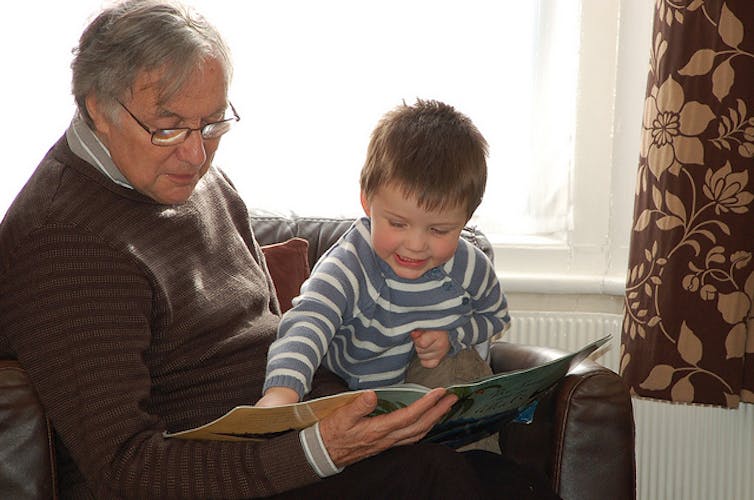
Books provide children with the opportunity for discussion and concept development. Jeremy Tarling/flickr, CC BY-SA
This was what we looked at in our study. We used data from a large scale nationwide study called the Longitudinal Study of Australian Children (LSAC). It has followed the development of 10,000 children and their families since 2004.
The sample we studied consists of 4,768 children from the cohort that was zero to one year old when the study commenced. During face-to-face interviews with trained LSAC interviewers, parents reported the frequency of them reading to their children at the age of two every week.
The LSAC then followed these children until they were four and eight years old. The good news is the majority of parents reported reading to their children at least three days a week. Specifically, 61.6% of the parents reported reading to their children every day and 21.1% of the parents read to their children between three to five days a week.
Our study showed the benefits of shared reading with children during early childhood at two to three years old is long-lasting. The more frequently parents read to their children when they were two years old, the more likely their children had better knowledge of spoken words and early academic skills such as recognising and copying geometric shapes, and writing letters, words and numbers, two years later when children were four to five years old.
What’s more, frequent early shared reading was linked to better performance in NAPLAN reading, writing, spelling and grammar. More surprisingly it was also linked to mathematics even six years later when children were eight to nine years old in year three.
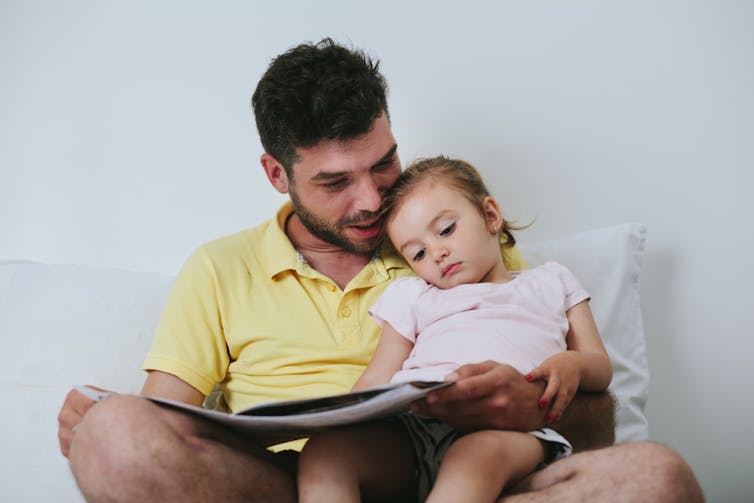
Even if you only have ten minutes to read to your children, it will benefit them. Shutterstock, CC BY-SA
The most encouraging finding is that children from disadvantaged families benefited more from shared book reading. This suggests increasing the frequency of book reading is a viable way for disadvantaged families to support their children’s vocabulary knowledge and general academic achievement.
To address whether the benefits of shared reading are a product of other factors associated with parents and families, we controlled for the effect of a range of potential confounding factors. These include indicators of children’s intelligence, the number of children’s books at home, and home activities that parents engage with children other than reading. These would include drawing pictures or doing art activities with children, playing music together, playing with toys or games, and exercising together.
Even though we controlled for these other factors, the long-term importance of early shared reading still holds.
Suggestions for parents
Read more to your children and with your children. Whenever you get a chance, even if it’s only ten minutes, engage in shared reading activities.
We also suggest parents make a reading session interactive. For example, parents are encouraged to ask children questions, such as if they know the vocabulary and ask them to guess the story and what the story characters will do. Try to make the reading a learning session.
Finally, not all books are created equal. Parents are encouraged to choose the most suitable books for their child’s age to reap the most benefits of early shared reading.
The link below is to an article about the website and organisation known as Unglue.it, which wants to make ebooks available for free and able to be shared for free.
I have been reading ‘Print is Dead – Books in our Digital Age,’ by Jeff Gomez and have now reached ‘Readers in a Digital Future.’ In this chapter Gomez begins to expound the possible future of the digital world for book readers. It is a world that abounds with possibility and an experience of reading that bibliophiles of the past could only dream of (if they could look passed the traditional book format). The book reading future will allow the reader to carry an entire library on a personalised device that can be accessed anywhere and at anytime, with the ability to interact with other digital sources of information and other readers from around the globe, to share insights and to communicate via chat and discussion functionality on book-based social networks, web applications and sites. The reader will also be able to store notes within the book that will be able to be edited and shared, to highlight text, search within a document or an entire library and even expand his/her own library seemingly endlessly. The possibilities and richness of the digital future for bibliophiles is incredible to think about and should be within our grasp.
As the digital future approaches I know it is a future I look forward to being able to grasp with both hands as a bibliophile. My traditional book library can expand no further – I have no more space for it to do so. However my digital library has already grown beyond the capability of a home twice my current size to hold and it continues to do so. Will I be able to read them all – probably not. But they will be entertainment, as well as tools, that I can use as I please and they will provide me with experiences as yet untold. The future of reading looks amazing as it continues to appear and unfold on the horizon and as the first rays of the digital era break forth upon us.
Of course, if ebooks are handled poorly by authors and publishers, the rich future of reading that could be, may not be. Many of the possibilities of a digital future could be squandered and Gomez warns us of this possibility. What a wasted opportunity should greed and jealousy stand in the way of a richer reading experience. The reading public also need to understand what it actually costs to produce an ebook and the ebook then needs to be priced fairly and be fairly accessible to the reader across all of their devices.


 Finally,
  At the BookShelf