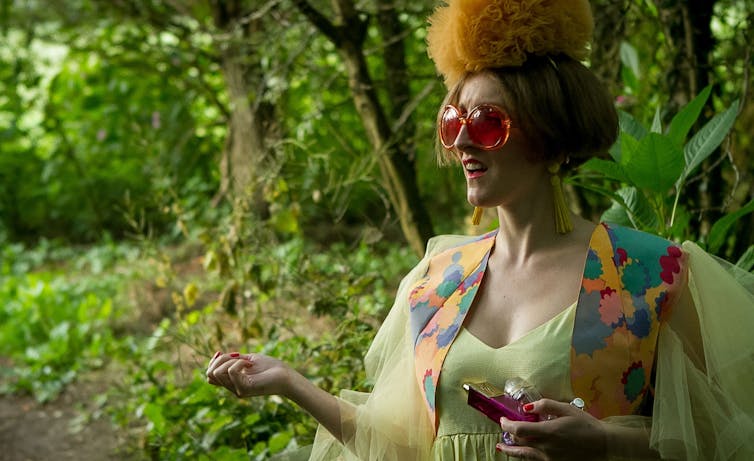
Creation Theatre/ Big Telly Theatre Company
Laura Jayne Wright, University of Oxford
While theatres remain closed, the way we watch Shakespeare is changing. When I picture the audiences Shakespeare would have written for, I think of the groundlings in Shakespeare in Love(1998). They stand, arms on the edges of the stage, staring upwards, eyes filled with tears – laughing, clapping, gasping. They are part of the show – and they show that they’re there. In the bright afternoon sun, the actors can see and hear every reaction.
Right now, of course, it’s not possible to take a trip to the playhouse. Still, with the National Theatre, the Globe, and the Really Useful Group moving quickly to put past performances online, the theatre can come to us via YouTube. We can see and hear the actors (and, having watched Hamlet, Jane Eyre and The Phantom of the Opera, I’ve been very grateful for it). But even though we can tweet our reactions, the actors can’t see or hear us.
The possibility of live performances during lockdown might change that. Over the Easter weekend, I watched an Oxford-based theatre company, Creation Theatre, and their co-producers at Big Telly Theatre Company from Portstewart in Northern Ireland, put on a production of The Tempest via video conferencing platform Zoom.
It seemed a tricky challenge under lockdown, with each cast member performing (and rehearsing) from home. Indeed, as chief executive and creative producer Lucy Askew warned before the play began, the night’s events were at the mercy of the technological gods.
But, when the play began and Ariel conjured a storm, suddenly it became clear that – despite our isolation – we too were part of the action. The audience’s microphones (muted while the actors spoke) were suddenly raised and we were asked to click our fingers to make it rain. The screen was full of audience members – and their pets, and their glasses of wine, and their pyjamas – and the storm was, even if I say so myself, convincing.
Within the space of an hour, the audience asked Antonio for answers via the chat function as he boasted of his usurpation of Prospero, we blew wind into the path of his ship and – in lieu of a banquet – all held up an offering of snacks (chocolate biscuits, from me). Each time other audience members appeared on screen, there was a rush of excitement as we got to see one another.
Listening to the island.
Shakespeare knew the importance of his audience’s reaction. At the end of The Tempest, Prospero relinquishes his magic and asks for something in return:
But release me from my bands
With the help of your good hands.
Gentle breath of yours my sails
Must fill, or else my project fails.
It’s a moment when we are asked to make some noise – to clap with our “good hands”, to cheer (or whistle, or shout) with our “gentle breath”. Prospero’s redemption, if we allow him that possibility, comes from finally turning outwards, it comes from him seeing the necessity of his connection to others – to his daughter, to his once-forgotten subjects in Milan, and, perhaps, to us.
Yet, for all of the noise we made, this new medium exposed the myriad kinds of loneliness in The Tempest. Prospero sat in front of a backdrop of television screens, reminding us that we were all at one remove from one another. When Caliban described the noises of the island, the “Sounds, and sweet airs that give delight and hurt not”, it was painfully apparent that he was alone and that there was nothing real to hear. When Ferdinand proposed to Miranda and reached from his screen to hers in an impressive feat of Zoom technology, that brief moment of “contact” was bittersweet.
After all, the despair of being alone is a fear which Prospero seeks to create. As ordered, Ariel deliberately scatters the shipwrecked courtiers across the island. Yet, as John Donne, a contemporary of Shakespeare, wrote:
No man is an island entire of itself;
every man is a piece of the continent, a part of the main.
The dispersed groups come back together – Prospero leaves his island exile, and returns home. It’s not a perfect resolution, and it’s not a happy ending, but it is, nonetheless, a reunion.
Somewhere new?
As site-specific, conference call plays go, The Tempest lends itself to such a production. It’s a play about isolation and exile, about characters moving around a small island without ever meeting one another. Creation’s performance did nothing to disguise its new medium. In fact, the most powerful part of the performance came as Prospero spoke the famous epilogue which begins: “Now my charms are all o’erthrown”.
The cast slowly and methodically packed up their bedsheet green screens and wiped off their makeup. They changed their onscreen identities from their character’s names back to their own. By the time we were invited to stay on Zoom for a moment or two, to catch up with friends, thank the actors, and wave goodbye, the spell was broken.
But the magic may not be entirely over, not least as the popularity of their performances have led to Creation extending its run. Moreover, The Tempest is not the only play offered in this new genre of “Zoom Shakespeare”. Another group of actors recently collaborated to create A Midsummer Night’s Stream, which they advertise not simply as a reading but a live performance, “adapted for our stage”. And there is no reason to think that “Zoom Theatre” will stick to Shakespeare.
While we will (to entirely misuse one of Prospero’s lines) return to a time when we “have no screen between this part he play’d/And him he play’d it for”, Zoom Theatre may not be a temporary measure. Perhaps new plays will be written with the possibilities of Zoom and YouTube in mind. For many, watching theatre from home will allow for greater access and comfort. And, for now, speaking back, making noise, and waving at strangers, could inject a bit of silliness into our own isolated worlds.
Laura Jayne Wright, Stipendiary Lecturer in English, University of Oxford
This article is republished from The Conversation under a Creative Commons license. Read the original article.





 At the BookShelf