Unknown's avatar

Orwell’s ideas remain relevant 75 years after ‘Animal Farm’ was published


George Orwell’s writings have left a lasting imprint on American thought and culture.
ullstein bild/ullstein bild via Getty Images

Mark Satta, Wayne State University

Seventy-five years ago, in August 1946, George Orwell’s “Animal Farm” was published in the United States. It was a huge success, with over a half-million copies sold in its first year. “Animal Farm” was followed three years later by an even bigger success: Orwell’s dystopian novel “Nineteen Eighty-Four.”

In the years since, Orwell’s writing has left an indelible mark on American thought and culture. Sales of “Animal Farm” and “Nineteen Eighty-Four” jumped in 2013 after the whistleblower Edward Snowden leaked confidential National Security Agency documents. And “Nineteen Eighty-Four” rose to the top of Amazon’s best-sellers list after Donald Trump’s Presidential Inauguration in 2017.

As a philosophy professor, I’m interested in the continuing relevance of Orwell’s ideas, including those on totalitarianism and socialism.

Early career

George Orwell was the pen name of Eric Blair. Born in 1903 in colonial India, Blair later moved to England, where he attended elite schools on scholarships. After finishing school, he joined the British civil service, working in Burma, now Myanmar. At age 24, Orwell returned to England to become a writer.

During the 1930s, Orwell had modest success as an essayist, journalist and novelist. He also served as a volunteer soldier with a left-wing militia group that fought on behalf of the Spanish Republic during the Spanish Civil War. During the conflict, Orwell experienced how propaganda could shape political narratives through observing inaccurate reporting of events he experienced firsthand.

Orwell later summarized the purpose of his writing from roughly the Spanish Civil War onward: “Every line of serious work I have written since 1936 has been, directly or indirectly, against totalitarianism and for democratic Socialism.”

Orwell did not specify in that passage what he meant by either totalitarianism or democratic socialism, but some of his other works clarify how he understood those terms.

What is totalitarianism?

For Orwell, totalitarianism was a political order focused on power and control. The totalitarian attitude is exemplified by the antagonist, O’Brien, in “Nineteen Eighty-Four.” The fictional O’Brien is a powerful government official who uses torture and manipulation to gain power over the thoughts and actions of the protagonist, Winston Smith. Significantly, O’Brien treats his desire for power as an end in itself. O’Brien represents power for power’s sake.
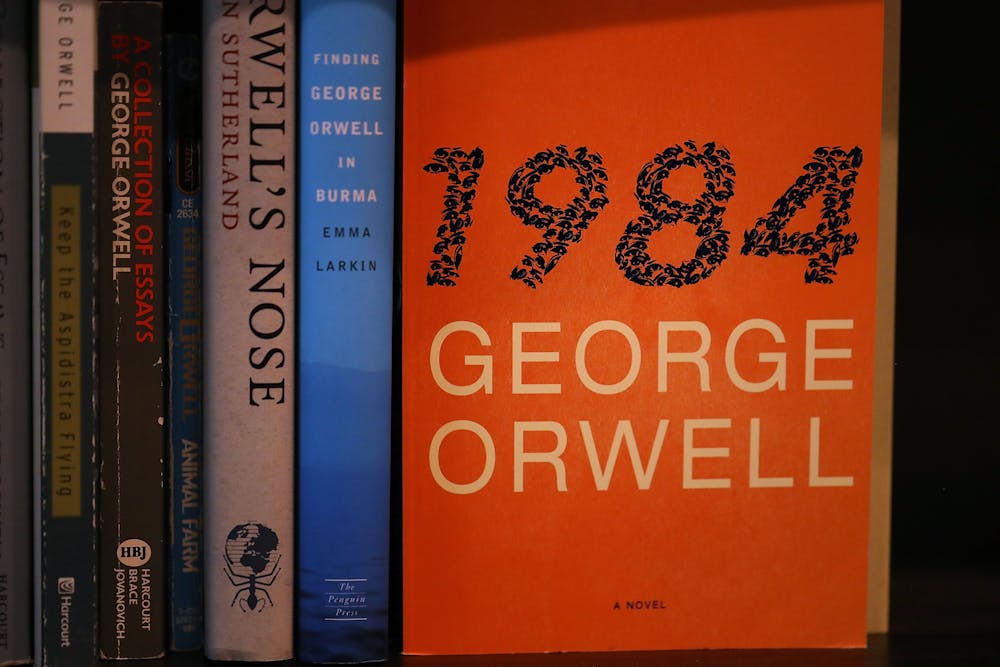
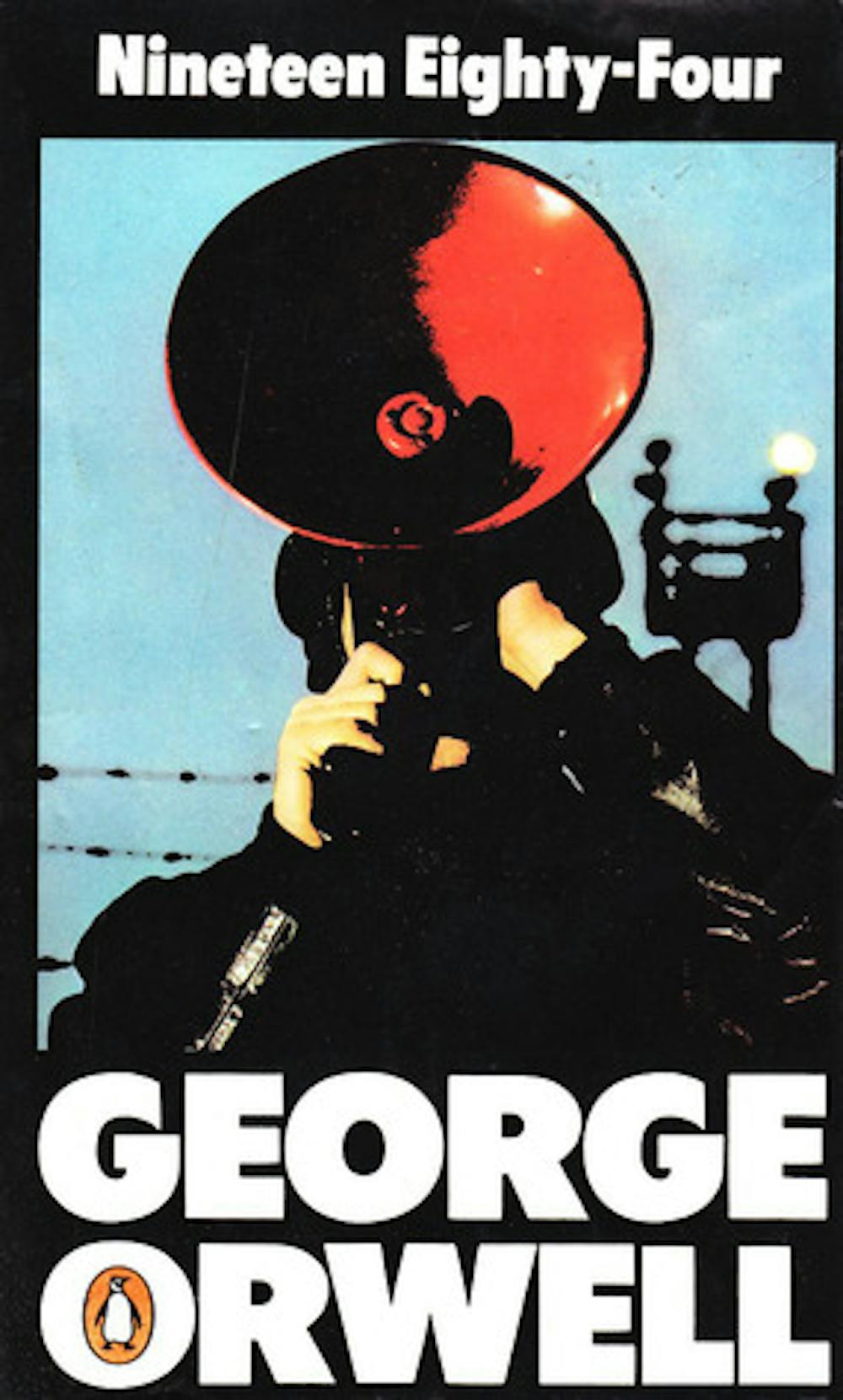
A copy of George Orwell's novel '1984' is displayed at The Last Bookstore on January 25, 2017, in Los Angeles.
George Orwell’s dystopian novel ‘Nineteen Eighty-Four’ (‘1984’) surged to the top of Amazon.com’s best-sellers list after Donald Trump’s Presidential Inauguration in 2017.
Justin Sullivan/Getty Images

Much of Orwell’s keenest insights concern what totalitarianism is incompatible with. In his 1941 essay “The Lion and the Unicorn,” Orwell writes of “The totalitarian idea that there is no such thing as law, there is only power … .” In other words, laws can limit a ruler’s power. Totalitarianism seeks to obliterate the limits of law through the uninhibited exercise of power.

Similarly, in his 1942 essay “Looking Back on the Spanish War,” Orwell argues that totalitarianism must deny that there are neutral facts and objective truth. Orwell identifies liberty and truth as “safeguards” against totalitarianism. The exercise of liberty and the recognition of truth are actions incompatible with the total centralized control that totalitarianism requires.

Orwell understood that totalitarianism could be found on the political right and left. For Orwell, both Nazism and Communism were totalitarian.

Orwell’s work, in my view, challenges us to resist permitting leaders to engage in totalitarian behavior, regardless of political affiliation. It also reminds us that some of our best tools for resisting totalitarianism are to tell truths and to preserve liberty.

What is democratic socialism?

In his 1937 book “The Road to Wigan Pier,” Orwell writes that socialism means “justice and liberty.” The justice he refers to goes beyond mere economic justice. It also includes social and political justice.

Orwell elaborates on what he means by socialism in “The Lion and the Unicorn.” According to him, socialism requires “approximate equality of incomes (it need be no more than approximate), political democracy, and abolition of all hereditary privileges, especially in education.”

In fleshing out what he means by “approximate equality of incomes,” Orwell later says in the same essay that income equality shouldn’t be greater than a ratio of about 10 to 1. In its modern-day interpretation, this suggests Orwell could find it ethical for a CEO to make 10 times more than their employees, but not to make 300 times more, as the average CEO in the United States does today.

But in describing socialism, Orwell discusses more than economic inequality. Orwell’s writings indicate that his preferred conception of socialism also requires “political democracy.” As scholar David Dwan has noted, Orwell distinguished “two concepts of democracy.” The first concept refers to political power resting with the common people. The second is about having classical liberal freedoms, like freedom of thought. Both notions of democracy seem relevant to what Orwell means by democratic socialism. For Orwell, democratic socialism is a political order that provides social and economic equality while also preserving robust personal freedom.

I believe Orwell’s description of democratic socialism and his recognition that there are various forms socialism can take remain important today given that American political dialogue about socialism often overlooks much of the nuance Orwell brings to the subject. For example, Americans often confuse socialism with communism. Orwell helps clarify the difference between these terms.

With high levels of economic inequality, political assaults on truth and renewed concerns about totalitarianism, Orwell’s ideas remain as relevant now as they were 75 years ago.

[Explore the intersection of faith, politics, arts and culture. Sign up for This Week in Religion.]The Conversation

Mark Satta, Assistant Professor of Philosophy, Wayne State University

This article is republished from The Conversation under a Creative Commons license. Read the original article.

Unknown's avatar

How George Orwell justified killing German civilians in the second world war


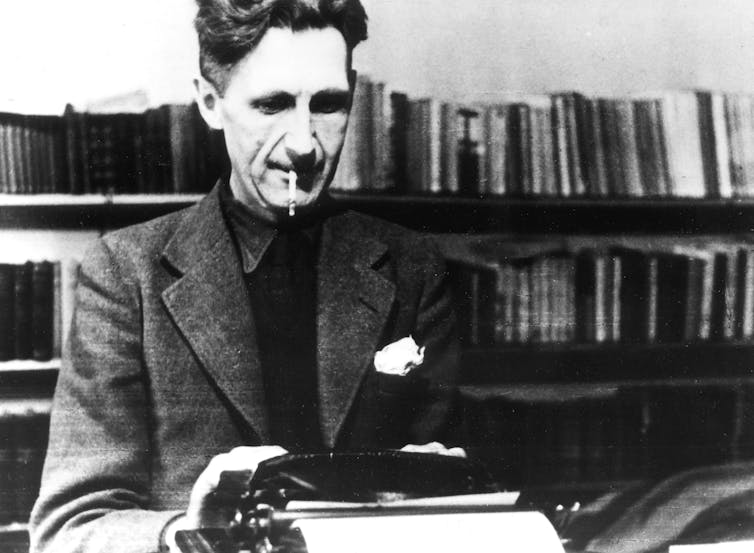
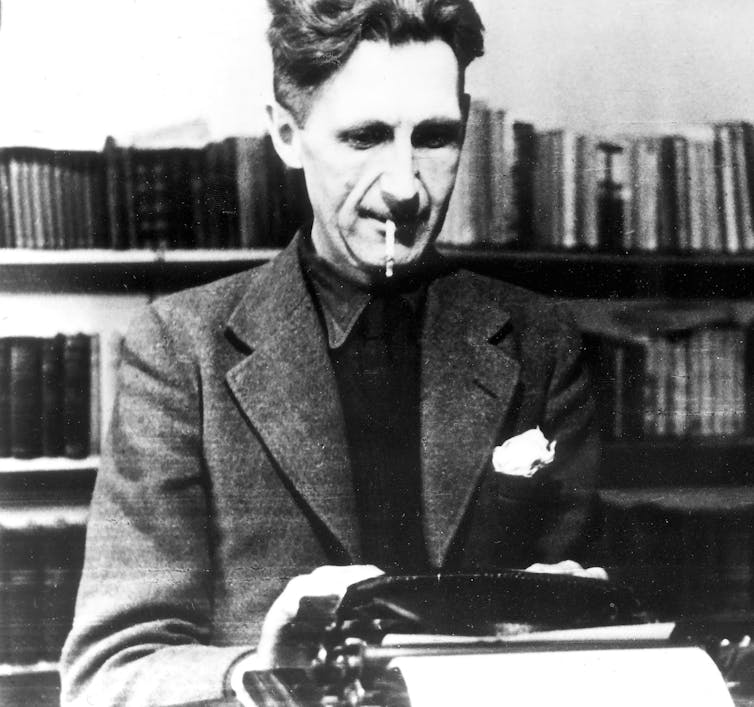
Eric Blair (better known as George Orwell) in characteristic pose.

Tim Luckhurst, Durham University

During the second world war, Britain’s national daily newspapers usually supported the government’s portrayal of the national war effort as flawlessly heroic. This was a just war – and supported as such even by many Britons who, until 1940, had supported pacifist organisations such as the Peace Pledge Union.

But Tribune, the weekly newspaper founded by wealthy Labour MPs Sir Stafford Cripps and George Strauss and edited by Aneurin Bevan, was bolder. Promoting itself as “Fresh and Fearless” Tribune relished controversy. In September 1943, it celebrated the recruitment of an expert controversialist as its literary editor: George Orwell.

Orwell soon seized upon a topic the wartime coalition had worked assiduously to conceal: the deliberate killing of German civilians in colossal RAF raids on German cities. His pretext was the publication by Vera Brittain, the feminist and pre-war pacifist, of Seed of Chaos, her pungent denunciation of obliteration bombing. Supporting her case with eyewitness accounts by neutral Swiss and Swedish newspaper correspondents, Brittain recounted tales of corpses “all over streets and even in the tree-tops” and women “demented after the raids, crying continuously for their lost children”.

Influential voice for Pacifism: Vera Brittain.

Detecting sanctimony, Orwell attacked head on with a piece entitled “As I Please”. There was, he wrote, “something very distasteful in accepting war as an instrument and at the same time wanting to dodge responsibility for its more obviously barbarous features”.

Talk of “limiting or humanising” total war was “sheer humbug”, Orwell insisted. Warming to his theme, he condemned Brittain’s “parrot cry” against “killing women and children” and insisted: “It is probably better to kill a cross section of the population than to kill only the young men.” If allied raids had killed 1.2 million German civilians, “that loss of life has probably harmed the German race somewhat less than a corresponding loss on the Russian front”.

Tribune’s readers were not unanimous in their support for Orwell. A flow of critical letters arrived but the literary editor did not budge. He “did not feel that mere killing is all important”. There was, he suggested, a moral case for killing German civilians. It brought home the nature of modern war and might make such conflict less likely.

Hard truths

Orwell’s stance was in stark opposition to government policy. This was to pretend that civilian deaths were rare collateral damage in raids meticulously targeted at German industrial and military infrastructure. In fact, Orwell’s defence challenged the Air Ministry as directly as Brittain’s moral outrage. Orwell recognised that area bombing was intended to cause mass civilian casualties and routinely did so.

Military historian and author Martin Middlebrook describes the British government’s statements about area bombing between 1942 and 1945 as “a three-year period of deceit on the British public and world opinion”. The areas attacked were “nearly always city centres or densely populated residential areas”. Britain had invested vast resources to build a fleet of heavy, four-engine bombers among which the Avro Lancaster was king. Mass raids against cities including Cologne, Essen and Hamburg soon demonstrated that the Lancaster’s brave, vulnerable crews could not hit targets with any precision.

Air Marshall Sir Arthur Harris pleaded with the prime minister to admit that raids involved the deliberate murder of civilians. In October 1943, he wrote to Churchill’s friend, the air minister Archibald Sinclair, demanding bombing tactics be “unambiguously and publicly stated”, writing:

That aim is the destruction of German cities, the killing of German workers and the disruption of civilised community life throughout Germany.

Harris wanted ministers to tell the public that the deaths of women and children were not a “byproduct of attempts to hit factories”. Such slaughter was one of the “accepted and intended aims of our bombing policy”.

Even when the Associated Press described Allied raids on Dresden as deliberate “terror bombing”, the government continued to deploy bland euphemisms. By recognising that RAF Bomber Command killed civilians as a conscious act of policy, Orwell and Tribune were playing with fire. They were not censored or condemned because it suited ministers to tolerate dissent in small circulation weekly titles. Such robust debate burnished Britain’s democratic credentials and reassured her American allies.

The last word

Brittain was not reassured. Writer Richard Westwood has shown that she resented Orwell’s attacks so intensely that she would revisit their dispute years after his death in order to “win her argument with Orwell in retrospect and when he could not respond”. This she attempted in Testament of Experience by quoting selectively from a report Orwell sent from Germany for The Observer in April 1945.

Brittain suggests he retracted his support for obliteration bombing. In fact, Orwell described damage done by allied bombs and argued that the Allies should not impose harsh reparations. A punitive approach would leave Germans dependent on international aid. He did not apologise for the RAF’s work. Instead, he repeated his defence that “a bomb kills a cross-section of the population whereas the men killed in battle are exactly the ones the community can least afford to lose”.

Orwell’s candour about area bombing was a robust example of dissenting wartime journalism. It demonstrated Tribune’s editorial courage and that the wartime coalition understood it could not reconcile defence of democracy with suppression of free speech.

Brittain was wrong to misrepresent him. His work illustrates how intelligent publications with thoughtful readers upheld Britain’s democratic tradition in wartime. Such journalism was not restricted to the left. The Spectator and The Economist played comparable roles on this and other subjects.


Tim Luckhurst will deliver his online lecture to the Centre for Modern Conflicts and Cultures via Zoom between 4pm and 5 pm on Tuesday, June 2, 2020. To attend please register here.The Conversation

Tim Luckhurst, Principal of South College, Durham University. He is a newspaper historian and an academic member of the University’s Centre for Modern Conflicts and Cultures., Durham University

This article is republished from The Conversation under a Creative Commons license. Read the original article.

Unknown's avatar

Not My Review: Animal Farm by George Orwell


The link below is to a book review of ‘Animal Farm’ by George Orwell.

For more visit”
https://blog.bookstellyouwhy.com/book-spotlight-animal-farm

Unknown's avatar

Guide to the classics: Orwell’s 1984 and how it helps us understand tyrannical power today


File 20190326 36256 lkfv0v.jpg?ixlib=rb 1.1
Written as the Cold War became entrenched, 1984 was meant as a warning on the nature of state power. Understanding this power is even more important today.
Shutterstock

Robert Hassan, University of Melbourne

It was a bright cold day in April, and the clocks were striking thirteen. Winston Smith, his chin nuzzled into his breast in an effort to escape the vile wind, slipped quickly through the glass doors of Victory Mansions, though not quickly enough to prevent a swirl of gritty dust from entering along with him.

As novel-openers go, they don’t come much better than this one in George Orwell’s Nineteen Eighty-Four. See how the unexpected “striking thirteen” runs powerfully into the beginnings of characterisation and world-building in just two arresting sentences.

Orwell knew that words could both grip the attention and change the mind. He wrote the book as the Cold War was becoming entrenched, and it was meant as an explicit warning on the nature of state power at that time.

The book still sells by the thousands, and is read by students who are compelled to do so. But it can be read voluntarily and profitably, and it can tell us a lot about contemporary politics and power, from Donald Trump to Facebook.

A world of ‘doublespeak’

George Orwell’s Nineteen Eighty-Four.
Goodreads

Nineteen Eighty-Four became an instant classic when published in 1949. People could see in it a world that could easily become a reality. The memory of Nazi dictatorship was still fresh, the Soviet Union had erected the Iron Curtain, and the USA had the atomic bomb.

The novel’s setting is a dystopian Britain, which has become a part of Oceania, a region in perpetual war with the other super-regions of Eurasia and Eastasia. Oppression, surveillance and control are facts of life in a society ruled by the Party and its four Ministries of Truth, Peace, Plenty and Love.

It is a world of “doublespeak” where things are the opposite of what they appear; there is no truth, only lies – only war and only privation.


Read more:
What does ‘Orwellian’ mean, anyway?


One of Orwell’s innovations is to introduce us to a new political lexicon, a “Newspeak” where he shows how words can be used and abused as a form of power. Words like “Thoughtcrime”, where it is illegal to have thoughts that are in opposition to the Party; or “unperson”, meaning someone who has been executed by the Party (e.g. for Thoughtcrime) will have all record of his or her existence erased.

Not only do we use many of these words today, but the manipulative function that Orwell described is still intact. For example, when Kellyanne Conway, advisor to US president Donald Trump, stated in 2017 that the Administration has its own “alternative facts”, she was indulging in “doublethink”: an attempted psychological control of reality through words.

Nineteen Eighty-Four became an Amazon bestseller following the election of Trump and the airing of this interview.

Kellyanne Conway explains the Trump adminstration’s ‘alternative facts’.

Within the corridors of Orwell’s Ministry of Truth, though, there’s a tiny flickering of real love that develops between protagonist Winston and co-worker Julia. They share unlawful thoughts about other possible ways of living and thinking, based upon vague and unreliable memories of a time before world wars and Big Brother and the Party.

But through its immense powers of surveillance and the efforts of the Thought Police, Big Brother knows everything, and soon the lovers are suspects. Winston is arrested and brought before O’Brien, the novel’s antagonist and a Party heavyweight who is openly cynical about the power structure of society. For him power is a zero-sum equation: if you don’t use it to keep others down, they will use it similarly against you.

There is much drama, suspense and even horror in Orwell’s book. He wrote about what he saw around him, but filtered it with an acute sensitivity to the innate fragility of civilisation. In 1943, when the plot-lines of Nineteen Eighty-Four were probably gestating in his head, Orwell wrote:

Either power politics must yield to common decency, or the world must go spiralling down into a nightmare into which we can already catch some dim glimpses.

1984 goes digital

These days, a lot of power politics circulates online. Orwell, who worked for the BBC during the war, was sensitive to the power of communications. What he calls the “telescreen” is essentially a surveillance device that “received and transmitted simultaneously”.

He writes of the device that “any sound that Winston made, above the level of a very low whisper, would be picked up by it; moreover […] he could be seen as well as heard”. Remind you of anything? Alexa or Siri and their ilk may be fads, but the technology now exists; and so then does a new kind of power.

Such power is contingent and shifting and does not always reside with governments.

Donald Trump wields a new digital power through Twitter and Facebook and can “speak to his base” whenever he’s angry, bored or overcome by impulse. But through ownership of new digital technologies, new actors – data corporations – have acquired old powers. These are the powers to manipulate, surveil, and influence millions of people through access to their data.

And their power in turn can be leeched by hackers, state-sponsored or independent. The complexity of political power today means we need to be more attuned to its changing forms, to more effectively strategise and resist.

Orwell’s “common decency” reference may now sound rather quaint. But its very absence in social media is a problem.

The algorithms that Twitter, Facebook and Google insert into our communications act essentially as “manipulation engines” that can cause division, favour extreme views, and set groups of people against each other.

Divide-and-rule is not their intention – getting you online in order to sell your data to advertisers is – but that is the effect, and democratic politics is the worse for it.


Read more:
How political engagement on social media can drive people to extremes


Understanding the nature of political power is even more important today than when Orwell wrote. Oppression and manipulation were “simpler” and more brutal then; today, social control and its sources are more opaque.

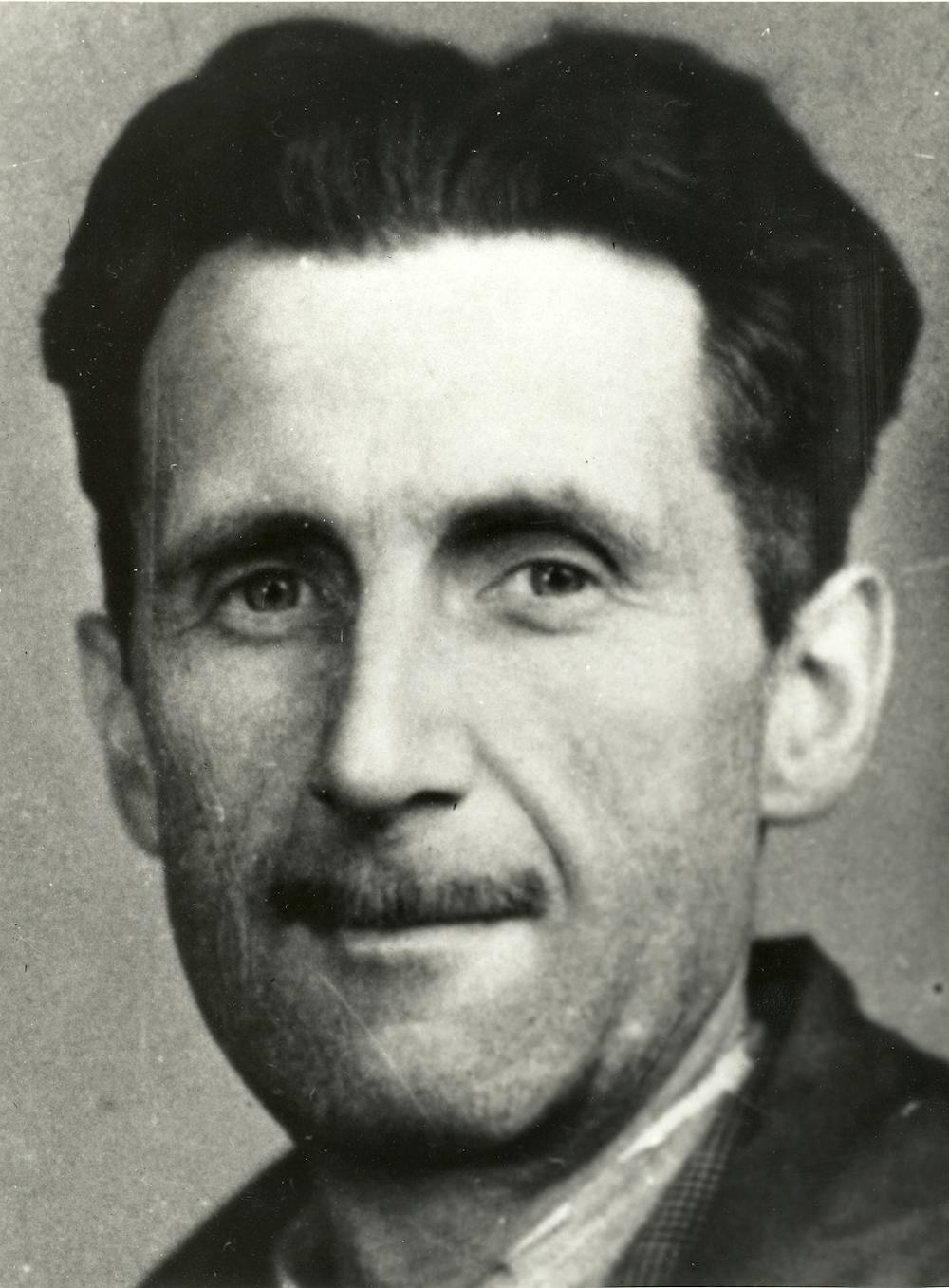
George Orwell in 1943.
Wikimedia Commons

Orwell’s imperishable value as a writer is that he provides a template on the character of political power that tells us that we cannot be complacent, cannot leave it to government to fix, and cannot leave it to fate and hope for the best.

Things did not turn out so well for Winston Smith. Pushed to the limit by torture and brainwashing, he betrays Julia. And in his abject state he convinces himself, finally, of the rightness of the Party: “He had won the victory over himself. He loved Big Brother.”

The story ends there. But for Orwell the writer and activist, the struggle for Truth, Peace, Plenty and Love was only beginning.

Today, Nineteen Eighty-Four comes across not as a warning that the actual world of Winston and Julia and O’Brien is in danger of becoming reality. Rather, its true value is that it teaches us that power and tyranny are made possible through the use of words and how they are mediated.

If we understand power in this way, especially in our digital world, then unlike Winston, we will have a better chance to fight it.The Conversation

Robert Hassan, Professor, School of Culture and Communication, University of Melbourne

This article is republished from The Conversation under a Creative Commons license. Read the original article.

Unknown's avatar

Finished Reading: 1984 by George Orwell


19841984 by George Orwell
My rating: 3 of 5 stars

View all my reviews

Unknown's avatar

Finished Reading: Animal Farm by George Orwell


Animal FarmAnimal Farm by George Orwell
My rating: 4 of 5 stars

View all my reviews

Unknown's avatar

Author: George Orwell


Unknown's avatar

Not My Review: Nineteen Eighty-Four, by George Orwell (1949)


The link below is to a book review of ‘Nineteen Eighty-Four,’ by George Orwell.

For more visit:
http://www.theguardian.com/books/2015/jan/19/100-best-novels-1984-george-orwell-nineteen-eighty-four-robert-mccrum

Unknown's avatar

Not My Review: 1984, by George Orwell