Unknown's avatar

William Shakespeare: archaeology is revealing new clues about the Bard’s life (and death)


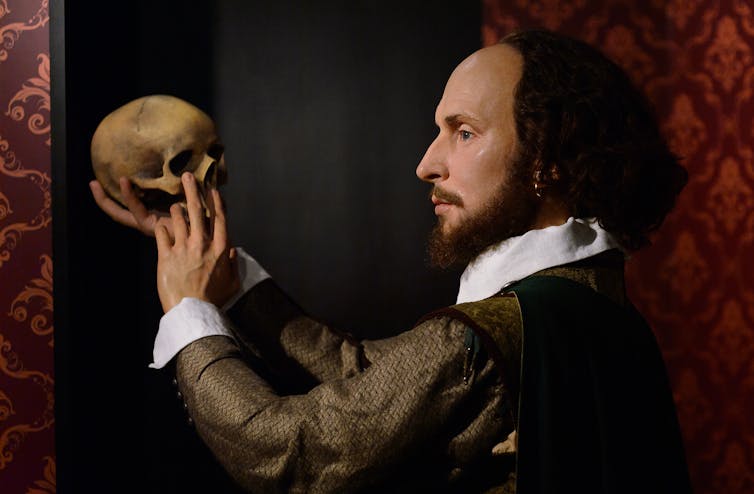
Waxwork of Shakespeare by Madame Tussauds in Berlin.
Anton Ivanov via Shutterstock

William Mitchell, Staffordshire University

William Shakespeare is widely regarded as one of the greatest authors of all time and one of the most important and influential people who has ever lived. His written works (plays, sonnets and poems) have been translated into more than 100 languages and these are performed around the world.

There is also an enduring desire to learn more about the man himself. Countless books and articles have been written about Shakespeare’s life. These have been based primarily on the scholarly analysis of his works and the official record associated with him and his family. Shakespeare’s popularity and legacy endures, despite uncertainties in his life story and debate surrounding his authorship and identity.

The life and times of William Shakespeare and his family have also recently been informed by cutting-edge archaeological methods and interdisciplinary technologies at both New Place (his long-since demolished family home) and his burial place at Holy Trinity Church, Stratford-upon-Avon. The evidence gathered from these investigations by the Centre of Archaeology at Staffordshire University provides new insights into his interests, attitudes and motivations – and those of his family – and shows how archaeology can provide further tangible evidence. These complement traditional Shakespearean research methods that have been limited to sparse documentary evidence and the study of his works.

Archaeology has the ability to provide a direct connection to an individual through the places and objects associated with them. Past excavations of the Shakespearean-era theatres in London have provided evidence of the places he worked and spent much of his time.

Attributing objects to Shakespeare is difficult, we have his written work of course, his portrait(s) and memorial bust – but all of his known possessions, like those mentioned in his will, no longer exist. A single gold signet ring, inscribed with the initials W S, is thought by some to be the most significant object owned and used by the poet, despite its questionable provenance.

Shakespeare’s house

Shakespeare’s greatest and most expensive possession was his house, New Place. Evidence, obtained through recent archaeological investigations of its foundations, give us quantifiable insights into Shakespeare’s thought processes, personal life and business success.

The building itself was lost in the 18th century, but the site and its remains were preserved beneath a garden. Erected in the centre of Stratford-upon-Avon more than a century prior to Shakespeare’s purchase in 1597, from its inception, it was architecturally striking. One of the largest domestic residences in Stratford, it was the only courtyard-style, open-hall house within the town.

This type of house typified the merchant and elite classes and in purchasing and renovating it to his own vision, Shakespeare inherited the traditions of his ancestors while embracing the latest fashions. The building materials used, its primary structure and later redevelopment can all be used as evidence of the deliberate and carefully considered choices made by him and his family.

Shakespeare focused on the outward appearance of the house, installing a long gallery and other fashionable architectural embellishments as was expected of a well-to-do, aspiring gentleman of the time. Many other medieval features were retained and the hall was likely retained as the showpiece of his home, a place to announce his prosperity, and his rise in status.

It provided a place for him and his immediate and extended family to live, work and entertain. But it was also a place which held local significance and symbolic associations. Intriguingly, its appearance also resembled the courtyard inn theatres of London and elsewhere with which Shakespeare was so familiar, presenting the opportunity to host private performances.

In search of the Bard

Extensive evidence of the personal possessions, diet and the leisure activities of Shakespeare, his family and the inhabitants of New Place were recovered during the archaeological investigations, revolutionising what we understand about his day-to-day life.

An online exhibition, due to be made available in early May 2020, presents 3D-scanned artefacts recovered at the site of New Place. These objects, some of which may have belonged to Shakespeare, have been chosen to characterise the chronological development and activities undertaken at the site.

Open access to these virtual objects will enable the dissemination of these important results and the potential for others to continue the research.

Here lies …

Archaeological evidence recovered from non-invasive investigations at Shakespeare’s burial place has also been used to provide further evidence of his personal and family belief. Multi-frequency Ground Penetrating Radar (GPR) was used to investigate the Shakespeare family graves below the chancel of Holy Trinity Church.

A number of legends surrounded Shakespeare’s burial place. Among these were doubts over the presence of a grave, its contents, tales of grave robbing and suggestions of a large family crypt. The work confirmed that individual shallow graves exist beneath the tombstones and that the various members of Shakespeare’s family were not buried in coffins, but in simple shrouds. Analysis concluded that Shakespeare’s grave had been disturbed in the past and that it was likely that his skull had been removed, confirming recorded stories.

These family graves occupy a significant (and expensive) location in Holy Trinity Church. Despite this, the simple nature of Shakespeare’s grave, with no elite trappings or finery and no large family crypt, coupled with his belief that he should not be disturbed, confirm a simple regional practice based on pious religious observance and an affinity with his hometown.


Read more:
How to read Shakespeare for pleasure


There is still so much we don’t know about Shakespeare’s life, so it’s a safe bet that researchers will continue to investigate what evidence there is. Archaeological techniques can provide quantifiable information that isn’t available through traditional Shakespearean research. But just like other disciplines, interpretation – based on the evidence – will be key to unlocking the mysteries surrounding the life (and death) of the English language’s greatest writer.The Conversation

William Mitchell, Lecturer in Archaeology, Staffordshire University

This article is republished from The Conversation under a Creative Commons license. Read the original article.
Unknown's avatar

How to read Shakespeare for pleasure


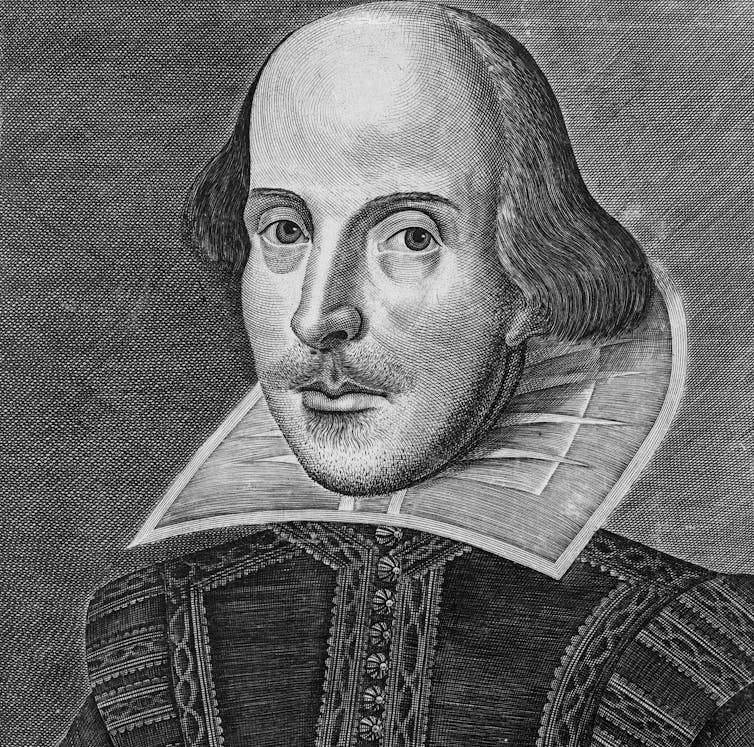
Martin’s Droeshout portrait of William Shakespeare (1623)
Bodleian Library, Oxford.

Emma Smith, University of Oxford

In recent years the orthodoxy that Shakespeare can only be truly appreciated on stage has become widespread. But, as with many of our habits and assumptions, lockdown gives us a chance to think differently. Now could be the time to dust off the old collected works, and read some Shakespeare, just as people have been doing for more than 400 years.

Many people have said they find reading Shakespeare a bit daunting, so here are five tips for how to make it simpler and more pleasurable.

1. Ignore the footnotes

If your edition has footnotes, pay no attention to them. They distract you from your reading and de-skill you, so that you begin to check everything even when you actually know what it means.

It’s useful to remember that nobody ever understood all this stuff – have a look at Macbeth’s knotty “If it were done when ‘tis done” speech in Act 1 Scene 7 for an example (and nobody ever spoke in these long, fancy speeches either – Macbeth’s speech is again a case in point). Footnotes are just the editor’s attempt to deny this.

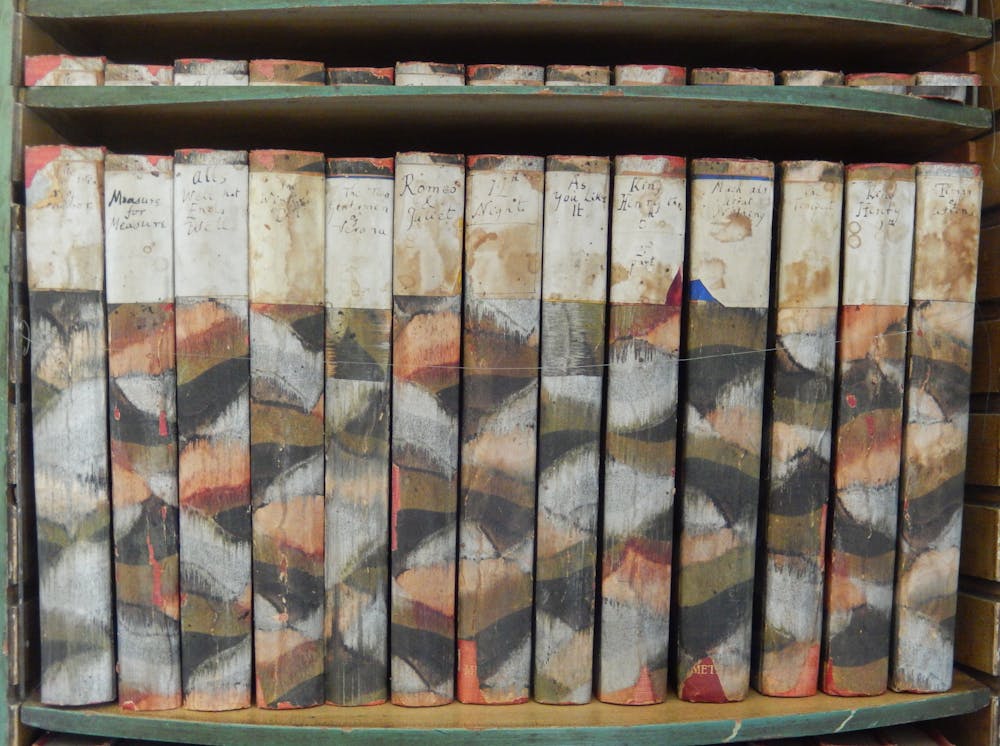
Shakespeare plays hand bound by Virginia Woolf in her bedroom at Monk’s House, Rodmell, Sussex, UK.
Ian Alexanber/Wikimedia Commons, CC BY-NC-SA

Try to keep going and get the gist – and remember, when Shakespeare uses very long or esoteric words, or highly involved sentences, it’s often a deliberate sign that the character is trying to deceive himself or others (the psychotic jealousy of Leontes in The Winter’s Tale, for instance, expresses itself in unusual vocabulary and contorted syntax).

2. Pay attention to the shape of the lines

The layout of speeches on the page is like a kind of musical notation or choreography. Long speeches slow things down – and, if all the speeches end at the end of a complete line, that gives proceedings a stately, hierarchical feel – as if the characters are all giving speeches rather than interacting.

Short speeches quicken the pace and enmesh characters in relationships, particularly when they start to share lines (you can see this when one line is indented so it completes the half line above), a sign of real intimacy in Shakespeare’s soundscape.

Blank verse, the unrhymed ten-beat iambic pentamenter structure of the Shakespearean line, varies across his career. Early plays – the histories and comedies – tend to end each line with a piece of punctuation, so that the shape of the verse is audible. John of Gaunt’s famous speech from Richard II is a good example.

This royal throne of kings, this sceptered isle,
This earth of majesty, this seat of Mars.

Later plays – the tragedies and the romances – tend towards a more flexible form of blank verse, with the sense of the phrase often running over the line break. What tends to be significant is contrast, between and within the speech rhythms of scenes or characters (have a look at Henry IV Part 1 and you’ll see what I mean).

3. Read small sections

Shakespeare’s plays aren’t novels and – let’s face it – we’re not usually in much doubt about how things will work out. Reading for the plot, or reading from start to finish, isn’t necessarily the way to get the most out of the experience. Theatre performances are linear and in real time, but reading allows you the freedom to pace yourself, to flick back and forwards, to give some passages more attention and some less.

Shakespeare’s first readers probably did exactly this, zeroing in on the bits they liked best, or reading selectively for the passages that caught their eye or that they remembered from performance, and we should do the same. Look up where a famous quotation comes: “All the world’s a stage”, “To be or not to be”, “I was adored once too” – and read either side of that. Read the ending, look at one long speech or at a piece of dialogue – cherry pick.

One great liberation of reading Shakespeare for fun is just that: skip the bits that don’t work, or move on to another play. Nobody is going to set you an exam.

4. Think like a director

On the other hand, thinking about how these plays might work on stage can be engaging and creative for some readers. Shakespeare’s plays tended to have minimal stage directions, so most indications of action in modern editions of the plays have been added in by editors.

Most directors begin work on the play by throwing all these instructions away and working them out afresh by asking questions about what’s happening and why. Stage directions – whether original or editorial – are rarely descriptive, so adding in your chosen adverbs or adjectives to flesh out what’s happening on your paper stage can help clarify your interpretations of character and action.

One good tip is to try to remember characters who are not speaking. What’s happening on the faces of the other characters while Katherine delivers her long, controversial speech of apparent wifely subjugation at the end of The Taming of the Shrew?

5. Don’t worry

The biggest obstacle to enjoying Shakespeare is that niggling sense that understanding the works is a kind of literary IQ test. But understanding Shakespeare means accepting his open-endedness and ambiguity. It’s not that there’s a right meaning hidden away as a reward for intelligence or tenacity – these plays prompt questions rather than supplying answers.

Would Macbeth have killed the king without the witches’ prophecy? Exactly – that’s the question the play wants us to debate, and it gives us evidence to argue on both sides. Was it right for the conspirators to assassinate Julius Caesar? Good question, the play says: I’ve been wondering that myself.

Returning to Shakespeare outside the dutiful contexts of the classroom and the theatre can liberate something you might not immediately associate with his works: pleasure.The Conversation

Emma Smith, Professor of Shakespeare Studies, University of Oxford

This article is republished from The Conversation under a Creative Commons license. Read the original article.

Unknown's avatar

Five eye-catching graphic novels that define the genre


Michael via Flickr, CC BY-SA

David Brauner, University of Reading

For someone who teaches about the graphic novel, compiling an all-time top five list is challenging. It’s not just the way that such a list is compiled, making agonising decisions over which favourites to exclude, but also because it raises tricky questions of definition. That the term refers not just to fiction but to life-writing, as in all manner of memoirs, diaries and so on, is accepted – but beyond that there is little consensus.

If there are multiple volumes (as with Neil Gaiman’s The Sandman or the Hernandez brothers’ Love and Rockets series), should the whole series be counted as one epic graphic novel, or should only individual volumes be eligible?

And what about a book like Phoebe Gloeckner’s The Diary of a Teenage Girl(2002), which tells the story of an authorial alter-ego, Minnie, through a combination of prose diary entries, illustrations with captions, comic-strip narratives, letters, poems and photographs? Or Joe Sacco’s comic-strip documentary journalism?

I’ve chosen five books that I (and many others) regard as central to the graphic novel canon. They are all richly textured, powerful, nuanced books that are immediately arresting but also reward repeated re-reading.

1. Watchmen (1987)

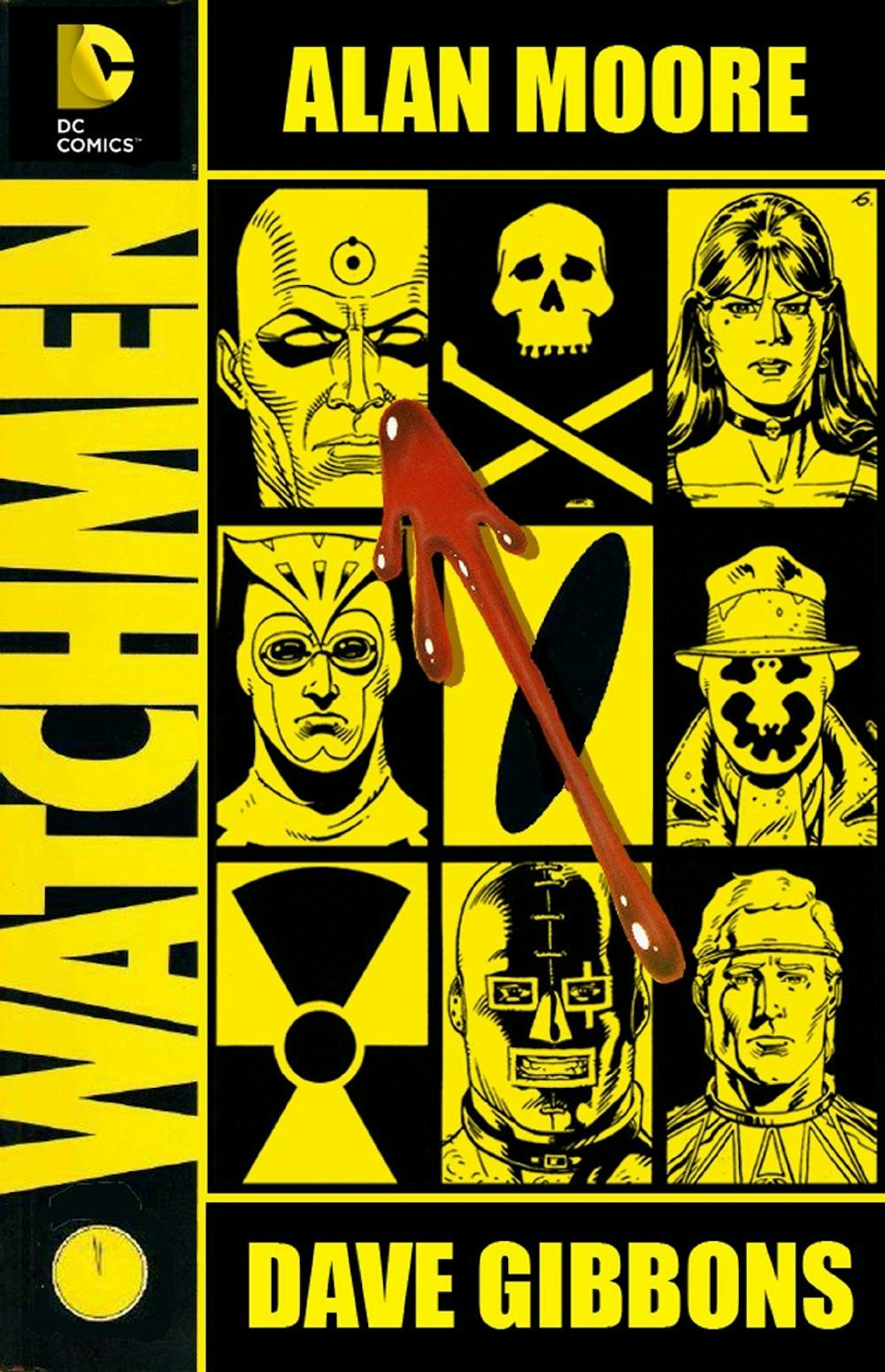
Alan Moore and Dave Gibbons’ Watchmen works on so many levels – it is, among other things, a whodunnit, a love story, a commentary on Cold War politics and an exploration of fundamental philosophical and ethical questions.

Wunderkind.
Amazon

Watchmen is an homage to – and a deconstruction of – the classic superhero comic-strip narrative, which in turn has inspired numerous subsequent revisions of the genre, from Pixar’s The Incredibles (2004) to the Marvel Comics (and later MCU’s) Avengers civil war storyline.

Shifting points of view, disrupting chronology, layering texts within texts, Watchmen is a hugely ambitious narrative that discloses new details with every fresh reading. It’s also a real page-turner.

2. Maus (1991)

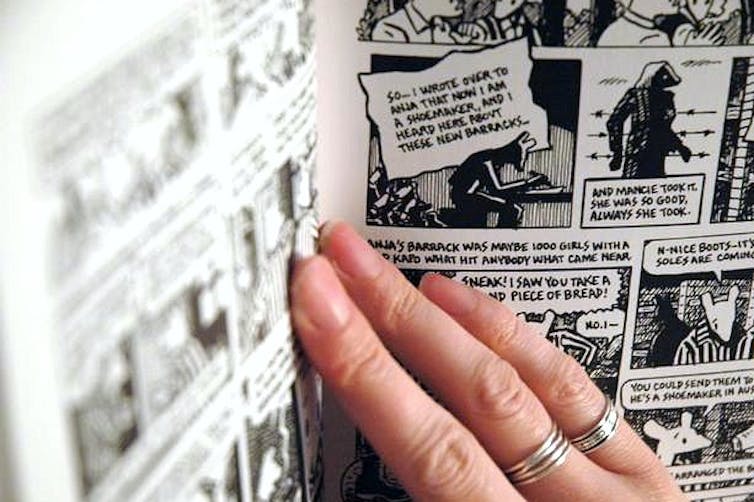
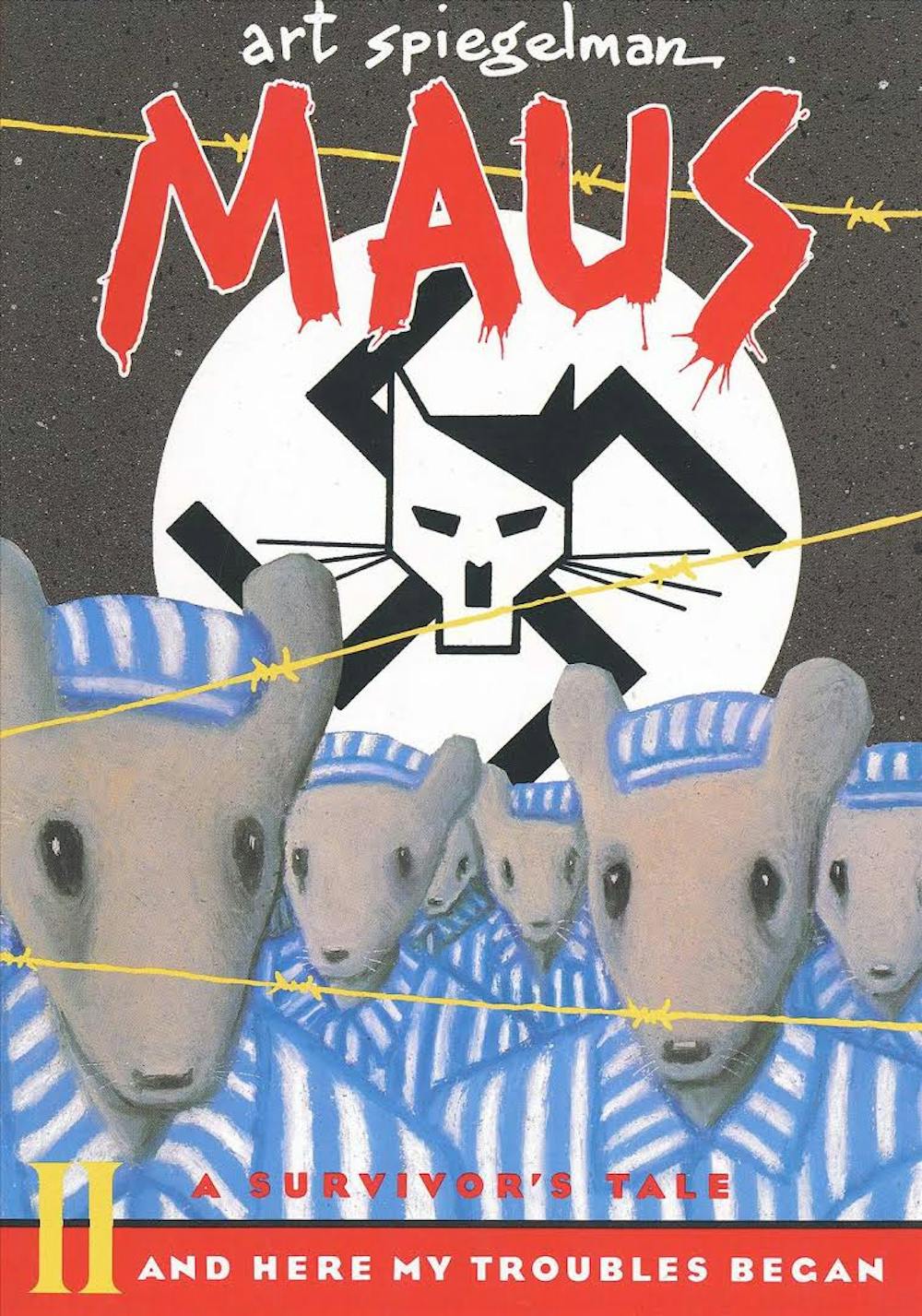
Art Spiegelman’s masterpiece, Maus, probably did more than any other graphic novel to make readers and critics take this genre seriously.

A Holocaust tale with a twist.
Google Books

It’s the story of the author’s father, Vladek, who survived Auschwitz, as well as the story of Spiegelman’s relationship with him. Controversially representing Jews as anthropomorphised mice, preyed upon by German cat-people and often betrayed by Polish pig-people, Maus nevertheless resists stereotypes. The novel represents both its author and his father as flawed, complex individuals who struggle in different ways to deal with the legacy of a trauma that makes itself felt in every aspect of their lives.

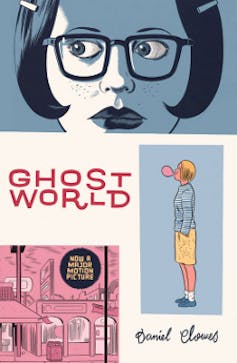
3. Ghost World (1997)

Daniel Clowes’ Ghost World is the shortest – and at first glance the most straightforward – of my choices. It’s a bittersweet tale of the friendship, and gradual estrangement, of recent high-school graduates Enid and Becky.

Coming of age story.
Amazon

Cynical and vulnerable, with a sardonic sense of humour and a nostalgic streak, Enid is, in part, a portrait of the artist as a young girl grappling with her sexuality, ethnicity and her conflicting expectations of herself.

But Ghost World is also a powerful evocation of what it is like to drift, ghost-like, through a nondescript, soulless urban environment that is itself ghostly. Full of quirky characters and memorable images, Ghost World manages, paradoxically, to represent boredom and ennui vividly and entertainingly.

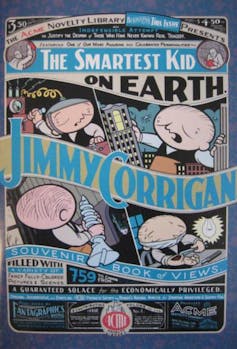
4. Jimmy Corrigan, the Smartest Kid on Earth (2000)

Chris Ware’s Jimmy Corrigan was the first graphic novel to be awarded major literary prizes on both sides of the Atlantic – the American Book Award and The Guardian First Book Award.

First graphic novel to win major literary prizes.
Amazon

Like Watchmen, Jimmy Corrigan has a complex, non-linear structure and subverts conventional notions of (super)heroism. Like Maus, it is a book about fathers and sons; and like Ghost World, it has a protagonist who is drifting aimlessly through life, alienated from the world around him.

Yet it is visually and formally more radical than any of the other books on this list. Chris Ware’s dark palette and landscape format and his use of diagrams, instructions and definitions make the book, as an object and text, highly unusual. In terms of narrative, too, Ware is a great innovator – the absence of exposition and page numbering, the abrupt transitions between a historical narrative focusing on Jimmy’s grandfather and the present-day narrative focusing on Jimmy, the use of surreal dream sequences and the disruption of conventional panel sequencing all make Jimmy Corrigan challenging.

But it’s well worth the effort. It is a beautiful, heartbreaking story that has been much imitated but never bettered.

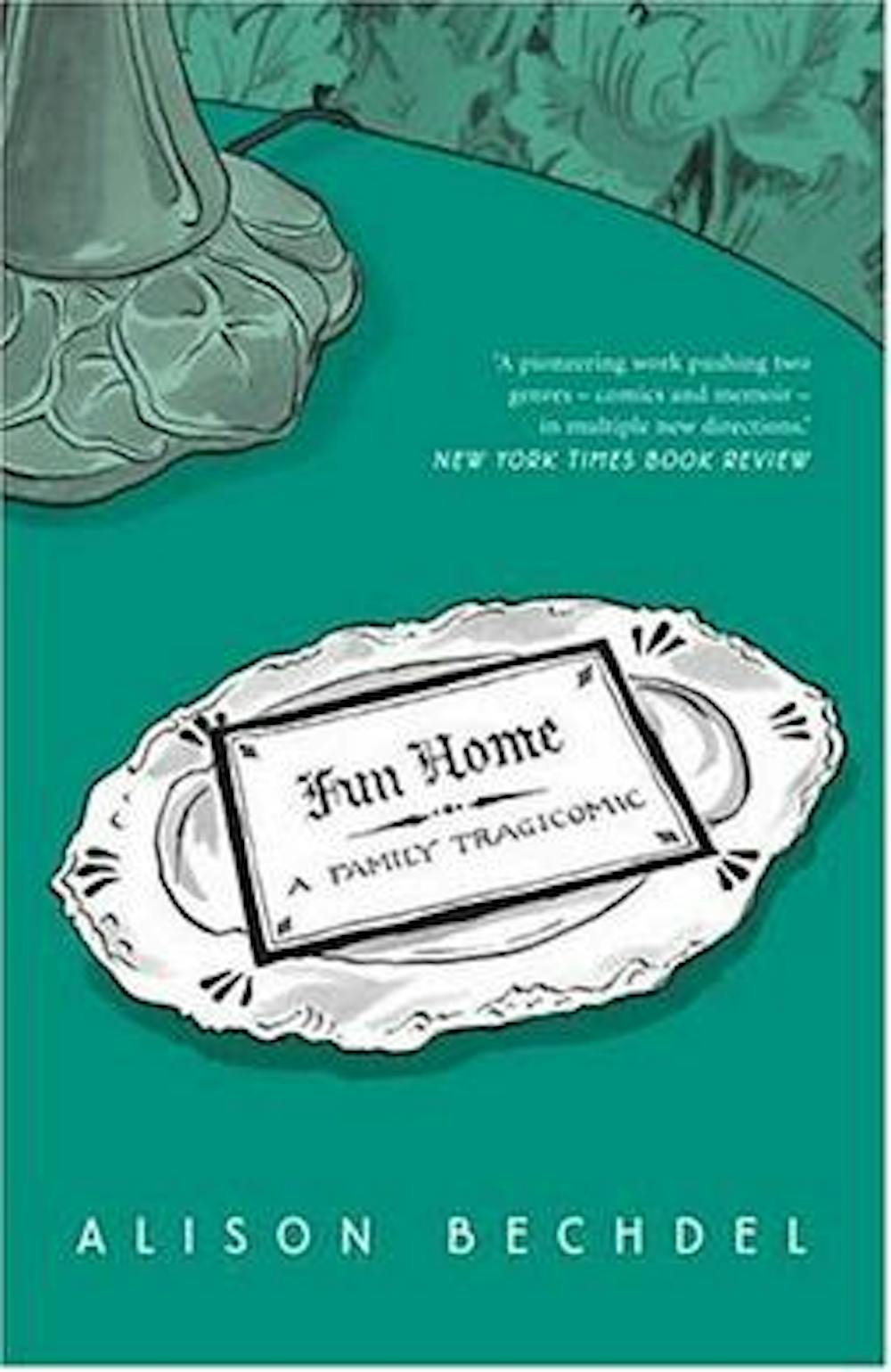
5. Fun Home (2006)

Alison Bechdel’s Fun Home is a self-consciously literary coming of age novel that pays homage to James Joyce, Marcel Proust and Oscar Wilde, among others.

Graphic novel became a musical.
Amazon

It is a moving memoir about the author’s relationship with her father, whose queer sexuality finds an echo in her lesbianism, and whose (possible) suicide haunts the book.

Adapted as an award-winning musical, Fun Home reached an audience that might never have encountered the bestselling graphic novel. Yet while Fun Home the musical is fun, just like the film adaptations of Watchmen and Ghost World, it can’t quite do justice to the complexity of the original.


Read more:
Guilty Pleasures: an English literature professor’s secret stash of graphic novels


What I hope a reading of these titles will demonstrate to any newcomers is that these are not just great graphic novels but great works of art. The term graphic novel was initially deployed in order to confer intellectual credibility on what had been previously seen as a trivial form of entertainment aimed primarily at children. But the works listed above rival anything done in the novel form over the same period – some of the most innovative and exciting work in fiction and life-writing is being done right now in the graphic novel form.The Conversation

David Brauner, Professor of Contemporary Literature, University of Reading

This article is republished from The Conversation under a Creative Commons license. Read the original article.
Unknown's avatar

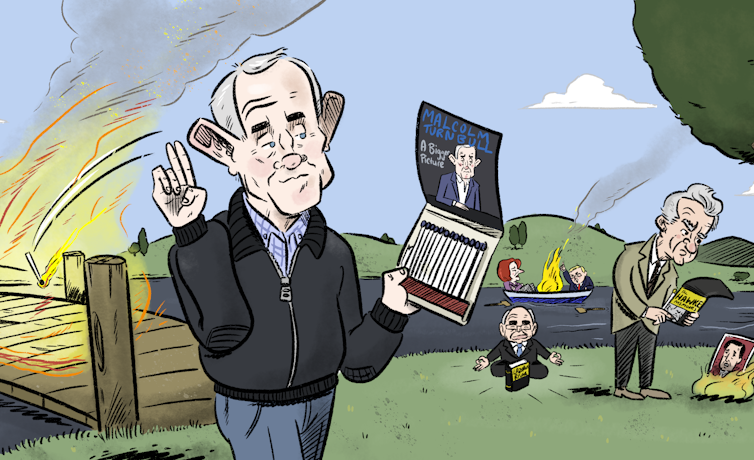
Secrets and scandals: where Malcolm Turnbull’s memoir fits in the rich history of prime ministerial books


Wes Mountain/The Conversation, CC BY-ND

Joshua Black, Australian National University

Landing in the middle of the coronavirus pandemic, it may seem strange former prime minister Malcolm Turnbull’s memoir has generated so much political controversy.

Turnbull has been accused of hypocrisy and championing socialism, and has been threatened with expulsion from the Liberal Party.


Read more:
Politics with Michelle Grattan: Former Prime Minister Malcolm Turnbull on his autobiography, ‘A Bigger Picture’


In A Bigger Picture, Turnbull deals candidly with his antagonists inside the Coalition, who fought him bitterly on the same-sex marriage reform and climate policy. Similarly, he names and shames those he blames for the leadership insurgency of August 2018. All of this was expected, but none of it must please the current government.

But is the book any more inflammatory than previous prime ministerial memoirs?

Political controversy is a trademark of political memoir publishing in Australia. A Bigger Picture is just another page in that story.

Until the 1960s, prime ministerial memoirs were the exception, not the rule. Between 1945 and 1990, just three former prime ministers chose to publish books about their political lives. Two of them – Billy Hughes and Robert Menzies – produced two books each, and both political veterans sought to avoid “telling tales out of school”. Both seemed more interested in foreign affairs, particularly our imperial relationship to the UK in the case of Menzies.

The dismissal of the Whitlam government provoked both Sir John Kerr and Gough Whitlam to publish their memoirs. After reading extracts of Kerr’s Matters for Judgement, Whitlam decided to “set the record straight immediately” by writing The Truth of the Matter. His second book, The Whitlam Government, was also designed to make a political splash. Promising to explain the “development and implementation” of his policy program, the book was timed for release on the tenth anniversary of the dismissal itself, ensuring maximum publicity.

Since then, political controversy has accompanied prime ministerial memoirs, in part because incumbent political parties and leaders have had a vested interest in how these books might affect their popularity.

In his 1994 political memoir, Bob Hawke accused his rival and successor, Paul Keating, of calling Australia “the arse-end of the world” during an argument about the Labor leadership. Further, Hawke accused Keating of failing to support Australia’s involvement in the Gulf War against Saddam Hussein’s invasion of Kuwait in 1990.

Keating, who was attacked in parliament in October 1994 over the claims, called both allegations “lies”. Hawke offered to take a lie-detector test to prove his sincerity. Senior ALP figures recorded their outrage at Hawke’s memoir. But Hawke hit back, describing them as “precious self-appointed guardians of proper behaviour”.

Hawke’s predecessor also damaged his relationship with his own party in the process of publishing his memoirs. Malcolm Fraser’s Political Memoirs, written with journalist Margaret Simons, was recognised as one of Australia’s top ten books of 2010. His outspokenness – in the book and in his post-prime-ministerial life more generally – earned him many attacks from Coalition MPs.

John Howard handled the politics of his memoirs better than most politicians. Though the book was antagonistic toward his former treasurer, Peter Costello, Howard promised to “deal objectively” with events and relationships in Lazarus Rising. Ever the party stalwart, Howard and his publishers re-issued the book after the 2013 election with a new chapter that touted Tony Abbott’s “high intelligence, discipline […] good people skills”.

Kevin Rudd and Julia Gillard both publicly took aim at one another in their memoirs, which made for plenty of media fodder. In My Story, Gillard described Rudd’s leadership as a descent into “paralysis and misery”. Rudd returned fire, calling her book her “latest contribution to Australian fiction”. However, he was unable to dent the book’s commercial success.

Four years later, Rudd in The PM Years accused Gillard of plotting “with the faceless men” to become prime minister. In a bid to patch over the historic rifts, he subsequently promised the Labor Party’s 2018 National Conference that the “time for healing” had come.

Critics of Turnbull’s book – such as Sky News’ Andrew Bolt and 2GB’s Ben Fordham – have argued that he and his publishers, Hardie Grant, were wrong to “betray confidences” and divulge “private conversations”.

In reality, political memoirs have always pushed against conventions of political secrecy. In the 1970s, British cabinet minister Richard Crossman published his Diaries, which included detailed descriptions of how cabinet functioned. The British establishment subsequently conducted the Radcliffe review into political memoirs and diaries. It found such material should be kept secret for 15 years, but that civil servants could do little to stop their political masters from publishing.

In 1999, Australia’s Neal Blewett was warned that publishing his A Cabinet Diary, recorded seven years earlier, could lead to prosecution under the Crimes Act because it revealed confidential cabinet discussions. Calling the public service’s bluff, Blewett published anyway. He explained in the book that “a few egos will be bruised, but cabinet ministers are a robust lot”. His diary shed significant light on the trials and tribulations of a ministerial life.

Since then, countless MPs and ministers have published books that claim to accurately represent personal conversations, some based on private notes (as Costello claimed in his memoirs), others on diary entries (as is the case in Turnbull’s book). In recent years, politicians have reproduced text messages and email exchanges in their books, as Bob Carr did in his 2014 book, Diary of a Foreign Minister. In each version of history, the author is the essential policymaker.


Read more:
View from The Hill: Malcolm Turnbull gives his very on-the-record account of Scott Morrison


In his book, Turnbull reveals private conversations and WhatsApp exchanges with colleagues, world leaders, public servants and more. His accounts of cabinet discussions are hardly ground-breaking: cabinet debates about the economy and national security under the Abbott government, for instance, were thoroughly detailed in Niki Savva’s The Road to Ruin, while the acrimonious debates about energy policy, same-sex marriage and home affairs inside the Turnbull government were laid bare in David Crowe’s Venom. Similarly, Turnbull’s criticisms of News Corporation’s biased reporting have been aired elsewhere, and stop short of Rudd’s argument in The PM Years that Rupert Murdoch should be the subject of a royal commission.

Turnbull’s book is another addition to the history of incendiary political memoir publishing in Australia. Political parties and their media associates have confirmed once again that a successful parliamentary memoir requires deft political management.

Ultimately, A Bigger Picture is not the compendium of revelations that some may perceive. Instead, it is another picture of politics in which “character” and “leadership” reign supreme at the expense of all other political forces.The Conversation

Joshua Black, PhD Candidate, School of History, National Centre of Biography, Australian National University

This article is republished from The Conversation under a Creative Commons license. Read the original article.
Unknown's avatar

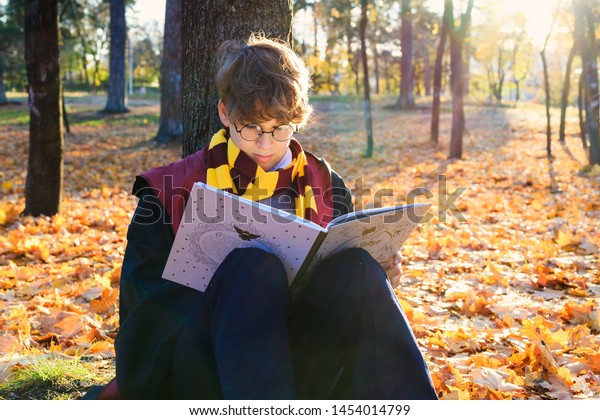
Missing your friends? Rereading Harry Potter might be the next best thing


Unsplash, CC BY

Elaine Reese, University of Otago

Humans are innately social creatures. But as we stay home to limit the spread of COVID-19, video calls only go so far to satisfy our need for connection.

The good news is the relationships we have with fictional characters from books, TV shows, movies, and video games – called parasocial relationships – serve many of the same functions as our friendships with real people, without the infection risks.


Read more:
Say what? How to improve virtual catch-ups, book groups and wine nights


Time spent in fictional worlds

Some of us already spend vast swathes of time with our heads in fictional worlds.

Psychologist and novelist Jennifer Lynn Barnes estimated that across the globe, people have collectively spent 235,000 years engaging with Harry Potter books and movies alone. And that was a conservative estimate, based on a reading speed of three hours per book and no rereading of books or rewatching of movies.

This human predilection for becoming attached to fictional characters is lifelong, or at least from the time toddlers begin to engage in pretend play. About half of all children create an imaginary friend (think comic strip Calvin’s tiger pal Hobbes).

Preschool children often form attachments to media characters and believe these parasocial friendships are reciprocal — asserting that the character (even an animated one) can hear what they say and know what they feel.

Younger children form easy relationships with fictional heroes.
Photo by Josh Applegate/Unsplash, CC BY

Older children and adults, of course, know that book and TV characters do not actually exist. But our knowledge of that reality doesn’t stop us from feeling these relationships are real, or that they could be reciprocal.

When we finish a beloved book or television series and continue to think about what the characters will do next, or what they could have done differently, we are having a parasocial interaction. Often, we entertain these thoughts and feelings to cope with the sadness — even grief — that we feel at the end of a book or series.

The still lively Game of Thrones discussion threads or social media reaction to the death of Patrick on Offspring a few years back show many people experience this.

Some people sustain these relationships by writing new adventures in the form of fan fiction for their favourite characters after a popular series has ended. Not surprisingly, Harry Potter is one of the most popular fanfic topics. And steamy blockbuster Fifty Shades of Grey began as fan fiction for the Twilight series.

As good as the real thing?

So, imaginary friendships are common even among adults. But are they good for us? Or are they a sign we’re losing our grip on reality?

The evidence so far shows these imaginary friendships are a sign of well-being, not dysfunction, and that they can be good for us in many of the same ways that real friendships are good for us. Young children with imaginary friends show more creativity in their storytelling, and higher levels of empathy compared to children without imaginary friends. Older children who create whole imaginary worlds (called paracosms) are more creative in dealing with social situations, and may be better problem-solvers when faced with a stressful event.

As adults, we can turn to parasocial relationships with fictional characters to feel less lonely and boost our mood when we’re feeling low.

As a bonus, reading fiction, watching high-quality television shows, and playing pro-social video games have all been shown to boost empathy and may decrease prejudice.

Collectively, humans have spent more than an estimated 200,000 years in the world of Harry Potter. And that’s not counting rereading or rewatching.
Chekyravaa/Shutterstock

Get by with a little help

We need our fictional friends more than ever right now as we endure weeks in isolation. When we do venture outside for a walk or to go the supermarket and someone avoids us, it feels like social rejection, even though we know physical distancing is recommended. Engaging with familiar TV or book characters is one way to rejuvenate our sense of connection.

Plus, parasocial relationships are enjoyable and, as American literature professor Patricia Meyer Spacks noted in On Rereading, revisiting fictional friends might tell us more about ourselves than the book.

So cuddle up on the couch in your comfiest clothes and devote some time to your fictional friendships. Reread an old favourite – even one from your childhood. Revisiting a familiar fictional world creates a sense of nostalgia, which is another way to feel less lonely and bored.


Read more:
Couch culture – six months’ worth of expert picks for what to watch, read and listen to in isolation


Take turns reading the Harry Potter series aloud with your family or housemates, or watch a TV series together and bond over which characters you love the most. (I recommend Gilmore Girls for all mothers marooned with teenage daughters.)

Fostering fictional friendships together can strengthen real-life relationships. So as we stay home and save lives, we can be cementing the familial and parasocial relationships that will shape us – and our children – for life.The Conversation

Elaine Reese, Professor of Psychology, University of Otago

This article is republished from The Conversation under a Creative Commons license. Read the original article.
Unknown's avatar

How to Buy Rare Books Online


The link below is to an article that looks at how to buy rare books online.

For more visit:
https://blog.bookstellyouwhy.com/how-to-buy-rare-books-online

Unknown's avatar

Emegency Fund for Authors


The link below is to an article reporting on an emergency fund that has been set up for author during the coronavirus pandemic.

For more visit:
https://www.theguardian.com/books/2020/mar/20/this-is-a-scary-time-coronavirus-emergency-fund-set-up-for-authors

Unknown's avatar

2020 Windham Campell Prize


The link below is to an article reporting on the winners of the 2020 Windham Campell Prize, with a particular focus on Maria Tumarkin.

For more visit:
https://www.booksandpublishing.com.au/articles/2020/03/20/148008/tumarkin-wins-2020-windham-campell-prize-for-nonfiction/

Unknown's avatar

US Book Sales Down


The link below is to an article reporting on the fall in US book sales as a result of the coronavirus pandemic – which is hardly a surprise.

For more visit:
https://goodereader.com/blog/bookselling/print-sales-are-crashing-due-to-coronavirus

Unknown's avatar

NSW Premier’s 2020 Literary Awards Shortlist


The link below is to an article reporting on the shortlists for the 2020 NSW Premier’s Literary Awards.

For more visit:
https://www.booksandpublishing.com.au/articles/2020/03/20/148069/nsw-premiers-literary-awards-2020-shortlists-announced/