Unknown's avatar

Trials of Portnoy: when Penguin fought for literature and liberty


IMDB

Patrick Mullins, University of Canberra

One grey morning in October 1970, in a crowded, tizzy-pink courtroom on the corner of Melbourne’s Russell and La Trobe Streets, crown prosecutor Leonard Flanagan began denouncing a novel in terms that were strident and ringing.

“When taken as a whole, it is lewd,” he declared. “As to a large part of it, it is absolutely disgusting both in the sexual and other sense; and the content of the book as a whole offends against the ordinary standards of the average person in the community today – the ordinary, average person’s standard of decency.”


Scribe

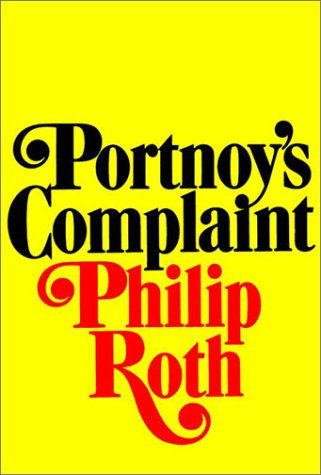
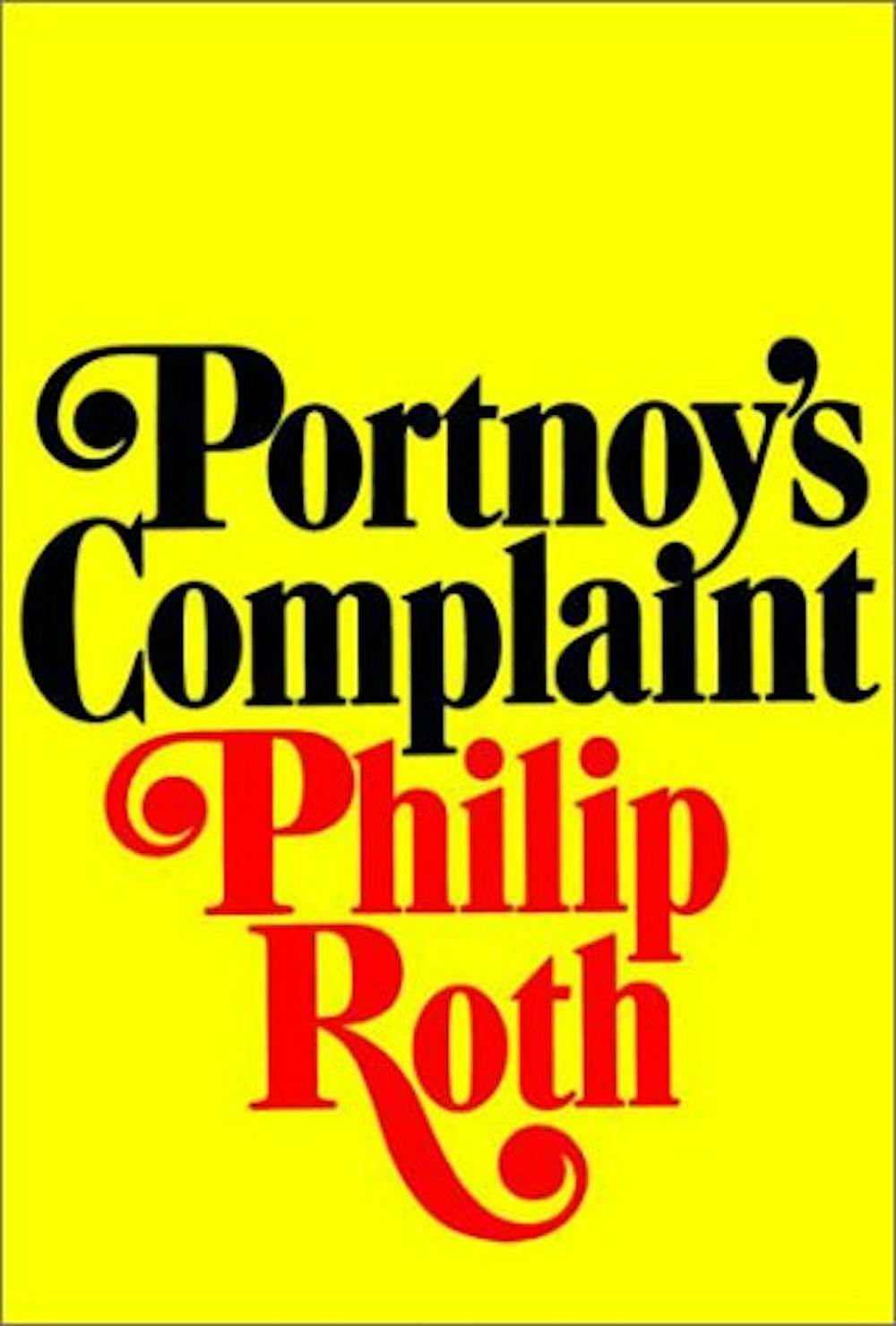
The object of Flanagan’s ire that day was the Penguin Books Australia edition of Portnoy’s Complaint. Frank, funny, and profane, Philip Roth’s novel — about a young man torn between the duties of his Jewish heritage and the autonomy of his sexual desires — had been a sensation the world over when it was published in February 1969.

Greeted with sweeping critical acclaim, it was advertised as “the funniest novel ever written about sex” and called “the autobiography of America” in the Village Voice. In the United States, it sold more than 400,000 copies in hardcover in a single year — more, even, than Mario Puzo’s The Godfather — and in the United Kingdom it was published to equal fervour and acclaim.

But in Australia, Portnoy’s Complaint had been banned.


Read more:
Philip Roth was the best post-war American writer, no ifs or buts


Banned books

Politicians, bureaucrats, police, and judges had for years worked to keep Australia free of the moral contamination of impure literature. Under a system of censorship that pre-dated federation, works that might damage the morals of the Australian public were banned, seized, and burned. Bookstores were raided. Publishers were policed and fined. Writers had been charged, fined and even jailed.

Seminal novels and political tracts from overseas had been kept out of the country. Where objectionable works emerged from Australian writers, they were rooted out like weeds. Under the censorship system, Boccacio’s Decameron had been banned. Nabokov’s Lolita had been banned. Joyce’s Ulysses had been banned. Even James Bond had been banned.

There had been opposition to this censorship for years, though it had become especially notable in the past decade. Criticism of the bans on J.D. Salinger’s The Catcher in the Rye and Norman Lindsay’s Redheap had prompted an almost complete revision of the banned list in 1958.

The repeated prosecutions of the Oz magazine team in 1963 and 1964 had attracted enormous attention and controversy.

Outcry over the bans on Mary McCarthy’s The Group and D.H. Lawrence’s Lady Chatterley’s Lover had been loud and pronounced, and three intrepid Sydney activists had exposed the federal government to ridicule when they published a domestic edition of The Trial of Lady Chatterley, an edited transcript of the failed court proceedings against Penguin Books UK for the publication of Lady Chatterley’s Lover in Britain in 1960.


Read more:
Friday essay: the Melbourne bookshop that ignited Australian modernism


Penguin goes to battle

Penguin Books Australia had been prompted to join the fight against censorship by the three idealistic and ambitious men at its helm: managing director John Michie, finance director Peter Froelich, and editor John Hooker.

In five years, the three men had overhauled the publisher, improving its distribution machinery and logistics and reinvigorating its publishing list. They believed Penguin could shape Australian life and culture by publishing interesting and vibrant books by Australian authors.

They wanted Penguin’s books to engage with the political and cultural shifts that the country was undergoing, to expose old canards, question the orthodox, and pose alternatives.

Censorship was no small topic in all this. Those at Penguin saw censorship as an inhibition on these ambitions. “We’d had issues with it before, in minor ways,” Peter Froelich recalled, “and we’d have drinks we’d say, ‘It’s wrong! How can we fix it? What can we do? How do we bring it to people’s attention, so that it can be changed?’”

The answer emerged when they heard of the ban placed on Portnoy’s Complaint. Justifiably famous, a bestseller the world over, of well-discussed literary merit, it stood out immediately as a work with which to challenge the censorship system, just as its British parent company had a decade earlier.

Why not obtain the rights to an Australian edition, print it in secret, and publish it in one fell swoop? As Hooker — who had the idea — put it to Michie, “Jack, we ought to really publish Portnoy’s Complaint and give them one in the eye”.

The risks were considerable. There was sure to be a backlash from police and politicians. Criminal charges against Penguin and its three leaders were almost certain. Financial losses thanks to seized stock and fines would be considerable. The legal fees incurred in fighting charges would be enormous. Booksellers who stocked the book would also be put on trial. But Penguin was determined.

John Michie was resolute. “John offered to smash the whole thing down,” Hooker said, later. When he was told what was about to happen, federal minister for customs Don Chipp swore that Michie would pay: “I’ll see you in jail for this.” But Michie was not to be dissuaded.

‘People who took exception to it at the time are mostly dead,’ Roth said, some 40 years and 30 books after Portnoy’s Complaint was published.

A stampede

In July 1970, Penguin arranged to have three copies of Portnoy smuggled into Australia. In considerable secrecy, they used them to print 75,000 copies in Sydney and shipped them to wholesalers and bookstores around the country. It was an operation carried out with a precision that Hooker later likened to the German invasion of Poland.

Wikimedia

The book was unveiled on August 31 1970. Michie held a press conference in his Mont Albert home, saying Portnoy’s Complaint was a masterpiece and should be available to read in Australia. Neither he nor Penguin were afraid of the prosecutions: “We are prepared to take the matter to the High Court.”

The next morning, as the trucks bearing copies began to arrive, bookstores everywhere were rushed. At one Melbourne bookstore, the assistant manager was knocked down and trampled by a crowd eager to buy the book and support Penguin. “It was a stampede,” he said later. A bookstore manager in Sydney was amazed when the 500 copies his store took sold out in two-and-a-half hours.

All too soon, it was sold out. And with politicians making loud promises of retribution, the police descended.

Bookstores were raided. Unsold copies were seized. Court summons were delivered to Penguin, to Michie, and to booksellers the whole country over. A long list of court trials over the publication of Portnoy’s Complaint and its sale were in the offing.

A stellar line-up

So the trial that opened on the grey morning of October 19 1970, in the Melbourne Magistrates Court, was only the first in what promised to be a long battle.

Neither Michie nor his colleagues were daunted. They had prepared a defence based around literary merit and the good that might come from reading the book. They had retained expert lawyers and marshalled the cream of Australia’s literary and academic elite to come to their aid.

Patrick White would appear as a witness for the defence. So too would academic John McLaren, The Age newspaper editor Graham Perkin, the critic A.A. Phillips, the historian Manning Clark, the poet Vincent Buckley, and many more. They were unconcerned by Flanagan’s furious denunciations, by his shudders of disgust, and by his caustic indictments of Penguin and its leaders.

They were confident in their cause. As one telegram to Michie said:

ALL BEST WISHES FOR A RESOUNDING VICTORY FOR LITERATURE AND LIBERTY.


This is an edited extract from Trials of Portnoy by Patrick Mullins, published by Scribe.The Conversation

Patrick Mullins, Adjunct assistant professor, Centre for Creative and Cultural Research, University of Canberra

This article is republished from The Conversation under a Creative Commons license. Read the original article.


Unknown's avatar

New Format for Audible


The link below is to an article reporting on a new format for audio books that Audible will now be using.

For more visit:
https://goodereader.com/blog/audiobooks/audible-moving-to-enhanced-format-for-audiobooks

Unknown's avatar

The Les Carlyon Literary Prize


The link below is to an article reporting on the establishment of a new book award in Australia, the $10,000 Les Carlyon Literary Prize.

For more visit:
https://www.booksandpublishing.com.au/articles/2020/05/28/151289/australian-war-memorial-establishes-10k-les-carlyon-literary-prize/

Unknown's avatar

Collaboration made easy: 6 ways to build a writing relationship


Alexis Brown/Unsplash

Sean Williams, Flinders University

Writing is a pastime best conducted on your own — or so common wisdom would have it. Yet writing teams exist, and in many realms they are expected. Take television, where the writers’ room is the norm. Or the academy: one physics paper has 5,154 authors.

In literature, collaborations are more common than you might realise. For every superstar Neil Gaiman and Terry Pratchett team-up (Good Omens), there might be an F. Scott Fitzgerald and his uncredited wife Zelda, or a “James S. A. Corey” (The Expanse) being the pseudonym for Daniel Abraham and Ty Franck.

Although new writers such as the Brontë siblings may collaborate, the practice seems to fall away with age, perhaps because writing relationships can be as fraught as familial ones, with as many pitfalls to navigate.

Add to this a collaboration nearly always proves to take as long as a solo work and any monies might have to be divided among the contributors. Why would anyone willingly share their art with someone else for little to no benefit?


Read more:
10½ commandments of writing


In my experience, collaborating can be creatively stimulating, educative, motivating, productive, and revitalising. Plus, it’s great to have a friend to keep you company on a publicity tour.

Here are six techniques to help would-be co-writers take their first steps in this direction.

1. The chain

This is the simplest method, one of two that require first settling on what your story will be and then breaking the writing of it into bits completed separately, in chronological order.

There are many ways to serially tackle the discrete tasks that will combine to form a glorious whole. Some teams might choose to write alternate scenes, chapters or sections; others might alternate whole drafts, giving each participant long stretches of time to work on solo projects.

Whichever way you tear it down, every member of the team has a professional obligation to deliver. Break one link in the chain and it falls apart.

The chain method can give each writer long stretches of time to work on solo projects.
Brad Neathery/Unsplash

2. Parallel processing

The second way to devolve an outline requires trust and communication beyond that required of ordinary collaborative relationships.

In parallel processing, you divide characters among authors, so one provides the voice of X, another Y, and so on. Each arc is written separately, then edited together when complete. If X or Y diverge too much from their expected paths, plotting and structural problems can arise, but the powerful juxtaposition of distinct voices can outweigh the risk.

3. The hothouse

An extreme version of serial collaboration, this method used to require being physically in the same room as your writing partner(s). One starts writing and keeps writing until they get stuck. They then tag in the next writer, who takes over. Repeat until done. Food and sleep are optional.

The benefit of this method is the words are guaranteed to keep coming.

These days the “in person” requirement is greatly relaxed. Google Docs is just one platform allowing writers to work on the same document at the same time, no matter where they are.

4. The undertakers

Brainstorming what a story will contain is, for many collaborators, the fun part — providing they can agree on a final project.

One method of achieving this agreement is by giving one of the co-writers a veto to be exercised when consensus can’t be reached.

Another method requires every element of the final project must be agreed to by every collaborator. This can be time-consuming to achieve but avoids any lingering resentment if someone is outvoted or overruled.

To avoid any lingering resentment, every decision can be agreed on by every collaborator.
Toa Heftiba/Unsplash

More generally, every shared undertaking should have a binding agreement in place before serious work commences, covering issues such as whose name goes first, which agent will sell the work, how any resulting IP will be divided, and so on.

It is much better to have these agreements in place and not need them than the other way around.

5. The Marxist Manifesto

Collaborators should have common ambitions but complementary skills, otherwise you might as well work alone. The way roles are divided in the working relationship can reflect those skill sets – which might, of course, lie in non-writerly areas such as business or marketing.

To some, the perfect collaboration is one in which every participant’s weaknesses are covered by strengths in their fellows. Everyone contributes and everyone learns by example.

Not everyone needs to write. Someone on the team might have the perfect brain for business or marketing.
Helena Lopes/Unsplash

6. Resurrection of the dead

Finally, the easiest and safest way to audition a potential co-writer is to give them a failed draft and see what they accomplish with it. If it’s a success, great: the original author gains a new collaborator and a finished work.

Should this (or any of these methods fail) the author is no worse off.

They can just revert to writing alone – for some their natural habitat.The Conversation

Sean Williams, Senior Lecturer, Flinders University

This article is republished from The Conversation under a Creative Commons license. Read the original article.

Unknown's avatar

Tips for Extending Kindle Battery Life


The link below is to an article that looks at ways to extend the battery life of Kindles.

For more visit:
https://the-digital-reader.com/2020/05/23/eight-tips-for-extending-the-battery-life-on-your-kindle/

Unknown's avatar

Free Ebooks By University Press


The link below is to an article that looks at the free ebooks offered by University Press from time to time.

For more visit:
https://www.getfreeebooks.com/free-ebooks-and-learning-resources-by-oxford-university-press/

Unknown's avatar

Free Ebooks by SeagullBooks


The link below is to an article that looks at free ebooks offered from time to time by SeagullBooks.

For more visit:
https://www.getfreeebooks.com/free-ebooks-by-seagullbooks/

Unknown's avatar

Audible & Podcasts


The link below is to an article reporting on how Audible is getting into podcasts in a big way.

For more visit:
https://goodereader.com/blog/audiobooks/audible-is-getting-serious-about-podcasts

Unknown's avatar

How Hemingway felt about fatherhood


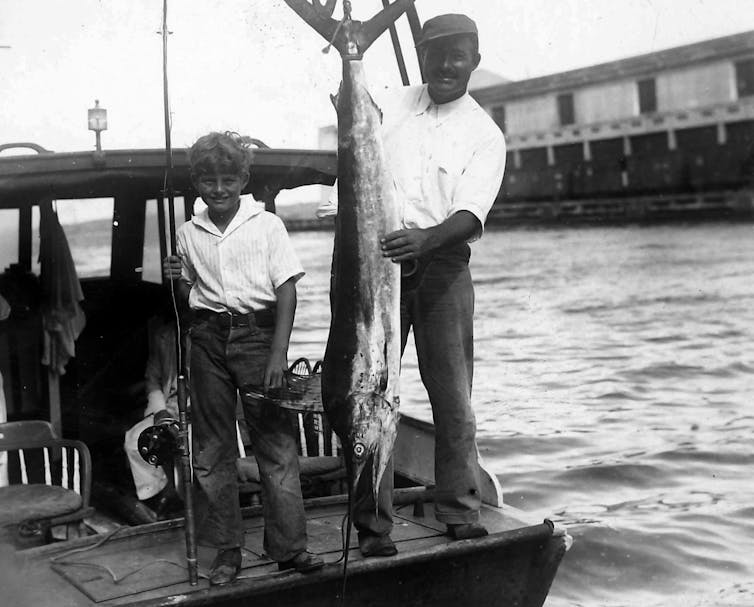
Hemingway and his eldest son, Bumby, pose in Havana harbor in 1933.
Collection of David Meeker, Author provided

Verna Kale, Pennsylvania State University

Ernest Hemingway was affectionately called “Papa,” but what kind of dad was he?

In my role as Associate Editor of the Hemingway Letters Project, I spend my time investigating the approximately 6,000 letters sent by Hemingway, 85% of which are now being published for the first time in a multivolume series. The latest volume – the fifth – spans his letters from January 1932 through May 1934 and gives us an intimate look into Hemingway’s daily life, not only as a writer and a sportsman, but also as a father.

During this period, Hemingway explored the emotional depths of fatherhood in his fiction. But his letters show that parenting could be a distraction from what mattered most to him: his writing.

‘No alibis’ in the writing business

Hemingway had three sons. His oldest, John – nicknamed “Bumby” – was born to Ernest and his first wife, Hadley, when Ernest was 24 years old. He had Patrick and Gregory with his second wife, Pauline.

Hemingway initially approached fatherhood with some ambivalence. In her 1933 memoir “The Autobiography of Alice B. Toklas,” Gertrude Stein recalls that one evening Hemingway came to visit and “announced…with great bitterness” that he was “too young to be a father.”

As the fifth volume of letters opens in January 1932, Hemingway is trying to finish “Death in the Afternoon,” his nonfiction account of bullfighting, in a household with a six-week-old baby, a three-year-old who ingests ant poison and nearly dies, a wife still recovering from a C-section, along with all the quotidian problems of home ownership, from a leaky roof to faulty wiring.

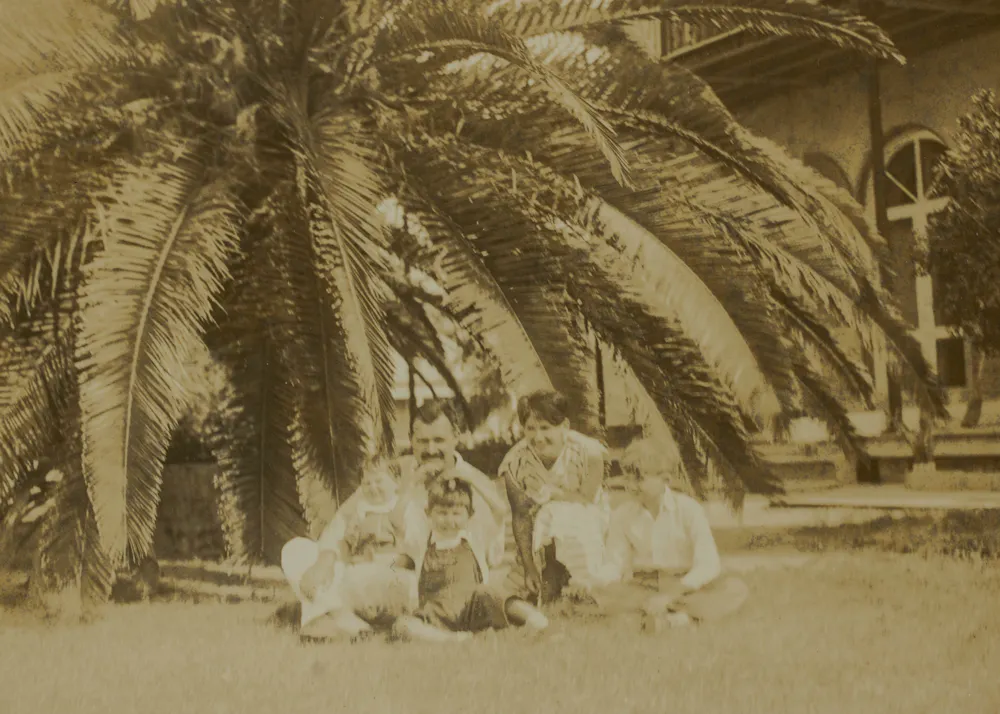
Ernest Hemingway and Pauline Pfeiffer Hemingway, with Gregory, Patrick and Bumby in Key West, 1933.
Princeton University Library, Author provided

Hemingway explained to his mother-in-law, Mary Pfeiffer, that if his latest book fell short, he couldn’t simply take readers aside and say, “But you ought to see what a big boy Gregory is…and you ought to see our wonderful water-work system and I go to church every Sunday and am a good father to my family or as good as I can be.”

There are “no alibis” in the writing business, Hemingway continued, and “a man is a fool” to allow anything, even family, to interrupt his work. “Taking refuge in domestic successes,” he added, “is merely a form of quitting.”

For Hemingway, work didn’t simply entail sitting at a desk and writing. It also included the various adventures he was famous for – the fishing, hunting, traveling and socializing with the people he met along the way. Though he would teach the boys to fish and shoot when they were older, when they were very young he didn’t hesitate to leave them with nannies or extended family for long stretches of time.

This separation was particularly hard on the youngest, Gregory, who, from a very young age, was left for months in the care of Ada Stern, a governess who lived up to her last name. Patrick sometimes joined his parents on their travels or stayed with other relatives. Bumby, the oldest, divided his time between his father and his mother in Paris. The children’s lives were so peripatetic that at the Letters Project we maintain a spreadsheet to keep track of their whereabouts at any given time.

‘Papa’ explores fathers and sons in his fiction

However, it would not be accurate to say that Hemingway did not care about his children. In the latest volume of letters, three are addressed to Patrick, two of them decorated with circled dots, a Hemingway family tradition called “toosies,” which represented kisses.

In his letters to his kids, Hemingway would sometimes draw dots called ‘toosies,’ which represented kisses.
Princeton University Library, Author provided

In Hemingway’s fiction, we can see the depth of that paternal feeling, and in his letters, the domestic moments that inspired him.

In November 1932, with his two youngest sons ill with whooping cough and being cared for by their mother at their grandparents’ home in Arkansas, Hemingway postponed a trip to New York to stay in Key West with Bumby.

“He is a good kid and a good companion,” Hemingway wrote his editor, Maxwell Perkins, “but I do not want to drag him around the speakies [bars] too much.”

That same month Hemingway worked on the story of a father and son traveling together that would become “Fathers and Sons” in the collection “Winner Take Nothing.” It’s one of the only stories in which Nick Adams – a semi-autobiographical recurring character – is portrayed as a parent, and the reflective, melancholy piece was written just three years after Hemingway’s own father had died by suicide.

In the story, Nick is driving along a stretch of highway in the countryside with “his son asleep on the seat by his side” when he starts thinking about his father.

Nick recalls many details about him: his eyesight, good; his body odor, bad; his advice on hunting, wise; his advice about sex, unsound. He reflects on viewing his father’s face after the undertaker had made “certain dashingly executed repairs of doubtful artistic merit.”

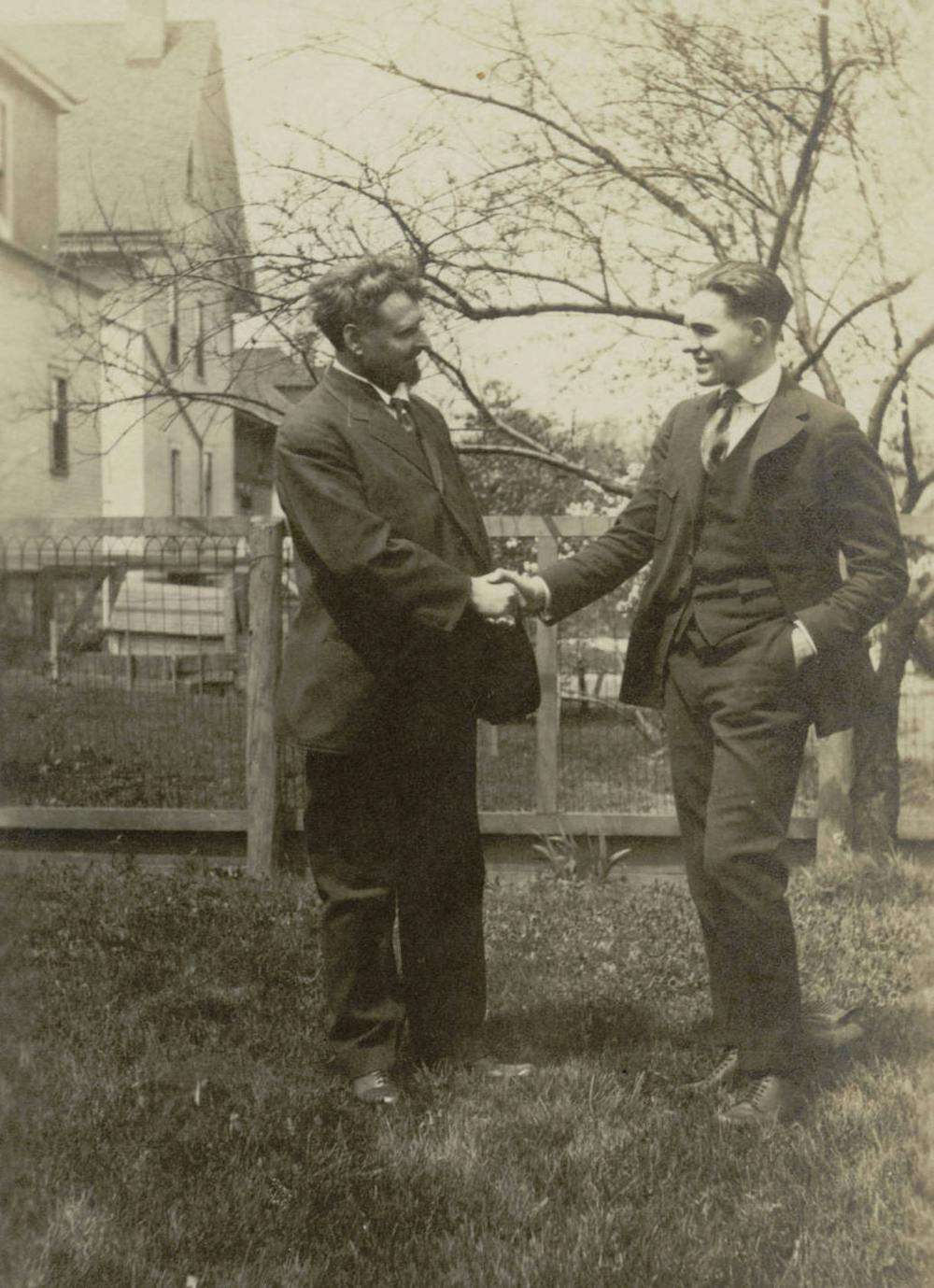
Clarence Edmonds Hemingway and Ernest Hemingway in Oak Park, Illinois, circa 1917-1918.
Ernest Hemingway Foundation of Oak Park/Oak Park Public Library, Oak Park, Illinois., Author provided

Nick is surprised when his son starts to speak to him because he “had felt quite alone” even though “this boy had been with him.” As if reading his father’s thoughts, the boy wonders, “What was it like, Papa, when you were a little boy and used to hunt with the Indians?’”

Hemingway’s letters show that another story in the collection, “A Day’s Wait,” was inspired by Bumby’s bout with influenza in the fall of 1932. It is a seemingly lighthearted story about a young boy’s misunderstanding of the differences between the centigrade and Fahrenheit scales of temperature. Like Bumby, the protagonist, “Schatz” – one of Bumby’s other nicknames, a term of endearment in German – attends school in France but is staying with his father when he becomes ill. Schatz had learned at school that no one can survive a temperature of 44 Celsius, so, unbeknownst to his father, he spends the day waiting to die of his fever of 102 Fahrenheit.

But there is more to this story than the twist. “You don’t have to stay in here with me, Papa, if it bothers you,” the boy tells him. “It doesn’t bother me,” his father replies. He unwittingly leaves his son to believe, for an entire day, not only that the boy is going to die, but that his death is of no importance to his father.

In this slight story – one of those stories he told Perkins was written “absolutely as they happen” – we find an unexpected Hemingway hero in the form of a nine-year-old boy who bravely faces death alone.

Though he once wrote that he wanted “Winner Take Nothing” to make “a picture of the whole world,” Hemingway also seemed to understand that no one ever truly knows the subjective experience of another, not even a father and son.

[Insight, in your inbox each day. You can get it with The Conversation’s email newsletter.]The Conversation

Verna Kale, Associate Editor, The Letters of Ernest Hemingway and Assistant Research Professor of English, Pennsylvania State University

This article is republished from The Conversation under a Creative Commons license. Read the original article.

Unknown's avatar

African crime and detective fiction reshapes the genre


Alexis Huguet/AFP/Getty Images

Aretha Phiri, Rhodes University and Sam Naidu, Rhodes University

Crime and detective fiction continues to top bestseller lists across the world, spawning TV series and films. In the hands of African writers, though, the genre offers a particularly textured world view.

That Ever-blurry Line Between Us and the Criminals: Re-Visioning Justice in African Noir is a colloquium paper by Sam Naidu. It focuses on African crime and detective fiction as a complex and disruptive variety of classic, Western crime and detective fiction.

In probing the transatlantic relationship between Africa and the West, Naidu presents a useful critique of seminal Black Atlantic studies like Paul Gilroy’s
1993 The Black Atlantic: Modernity and Double Consciousness. Aretha Phiri interviewed the author.


Aretha Phiri: Your paper addresses classic noir and African noir, sub-genres of crime and detective fiction?

Sam Naidu: African crime fiction builds on and extends classic crime fiction to explore philosophical questions about identity, knowledge and power. Referencing the same dark aesthetic of classic noir – characterised by themes of alienation, pessimism, moral ambivalence and disorientation – African crime fiction amplifies political awareness. And, occasionally, it destabilises the conventions of classic crime fiction, which arose during the aftermath of the two world wars when the world was in the grip of the Cold War.

Aretha Phiri: What is the ‘political’ relationship between classic and African crime fiction?

Sam Naidu: African crime fiction builds on and extends classic crime fiction’s exploration of philosophical questions about identity, knowledge and power in the modern world.

Politically, there is a deliberate shift to consider fundamental questions about Africa and its specific requirements. The novels I have read demonstrate a preoccupation with the ambiguity of justice. They express a poignant, Afro-pessimistic lament for a continent and its injustices.

They provide this focus in terms of colonialism and the power differentials of neo-colonialism in Africa. So, you find that economic exploitation and inequalities, race, war, genocide, corruption and state capture are common subject matter.

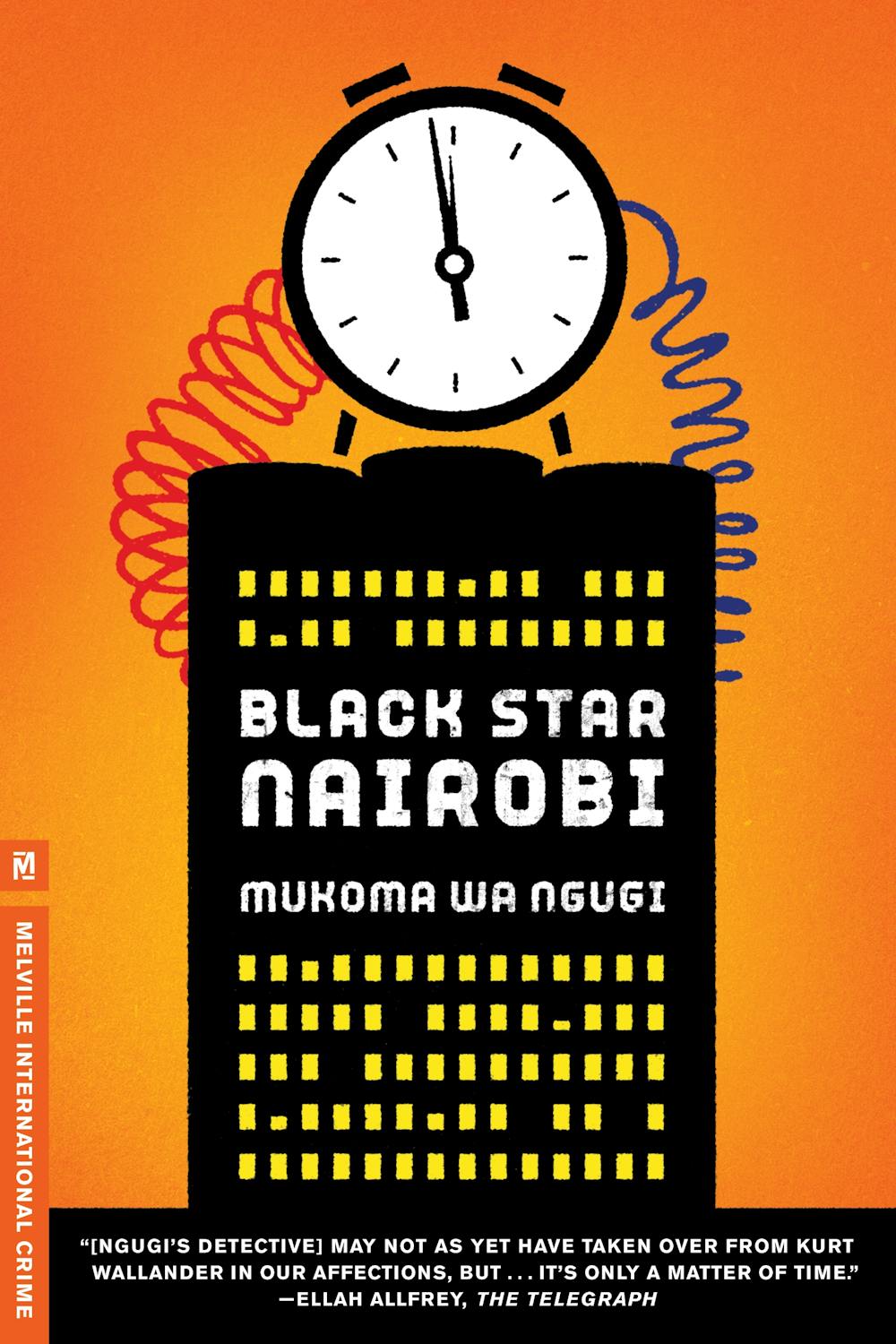
Aretha Phiri: You read Mũkoma wa Ngũgĩ’s novel Black Star Nairobi (2013) as a valuable way of demonstrating the disruption of the classical by the African? What’s it about?

Sam Naidu: It’s set mainly in Nairobi, Kenya, in 2007. It’s the eve of Barack Obama’s election as the first black US president and presidential elections in Kenya. O (short for Odihambo), a Kenyan former policeman who still works part-time for the police, has teamed up with Ishmael from the US, a former cop. Together they’ve formed a detective agency, Black Star, which is given a lucky break when O’s former boss hires them to investigate the murder of an unidentified person whose corpse is found gruesomely disfigured in the Ngong Forest outside Nairobi.


Melville House International, 2013

Aretha Phiri: You conclude in your paper that the predominant effect of African crime fiction is not so much a ‘dark’ sensibility as it is one of obscurity and poignant Afro-pessimism?

Sam Naidu: I reach this conclusion based on the literary texts. This is not my opinion of the state of the continent. The novels are very dark. They overwhelm the reader, with the mess, tragedy, garbage, cruelty, indignity and inhumanity that Africans face in reality. Due, of course, to historical and ongoing systemic oppression and corruption. For characters – and for readers – this can lead to muddledness and despair.

But the novels also offer a counterpoint – in the form of fearless detectives on the quest for justice. In the midst of the disquiet there is a faint flicker … It is this murkiness, taken to new depths, which makes African crime fiction particularly effective and significant. For example, the novel closes with a highly lyrical and metaphorical scene of African musicians in a market. Ishmael describes the competing rhythms of African music – a metaphor for the strife and power struggles of the continent. Despite the discord he detects a harmony –- “a tense harmony”.


Read more:
Nigeria’s queer literature offers a new way of looking at blackness


Aretha Phiri: How does Black Star Nairobi manage to disrupt classic crime fiction?

Sam Naidu: For example, through its innovative use of setting, characterisation, pace and conclusion to comment on ontological, existential and ethical themes to do with justice, it’s an exemplary African noir text. It explicitly extends classic noir into the realms of neo-noir.

Its blend of previous influences, use of setting, and its specific thematic concern with Afro-pessimism prompt the observation that African crime fiction extends classic noir into new literary, geo-political, and moral territories.

Murkiness, so characteristic of classic noir sensibility, mutates, at times, in African crime texts such as Black Star Nairobi and Leye Adenle’s When Trouble Sleeps, to a deliberate generic nebulousness. And thematically, to a moral blurriness so obscure as to disorient the reader and dismantle the basic binaries on which classic detective and crime fiction were predicated.

In classic noir or classic crime fiction there are clear detective heroes set up against indisputable villains (think of Sherlock Holmes) but in African crime fiction the heroes and villains often exchange roles or are complicit in some way.


Read more:
Black and queer women invite the Black Atlantic into the 21st century


Aretha Phiri: You describe this evolving genre as occupying a kind of borderland. How does this connect to your research in migration and diaspora?

Sam Naidu: In my work on literature of migration and diaspora I am mainly concerned with the experience of migrants. I am, however, also interested in how literary genres migrate. What processes of cross-pollination occur as a result of diaspora?

Aretha Phiri: What do you see African crime fiction contributing to Black Atlantic scholarship?

Sam Naidu: As a form of postcolonial, transnational writing, African crime fiction points to the relations between Africa and America. Gilroy’s Black Atlantic puts forward that race is fluid and ever-changing, rather than static. That it is transnational and intercultural, rather than national. I am arguing that African crime fiction represents race as a transnational or diasporic phenomenon while at the same time engaging with the notion that race is closely bound up with both nationality and ethnicity.

So, look at the detective hero figure Ishmael. He is an African-American who returns to Africa, gesturing, of course, to transatlantic slavery and colonialism. He’s neither African nor American – he is both. The novel explores his hybridity. At the same time, the novel presents Kenya as nation marred by ethnic clashes and wide-scale civil unrest.

African crime fiction, being the second most popular literary genre on the continent after romance, is worthy of study because of its accessibility, wide-spread, diverse readership and also its capacity for socio-political analysis. It is the ideal vehicle for such pertinent ‘detection’.

This article is part of a series called Decolonising the Black Atlantic in which black and queer women literary academics rethink and disrupt traditional Black Atlantic studies. The series is based on papers delivered at the Revising the Black Atlantic: African Diaspora Perspectives colloquium at the Stellenbosch Institute for Advanced Study.The Conversation

Aretha Phiri, Senior lecturer, Department of Literary Studies in English, Rhodes University and Sam Naidu, Professor, Department of Literary Studies in English, Rhodes University

This article is republished from The Conversation under a Creative Commons license. Read the original article.