
The link below is to an article reporting on the winner for the 2020 Wainwright Prize for nature writing, Dara McAnulty, for ‘Diary of a Young Naturalist.’

The link below is to an article reporting on the winner for the 2020 Wainwright Prize for nature writing, Dara McAnulty, for ‘Diary of a Young Naturalist.’
The link below is to an article that looks at Kindle Books and what you need to know if you haven’t used them before.
For more visit:
https://ebookfriendly.com/ebooks-amazon-guide/
The link below is to an article that takes a look at the costs of ebooks and audiobooks for libraries.
For more visit:
https://smartbitchestrashybooks.com/2020/09/hold-on-ebooks-cost-how-much-the-inconvenient-truth-about-library-ecollections/
The links below are to articles reporting on the 2020 United Kingdom’s Women’s Prize for Fiction winner, Maggie O’Farrell for ‘Hamnet.’
For more visit:
– https://publishingperspectives.com/2020/09/maggie-ofarrell-wins-the-2020-womens-prize-for-fiction-covid19/
– https://lithub.com/maggie-ofarrells-hamnet-has-won-the-womens-prize-for-fiction/
– https://www.booksandpublishing.com.au/articles/2020/09/10/156444/ofarrell-wins-2020-womens-prize-for-hamnet/
– https://www.theguardian.com/books/2020/sep/09/maggie-o-farrell-wins-womens-prize-for-fiction-with-exceptional-hamnet
– https://bookriot.com/2020-womens-prize-winner/
Roger J. Kreuz, University of Memphis
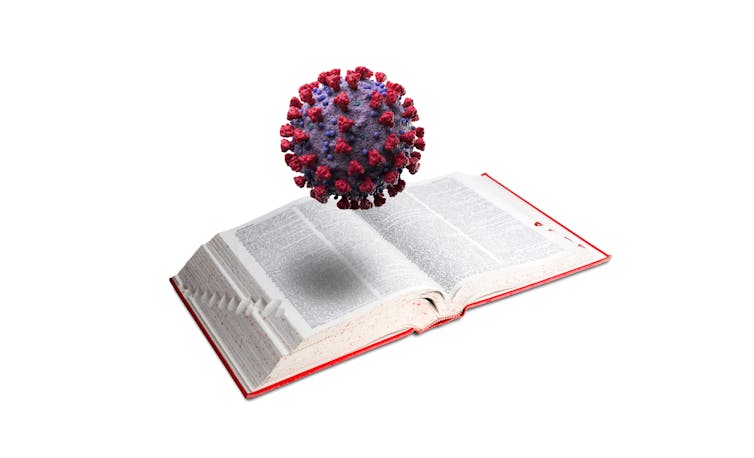
In April, the editors of the Oxford English Dictionary did something unusual. For the previous 20 years, they had issued quarterly updates to announce new words and meanings selected for inclusion. These updates have typically been made available in March, June, September and December.
In the late spring, however, and again in July, the dictionary’s editors released special updates, citing a need to document the impact of the COVID-19 pandemic on the English language.
Although the editors have documented many coronavirus-related linguistic shifts, some of their observations are surprising. They claim, for example, that the pandemic has produced only one truly new word: the acronym COVID-19.
Most of the coronavirus-related changes that the editors have noted have to do with older, more obscure words and phrases being catapulted into common usage, such as reproduction number and social distancing. They’ve also documented the creation of new word blends based on previously existing vocabulary.
The Oxford English Dictionary aspires to be the most extensive and complete record of the language and its history.
In 1884, parts of the first edition were released. It wasn’t completed until 1928. Over the ensuing years, additional volumes of new words were published to supplement the first edition, and these were integrated into a second edition that appeared in 1989. This is the version you’ll find in most libraries. A digital release, on CD-ROM, followed in 1992.
In March 2000, the dictionary launched an online version. For this new edition, the editors have been revising definitions dating from the first edition that are, in many cases, over a century old. Due to its size, this third edition will not appear in printed form, and these revisions may not be completed until 2034.
At the same time, the editors continue to document the language as it grows, changes and evolves. The quarterly updates provide a list of new words and revisions. The September update, for example, includes “craftivist” and “Cookie Monster.”
The special, coronavirus-related updates give us a glimpse into how language can quickly change in the face of unprecedented social and economic disruption. For example, one of the effects of the pandemic is that it’s brought previously obscure medical terms to the forefront of everyday speech.
Traditionally, dictionary editors include scientific and technical terms only if they achieve some degree of currency outside of their disciplines. This is the case for the names of drugs, since there are many thousands of these. For example, you’ll see Ritalin and Oxycontin in the dictionary, but you won’t see Aripiprazole.
However, the pandemic has seen at least two drug names jump into public discourse.
Hydroxychloroquine, a malaria treatment touted by some as a magic bullet against the virus, was added to the Oxford English Dictionary in July, although the drug’s name had appeared in print as early as 1951.
Another newly famous drug is dexamethasone, a corticosteroid that has reduced the COVID-19 death rate. It appeared in print as early as 1958 and was included in the dictionary’s second edition. In the July update, the editors provided a quotation illustrating the drug’s current use to combat the coronavirus.
The updates also include new citations for such terms as community transmission, which dates to 1959, and community spread, which was first documented in print in 1903.
Terms related to social isolation existed long before the COVID-19 pandemic, but they’ve become much more common in 2020.
Self-isolate, self-isolated and shelter in place all received new citations to illustrate their current usage.
Some terms have seen a shift in meaning. Originally, sheltering in place referred to seeking safety during a circumscribed event, like a tornado or an active shooter attack. It’s now being used to refer to a prolonged period of social isolation.
Similarly, elbow bump has evolved from a gesture akin to a high-five, as documented in 1981, to its present form: a safe way to greet another person.
Some regional differences are also emerging in COVID-19 language. Self-isolate has been the preferred term in British English, whereas self-quarantine is more commonly employed in the U.S. “Rona” or “the rona” as slang for coronavirus has been observed in the U.S. and Australia, but the dictionary editors haven’t documented wide enough usage to warrant its inclusion.
A perennial issue for lexicographers is deciding whether or not a term has enough staying power to be enshrined in the dictionary. The COVID-19 pandemic has produced its fair share of new terms that are blends of other words, and many of these are on the editors’ watch list. They include “maskne,” an acne outbreak caused by facial coverings; “zoombombing,” which is when strangers intrude on video conferences; and “quarantini,” a cocktail consumed in isolation.
Other new blends include “covidiot,” for someone who ignores public safety recommendations; “doomscrolling,” which happens when you skim anxiety-inducing pandemic-related stories on your smartphone; and the German term “hamsterkauf,” or panic buying. Whether such terms will be in common usage after the pandemic is anyone’s guess.
And what of COVID-19 itself?
According to the dictionary’s editors, it first appeared in a Feb. 11 World Health Organization situation report as shorthand for “coronavirus disease 2019.”
But should it be written as COVID-19 or as Covid-19? The dictionary’s editors report regional differences for this term as well.
“COVID” is dominant in the U.S., Canada and Australia, while “Covid” is more common in the U.K., Ireland, New Zealand and South Africa.
Because the Oxford English Dictionary is edited and published in England, British forms take precedence: in the online dictionary, it appears under the headword Covid-19.
Earlier health crises also spawned new acronyms and terminology. Nearly 40 years ago, the terms AIDS and HIV entered the language. However, they didn’t appear in the dictionary until the second edition was published at the end of the 1980s.
By releasing updates online, the editors can track language changes as they occur in near real time, and the arbiters of the English language no longer have to play catch-up.
Roger J. Kreuz, Associate Dean and Professor of Psychology, University of Memphis
This article is republished from The Conversation under a Creative Commons license. Read the original article.

Margaret Kristin Merga, Edith Cowan University
Students in Australia and around the world have experienced significant challenges this year, including the COVID-19 pandemic and natural disasters.
Globally, as many as one in five young people may experience mental-health problems. These can be exacerbated, or even brought on by, stressful life events including economic pressures related to the pandemic.
We know teacher librarians and school libraries play an important role in supporting young people’s reading and broader academic achievement. But school libraries play a more diverse role in students’ lives, among which is to support their well-being.
Here are five ways they do this.
Creating a positive, safe and supportive school environment can help schools meet young people’s academic, emotional and social needs.
Whether students are victims of bullying or simply feel like they don’t fit in, school libraries can provide safe spaces in sometimes challenging school environments. In some schools, the library is the only space intentionally created as a refuge for young people.
Both the library as a whole, and spaces in it, can be adapted to be comforting sanctuaries. A quiet space with comfortable furniture can make the library a place to “get away from it all”.

In recent times the school library has been expected to cater to a growing array of diverse purposes such as sports equipment storage and meeting venues, perhaps challenging its ability to be a safe space. It’s important for schools to ensure, within these demands, students still have a special spot to come to for refuge.
When students are experiencing health and other well-being issues, libraries can have valuable resources to help them understand what they are going through and where to get help. School libraries can also potentially provide valuable health resources to the broader community.
Read more:
Why every teacher needs to know about childhood trauma
Teacher librarians curate resources (and weed out irrelevant ones) to ensure students get current, quality information. Library staff may also work with teachers and school psychologists to ensure the school community is well resourced for meeting young people’s needs.
The World Health Organisation has emphasised the importance of health literacy and its potential to support better individual and community health outcomes.
Young people need these skills to prevent potentially dangerous misconceptions, such as those that have circulated during the COVID-19 pandemic.
In a 2017 study, researchers worked with school librarians to improve young people’s digital health-literacy skills. The study showed young people had good digital literacy skills when it came to searching for general information. But they had poor knowledge when it came to evaluating the credibility of websites and health information.
Read more:
Teach questions, not answers: science literacy is a crucial skill
School librarians are digital literacy experts. Supporting staff and students with their information skills is part of their job description. School libraries can build students’ digital and information health-literacy skills, helping them evaluate online health information sources.
Reading for pleasure is associated with mental well-being.
School libraries facilitate reading for pleasure by providing comfortable reading spaces, as well as access to interesting texts. Visits to the library encourage young people to read more and positive attitudes toward reading.
Teacher librarians may also make recommendations and read books aloud, which is relaxing for young people.

While much is known about the literacy benefits of reading, keen reading in childhood is also linked to healthy choices and fewer issues with behaviour in the teen years. Reading for pleasure can provide a valuable escape from the challenges of everyday life.
Read more:
Love, laughter, adventure and fantasy: a reading list for teens
However, the crowded curriculum can lead to reading for pleasure being undervalued in schools. Students at schools with libraries do not always have regular access to them, which is something schools need to ensure is provided.
Teacher librarians may also support students to engage with literature in healing ways. Known as bibliotherapy, which is “healing through books”, students can deal with issues challenging their well-being from a safe distance when they are experienced by book characters. They can also get guidance on how to cope from the experiences and perspectives of book characters.
Teacher librarians may select specific literature to support students encountering particular challenges. This is one of the numerous benefits of the literature expertise of teacher librarians.
School libraries and staffing are under threat and undervalued. These resources are easy to take for granted, and school libraries often lose out in budget cuts.
Where school libraries do not have the staff and materials they need, this can limit their ability to support student well-being. We need to better understand how our school libraries and staff contribute to student well-being so we can make the most of this valuable resource.
Margaret Kristin Merga, Senior Lecturer in Education, Edith Cowan University
This article is republished from The Conversation under a Creative Commons license. Read the original article.
The link below is to an article that looks at why you shouldn’t stack books on the floor.
For more visit:
https://bookriot.com/stop-stacking-books-on-the-floor/
The link below is to an article that takes a look at bookcases for small spaces.
For more visit:
https://bookriot.com/bookshelves-for-small-spaces/
The link below is to an article that takes a look at using an unregistered Kindle.
For more visit:
https://ebookfriendly.com/unregistered-kindle-pros-cons/
The link below is to an article reporting on the winner of the 2020 National Biography Award, ‘Tiberius with a Telephone: The life and stories of William McMahon,’ by Patrick Mullins.
For more visit:
https://www.booksandpublishing.com.au/articles/2020/08/31/155902/tiberius-with-a-telephone-wins-national-biography-award/
 At the BookShelf
You must be logged in to post a comment.