
The link below is to an article that takes a look at 25 of the ‘best’ feuds between writers.
For more visit:
https://lithub.com/25-legendary-literary-feuds-ranked/

The link below is to an article that takes a look at 25 of the ‘best’ feuds between writers.
For more visit:
https://lithub.com/25-legendary-literary-feuds-ranked/
Shalini Vohra, Sheffield Hallam University
The children’s writer Michael Morpurgo has written a new novel inspired by his autistic grandson, which is set to be published later this year. Flamingo Boy is set in the Camargue in the south of France during World War II and features a boy who “sees the world differently”.
Morpurgo explained how it didn’t occur to him to write a book about autism until his grandson was born, which isn’t totally surprising – as autistic characters in books are few and far between.
Fiction plays a significant role in shaping how people understand and respond to autism. And in this way, books are often used by both schools and parents to help children and young people understand more about autism.
But the limited and skewed portrayal of autism means it is often
misrepresented rather than represented in fiction. For an autistic child or young person this can be extremely isolating and they are often unable to find a version of “themselves” in a book.
The sad reality is many authors and publishers – perhaps from fear of causing offence – appear to steer clear of autistic characters in their narrative. As a consequence, books with autistic characters are either tucked away in the special section of bookshops and libraries, or absent altogether.
My research looks at the role fiction plays in creating awareness and acceptance of autism among children, as well as how the portrayal of autism in children’s books shapes how autism is understood and responded to. As part of the research, I recently put on an interactive discussion at the Festival of Social Science around the topic of how autism is portrayed in children’s fiction.
The panel included Vicky Martin, writer of M is for autism and M in the middle, and Amanda Lillywhite, writer and illustrator of picture books including Friends, written for the Neuro Foundation which works to improve the lives of those affected by neurofibromatosis – a genetic condition caused by a mutation in one of their genes. On the panel was also Elaine Bousfield, founder of new publishing house Zuntold. And the audience consisted of autistic children, young people and adults. As well as parents of autistic children, secondary school teachers, academics and the general public.
One of the key topics discussed at the event was around the idea of “co-production”. This is where books are written in collaboration with autistic children and young people – much like the M in the Middle series, which was authored by Martin, but written jointly with girls of Limpsfield Grange, a school for autistic girls.
The story of M has captured the hearts of readers and already resulted in a sequel to the first book. The girls of Limpsefield Grange have also featured in an ITV documentary Girls with autism. Why? Because M is the story of an autistic teenage girl who is interesting, endearing and real.
She’s written and created with a group of teenage autistic girls. Big chunks of the book is written verbatim, with their very words, and the rest is heavily edited by them. It doesn’t get more real than that. M is the one girl they all created together.
Similarly, as a part of her book for the Neuro Foundation, Lillywhite spent time with children with neurofibromatosis. They spoke about themselves and their experiences of things that matter not just to them but also to many other children, such as bullying. And while all the characters in the book have the genetic disorder neurofibromatosis, the stories aren’t about that and are just as relevant for every child.
Autism is extremely diverse and perhaps the only way to have a good representation of it in fiction is by having lots of autistic characters – in comics, in picture books and in novels.
Publishers too have an important role to play in garnering collaborations and bringing work co-produced with autistic children and young people to market – much as in the M books. Publishing house Zuntold, for example, has an interactive novel writing project which encourages people to write the next piece.
Ultimately, every story – whether in life or fiction – has characters, and all characters are different. So given that autism affects more than one in 100 people, there needs to be more done to represent the outside world inside story books.
 Millions of people have a relative on the autism spectrum. And it is only by making autistic characters a part of mainstream books that we can hope for widespread understanding and acceptance of autism.
Shalini Vohra, Senior Lecturer in Marketing, Sheffield Hallam University
This article was originally published on The Conversation. Read the original article.
Marguerite Johnson, University of Newcastle
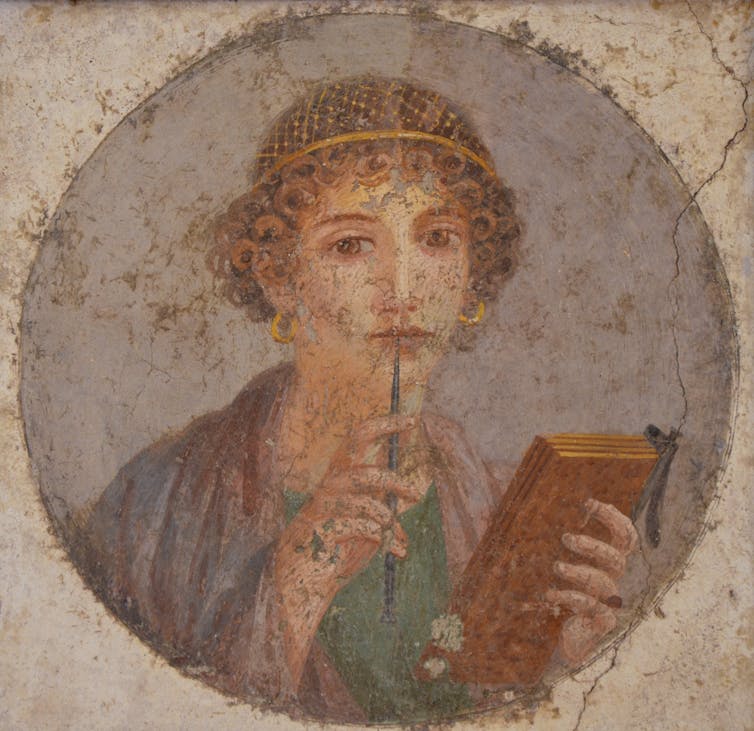
For those who have read the fragmented remains of the Greek poet, Sappho the loss of most of her poetic corpus is something to regret. With a mere two complete poems extant from nine books of verse, much is left to the imagination in the reconstruction of the output (and life) of this most mysterious of ancient poets.
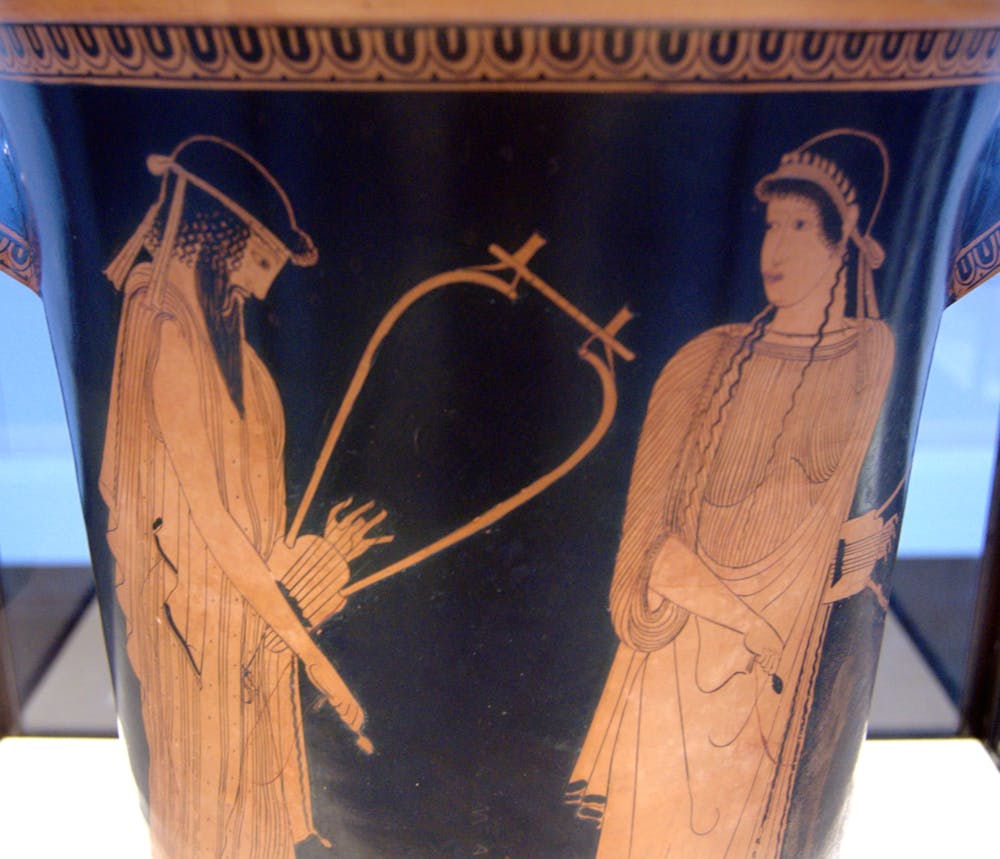
In a world dominated by male voices whose view of life, the universe and everything was the loudest and most respected, Sappho’s songs were regarded as extraordinary. So revered was she that the ancients called her the Tenth Muse, and her songs were passed down over centuries, inspiring generations of poets, none of whom managed to replicate her command of metre and sensual artistry.
How Sappho managed to acquire the educational acumen to compose her masterpieces has sometimes baffled both ancient and modern scholars. Women lived quiet and controlled lives in ancient Mediterranean cultures with limited, if any, access to formal education. If there were any perceived need to teach a girl basic skills in reading, writing and arithmetic, it was only to equip her to run a household once she was married-off.
Even if a girl demonstrated extraordinary artistic skills, there was usually no avenue to express them, as the aspirations of women were limited to marriage and motherhood. Females who displayed a talent were normally suppressed and regarded with suspicion. Why? Because men were the artists, intellects and leaders. Ergo, for a woman to possess such qualities meant she also possessed a masculinity that set her apart from nature.
So, where did Sappho come from? What strange land or culture gave her birth and permitted her extraordinary skills to flourish? While we know little that is certain of her life, we do know Sappho was born in the city of Mytilene on the Greek island of Lesbos, off the coast of Turkey in the late 7th Century BC. Mytilene appears to have been an enlightened society compared to other communities in Archaic Greece. Sappho’s works clearly indicate that women – at least from her privileged social standing – had access to a formal education that included training in choral composition, musical accomplishment and performance.
Her estimated birth date places her sometime after the composition and transmission of the works of the Homeric poets, which told the stories of the Trojan War and are preserved in the epics known as the Iliad and the Odyssey.
Read more:
Guide to the classics: Homer’s Iliad
But Sappho was no epic poet, rather she composed lyrics: short, sweet verses on a variety of topics from hymns to the gods, marriage songs, and mini-tales of myth and legend. She also sung of desire, passion and love – mostly directed towards women – for which she is best known. And it is for such poems that Sappho has come down to us as history’s first lesbian.
Was Sappho a lesbian? An answer depends on how one is defined. If love of women, even in a non-sexual sense, and an exclusive focus on the needs and lives of women define a woman as a lesbian, then – yes – Sappho was a lesbian. However, if a lesbian is defined more narrowly as a woman who has sex with another woman, then evidence to define Sappho as one is harder to establish.
Of course, these two binaries are inherently artificial and without nuance. They are also ignorant of social constructionism, which insists on understanding an individual in her or his historical environment, its values, and its cultural specificities. And, in the society of Archaic Mytilene, Sappho was not defined as a lesbian. After all, the word “lesbian” was not invented until the Victorian age.
Sappho’s contemporaries were not responsible for her synonymy with women-loving. That began with the Greeks and Romans of later centuries, who tended to interpret her skill as stemming from a perverted form of masculinity, which sometimes found expression in representations of her through the lens of a hyper-sexuality. Sappho’s reputation for sexual proclivity initially linked her to passionate relations with men, which later morphed into a stronger association with women.
The Sappho mystique is further confounded by later testimonies such as the 10th century Byzantine encyclopedia called the Suda (or the Stronghold), which chronicled the history of the ancient Mediterranean. In one of two entries on Sappho, readers are informed that she was in love with a ferryman by the name of Phaon whose rejection of her caused her to leap to her death from the Leucadian Cliff.
This apocryphal history, which emerged in antiquity, went on to inspire artists, poets and playwrights for hundreds of years, despite the strange origins of Phaon as a figure of myth and legend. In the second entry on Sappho in the Suda, it is stated that Sappho was married, had a daughter by the name of Cleis, and was also a lover of women.
Turning to the fragments and scant number of complete poems from Sappho’s canon, there are references to her daughter, and to her close female companions – even her brothers – although the extant verses do not sing of a husband. In Fragment 132, for example, Sappho sings of Cleis:
I have a beautiful child whose face is like
golden flowers, my beloved Cleis …
Sappho, following the poetic traditions of Archaic Greece, tended towards floral and natural imagery to depict feminine beauty and youth. Elsewhere, she evokes images of garlands, scents and even apples to convey feminine sensuality. Hers was largely a world of beauty, caresses, whispers and desires; songs sung in honour of the goddess Aphrodite, and tales of mythical love.
In Fragment 16, arguably Sappho’s most sublime poem, fortunately well preserved albeit a little tattered, her definition of beauty anticipates the maxim of the philosopher, Protagoras that “man is the measure of all things”:
Some say a host of cavalry, others of infantry,
and others of ships, is the most beautiful
thing on the dark earth, but I say it is
whatever a person loves.
It is perfectly easy to make this
understood by everyone: for she who far
surpassed mankind in beauty,
Helen, left her most noble husband
and went sailing off to Troy with no thought at all
for her child or dear parents,
but [love?] led her astray …
lightly …
[and she]
has reminded me
now of Anactoria
who is not here;
I would rather see her
lovely walk and the bright sparkle of her
face than the Lydians’ chariots and armed
infantry …
Sappho’s definition of beauty – that which a person loves – privileges the individual over the community. She extends her dictum with the example of the mythical figure of Helen of Troy, renowned in antiquity as the most beautiful woman in the world. As testimony to Sappho’s unique interpretation of the story, she removes the standard figures of blame for Helen’s role in the Trojan War – Paris, the Trojan prince who abducted her or, in other versions, Aphrodite who forced her to go with him – and gives agency to Helen herself. In Sappho’s world, where love is all, it is Helen who decides to leave her husband and elope with Paris. Consequences be damned!
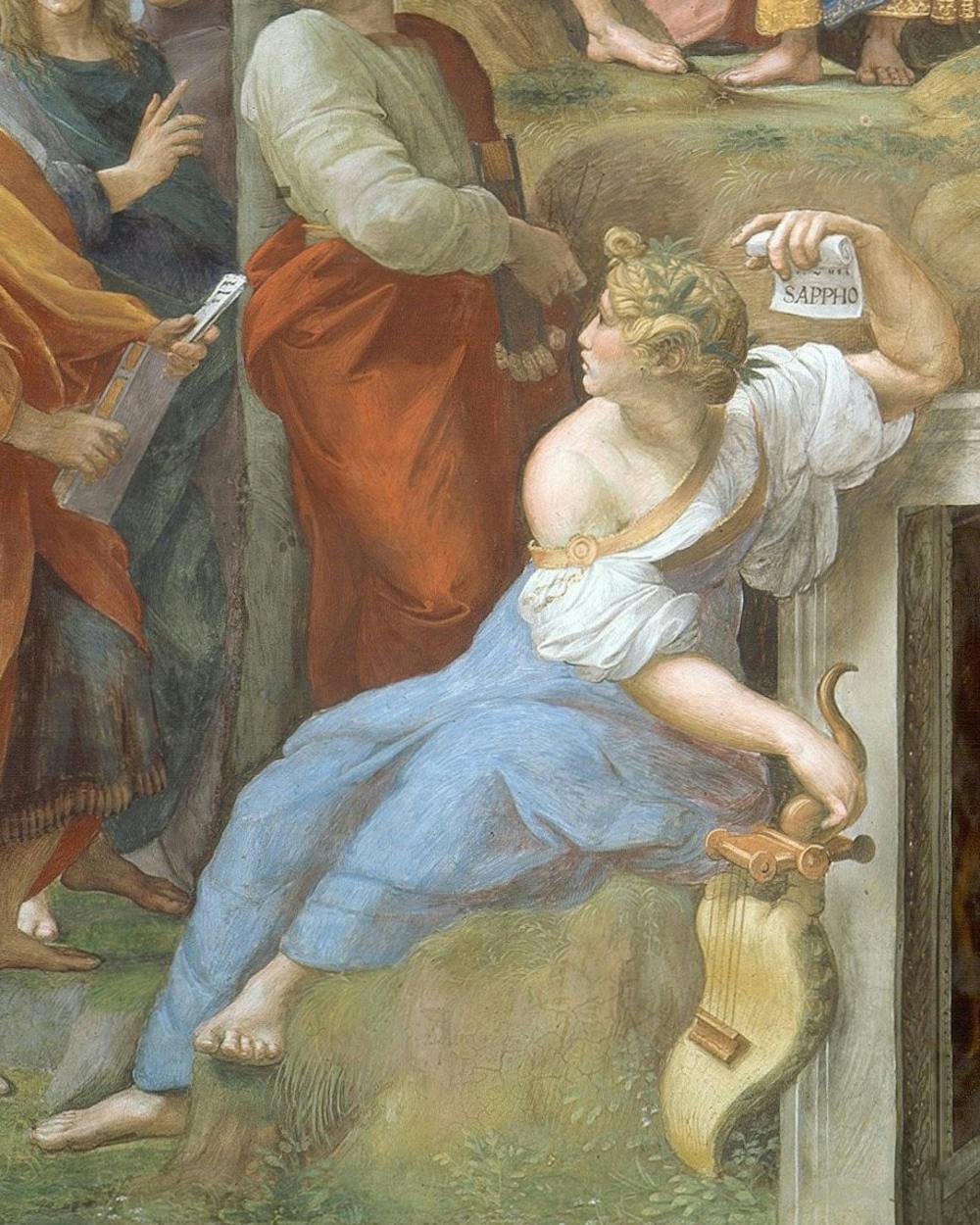
Sappho’s thoughts on love and desire extend to a personal reverie on a woman by the name of Anactoria. Sappho reveals that Anactoria is gone and is missed. She compares her, indirectly, to Helen and then evokes her beauty, namely her gait and her sparkling face. Sappho’s lyrics are sensual, gentle, intense. But they are also powerful, as she rejects the world of masculine warfare in preference for beauty and desire.
In another well-preserved piece, Fragment 31, Sappho evokes the sensations she experiences as a result of being seated opposite a beautiful woman:
He seems to me equal in good fortune to the
whatever man, who sits on the opposite side to you
and listens nearby to your
sweet replies
and desire-inducing laugh: indeed that
gets my heart pounding in my breast.
For just gazing at you for a second, it is impossible
for me even to talk;
my tongue is broken, all at once a soft
flame has stolen beneath my flesh,
my eyes see nothing at all,
my ears ring,
sweat pours down me, a tremor
shakes me, I am more greenish than
grass, and I believe I am at
the very point of death.
The power of the fragment, and indeed the meaning, are substantially derived from the Greek pronouns that denote three players in Sappho’s drama: Sappho, the man, and the woman.
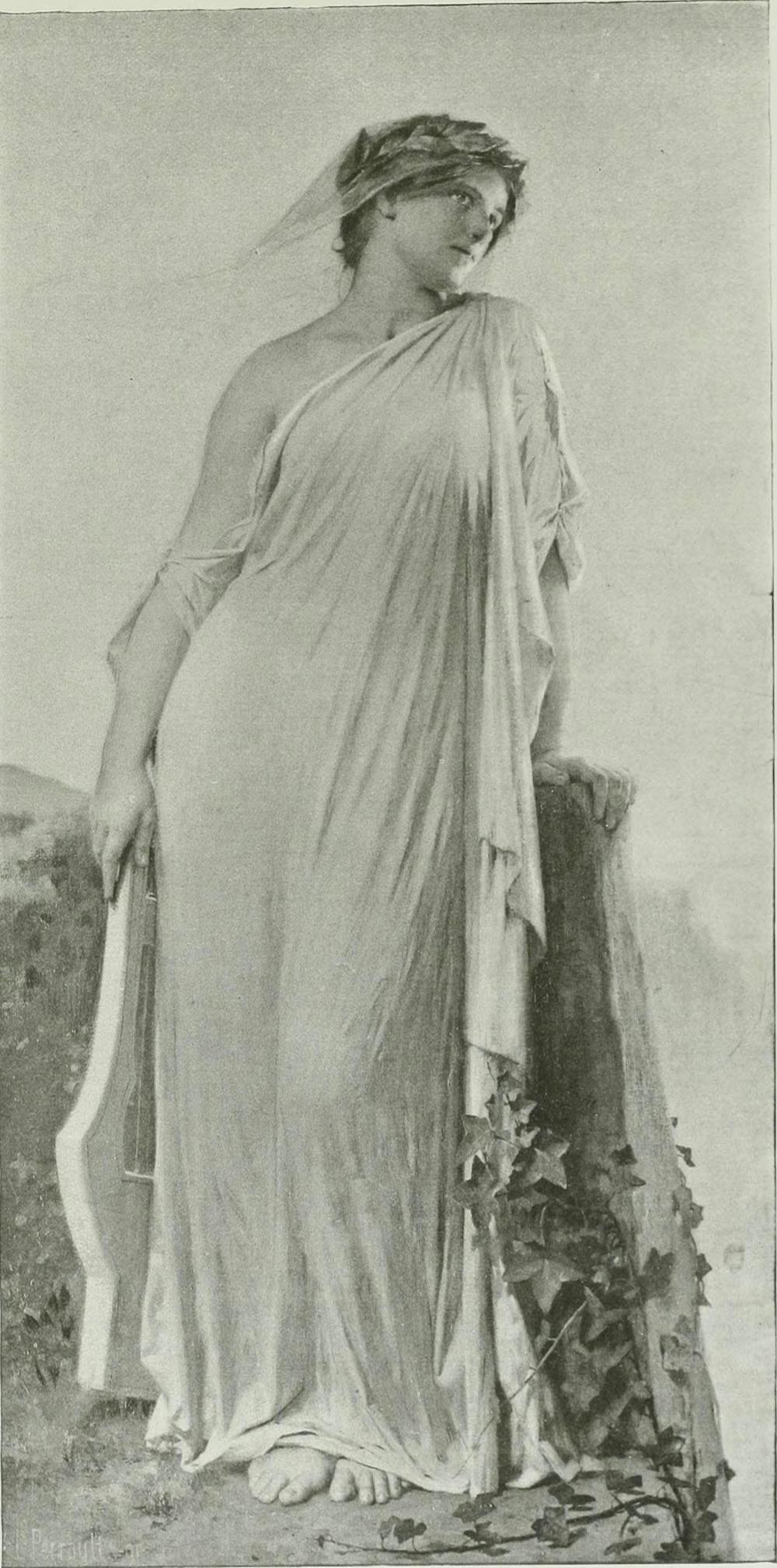
The man is god-like because he can be in the presence of the woman and remain unaffected. Sappho, in contrast, is a physical, mental and emotional wreck. The fragmented condition of the piece includes a few words that indicate at least one more stanza followed.
Such was the power of Sappho’s poem that it went on to inspire various intellectuals and poets who followed her. The Roman poet, Catullus was so enamoured of Sappho’s work that he reworked Fragment 31, which he would have known in its complete form, into his own version that even rendered the original Sapphic hendecasyllabic metre into Latin [Poem 51].
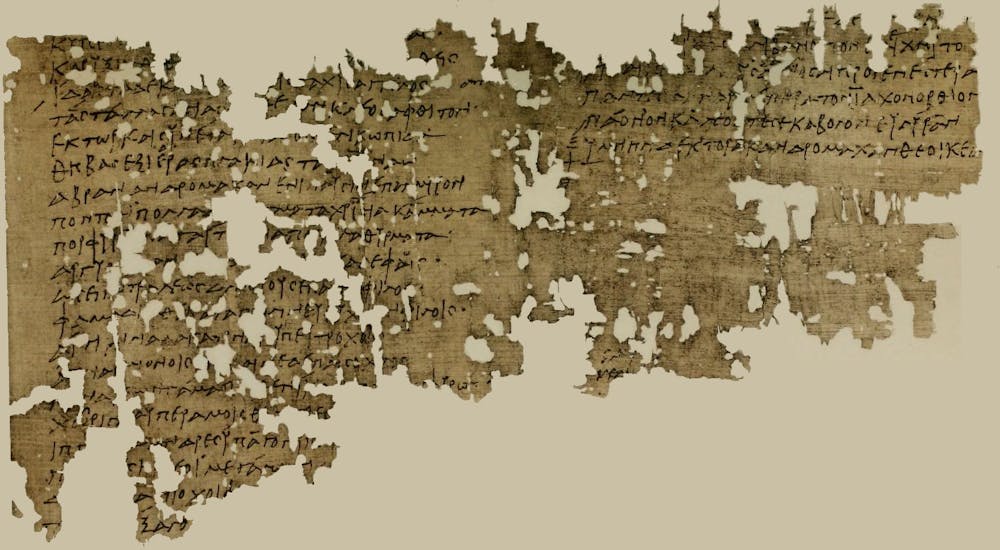
Translating Sappho is no mean feat. Most of the work is in poor condition, pieced together by papyrologists to make readable texts for scholars to work from. Confronted with the Aeolic Greek of the poet, printed neatly on a page, the translator is immediately drawn into emendations, conjectures, broken lines, missing words, incomplete words, hypothetical punctuation and, in short, a philological headache.
And, after persisting, the translator is always dissatisfied. It is impossible to capture the poet’s genius in another language, especially if the translator is simultaneously striving for a metrical equivalent. Catullus, too, was a poetic genius – an artist with complete control over style, metrics and meaning – yet he was humble enough not to replicate Sappho’s words but to imitate them, to compose a response to them, to make them his own as a homage to the Tenth Muse.
But despite the hurdles and the intellectual heartache, there are rewards in recent discoveries that continue to add more words, more lines, more stanzas and sometimes even new poems to the canon. In 2004, the discovery of piece of papyrus that completed an existing fragment – thereby making a new poem by Sappho – received international media coverage. The process of repair resulted in Poem 58, which deals with the themes of youth and old age.
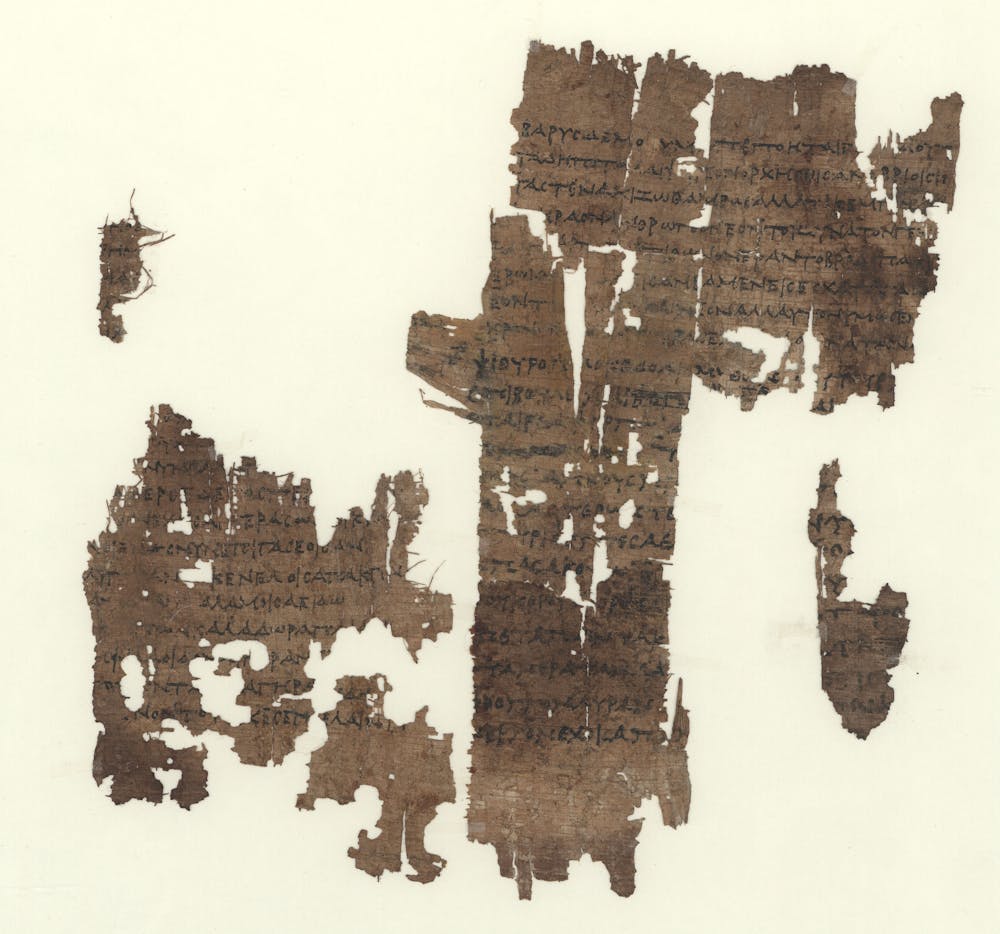
Sappho mourns the passing of her youth, and reminds her audience of the myth of Tithonos, one of the few mortals to be loved by a goddess. Struck by the beauty of the young man, the goddess Eos asks Zeus to permit her to take the young man to live with her eternity. But Eos forgets to ask that Tithonos be granted a second gift: eternal youth. And so, she is left with a lover she quickly finds hideous and repellent, and Tithonos is left alone, trapped in a never-ending cycle of ageing.
More and more of Sappho is emerging. In 2013, more new fragments were discovered that have assisted in reconstructing existing pieces, and bringing to light four previously unknown pieces. One relatively complete poem, Brothers Song is the most significant of the find because of its hitherto unknown status.
The piece is also important because it further develops the image of the poet as an artist whose themes extended beyond the sensual and romantic. While previously extant fragments and details in works such as the Suda reference Sappho’s brothers, the poem provides more insight into Sappho’s familial world. While the first three stanzas are missing, there are five complete ones, the subject of which is a speaker’s concerns for the safe return of her two brothers, Charaxos and Larichos from a maritime trading venture.
The discoveries of this century are testimony to the fascinating and random nature of such finds. Rather than being hidden away in obscure manuscripts in dusty archives or included in elaborate scrolls, the fragments have sometimes come from less salubrious environments.
For example, much of Sappho’s work, along with pieces from poets and writers ranging from Homer, the Greek playwrights, Plato and Saint Paul came from Oxyrhynchus – an ancient garbage dump in Egypt.
And while other pieces were preserved as quotations in more respectable formats, such as books on grammar, composition and philosophy, the 2004 poem originally came from the cartonnage of an Egyptian mummy.
Indeed, cartonnage – a plaster-like material made from material scraps, including papyri that was wrapped around mummified bodies and then decorated – has yielded rich results, Sappho’s fragments being just one example. Hopefully more garbage will be excavated to reveal more of Sappho’s poetic diamonds.
 For a recent, reliable edition of Sappho’s works, see Sappho: A New Translation of the Complete Works, translated from the ancient Greek by Diane J. Rayor, with an introduction and notes by André Lardinois (Cambridge University Press).
Marguerite Johnson, Professor of Classics, University of Newcastle
This article was originally published on The Conversation. Read the original article.
Graeme Austin, Victoria University of Wellington and Emily Hudson, King’s College London
A bill before the Australian Parliament will extend immunities from copyright infringement currently enjoyed by internet service providers (ISPs) to cultural institutions, educational institutions, and organisations assisting people with disabilities.
These immunities are known as “safe harbours”. They can be a useful policy tool. They help ensure that exposure to copyright liability doesn’t inhibit socially or economically useful activity such as developing internet infrastructure.
We argue that copyright issues for not-for-profit organisations differ from those affecting ISPs and their subscribers. Rather than expanding existing safe harbours, policy makers should tailor the concept to the needs of the cultural sector.
Read more:
Instagram is changing the way we experience art, and that’s a good thing
Safe harbours have been justified as a quid pro quo to encourage investment in Internet infrastructure. ISPs were concerned that they could themselves be liable for their customers’ copyright infringements. Investment in internet technologies might have been inhibited by the risk of potentially enormous damages claims.
Currently, Australian safe harbours apply only to telecommunications providers such as Telstra and Optus. They shelter ISPs against monetary awards for copyright infringement for actions such as transmission and caching, and storage of infringing material uploaded by subscribers. The immunities don’t apply when the ISP is itself responsible for storing infringing material.
Immunity can also be lost when an ISP fails to meet key conditions, such as removing infringing material once the ISP knows about it.
At first blush the bill makes sense. The institutions mentioned in the Copyright Amendment (Services Providers) Bill 2017 (Cth) do important work. A not-for-profit running a website that allows the uploading of material suitable for people suffering from visual disabilities, for instance, deserves immunity from copyright damages claims if some of that material turns out to be infringing.
However, the Australian bill should also prompt us to revisit the safe harbour concept itself. A safe harbour reflects a policy that certain activities are sufficiently important that they should not be inhibited by the risk of copyright proceedings. Rather than extending existing safe harbours to other institutions, we should look at how such institutions are currently inhibited by exposure to copyright claims, and how the law might be adapted.
There are many ways we can craft copyright immunities for the not-for-profit GLAM sector: public galleries, libraries, archives and museums. GLAM institutions currently enjoy some exemptions from copyright infringement, and there have been calls for a broader fair use or fair dealing defence.
Another possibility would be a safe harbour that is tailor-made for the GLAM sector.
The reforms in the Australian bill would apply only where the infringing activity is undertaken by patrons. But unlike ISPs, GLAM institutions need the greatest protection for the things they do themselves. We value museums, for example, for the expert work of their own curators and collection managers, not because they sometimes allow other people to upload material to their websites.
GLAM organisations use digital technologies in innovative ways. They put their collections online, link to the online collections of other institutions, and create vast repositories of metadata about collection items. Some exhibitions are digitally curated, with links to related objects and information, often located on remote sites. While some GLAM organisations allow third parties to post material to their websites, that’s not their core work.
Anyone working in the GLAM sector will tell you how copyright concerns limit their work. Institutions also fear the reputational damage of allegations that they disregard copyright. But so long as GLAM organisations act responsibly, these valuable contributions to cultural life should not be unduly inhibited by risks of copyright liability.
Most GLAM sector organisations are responsible about copyright. If GLAM institutions use some material without copyright permissions, this is typically of limited commercial significance – quite unlike the commercially valuable material that is transmitted by ISP subscribers every second.
A fit-for-purpose GLAM safe harbour could encourage responsible behaviour while ensuring that the GLAM sector’s work is less impeded by risks of copyright claims. Unlike the ISP scheme, a GLAM safe harbour would not be limited to patrons’ activities. It might be conditioned on good faith efforts to raise copyright awareness among staff, including regular training. In the digital context, it might have a take down requirement.
 In summary, the copyright issues for publicly funded not-for-profits doing valuable social work are not the same as those affecting ISPs and their subscribers. Lumping them together in the same safe harbour avoids more nuanced thinking about their relative social value and the different risks each poses for those who rely on copyright protections for their livelihood.
Graeme Austin, Professor of Law, Victoria University of Wellington and Emily Hudson, Senior Lecturer in Law, King’s College London
This article was originally published on The Conversation. Read the original article.
The link below is to an article that takes a look at the call for US authors to not be included in the Man Booker Prize.
For more visit:
https://www.theguardian.com/books/2018/feb/02/publishers-call-on-man-booker-prize-to-drop-american-authors
The link below is to an article that looks at the branch of fiction known as dystopia.
For more visit:
http://lithub.com/dystopia-for-sale-how-a-commercialized-genre-lost-its-teeth/
The link below is to an article that takes a look at ‘Folktexts,’ an online archive of folklore stories.
For more visit:
https://boingboing.net/2018/02/06/folktexts-how-to-fill-your-he.html
The link below is to an article that looks at Amazon and Audible on there strategy for audiobooks into the future.
For more visit:
http://observer.com/2018/02/amazon-audible-audiobooks-changes-book-publishing/
Sunanda Creagh, The Conversation
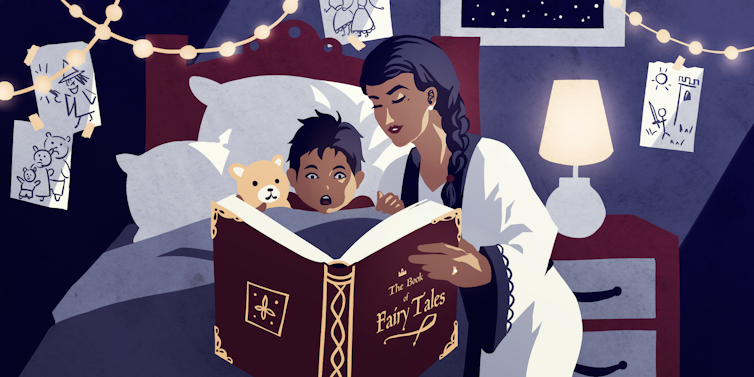
Originally for adults, many fairy tales can be brutal, violent, sexual and laden with taboo. When the earliest recorded versions were made by collectors such as the Brothers Grimm, the adult content was maintained. But as time progressed, the tales became diluted, child-friendly and more benign.
Adults consciously and unconsciously continue to tell them today, despite advances in logic, science and technology. It’s as if there is something ingrained in us – something we cannot suppress – that compels us to interpret the world around us through the lens of such tales.
That’s what we’re exploring on the latest episode of Essays On Air, the audio version of our Friday essay series. Today, Marguerite Johnson, Professor of Classics at the University of Newcastle, is reading her essay Why grown-ups still need fairy tales.
Join us as we read to you here at Essays On Air, a podcast from The Conversation.
Find us and subscribe in Apple Podcasts, in Pocket Casts or wherever you get your podcasts.
Snow by David Szesztay
Mourning Song by Kevin MacLeod
Jack and the Beanstalk by UB Iwerks
Cinderella (1950), produced by Walt Disney
Candle in the Wind/Goodbye England’s Rose by Elton John
P. I. Tchaikovsky: Dance of the Sugar Plum Fairy, performed by Kevin MacLeod from Free Music Archive.
 This episode was recorded by Eddie O’Reilly and edited by Jenni Henderson. Illustration by Marcella Cheng.
Sunanda Creagh, Head of Digital Storytelling, The Conversation
This article was originally published on The Conversation. Read the original article.
Kylie Pappalardo, Queensland University of Technology and Karnika Bansal, Queensland University of Technology
Australian creators struggle to understand copyright law and how to manage it for their own projects. Indeed, a new study has found copyright law can act as a deterrent to creation, rather than an incentive for it.
Interviews with 29 Australian creators, including documentary filmmakers, writers, musicians and visual artists, sought to understand how they reuse existing content to create. It considered issues such as whether permission (“licences”) had been sought to reuse copyrighted content; the amount of time and cost involved in obtaining such permissions; and a creator’s recourse if permission was either denied or too expensive to obtain.
For the majority interviewed, seeking permission to reuse copyrighted content – for example, as snippets of music or video in films, or long quotes in written works – was a source of great frustration and confusion. The process was variously described as “incredibly stressful”, “terrifying” and “a total legal nightmare”.
Problems mostly centred on time delays and financial expenses. Creators found that the paperwork required to request permission was often long, complex and not standard across publishers and other rights-holder bodies. Many waited months for a response to a request; some never received one at all. Many reported feeling ignored and disrespected.
One interviewee, a composer, waited over a year for permission to set poetry to music. The music was due to be performed in a theatre production. The original poet was deceased but his publisher controlled the copyright.
After waiting months and not receiving a response, the composer was forced to painstakingly replace the words to the song with new ones that fit the same rhyme scheme, stresses, cadences and meaning as the original poem. This was a long and difficult process. Roughly a year after the play was staged, permission to use the poem came through from the publishers. By then it was too late.
Licence fees were also an issue for the creators interviewed. Licence fees can be expensive, even for very small samples. Many creators thought that copyright fees demanded for reusing small samples were unfair and stifling.
A filmmaker making a documentary about a small choir in rural Australia could not afford the licence fees to release the film to the public. To show snippets of songs sung by the choir, totalling less than two minutes of copyrighted music in a 20-minute film, with each snippet only seconds in length, the licence fees came to over $10,000. The project was ultimately abandoned because the filmmaker could not raise the funds to cover the licensing fees.

Avoiding and abandoning projects were common reactions to the restraints imposed by copyright law, although a very small number of creators proceeded anyway, hoping to “fly under the radar”.
Some changed projects to try to circumvent copyright restrictions. For example, filmmakers might degrade the sound on their films for scenes where background music might be playing, such as those filmed in a pub or restaurant.
Ideas were filtered out early at the brainstorming stage because they were “too risky” or licensing would be “too expensive”. Some people avoided entire areas of creativity, such as appropriation art, music sampling or documentaries about music or musicians, because it was all just “too hard”.
Court decisions such as the 2010 “Kookaburra” case have further aggravated the problems. In this case, despite significant elements of original creativity, the Australian band Men at Work were found to have infringed copyright of a 1934 folk song, Kookaburra Sits in the Old Gum Tree.
Read more:
The Down Under book and film remind us our copyright law’s still unfair for artists
This case is a classic example of the gap that exists between law and creative norms. The law’s concern, in that case and others, is with what has been taken from an existing work. Creators, on the other hand, most commonly focus on the elements they have added to the work.
The study also highlights creators’ confusion about the scope and application of Australian copyright law. Creators were especially confused about legal exceptions to copyright infringement. In Australia, these are called “fair dealing” exceptions and they are narrow – they apply only to specified purposes (such as for research and study; parody and satire; reporting the news; and criticism and review).
Read more:
Explainer: what is ‘fair dealing’ and when can you copy without permission?
Creators expressed concern about what, exactly, fell within “parody and satire” or “criticism or review”. What do those terms mean when applied to art? Once participant remarked: “Everybody is out there flying a bit blind about this.”
Other countries, including the United States, South Korea and Sri Lanka, have broader exceptions to copyright infringement, which permit reuse for things such as remix or appropriation art, provided that the use is “fair”. These exceptions are generally called “fair use”. Importantly, these exceptions do not require the use to fall within a predetermined category, like reporting the news. Each use is assessed on its own merits.
Courts apply some basic standards in determining what amounts to “fair use”, which include examining the purpose for which an original work has been used; the extent to which it has been transformed; and the extent to which a new work impacts on the market of the original work.
In recent years, the Australian Law Reform Commission and Productivity Commission’s recommendations that Australia adopt a US-style fair use exception attracted significant criticism from much of Australia’s creative sector. Many considered that such an exception would be too broad and too uncertain. However, the study suggests this criticism may be largely unfounded.
The creators interviewed used their own strong sense of morality and fairness to guide what reuse they considered to be acceptable. These principles and norms align quite closely with the factors that courts use in assessing fair use, including how much new creativity has been added to the existing work and whether the new work commercially impacts the existing work in an unfair way.
 This new study suggests that more flexibility in the law might actually help to spur the creation of new Australian work.
Kylie Pappalardo, Lecturer, School of Law, Queensland University of Technology and Karnika Bansal, Research Assistant, Faculty of Law, Queensland University of Technology
This article was originally published on The Conversation. Read the original article.
 At the BookShelf
You must be logged in to post a comment.