
The link below is to an article that takes a look at 2018 National Book Award finalist Victoria Johnson.
For more visit:
https://lithub.com/meet-national-book-award-finalist-victoria-johnson/

The link below is to an article that takes a look at 2018 National Book Award finalist Victoria Johnson.
For more visit:
https://lithub.com/meet-national-book-award-finalist-victoria-johnson/
The link below is to an article that considers the ‘weirdos’ of Russian literature.
For more visit:
https://lithub.com/the-weirdos-of-russian-literature/
The link below is to an article that looks at John W. Campbell, considered the father of modern science fiction.
For more visit:https://lithub.com/the-man-who-made-science-fiction-what-it-is-today/
The link below is to an article reporting on J. K. Rowling suing her former assistant for scamming her out of money which was spent on cats and other things.
For more visit:
https://nylon.com/articles/jk-rowling-sues-former-assistant
The link below is to an article that takes a look at National Book Award finalist Jamel Brinkley.
For more visit:
https://lithub.com/meet-national-book-award-finalist-jamel-brinkley/
Have you ever thought you might have what it takes to be a writer? The link below is to an article that looks at traits that may indicate that you have what it takes.
For more visit:
https://lithub.com/if-you-have-these-traits-you-might-be-a-writer/
Wim Van Mierlo, Loughborough University
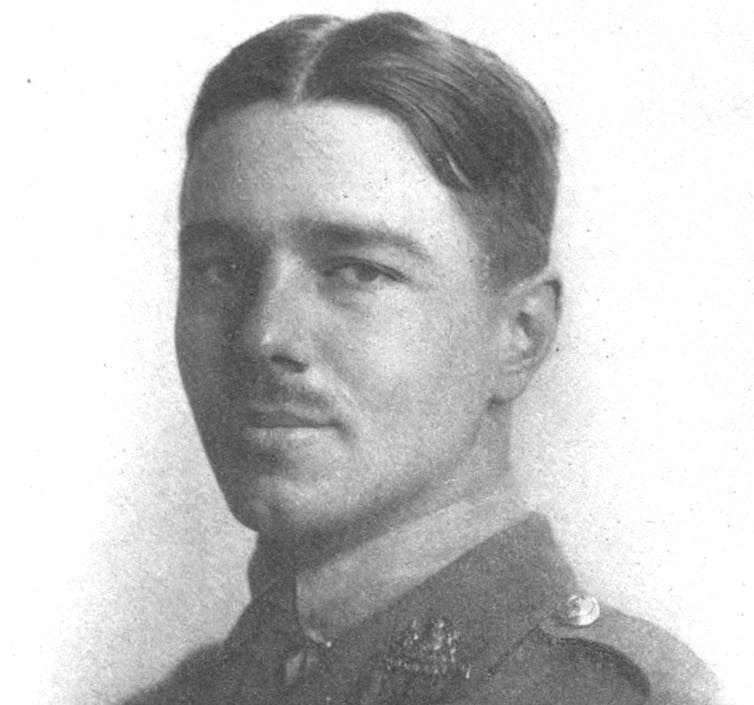
For many people, most of what they know about the futility, sacrifice and tragedy of World War I, they learned through reading the poetry of Wilfred Owen. But what they may not be aware of is how close the Armistice was when Owen was killed at the age of 25.
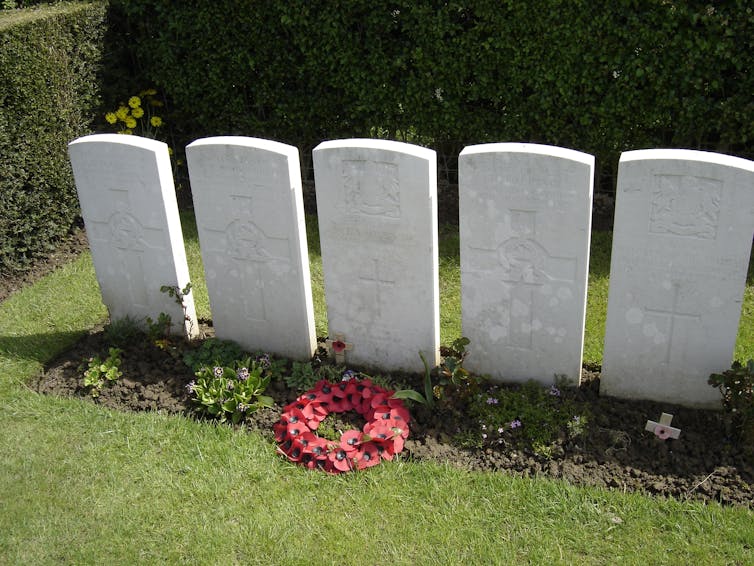
On November 4 1918, the 2nd Manchester Regiment received orders to cross the Sambre and Oise Canal near the village of Ors to capture German positions at the opposite side. But as the troops attempted to build a pontoon bridge, they came under heavy machine gun fire. Against the odds, they forced a crossing and routed the enemy, but in so doing they suffered more than 200 casualties.
The attack was one of multiple attempts made up and down the canal to push back the Germans, all with similar consequences. But what made the crossing at Ors different however was the death of its most celebrated officer – Lieutenant Wilfred Owen – who was hit while helping the men who were building the bridge.
The tragedy of Owen’s end, just seven days before the guns fell silent, stands out in the cultural memory ahead of the thousands of men who died – or were yet to die – during the final moments of World War I. As a poet, Owen understood the irony of heroism very well. He resisted giving concrete identities to the soldiers who populate his poems to stop their experiences from becoming mere anecdotes. One man’s suffering is not more tragic than that of another.
In a provisional preface, written for a collection of his verse he would never see published, he set down his belief in what poetry could do – or could not do – to appropriately remember the atrocity of war:
This book is not about heroes. English poetry is not yet fit to speak of them. Nor is it about deeds, or lands, nor anything about glory, honour, might, majesty, dominion, or power, except War.
Above all I am not concerned with Poetry.
My subject is War, and the pity of War.
The Poetry is in the pity.
Yet these elegies are to this generation in no sense consolatory. They may be to the next. All a poet can do today is warn.
The sentiment here echoes a shift in war poetry, away from the jingoistic tenor of Rupert Brooke’s sonnets from 1914 about “some corner of a foreign field/That is for ever England” and the men that gave their life for “immortality” to Siegfried Sassoon’s defiant denunciations of the evils of war.
The “big” words “War” and “Poetry” were ultimately not important for Owen – the more humane invocation of “pity” was poignantly written in lowercase. What the country needed, what the world needed, was empathy and regret, not hero worship – there was nothing glorious in being dead. But the time for this was not now. He disbelieved whether his own generation would ever be able to deal truthfully with the trauma. He was probably correct.
Owen had aspired to become a poet since boyhood. His early lyric verse written before the war showed promise, but it didn’t set him apart. The effects of war, and of his reading Sassoon, would change all that. Traditional lyricism gave way to starker rhythms, direct imagery and extensive use of assonance and half rhyme, which at once created sonic cohesion within a broken, phantasmagoric world. The protagonists in Owen’s poems are often no more than a spectre of themselves, mere voices who have lost all sense of their surroundings –- “unremembering” souls “[o]n dithering feet” who have “cease[d] feeling | Even themselves or for themselves”.
These poetic phantoms, spectres, ghosts were not shaped by the fighting alone; more than the trenches, it was Owen’s experiences at the Craiglockhart War Hospital for Officers, near Edinburgh, that coloured his vision. The four months spent there convalescing from shell shock would prove highly significant. Not only did he meet Sassoon there, who encouraged his poetic sensibilities, it was conducive to his creativity.
As part of their treatment, patients were subjected to ergotherapy, a behavioural therapy developed by Dr Arthur Brock, who believed that through useful work and activity patients would regain healthy links with the world around them. Owen was put in charge of The Hydra, the hospital’s literary magazine, and encouraged to write poetry. But his surroundings also furnished Owen with something more valuable: a space to process the suffering he had seen and was seeing around him. This emotion, recollected in tranquillity, is crystallised in the subject matter of some of his best known poems – characterised by an evocation of the sick, the wounded and the dying.
His manuscripts reflect that state of mind. Composition for Owen was neither frenzied nor easy, but rather it involved a steady process of probing words and phrases from which he manufactured the emotional intensity in his poetry. Differences in pen and ink show how Owen revisited his drafts and touched them up at different moments in time, at Craiglockhart and also afterwards when awaiting medical clearance at Scarborough Barracks.
In May 1918, C K Scott-Moncrief, who had tried and failed to secure Owen a Home posting as cadet instructor, told the young poet he ought to send his work to the publisher Heinemann. Owen was enthused by the encouragement. He drafted his Preface and hastily drew up a table of contents.
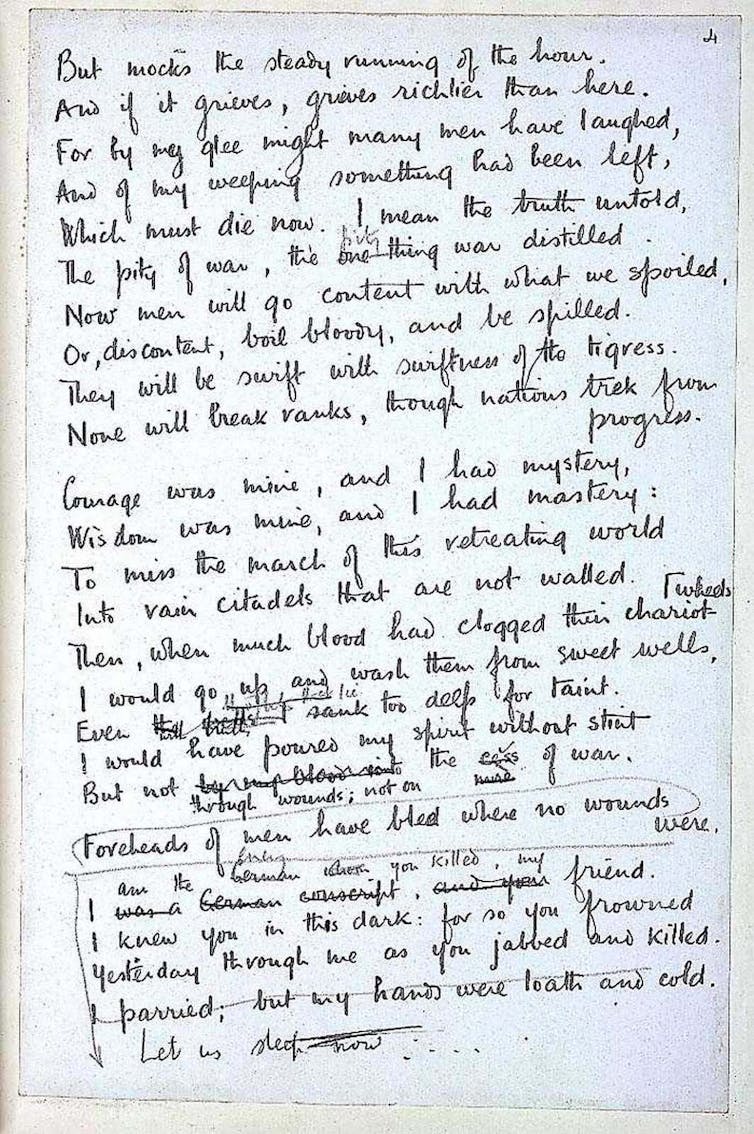
But it is likely that getting his work in order led to more writing and rewriting. Two poems, Hospital Barge and Futility (one revised, the other new), appeared in The Nation a month later – in August he received his embarkation orders to return to France. On September 17, at 7.35am, he boarded a military train to Folkestone from where he crossed the English Channel. With the exception of just five poems published in magazines, he never prepared any of his poems for the press, leaving the bulk of his work in various stages of completion.
In 1920, his friend Sassoon published a slim volume from the surviving manuscripts with Chatto & Windus, soon followed by a reprint in 1921, which indicates reasonable sales. (A more complete edition appeared in 1931.) The critical response, however, was mixed. Writing in The Athenaeum, John Middleton Murray praised Owen for achieving “the most magnificent expression of the emotional significance of the War”.
The hidebound Basil de Selincourt, on the other hand, dismissed Owen’s “soothing bitterness” in the Times Literary Supplement. He countered that “[t]he only glory imperishably associated with war is that of the supreme sacrifice which it entails; the trumpets and the banners are poor humanity’s imperfect tribute to that sublime implication”.
Owen’s posthumous reputation, however, owes much to the way that first volume introduced his work to the public. “All that was strongest in Wilfred Owen survives in his poems”, Sassoon wrote in his introduction. Unwittingly, perhaps, that phrase – and the frontispiece of Owen in his regimental uniform – entailed an act of monumentalisation that went against Owen’s preface that his book was “not about heroes”.
Owen’s legacy is inscribed into a culture of remembrance (that persists to this day) which seems to go against his own views. By 1920 the nation was in the grip of commemoration as it began the erection of monuments to the war dead all across the country – and the language adopted was the language of glory, honour, dominion and power which Owen had found repugnant:
The old Lie: Dulce et decorum est
Pro patria mori.
Wim Van Mierlo, Lecturer in Publishing and English, Loughborough University
This article is republished from The Conversation under a Creative Commons license. Read the original article.
Ryna Ordynat, Monash University
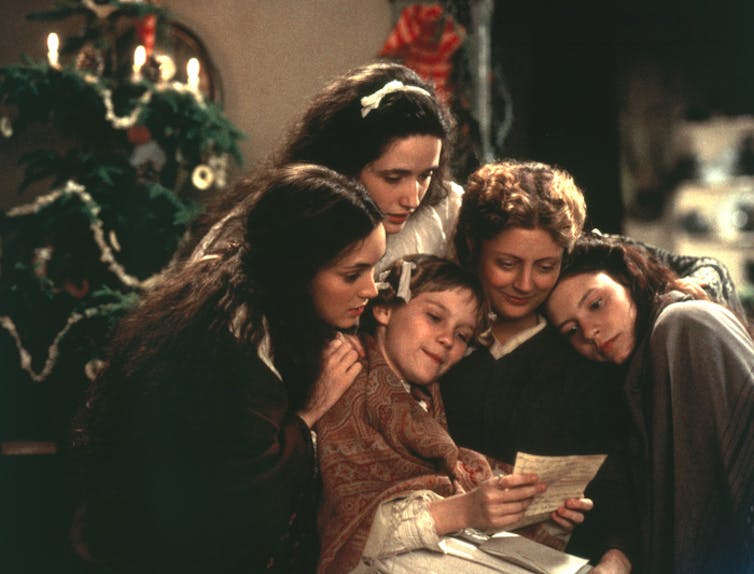
It’s 150 years since Little Women by Louisa May Alcott was published and in the time since, the book has never been out of print. The story of the March sisters struck a chord with readers – especially young girls – early on, and continues to resonate today.
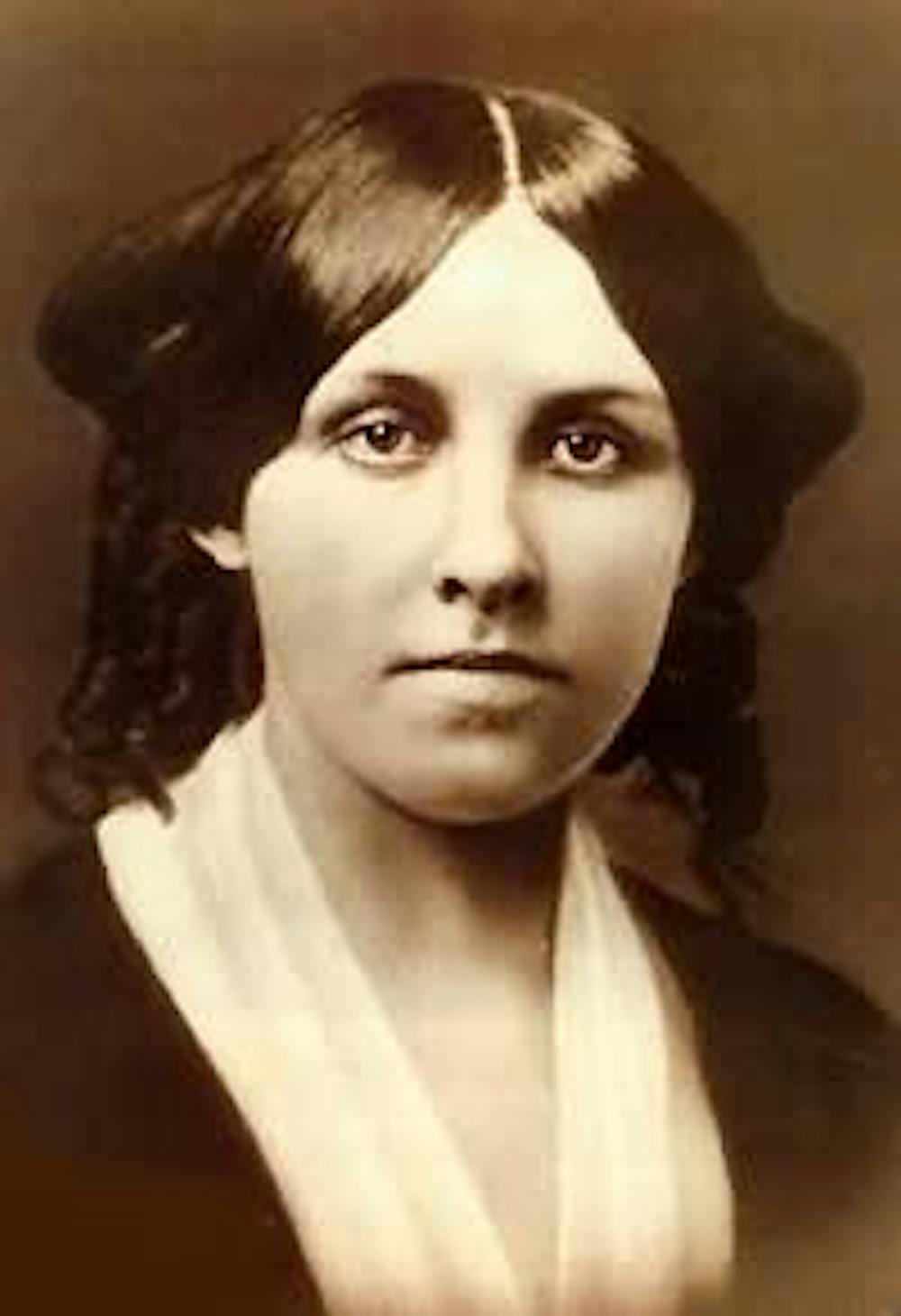
The book’s continuing popularity is evident in the many film, theatre and TV adaptations. In 2018 alone, it was adapted into a film set in our modern-times and a heavily stylised TV mini-series, starring Emily Watson and Maya Thurman-Hawke. It is scheduled for yet another major Hollywood adaptation in 2019, directed by Greta Gerwig and starring Meryl Streep, Emma Watson and Saoirse Ronan.
Little Women follows the lives of the four March sisters, Meg, Jo, Beth and Amy, as they endure hardships, learn life lessons and build enduring bonds on their passage from childhood to womanhood. The first part of the book depicts the girls’ childhoods – their struggles with poverty and their own personalities and faults and how they overcome these obstacles. The second part is about them entering womanhood, marrying and becoming good wives, mothers and women.
The genteel poverty the March family endures is based on the real poverty the Alcott family experienced. The difference is that the poverty of the Alcott family was mostly imposed on them by Louisa’s father, Amos Bronson Alcott, a famous Transcendentalist educational reformer in his day.
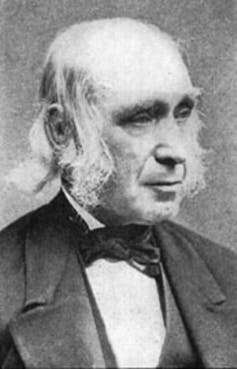
In stark contrast to the book, and at a time when social conventions actively discouraged and frowned upon women undertaking paid employment, Bronson Alcott’s noble willingness to, as he put it, “starve or freeze before he will sacrifice principle to comfort” resulted in him not supporting his family financially. This forced his wife and daughters to provide for the family, and in Louisa’s case to write for money.
Bronson was wholly supported and encouraged by his wife, Abigail (Marmee in Little Women), to the complete bafflement and increasing frustration of Louisa. One of Alcott’s biographers suggests that the familiar sentimental tone in Little Women of poverty being dictated by circumstance, and something we should learn to bear, comes from her trying to cope with, and somehow justify her father’s outrageous lack of concern for the family’s financial well-being.
Louisa Alcott was devoted to and dominated by her parents, especially her father. His worldview was based on the romanticised and spiritual idea of inherent goodness and perfection of human beings. For many years, Bronson Alcott insisted to his daughter on the need for simple stories for boys and girls about how to overcome selfishness and anger, faults which he constantly pointed out in Louisa. Eventually, Bronson’s ideas made their way into Little Women, where the March sisters strive to achieve their perfect “womanliness”.
Louisa was a problem and a disappointment to her father – she was impatient and energetic, always “subject of her instinct” and showing, what Bronson called early signs of “impending evil”. Alcott made the choice to remain unmarried, yet, against her wishes, but mainly due to the demands of her publisher and her growing fan base, she did make Jo marry in the end.
Alcott may never have written Little Women at all, had she been more financially successful in the types of gothic fiction she excelled at and enjoyed writing. But she dreaded debts “more than the devil”. And her publisher pressured her with continuous requests for a book for girls – and a promise to publish her father’s book, Tablets, if she wrote one.
The death of Jo’s younger sister Beth is a memorable and tragic event in Little Women. Beth is the shyest of the sisters and lives a very secluded life. Her death is portrayed by Alcott as a sort of “self-sacrifice” as she gives up her life knowing that it has had only private, domestic meaning.
Alcott’s sister Elizabeth or “Lizzie”, did in fact die due to complications of scarlet fever. Beth’s death in the book is written to resemble a typical trope of Victorian literature – the sentimental, suffering, pathetic yet angelic “ideal” child. But Lizzie died in 1858, aged 22: in pain, angry and frightened, resenting the invisible, stifling life that was imposed on her largely by her parents. She may also have suffered from anorexia. Alcott witnessed the death of her sister in horror.
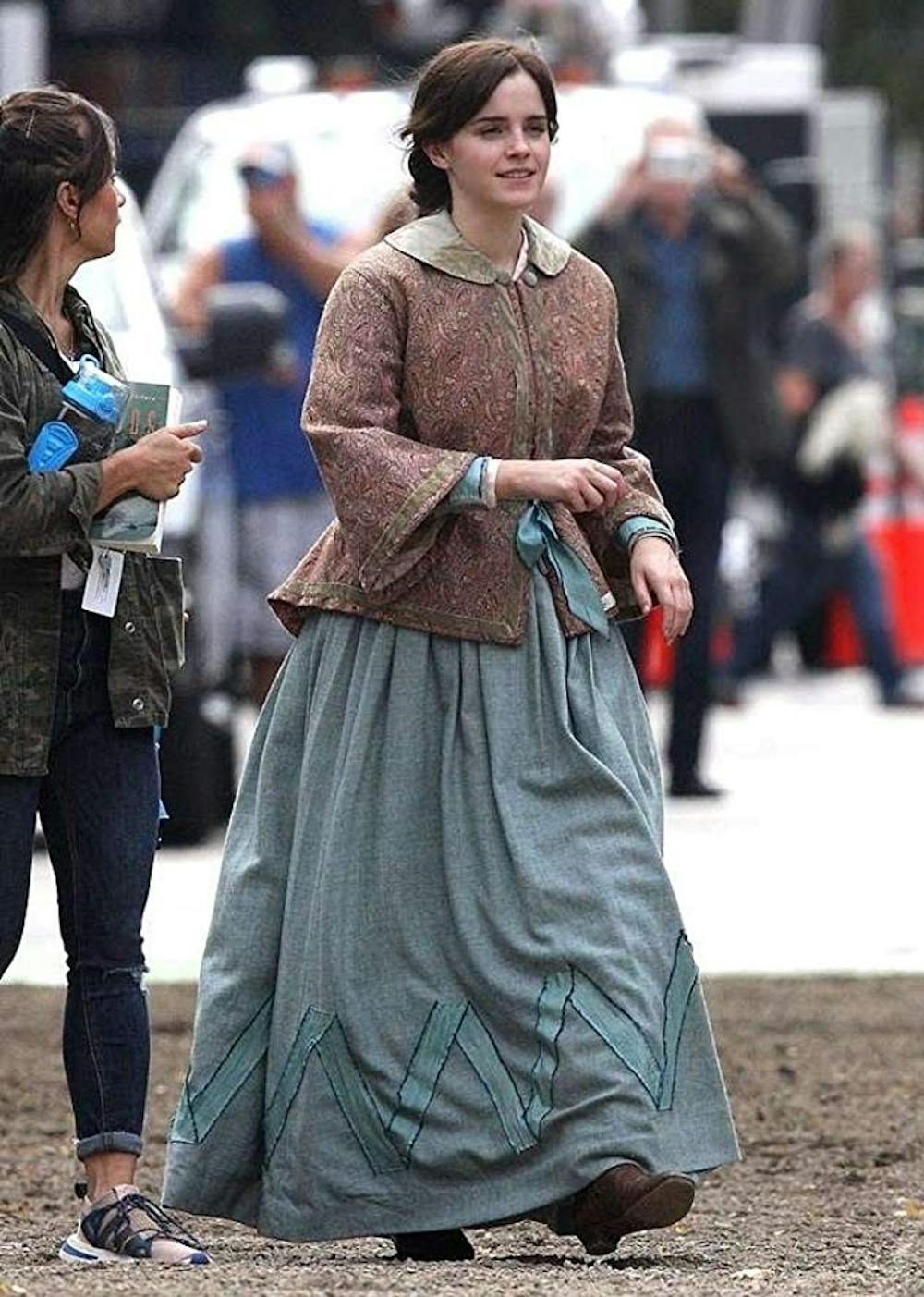
Ultimately, Little Women’s themes of love, grief and sisterly bonds still appeal to us. As Robin Swicord, who will produce the upcoming 2019 film adaptation says: “It’s really taking a look at what it is for a young woman to enter the adult world”. (She adds that “given the material, it’s always going to be romantic.”)
Yet many of the themes and morals of this book are sentimentalised and outdated today. They were inserted for reasons of convention, in order to provide moral instruction, or to appeal to the requests of a publisher.
Alcott wrote Little Women because her father wanted her to, and he dictated its terms, morals and lessons. It was an instant and enduring success, even though she did not want to write it, and it forced her to relive some of the most difficult years of her life. For readers (and viewers) today, understanding these circumstances enables a much more authentic, multi-layered and complex interpretation.
Ryna Ordynat, PhD Candidate in History, Monash University
This article is republished from The Conversation under a Creative Commons license. Read the original article.
Anita Collins, University of Canberra and Misty Adoniou, University of Canberra
Neuroscience has found a clear relationship between music and language acquisition. Put simply, learning music in the early years of schooling can help children learn to read.
Music processing and language development share an overlapping network in the brain. From an evolutionary perspective, the human brain developed music processing well before language and then used that processing to create and learn language.
At birth, babies understand language as if it was music.
They respond to the rhythm and melody of language before they understand what the words mean.
Babies and young children mimic the language they hear using those elements of rhythm and melody, and this is the sing-song style of speech we know and love in toddlers.
The foundation of reading is speech and to learn how to speak, children must first be able to distinguish speech from all other sounds. Music helps them do this.
Reading is ultimately about making meaning from the words on the page. A number of skills combine to help us make those meanings, including the ability to distinguish between the sounds in words, and fluency of reading.
Read more:
How do we learn to read?
Fluency includes the ability to adjust the the patterns of stress and intonation of a phrase, such as from angry to happy and the ability the choose the correct inflection, such as a question or an exclamation. These highly developed auditory processing skills are enhanced by musical training.
Musically trained children also have better reading comprehension skills.
Music can also give us clues about a child’s struggles with reading.
Research has found three- and four-year-old children who could keep a steady musical beat were more reading-ready at the age of five, than those who couldn’t keep a beat.
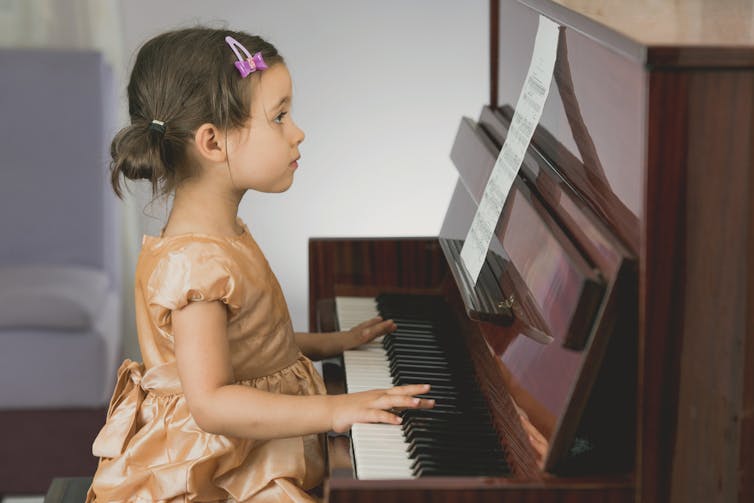
Language learning starts from day one of life with parents talking and singing to their babies. Babies bond with their parents and community primarily through their voice, so singing to your baby both forms a bond with them and engages their auditory processing network.
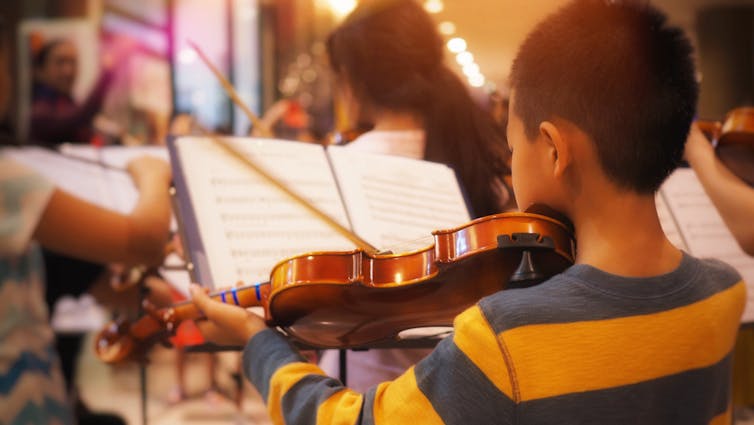
Taking toddlers to a well-structured, high quality music class each week will build the musical skills that have been found to be so effective in learning to read. It is vital to look for classes that include movement activities, singing, and responding to both sound and silence. They should use good quality music-making toys and instruments.
As they head into preschool, a crucial time for language development, look for the same well-structured music learning programs delivered daily by qualified educators. The songs, rhymes and rhythm activities our children do in preschool and daycare are actually preparing them for reading.
Read more:
Does your child struggle with spelling? This might help
Music programs should build skills sequentially. They should encourage children to work to sing in tune, use instruments and move in improvised and structured ways to music.
Children should also be taught to read musical notation and symbols when learning music. This reinforces the symbol to sound connection which is also crucial in reading words.
Importantly, active music learning is the key. Having loud music on in the background does little for their language development and could actually impede their ability to distinguish speech from all the other noise.

This isn’t to say children need silence to learn. In fact, the opposite is true. They need a variety of sound environments and the ability to choose what their brains need in terms of auditory stimulation. Some students need noise to focus, some students need silence and each preference is affected by the type of learning they are being challenged to do.
Sound environments are more than just how loud the class is getting. It’s about the quality of the sounds. Squeaky brakes every three minutes, loud air-conditioning, background music that works for some and not others and irregular bangs and crashes all impact on a child’s ability to learn.
Teachers can allow students to get excited in their lessons and make noise appropriately, but keep some muffled headphones in your classroom for when students want to screen out sound.
Our auditory processing network is the first and largest information gathering system in our brains. Music can enhance the biological building blocks for language. Music both prepares children for learning to read, and supports them as they continue their reading journey.
Unfortunately, it’s disadvantaged students who are least likely to have music learning in their schools. Yet research shows they could benefit the most from music learning.
As we look to ways to improve the reading outcomes of our young children, more music education in our preschools and primary schools may be one way clear way forward.
Anita Collins, Adjunct assistant professor, University of Canberra and Misty Adoniou, Associate Professor in Language, Literacy and TESL, University of Canberra
This article is republished from The Conversation under a Creative Commons license. Read the original article.

Jane Herbert, University of Wollongong and Elisabeth Duursma, University of Wollongong
We often hear about the benefits of reading storybooks at bedtime for promoting vocabulary, early literacy skills, and a good relationship with your child. But the experts haven’t been in your home, and your child requests the same book every single night, sometimes multiple times a night. You both know all the words off by heart.
Given activities occurring just before sleep are particularly well-remembered by young children, you might wonder if all this repetition is beneficial. The answer is yes. Your child is showing they enjoy this story, but also that they are still learning from the pictures, words, and the interactions you have as you read this book together.
Read more:
Six things you can do to get boys reading more
A preference for familiarity, rather than novelty, is commonly reported at young ages, and reflects an early stage in the learning process. For example, young infants prefer faces that are the same gender and ethnicity as their caregiver.
With age and experience, the child’s interests shift to novelty seeking. By four to five months, novel faces are more interesting than the now highly familiar caregiver face.
But even three-day olds prefer looking at a novel face if they’re repeatedly shown a picture of their mother’s face. So once infants have encoded enough information about an image, they’re ready to move on to new experiences.
Your child’s age affects the rate at which they will learn and remember information from your shared book-reading. Two key principles of memory development are that younger children require longer to encode information than older children, and they forget faster.
For example, one-year olds learn a sequence of new actions twice as fast as six-month olds. And while a 1.5-year old typically remembers a sequence of new actions for two weeks, two-year olds remember for three months.
Two dimensional information sources, like books and videos, are however harder to learn from than direct experiences. Repeated exposure helps children encode and remember from these sources.

Being read the same story four times rather than two times improved 1.5- and two-year olds’ accuracy in reproducing the actions needed to make a toy rattle. Similarly, doubling exposure to a video demonstration for 12- to 21-month olds improved their memory of the target actions.
Repeated readings of the same storybook also help children learn novel words, particularly for children aged three to five years.
Read more:
Children prefer to read books on paper rather than screens
Repetition aids learning complex information by increasing opportunities for the information to be encoded, allowing your child to focus on different elements of the experience, and providing opportunities to ask questions and connect concepts together through discussion.
You might not think storybooks are complicated, but they contain 50% more rare words than prime-time television and even college students’ conversations. When was the last time you used the word giraffe in a conversation with a colleague? Learning all this information takes time.
The established learning benefits of repetition mean this technique has become an integral feature in the design of some educational television programs. To reinforce its curriculum, the same episode of Blue’s Clues is repeated every day for a week, and a consistent structure is provided across episodes.
Five consecutive days of viewing the same Blue’s Clues episode increased three to five year olds’ comprehension of the content and increased interaction with the program, compared to viewing the program only once. Across repetitions, children were learning how to view television programs and to transfer knowledge to new episodes and series. The same process will likely occur with storybook repetition.
The next time that familiar book is requested again, remember this is an important step in your child’s learning journey. You can support further learning opportunities within this familiar context by focusing on something new with each retelling.
One day look more closely at the pictures, the next day focus on the text or have your child fill in words. Relate the story to real events in your child’s world. This type of broader context talk is more challenging and further promotes children’s cognitive skills.
You can also build on their interests by offering books from the same author or around a similar topic. If your child currently loves Where is the Green Sheep? look at other books by Mem Fox, maybe Bonnie and Ben rhyme again (there are sheep in there too). Offer a wide variety of books, including information books which give more insight into a particular topic but use quite different story structures and more complex words.
Remember, this phase will pass. One day there will be a new favourite and the current one, love it or loathe it, will be back on the bookshelf.
Read more:
Reading teaching in schools can kill a love for books

Jane Herbert, Associate Professor in Developmental Psychology, University of Wollongong and Elisabeth Duursma, Senior Lecturer in Early Childhood Literacy, University of Wollongong
This article is republished from The Conversation under a Creative Commons license. Read the original article.

 At the BookShelf
You must be logged in to post a comment.