
The link below is to an article that predicts/announces the demise of the ebook (what nonsense).
For more visit:
https://observer.com/2018/11/ebook-sales-decline-independent-bookstores/

The link below is to an article that predicts/announces the demise of the ebook (what nonsense).
For more visit:
https://observer.com/2018/11/ebook-sales-decline-independent-bookstores/
The link below is to an article that takes a look at how to read big/long books.
For more visit:>br>https://bookriot.com/2018/11/14/reading-big-books/
The link below is to an article that reports on changes to ebooks published by Harlequin.
For more visit:
https://goodereader.com/blog/electronic-readers/harlequin-ebooks-will-no-longer-work-on-e-readers

Albert-László Barabási, Northeastern University
The average American reads 12 or 13 books a year, but with over 3 million books in print, the choices they face are staggering.
Despite the introduction of 100,000 new titles each year, only a tiny fraction of these attract a large enough readership to make The New York Times best-seller list.
Which raises the questions: How does a book become a best-seller, and which types of books are more likely to make the list?
I’m a data scientist. Recently, with help of Burcu Yucesoy, a postdoc in my lab, I put the reading habits of Americans under our data microscope.
We did so by analyzing the sales patterns of the 2,468 fiction and 2,025 nonfiction titles that made The New York Times best-seller list for hardcovers during the last decade.
The first thing the data reminded me is just how few books in my favorite category, science, become best-sellers – a paltry 1.1 percent. Science books compete for a spot on the nonfiction list with everything from business to history, sports to religion.
Yet, on the whole, hardcovers in these categories don’t fly off the shelves, either.
Which nonfiction titles do? Memoir and biographies, with almost half of the 2,025 nonfiction best-sellers falling into this category.
Then we examined the fiction list. Much of the press focuses on literary fiction – books we see debated by critics, lauded as important and culturally relevant, and eventually taught in schools.
But in the past decade, only 800 books categorized as literary fiction made the best-seller list. Most best-sellers – 67 percent of all fiction titles – represent plot-driven genres like mystery or romance or the kind of thrillers that Danielle Steel and Clive Cussler write.
Action sells – there’s no surprise there.
But it was unexpected the degree to which only a handful of authors repeatedly appear: Eight-five percent of best-selling novelists have landed multiple books on the list. Mystery and thriller novelist James Patterson, for example, had 51 books on the best-seller list in the period we explored.
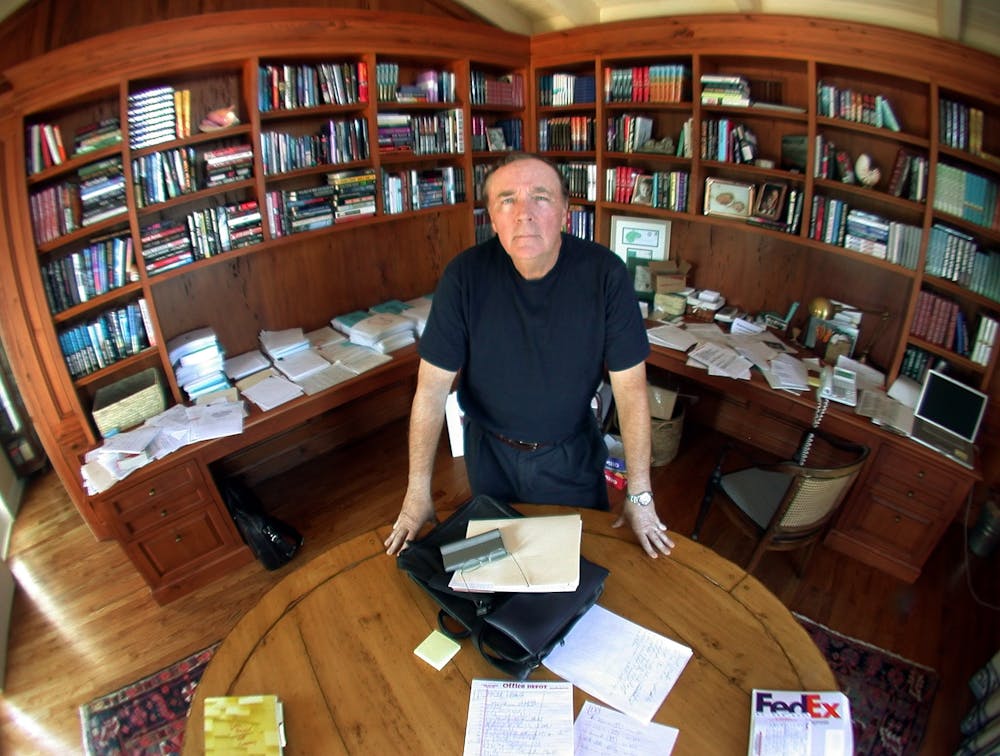
By contrast, only 14 percent of nonfiction authors had more than one best-selling book. Perhaps this is because the genre often requires expertise on a specific subject matter. If an author primarily writes about football, or neuroscience, or even her own life, it’s difficult to generate 10 books on the topic.
Publishers eagerly slap “New York Times Bestseller” stickers on each book that appears on the list’s 15 slots.
A quarter of those, however, have only a cameo appearance, briefly grabbing a spot at the bottom of the list and dropping out after a single week. Only 37 percent have some staying power and spend more than four weeks on the best-seller list. Even fewer – 8 percent – attain the number one spot.
Some rare exceptions can lease out a spot for years: “The Help” by Kathryn Stockett lingered on the fiction list for an astonishing 131 weeks, while Laura Hillenbrand’s “Unbroken” stayed on the nonfiction list for a record 203 weeks.
One big misconception is that you have to write a mega-seller to make the list. The majority of titles on The New York Times best-seller list only sell between 10,000 and 100,000 copies in their first year. “The Slippery Year,” a 2009 memoir by Melanie Gideon, made the list with a yearly sale of fewer than 5,000 copies.
How is this possible?
Our data set shows that just about your only chance of making the list is right after your publication date.
That’s because book sales, we discovered, follow a universal sales curve – there’s a single mathematical formula that captures the weekly sales of all books. And that sales curve has a prominent peak right after the release, meaning you sell the most copies during the first weeks after your book’s release. Fiction sales almost always peak within the first two to six weeks; for nonfiction, the peak can come any time during the first 15 weeks.
https://datawrapper.dwcdn.net/A6uG3/1/
While you might assume that there would be overlooked books that build their audiences slowly and eventually make it onto the hallowed list, there really aren’t.
In other words, what happens during a brief window of time can foretell a book’s success.
For this reason, the timing of the release matters a great deal, especially since the threshold to reach the list varies throughout the year.
In February or March, selling a few thousand copies can land a book on the best-seller list; in December – when sales skyrocket during the holidays – selling 10,000 copies a week might not guarantee a book a spot.
So when should authors publish?
It depends on their circumstances. If they lack a strong fan base, and their hope is to simply make it onto the best-seller list, it’s best to aim for February or March.
At the same time, appearing on The New York Times best-seller list doesn’t necessarily guarantee that a book will sell more copies. Research shows that appearing on the list tends to boost sales only for unknown authors, and the effect disappears after one to three weeks.
So for well-known authors or celebrities who already have built-in fan bases, appearing on the best-seller list might not matter as much. Instead, they’ll likely want to maximize sales – in which case, it’s best to publish in late October: The release will coincide with peak sales in December, when bookstores are packed with Christmas shoppers.
The good news is that if you’re like me – and have written several books that didn’t end up as best-sellers – you still have a chance to break through: Our analysis shows that only 14 percent of novelists made the list with their first book.
Albert-László Barabási, Robert Gray Dodge Professor of Network Science, Northeastern University
This article is republished from The Conversation under a Creative Commons license. Read the original article.
The links below are to articles on Little Free Libraries.
For more visit:
– https://www.goodreads.com/blog/show/1419-do-good-how-to-help-the-little-free-libraries
– https://bookriot.com/2018/11/12/maintain-a-little-free-library/
The links below are to articles reporting on Canada’s Cundill History Prize for 2018, including the shortlist and winner. The chronology runs from top to bottom.
For more visit:
– https://publishingperspectives.com/2018/06/canada-cundill-history-prize-2018-jurors-search-for-new-insights/
– https://publishingperspectives.com/2018/09/canada-cundill-history-prize-announces-2018-shortlist/
– https://publishingperspectives.com/2018/11/cundill-history-prize-2018-finalists-author-biographies-climate/
– https://publishingperspectives.com/2018/11/cundill-history-prize-2018-winner-maya-jasanoff-praise/
The Dawn Watch – Joseph Conrad in a Global World by Maya Jasanoff
The link below is to an article that explores the need for difficult books and comments on the 2018 Man Booker winner, ‘Milkman,’ by Anna Burns.
For more visit:
https://www.theguardian.com/books/2018/nov/10/anna-burns-milkman-difficult-novel
The link below is to an article that comments on the ‘grammar police.”
For more visit:
https://www.denisecowleeditorial.com/blog/why-the-grammar-police-arent-cool
Sarah Jilani, University of Cambridge
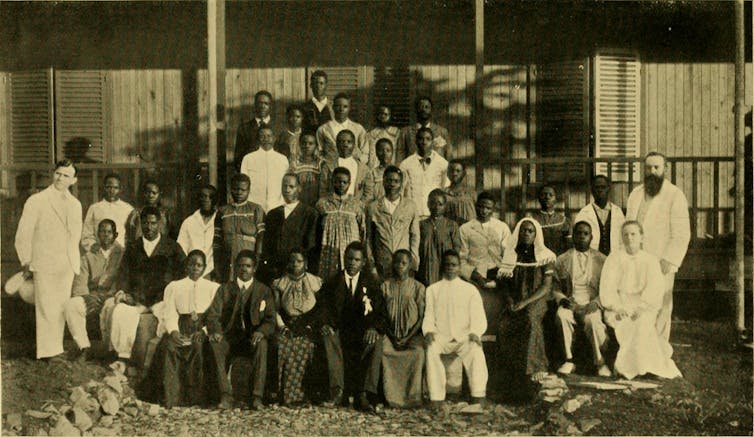
“One of the most infuriating habits of these people was their love of superfluous words,” thinks the colonial district commissioner to himself in the final chapter of Chinua Achebe’s Things Fall Apart. It is from the only section of this groundbreaking novel that is not written from the perspective of Africans. Telling of the colonisation of the Igbo from their point of view, the line foreshadows much: how colonisation will attempt to write African perspectives, deemed “superfluous”, out of their own histories, but also that, “infuriatingly” enough for an oppressor, the colonised Africans wield words of their own.
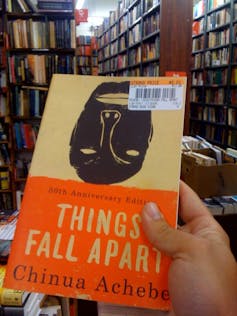
Published 60 years ago this year by Heinemann in London, Things Fall Apart has sold more than 10m copies and been translated into more than 50 languages. It follows Okonkwo, a renowned warrior from a fictional Igbo village in early 20th-century eastern Nigeria. In straightforward and evocative prose, Achebe depicts how a culturally rich and well-governed society is destabilised by the arrival of Christian missionaries and British colonialists. Okonkwo is a flawed hero, but his attempts to confront the forces transforming his village speak to a long history of anti-colonial resistance.
Now considered essential reading in many African Studies and English Literature courses, Things Fall Apart can hardly be dissociated from the emergence of the African novel and modern African writing in general. However, Achebe’s debut also sparked a formative debate on language and African literatures. With English so intimately entwined with colonial history, the fact that the novel hailed as inaugurating a modern, independent Africa’s literature was also written in English became a point of contention. Was Things Fall Apart upholding a Western model, or confronting and subverting it?
Language is never ahistorical or apolitical, but it carries an especial charge in post-colonial contexts. Educational, administrative and religious institutions had conducted life in the colonies in the language of the coloniser. Speaking it would often mean access to privileges, while speaking only African languages could mean economic disadvantage at best, physical punishment at worst. With this history in mind, Achebe and his contemporaries had to ask: did reaching global audiences to challenge their perceptions about Africa matter more than enriching their own languages by helping African readerships flourish?
The debate extended beyond the question of use and reach: it was also about post-colonial identities. Language provides the names, value systems and and discourses by which we “know” our world and ourselves. A dominant language dominates the terms by which your reality is constituted. To prioritise reading and writing in European languages could perpetuate colonial structures after independence, once again delineating who could speak, on what terms, and by what criteria African writers would be judged.
Whether to foster post-independence African literary cultures in European or African languages fuelled the historic 1962 African Writers Conference at Makerere University in Uganda. Many of its participants went on to become well-known literary voices from the continent. These included the first African Nobel laureate Wole Soyinka, a Nigerian poet and playwright; Grace Ogot, one of the first Anglophone female Kenyan writers to be published; and Christopher Okigbo, who together with Achebe established Citadel Press. Also prominent were Kofi Awoonor, a Ghanaian poet and diplomat who was among those killed in the 2013 attack in Westgate shopping mall in Nairobi, and Lewis Nkosi, whose literary career in exile from South Africa spanned nearly every genre.
There was division on the issue. Kenyan playwright and academic, Ngugi wa Thiong’o – then a student at Makerere – believed that the restoration of cultural memory rested on rehabilitating mother tongues. Now a major voice in African letters who writes mostly in Gĩkũyũ, Ngugi argued that, without this “decolonisation of the mind”, they would otherwise be forever living by moral, ethical and aesthetic values not their own.
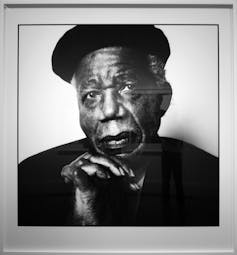
Born into a family of Christian converts in eastern Nigeria in 1930, Achebe was educated in local Anglican schools and went onto become one the first graduates of the University of Ibadan. So English was indeed a part of his identity in ways not every Nigerian would have shared. But Achebe was therefore all the more aware that education and religion were complex facets of colonialism. Things Fall Apart dramatises this with nuance in the character of Nwoye, who rebels after his brother’s death by converting to Christianity.
Achebe advocated a “both” rather than an “either/or” approach in his 1965 essay The African Writer and the English Language. He argued that the African writer, in “fashioning out an English which is at once universal and able to carry his peculiar experience”, would bring about a far more subtle rejection of the historical dominance standard English represented.
Ultimately, English was one factor that helped Things Fall Apart, as it did other works of African literature, to transcend national boundaries for six decades. But these probing political and cultural questions were carried right along with it – and they informed a legacy of African thought on the meaning and purpose of literature, which the continent’s contemporary voices can stand on today.
When African writers choose to contribute to literatures in their mother tongues, this can only be positive. But when they chose to reach the world’s Anglophone readers, it is as Achebe envisioned it: with “a new English, still in full communion with its ancestral home but altered to suit its new African surroundings”.
Sarah Jilani, PhD Candidate, Faculty of English, University of Cambridge
This article is republished from The Conversation under a Creative Commons license. Read the original article.
The link below is to an article reporting on the shortlist and winner of the 2018 Nayef Al-Rodhan Prize for Global Cultural Understanding. The winner was ‘Border – A Journey to the Edge of Europe,’ by Kapka Kassabova.
For more visit:
https://publishingperspectives.com/2018/11/kapka-kassabova-named-2018-nayef-al-rodhan-prize-winner/
 At the BookShelf
You must be logged in to post a comment.