In the late 17th century, the female English playwright Aphra Behn wrote a smash hit play about a man obsessed with the moon, who was constantly travelling there in his imagination. Exactly 282 years later, Neil Armstrong and Buzz Aldrin actually made that dream a reality.
Their astonishing achievement on July 20, 1969 led some to worry that the moon would become an object of purely scientific study – a barren and lifeless body, no longer a source of romantic inspiration. Fortunately, this fear did not come to pass.
For example, in the year that marked the 40th anniversary of the landings ten years ago, the then poet laureate Carol Ann Duffy edited To the Moon: An Anthology of Lunar Poems which gathered together works from ancient to modern, and included her own poem, The Woman in the Moon.
And while no woman has yet stepped on to this celestial body, women have long been associated with the moon – with its tidal pull, and the binary thinking that places it secondary in majesty to the sun. It is no wonder, then, that the moon has stimulated some incredible literature by female writers.
The moon is often envisaged as a female entity, which inspired poems on the theme of her gaze as she looks down on Earth benignly. Way back in antiquity, the Greek poet Sappho did just this in her short song describing how:
When, round and full, her silver face, Swims into sight, and lights all space.
This trope continued for millennia and into the 19th century. Louisa May Alcott (author of Little Women) wrote The Mother Moon in 1856, imagining a benevolent maternal moon looking down on the Earth, occasionally hidden but ultimately undiminished by clouds. Also in the 19th century, American poet Emily Dickinson’s moon similarly shone “Her perfect Face Upon the World below”.
Duffy’s more recent poem contains these familiar elements, being written in the persona of a woman in the moon – one who is incredulous anyone could have believed instead in a man in the moon. The woman in the moon has spent millennia observing Earth and now implores those gazing up at her to reflect on the neglect humans have wrought on planet Earth, repeating the question “What have you done?”
Shining a light
Of course, not all female literary responses to the moon have been quite so lyrical. Aphra Behn’s hilarious farce The Emperor of the Moon, which took the London stage by storm, is one example. Behn was one of the first English women to earn a sustained living through writing, breaking social barriers and becoming a valued literary role model for later generations of women authors.
Based on a French source, but changed in many ways to make it Behn’s own, the play centres on a doctor, Baliardo, who is tricked into believing he is in the company of men from the moon.
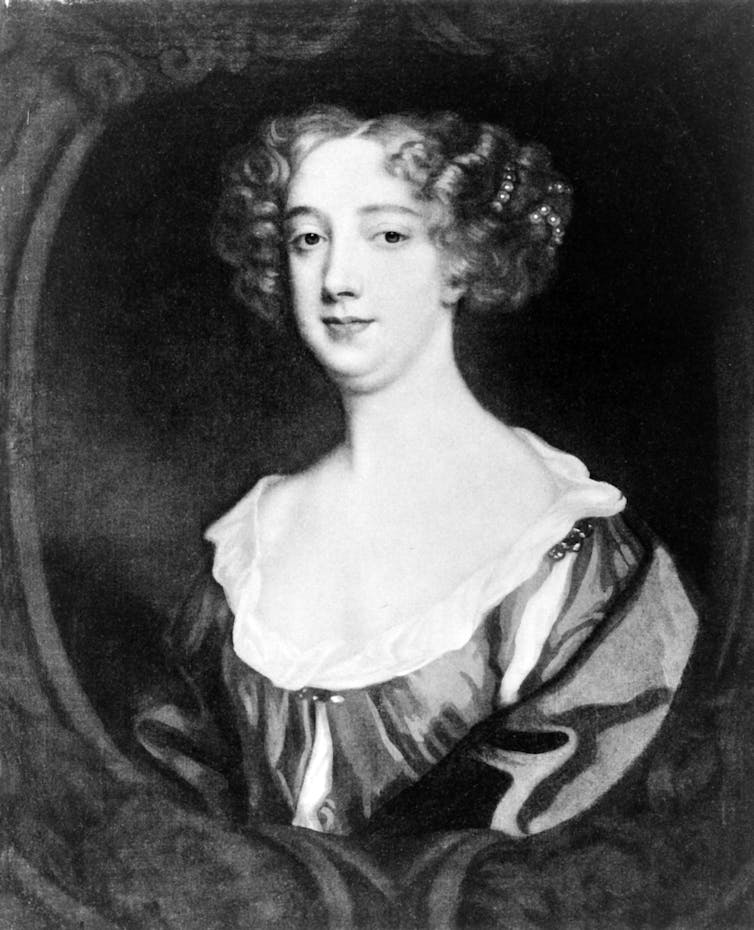
Aphra Behn (1640-1689), the first known professional English female writer. Shutterstock
He longs to know whether the moon has seas, why it shines so brightly, and whether there is proof to the theory that its atmosphere was so like the Earth’s that it, too, was inhabited.
The obsession makes him so gullible that when his daughter’s mischievous lover pretends to be the “Emperor Iredonzor”, and spouts clever sounding jargon in order to complete the disguise that he is an inhabitant of the moon descended to Earth, the doctor is convinced.
The fake emperor of the moon is then able to convince his future father-in-law that he is conferring a great honour on the family through a conjugal union with his daughter (who is in on the scheme). As the play finishes, the doctor realises that he has conceded to marry his daughter not to a superior creature from another planet, but to the fairly ordinary boy next door.
The farcical plot was spectacular and breathtaking in production and special effects. The original stage directions describe how:
The Globe of the Moon appears, first, like a new Moon; as it moves forward it increases, till it comes to the Full. When it is descended, it opens, and shows the Emperor and the Prince. They come forth with all their Train, the Flutes playing a Symphony before him, which prepares the Song.
We can only imagine the audience’s reaction, but the play was an enormous success, staged 130 times by 1749. If Behn had thoughts of space travel, too, she did not commit them to paper.
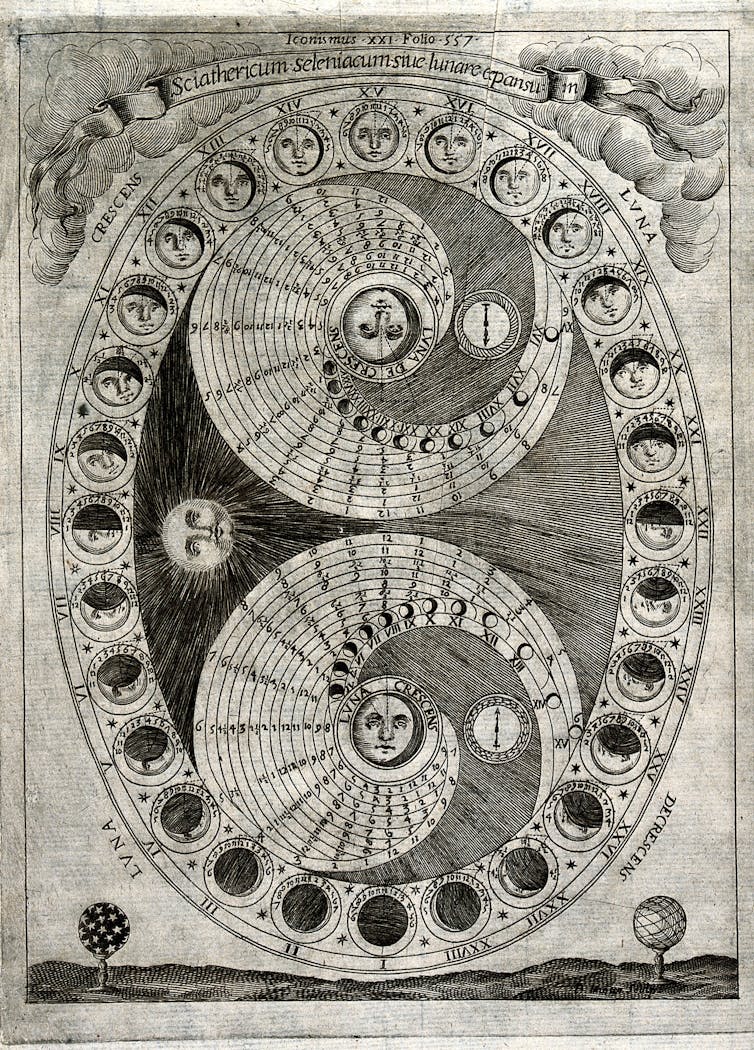
The 28 phases of the moon in a lunar month. Engraving by P. Miotte, 1646. Wellcome Collection, CC BY
But perhaps as NASA ramps up preparations for further lunar exploration, the moon will move out of the purely imaginary. Maybe women will at last be among the exclusive number of humans to have stepped on to the moon and gazed back to Earth for themselves.
Most written works are not available in accessible formats, and this barrier affects about 168,000 New Zealanders. from http://www.shutterstock.com, CC BY-NC-SA
The New Zealand parliament seems closer to adopting a bill to amend copyright legislation to make it easier for visually impaired people to access published works.
An estimated 90% of all written works published worldwide are not available in formats accessible to people with a print disability. This barrier affects an estimated 168,000 New Zealanders.
The 2013 Marrakesh Treaty, which New Zealand joined in 2017, would help end the “global book famine” by allowing access to more written works in formats such as Braille, large print or audio. Bringing the treaty into effect in New Zealand requires changes to the Copyright Act 1994, and the amendment bill is due to go through its final reading this week.
Currently, creating accessible formats from existing works is only possible with the permission of the copyright owner or if there are exceptions limiting the copyright owner’s rights. Combined with a lack of infrastructure and the high cost of producing accessible works, this has created a global “book famine” for visually impaired people.
This affects not only those who read for leisure but also students and researchers, especially in developing and least developed countries. This lack of access to books and other copyright material is a hurdle to the realisation of several human rights, including the right to education, access to information, the right to participate in culture and to enjoy scientific progress, as well as the rights to health and employment. This is reflected in the Marrakesh Treaty’s focus on human rights and equality for the visually impaired.
The treaty’s provisions are designed to address problems such as long waits for authorisation or accessible format copies from a copyright owner, unreasonable restrictions imposed on accessible formats, and barriers to cross-border exchange of available accessible works that often result in duplication of production efforts.
Access to copyright works and higher education
Australian research found that when universities provided their visually impaired students with access to essential or prescribed texts, students generally obtained readings late. For instance, only 50% of print disabled first-year students had access to prescribed textbooks before the semester started.
Some universities reported far more substantial delays. In such cases, students would receive their essential readings only very late in the semester or after the semester is over. The reasons for delays vary, with some students not notifying the university that they require assistance. Additionally, reading lists are often not finalised until the first week of semester and publishers fail to respond to requests to provide accessible texts in a timely manner.
Publishers generally require students to buy a print copy of the work before they will provide access to an electronic version. Some are willing to provide download links, while others, particularly in the United States, often prefer to mail disc copies. Sometimes works are only available as preprint versions, which require a considerable amount of editing before they can be provided to students. This is a drain on university resources.
Consequently, not all students who would benefit from accessible formats currently obtain them. This means their chances of demonstrating their full potential are often compromised.
New Zealand’s Marrakesh Treaty implementation bill
The bill is part of a broader review of New Zealand’s copyright legislation to ensure “the copyright regime keeps pace with technological and market developments” since its last significant amendment in 2008. It expands the reach of section 69 of the Copyright Act 1994 that addresses the reproduction and distribution of accessible works.
One of the main changes is to broaden the scope of current exceptions and improve access for visually impaired New Zealanders. The bill also introduces measures to facilitate international sharing of accessible works. These changes help realise visually impaired people’s “right to read”.
A contentious issue for the implementation of the treaty in New Zealand and elsewhere is the so called “commercial availability test”. The test is currently a requirement in New Zealand for an “authorised entity” to make reasonable efforts to obtain an accessible copy at an ordinary commercial price. By far the cheapest, fastest and most convenient means of obtaining accessible format works is if they are available for sale through the normal channels.
But in the absence of easily available accessible copies, the test creates uncertainty and imposes an administrative burden on institutions that provide the visually impaired with accessible copies. This is why after hearing submissions on the bill, a select committee recommended the removal of the test.
The proposed changes to copyright legislation would allow people with a print disability to make accessible format copies or to receive those made by an authorised entity in New Zealand or elsewhere, without infringing copyright. While broadening the scope of the current exceptions, the bill has checks and balances in place that protect reproduced accessible formats, contrary to a misconception of allowing free-riding on copyright works.
This is of significance to university students as some may self-declare disabilities while others are reluctant to disclose an impairment. Universities emphasise that they provide a safe place for disclosure, but speedy provision of services remains an issue.
The increase in the availability of electronic texts has helped to meet needs, but it is not keeping pace with student demand and expectation. As part of an increasingly technology savvy student population, students with impairments now request electronic versions of texts and use technology to adapt them to their needs. Students no longer want enlarged or scanned material as this is much harder to manipulate. The amendments in the bill would enable them to create their own accessible formats, or source them without having to identify as print disabled.
Overall, the proposed law change is a positive step towards improving access to copyright works for visually impaired New Zealanders. It also helps New Zealand maintain its good global citizen status by allowing an exchange of accessible works with other Marrakesh Treaty members.
Australian authorities have been told to stop interfering in the case of the Chinese-Australian writer Dr Yang Hengjun who has been detained by China since January.
I’ve known Yang for many years – he is a former PhD student of mine – and I also believe he should be released.
I’ve seen reports sent to his wife, Yuan Xiaoliang, from Australian consul visits to Yang.
The reports say Yang is sealed off from the outside world without access to legal counsel or visits by relatives, and he has been subjected to interrogations twice a day.
A novel critic
So what has Yang done that has led to his detention for so long? In a nutshell, Yang is a political dissident no longer tolerated by the Chinese communist regime. He is paying a heavy price as a long-standing critic of the Chinese Communist Party (CCP).
Yang, aged 54, abandoned his career as a communist cadre to embrace freedom and democracy in his middle age.
He earned his first degree in politics from Fudan University in China in 1987 and was assigned to work in the Ministry of Foreign Affairs with connection to the Chinese secret police. He was eventually alienated by his job and developed a strong interest in literature.
He resigned from his post and moved to Australia with his wife and two sons in 1999 to pursue his dream of becoming a writer. In 2002-2005, he published a trilogy of spy novels, Fatal Weakness, Fatal Weapon and Fatal Assassination, in print and online.
These novels used his own experiences and those of his colleagues to tell the soul-stirring stories of a China-US double agent who ultimately serves the agenda for neither side but works for his own inspiration and conviction to serve the real interests of the people.
But the novels did not bring him the fame and wealth he expected, because they were published in Taiwan and banned in mainland China. An attempt to turn them into movies in Hong Kong also failed.
The rise of the blogger
At the end of 2005, Yang enrolled in a PhD in China Studies at the University of Technology Sydney under my supervision, starting his journey as a liberal scholar. By that time, I’d become a major contributor to the emergence of the Chinese liberal camp and Chinese liberal intellectuals.
Yang got his PhD in 2009 with a thesis titled The Internet and China: the Impacts of Netizen Reporters and Bloggers on Democratisation in China. The thesis was a timely, in-depth analysis of the complicated information warfare between the internet and the CCP regime.
As part of an experiment for his PhD thesis, Yang started his own blog (available now only on archive.org) and wrote commentaries on current affairs as a “citizen journalist”.
Yang is that rare combination of a scholar well trained in both China and the West, with a firm belief in the universal values of human rights, democracy and the rule of law.
He chose to devote his talent and passion to online journalism in Chinese, hoping to accelerate China’s transformation toward constitutional democracy. He has published more than ten million words of online articles on this theme, earning the nickname “democracy pedlar” with tremendous following in the Chinese speaking world.
Several collections of his online articles have been published to wide audience, such as Family, State and the World (2010), Seeing the World with Black Eyes: The World in the Eyes of a Democracy Pedlar (2011), Talking about China (2014), and Keeping You Company in Your Life Journey (2014).
Yang is extremely good at explaining the profound in simple terms, using moving examples in everyday life to expose the social ills of communist autocracy and promote democratic values and institutions.
In particular, he provides timely analysis on all sorts of events around the world reported in the news, revealing the stark contrast between the harsh reality and the official rhetoric of the CCP.
Yang rarely engages in social activism, although he has maintained extensive connections with some Chinese human rights and democracy activists.
Detained before
Yang has long been targeted by the Chinese security apparatus, which detained him in March 2011, taking him as one of the opinion leaders who has the capacity to mobilise nationwide social protests.
He was quickly released back to Australia due to the international media campaign and the diplomatic pressure of then Prime Minister Julia Gillard’s visit to China.
Why did he not learn his lesson? Well, he did tone down his voice after 2011. Since Xi Jinping’s rise to general secretary of the CCP in 2012, Yang adopted a soft strategy of packaging his advocacy for human rights and democracy as publicising “socialist core values” promoted by the CCP.
Yang was so successful with this new strategy that thousands of his followers organised support groups via the social media app WeChat in more than 50 cities around China. These include Beijing, Shanghai and Guangzhou in 2015, when human rights and democracy activists had met with brutal repression.
In 2016, when the political environment turned from bad to worse and Yang’s blogs were shut down one by one, he closed down all of the WeChat groups and substantially scaled down his online writing.
Moved to the US
He moved to New York as a visiting scholar at Columbia University in 2017. He was able to travel to China several times and Chinese authorities lifted the ban on several of his blogs in China towards the end of 2018. This gave him the impression it was safe for him to visit China.
Thousands of Yang’s supporters have been in despair, engaging in heated debates about his ordeal and its implications for political development in China.
Instead of following the international norm of presumption of innocence, the CCP regime continues Yang’s criminal detention despite the lack of evidence he’s done anything wrong.
This behaviour of political persecution and hostage diplomacy clearly demonstrates the contempt China has for human rights and international moral standards.
The Australian government and public are obligated to challenge the laws and practice of the CCP regime in safeguarding basic human rights of innocent citizens. The international community are also obligated to support this endeavour for human dignity, and thus the immediate release of Yang.
In the digital age, a public library can connect even the most remote community to networks of knowledge and information. Today’s public libraries work to engage marginalised communities as users; pioneering projects like Townsville’s Murri Book Club explore ways to make the library meaningful to Indigenous people.
Despite all this, there is one area in which public libraries are underused. Libraries can also help us plan for the future.
Long-term planning is always challenging. It’s simply impossible to gather data from events that haven’t happened yet.
Sometimes we may detect trends, but these can fall apart under what some foresight experts call “TUNA conditions”, when we face Turbulence, Uncertainty, Novelty or Ambiguity.
Think of someone trying to predict that experiments with debt on Wall Street would lead to the global financial crisis and the political ripples that have followed. Think of trying, today, to foretell all the long-term consequences of climate change.
Enter scenario planning
That means we’ve had to find new ways to look at the unpredictable future. Big business has used scenario planning since the 1960s, when Pierre Wack pioneered the approach for Shell.
Shell’s scenarios became famous in the 1970s when the company successfully anticipated the oil crisis that followed the Yom Kippur War. Shell hadn’t predicted the conflict, but had imagined scenarios where Middle Eastern oil producers worked as a cartel to control global supply. When those countries did start an oil embargo, scenario planning meant Shell had already thought through this possibility ahead of its competitors.
Today, experts thinking about the future acknowledge the need for engagement from the bottom up as well as top down. For example, the European Union’s new proposal for “mission-oriented innovation” aims to get all of us focused on solving society’s problems. In turbulent times, it’s important that at every level of society we strengthen our ability to imagine the future that awaits us – and our own future choices.
Public library services are built on relationships, not just transactions; they are entwined with the specific and deeply local context of everyday life in the communities they serve.
Locally held scenario planning sessions, convened by communities at their public library, would make use of the library’s existing capacity to connect people – but this time with the goal of helping us reimagine the future.
Librarians would work with their local council to identify issues that call for a long-term perspective. Should we invest in “smart” tech for our small country towns? How much should we rely on recycled water or desalination in the big coastal cities?
Librarians would provide background research and host community workshops to develop local scenarios. People would start to have deeper, richer discussions about the future: there’s a reason scenarios have been called “the art of strategic conversation”.
The scenario process depends on bringing together a group of individuals in a trusted space, with enough information to give the scenarios detail and flavour. In a local community, the public library is that place of trust and information.
Much as public librarians use their skills to help with job seeking or support people’s health and well-being, as scenario planners they would apply their talents to a new domain.
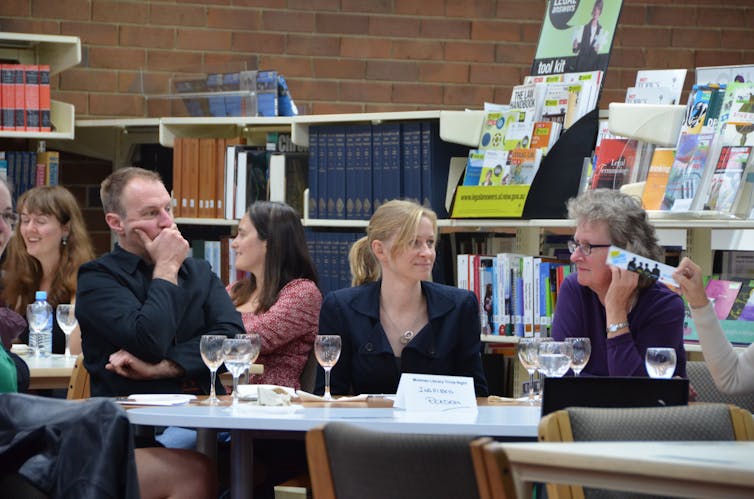
A playful event at Ann Arbor Public Library to explore an imagined future.
If public libraries were supported to deliver strategic foresight to their communities, politics could transform. The electorate would be better informed, thinking deeper and further ahead about political issues. Councils could take decisions with confidence that the community had been consulted about the long-term consequences.
Scenarios would offer a playbook of potential futures, already imagined and rehearsed. Every Australian could have access to the kind of foresight tools that have been informing the decisions of government and big business for the past half century.
Imagine the conversations we, as a country, would be having about our future if we democratised those tools via the local library.
Last year, I toted Anna Karenina along with me — it got soaked, and I abandoned it in an AirBnB in Dubrovnik, Croatia, after I’d finished reading it. It lasted nearly the whole trip and left a gaping, souvenir-sized hole in my suitcase; it was perfect. So as much as I’d like to dissolve the beach read label entirely, I must also admit I have a type: I want a meaty, absorbing book that takes me further into a vacation by connecting with the cultures that produced it. I want a book that can’t be disposed of, one that will take me somewhere entirely new.
In a cultural climate where the limits of empathy are increasingly under a microscope, forging cross-cultural connections feels like a pressing task. Much has been made of the relationship between fiction reading and empathy, but what happens when the limits of our worldview are bounded by the English language? While linguistic diversity is growing in Canada, the majority of Canadians still speak only English at home, and comparatively few books are translated into English. If, as José Ortega y Gasset proposes, reading in translation should transport the reader into the language — and therefore the perspective — of the author, then reading translated works may be one of the best ways to expand empathy beyond the boundaries of language.
I’m not going abroad this summer, at least not physically. I’ll be staying in Canada, with only my books to pull me to other times and places. While in recent years, I’ve focused on keeping up with new releases, this year I’m fixated on atmosphere and transportation, in a mix of old favourites and new-to-me classics from around the world.
One of my favourite themes in European literature is that of movement and fluidity, the running sense of unity of purpose amidst myriad diverse pockets of culture. The ubiquity of trains and boats support transcontinental journeys by characters who switch language mid-conversation. Last year’s Man Booker International winner, Flights by Olga Tokarczuk takes traveling and travelers as the subject of its interconnected musings, making it an ideal choice for the vacation headspace. This year’s winner, Celestial Bodies from Oman’s Jokha Alharthi, has an English edition but has not yet been published in Canada.
Croatia
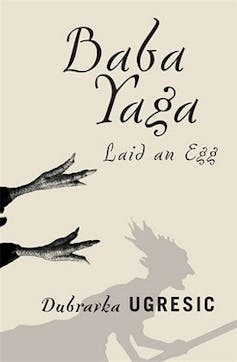
‘Baba Yaba Laid an Egg’ 2009. Canongate Books
In my opinion, no contemplation of Pan-European lore can be complete without Dubravka Ugrešic’s Baba Yaga Laid an Egg. Once labeled a witch herself and driven into exile from Croatia, Ugrešic’s take on Baba Yaga explores the shifting nature of popular folklore.
Nigeria
‘Half of a Yellow Sun,’ 2006. Knopf
Half of a Yellow Sun by Nigerian author Chimamanda Ngozi Adichie is not a translation, but it will take you to a place that only briefly existed: Biafra, a West African state founded in 1967. While the brutality of recent war may not make a particularly appetizing subject for vacation, Adichie contrasts the brutality with sumptuous descriptions of pre-war food and luxury, giving her vision of Biafra the aura of a lost dream. Adichie has referred to the war as a shadow over her childhood.
Norway
‘Kristen Lavransdatter,’ 2005. Penguin Books
There are no beaches in Kristen Lavransdatter and many more Christmases than summers, but if you start Nobel Prize-winner Sigrid Undset’s oeuvre now, it may take you until winter to finish it. Set in Medieval Norway, the book follows the titular Kristen from childhood until death, focusing on her tumultuous love affair and marriage to Erlend Nikulaussøn. Tiina Nunnally’s translation, focusing on plain, stripped-down language, presents a change in philosophy from the first English translation that cut large portions of the text and enforced stiff, archaic language absent from the original Norwegian.
Argentina
‘Fever Dream,’ 2017. Riverhead Books
Samanta Schweblin’s Fever Dream is slight in length but packs a heavy punch in both atmosphere and psychological investment. The story of a vacation gone terribly wrong, the novel’s Spanish title closely translates to “rescue distance,” a recurring concept instantly familiar to parents of young children and terrifying as it becomes repeatedly destabilized. Fever Dream is so unsettling that I sometimes hesitate to recommend it, but I’ve found myself repeatedly drawn back to its tantalizing surrealism.
Canada
‘Secwépemc People, Land and Laws,’ 2017. McGill-Queen’s University Press
I’ve spent much of my life moving around, and as a recent settler on unceded Secwepemc territory, I want to learn more about the land I live on. In a summer steeped in fiction, Secwépemc People, Land, and Laws by Marianne and Ronald Ignace is the only history on my list, but in many ways it feels similar to the others, reaching out to add a new dimension to a place in which I’m still mostly an outsider. For better or for worse, Kamloops feels the most like itself in summer, the climate wants to have its stories told. It can feel intimidating to contemplate a 10,000 year history I know nothing about, but also comforting and necessary to reach back and hear the tales of the land I now call home.
















 At the BookShelf
You must be logged in to post a comment.