
Unknown's avatar

Tropic of Shakespeare: what studying Macbeth in Queensland could teach us about place and shipwrecks


Macbeth’s Scottish heaths may seem a long way from tropical Queensland, but there are points of connection.
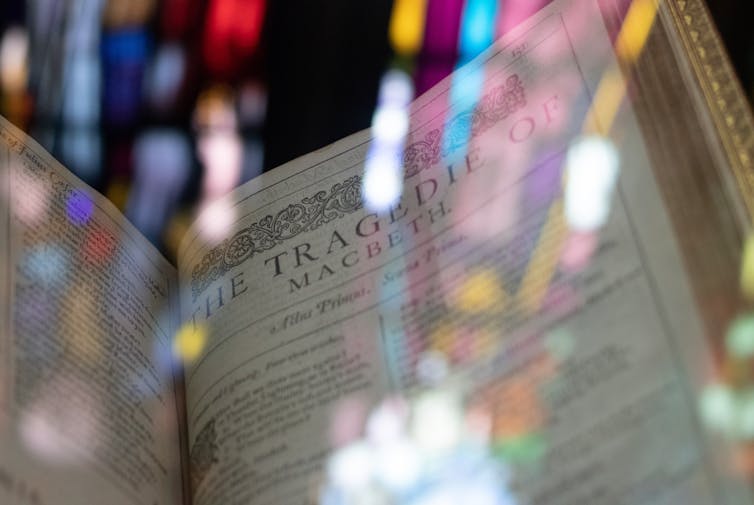
Unsplash/Matt Riches, FAL

Claire Hansen, James Cook University

When you imagine the setting for Macbeth, misty heaths, battlefields, and the brooding highlands spring to mind. Teaching the play in the midst of a tropical summer in Townsville, far north Queensland, highlights disjunctions and surprising correlations between play and place.

In their 2011 book Ecocritical Shakespeare, Lynne Bruckner and Dan Brayton consider this relationship between our environment and our practices of reading, writing about, and teaching Shakespeare:

What does the study of literature have to do with the environment? … What is the connection between the literary and the real when it comes to ecological conduct, both in Shakespeare’s era and now?

One way of answering these questions is through the use of place-based education. Educational theorists Amanda Hagood and Carmel E. Price reason that “student learning is enhanced when course content is grounded in a particular place of meaning”.

This approach is neither new nor (on the surface) complex. Educational philosopher John Dewey prioritised experiential learning such as nature studies. More recently, Swansea University educators have published research on the benefits of curriculum-based outdoor learning for primary school students.

But preliminary research on outdoor Shakespeare education conducted with Townsville secondary school students shows contradictory responses: some students found the location “calming” and “less stressful” than classrooms. Others believed that learning did not “rely on location”.

Christopher Gaze founded Vancouver’s Bard on the Beach Shakespeare Festivalin 1990. Attendance at the beachside performances has since topped 91,000.

Students’ sense of place

In 2019, 60 first-year English students at James Cook University were asked to rate the importance of setting in Shakespeare plays, and the importance of their own place to the study of Shakespeare.

Of those surveyed, 85% felt that the setting was important to the play, while 96% believed that Shakespeare had little or no relevance to their local area. Few felt that their real life location was important in their study of the playwright’s work.

These results show a contrast between the perceived value of literary and of lived place. This is problematic: how do students engage with fictional, imagined literary places if their own lived experience of place is devalued?

When asked to explain their ratings, students said:

I believe the setting plays a big part in the play as it allows the audience to understand why the characters are doing what they are doing. Shakespeare isn’t important in Townsville.

I live in a rural area. There is not a lot of room for Shakespeare – though given small town conflicts you would see his plots acted out in real life.

There is slippage here between the student’s reference to physical place and their conceptual space, which does not have a lot of cultural room for Shakespeare.

A third student wrote:

My family doesn’t really care about Shakespeare, but I do enjoy some of his works personally.

Here, place was understood to refer to relationships, not environment – an understanding backed by British social scientist and geographer Doreen Massey’s theories.

The disparity between students’ conceptualisations of place and their devaluation of their own location as relevant to their studies may be symptomatic of what Alice Ball and Eric Lai identify as “an ethos of placelessness in education”. In Canada, David Gruenewald has argued that the curriculum is largely “placeless”, with educational reforms and high stakes testing increasingly disconnected from our places.

Shakespeare’s shipwrecks

One approach to teaching Shakespeare through place-based education could centre on shared spaces in lived place and text. As a Shakespeare scholar living near the Great Barrier Reef, I’m interested in what Steve Mentz identifies as the “blue ecology” of Macbeth; the play’s many references to the ocean, liquids, and bodily fluids.

One blue image common to both Shakespeare and Townsville is that of the shipwreck – a favourite trope of Shakespeare’s, essential to plays including The Comedy of Errors, Twelfth Night, The Tempest, The Winter’s Tale, and Pericles.

Macbeth invokes shipwreck imagery with a tale of changed fortune after Macbeth’s victory over the traitor Macdonald:

As whence the sun ‘gins his reflection,

Shipwrecking storms and direful thunders break,

So from that spring, whence comfort seemed to come,

Discomfort swells.

The Witches offer a literal description of a ship or “bark”:

1 WITCH

Though his bark cannot be lost,

Yet it shall be tempest-tossed.

2 WITCH

Show me, show me.

1 WITCH

Here I have a pilot’s thumb,

Wrecked as homeward he did come.

Shipwreck is something that Shakespeare and Townsville have in common. Two of the most famous shipwrecks off Townsville’s coast are the SS Yongala (which sank in 1911 and is now a popular diving site) and the HMS Pandora (hulled on the Great Barrier Reef in 1791 after capturing some of the Bounty mutineers; remnants of the wreckage are on display at the Museum of Tropical Queensland in Townsville).

Our students could both explore Shakespeare through the shipwreck and engage more with the history and culture of their own local places. This approach requires us to think about place as real and imagined; fitting for Macbeth, a play defined as a “tragedy of imagination”.The Conversation

Claire Hansen, Lecture in English/Writing, James Cook University

This article is republished from The Conversation under a Creative Commons license. Read the original article.

Unknown's avatar

2019 Longlist for the US National Book Awards for Translated Literature


The links below are to articles reporting on the longlist for the 2019 US National Book Awards for Translated Literature.

For more visit:
https://ebookfriendly.com/national-book-awards-2019-translated-literature/
https://www.barnesandnoble.com/blog/announcing-the-longlist-for-the-2019-national-book-award-for-translated-literature/
https://publishingperspectives.com/2019/09/us-national-book-awards-2019-longlist-in-translated-literature/

Unknown's avatar

2019 Winners of the University of Melbourne’s Australian Centre Literary Awards


The link below is to an article reporting on the winners of the 2019 University of Melbourne’s Australian Centre Literary Awards.

For more visit:
https://www.booksandpublishing.com.au/articles/2019/09/10/138893/australian-centre-literary-awards-2019-winners-announced/

Unknown's avatar

2019 Longlist for the USA National Book Award for Young People’s Literature


The links below are to articles reporting on the longlist for the 2019 USA National Book Award for Young People’s Literature.

For more visit:
https://www.barnesandnoble.com/blog/announcing-the-longlist-for-the-2019-national-book-award-for-young-peoples-literature/
https://publishingperspectives.com/2019/09/us-national-book-awards-2019-longlist-in-young-peoples-literature/

Unknown's avatar

Science fiction offers a useful way to explore China-Africa relations


Science fiction can serve as an imaginative production of political theory.
Shutterstock

Nedine Moonsamy, University of Pretoria

In 2007 the then President of China, Hu Jintao, delivered a speech to South Africans acknowledging the benefits of a strategic partnership. He also stressed that the connection is not merely pragmatic. It must, he argued, serve to honour and deepen the countries’ long abiding friendship in the future.

The idea of friendship has undoubtedly informed the nature of Sino-African engagement. But if we use contemporary science fiction as a barometer, African sentiment towards China appears more inclined towards dystopian forecasts.

Science fiction writing often serves as a thought experiment that explores shared and hidden beliefs whose material and political reverberations lie further in the future. Various short stories portray how China’s economic ascension, operating under the guise of African development, uses technology as a means to invade and control Africa.

Narratives of this kind surface neo-colonial fears that a “new scramble for Africa” seems imminent. But they also provide a speculative arena to interrogate how we ultimately perceive the value, use and future of Sino-African political friendship.

As I’ve explored in my research, this means that science fiction can serve as an imaginative production of political theory. It intercedes in ways that international relations cannot because of the confines of diplomacy.

Three stories

My research focused on three short science fiction stories from Africa.

In the first, Tendai Huchu’s “The Sale”, China has taken control of Zimbabwe through the production of a corporatised state called CorpGov. It’s a surveillance state that leaves no room for political dissension. Zimbabwe has been purchased by China in a piecemeal fashion. It is now set to lose its last free portion of land in a final sale. When a young Zimbabwean man fails to prevent the sale of this remaining plot of land, he succumbs to despair and puts himself in the path of a Chinese bulldozer.

His suicide evokes a sense of profound helplessness and warns that China will need to be vehemently counteracted in the near future to protect Zimbabwe’s already breached borders. Huchu’s narrative provides a sharp sense of clarity that makes the story incredibly impactful.

The pathos of “The Sale” holds a mirror up to China. It communicates an earnest appeal for more humane engagement. Yet the heaviness of its dystopian narrative also breeds a spirit of nihilism or Afropessimism. This overrides any sense of African accountability in the degenerative state of future Sino-Zimbabwean relations.

Abigail Godsell’s “Taal” (an Afrikaans word meaning “language”) is self-conscious in this regard. It’s set in the year 2050, after a nuclear war between China and America has left the entire globe in a state of desolation. As a result, the South African government willingly signed over ownership of the country to China in exchange for protection.

The central protagonist, an especially resentful young woman named Callie, has joined a militant rebel group in a covert attempt to overthrow the Chinese. But after injuring a soldier, she pulls off his helmet and is surprised that he converses in Afrikaans because, to all other appearances, he is Chinese. The fact that he speaks Afrikaans implies he is a South African. She is stupefied by the exchange: it highlights her simplistic understanding of what the enemy should look like.

This uncanny revelation undoubtedly draws attention to the spectral presence of Chinese-South Africans who have not received due recognition as bona fide citizens.

Callie, who is initially critical of Chinese propaganda, begins to read her positionality as a South African freedom fighter on equally problematic terms. Her defensiveness drops and she confesses that South Africa was caught off-guard amid a global crisis. The country did not have a sufficient national security plan; China has offered significantly more protection than the South African government was capable of at the time.

Godsell’s introspective narrative shift focus away from Chinese agitation. It allows the reader to consider the nature of South African apathy by conveying that the country may not lack a fighting spirit but, unlike China, lacks the necessary foresight and organisation to bolster the nation.

Negative representations of China in the African imaginary gesture at the idea that a certain amount of envy informs the continent’s responses to China. They also suggest that African countries can benefit from emulating China’s uncompromising nationalistic and commercial drive. This possibility is more fully explored in Mandisi Nkomo’s “Heresy”.

Nkomo’s narrative is set in the year 2040. South-South interactions challenge the global status quo. China has risen in global economic rankings. But South Africa has not fallen under its sway: the nations are caught up in a highly competitive space race. South Africa is determined to not be outdone by the Chinese and channels its resources in meeting this goal.

“Heresy” conveys how Africans can construct an invisible enemy out of China by exponentially accelerating South African development. This light-hearted narrative assumes the challenge of imagining the current tension of Sino-African relations otherwise. It shows how friendly rivalry can inadvertently lead to African progress.

Rethinking friendship

In their book Friendship and International Relations, academics Andrea Oelsner and Simon Koschut write that it is:

necessary to think of international friendship not as something that is merely being performed at the intergovernmental level but as something that is being enacted in the day-to-day activities and imaginations at all levels of society.

This certainly includes science fiction narratives that present us with a “succession of literary experiments, each one examining a small part of a much larger image and each equally necessary to the greater vision”.

Through these short stories, it immediately becomes possible to consider how China-Africa relations need not result in Chinese neocolonialism and African exploitation. They offer us more creative approaches to political friendship by reinventing and reinterpreting the roles of both parties in their narratives.

Similarly, pursued in this way, the future of China-Africa relations need not be seen as a singular act of solidarity that demands repeating. Instead it could be viewed as a more fluid encounter that allows for mutual investment in world-building projects while also providing enough objective distance to nurture difference and autonomy.The Conversation

Nedine Moonsamy, Senior Lecturer, University of Pretoria

This article is republished from The Conversation under a Creative Commons license. Read the original article.

Unknown's avatar

The Benefit of Reading Comics


The link below is to an article that looks at the value and educational benefit of reading comics.

For more visit:
https://bookriot.com/2019/09/16/value-of-reading-comics/

Unknown's avatar

12 Book Podcasts


The link below is to an article that takes a look at 12 book podcasts.

For more visit:
https://www.epicreads.com/blog/book-podcasts/

Unknown's avatar

Preventing Ghosting and Shadowing in Books


The link below is to an article that takes a look at preventing ghosting and shadowing in books.

For more visit:
https://blog.bookstellyouwhy.com/bid/240800/how-to-prevent-ghosting-and-shadowing-in-rare-books

Unknown's avatar

2019 Richell Prize Longlist


The link below is to an article that reports on the longlist for the 2019 Richell Prize.

For more visit:
https://www.booksandpublishing.com.au/articles/2019/09/09/138853/richell-prize-2019-longlist-announced/

Unknown's avatar

Developing a Reading Habit


The link below is to an article that looks at developing a reading habit.

For more visit:
https://www.goodreads.com/blog/show/1704-expert-advice-on-how-to-develop-a-reading-habit