
The link below is to an article that looks at book collecting and asks, ‘is book collecting a dying art?’
For more visit:
https://blog.bookstellyouwhy.com/is-book-collecting-a-dying-art

The link below is to an article that looks at book collecting and asks, ‘is book collecting a dying art?’
For more visit:
https://blog.bookstellyouwhy.com/is-book-collecting-a-dying-art
Andy Simionato, RMIT University and Karen ann Donnachie, RMIT University
Books are always transforming. The book we hold today has arrived through a number of materials (clay, papyrus, parchment, paper, pixels) and forms (tablet, scroll, codex, kindle).
The book can be a tool for communication, reading, entertainment, or learning; an object and a status symbol.
The most recent shift, from print media to digital technology, began around the middle of the 20th century. It culminated in two of the most ambitious projects in the history of the book (at least if we believe the corporate hype): the mass-digitisation of books by Google and the mass-distribution of electronic books by Amazon.
The survival of bookshops and flourishing of libraries (in real life) defies predictions that the “end of the book” is near. But even the most militant bibliophile will acknowledge how digital technology has called the “idea” of the book into question, once again.
To explore the potential for human-machine collaboration in reading and writing, we built a machine that makes poetry from the pages of any printed book. Ultimately, this project attempts to imagine the future of the book itself.
Our custom-coded reading-machine reads and interprets real book pages, to create a new “illuminated” book of poetry.
The reading-machine uses Computer Vision and Optical Character Recognition to identify the text on any open book placed under its dual cameras. It then uses Machine Learning and Natural Language Processing technology to “read” the text for meaning, in order to select a short poetic combination of words on the page which it saves by digitally erasing all other words on the page.
Armed with this generated verse, the reading-machine searches the internet for an image – often a doodle or meme, which someone has shared and which has been stored in Google Images – to illustrate the poem.
Once every page in the book has been read, interpreted, and illustrated, the system publishes the results using an online printing service. The resulting volume is then added to a growing archive we call The Library of Nonhuman Books.
From the moment our machine completes its reading until the delivery of the book, our automated-art-system proceeds algorithmically – from interpreting and illuminating the poems, to pagination, cover design and finally adding the endmatter. This is all done without human intervention. The algorithm can generate a seemingly infinite number of readings of any book.
The following poems were produced by the reading-machine from popular texts:
deep down men try there
he’s large naked she’s even
while facing anything.
from E.L. James’ Fifty Shades of Grey
how parties popcorn
jukebox bathrooms depressed
shrug, yeah? all.
from Bret Easton Ellis’ The Rules of Attraction
Oh and her bedroom
bathroom brushing sending it
garter too face hell.
from Truman Capote’s Breakfast at Tiffany’s
So what does all this have to do with the mass-digitisation of books?
Faced with growing resistance from authors and publishers concerned with Google’s management of copyright, the infoglomerate pivoted away from its primary goal of providing a free corpus of books (a kind of modern day Library of Alexandria) and towards a more modest index system used for searching inside the books Google had scanned. Google would now serve only short “snippets” of words highlighted on the original page.
Behind the scenes, Google had identified a different use for the texts. Millions of scanned books could be used in a field called Natural Language Processing. NLP allows computers to communicate with people using everyday language rather than code. The books originally scanned for humans were made available to machines for learning, and later imitating, human language.

Algorithmic processes like NLP and Machine Learning hold the promise (or threat) of deferring much of our everyday reading to machines. History has shown that once machines know how to do something, we generally leave them to it. The extent to which we do this will depend on how much we value reading.
If we continue to defer our reading (and writing) to machines, we might make literature with our artificially intelligent counterparts. What will poetry become, with an algorithm as our muse?
We already have clues to this: from the almost obligatory use of emojis or Japanese Kaomoji (顔文字) as visual shorthand for the emotional intent of our digital communication, to the layered meanings of internet memes, to the auto-generation of “fake news” stories. These are the image-word hybrids we find in post-literate social media.
Take the book, my friend, and read your eyes out, you will never find there what I find.
Ralph Waldo Emerson’s Spiritual Laws
Emerson’s challenge highlights the subjectivity we bring to reading. When we started working on the reading-machine we focused on discovering patterns of words within larger bodies of texts that have always been there, but have remained “hidden in plain sight”. Every attempt by the reading-machine generated new poems, all of them made from words that remained in their original positions on the pages of books.
The notion of a single book consisting of infinite readings is not new. We originally conceived our reading-machine as a way of making a mythical Book of Sand, described by Jorge Luis Borges in his 1975 parable.
Borges’ story is about the narrator’s encounter with an endless book which continuously recombines its words and images. Many have compared this impossible book to the internet of today. Our reading-machine, with the turn of each page of any physical book, calculates combinations of words on that page which, until that moment, have been seen, but not consciously perceived by the reader.
The title of our early version of the work was To Hide a Leaf. It was generated by chance when a prototype of the reading-machine was presented with a page from a book of Borges’ stories. The complete sentence from which the words were taken is:
Somewhere I recalled reading that the best place to hide a leaf is in a forest.
The latent verse our machine attempts to reveal in books also hides in plain sight, like a leaf in a forest; and the idea is also a play on a page being generally referred to as a “leaf of a book”.
Like the Book of Sand, perhaps all books can be seen as combinatorial machines. We believed we could write an algorithm that could unlock new meanings in existing books, using only the text within that book as the key.
Philosopher Boris Groys described the result of the mass-digitisation of the book as Words Without Grammar, suggesting clouds of disconnected words.
Our reading-machine, and the Library of Nonhuman Books it is generating, is an attempt to imagine the book to come after these clouds of “words without grammar”. We have found the results are sometimes comical, often nonsensical, occasionally infuriating and, every now and then, even poetic.
The reading-machine will be on display at the Melbourne Art Book Fair in March and will collect a Tokyo Type Directors Club Award in April. Nonhuman Books are available via Atomic Activity Books.
Andy Simionato, Lecturer, RMIT University and Karen ann Donnachie, Independent artist / Lecturer (adjunct), RMIT University
This article is republished from The Conversation under a Creative Commons license. Read the original article.
Michelle Coupal, University of Regina
There is a growing body of literature — novels, memoirs, poetry, graphic novels, picture books — through which Indigenous writers are giving voice and agency to the experiences and histories of Indian residential schooling in Canada.
The ethical teaching of residential school narratives can be thought of as a relational process that requires consultation and accountability.
Rather than view residential school literature as primarily concerned with past history, I want to advocate for the importance of teaching these narratives as stories that probe our colonial present and the possibility of a more just future.

Former prime minister Stephen Harper, in his 2008 apology on behalf of Canadians for the Indian residential schools system, put residential schooling firmly in the past by calling it a “sad chapter in our history.” This narrative of pastness allowed Harper to swagger to the aspirational conclusion that “there is no place in Canada for the attitudes that inspired the Indian residential schools system to ever again prevail.”
The policies of assimilation that governed the schools in the past, however, remain in operation today, although in different forms. Gitksan professor Cindy Blackstock, for example, asks of residential schools: “Did they really close or just morph into child welfare?”
Read more:
Canada guilty of forging crisis in Indigenous foster care
And Mi’kmaq lawyer and professor Pam Palmater suggests that “the abuse did not end with the closing of the last residential school in 1996. Today, there are more Indigenous children forcibly removed from their parents and placed into foster care than at the height of the residential school era.”
Following the release in 2015 of 94 Calls to Action by the Truth and Reconciliation Commission of Canada, educators across the country — most of whom are not Indigenous — were tasked with the urgent imperative to bring the history and legacies of residential schooling into the classroom. Many teachers chose to respond through story by teaching residential school literature.
To teach residential school literature (fiction or memoir) is to bring deeply felt, personal stories of capture, imprisonment and cultural erasure into largely non-Indigenous classrooms.
In this context, it’s important to ask:
How can we teach residential school literature in culturally responsive ways?
What do we owe the survivors of residential schooling who have gifted their stories to us?
How do we bring our hearts, minds, bodies and spirits into dialogue with genocide?
In a nutshell, it’s all about relationships: between the reader and the story being told, and between the reader and the Indigenous writers and communities to which we are all accountable.
Building accountability into the practice of reading and teaching these often intensely personal and traumatic stories can be fostered through consultation and engagement with Indigenous communities.
Accountability also requires that we immerse ourselves fully in the material on its own sovereign terms and in all of its depth and complexity. We need to be ethical witnesses, and we need to ask what the stories teach us about our present.
My students created and contributed to a Facebook page, Indian Residential Schools in Canada: Literature, Art, Media over the past years. This page is an example of how to engage students in the material in meaningful ways that promote an ongoing dialogue about truth, reconciliation and colonialism in Canada.
This dialogue is critical, and key to it is that we keep thinking and reading about residential schools in the present day and for the future. These are in many ways stories of our time. It’s the guise that has changed. And without radical decolonization in this country, these are stories of our future.
Last February, one day after the acquittal of Gerald Stanley for the murder of Colten Boushie, Métis writer and author of The Marrow Thieves, Cherie Dimaline, tweeted:
“I wrote a book about Indigenous people being considered not human, being considered ‘things’ at the hands of a colonial Canada. I thought I was writing about a potential future. #justiceforcolten #themarrowthieves @canadareads.”
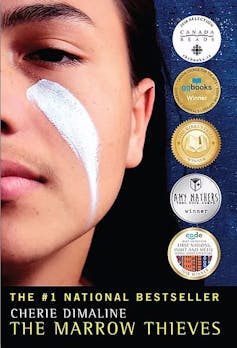
The Marrow Thieves is a young-adult novel set forty years into the future. In the wake of environmental disaster, Indigenous peoples are being captured and sent to residential schools. They are being hunted and killed for their bone marrow, which allows non-Indigenous people, who have all lost their ability to dream, to dream again and, thus, to imagine again.
Cree poet Billy-Ray Belcourt asks, “What is an NDN if not the ceiling of a country’s political imagination?” In The Marrow Thieves, the political ceiling is high.
The limit of the colonial imagination is the cannibalistic harvesting of Indigenous bodies to support non-Indigenous nation-state survival.
There is an inevitability to the narrative arc of the novel that suggests that it is as realistic to imagine a future of ecological devastation as it is to imagine a future of residential schools — a future where Indigenous peoples continue to be hunted down, like Colten Boushie, because they are considered somehow less than human by colonial Canada.
Tanya Talaga’s Seven Fallen Feathers focuses on seven Indigenous young people who went missing and ultimately died in Thunder Bay, Ont.
An inquest into the seven youths’ deaths found that First Nations people in Thunder Bay “are often treated as less than worthy victims” and exposed systemic problems surrounding supports for the youth and responses to their deaths.
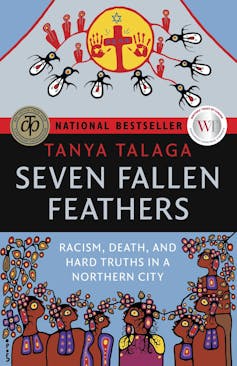
A civilian police review body found in December 2018 that police failed to adequately investigate the deaths of nine Indigenous people in Thunder Bay, including four youths discussed in Talaga’s book, at least in part because of racist attitudes and stereotyping.
The seven fallen feathers were all from communities in northern Ontario. Because of the refusal of the government to adequately fund on-reserve education, Indigenous young people are frequently unable to complete a high-school education in their communities. They must go south, far from their homes, to what is often a hostile and culturally unfamiliar place.
Remember that Thunder Bay is where a young white man, Brayden Bushby, stands accused of second degree murder for allegedly throwing a metal trailer hitch from a moving vehicle at an Indigenous woman, Barbara Kentner, who was simply walking by. She was hospitalized and died from her injuries about six months after being attacked.
The violent deaths of Barbara Kentner and Colten Boushie remind us that in present-day Canada, it’s threatening and even perilous for Indigenous people to walk around.
Talaga’s book reveals the many comparisons between students from remote Northern reserves boarding and attending school in Thunder Bay — far from their communities, far from their families, far from their languages and far from their cultural traditions — and the Indian residential school system.
Talaga thus draws important connections to the assimilative system that stole generations of children to obliterate any traces of their identities as self-determining and self-sustaining peoples with a wealth of languages, knowledge systems and cultural traditions.
Dimaline’s and Talaga’s books teach us that versions of residential schooling exist not only in the present, but also in the future if Canada does not take seriously and implement the United Nations Declaration on the Rights of Indigenous Peoples.
Memoirs and fictions about residential school experiences and legacies are thus necessary readings in neo-colonial Canada. Teaching and reading residential school literature foster richer understandings of present and future colonialisms.
To understand the colonial past is to open the door to understanding the colonial present and future. This understanding is a crucial part of the pathway to real change.
Michelle Coupal, Canada Research Chair in Truth, Reconciliation and Indigenous Literatures and Associate Professor, Department of English, University of Regina
This article is republished from The Conversation under a Creative Commons license. Read the original article.
The link below is to an article that takes a look at some book art (sculptures).
For more visit:
https://www.hongkiat.com/blog/book-paper-sculptures/

Dr Michael X. Savvas, Flinders University
A recent project to encourage South Australian prisoners to write provides insights into how prisoners may benefit from written expression.
The project, Life Sentences, gave more than 70 contributors professional feedback, certificates of merit and publication in a booklet produced annually from 2017 to 2019.
The submissions revealed a surprising diversity of topics, considerable talent and self-awareness.
Life Sentences began as an offshoot of Art by Prisoners, a visual arts competition organised by Jeremy Ryder, who wanted to showcase art from prisoners across South Australia.
We wondered if prisoners may also want to express themselves through writing. Department for Correctional Services officers promoted Life Sentences and prisoners responded with interest. After the program, Life Sentences booklets were available to the public at the Art by Prisoners exhibitions.
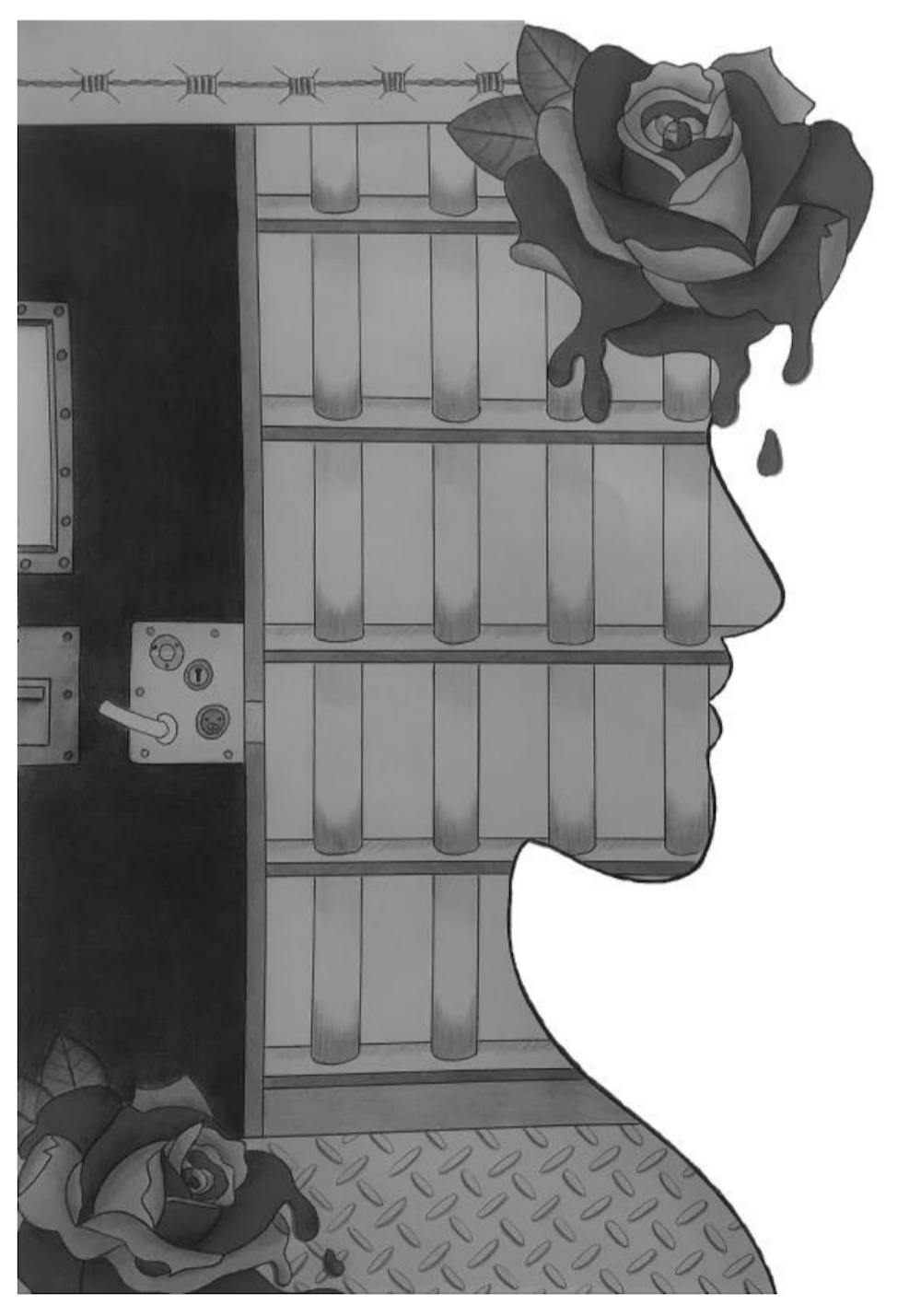
Firsthand writing from and about prisons isn’t new. Prison literature has a rich tradition, with writers such as Jack London, O. Henry and Oscar Wilde writing about their experiences in jail. The nine years Dostoyevsky spent in Siberian imprisonment and exile gave him the focus and depth of understanding to become one of the greats.
Conversely, illiteracy in Australian prisons is prevalent. A recent government report found around one in three Australian prisoners had only completed Year 9 (or under) at secondary school. One aim of Life Sentences was to provide encouraging feedback for prisoners of varying literacy levels. Although not all of the writing submitted was grammatically perfect, feedback focused on what the prisoners did well in their writing. This was seen as a first step in getting prisoners to enjoy writing and begin the adventure of literacy.
What Life Sentences contributors wrote about was telling. Most entries directly related to what American criminologist Greshem Sykes called the “pains of imprisonment” in 1958. This wasn’t surprising, and it is hoped writing about such pains was healing for the writers. What was more surprising was the number of entries not directly about imprisonment.
Of 77 contributors over three years, 26 expressed pain, fear and depression from imprisonment (even suicidal thoughts), and often how much they missed their children or loved ones. The heartbreaking lines from a 26-year-old woman’s poem called Little Treasure illustrate this:
But I will never forget
His sweet little smile
My darling little boy
Is now their child.
Although male and female prisoners both expressed tender feelings towards their lost partners, the male writers would at times also express sexual longing for their loved ones or for imagined partners. In Prisoner’s Lament, a 61-year-old male wrote:
I can but lament the way my life went,
Before I ended up here,
Instead of a gun and a greed-driven bent,
I’d be armed with a babe and a beer.
Eight of the poems – both fictional and autobiographical pieces – describe prison life using humour. In Lean Cuisine, a man, 45, wrote of the food, gloryless food he got over the course of a week:
Friday’s no surprise with some sort of sloppy pasta
Nothing is as bad as that tomato disaster.
Saturday is early lockup: chicken wings and rice
Some blokes sprint for seconds, yelling ‘This shit’s so fucking nice!‘
Although some contributors wrote about their abusive childhoods, others wrote with nostalgia about their upbringings. A 51-year-old man’s poem, Edge of the World, tells of spending a day on a jetty with his father and siblings:
Like well-practised commandos
we inched along the side rail
dodging gut stains
jagged notches and salty scales.

Eight entries philosophised about life, and two honoured religious deities. Two contributors wrote about their lives, with the goal of inspiring others to stay out of jail and lead happier, more productive lives.
Five entries pondered the personal meanings of art or writing. Other themes explored drugs and alcohol, futuristic societies, rock band membership, friendship, political statements (Fuck the System), dreams and the supernatural (The Love of a Lycan was a song about a werewolf). Three entries were hip hop raps.
The Western Australian literary journal Westerly included several of the 2017 entries in a special edition about South Australian writing.
Hidden talents emerged. A 22-year-old male rapper demonstrated advanced verbal skills in his Laggin Rap:
I want my chance to climb but I’m firmly underground
proud to get his lips clappin louder than a thunder cloud.
Man, Hip Hop’s beautiful — totally therapeutical —
better health benefits than pharmaceuticals.
Another contributor submitted two novels in 2017 and two more in the following competitions. Although already an accomplished writer, he incorporated the feedback he received in the first year. His manuscript was an exciting adventure set in 18th century France. The novel begins:
The battlefields were torn by heavy hooves and ran red with blood. Pieces of meat that used to be men lay tossed about and were scattered in windrows. Mud made it difficult to distinguish between uniforms, yet they found uniformity in a death that made a mockery of it all. It was not yet lunchtime.
The same author printed, bound and illustrated his own novels. He and other contributors also revealed a pattern by the third edition of Life Sentences: a growing awareness of their new identities as writers.

Australian prison libraries are often inadequate for supporting prisoners who seek to improve their literacy skills.
Knowing what prisoners like to write about could inform decisions about the types of books to stock in prisons to encourage reading and writing. Prisoners who wish to write motivational books could be exposed to notable authors in this genre, such as Tony Robbins and Dale Carnegie.
Education is a powerful way to prevent prisoners from reoffending once they leave jail.
To stay out of prison, ex-prisoners need to achieve what criminologists call “secondary desistance”, meaning both the prisoner and society see the prisoner as changed and occupying a law-abiding role in society. Writing might be one way to achieve this and open up new career paths. Writing may also allow prisoners and “civilians” to connect. As one Life Sentences writer put it:
Without seeing their individual faces, I recognise that I am part of the greater consciousness that makes up the brotherhood of writers across the world.
Dr Michael X. Savvas, Senior Lecturer in the Transition Office (PhD in Creative Writing), Flinders University
This article is republished from The Conversation under a Creative Commons license. Read the original article.
Photo by Bruce Milton Miller/Fairfax Media via Getty Images.
Kingsley Ugwuanyi, Northumbria University, Newcastle
Nigeria was recently in the spotlight when the Oxford English Dictionary announced that its January 2020 update included 29 Nigerian English words.
The reception, in both the traditional and new media, was nothing short of sensational. Most Nigerians expressed a great sense of pride in the fact that the unique ways in which they use English were being acknowledged internationally.
The Oxford English Dictionary said in the release note:
By taking ownership of English and using it as their own medium of expression, Nigerians have made, and are continuing to make, a unique and distinctive contribution to English as a global language.
Interestingly, the idea of Nigerians owning English is the fulcrum of my doctoral research. In it, I found that increasingly Nigerians are demonstrating a strong sense of ownership of the English language, and in particular their use of it.
The inclusion of Nigerian English words in the Oxford English Dictionary is, in a sense, a recognition of the tremendous efforts by scholars of Nigerian English many of whom have produced discipline-shaping research. This has included four published dictionaries of Nigerian English.
These developments indicate that Nigerian English has indeed come of age. They also validate the concentric circle model developed by Professor Braj Kachru, the father of world Englishes research. This avers that the ‘outer-circle’ varieties of English (where Nigerian English belongs) is ‘norm-developing’. In other words, that Nigerian English is adding to the norms of English.
I think the English, indeed the English-speaking world, should be thankful to Nigeria for this historic gift.
So how were the words chosen?
As the Nigerian consultant to the project which saw the inclusion of the words, I have insights into the process the team underwent in adding them. These include the rationale for adding them, and the enormous significance the inclusion holds for the English language.
The Oxford English Dictionary has a wide variety of resources to track the emergence of new words and new senses of already existing words.
The Oxford English Corpus is one. This is an electronic database of different types of written and spoken texts specifically designed for linguistic research. In the case of Nigerian English and other World English varieties, for instance, suggestions of new words and senses come from the corpus, reading books and magazines written in the English varieties in question as well as looking at previous studies, and the review of existing dictionaries, if any.
Once there is a list of candidates, a team of expert editors at the Oxford English Dictionary looks closely at the databases to ensure that there are several independent instances of the words being used. And how they are being used.
Other factors that are considered include the time period over which words have been used, as well as their frequency and distribution. But there’s no exact time-span and frequency threshold. Some words – such as Brexit – are relatively young but were included quickly because of the huge social impact they had in a short space of time. Others are not used frequently but are included because they are of specific cultural, historical, or linguistic significance to the community of their users. An example is ‘Kannywood’, the word describing the Nigerian Hausa-language film industry, based in the city of Kano.
It’s clear therefore that the editors don’t simply select the words or senses that appeal to them. Instead, they are guided by use, which links in with the prevailing thought in lexicography and linguistics more generally: that the remit of dictionaries and linguistic research is not to prescribe how languages should be used but to describe how languages are being used.
Words are added because the Oxford English Dictionary recognises that English is a universal language. It believes that including words from varieties of English all over the world enables it to tell a more complete story of the language.
These varieties also reflect the unique culture, history, and identity of the various communities that use English across the world. Nigerian English is a good example. Like other English varieties, it is a living ‘being’ with its own unique vocabulary, encompassing all sorts of lexical innovations. These include borrowings from local languages, new abbreviations, blends and compounds.
Failure to capture such words would deny English an opportunity to grow. It would also deny the flavour of what the speakers of these varieties contribute to the development of English.
One of the reasons previous world languages such as Egyptian and Ancient Greek ceased to exert dominance internationally was their inability to keep pace with developments around the world.
Perhaps this is one factor that clearly distinguishes English. It has demonstrated a capacity for growth by keeping its borders open, helping it to develop from a West Germanic dialect spoken in a small island into a world language. English is now spoken by about 1.75 billion people – a quarter of the
world’s population. This includes first and second language speakers.
One way English grows is by admitting new words and senses not just from other English varieties but from virtually all languages of the world. For instance, English has had the word ‘postpone’ since the late 15th century, but it was through India that its opposite ‘prepone’ entered English in current use during the 20th century.
Similarly, Nigerian English is reintroducing the verb meaning of ‘barb’, which existed in 16th century British English.
This is how English maintains its dominance. In addition, the Internet has given today’s Oxford English Dictionary editors wider access to non-traditional sources of linguistic evidence. This has enabled them to widen and improve the dictionary’s coverage of world varieties of English, affirming Oxford English Dictionary’s claim as “the definitive record of the English language”.
Kingsley Ugwuanyi, Lecturer/Doctoral Researcher, Northumbria University, Newcastle
This article is republished from The Conversation under a Creative Commons license. Read the original article.
Liu zishan via Shutterstock
Gavin Miller, University of Glasgow
Science fiction has struggled to achieve the same credibility as highbrow literature. In 2019, the celebrated author Ian McEwan dismissed science fiction as the stuff of “anti-gravity boots” rather than “human dilemmas”. According to McEwan, his own book about intelligent robots, Machines Like Me, provided the latter by examining the ethics of artificial life – as if this were not a staple of science fiction from Isaac Asimov’s robot stories of the 1940s and 1950s to TV series such as Humans (2015-2018).
Psychology has often supported this dismissal of the genre. The most recent psychological accusation against science fiction is the “great fantasy migration hypothesis”. This supposes that the real world of unemployment and debt is too disappointing for a generation of entitled narcissists. They consequently migrate to a land of make-believe where they can live out their grandiose fantasies.
The authors of a 2015 study stress that, while they have found evidence to confirm this hypothesis, such psychological profiling of “geeks” is not intended to be stigmatising. Fantasy migration is “adaptive” – dressing up as Princess Leia or Darth Vader makes science fiction fans happy and keeps them out of trouble.
But, while psychology may not exactly diagnose fans as mentally ill, the insinuation remains – science fiction evades, rather than confronts, disappointment with the real world.
The psychological accusation that science fiction evades real life goes back to the 1950s. In 1954, the psychoanalyst Robert Lindner published his case study of the pseudonymous “Kirk Allen”, a patient who maintained an extraordinary fantasy life modelled on pulp science fiction.
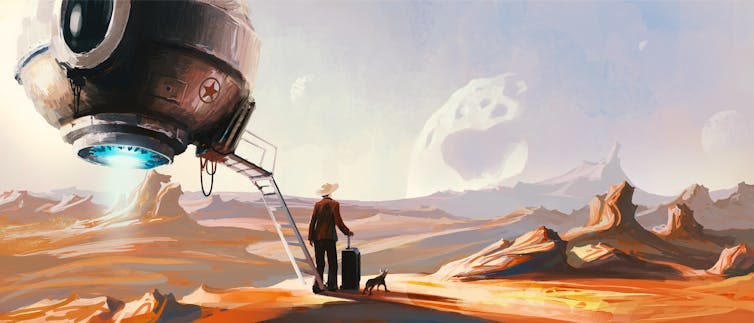
Allen believed he was at once a scientist on Earth – and simultaneously an interplanetary emperor. He believed he could enter his other life by mental time travel into the far-off future, where his destiny awaited in scenes of power, respect, and conquest – both military and sexual.
Lindner explained Allen’s condition as an escape from overwhelming mental anguish rooted in childhood trauma. But Lindner, himself a science fiction fan, remarked also on the seductive attraction of Allen’s second life, which began to offer, as he put it, a “fatal fascination”. The message was clear. Allen’s psychosis was extreme, but it showed in stark clarity what drew readers to science fiction: an imagined life of power and status that compensated for the readers’ own deficiencies and disappointments.
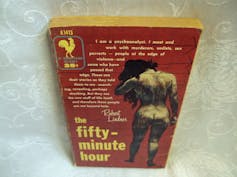
Lindner’s words mattered. He was an influential cultural commentator, who wrote for US magazines such as Time and Harper’s. The story of Kirk Allen was published in the latter, and in Lindner’s book of case studies, The Fifty-Minute Hour, which became a successful popular paperback.
Psychology had very publicly diagnosed science fiction as a literature of evasion – an “escape hatch” for the mentally troubled. Science fiction answered back, decisively changing the genre in the following decades.
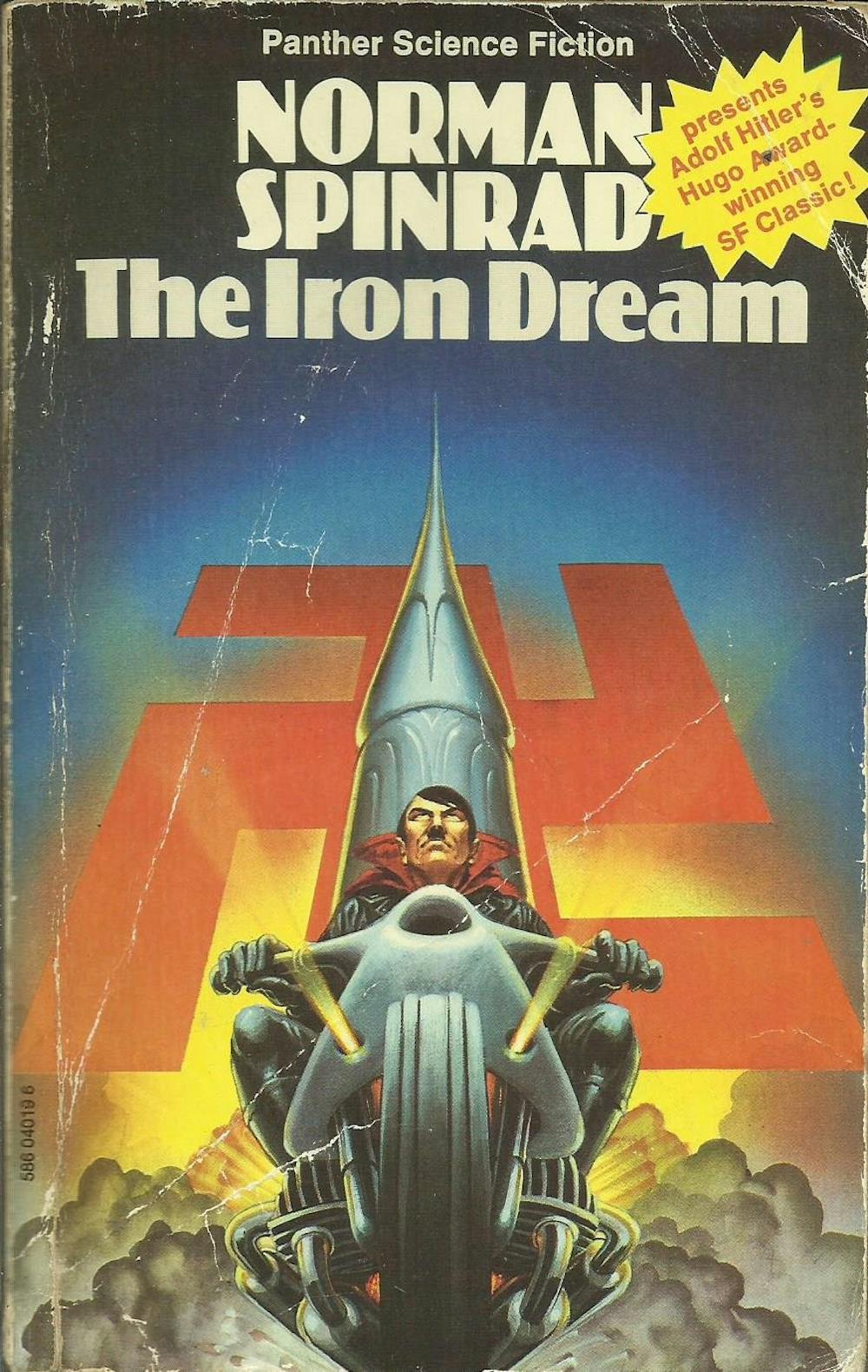
To take one example: Norman Spinrad’s The Iron Dream (1972) purports to reprint a prize-winning 1954 science fiction novel. The novel is apparently written, in an alternate history timeline, by Adolf Hitler, who gave up politics, emigrated to the US, and became a successful science fiction author and illustrator. A fictional critical afterword explains that Hitler’s novel, with its “fetishistic military displays and orgiastic bouts of unreal violence”, is just a more extreme version of the “pathological literature” that dominates the genre.
In her review of The Iron Dream, the now-celebrated science fiction author Ursula Le Guin – daughter of the distinguished anthropologist Alfred Kroeber – wrote that the “essential gesture of SF” is “distancing, the pulling back from ‘reality’ in order to see it better”, including “our desires to lead, or to be led”, and “our righteous wars”. Le Guin wanted science fiction to make strange the North American society of her time, showing afresh its peculiar psychology, culture, and politics.
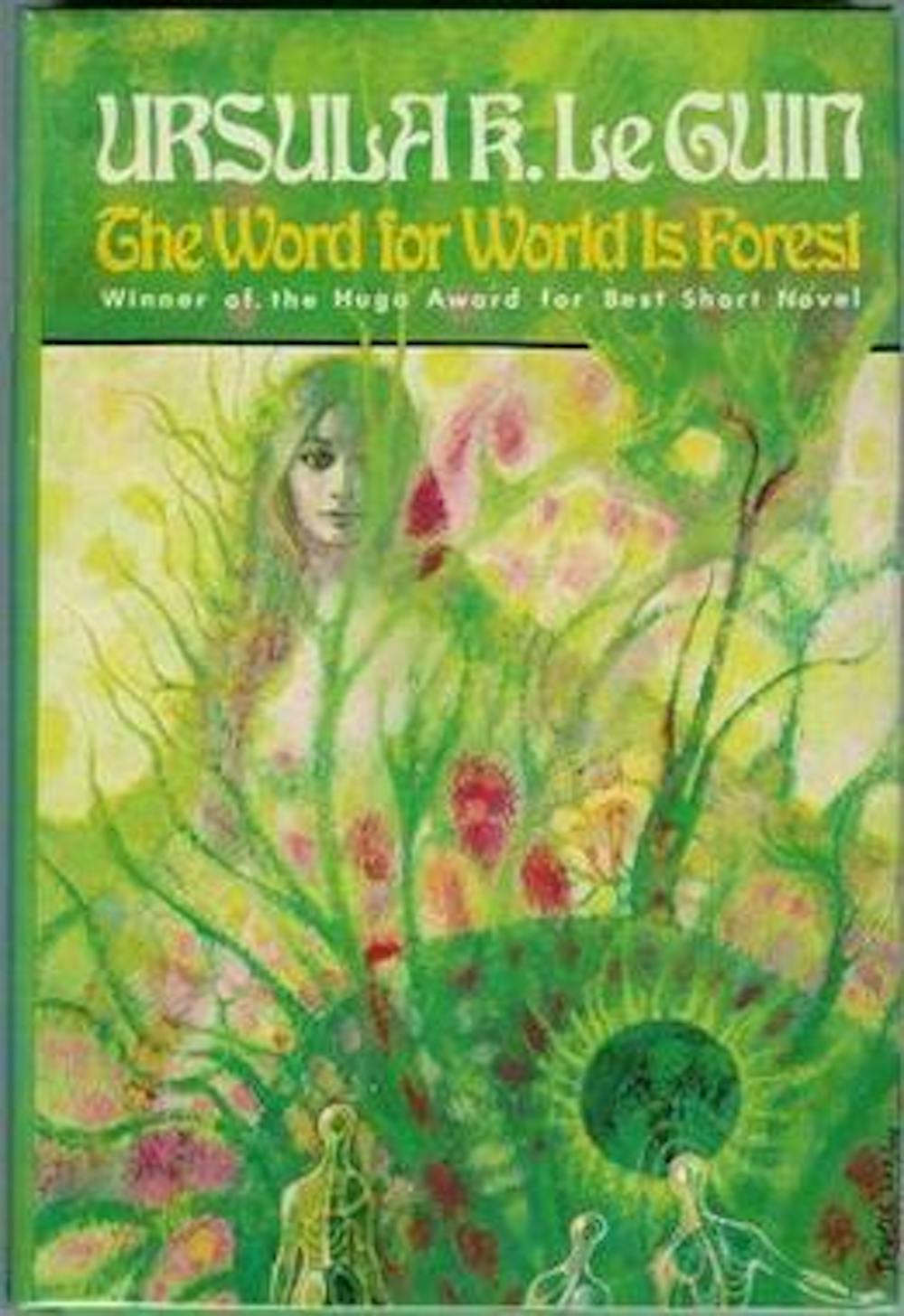
In 1972, the US was still fighting the Vietnam War. In the same year, Le Guin offered her own “distanced” version of social reality in The Word for World is Forest, which depicts the attempted colonisation of an inhabited alien planet by a macho, militaristic Earth society intent on conquering and violating the natural world – a semi-allegory for what the USA was doing at the time in south-east Asia.
As well as repudiating the worst parts of the genre, such responses implied a positive model for science fiction. Science fiction wasn’t about evading reality – it was a literary anthropology which made our own society into a foreign culture which we could stand back from, reflect on, and change.
Rather than ask us to pull on our anti-gravity boots, open the escape hatch and leap into fantasy, science fiction typically aspires to be a literature that faces up to social reality. It owes this ambition, in part, to psychology’s repeated accusation that the genre markets escapism to the marginalised and disaffected.
Gavin Miller, Senior Lecturer in Medical Humanities, University of Glasgow
This article is republished from The Conversation under a Creative Commons license. Read the original article.
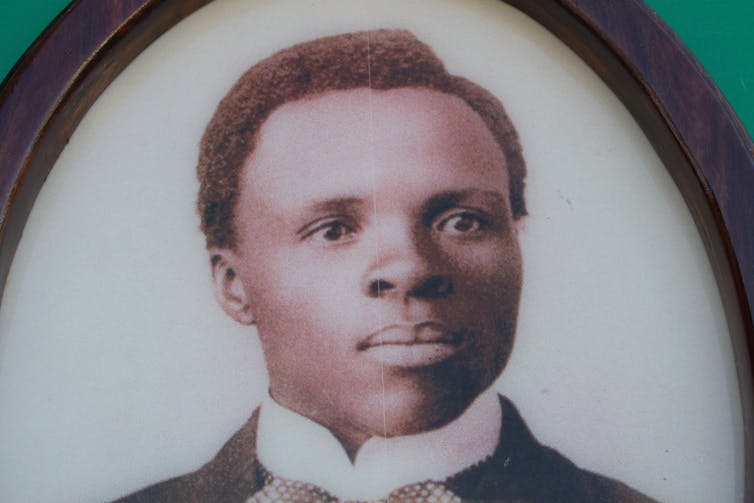
Flowcomm/Flickr/Sol Plaatje House Museum
Chris Thurman, University of the Witwatersrand
Over the last decade, inquiry into the life and work of South African writer, intellectual and politician Solomon T. Plaatje has been spurred by a series of hundred-year anniversaries.
In 2010 it was the centenary of the formation of that dubious political and geographical structure, the Union of South Africa, which would shape the focus of Plaatje’s many projects until his death in 1932. It was also in 1910 that he founded his second Setswana-language newspaper, Tsala ea Becoana.
Two years later, Plaatje was one of the eminent group who formed the South African Native National Congress, which would later become the African National Congress (ANC). In 2012, when the ANC celebrated its centenary, Plaatje’s name was often cited, although he has been more readily associated with a cosmopolitan, erudite – “elitist”? – strand in the ANC that did not fit with the populist brand emphasised by the party in the shift from Thabo Mbeki’s presidency to Jacob Zuma’s.
There was another hundred-year anniversary in 2016, this time of the publication of Native Life in South Africa. The book was Plaatje’s seminal response to the passage of the Natives Land Act of 1913. This notorious piece of legislation set a traumatic tone for the dispossession, segregation and violent oppression that would characterise late-colonial and apartheid South Africa as the 20th century wore on.
Here was Plaatje in strident “Give back the land!” mode, an appealing figure to those advocating for more radical approaches to redressing the disenfranchisement of black South Africans.

The year 1916 is also significant in the field of Plaatje studies because it was when he contributed his short bilingual English-Setswana essay “A South African’s Homage” to the Book of Homage to Shakespeare.
Here again, we have the paradox of Plaatje writ large. The “Homage” signals his future undertaking as a translator of Shakespeare’s plays into Setswana. He saw this as complementary work to his wider promotion of the language. Yet his affinity for Shakespeare cannot be disconnected from his attachment to Britain and to its empire, his role indeed as an imperial apologist, which can seem difficult to reconcile with some of his other political and literary credentials.
To make sense of this requires a deeper understanding of Plaatje’s historical context as well as his life’s trajectory, and the people, convictions, accidents and circumstances that shaped it. Happily, this is made possible by historian Brian Willan, who has chosen Plaatje as the main focus of his own life’s work and who knows his subject better than anyone else. Willan wrote a biography of Plaatje in 1984. The book seemed definitive until, in 2018, Jacana Media published his Sol Plaatje: A Life of Solomon Tshekisho Plaatje, 1876-1932.
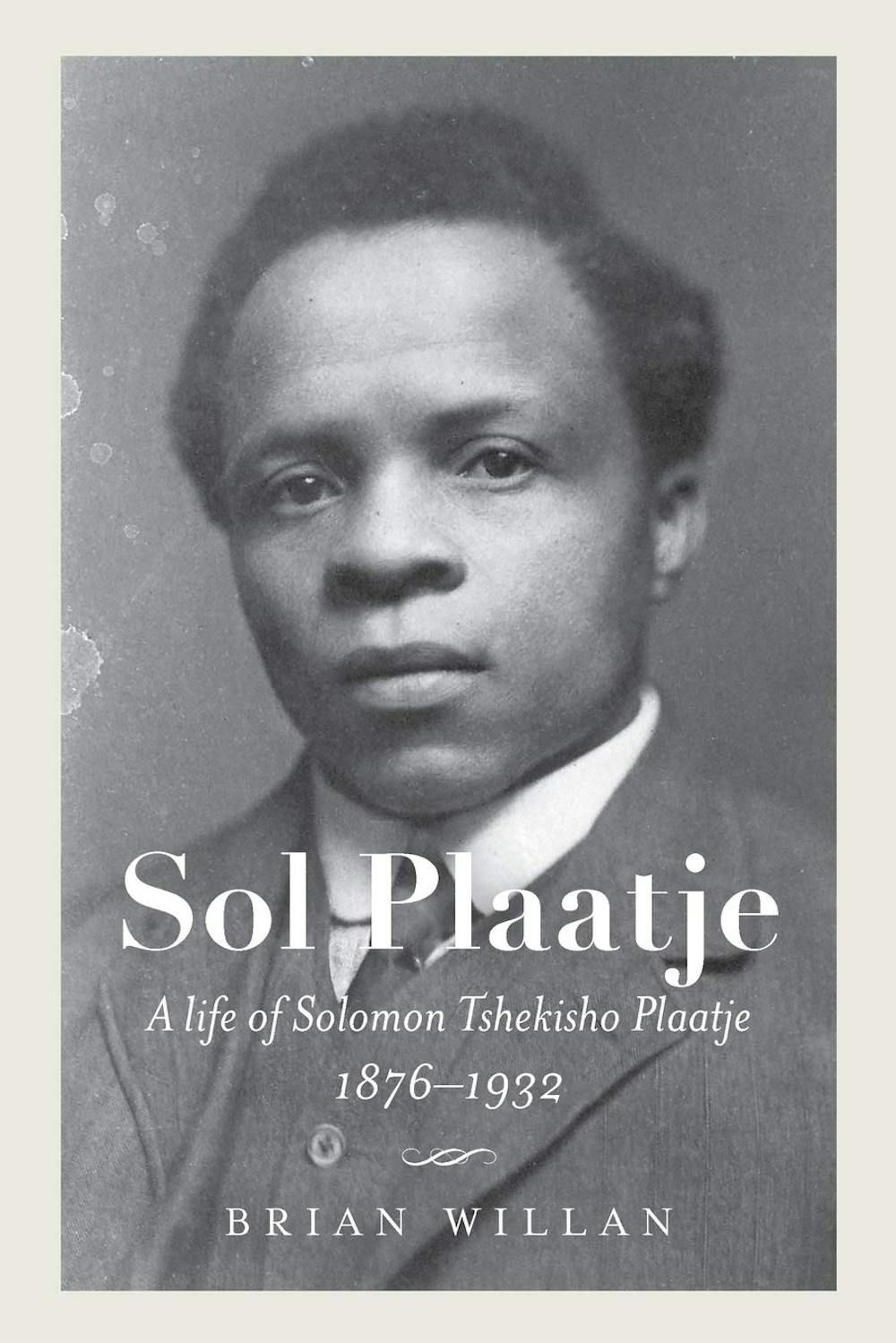
“Magisterial” is a word too often applied to biographies that don’t quite merit the moniker. But in the case of Willan’s book it is entirely apt. This may not be the final word on Plaatje. Nevertheless, it is a text to which all future scholars and researchers working on Plaatje will have to refer.
At almost 600 pages it is an encyclopaedic tome, documenting Plaatje’s life and times in rich detail. The true achievement of the book, however, is that it manages to do this in an engaging manner and with a prose style that – while never “chatty” – imagines a kind of conversation with the reader.
One can follow the chronological narrative, through 18 chapters marking out distinct periods in Plaatje’s astonishingly productive life. Alternatively one can dip into and out of its pages, navigating its riches via the index, or even flipping idly between phases and themes.
Fortunately, Willan is neither zealous nor jealous when it comes to his subject. His collaborations with other scholars have yielded fruit in various other Plaatje-oriented publications. In 2016, Wits Press published a collection of essays on Native Life co-edited by Willan, Bhekizizwe Peterson and Janet Remmington.
Later this year, Jacana will publish a similar collection, co-edited by Willan and fellow Plaatje biographer Sabata-mpho Mokae, focusing on Plaatje’s novel Mhudi. I am fortunate to be one of the contributors to this volume.
Mhudi appeared in 1930 after an exhausting 10-year battle to get it into print. So 2020 marks another centenary of sorts.
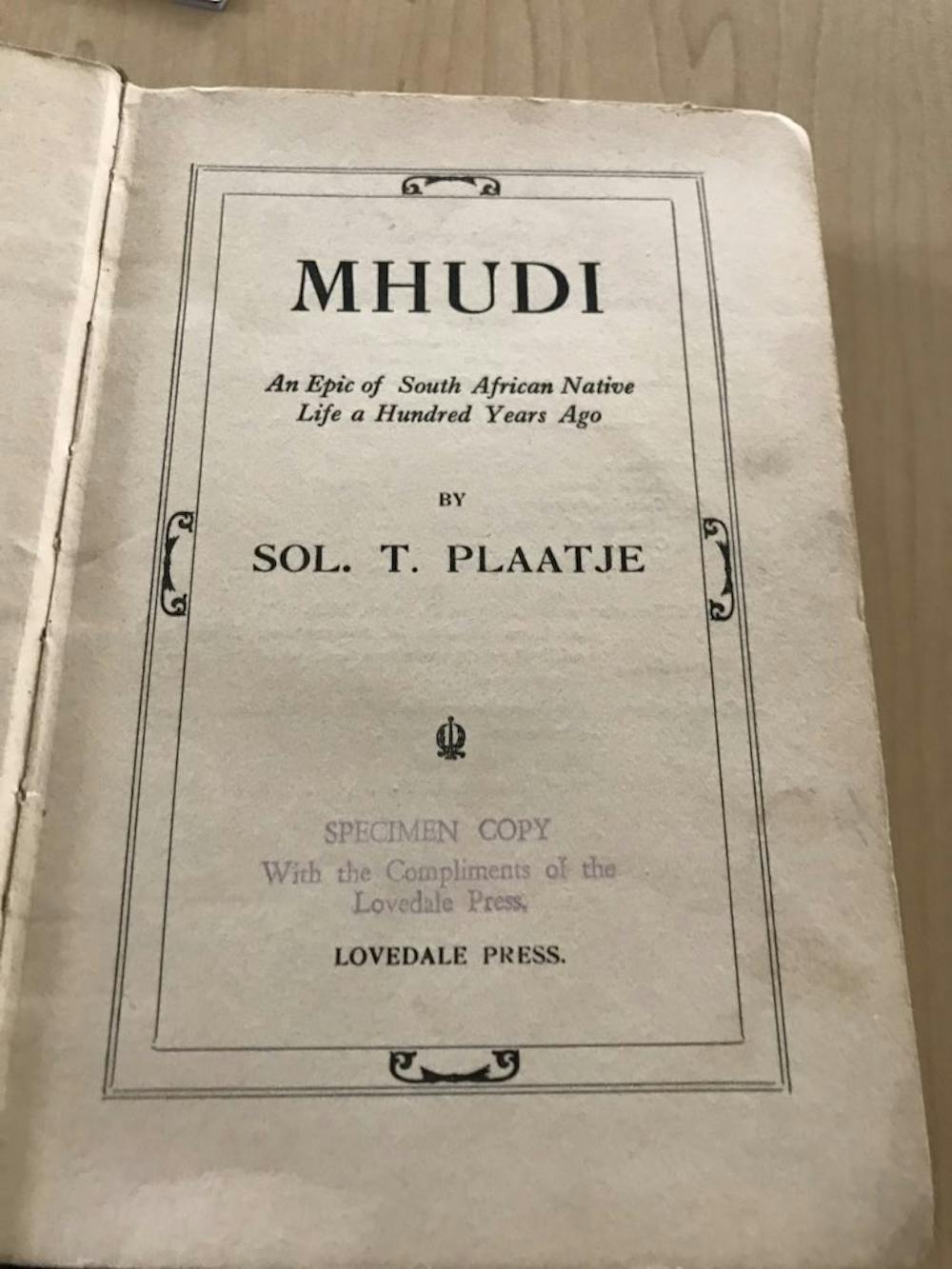
What are we to make of this novel, with its eponymous heroine and her husband Ra-Thaga, whose lives coincide with major colonial-era clashes in the first half of the 1800s?
It seems, by turns, to be an imperial romance and an allegory that is critical of empire; a naïve vision of interracial cooperation and a reminder that history is relentless in its cycles of violence.
Is it an affirmation of tribal tradition, or a feminist riposte to patriarchal culture? Is it a patchy experiment in need of an editor, or a genre-busting proto-postmodern pastiche influenced as much by oral narrative traditions as by the polyvocality of Shakespearean drama?
What is beyond question is the significance of Mhudi as the first novel in English by a black South African writer.

The novel’s original publisher, Lovedale Press, sadly faces the prospect of closure. But it is encouraging to note that other independent publishers have committed their resources to keeping Mhudi current. Blackman Roussouw’s Strandwolf imprint has brought out a new edition. Jacana also has plans to publish another edition alongside Willan and Mokae’s critical volume on the novel.
It is to be hoped that, by the time we reach the centennial celebration of Mhudi being published by Lovedale (1930) and the centennial commemoration of the author’s death in 2032, the new wave of scholarship on Plaatje will have challenged readers to grapple with this enigmatic, protean polymath anew.
Chris Thurman, Associate professor, University of the Witwatersrand
This article is republished from The Conversation under a Creative Commons license. Read the original article.
Donna Mazza, Edith Cowan University
Warning: this piece features frequent coarse language that may offend some readers.
Since Adam Mansbuch’s 2011 bestseller, Go the Fuck to Sleep, book titles have been swearing profusely to grab audience attention. The author followed up on the winning formula with You Have to Fucking Eat and Fuck, Now There Are Two of You.
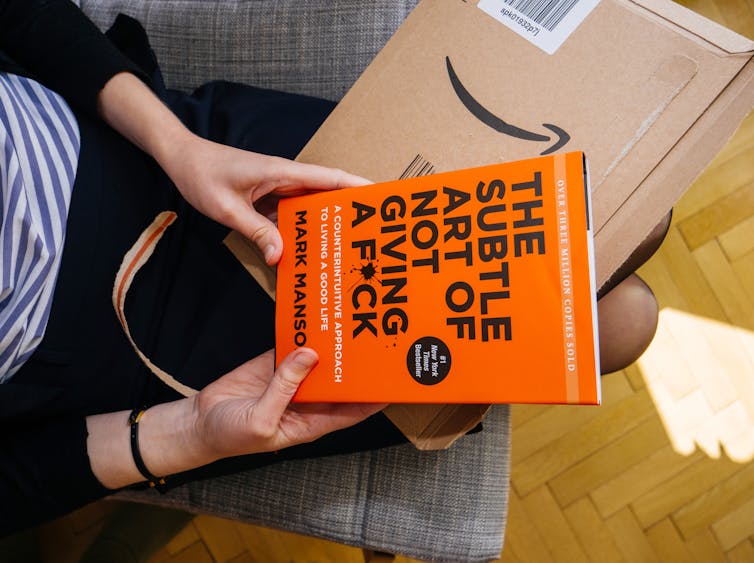
Book covers compete with a barrage of information and images, so it’s no wonder many writers resort to shock tactics. It works. The Subtle Art of Not Giving a Fuck is testament to this, selling 2 million copies and translated into 25 languages. Without the “Fuck” this would very likely have been a different story.
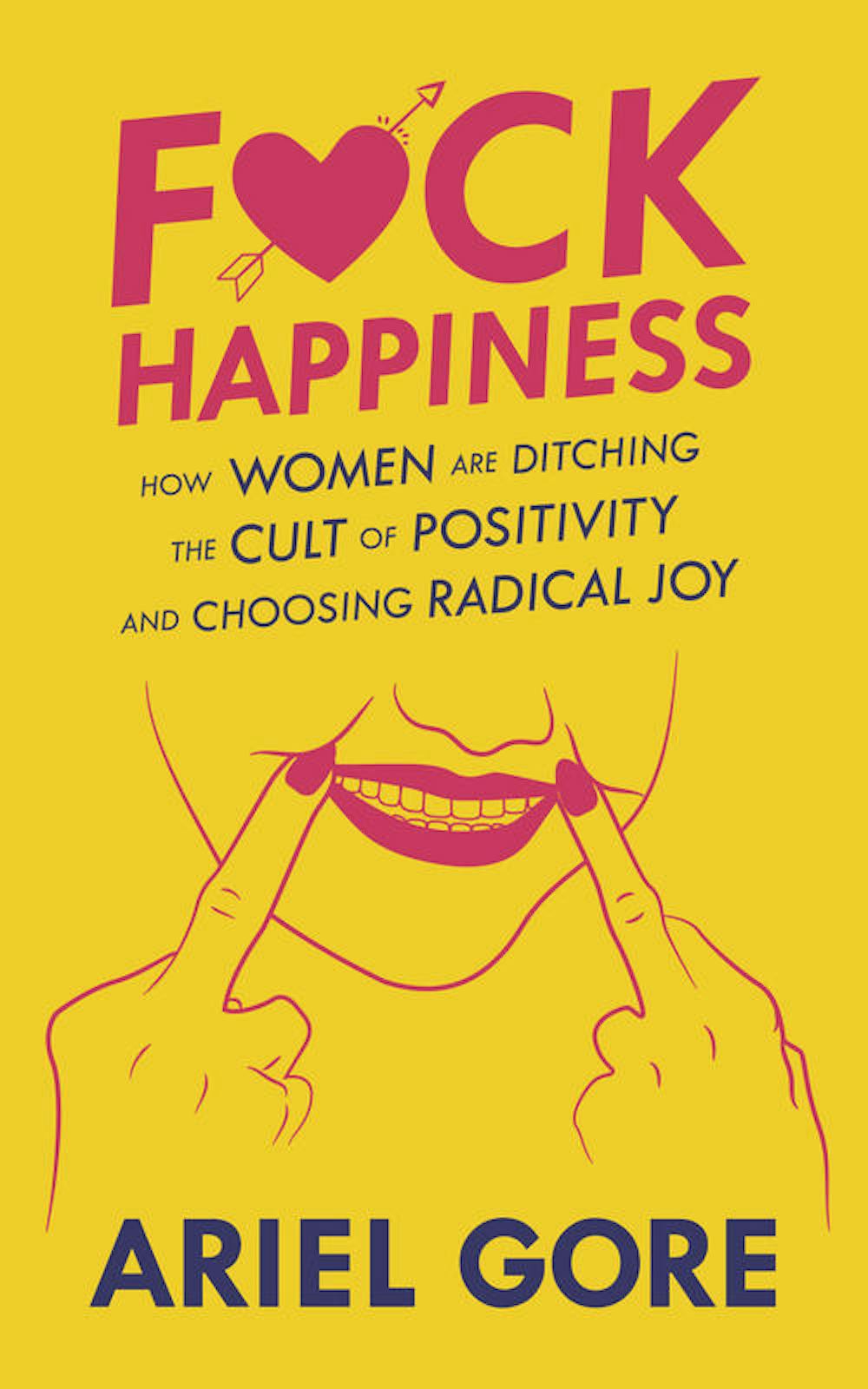
Presumably hoping to ride on the back of this success, upcoming releases include Fuck Happiness and The Middle Finger Project.
In the English language, at least, fuck and other words on the more extreme end of profanity are the last frontier of using language to shock. In 2020, we find ourselves in a place of extremes so they come in quite handy.
But with so many fucks on book covers, where do writers go from here to express our fear, horror, rage and disgust?
Eventually we become desensitised to the overuse of words. Shit, a taboo for older generations, is now so lacking as an obscenity it is written on the covers of notebooks and pencil cases available in stationery chain stores popular with schoolchildren, such as Typo.
According to a 2019 ABC study of 1,538 subjects, Australians are seeing and hearing more coarse language than they did five years ago, both in the media and in public.
“In line with this normalisation of coarse language, concerns relating to the use of coarse language in the media have diminished over time,” the study found. Of people studied, 38% were offended by coarse language on TV, radio or the internet in 2019, compared with 47% in 2011.
Tennis, one of the last bastions of politeness, does constant battle with players like Nick Kyrgios who rack up massive fines for dropping the F-bomb on the court.
Fines, like detention, seem to be on the train that has left the station when you consider reputable online booksellers currently carry almost a hundred books with fuck in the title. Most of these are self-help books, because we are, obviously, quite fucked and need help, and cookbooks, such as Yumi Stynes’ The Zero Fucks Cookbook. Kitchens seem to be a hotbed of fucks, a trend set some time ago by Gordon Ramsay.
Meaning and language are in a constant evolution and can act as a moral barometer. Expressing the fears and horrors of her times 200 years ago, author Mary Shelley created a “fiend”, formed through “unspeakable” horrors. Some initially derided the work as “disgusting”, but the extremes of her Frankenstein left an impact on literature and society of mythic proportions, without resorting to profanity or cheap tricks. She left the unspeakable to our imaginations, yet it broke boundaries and challenged our understanding of life and human nature.

In 1959, the unabridged edition of D.H. Lawrence’s Lady Chatterley’s Lover was published with several instances of fuck. The edition was banned. In 1963, fuck was included in the Dictionary of Slang and Unconventional English, triggering complaints to schools, libraries and the police.
Taboos and standards are forever in flux and younger generations always seek a boundary to break through. In our times of consumption and greed, we are eating our way through those boundaries at a great rate, along with as many of the Earth’s resources as we possibly can.
Several hundred book covers later, fuck is completely worn out.
Sure, there is still coarser language that will work for a few years until it also becomes a meme; until we wear it out as a book title or, perhaps, if we think too hard about what it means and how we might use it.

Language can only evolve creatively with a dynamic culture, deep education and critical practitioners of the literary arts, within and outside of the academy. Words are weapons; they are our way of making sense of life and without them we are unspeakable.
Language and how we use it really matters. It creates knowledge, culture and community. If we are to navigate our way through the future and avoid reaching a place of anarchy, we need a language for it.
Resorting to coarse language on book covers could be a symptom of society’s collective misery, but it could also be attributable to the starvation of the arts by government and a desperate need to grab readers’ attention. If literature loses the power to shock then it loses an important mode of engagement, according to postcritical theorist Rita Felski. It’s enough to make you want to swear and curse and scream. Unfortunately, as a word to save for extremes, we have really fucked up fuck.
Donna Mazza’s new novel has an f-word in the title but it’s Fauna.
Donna Mazza, Senior Lecturer in Creative Arts, Edith Cowan University
This article is republished from The Conversation under a Creative Commons license. Read the original article.
The link below is to an article with some tips on retaining what you read. I’m not sure to the merit of each of the tips, though some are useful – the last is not (in my opinion).
For more visit:
https://www.dumblittleman.com/remembering-what-you-read/

 At the BookShelf
You must be logged in to post a comment.