
The link below is to a book review of ‘A Higher Loyalty,’ by James Comey.
For more visit:
https://www.theguardian.com/books/2018/apr/17/higher-loyalty-james-comey-jonathan-freedland-review

The link below is to a book review of ‘A Higher Loyalty,’ by James Comey.
For more visit:
https://www.theguardian.com/books/2018/apr/17/higher-loyalty-james-comey-jonathan-freedland-review
Lynda Clark, Nottingham Trent University
If you’re a fan of the TV series, Westworld, you’re probably aware that it’s based on Michael Crichton’s 1973 film of the same name. What you may not know is that the concept has been kicking around for a very long time. While Crichton insists his dystopian vision had no “literary antecedents”, there’s at least one writer who may beg to differ. Charles Dickens imagined a robot theme park way back in 1838. Just like Westworld, the patrons of Dickens’ park are able to enact their “violent delights” on realistic humanoid androids.
In the short story titled: Full Report of the First Meeting of the Mudfog Association for the Advancement of Everything, a group of scientists meet to discuss a variety of proposals, including the classification of a one-eyed horse as “Fitfordogsmeataurious” and a snuffbox-sized machine for more efficient pickpocketing. The most vividly described of these outlandish ideas, though, is entrepreneurial inventor Mr Coppernose’s suggestion for a park filled with “automaton figures” which would enable wealthy young men to run riot without causing a public nuisance. Sound familiar? So, how do the two parks measure up?
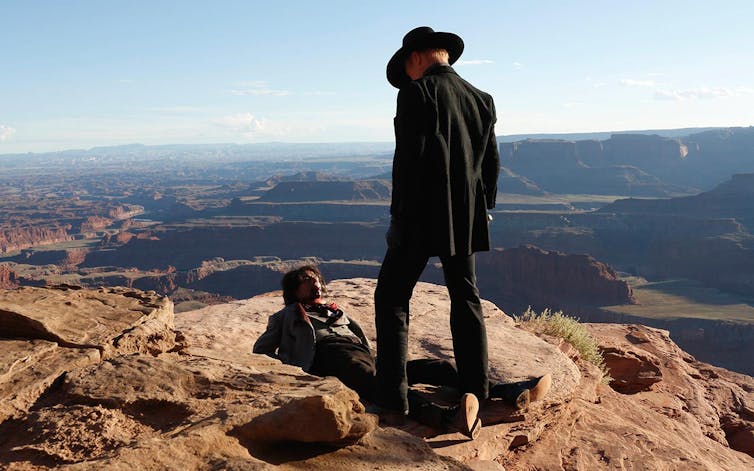
In purely physical terms, Dickens’ park is much smaller. The series’ showrunner, Jonathan Nolan, has indicated that Westworld covers around 500 square miles, while Coppernose suggests a more modest “space of ground of not less than ten miles in length” for his park. But both demonstrate a similar attention to detail when it comes to creating a realistic environment for their patrons to explore. Westworld offers trading outposts, farmsteads and wide open plains populated by robot cowboys, saloon girls and the Ghost Nation Tribe. Coppernose’s park strives to recreate a version of semi-rural England using “highway roads, turnpikes, bridges [and] miniature villages”, inhabited by automaton police officers, cab drivers and elderly women.
Delos Incorporated (the company which owns Westworld) expects its players will use these environments and android “hosts” to engage in both whitehat (heroic) and blackhat (villainous) activities. Meanwhile, Coppernose assumes only the most base and destructive behaviour from his park patrons. This is evidenced in various design choices, such as the “gas lamps of real glass, which could be broken at a comparatively small expense per dozen”, and the vocal abilities of the automatons themselves which, when struck, “utter divers groans, mingled with entreaties for mercy, thus rendering the illusion complete and the enjoyment perfect”.
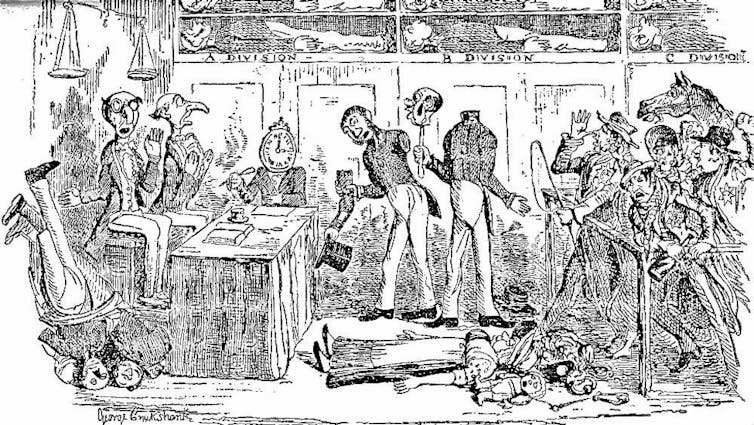
Yet this advanced speech technology isn’t the only thing Coppernose’s automatons have in common with Westworld’s hosts, as demonstrated in George Cruikshank’s illustration. Here the lifelike robots are shown to be operational despite missing limbs – something we’ve seen during diagnostic sessions with Westworld’s damaged hosts in the repair lab.
While Coppernose doesn’t provide specific details of any maintenance crews, it seems he has a similar rotational system in mind when he suggests a stock of 140 automatons, with around half kept in reserve so that broken units can be exchanged. However, rather than the spooky warehouse filled with dormant hosts seen in Westworld, Coppernose has a far more space-saving storage solution, keeping inert robot police officers on shelves until needed.
Although its never been explicitly explained in the show, showrunner Lisa Joy has described the “good samaritan reflex” as a safety measure programmed into all Westworld’s hosts – including the animals. This ensures that if a guest is at risk of endangering themselves or another guest, a host will step in to save them from harm. Humans don’t fare so well in Dickens’ park – Coppernose advocates the use of “live pedestrians … procured from the workhouse” for the wealthy park guests to run down in their cabriolets.
However, this is where a theme only lightly touched on in Westworld is brought to the fore in Dickens’ text: the disparity between justice for the rich and the poor. Coppernose’s affluent young adventurers must attend a mock trial following their wild and destructive behaviour, where wooden-headed automaton magistrates side with the defendants rather than the robot police attempting to prosecute them. Dickens describes this process as “quite equal to life” serving to underline the inequality at play in the justice system.
While Westworld primarily focuses on what it means to be human it does hint at this same idea: that we’re inclined to overlook the bad behaviour of the rich and powerful. When wealthy park patron “Man in Black” kills hosts indiscriminately, security chief Ashley Williams says: “That gentleman gets whatever he wants.”
 Of course, now that Westworld’s robots have gone rogue, the Man in Black may not go unpunished in season two. Perhaps the retribution Dickens would doubtless have liked to have seen will be delivered not by the courts, but the robots themselves.
Lynda Clark, PhD Researcher in Creative and Critical Writing, Nottingham Trent University
This article was originally published on The Conversation. Read the original article.
The link below is to an article that takes a look at the latest Kindle for PC update.
For more visit:
http://blog.the-ebook-reader.com/2018/04/18/kindle-for-pc-update-1-23-adds-new-features-and-fonts/
The link below is to an article that takes a look at the EPub format.
For more visit:
http://epubsecrets.com/why-specs-change-epub-3-2-and-the-evolution-of-the-ebook-ecosystem.php
Thomas Kaiserfeld, Lund University
The Swedish Academy is in trouble. The body which bestows the annual Nobel Prize in Literature has been hit by the withdrawal of a number of its members after a row over allegations of sexual abuse and harassment. The crisis came to a head after the decision of the permanent secretary, Sara Danius, to step down on April 12, prompting King Carl XVI Gustaf to intervene, promising reforms to enable to academy to continue.
The academy’s rules don’t allow for members to resign, so disenchanted members withdraw from active participation. Danius’s withdrawal is the first by a permanent secretary in more than than 230 years. It means there are only 11 active members of the academy and the rules require that new members must be elected by 12 members.
The Swedish Academy was established in 1786 to promote the Swedish language by setting standards and developing poetry and other forms of linguistic expression. For a century and more, this was where writers rubbed shoulders with high-ranking officials and aristocrats. But for the past century, the 18 members of the Academy have tended to be well-known writers and academics – a fine family name is no longer enough for entrance.
But apart from this small modernisation in the interests of promoting equality, the Swedish Academy has remained surprisingly stable. There have been scandals and expulsions, most notably that of founding member, Gustaf Mauritz Armfelt, a director of both the Royal Opera and the Royal Theatre in Stockholm, who was excluded twice – both times for political reasons when Armfelt was forced to flee the country in fear of his life. Another prominent exclusion was that of politician and aristocrat Count Henning Hamilton who resigned after financial wrongdoing.
But overall the academy has been remarkably stable and, when Alfred Nobel’s will stipulated in 1895 that the Nobel Prize in Literature should be decided upon by “the academy in Stockholm”, the organisation received an enormous boost in prestige as well as a financial boost that has allowed it to fund the Nobel Library.
The current crisis actually has its roots in a row as far back as 1989 when members Kerstin Ekman and Lars Gyllensten left their chairs after a majority of the academy voted against a proposition to submit an appeal to the Swedish government to engage against the fatwa issued by Iran against Salman Rushdie for his controversial novel The Satanic Verses. In 2015, another member, Lotta Lotass, left her chair for personal reasons.
After Gyllenstein’s death and replacement by Kristina Lugn, this meant that only 16 of the 18 members of the academy were now actively involved in its work. These included five women including Danius the permanent secretary and the poet Katarina Frostenson whose husband Jean-Claude Arnault is reported to have been the subject of numerous complaints of sexual harassment and abuse. These go back as far as 1996 when there is evidence that a young artist called Anna-Karin Bylund contacted the then permanent secretary Sture Allén (confusingly, the permanent secretary actually holds the office for a limited term which varies) with allegations of sexual harassment against Arnault. No action was taken at the time.
Towards the end of 2017, in the wake of the Weinstein scandal and the #MeToo movement, 18 women came forward in the Swedish press with further allegations against Arnault, who is not only married to an Academy member but runs the Forum, a club for artists in Stockholm which is subsidised by the Academy. There were also allegations going around that the names of several winners had been leaked in the past, although there is said to be no record of odd betting patterns in Sweden. In the UK, Ladbrokes is reported to have suspended betting on one occasion after large amounts of money were placed on the eventual winner. Arnault’s lawyer Bjorn Hurtig told Reuters that his client denied all the allegations, including that of being the source of leaks.
According to reports of the affair, moves to expel Frostenson were frustrated by the Academy’s dominant conservative male faction, led by Allén and literary scholar Horace Engdahl (also a former permanent secretary), which voted against the measure on the grounds that it would be unfair to punish Frostenson for the perceived crimes of her husband. Three members: novelist Klas Ostergren, literary scholar Kjell Espmark and historian Peter Englund duly resigned and Danius stood down as permanent secretary and withdrew from active participation, as did Frostenson.
 The affair would not have attracted so much international interest but for the Swedish Academy’s role in selecting the recipients of the Nobel Prize. And now, thanks to all the resignations, the existence of the Academy itself has been put in jeopardy. All eyes are now on the king and his possible reforms to reach some kind of solution that can secure the future of the Nobel Prize in Literature.
Thomas Kaiserfeld, Professor at Division of History of Ideas and Sciences, Lund University
This article was originally published on The Conversation. Read the original article.
OK, I’m more of a conventional, traditional bibliophile in the way that I store and display books. I use the bookcase/bookshelves approach – others like to be a bit more ‘showy’ in their approach. I prefer my books to be useful, to be like my tools – not mere dust catchers. The link below is to an article that looks at 5 ways to creatively display books, which isn’t really my cup of tea (which I don’t drink – so much for traditional then), but could be someone else’s I guess.
For more visit:
https://bookriot.com/2018/04/20/ways-to-display-your-books/
Elizabeth Hale, University of New England and Lynnette Lounsbury, Avondale College of Higher Education
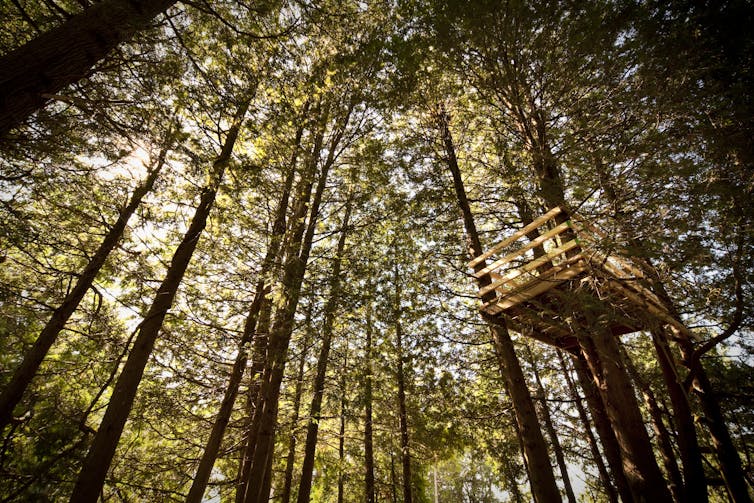
Two of Australia’s most popular children’s storytellers live in a treehouse. It’s a Thirteen-Storey one, at least it started out that way. The storytellers are Terry Denton and Andy Griffiths, responsible for an array of children’s comedies, who live in a fantasy treehouse paradise. There they write and illustrate their stories, distracted by the lemonade fountains, see-through shark-infested swimming pool and a marshmallow gun that shoots directly into your mouth.
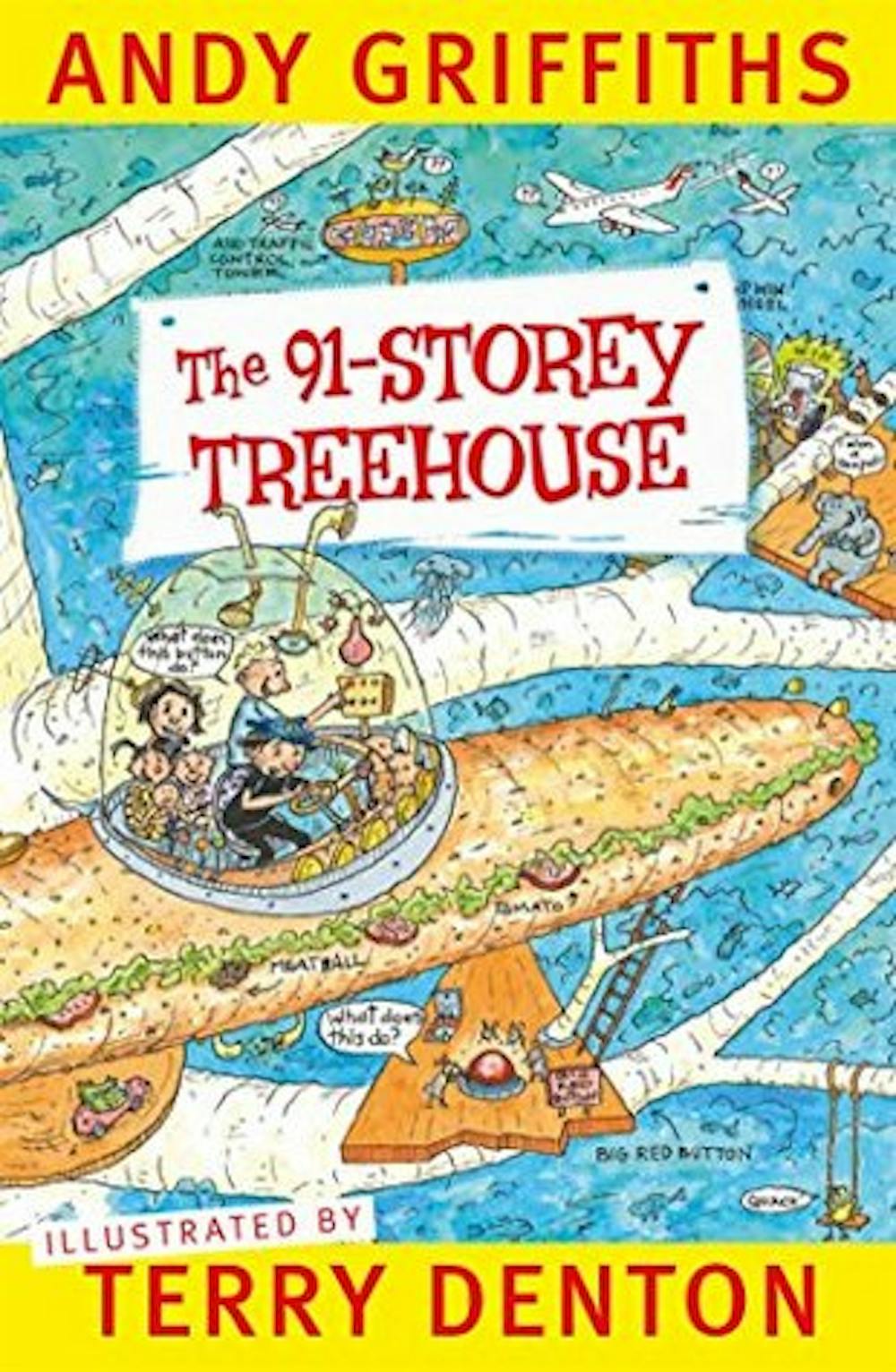
Since its arrival on the literary scene in 2011, this Treehouse has grown by 13 storeys at a time. The next edition will be 104 storeys. The books have sold over 3 million copies in Australia alone. The treehouse now contains a detective agency, a mashed potato and gravy train and a machine that makes money… or honey… depending on what you’d prefer. These delights interrupt Andy and Terry as they write for their publisher, Mr Bignose. Indeed the treehouse functions as a metaphor for the writing process … its storeys provide food for the stories produced inside.
Treehouses feature often in children’s stories. In Dav Pilkey’s popular Captain Underpants series, the heroes George and Harold write comics in their treehouse and retreat to it when things get out of hand, to regroup and create their way out of trouble. There are, of course, Tolkien’s Ents, the walking trees who fight on the side of good against Sauron and his army. Or Dr Seuss’s Lorax, who guards the Truffula trees from devastation. Ents and the Lorax are guardians of the ecosystem. When they act we know that something is badly out of kilter – in these cases in the fight between good and evil.
Mention Enid Blyton’s Faraway Tree stories, meanwhile, and many a grown-up gets misty-eyed. Mary Pope Osborne’s Magic Tree House series has been going strong for 25 years, and has nearly 100 titles. Carter Higgins’s Everything You Need for a Treehouse helps you get kitted out for your own woodland home. And mythology is full of trees.
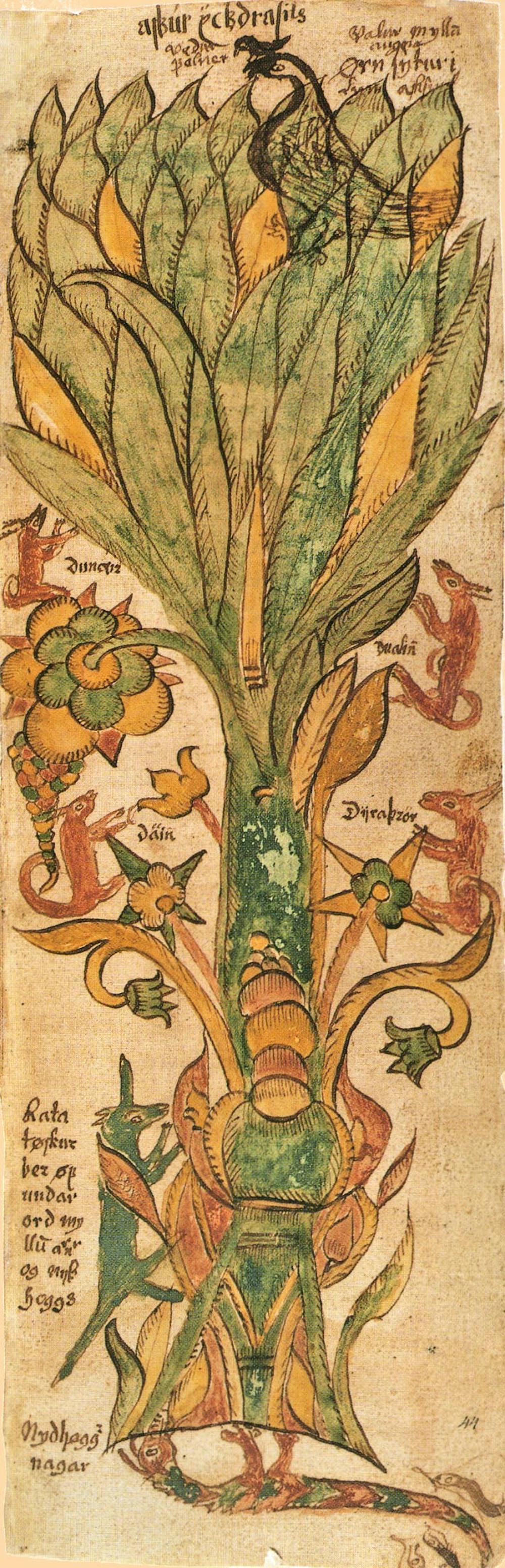
The World Tree of ancient Norse mythology, Yggdrasil, is similar to the thirteen-storey treehouse, linking the nine realms of the world (of fire, of ice, of elves, of gods, of fertility, of giants, of dwarves, of humans, and of the dishonorable dead). In Ovid’s Metamorphoses, when King Eresichthyon of Thessaly cut down the Greek Goddess Demeter’s favourite oak tree she teamed up with her sister Fames to torment him with a hunger so eternal that he eventually ate himself.
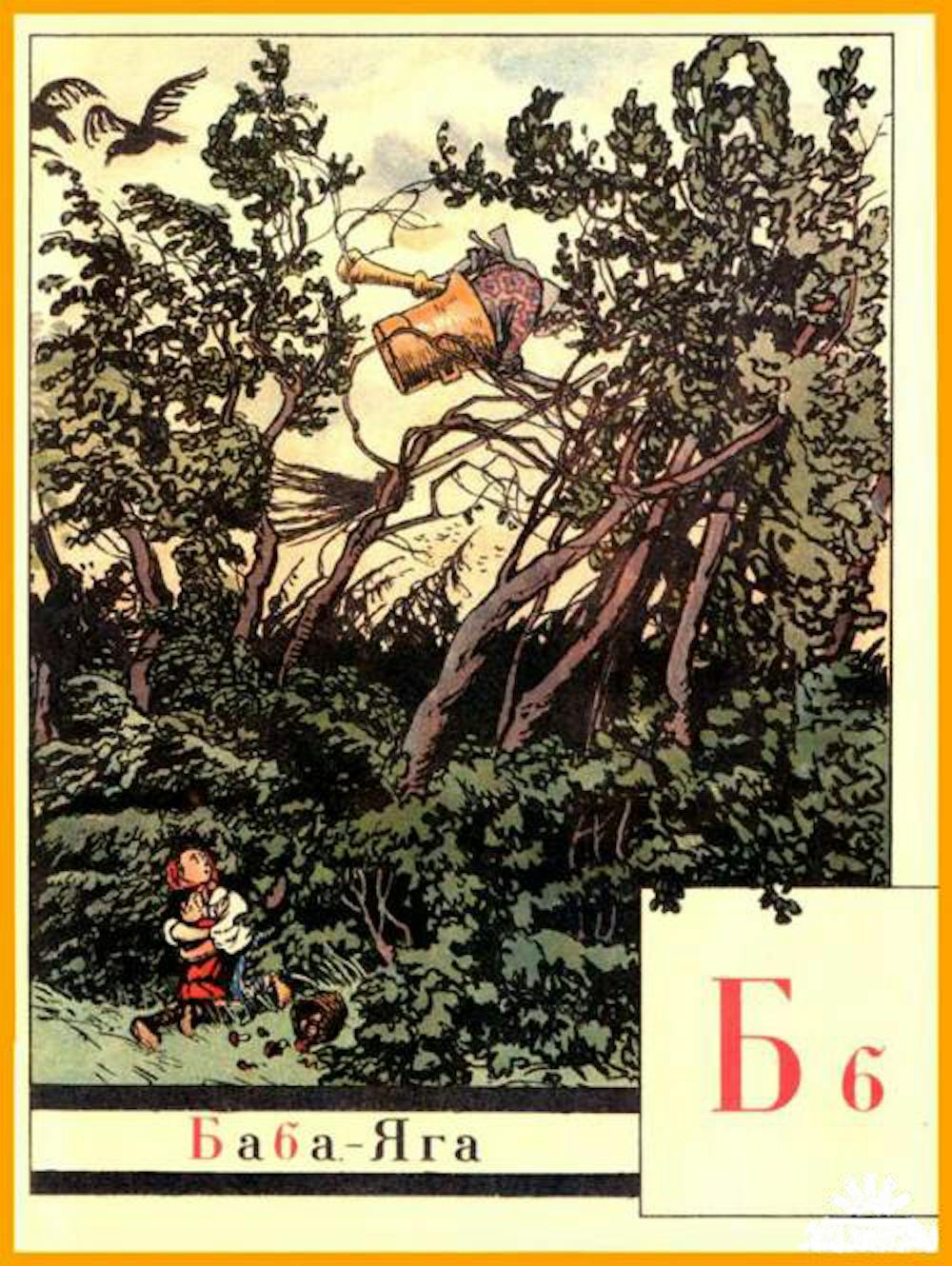
The Russian witch, Baba Yaga, lives in a mobile treehouse on a chicken foot, like an old-fashioned Grey Nomad. The Biblical serpent tempted Eve to taste fruit of the tree of knowledge. And many European forests are inhabited by tree creatures, such as sylphs and dryads, eco-friendly creatures that appear in fantasy literature such as Polish writer Andrzej Sapkowski’s The Witcher.
So it’s not surprising that living in the trees gives Andy and Terry and George and Harold access to fantasy spaces, and to magic and mystery. A technical term for this is liminality: in a liminal space, you are on the borders of things, or thresholds (the word come from the Latin for threshold, limen). If you live in a tree, you are up in the air, but connected to the earth.
At heart, most myths respond to fundamental practical needs. Tree house stories recognise that children need time in nature. For generations of urban children, these books offer a fantasy of unsupervised creative spaces where they can control their own adventures, face dangers that test them and engage with others in a less restricted way.
In Vitamin N: The Essential Guide to a Nature Rich Life (2016), author Richard Louv coined the phrase “Nature deficit disorder” to describe the human costs of alienation from the natural world. Opportunities for play in nature have dramatically declined in urbanised societies and with them, benefits such as creativity, problem-solving and emotional and intellectual development.
Writers like Denton and Griffiths recognise the child’s need for nature. So does Tina Matthews, in whose Waiting for Later a tree provides company for a child whose family is too busy to spend time with her. And so does mythology which regularly takes characters into nature, to confront, to challenge or to come to terms with life.
 While the Thirteen-Storey Treehouse may not be directly inspired by Yggdrasil or Demeter’s Oak, or hop about like Baba Yaga’s hut, it understands the relation between creativity and time in the woods, taking part in a grand literary tradition that goes as far back as myth itself.
Elizabeth Hale, Senior Lecturer in English and Writing (children’s literature), University of New England and Lynnette Lounsbury, Lecturer in Communications and History, Avondale College of Higher Education
This article was originally published on The Conversation. Read the original article.
Josh Stenberg, University of Sydney
In our series, Guide to the classics, experts explain key works of literature.
When asked to explain the significance and pleasure of the Chinese novel Dream of the Red Chamber, by Cao Xueqin, I’m afraid I usually flounder. How to put it to friends, students or colleagues that the tiffs, the leisurely intrigues and frustrated aspirations of a fractious bunch of adolescents constitute one of the great efforts at plumbing human experience?
Yet Dream of the Red Chamber, written in the mid-18th century, is the fullest immersion one could hope for into late imperial China, the best access to the minds, hearts and habits of that period, complete in everything from cosmology to cosmetics.
Read more:
Far from white-washing, ABC’s Monkey Magic remake takes us back to its cross-cultural roots
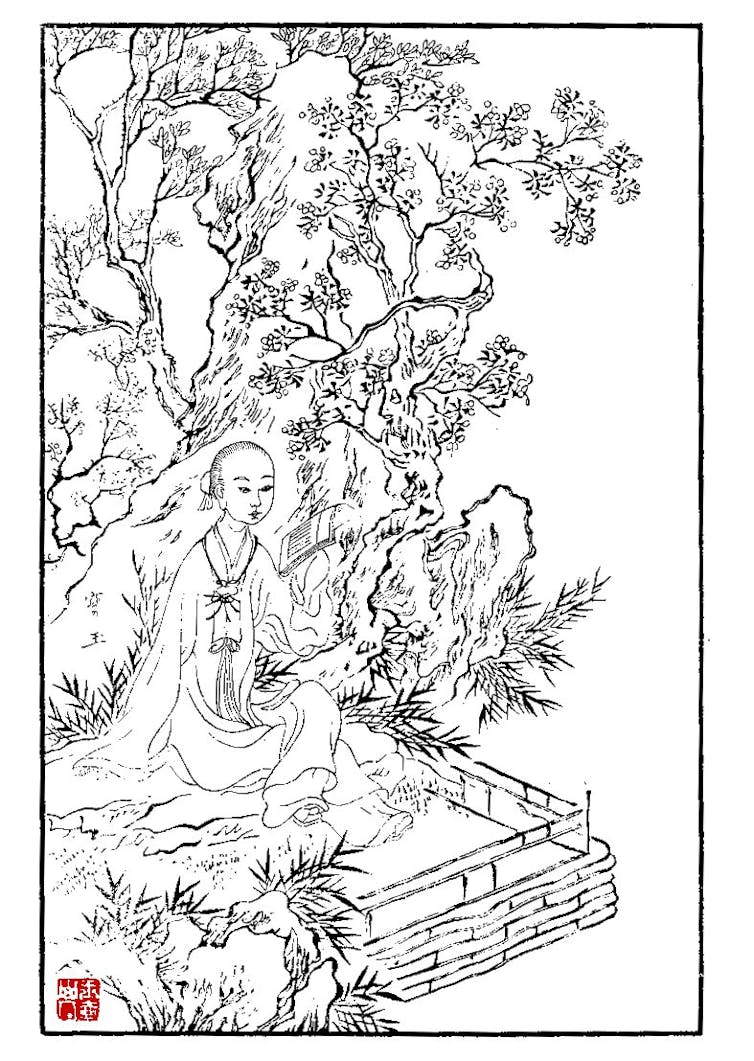
The episodic plot, sprawling over 2,500 pages in the standard Penguin translation, follows the infatuations and travails of a pubescent boy, Jia Baoyu. Baoyu is the unstudious and distracted son of a great, albeit troubled, house in Beijing. He is surrounded by a bevy of erudite and beautiful girls (relatives and maidservants), doted upon by his elderly grandmother, and terrified by his strict, pedantic father — a paragon or parody of the Confucian gentleman. In the pavilions, halls and gardens of this grand estate, allegory of and escape from the world, Baoyu struggles reluctantly towards adulthood.
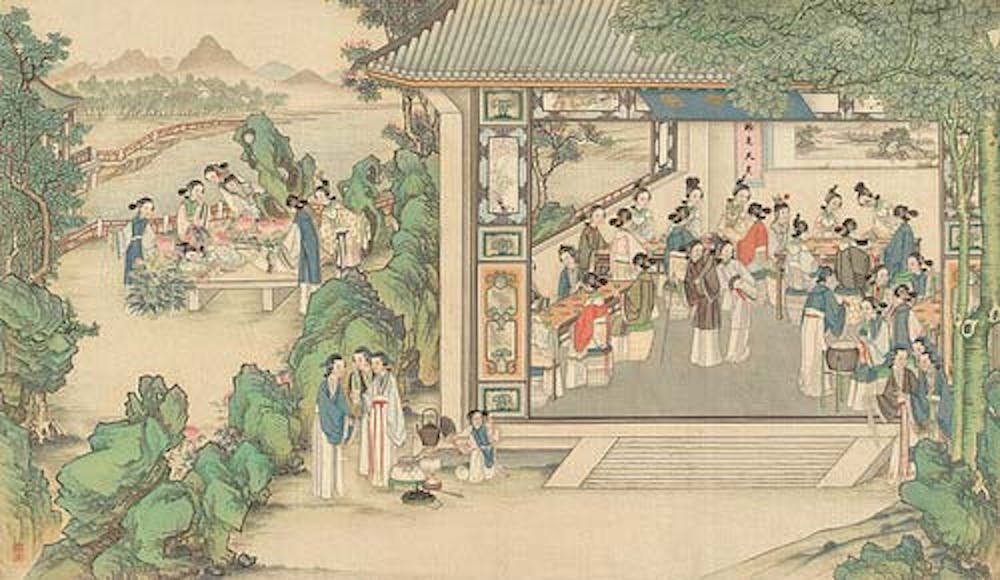
The interlocking pieces of the plot are revealing vignettes and character studies, many of which have reached iconic status in Chinese culture, and proved fertile ground for theatre and the visual arts.
They function also as a mirror of a reader’s personality, status, age and values. Do you tend towards the maiden who moderates with steady counsel or to the volatile but brilliant orphan girl? Do you deplore or delight in the fiery, funny administrating aunt’s shady outlay of expenses and sometimes malicious (or even murderous) feistiness? As with Proust, the perspective changes with age: re-reading the novel this year, I noticed how my sympathies were shifting upward a generation.
The deceptively immaterial occupations of the characters’ daily rounds of visits and chats provide material as much for metaphysics as for psychology. Drama can be constructed one moment around whether Baoyu will have his tea (his nanny sometimes appropriates it), and the next moment around the boundaries of reality, or the purpose of human striving.
Somehow, almost deviously, through the spats, crushes and rivalries of a handful of teenagers, the great questions of the human condition are broached: what is a good life, faced with the inevitability and omnipresence of death? What are one’s obligations? How real is this life and what is it for?
Take the famous little scene in Chapter 22 when Baoyu is inspired to throw fallen flower petals into the stream, but is chided by his sensitive cousin, Daiyu, who remarks:
It isn’t a good idea to tip them into the water … The water you see here is clean, but farther on beyond the weir, where it flows on beyond people’s houses, there are all sorts of muck and impurity, and in the end they get spoiled just the same. In that corner over there I’ve got a grave for the flowers, and what I am doing now is sweeping them up and putting them in this silk bag to bury them there, so that they can gradually turn back into earth.
Contained in this image is, depending on how you see it, a poignant image of grief, an allegory of love or its inadequacy, or a Buddhist exhortation to accept impermanence. The work’s ability to imbue petty incident and trifling games with philosophical resonance is peerless.
Read more:
Book review – Clive Hamilton’s Silent Invasion: China’s Influence in Australia
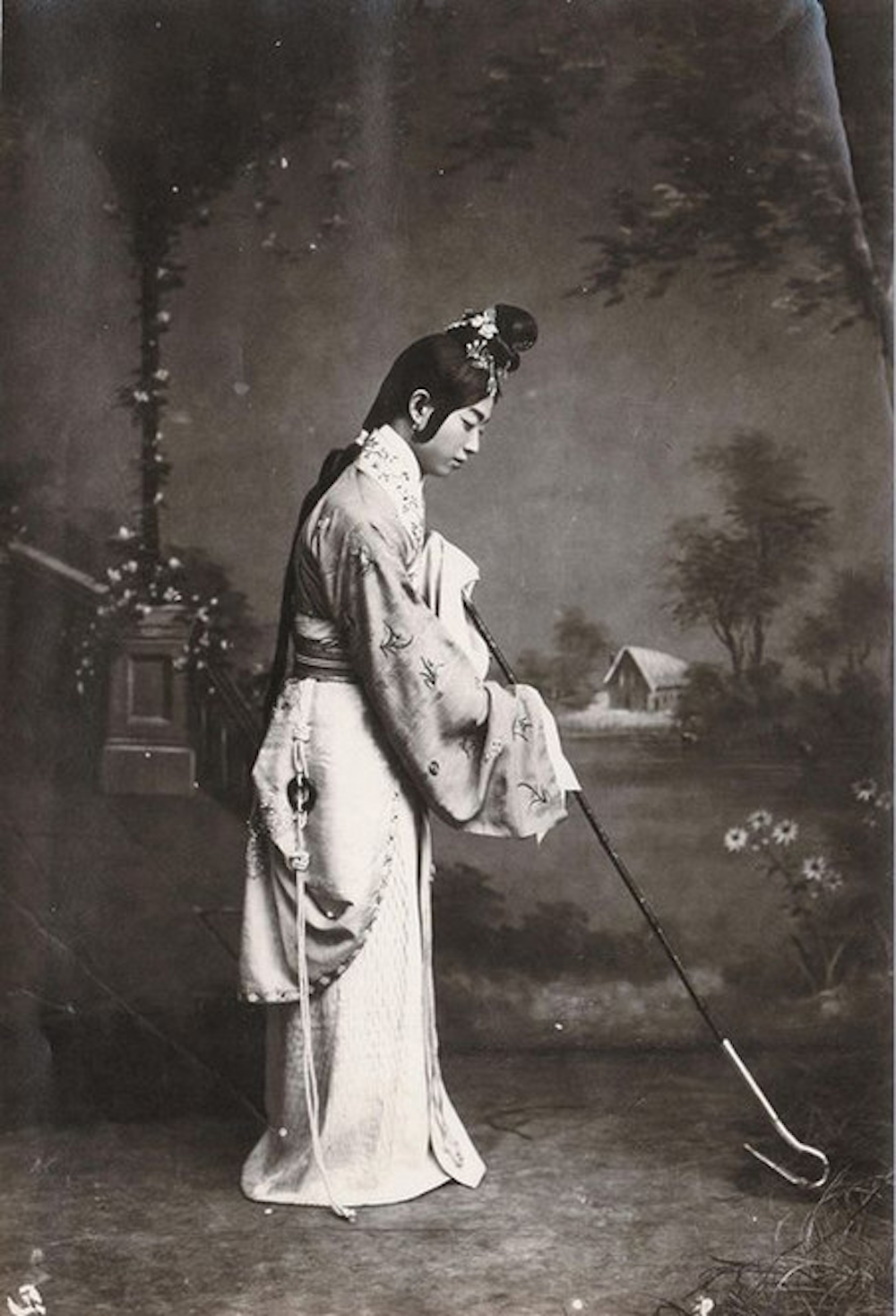
But while you are distracted by the intricate web of their relations, and, we hope, by Baoyu’s marriage and/or enlightenment, the reader realises that this is a family, an estate, a dynasty, a universe, in decay.
Cao Xueqin, the author, was himself the scion of a family in slow collapse, and the work (left unfinished and completed after his death) is often read as an elegy to his own vanished childhood. From our historical vantage point, it is hard not also to recall that within 50 years of the novel’s publication, China was in the throes of the Opium War, its sense of self-sufficiency and centrality forever fractured (until, perhaps, now).
Scholars of the novel, whose field of study has expanded so far that it is known as “Redology”, have used the text to look into everything from the era’s medical practices, the prevalent tastes in theatre, its queer desire, ethnic power relations and reading habits.
Dream of the Red Chamber has Balzac’s panoramic view of society, the satire of arrogance and fashion of Vanity Fair, the funny, meandering mischief of Decameron. But these comparisons are inadequate to a work so monumental and so vehemently itself, the epitome of the great tradition of Chinese family fiction.
The novel has spawned innumerable adaptations for the stage and screen, as well as dozens of sequels attempting to rescue or resolve its characters’ dilemmas and narrative arcs. It has influenced everything from the witty, cruel short stories of Eileen Chang, to the claustrophobic film, Raise the Red Lantern, and the opulent concubine-poisoners’ dramas of popular TV serials such as Empresses in the Palace.
Above all, reading (or prescribing) the novel feels like the antidote to facile stereotyping of Chinese culture. All the core topics are present: family dynamics; Confucianism, Buddhism and Taoism; face and status; strategy and emotion. But all of these are played out for a readership which still regarded the world outside China as a curiosity, and was under no pressure to defend or justify its culture. It is a work of the Qing Dynasty, by a Qing author, for Qing readers; and it is the modern reader’s good fortune just to be allowed in.
 Whether you read it straight through or dip in from time to time, this work affords entry to one of the great fictional universes.
Josh Stenberg, Lectuter in Chinese Studies, University of Sydney
This article was originally published on The Conversation. Read the original article.
The link below is to an article that takes a look at the success of thrillers.
For more visit:
https://www.theguardian.com/books/2018/apr/14/perfect-crime-fiction-bestsellers-whodunnits-thrillers-leave-rivals-for-dead
 At the BookShelf


You must be logged in to post a comment.