Unknown's avatar

Anne Summers’ new memoir and the bitter struggle over memory narratives of feminism


File 20181101 83654 hz75fv.jpg?ixlib=rb 1.1
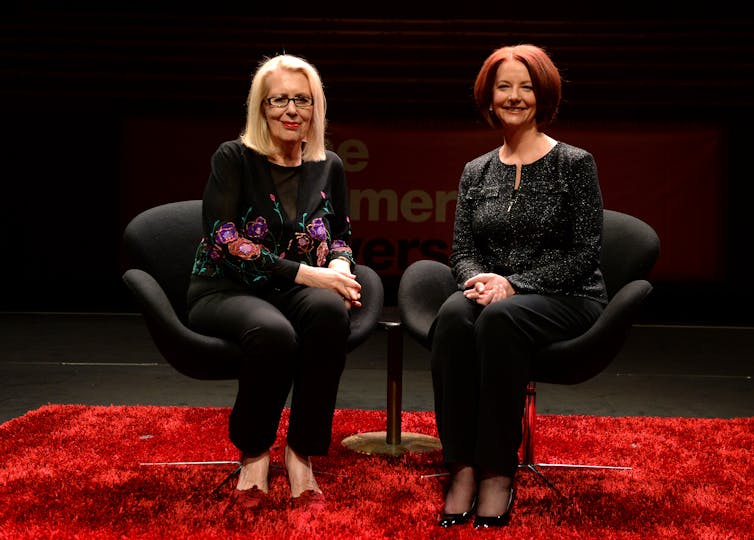
Anne Summers photographed in 2013 with Julia Gillard.
Dan Himbrechts/AAP

Camilla Nelson, University of Notre Dame Australia

Review: Unfettered and Alive by Anne Summers (Allen and Unwin)


Years ago, when I was young, I lived in an apartment in Sydney’s Potts Point that looked straight down into Anne Summers’ house. Summers had recently published her “Letter to the Next Generation” – and it’s likely that any discomfort not arising from the strange proximity of our urban views was directly attributable to this.

In the “Letter”, Summers famously wrote that she was “horrified” and “mortified” by the antics of women like my younger self – the wayward daughters of the revolution who had failed to measure up on the long tough march to gender equality.

The “Letter” drew its inspiration from years Summers spent as editor of Ms. magazine. Oddly enough, Summers’ new autobiography, Unfettered and Alive, is also shot through with the upheaval of these years and the aftermath of her falling out with US feminists Gloria Steinem and Susan Faludi.
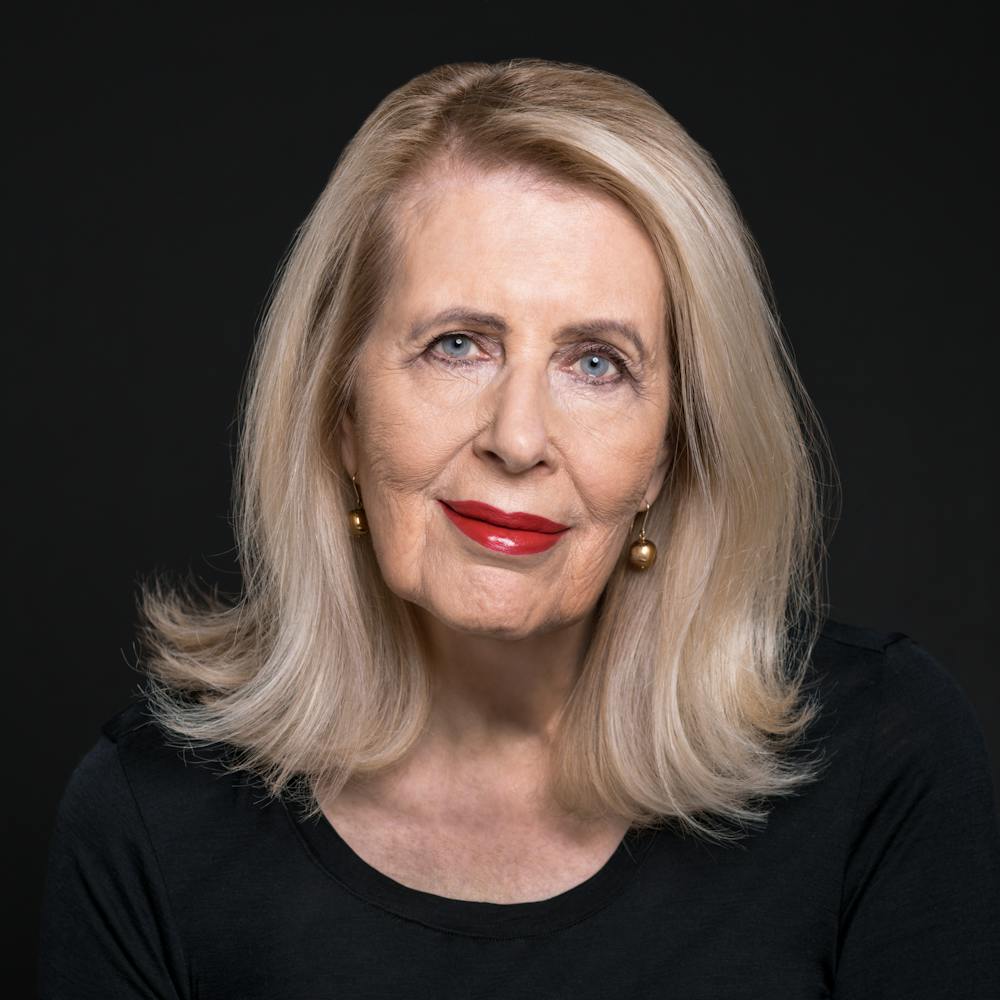
Anne Summers.
Kevin McDermott

Many harsh things are said in this book. It’s difficult to decide whether to praise its “breathtaking honesty” – as critics undoubtedly will – or draw back like a witness to some gruesome accident.

These are bitter struggles over the memory narratives of feminism.

Unfettered and Alive picks up where Summers’ earlier autobiography, Ducks on the Pond, leaves off. It’s the 1970s, a time when women’s choices are startlingly limited. Women earn just 65.2% of men’s salaries. The employment ads are divided into men’s and women’s jobs. Women are not allowed to drink in the front bar at pubs – they are banished to the ladies lounge.

Summers, age 30, is already a leading figure in the Women’s Liberation Movement that puts an end to all this. She is the author of one of the most significant early works of Australian feminist history, Damned Whores and God’s Police, and a co-founder of the inner-city women’s refuge, Elsie.

Later, she will be remembered as the head of the Office of the Status of Women, and a significant figure in the passage of the Anti-Discrimination Act and the battles over affirmative action, though only a chapter of the book is devoted to this.


Read more:
Damned Whores and God’s Police is still relevant to Australia 40 years on – more’s the pity


A writer at last

Summers starts her story in 1975, when she answers an advertisement for an “energetic self-starter” at The National Times, then under the “wily” editorship of Max Suich. Here, she quickly sets to work on the multi-feature series that gave fresh impetus to the royal commission into the state of NSW prisons, and wins her a Walkley.
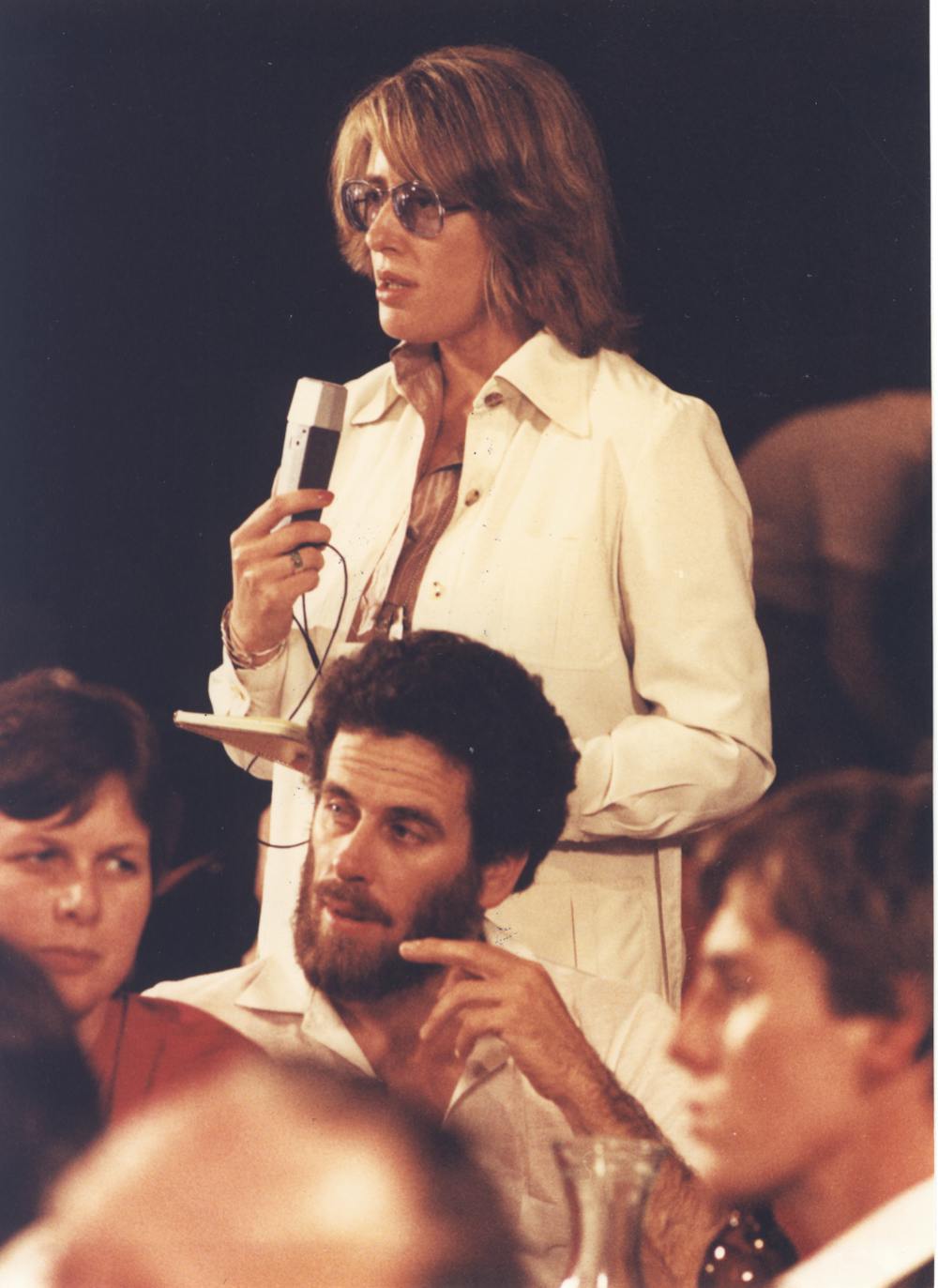
Summers at the National Press Club during the 1980 CHOGM meeting in Australia directing a question at British Prime Minister Margaret Thatcher.
Allen and Unwin

Other more woman-focused stories follow. There’s the “gang bang” of a teenage girl at St Paul’s College, Sydney University. Another story, “How women are trained: if it’s not rape what is it?” reports on events in the Far North Queensland town of Ingham, where police openly acknowledge that 30 or 40 local women and children have been raped. “I reported it to police,” one girl told Summers, recollecting the first time she was gang-raped by five men at the age of 13. “But I didn’t have enough evidence. I wasn’t bruised enough.”

Working in Canberra as a political correspondent in the Fraser years, Summers is painfully honest about her fear of not doing the job well. “I can see the absolute terror in your eyes,” a reporter from a rival newspaper told her.

She reports walking out of a media conference held by Bill Hayden, in which the “alternative prime minister” decided to kick things off with a rape joke. “My colleagues didn’t seem bothered by such things,” Summers writes. Sexist behaviour went unchallenged and unnoticed because “it was the way things were back then”.

But Summers is also judgmental about other women in her memoir. In an atmosphere in which cabinet ministers chase female reporters around their desks, Summers recollects telling off a female reporter for wearing a “sexy outfit”. “I was very tough on a woman in my bureau who came to work one day with a dress that was slit practically to the waist.”

Confessions tumble across the pages: her breast-reduction surgery, the weight-loss regime that saw her drop 10kg and her pride in her “brand new body”. She talks about being brought up on a DUI charge when she took up her appointment at the Office of the Status of Women. She reveals her fondness for Robert Burton suits – it’s the era of the “femocrats” and big hair, shoulder pads and flats are in.

The 1980s are a time of epic change for women. New legislation and policy frameworks are put into place. Not everybody appreciated it. “One morning I found flung across the windscreen of my car a life-size plastic sex doll … ” Summers is alarmed, “not because this tawdry piece of plastic could hurt me but because whoever put it there could”.
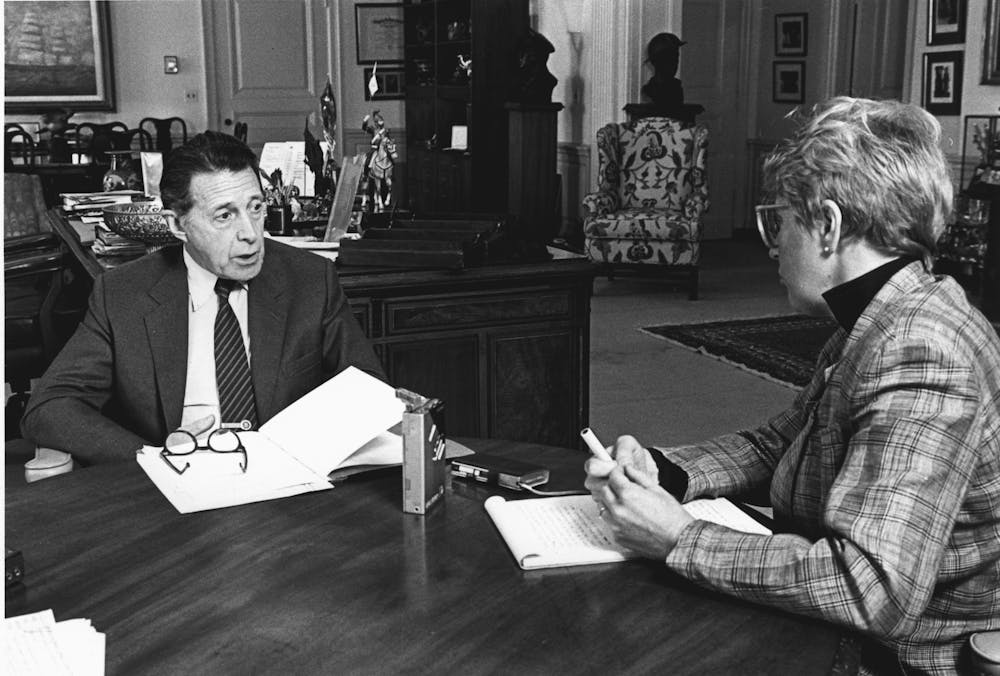
‘I was the first Australian journalist to interview a US Secretary of Defence when I sat down with Caspar Weinberger in his office at the Pentagon in June 1986.’
Allen and Unwin

The Ms. Years

Summers arrived at the “shambolic offices” of Ms. magazine, on West 40th Street, New York, following the unexpected purchase of the iconic feminist publication by Fairfax in 1987. Summers calls the magazine “chaotic”. It operated like a feminist collective, she writes, in which “everyone appeared to be equal” and everybody had to do their own “shitwork”.

According to Summers, this “might have been okay for the women’s movement” but it was “no way to run a magazine”. But Ms. did not understand itself as just another media outlet. It was the printed vanguard of US feminism. It was – and still is – synonymous with the name of US feminist Gloria Steinem.

Summers put the entire staff on 60 days’ probation and fired three. But later in the chapter she adds: “I … should have cleared out the whole place.”

Summers set about giving the magazine an “80s lift”. This included increasing the focus on fashion, makeup advertisements, and the inclusion of a gardening page.
She also embarked on a total redesign, including a new logo, masthead and an advertising campaign with the tagline, “We’re not the Ms. we used to be”. The ad featured a string of photographs showing an old hippie morphing into a young woman with a “glamorous 1980s look”.

It can’t have been an easy time. Steinem lost editorial control over the magazine as part of the financial arrangement. But, according to Summers, the magazine remained “almost neurotically dependent on Steinem”.

The relationship between the two women quickly became strained. Summers says she constantly questioned “the gap between Steinem’s rhetoric and the way she conducted herself”. The contents of Steinem’s apartment are said to be “disturbing”, including the covers on Steinem’s loft bed, which was draped in “flimsy white fabric” and a “set of physician’s weighing scales” in her kitchen, all of which are said to be “strange stuff for a feminist”.
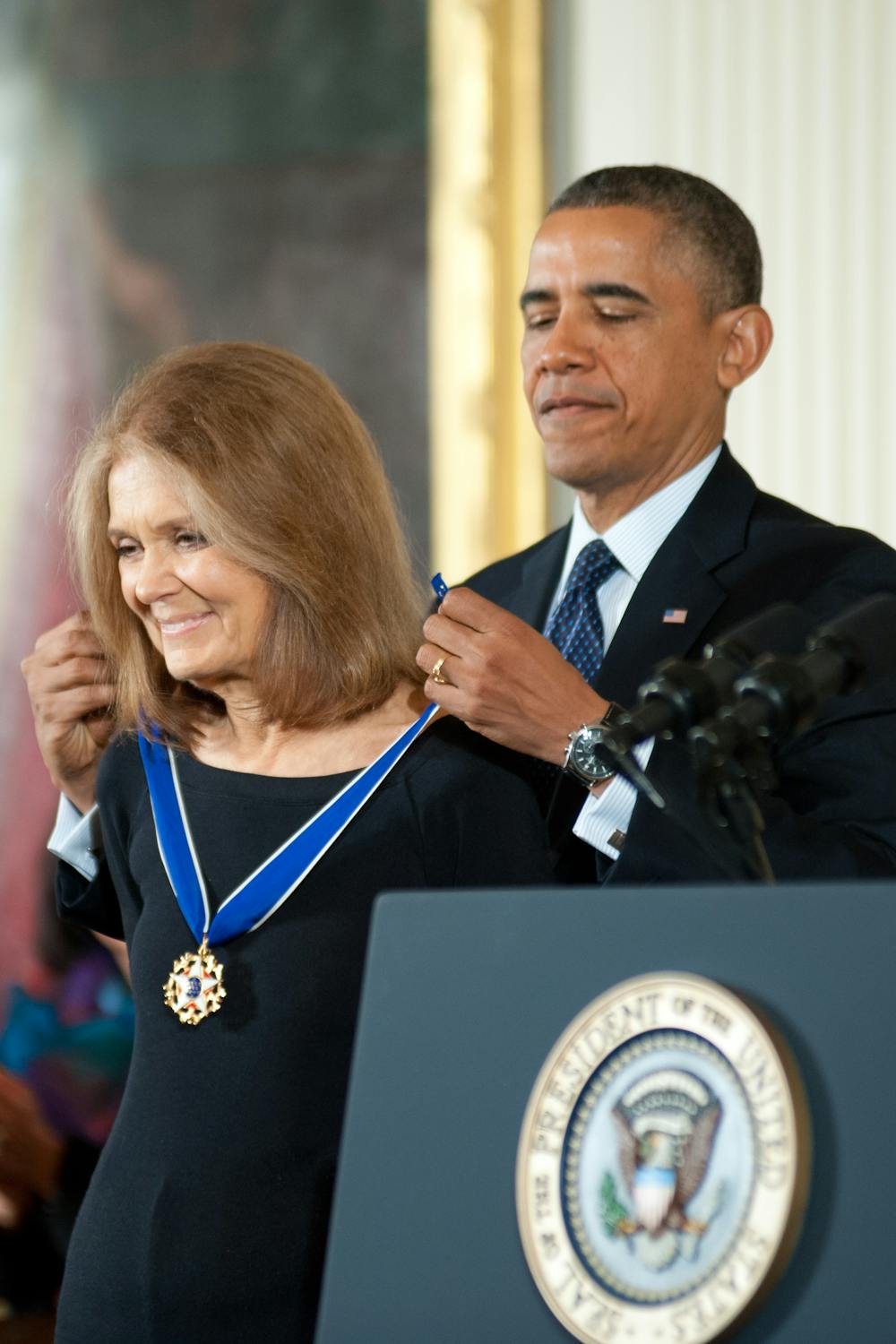
Gloria Steinem receives the Presidential Medal of Freedom from then US President Obama in 2013.
Shutterstock

It was the Hedda Nussbaum case that brought matters at Ms. to breaking point. When Joel Nussbaum murdered his six-year-old daughter and bashed his wife Hedda, debates raged in feminist circles as to whether Hedda should have been treated as an accomplice to her daughter’s death. Summers and Steinem took up opposed positions. Summers argued it was time to “stop excusing the behaviour of all battered women”. Steinem argued that Hedda was a “total victim” and believed the coverage was a “betrayal of everything Ms. had ever stood for”.

The decision to pull a close-up image of the heavily beaten Hedda off Ms’s cover remains a matter of controversy today. Summers writes that the photo was removed on the advice of her head of advertising sales who said: “We’ve just cracked the beauty category. You can’t do this to me.”

There was a lot of pressure around revenue. Summers and Australian colleague Sandra Yates had recently engaged in an audacious management buyout, after Warwick Fairfax announced his untimely decision to sell. According to Summers, Ms. advertisers wanted their customers to be “happy” not “challenged or confronted”. “… our only chance of survival was to meet or, if possible, exceed our advertising budget.”

Fraught decisions followed. “I was stricken when Barbara Ehrenreich proposed her next column be a satire on fast cars,” writes Summers. “I explained to her how sensitive and demanding these advertisers were, how we could not afford to lose them. Would she be willing to change topics?”

Ehrenreich, the acerbic social critic, refused.

The first edition of Susan Faludi’s global bestseller Backlash: the Undeclared War Against Women carried several pages attacking the editorial direction of Ms. under Summer’s leadership. Back in Australia, following the forced sale of the publication, Summers was “stunned”. There was “a tone to the writing that made it sound almost malicious”. She initiated a “tough” exchange of lawyer’s letters, demanding a rewrite of all subsequent editions of the book.

The entry now stands at around one page, which Summers quotes. Faludi writes:

The magazine that had once investigated sexual harassment, domestic violence, the prescription drug industry and the treatment of women in third world countries now dashed off tributes to Hollywood stars, launched a fashion column, and delivered the real big news – pearls are back.

An air of anxiety

Women who do not conform to certain gender ideologies fare badly in Summers’ book. Stay-at-home mums are berated for pushing baby buggies, young women are berated for “baking and doing craftwork”.

An air of anxiety runs through the remaining chapters. The months on Paul Keating’s staff end with Summers “sobbing with humiliation and rage” at the notorious “True Believer’s Dinner” that wound up costing $35,000. She had wanted Bob McMullan to be minister for women, and he had refused. She also didn’t think the unions at Parliament House ought to be paid for working through the $100 per ticket event.

Her period as editor of The Sydney Morning Herald’s Good Weekend magazine was also clouded when the MEAA took action to “protest my management style”, after Summers fired her deputy for “disloyalty” over a sexual harassment allegation. “I was not a mother, so I must be a whore,” writes Summers, explaining the ferocity of the attacks.

In 2013, Summers returned to address this same “widespread hostility towards women”, which had prominently manifested itself in the “woman-shaming” of the prime minister, Julia Gillard. In a new book, and a series of articles and interviews, she situated Gillard’s treatment as part of a continuing cultural pattern of “malicious and mendacious slurs” against high-achieving women.
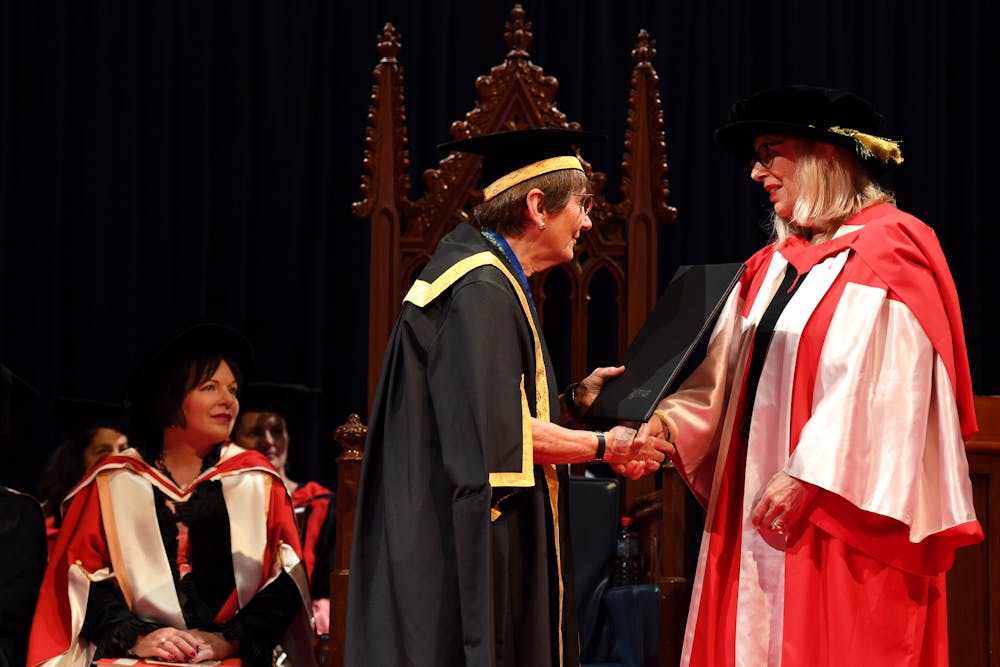
Anne Summers (right) receives an honorary Doctorate of Letters from Pro-Chancellor Dorothy Hoddinott at the University of Sydney in 2017.
Paul Millar/AAP

Women are immeasurably better off for the achievements set out in Summers’ book, despite some frightening backwards steps since, not to mention a failure to gain ground on childcare policy and the gender wage gap. Feminism has also become more flexible, opening itself up to longstanding critiques around class and race.

But it remains difficult for women to have their voices heard. Women in Australia who have spoken up on #MeToo are almost immediately threatened with defamation action – and some of them are being sued. Women of all ages still name family and domestic violence, workplace sexual harassment and street violence and harassment close to the top of their list of concerns.

Next to this, “doing craftwork”, wearing a split skirt, or covering your bed in “flimsy white fabric” – as Gloria Steinem undoubtedly did – doesn’t seem like much to worry about.The Conversation

Camilla Nelson, Associate Professor in Media, University of Notre Dame Australia

This article is republished from The Conversation under a Creative Commons license. Read the original article.

Unknown's avatar

Friday essay: how speculative fiction gained literary respectability


File 20181101 78447 11kbg3c.jpg?ixlib=rb 1.1
Biologists are gathering evidence of green algae (pictured here in Kuwait) becoming carbohydrate-rich but less nutritious, due to increased carbon dioxide levels. As science fiction becomes science fact, new forms of storytelling are emerging.
Raed Qutena

Rose Michael, RMIT University

I count myself lucky. Weird, I know, in this day and age when all around us the natural and political world is going to hell in a handbasket. But that, in fact, may be part of it.

Back when I started writing, realism had such a stranglehold on publishing that there was little room for speculative writers and readers. (I didn’t know that’s what I was until I read it in a reader’s report for my first novel. And even then I didn’t know what it was, until I realised that it was what I read, and had always been reading; what I wrote, and wanted to write.) Outside of the convention rooms, that is, which were packed with less-literary-leaning science-fiction and fantasy producers and consumers.

Realism was the rule, even for those writing non-realist stories, such as popular crime and commercial romance. Perhaps this dominance was because of a culture heavily influenced by an Anglo-Saxon heritage. Richard Lea has written in The Guardian of “non-fiction” as a construct of English literature, arguing other cultures do not distinguish so obsessively between stories on the basis of whether or not they are “real”.

China Miéville in 2010.
Pan MacMillan Australia/AAP

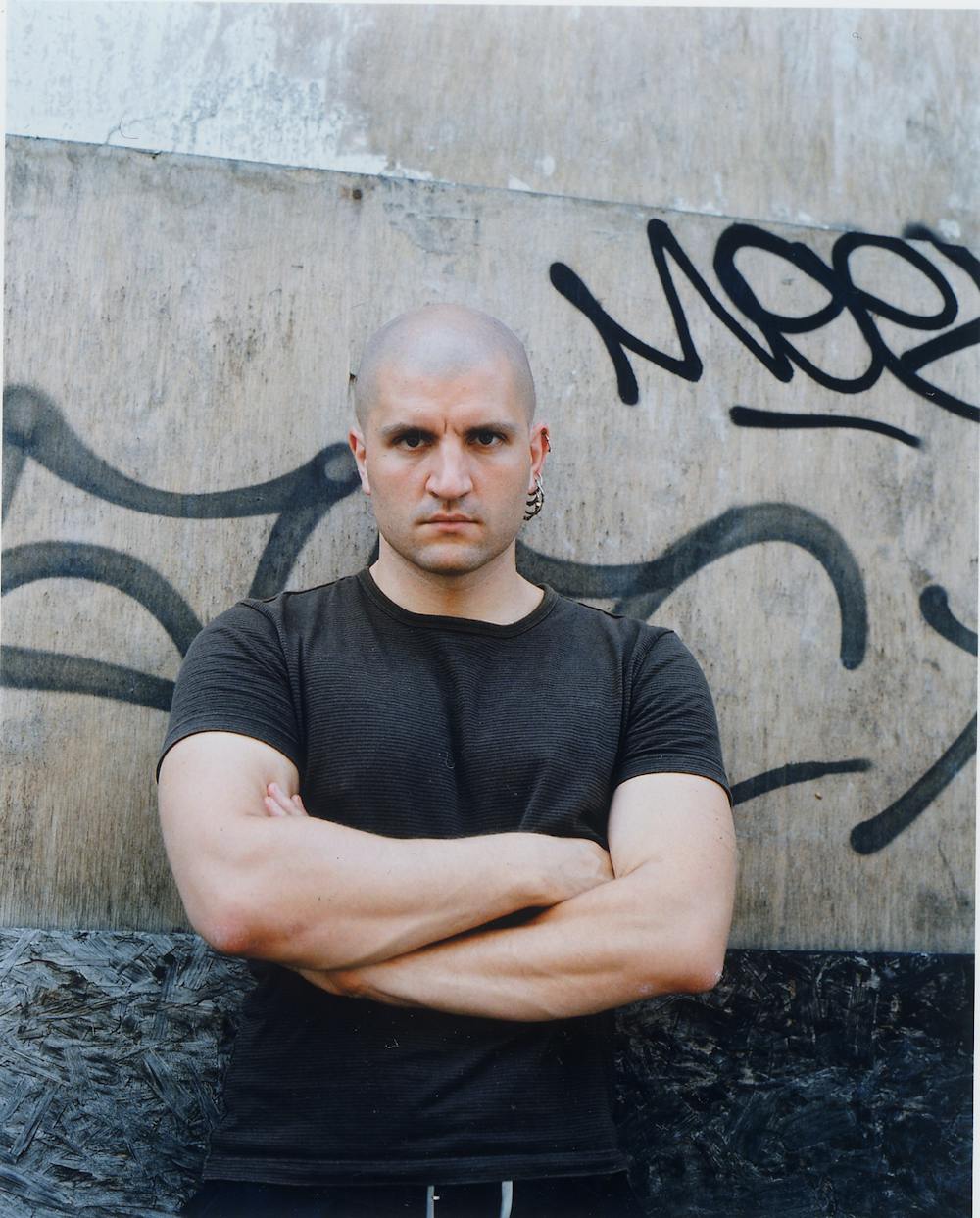
Regardless of the reason, this conception of literary fiction has been widely accepted – leading self-described “weird fiction” novelist China Miéville to identify the Booker as a genre prize for specifically realist literary fiction; a category he calls “litfic”. The best writers Australia is famous for producing aren’t only a product of this environment, but also role models who perpetuate it: Tim Winton and Helen Garner write similarly realistically, albeit generally fiction for one and non-fiction for the other.

Today, realism remains the most popular literary mode. Our education system trains us to appreciate literatures of verisimilitude; or, rather, literature we identify as “real”, charting interior landscapes and emotional journeys that generally represent a quite particular version of middle-class life. It’s one that may not have much in common these days with many people’s experiences – middle-class, Anglo or otherwise – or even our exterior world(s).

Like other kinds of biases, realism has been normalised, but there is now a growing recognition – a re-evaluation – of different kinds of “un-real” storytelling: “speculative” fiction, so-called for its obviously invented and inventive aspects.

Feminist science-fiction writer Ursula K. Le Guin has described this diversification as:

a much larger collective conviction about who’s entitled to tell stories, what stories are worth telling, and who among the storytellers gets taken seriously … not only in terms of race and gender, but in terms of what has long been labelled “genre” fiction.

Closer to home, author Jane Rawson – who has written short stories and novels and co-authored a non-fiction handbook on “surviving” climate change – has described the stranglehold realistic writing has on Australian stories in an article for Overland, yet her own work evidences a new appreciation for alternative, novel modes.

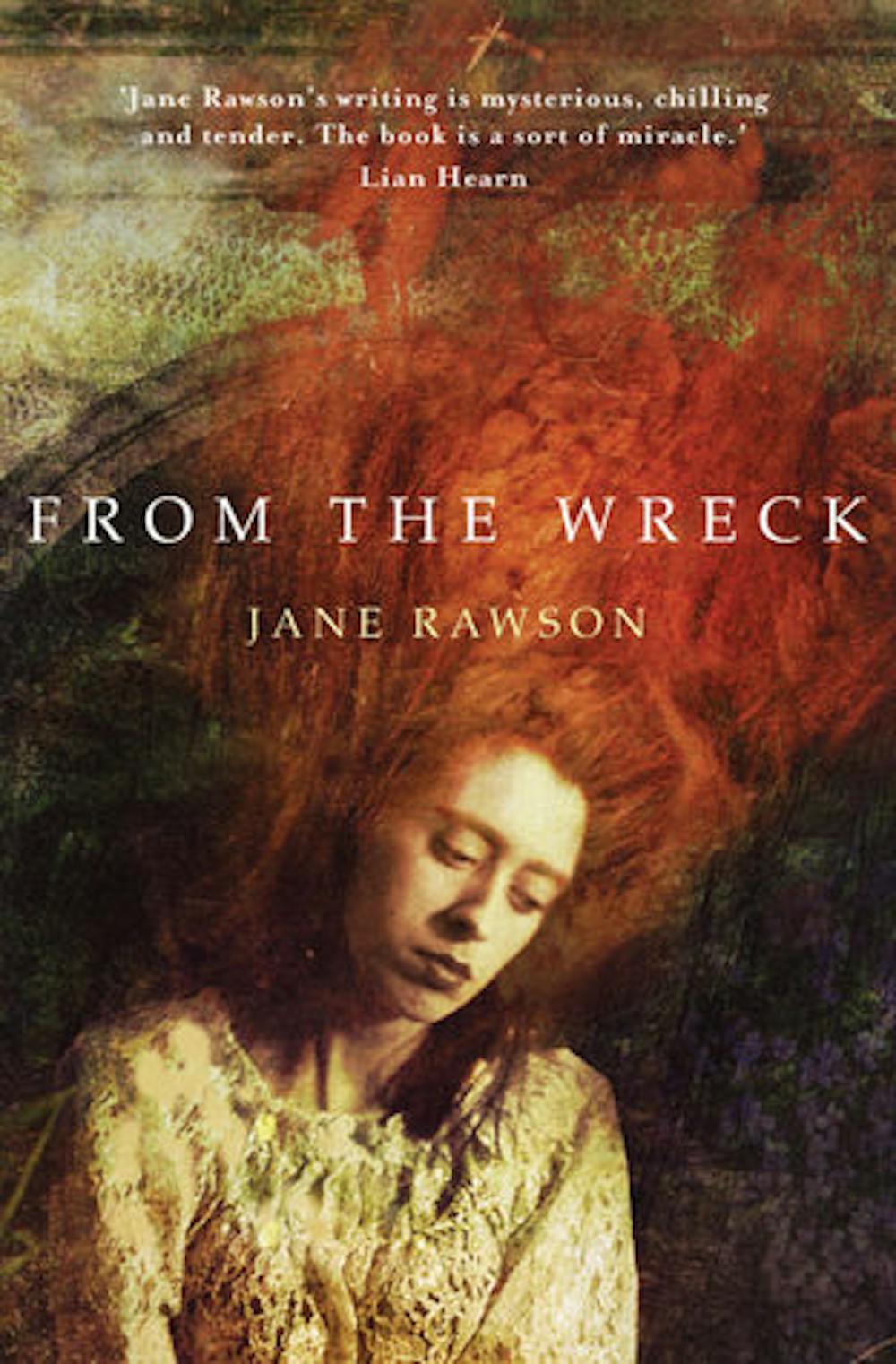
Rawson’s latest book, From the Wreck, intertwines the story of her ancestor George Hills, who was shipwrecked off the coast of South Australia and survived eight days at sea, with the tale of a shape-shifting alien seeking refuge on Earth. In an Australian first, it was long-listed for the Miles Franklin, our most prestigious literary award, after having won the niche Aurealis Award for Speculative Fiction.

The Aurealis awards were established in 1995 by the publishers of Australia’s longest-running, small-press science-fiction and fantasy magazine of the same name. As well as recognising the achievements of Australian science-fiction, fantasy and horror writers, they were designed to distinguish between those speculative subgenres.

Last year, five of the six finalists for the Aurealis awards were published, promoted and shelved as literary fiction.

A broad church

Perhaps what counts as speculative fiction is also changing. The term is certainly not new; it was first used in an 1889 review, but came into more common usage after genre author Robert Heinlein’s 1947 essay On the Writing of Speculative Fiction.

Whereas science fiction generally engages with technological developments and their potential consequences, speculative fiction is a far broader, vaguer term. It can be seen as an offshoot of the popular science-fiction genre, or a more neutral umbrella category that simply describes all non-realist forms, including fantasy and fairytales – from the epic of Gilgamesh through to The Handmaid’s Tale.


Read more:
Guide to the classics: the Epic of Gilgamesh


While critic James Wood argues that “everything flows from the real … it is realism that allows surrealism, magic realism, fantasy, dream and so on”, others, such as author Doris Lessing, believe that everything flows from the fantastic; that all fiction has always been speculative. I am not as interested in which came first (or which has more cultural, or commercial, value) as I am in the fact that speculative fiction – “spec-fic” – seems to be gaining literary respectability.
(Next step, surely, mainstream popularity! After all, millions of moviegoers and television viewers have binge-watched the rise of fantastic forms, and audiences are well versed in unreal onscreen worlds.)

One reason for this new interest in an old but evolving form has been well articulated by author and critic James Bradley: climate change. Writers, and publishers, are embracing speculative fiction as an apt form to interrogate what it means to be human, to be humane, in the current climate – and to engage with ideas of posthumanism too.

These are the sorts of existential questions that have historically driven realist literature.

According to the World Wildlife Fund’s 2018 Living Planet Report, 60% of the world’s wildlife disappeared between 1970 and 2012. The year 2016 was declared the hottest on record, echoing the previous year and the one before that. People under 30 have never experienced a month in which average temperatures are below the long-term mean. Hurricanes register on the Richter scale and the Australian Bureau of Meteorology has added a colour to temperature maps as the heat keeps on climbing.

Science fiction? Science fact.

A baby Francois Langur at Taronga Zoo in June. François Langurs are a critically endangered species found in China and Vietnam.
AAP Image/Supplied by Taronga Zoo

What are we to do about this? Well, according to writer and geographer Samuel Miller-McDonald, “If you’re a writer, then you have to write about this.”

There is an infographic doing the rounds on Facebook that shows sister countries with comparable climates to (warming) regions of Australia. But it doesn’t reflect the real issue. Associate Professor Michael Kearney, Research Fellow in Biosciences at the University of Melbourne, points out that no-one anywhere in the world has any experience of our current CO2 levels. The changed environment is, he says – using a word that is particularly appropriate for my argument – a “novel” situation.

Elsewhere, biologists are gathering evidence of algae that carbon dioxide has made carbohydrate-rich but less nutritious. So the plankton that rely on them to survive might eat more and more and yet still starve.

Fiction focused on the inner lives of a limited cross-section of people no longer seems the best literary form to reflect, or reflect on, our brave new outer world – if, indeed, it ever was.

Whether it’s a creative response to catastrophic climate change, or an empathic, philosophical attempt to express cultural, economic, neurological – or even species – diversification, the recognition works such as Rawson’s are receiving surely shows we have left Modernism behind and entered the era of Anthropocene literature.

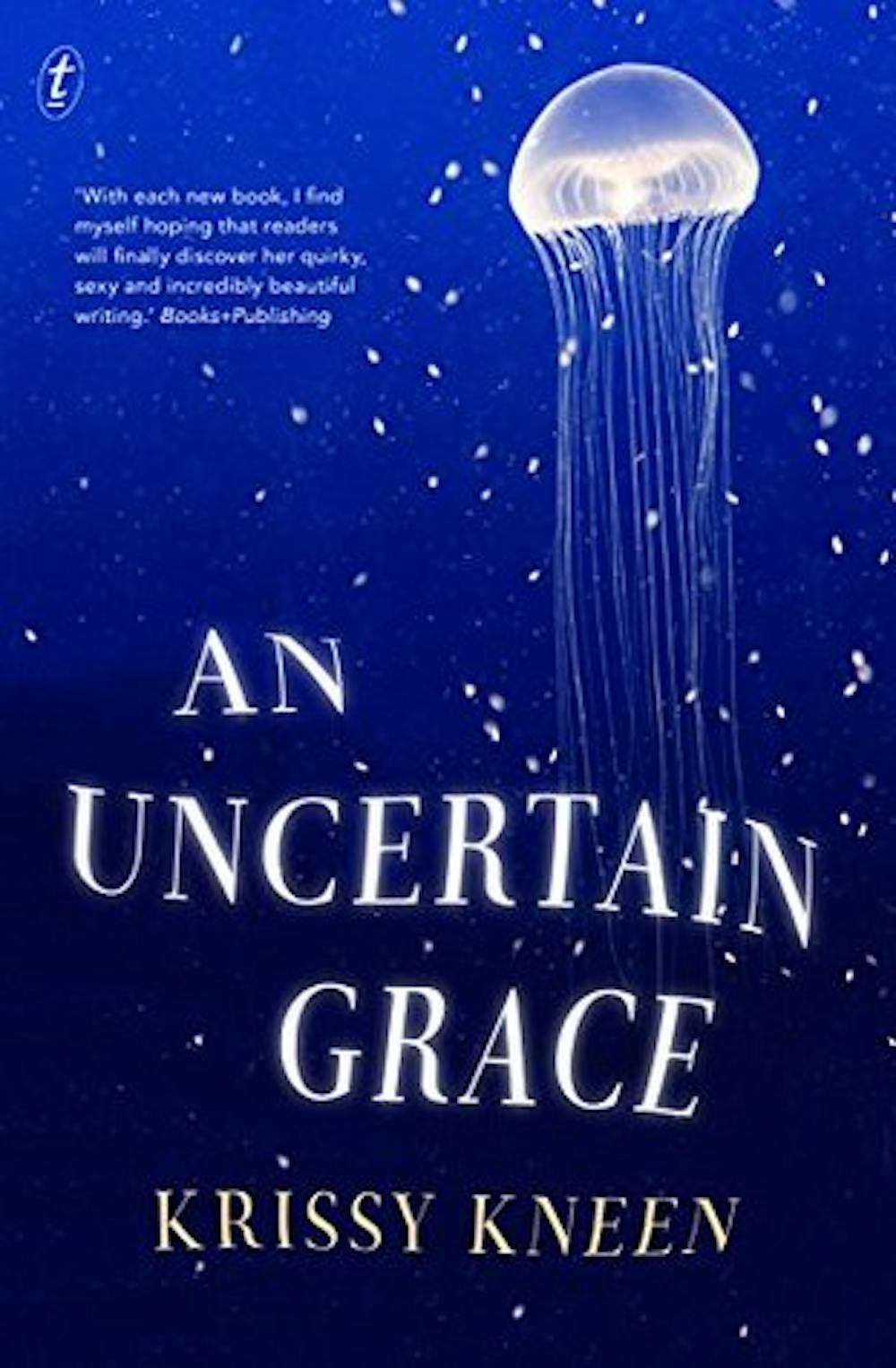
And her book is not alone. Other wild titles achieving similar success include Krissy Kneen’s An Uncertain Grace, shortlisted for the Aurealis, the Stella prize and the Norma K. Hemming award – given to mark excellence in the exploration of themes of race, gender, sexuality, class or disability in a speculative fiction work.

Kneen’s book connects five stories spanning a century, navigating themes of sexuality – including erotic explorations of transgression and transmutation – against the backdrop of a changing ocean.

Earlier, more realist but still speculative titles (from 2015) include Mireille Juchau’s The World Without Us and Bradley’s Clade. These novels fit better with Miéville’s description of “litfic”, employing realistic literary techniques that would not be out of place in Winton’s books, but they have been called “cli-fi” for the way they put climate change squarely at the forefront of their stories (though their authors tend to resist such generic categorisation).

Both novels, told across time and from multiple points of view, are concerned with radically changed and catastrophically changing environments, and how the negative consequences of our one-world experiment might well – or, rather, ill – play out.

Catherine McKinnnon’s Storyland is a more recent example that similarly has a fantastic aspect. The author describes her different chapters set in different times, culminating – Cloud Atlas–like, in one futuristic episode – as “timeslips” or “time shifts” rather than time travel. Yet it has been received as speculative – and not in a pejorative way, despite how some “high-art” literary authors may feel about “low-brow” genre associations.

Kazuo Ishiguro in 2017.
Neil Hall/AAP

Kazuo Ishiguro, for instance, told The New York Times when The Buried Giant was released in 2015 that he was fearful readers would not “follow him” into Arthurian Britain. Le Guin was quick to call him out on his obvious attempt to distance himself from the fantasy category. Michel Faber, around the same time, told a Wheeler Centre audience that his Book of Strange New Things, where a missionary is sent to convert an alien race, was “not about aliens” but alienation. Of course it is the latter, but it is also about the other.

All these more-and-less-speculative fictions – these not-traditionally-realist literatures – analyse the world in a way that it is not usually analysed, to echo Tim Parks’s criterion for the best novels. Interestingly, this sounds suspiciously like science-fiction critic Darko Suvin’s famous conception of the genre as a literature of “cognitive estrangement”, which inspires readers to re-view their own world, think in new ways, and – most importantly – take appropriate action.

A new party

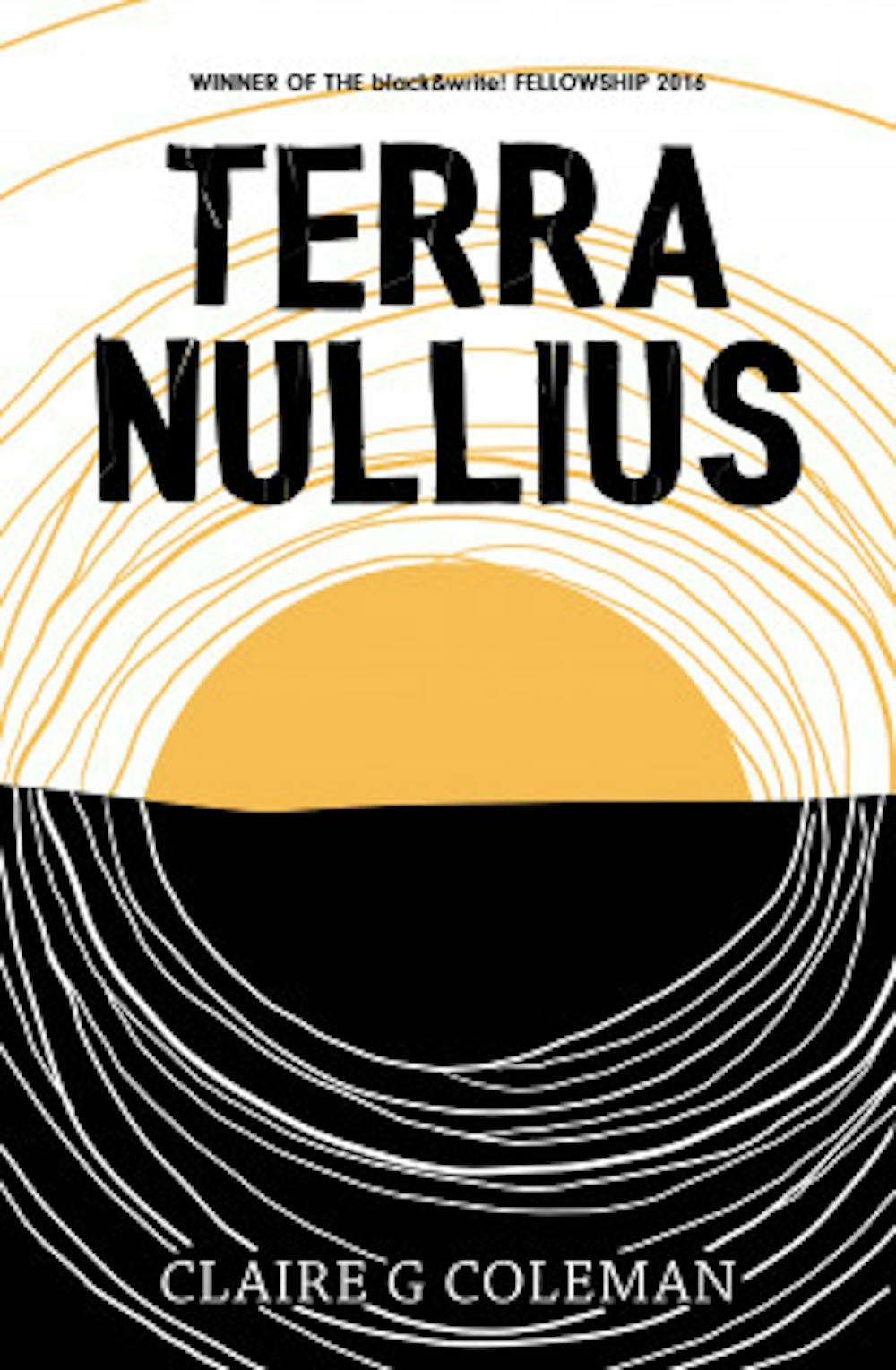
Perhaps better case studies of what local spec-fic is or does – when considering questions of diversity – are Charlotte Wood’s The Natural Way of Things and Claire Coleman’s Terra Nullius.

The first is a distinctly Aussie Handmaid’s Tale for our times, where “girls” guilty by association with some unspecified sexual scenario are drugged, abducted and held captive in a remote outback location.

The latter is another idea whose time has come: an apocalyptic act of colonisation. Not such an imagined scenario for Noongar woman Coleman. It’s a tricky plot to tell without giving away spoilers – the book opens on an alternative history, or is it a futuristic Australia? Again, the story is told through different points of view, which prioritises collective storytelling over the authority of a single voice.


Read more:
Friday essay: science fiction’s women problem


“The entire purpose of writing Terra Nullius,” Coleman has said, “was to provoke empathy in people who had none.”

This connection of reading with empathy is a case Neil Gaiman made in a 2013 lecture when he told of how China’s first party-approved science-fiction and fantasy convention had come about five years earlier.

Neil Gaiman.
Julien Warnand/EPA

The Chinese had sent delegates to Apple and Google etc to try to work out why America was inventing the future, he said. And they had discovered that all the programmers, all the entrepreneurs, had read science fiction when they were children.

“Fiction can show you a different world,” said Gaiman. “It can take you somewhere you’ve never been.”

And when you come back, you see things differently. And you might decide to do something about that: you might change the future.

Perhaps the key to why speculative fiction is on the rise is the ways in which it is not “hard” science fiction. Rather than focusing on technology and world-building to the point of potential fetishism, as our “real” world seems to be doing, what we are reading today is a sophisticated literature engaging with contemporary cultural, social and political matters – through the lens of an “un-real” idea, which may be little more than a metaphor or errant speculation.The Conversation

Rose Michael, Lecturer, Writing & Publishing, RMIT University

This article is republished from The Conversation under a Creative Commons license. Read the original article.
Unknown's avatar

What are ‘decodable readers’ and do they work?


File 20181031 76387 89ulzh.jpg?ixlib=rb 1.1
Children with access to books reach higher levels of education.
from http://www.shutterstock.com

Misty Adoniou, University of Canberra; Brian Cambourne, University of Wollongong, and Robyn Ewing, University of Sydney

The Victorian Coalition has promised $2.8 million for “decodable readers” for schools if they win the upcoming election.

Money for books must surely be a good thing. But what exactly is a “decodable reader”? After all, surely all books are decodable. If they weren’t decodable they would be unreadable.


Read more:
Lost for words: why the best literacy approaches are not reaching the classroom


What is decoding?

The Australian curriculum provides a clear definition of decoding:

A process of working out the meaning of words in a text. In decoding, readers draw on contextual, vocabulary, grammatical and phonic knowledge.

However the Victorian Coalition is defining decoding as “sounding out letters”. As their policy platform states:

Decodable books are designed to align with explicit, systematic phonics instruction. They are simple stories constructed using almost exclusively words that are phonetically decodable, using letters and letter-groups that children have learned in phonics lessons.

The “decodable readers” they are funding are books that are contrived to help children practise a particular letter-sound pattern taught as part of a synthetic phonics program.

For example, the following sentences are from a decodable reader designed to focus on the consonants “N” and “P” and short vowel /a/

Nan and a pan.

Pap and a pan.

Nan and Pap can nap.

Decodable readers don’t have a narrative.
Reading a-z.com

Books like this have no storyline; they are equally nonsensical whether you start on the first page, or begin on the last page and read backwards.

While they may teach the phonics skills “N” and “P”, they don’t teach children the other important decoding skills of grammar and vocabulary.

And as many a parent will testify, they don’t teach the joy of reading.


Read more:
The way we teach most children to read sets them up to fail


What about the children’s vocabulary development?

Meaning and vocabulary development are not the focus of decodable readers. Yet, research shows the importance of vocabulary for successful reading.

Students need to add 3,000 words a year to their vocabulary to be able to read and write successfully at their year level.

Limited vocabulary in books translates to lack of vocabulary growth.

What is the alternative to ‘decodable readers’?

Supporters of decodable readers are hopeful these books will support students with reading difficulties, by focusing closely on the sounds in words. However, focusing on sounds alone is not sufficient to support a struggling reader.

The reality is all children learning to read need to listen to, and read books that are written with rich vocabulary, varied sentence structures and interesting content knowledge that encourages them to use their imagination.

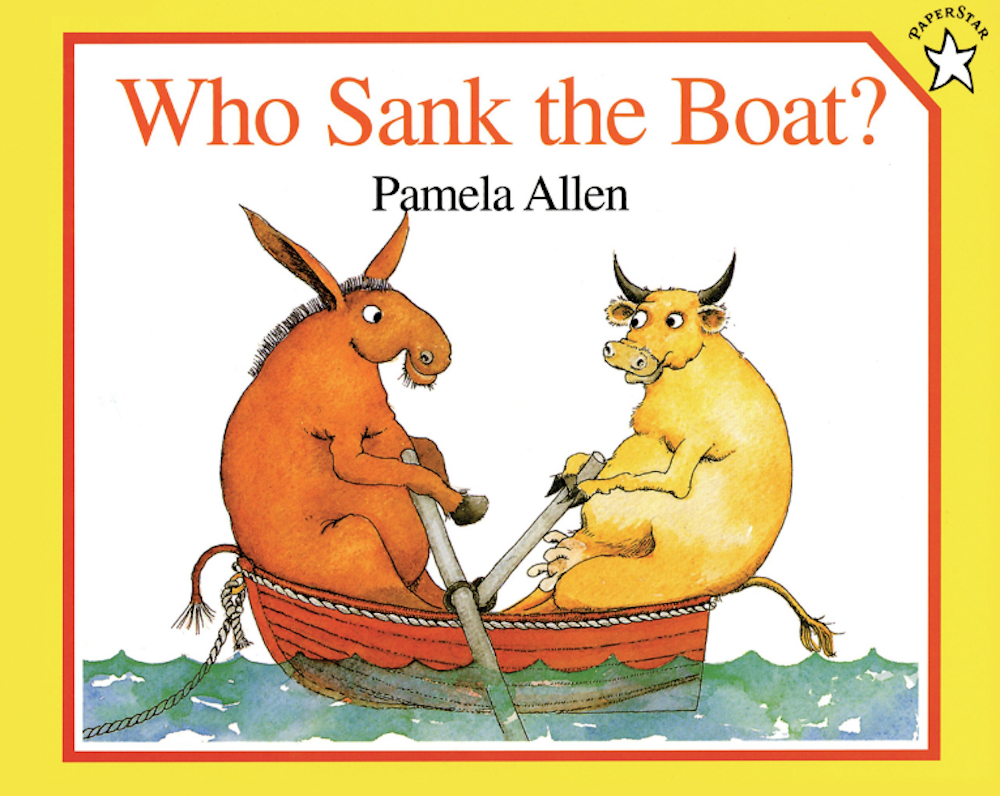
Compare the text about Pan and Nap with the opening lines of Pamela Allen’s very popular story Who Sank the Boat?:

Beside the sea, on Mr Peffer’s place, there lived
a cow, a donkey, a sheep, a pig, and a tiny little mouse.
They were good friends and one sunny morning, for no particular reason,
they decided to go for a row on the bay.
Do you know who sank the boat?

This book immediately engages children and asks them to question, imagine and help solve a problem. Children always ask for this book to be read again and again and they enjoy joining in. They learn new vocabulary and incidentally learn about complex sentence structures, which they emulate in their oral language and story writing.

Kids want to unveil the mystery of who sank the boat – and they learn in the process.
Amazon.com


Read more:
A balanced approach is best for teaching kids how to read


Using books to teach all the decoding skills

Using rich authentic texts supports all the decoding skills described in the Australian curriculum – phonics, vocabulary and grammar.

In Pamela Allen’s story above, we can look at the word “bay” and notice the parts /b/ – /ay/, which help us to say and spell the word. What happens if we change the beginning – how many other words could we write and read? For example, day, say, play, and so on.

We can look at the “frequent” words. These are the words that we can’t always “sound out” but which make up the 100 most frequent words in English. For example, do, you, they, were, the.

These words are very important to teach children, as these 100 words make up 50% of all written language.

We can develop their vocabularies with words and phrases such as “for no particular reason”, “decided” and “beside” .

We can introduce them to beautifully literate sentence structures, for example,
“Beside the sea, on Mr Peffer’s place, there lived a cow, a donkey, a sheep, a pig, and a tiny little mouse”.

Decodable readers can only do the phonics part of the reading puzzle. They are a very inefficient way to teach reading.

So what do we want for all children learning to read?

When teaching children to read, we hope they will learn reading is pleasurable and can help them to make sense of their lives and those around them.

The strategies children are taught to use when first learning to read greatly influence what strategies they use in later years.
When children are taught to focus solely on letter-sound matching to read the words of decodable readers, they often continue in later years to over-rely on this strategy, even with other kinds of texts. This causes inaccurate, slow, laborious reading, which leads to frustration and a lack of motivation for reading.

A book must be worth reading and give children the opportunity to learn the full range of strategies needed to read any text.

Children who grow up with real books, with rich vocabularies, beautiful prose and genuine storylines reach a higher level of education than those who do not have such access, regardless of nationality, parents’ level of education or socioeconomic status.

And yet it’s children from disadvantaged backgrounds who are less likely to have access to these books in their homes. It’s crucial schools fill the gap.

A$2.8 million spent on beautifully written books to fill Victorian classroom libraries would be a far more effective use of the education budget.The Conversation

Misty Adoniou, Associate Professor in Language, Literacy and TESL, University of Canberra; Brian Cambourne, Principal Fellow, Faculty of Education, University of Wollongong, and Robyn Ewing, Professor of Teacher Education and the Arts, University of Sydney

This article is republished from The Conversation under a Creative Commons license. Read the original article.

Unknown's avatar

Not My Review: The Martian by Andy Weir


Unknown's avatar

2018 Rebekah Johnson Bobbitt National Prize for Poetry


The link below is to an article that looks at the winner of the 2018 Rebekah Johnson Bobbitt National Prize for Poetry, Jorie Graham.

For more visit:
https://www.nytimes.com/2018/11/01/arts/jorie-graham-bobbitt-poetry-prize.html

Unknown's avatar

2018 JCB Prize For Literature (India)


The link below is to an article that takes a look at India’s 2018 JCB Prize for Literature.

For more visit:
https://publishingperspectives.com/2018/10/jcb-prize-literature-2018-inaugural-india-benyamin-jasmine-days/

For more on the JCB Prize for Literature visit:
https://thejcbprize.org/

Unknown's avatar

Not My Review: Everything Under by Daisy Johnson


The link below is to a book review of ‘Everything Under,’ by Daisy Johnson.

For more visit:
https://ew.com/books/2018/10/26/daisy-johnson-everything-under-profile/

Unknown's avatar

Not My Review: Kingdom on Fire (Book 1) – A Shadow Bright and Burning by Jessica Cluess


Unknown's avatar

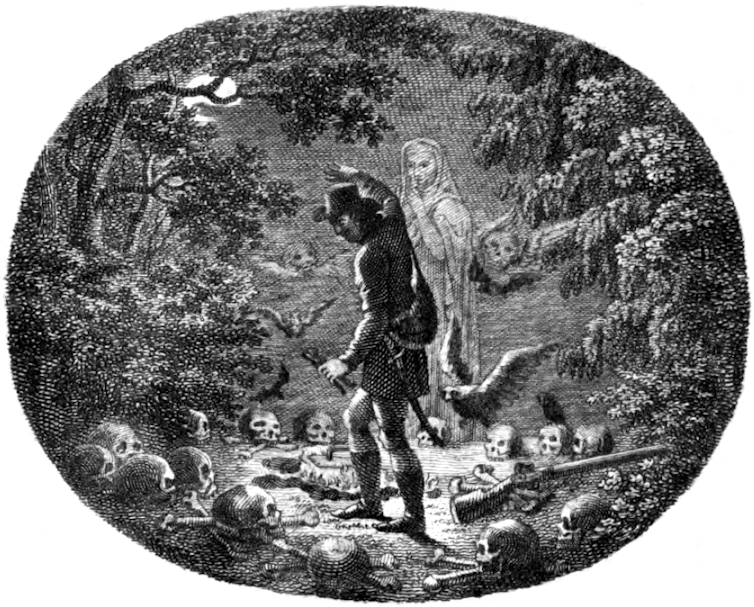
Fantasmagoriana: the German book of ghost stories that inspired Frankenstein


File 20181029 76413 65m8ga.png?ixlib=rb 1.1
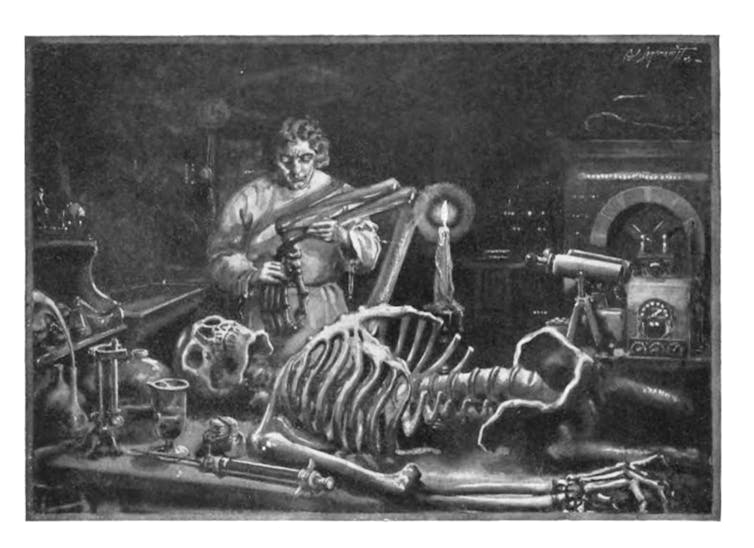
Frontispiece from the original German version of Fantasmagoriana.
Schnorr von Carolsfeld

Fabio Camilletti, University of Warwick

The story of how Frankenstein was born is well known, and largely relies on the account given by Mary Shelley in her preface to the 1831 edition to her novel. She and her (soon-to-be) husband, the poet Percy Bysshe Shelley, were summering on the shores of Lake Geneva and close by Lord Byron and his personal physician John Polidori. It was 1816 – the so-called “year without a summer” and the inclement weather kept the party indoors, reading ghost stories as a pastime.

In one of the most famous propositions in literary history, Lord Byron suggested that each of them should try their hand at writing a supernatural tale. Ironically, it was the two novice writers, Mary Shelley and Polidori, whose works have endured. Almost out of nothing, the pair invented modern horror. Polidori’s story, The Vampyre, would inspire Bram Stoker 80 years later to write Dracula, while the 18-year-old Shelley wrote Frankenstein – which also has a good claim to be the first science fiction novel.


Read more:
Older than Dracula: in search of the English vampire


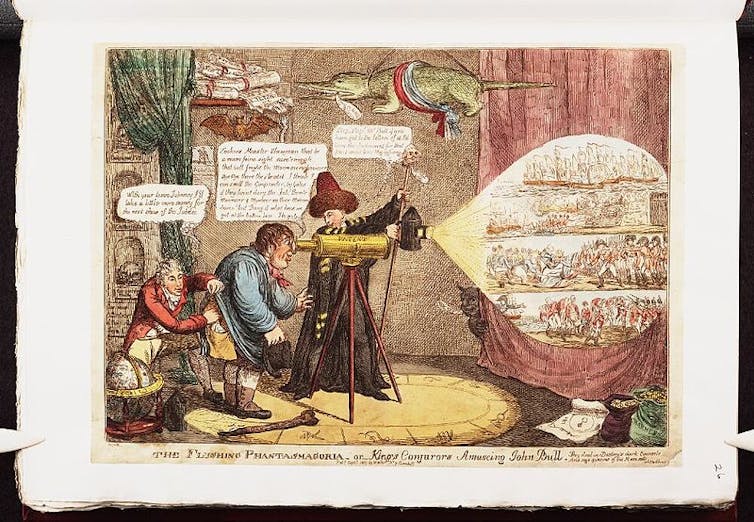
The book the Shelleys, Byron, and Polidori were reading during their trip was called Fantasmagoriana. It was an anthology of eight stories of the supernatural published in Paris in 1812 but translated from the German. No indication of authors or of original sources was given and readers were invited to think of stories as of embellished versions of real supernatural cases. The title joyfully played with this ambiguity, evoking the kind of shows, popular at the time, which were known as phantasmagorias.

A Victorian depiction of a phantasmagoria, or magic lantern show.
William Heath (1794–1840)

Based on the magic lantern (an ancestor of cinema), these shows enabled audiences to see ghosts floating in the air, devils appearing and disappearing, young girls transforming into skeletons. In the end, the impresario came upon the stage, explaining it was all a trick. But in Paris, around 1798-99, such shows had been briefly shut down by the police, when rumours had spread that the phantasmagoria could bring the king, Louis XVI, back from the dead. The book read by our holidaying writers proposed a similar gallery of horrors. As Mary Shelley recalled:

There was the History of the Inconstant Lover, who […] found himself in the arms of the pale ghost of her whom he had deserted. There was the tale of the sinful founder of his race, whose miserable doom it was to bestow the kiss of death on all the younger sons of his fated house […] he advanced to the couch of the blooming youths, cradled in healthy sleep.

It’s worth looking into the influence of such stories on Frankenstein. At some point in Shelley’s novel, Victor Frankenstein dreams to hold in his arms the “pale ghost” of his bride to be, which may remind us of the story Shelley referred to as History of the Inconstant Lover (in truth, La Morte Fiancée or The Corpse Bride, by Friedrich August Schulze).

Frankenstein’s “Creature” is a gigantic being who causes the extermination of an entire family – a plot device that may have been inspired by what she calls “tale of the sinful founder of his race” who “bestows the kiss of death” on his descendants (actually a story called Le Portraits de Famille – or The Family Portraits, by Johann August Apel).

But if we read Frankenstein with Fantasmagoriana in mind, we see that the influence of those stories is definitely more profound than a simple inspiration.

Illustration from the 1922 edition of Frankenstein, or the Modern Prometheus.
Cornhill Publishing Company

While trying to describe in the preface to the book: “How I, then a young girl, came to think of, and to dilate upon, so very hideous an idea,” Shelley describes her mental processes as a phantasmagorical show. Imagination, in her words, is a screen onto which stories project impressions. At night, in her bed, Shelley sees “with shut eyes, but acute mental vision” the central scene of her novel to be – the idea of the novel comes first as an image, not as a plot.

It is an image she knows perfectly not to be true – but which is nonetheless frightening: like the ghosts of phantasmagoria shows or of Fantasmagoriana, which were explained to be tricks of the mind, but still left the imperceptible feeling of the uncanny. In Les Portrais de Famille, Shelley read of a ghost “advanc(ing) to the couch of the blooming youths, cradled in healthy sleep” – half asleep she imagines a man in bed, beholding “the horrid thing” he created “stand(ing) at his bedside, opening his curtains”. The story read, in other words, mirrors and anticipates the story to be written.

At her bedside, Shelley too is visited by a ghost – in this case, the ghost of the novel:

On the morrow I announced that I had thought of a story.The Conversation

Fabio Camilletti, Head of Italian Studies, University of Warwick

This article is republished from The Conversation under a Creative Commons license. Read the original article.
Unknown's avatar

How the apartheid regime burnt books — in their tens of thousands


File 20181018 67179 1l3q6ep.png?ixlib=rb 1.1
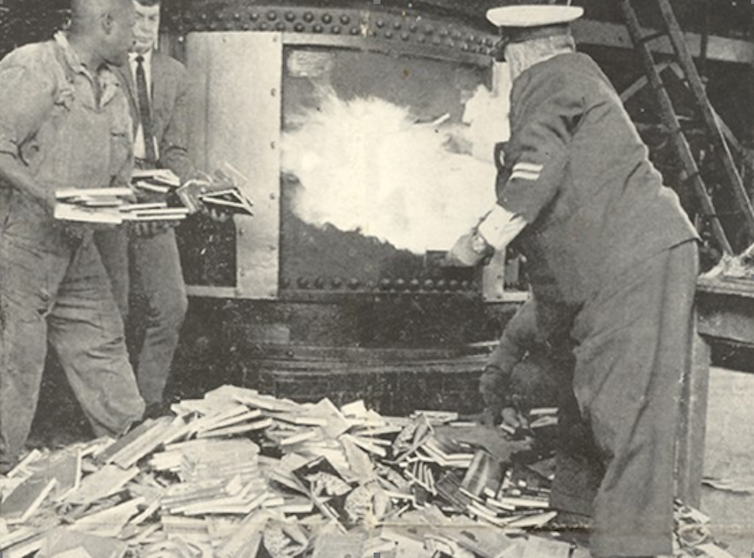
The Railway Depot furnace at Kaserne, Johannesburg in 1971. Banned and confiscated books and magazines were burnt weekly.
Wits Student

Archie Dick, University of Pretoria

On the advice of the State Librarian one fine day in the 1970s, a truck transported thousands of books and magazines from Pretoria’s Central Police Station to a dark hall at the Iscor state steel company, just outside the South African capital. A large mechanical shovel scooped up and dropped them into a 20 metre high oven, causing it to spew flames and smoke. This was another truckload of material that had been banned for political reasons and was routinely burned in furnaces across South Africa from the 1950s to the 1970s.

Historical examples show that books are banned and destroyed because they offend the politics, morals, or religion of the day. Information science academic Rebecca Knuth, wrote in Burning Books and Leveling Libraries that if a regime is racist, it destroys the books of groups deemed inferior; if nationalistic, the books of competing nations and cultures; and if religiously extremist, all texts contradicting sacred doctrines.

Sometimes these forces combine. Recent examples include the destruction of Muslim books and libraries in Bosnia in the 1990s by
Serbian nationalist forces. In 2013 there was the burning by Islamist insurgents of the Timbuktu library and the next year the same happened in Lebanon to Tripoli’s historic Al Sa’eh Library.

The apartheid era – from the middle of the 20th century – had its own variation on the theme. Thousands of books were banned, ranging from Russian novelist Fyodor Dostoyevsky’s The Insulted and Humiliated to popular Westerns writer Louis L’Amour’s Hopalong Cassidy series.

The fact that books were burnt underscored the state’s desire to make sure the printed word was utterly destroyed. The practice also revealed a darker side of the library profession which connived in the book burning. Between 1955 and 1971 most librarians didn’t protest when thousands of books and other reading material were taken from libraries, and burned at municipal incinerators and furnaces. Some even joined in.

The rise of authoritarianism

State sanctioned book burnings were common as authoritarianism accompanied a growing Afrikanerisation of South African society as the dominant, ruling Afrikaner elite started to impose its culture on all spheres of society. Members of the elite did this first by unifying Afrikaner cultural and church organisations. This took the form of a declaration on behalf of “Volksorganisasies” (Afrikaner people’s organisations) that was signed in 1941 and pledged support for conservative Christian national ideology.

This sometimes involved the burning of books as a symbol of purification. One of the more worrying aspects was the solid support from ordinary South African librarians for these treacherous acts.

Even when books were burned by public libraries, the profession meekly accepted the situation. This signified support and agreement with what was happening, and reflected the dominant authoritarian mood and spirit in South Africa and the library community at that time.

In October 1955, the city librarian of Johannesburg, exclaimed:

All copies are brought in to me and I destroy them personally.

In the same month, a Cape Town newspaper reported that a couple of hundred books had been burned. Two years later, the deputy city librarian of Cape Town announced the fate of banned books returned from branch libraries to his Central Library:

We will have a big bonfire and burn them.

All-out attack on free speech

What started as the burning largely of imported pornographic books, became an all-out attack on free speech after the findings of a commission of inquiry into “undesirable publications” were made public in October 1957. The inquiry gave the Nationalist government the excuse to destroy books and pamphlets critical of its policies, and of dramatic developments in the country.

Each new issue of the Government Gazette included the latest additions to the list of banned books. Books on communism and those that criticised apartheid dogma were targeted. In 1954 banned titles included the Pravda and Daily Worker newspapers, and Vladimir Lenin’s Two Tactics of Social-Democracy in the Democratic Revolution. Books on innocuous topics about communist countries, like China’s “Railways and Labour Insurance Regulations of the People’s Republic of China”, were also deemed subversive and added to the list.

Even Ray Bradbury’s dystopian novel Fahrenheit 451 (which, ironically, is the temperature at which book paper starts burning) was burned. From the town of Brakpan in the North to Durban in the East and Cape Town in the South, several thousands of books were removed from library shelves and burned. In July 1964 Cape Town City library services announced that more than 800 books had been burned.

By this time the list of banned publications had swelled to a total of 12 000 titles. In June 1968, a newspaper reported that 5 375 books of the Natal Provincial libraries had been withdrawn from circulation and burned. By April 1971 books were still steadily being burned in Cape Town – at the rate of two per day.

It was only in the late 1980s that successful appeals from a few brave librarians to the state censors saw restricted books unbanned, and saved from apartheid’s furnaces.

In the early-1990s as South Africa moved towards becoming a democracy hundreds of archival documents and public records were shredded and burned by the apartheid state’s security establishment – once again in the furnaces of Iscor.

Could book burning happen again in contemporary South Africa? Given a similar set of circumstances, there is every reason to believe that it can. South Africans should remain diligent and alert to threats to freedom of expression.
The ashes of burnt books tell of the barbarism to which a society can descend.The Conversation

Archie Dick, Head of Department and Professor of Information Science, University of Pretoria

This article is republished from The Conversation under a Creative Commons license. Read the original article.