In the digital age, a public library can connect even the most remote community to networks of knowledge and information. Today’s public libraries work to engage marginalised communities as users; pioneering projects like Townsville’s Murri Book Club explore ways to make the library meaningful to Indigenous people.
Despite all this, there is one area in which public libraries are underused. Libraries can also help us plan for the future.
Long-term planning is always challenging. It’s simply impossible to gather data from events that haven’t happened yet.
Sometimes we may detect trends, but these can fall apart under what some foresight experts call “TUNA conditions”, when we face Turbulence, Uncertainty, Novelty or Ambiguity.
Think of someone trying to predict that experiments with debt on Wall Street would lead to the global financial crisis and the political ripples that have followed. Think of trying, today, to foretell all the long-term consequences of climate change.
Enter scenario planning
That means we’ve had to find new ways to look at the unpredictable future. Big business has used scenario planning since the 1960s, when Pierre Wack pioneered the approach for Shell.
Shell’s scenarios became famous in the 1970s when the company successfully anticipated the oil crisis that followed the Yom Kippur War. Shell hadn’t predicted the conflict, but had imagined scenarios where Middle Eastern oil producers worked as a cartel to control global supply. When those countries did start an oil embargo, scenario planning meant Shell had already thought through this possibility ahead of its competitors.
Today, experts thinking about the future acknowledge the need for engagement from the bottom up as well as top down. For example, the European Union’s new proposal for “mission-oriented innovation” aims to get all of us focused on solving society’s problems. In turbulent times, it’s important that at every level of society we strengthen our ability to imagine the future that awaits us – and our own future choices.
Public library services are built on relationships, not just transactions; they are entwined with the specific and deeply local context of everyday life in the communities they serve.
Locally held scenario planning sessions, convened by communities at their public library, would make use of the library’s existing capacity to connect people – but this time with the goal of helping us reimagine the future.
Librarians would work with their local council to identify issues that call for a long-term perspective. Should we invest in “smart” tech for our small country towns? How much should we rely on recycled water or desalination in the big coastal cities?
Librarians would provide background research and host community workshops to develop local scenarios. People would start to have deeper, richer discussions about the future: there’s a reason scenarios have been called “the art of strategic conversation”.
The scenario process depends on bringing together a group of individuals in a trusted space, with enough information to give the scenarios detail and flavour. In a local community, the public library is that place of trust and information.
Much as public librarians use their skills to help with job seeking or support people’s health and well-being, as scenario planners they would apply their talents to a new domain.
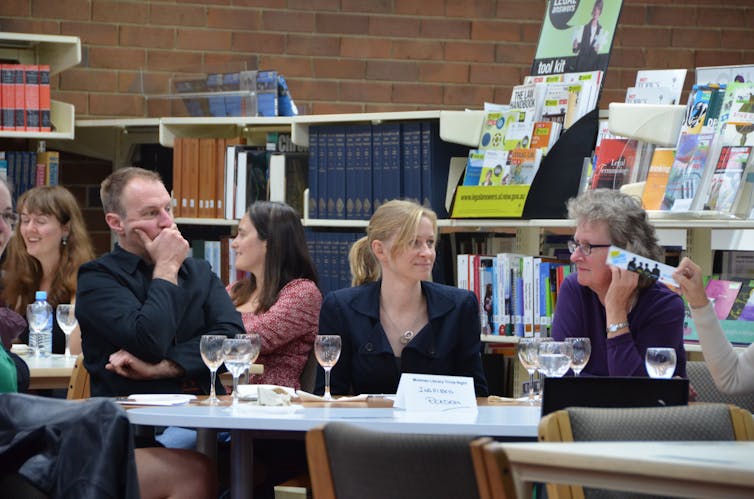
A playful event at Ann Arbor Public Library to explore an imagined future.
If public libraries were supported to deliver strategic foresight to their communities, politics could transform. The electorate would be better informed, thinking deeper and further ahead about political issues. Councils could take decisions with confidence that the community had been consulted about the long-term consequences.
Scenarios would offer a playbook of potential futures, already imagined and rehearsed. Every Australian could have access to the kind of foresight tools that have been informing the decisions of government and big business for the past half century.
Imagine the conversations we, as a country, would be having about our future if we democratised those tools via the local library.
Last year, I toted Anna Karenina along with me — it got soaked, and I abandoned it in an AirBnB in Dubrovnik, Croatia, after I’d finished reading it. It lasted nearly the whole trip and left a gaping, souvenir-sized hole in my suitcase; it was perfect. So as much as I’d like to dissolve the beach read label entirely, I must also admit I have a type: I want a meaty, absorbing book that takes me further into a vacation by connecting with the cultures that produced it. I want a book that can’t be disposed of, one that will take me somewhere entirely new.
In a cultural climate where the limits of empathy are increasingly under a microscope, forging cross-cultural connections feels like a pressing task. Much has been made of the relationship between fiction reading and empathy, but what happens when the limits of our worldview are bounded by the English language? While linguistic diversity is growing in Canada, the majority of Canadians still speak only English at home, and comparatively few books are translated into English. If, as José Ortega y Gasset proposes, reading in translation should transport the reader into the language — and therefore the perspective — of the author, then reading translated works may be one of the best ways to expand empathy beyond the boundaries of language.
I’m not going abroad this summer, at least not physically. I’ll be staying in Canada, with only my books to pull me to other times and places. While in recent years, I’ve focused on keeping up with new releases, this year I’m fixated on atmosphere and transportation, in a mix of old favourites and new-to-me classics from around the world.
One of my favourite themes in European literature is that of movement and fluidity, the running sense of unity of purpose amidst myriad diverse pockets of culture. The ubiquity of trains and boats support transcontinental journeys by characters who switch language mid-conversation. Last year’s Man Booker International winner, Flights by Olga Tokarczuk takes traveling and travelers as the subject of its interconnected musings, making it an ideal choice for the vacation headspace. This year’s winner, Celestial Bodies from Oman’s Jokha Alharthi, has an English edition but has not yet been published in Canada.
Croatia
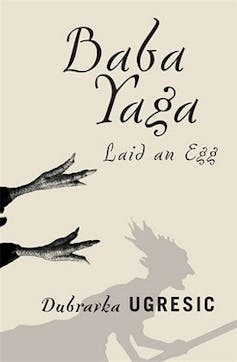
‘Baba Yaba Laid an Egg’ 2009. Canongate Books
In my opinion, no contemplation of Pan-European lore can be complete without Dubravka Ugrešic’s Baba Yaga Laid an Egg. Once labeled a witch herself and driven into exile from Croatia, Ugrešic’s take on Baba Yaga explores the shifting nature of popular folklore.
Nigeria
‘Half of a Yellow Sun,’ 2006. Knopf
Half of a Yellow Sun by Nigerian author Chimamanda Ngozi Adichie is not a translation, but it will take you to a place that only briefly existed: Biafra, a West African state founded in 1967. While the brutality of recent war may not make a particularly appetizing subject for vacation, Adichie contrasts the brutality with sumptuous descriptions of pre-war food and luxury, giving her vision of Biafra the aura of a lost dream. Adichie has referred to the war as a shadow over her childhood.
Norway
‘Kristen Lavransdatter,’ 2005. Penguin Books
There are no beaches in Kristen Lavransdatter and many more Christmases than summers, but if you start Nobel Prize-winner Sigrid Undset’s oeuvre now, it may take you until winter to finish it. Set in Medieval Norway, the book follows the titular Kristen from childhood until death, focusing on her tumultuous love affair and marriage to Erlend Nikulaussøn. Tiina Nunnally’s translation, focusing on plain, stripped-down language, presents a change in philosophy from the first English translation that cut large portions of the text and enforced stiff, archaic language absent from the original Norwegian.
Argentina
‘Fever Dream,’ 2017. Riverhead Books
Samanta Schweblin’s Fever Dream is slight in length but packs a heavy punch in both atmosphere and psychological investment. The story of a vacation gone terribly wrong, the novel’s Spanish title closely translates to “rescue distance,” a recurring concept instantly familiar to parents of young children and terrifying as it becomes repeatedly destabilized. Fever Dream is so unsettling that I sometimes hesitate to recommend it, but I’ve found myself repeatedly drawn back to its tantalizing surrealism.
Canada
‘Secwépemc People, Land and Laws,’ 2017. McGill-Queen’s University Press
I’ve spent much of my life moving around, and as a recent settler on unceded Secwepemc territory, I want to learn more about the land I live on. In a summer steeped in fiction, Secwépemc People, Land, and Laws by Marianne and Ronald Ignace is the only history on my list, but in many ways it feels similar to the others, reaching out to add a new dimension to a place in which I’m still mostly an outsider. For better or for worse, Kamloops feels the most like itself in summer, the climate wants to have its stories told. It can feel intimidating to contemplate a 10,000 year history I know nothing about, but also comforting and necessary to reach back and hear the tales of the land I now call home.
The links below are to articles reporting on the renaming of the Melvil Dewey (yes, that Dewey) Medal because… well, he was something of a disgraceful scrub.


 Royal Assassin by Robin Hobb







 At the BookShelf
You must be logged in to post a comment.